Tender Is the Night (1962) ***

Hollywood hadn’t had much luck with F. Scott Fitzgerald, now considered one of the three American literary geniuses of the 20th century along with Nobel prize-winners Ernest Hemingway and William Faulkner. His novel The Great Gatsby has easily proven the century’s best-read literary novel. He was an alcoholic wastrel when in the employ of studios, in the latter stages of his life. Although The Great Gatsby had been filmed twice, in 1926 with Warner Baxter and 1949 with Alan Ladd, both versions had flopped.

His biggest seller, debut novel The Beautiful and the Damned (1922) didn’t hit the box office mark either. The Last Time I Saw Paris (1954), based on one of his short stories and starring Elizabeth Taylor, and a modest success, didn’t inspire Hollywood and it took Beloved Infidel, the memoir of his lover, gossip columnist Sheilah Graham, to kickstart further interest. But the film of that book, even with top marquee name Gregory peck, died at the box office in 1959.

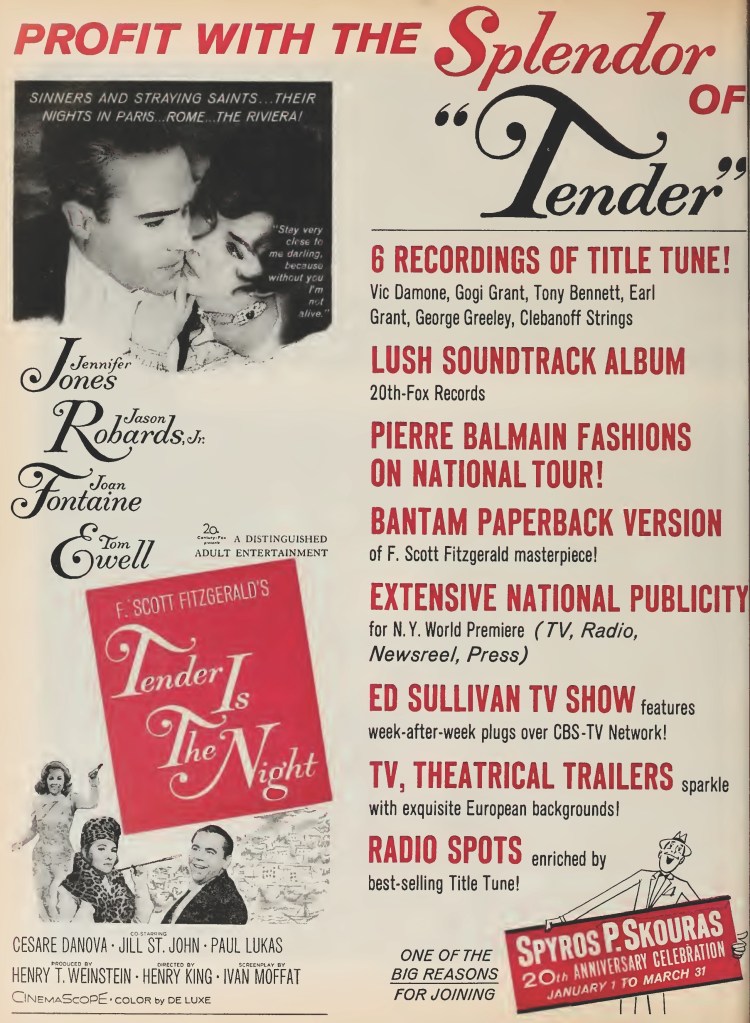
So, whatever way you cut it, Twentieth Century Fox was taking a serious gamble – the budget was $3.9 million – trying to mount Tender Is the Night especially with such questionable stars. It was a comeback for Jennifer Jones, at one time a solid performer at the box office and an Oscar-winner besides. But she had been out of the business for five years, a lifetime in Hollywood terms. Male lead Jason Robards was virtually a movie unknown. This was his sophomore outing and his debut By Love Possessed (1961) had flopped. How much his Broadway prowess would attract audiences outside the Big Apple was anyone’s guess.

But Oscar-nominated director Henry King (Beloved Infidel) who had helmed Jones’s breakthrough picture Song of Bernadette (1944) clearly thought he was on to a winner because this had the slow and stately feel – running time close on two-and-a-half-hours – of a movie that’s never going to run out of breath never mind pick up a head of steam.

Truth is, it’s slow to the point of being ponderous. Takes an age to set up the story. Psychiatrist Dr Dick Diver (Jason Robards) living with ex-patient wife Nicole (Jennifer Jones) – an arrangement that would be professionally frowned upon these days – in the French Riviera in the 1920s host a party where the husband takes a shine to Rosemary (Jill St John) and the wife shows she has not shaken off her mental malady. Despite there not being a great deal of actual period detail, we spend a long time at the party as various permutations take shape.
Then we dip into a long flashback to find out how we got here, mostly consisting of Dick falling in love with his patient, abandoning his career  to enjoy a hedonistic lifestyle funded by Nicole’s wealthy sister Baby Warren (Joan Fontaine). There’s a stack of gloss. We swap the South of France for Paris and Switzerland and we’re hopping in and out of posh restaurants and hotels and the kind of railway trains that for the rich never meant a draughty carriage and hard seats.

Basically, it’s the tale of a disintegrating marriage – one that would have been better avoided in the first place as most of the audience would have pointed out – and falls into one of those cases of repetitive emotional injury. Clearly, living on his wife’s sister’s money renders Dick impotent, compounded by the loss of peer regard.

Jennifer Jones (The Idol, 1966) is pretty good, essaying a wide variety of moods, flighty, whimsical, and stubborn, exhibiting the kind of nervous energy that was implicit in her illness and which he managed to tamp down but not fully control. Jason Robards is basically on the receiving end of a character he knows only too well, and he is simply worn down by the force of her personality. So, he can’t come across as anything but pathetic, especially when he wishes to succumb to the temptations of the likes of Rosemary.

For all the strength of his usual screen persona, Robards is miscast. He doesn’t command as he needs to in order for the film to work and for the audience to sympathize with his downfall. At this stage of her career, Jennifer Jones was so far more accomplished it doesn’t take much, even when she’s not letting fly, for her to hog the screen at the expense of a balanced drama. There’s a twist in the tale but by the time that comes we couldn’t care less.

In a less showy role than was her norm, Jill St John (Banning, 1967) is effective.

Ivan Moffat (The Heroes of Telemark, 1965) wrote the screenplay. A box office disaster, it only hauled in $1.25 million in U.S. rentals. Henry King didn’t direct another picture.

Trimmed by 30 minutes, this would have been more effective.

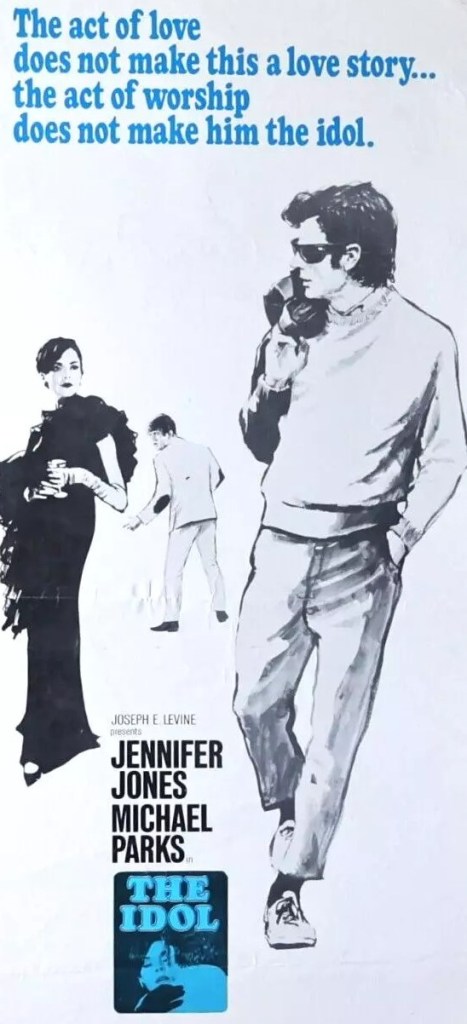
The Idol (1966) ***

By this point in the 1960s the use of black-and-white photography was a statement of artistic intent. So no bright red London buses or other colorful tourist features here. Instead, there’s an overall drabness, lack of bite and energy and a curious tale headlined by a purportedly rising star and a faded Hollywood marquee name. We’re back in rebel territory without much to distinguish it, a poor American studying art on a scholarship who gets in with a wealthier crowd, an under-explored Oedipal theme. On the other hand, the gender-reversed May-December episode is treated with more realism. There’s one superb scene of spite.

The impoverished Marco (Michael Parks), friendly with medical student Timothy (John Leyton), quickly appropriates his girlfriend Sarah (Jennifer Hilary), the cuckolded one too spineless to object, too needy of the arrogant buddy’s attention. They move into an apartment together. Timothy’s over-protective widowed mother Carol (Jennifer Jones), seeing the dangerous influence Marco wields, tries to separate them. She’s worried about how her son will react to her plan to marry confident businessman Martin (Guy Doleman).

Marco is theoretically at least the kind of pushy character who’s had to pull himself up by the bootstrings and despises his friends who merely inherited their good luck. He’s less of an Alfie (1965) than a self-destructive version of the rough-hewn Albert Finney character in Saturday Night and Sunday Morning (1960) but minus any genuine redemptive working class credentials. We never learn much about him.

When he makes an ill-advised play for Carol she dismisses his “schoolboy attempts at flirtation” and humiliates him. When she catches him in a bedroom in her house with Sarah. she wipes the lipstick from his mouth with a linen handkerchief and tosses said item out of the window. This scene taking place in front of a bunch of partygoers being given a tour of her grand house. He is thrown out.

Later, he wins back her favor after saving Timothy from being beaten up in a fight. What begins as a demonstration of maternal instinct soon leads to bed. But in the morning, in a reversal of the scene at the party, his draws lipstick on her lips, then wipes it off with a linen handkerchief and tosses the item out of the window. He was just using her. One of the best revenge scenes you’re likely to come across and carrying contemporary reverberation, not so much of the older woman falling for the younger man (an ongoing trope these days) but of the foolish woman trusting a man who has little interest in being faithful and treats her either as a sex object or an extension of his domination over the opposite sex.

Doting mother, spineless son.

It doesn’t end well, once Tomothy gets wind of his act, but the climax, especially the minor twist, feels tacked on. Marco’s the kind of character who romances them and leaves them, no love involved (except for himself), relatively little consequence, only tripped up by happenstance, and without engendering any empathy or sympathy from the audience.

In part this is because Michael Parks was an inexperienced movie actor, a rising talent after landing the male lead in Bus Riley’s Back in Town (1965) opposite Ann-Margret, which had a much better script, was in color (natch) and any time the plot slackened the camera could turn to the actress to save the day.

And in part it fails because Jennifer Jones was attempting one comeback too many, her first picture in four years, and only in her second in a decade, the marquee appeal that won her an Oscar for Song of Bernadette (1943) and a quartet of nominations besides long gone. Like contemporary Olivia de Havilland in Light in the Piazza (1962) she’s on relatively solid ground as a mother, but it’s quite a stretch for her to fall, even in a moment of weakness – unlike de Havilland who resists blandishments – for the churlish Marco.

It’s not helped by the weakness of the rest of the acting. John Leyton (The Great Escape, 1963) never managed the leap from pop star to movie star and Jennifer Hilary (The Heroes of Telemark, 1965) was merely another ingenue.

Daniel Petrie (Stolen Hours, 1963) is out of his depth with material that doesn’t quite fit together and doesn’t get a tune out of his male lead. Script by Millard Lampell (Escape from East Berlin, 1962).

The lipstick-wiping scenes stand out, and Jones is always watchable, but this is hardly memorable.

Discover WordPress

A daily selection of the best content published on WordPress, collected for you by humans who love to read.

The Atavist Magazine

by Brian Hannan

WordPress.com News

The latest news on WordPress.com and the WordPress community.