Cauldron of Blood / Blind Man’s Bluff / The Corpse Collector (1968) ***

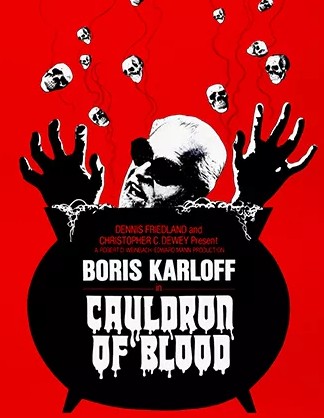
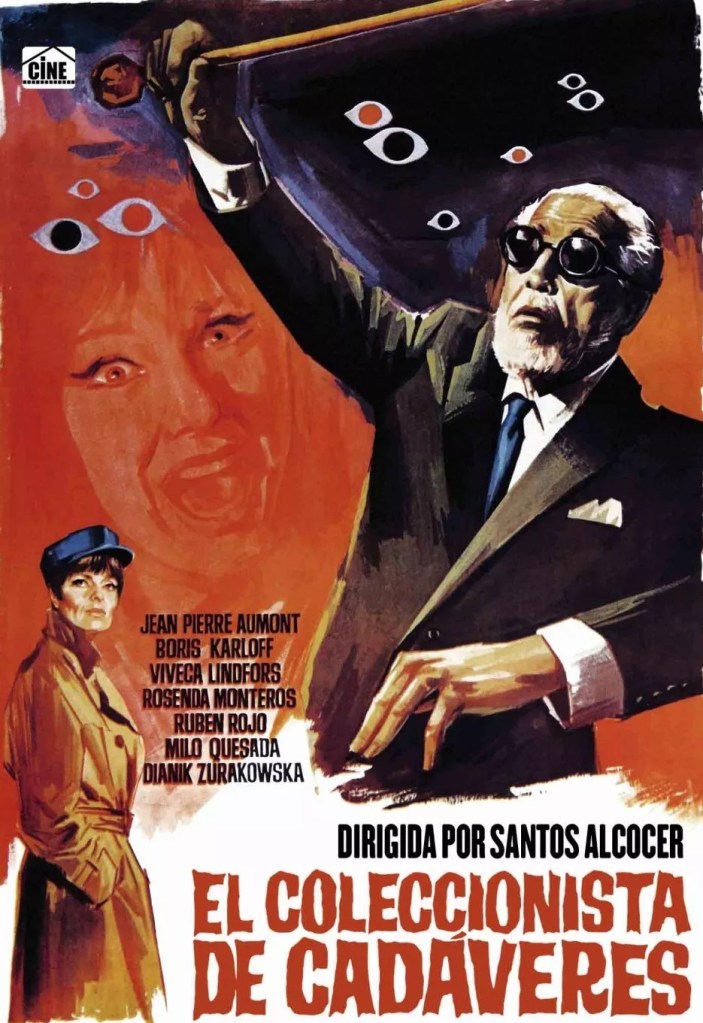
Superior “lost” horror picture that suffered from minimal initial release and is now rapidly entering the cult dominion. Effective and occasionally very stylish entry to the genre. Apart from Boris Karloff (The Sorcerers, 1967) playing against type, it’s not populated by the usual horror actors but a surprisingly mainstream cast including suave Frenchman Jean-Pierre Aumont (Castle Keep, 1969), Swede Viveca Lindfors (Sylvia, 1965) and Mexican Rosenda Monteros (The Magnificent Seven, 1960). In keeping with a new trend mostly personified in the espionage division, a woman is the villain of the piece.

Begins with an excellent sequence that twists on audience expectation. A young woman sunbathing on a deserted beach is viewed through a telescope. A hand touches her cheek, arousing her from her slumber. You expect her to react, and she does but not as much as you would imagine. It’s only the old guy who rents out beach umbrellas telling her he’s closing shop. We cut to someone in a trench coat with a garotte. It’s not the girl he stalks, but the old fella.
Surprising number of effective scenes beginning with a terrifying nightmare sequence of a young girl being whipped and then attacked by a skeleton. Outside of the dream landscape, a mute maid is whipped.  And a clever note when a young woman pours a glass of red wine, like blood, into her bath, prefiguring trouble to come. There’s a monkey crouched in the beams of a mansion impervious to various nefarious episodes taking place below. And some trick photography of a girl running only to disappear, captured in an overhead shot. A killer dresses up in a skeleton costume.

Journo Claude (Jean-Pierre Aumont) arrives to interview blind sculptor Franz (Boris Karloff) who lives in seclusion and is cared for by wife Tania (Viveca Lindfors). Claude tackles the rumor that the reason for Franz’s very realistic sculpture is that he uses human bones, a suggestion that is batted away.

Claude makes the acquaintance of artist Valerie (Rosenda Monteros) and her nude model Elga (Dyanik Zurakowska), encounters old drunken buddy Pablo (Ruben Rojo) and unleashes his entrepreneurial instinct, planning with other villagers to buy up all the property and cash in on the tourist boom he expects to generate by his coverage of the sculptor.

It’s not just poor old guys who are disappearing; Pablo’s dog is also for the garotte. And all is not well in the sculptor’s household. He accuses his wife of trying to kill him, but botching the job, resulting in his blindness. “I am not your prisoner, you are mine,” he claims, pointing to the fact that he now requires so much care. Later, he accuses her of salting away his money.

The mansion has an underground lair where Tania bleaches bones in a cauldron (like the scene in Jaws, 1975, where sharks undergo similar treatment) and where she meets her lover Shanghai (Milo Quesada) who carries out the killings as well as the occasional rape. Franz believes his wife is merely indulging in a bit of grave robbing to supply him with carcasses for his art.

Suspicions are not raised in the village though Valerie, who turns out to have practical experience of the mechanics of sculpture, reckons too much smoke emanates from the Franz chimney. Elga and Pablo are next to fall victim. When Valerie discovers Pablo’s body, she is added to the list.

And that sets up a quite splendid three-part climax. Racing to the rescue, Claude uses his car as a battering ram to enter the house and then engages in fisticuffs with Shanghai. But, in another twist, that fight takes a helluva time to reach a conclusion so that Valerie remains trapped and with legs bound and drugged must tackle Tania on her own. Meanwhile, the blind sculptor tries to take on his wife. This is a marvelous section where she dupes him with various noises.

Jean-Pierre Aumont is outshone by both Viveca Lindfors and Rosenda Monteros.

Quadruple hyphenate Edward Mann (Island of Terror, 1966) – writer, producer, director and composer of the theme tune – has a splendid time leading the audience astray and producing some moments of sheer terror.

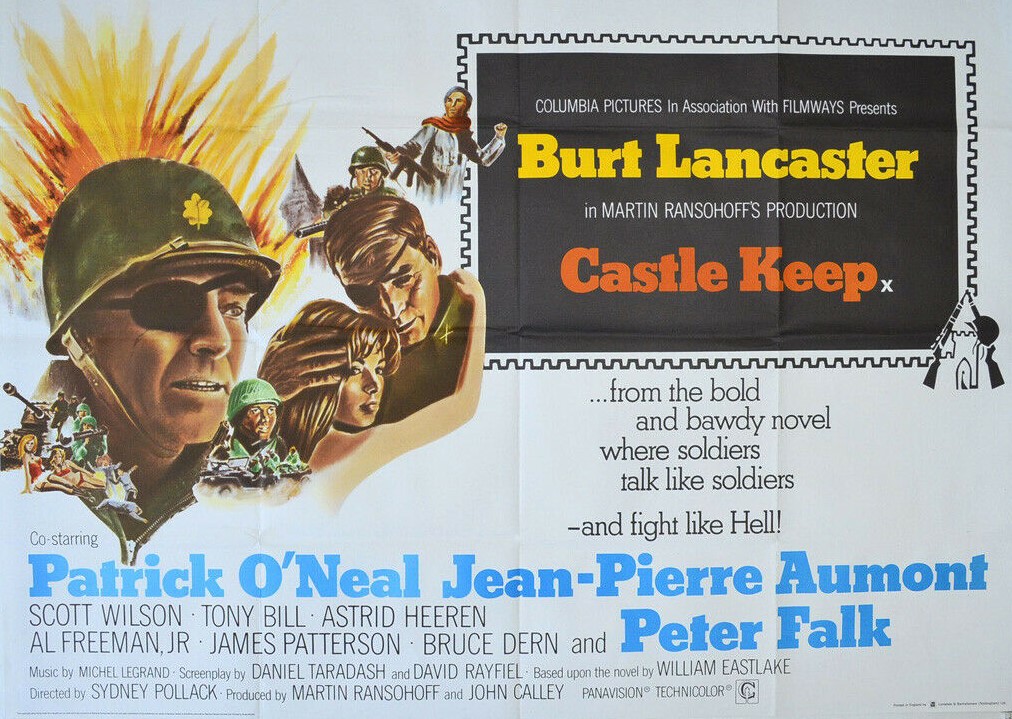
Castle Keep (1969) ****

A bit more directorial bombast and this could have matched Apocalypse Now (1979) in the surrealist war stakes. Never mind the odd incidents surrounding a small unit of G.I.s  taking over a magnificent Belgian castle towards the end of World War II prior to what turned out to be the Battle of the Bulge, this has on occasion such a dreamlike quality you wonder if it is all a figment of the imagination of one of the characters, wannabe writer Private Benjamin (Al Freeman Jr.). Throw in a stunning image, for the beleaguered soldiers at the start, of a horsewoman charging by in a yellow cloak, so out of place that it carries as much visual impact as the unicorn in Blade Runner (1982), and we are in definite cult territory.

One of the unusual elements is that, in this unexpected respite from battle, the soldiers are defined by character traits rather than dialogue or bravery as would be the norm. This ranges from baker Sergeant Rossi (Peter Falk) taking over the boulangerie and bedding the baker’s wife (Olga Bisera), mechanic Corporal Clearboy (Scott Wilson) diving into a lake to rescue a Volkswagen and the troops receiving a lecture on art history from Captain Beckman (Patrick O’Neal).

Commander Major Falconer (Burt Lancaster) is not only brilliant in the art of war, but calmly  mentors Beckman through a firefight with an enemy airplane, teaches local sex workers how to make Molotov cocktails and, evoking ancient aristocratic tradition, enjoys conjugal relations with the conquered countess (Astrid Heeren), whose impotent husband (Jean-Pierre Aumont) encourages the relationship since the castle needs an heir.  

There is wistful revelation, Beckman clearly hankering after his turn with the countess, a minister who wishes he had the courage to join the boys in the brothel, the young soldiers there being treated as children rather than customers. And there are juvenile pranks – moustaches are painted on statues, wine bottles used for ten-pin bowling practice.

But the surreal moments keep mounting up. The Volkwagen, though riddled with bullets, refuses to sink in the lake, a hidden German reveals himself by playing the same tune on a flute as one of the soldiers. The countess often appears as an ethereal vision.

Through it all is rank realism. Falconer knows a German previously shared the countess’s bed. The count will do anything to safeguard his castle and maintain the family line, even to the extent of incest, since his wife is actually his niece. But above all, while his troops believe the war is at an end and enjoy the pleasures at hand, Major Falconer prepares for rearguard action by the Germans, filling the moat with gasoline, planning to pull up the drawbridge and control the high ground.

The battle, when it comes, is vivid and brutal, the initial skirmish a hand-to-hand battle in the village before the Germans begin their siege of the castle.

Burt Lancaster (The Swimmer, 1968) is superb, far removed from his normal aggressive or athletic persona, slipping with pragmatic ease from the countess’s bed to battle stations. War films in the 1960s were full of great individual conflicts often won on a twist of ingenious strategy but seldom have we encountered a soldier like Falconer who knows every detail of war, from where and how the enemy will approach, to the details of the range of weaponry, and knows that shooting dead four soldiers from a German scouting mission still leaves one man unaccounted for.

Patrick O’Neal (Alvarez Kelly, 1966) also leaves behind his usual steely-eyed screen persona, here essaying a somewhat timid and thoughtful character. Peter Falk’s (Machine Gun McCain, 1969) baker is a beauty, a man who abandons war, if only temporarily, for a second “home,” baking bread, adopting a wife and child. In a rare major Hollywood outing French actor Jean-Pierre Aumont (Five Miles to Midnight, 1962) carries off a difficult role as a count willing to accept the humiliation of being cuckolded if it improves his chances of an heir. In one of only four screen appearances German actress Astrid Heeren (The Thomas Crown Affair, 1968) makes the transition from a woman going to bed with whoever offers the greatest chance of saving the beloved castle to one gently falling in love.

There is an excellent supporting cast. Bruce Dern (Support Your Local Sheriff, 1969) makes the most of a standout role as a conscientious objector.  You will also find Scott Wilson (In Cold Blood, 1967), Al Freeman Jr. (The Detective, 1968), future director Tony Bill (Ice Station Zebra, 1968) and Michael Conrad (Sol Madrid / The Heroin Gang, 1968).

Two top-name writers converted William Eastlake’s novel into a screenplay – Oscar-winning Daniel Taradash (Hawaii, 1966) and newcomer David Rayfiel who would work with Lancaster again on Valdez Is Coming (1971) and with Pollack on Three Days of the Condor (1973) and Havana (1990)

Sydney Pollack (This Property Is Condemned, 1966), who had teamed up with Lancaster on western The Scalphunters, 1968), does a terrific job of marshalling the material, casting an hypnotic spell in pulling this tantalising picture together, giving characters space and producing some wonderful images, but more especially for having the courage to leave it all hanging between fantasy and reality.

Expressions like  “we have been here before,” “once upon a time,” “the supernatural” and “a thousand years old” take solid root as the narrative develops and will likely keep spinning in your mind as you try to work out what it’s all about.

Castle Keep (1969) ****

A bit more directorial bombast and this could have matched Apocalypse Now (1979) in the surrealist war stakes. Never mind the odd incidents surrounding a small unit of G.I.s  taking over a magnificent Belgian castle towards the end of World War II prior to what turned out to be the Battle of the Bulge, this has on occasion such a dreamlike quality you wonder if it is all a figment of the imagination of one of the characters, wannabe writer Private Benjamin (Al Freeman Jr.). Throw in a stunning image, for the beleaguered soldiers at the start, of a horsewoman charging by in a yellow cloak, so out of place that it carries as much visual impact as the unicorn in Blade Runner (1982), and we are in definite cult territory.

One of the unusual elements is that, in this unexpected respite from battle, the soldiers are defined by character traits rather than dialogue or bravery as would be the norm. This ranges from baker Sergeant Rossi (Peter Falk) taking over the village boulangerie and bedding the baker’s wife (Olga Bisera), mechanic Corporal Clearboy (Scott Wilson) diving into a lake to rescue a Volkswagen he has adopted and the troops receiving a lecture on art history from Captain Beckman (Patrick O’Neal).

Commander Major Falconer (Burt Lancaster) is not only brilliant in the art of war, but calmly  mentors Beckman through a firefight with an enemy airplane, teaches local sex workers how to make Molotov cocktails and, evoking ancient aristocratic tradition, enjoys conjugal relations with the conquered countess (Astrid Heeren), whose impotent husband (Jean-Pierre Aumont) encourages the relationship since the castle needs an heir.   

There is wistful revelation, Beckman clearly hankering after his turn with the countess, a trainee minister who wishes he had the courage to join the boys in the brothel, the young soldiers there being treated as children rather than customers. And there are juvenile pranks – moustaches are painted on statues, wine bottles used for ten-pin bowling practice.

But the surreal moments keep mounting up. The Volkwagen, though riddled with bullets, refuses to sink in the lake, a hidden German reveals himself by playing the same tune on a flute as one of the enemy, the countess often appearing as an ethereal vision.

Through it all is rank realism. Falconer knows a German previously shared the countess’s bed. The count will do anything to safeguard his castle and maintain the family line, even to the extent of incest, since his wife is actually his niece. But above all, while his troops believe the war is at an end and enjoy the pleasures at hand, Major Falconer prepares for rearguard action by the Germans, filling the moat with gasoline, planning to pull up the drawbridge and control the high ground. The battle, when it comes, is vivid and brutal, the initial skirmish hand-to-hand in the village before the Germans advance to the castle.

Burt Lancaster (The Swimmer, 1968) is superb, far removed from his normal aggressive or athletic persona, slipping with pragmatic ease from the countess’s bed to battle stations. War films in the 1960s were full of great individual conflicts often won on a twist of ingenious strategy but seldom have we encountered a soldier like Falconer who knows every detail of war, from where and how the enemy will approach, to the details of the range of weaponry, and knows that shooting dead four soldiers from a German scouting mission still leaves one man unaccounted for.

Patrick O’Neal (Alvarez Kelly, 1966) also leaves behind his usual steely-eyed screen persona, here essaying a somewhat timid and thoughtful character. Peter Falk’s (Machine Gun McCain, 1969) baker is a beauty, a man who abandons war, if only temporarily, for a second “home,” baking bread, adopting a wife and child. In a rare major Hollywood outing French actor Jean-Pierre Aumont (Five Miles to Midnight, 1962) carries off a difficult role as a count willing to accept the humiliation of being cuckolded if it improves his chances of an heir. In one of only four screen appearances German actress Astrid Heeren (The Thomas Crown Affair, 1968) makes the transition from a woman going to bed with whoever offers the greatest chance of saving the beloved castle to one gently falling in love.

There is an excellent supporting cast. Bruce Dern (Support Your Local Sheriff, 1969) makes the most of a standout role as a conscientious objector.  You will also find Scott Wilson (In Cold Blood, 1967), Al Freeman Jr. (The Detective, 1968), future director Tony Bill (Ice Station Zebra, 1968) and Michael Conrad (Sol Madrid / The Heroin Gang, 1968).

Two top-name writers converted William Eastlake’s novel into a screenplay – Oscar-winning Daniel Taradash (Hawaii, 1966) and newcomer David Rayfiel who would work with Lancaster again on Valdez Is Coming (1971) and with Pollack on Three Days of the Condor (1973) and Havana (1990)

Sydney Pollack (This Property Is Condemned, 1966), who had teamed up with Lancaster on western The Scalphunters, 1968), does a terrific job of marshalling the material, casting an hypnotic spell in pulling this tantalising picture together, giving characters space and producing some wonderful images, but more especially for having the courage to leave it all hanging between fantasy and reality.

Expressions like  “we have been here before,” “once upon a time,” “the supernatural” and “a thousand years old” take solid root as the narrative develops and will likely keep spinning in your mind as you try to work out what it’s all about.

Discover WordPress

A daily selection of the best content published on WordPress, collected for you by humans who love to read.

The Atavist Magazine

by Brian Hannan

WordPress.com News

The latest news on WordPress.com and the WordPress community.