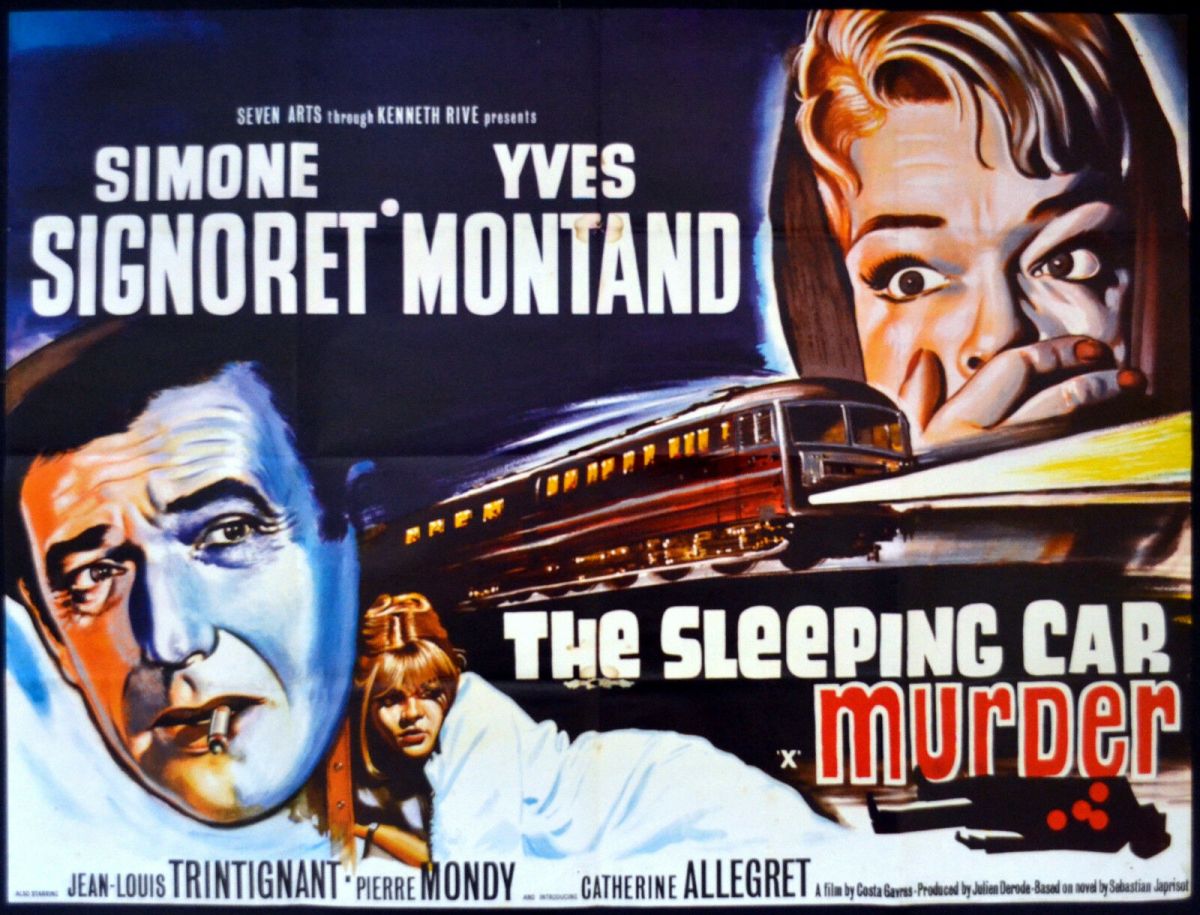
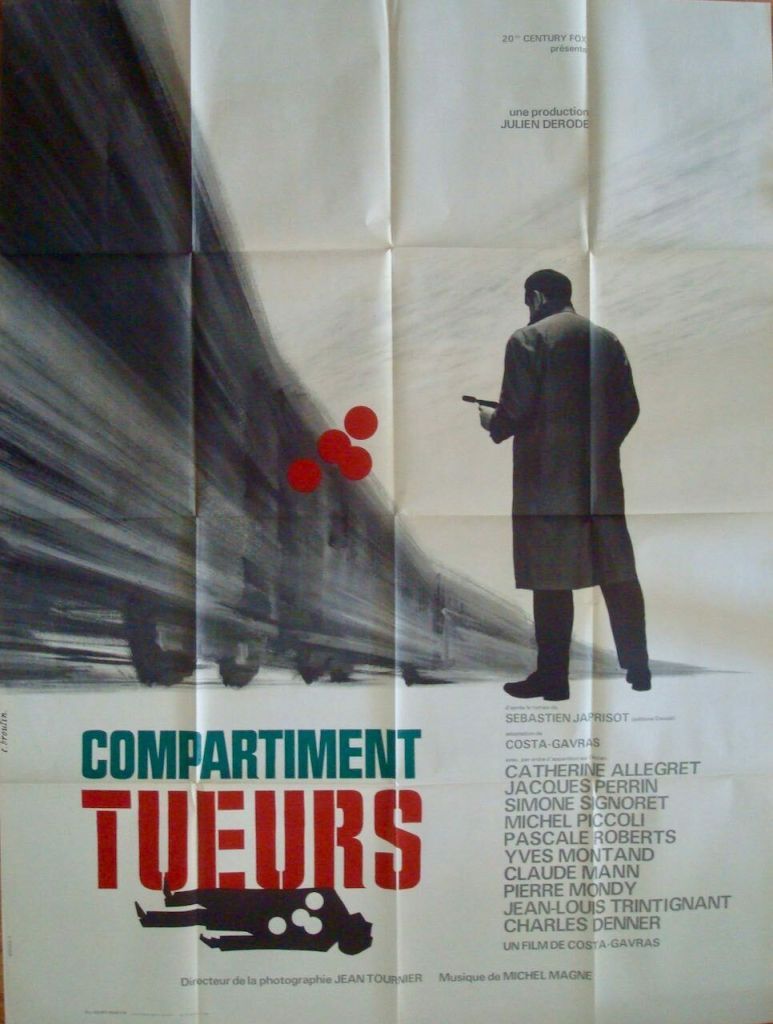
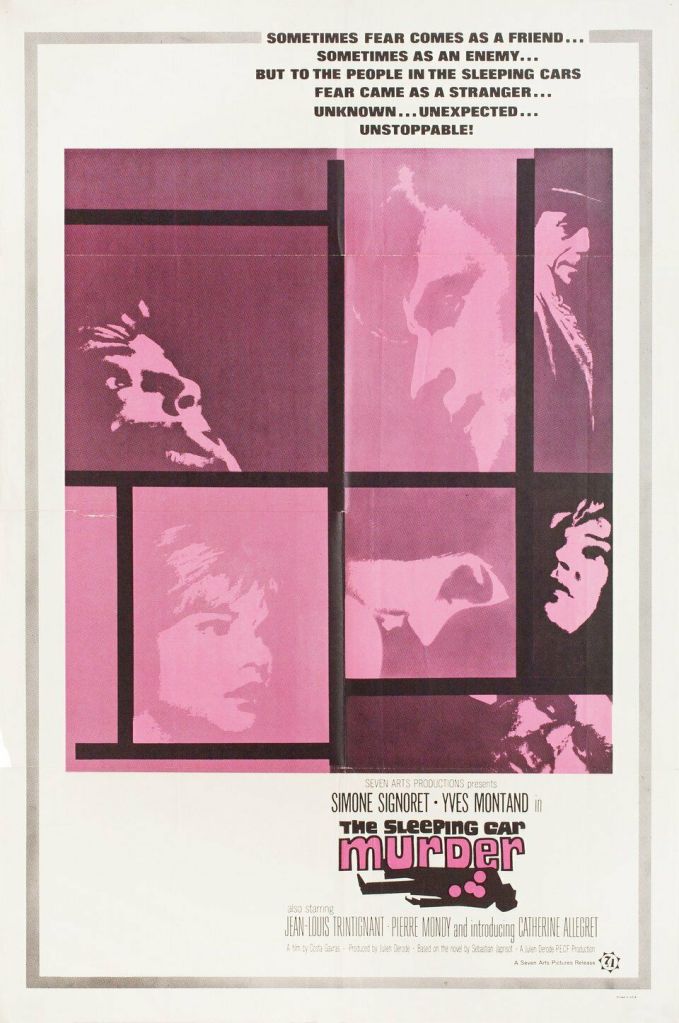
The Sleeping Car Murder (1965) ****

Absolutely brilliant thriller. Even after a half a century, still a knock out. A maniac on the loose, baffled cops, glimpses into the tattered lives of witnesses, victims and relatives, told at break-neck speed by Greek director Costa-Gavras (Z, 1969) on his debut and concluding with an astonishing car chase through the streets of Paris.  Not just an all-star French cast – Yves Montand (Grand Prix, 1966), Oscar-winner Simone Signoret (Is Paris Burning?, 1966), Jean-Louis Trintignant (Les Biches, 1968) and Michel Piccoli (Topaz, 1969) – but directed with a Georges Simenon (creator of Maigret) sensibility to the frailties of humanity.

As well as the twists and turns of the narrative, what distinguishes this thriller are the parallel perspectives. Where most whodunits present an array of suspects, inviting the audience to work out the identity of the killer, here virtually all the characters are presented both objectively and subjectively. Some are delusional, others highly self-critical, occasionally both, and we are given glimpses into their lives through the characters’ internalized voice-over and dialog.
Tiny details open up worlds – the wife of a dead man bewailing that he would not be able to wear the fleecy shoes she had just bought him to keep out the cold during his night-time job, a policeman revealing he wanted to be a dancer, a vet who wants to create a new breed of animals, a witness whose parents committed suicide. But just as many, the flotsam and jetsam of the police life, irritate the hell out of the cops: Bob Valsky (Charles Denner) constantly berates their efforts, relatives bore the pants off their interviewer, not to mention self-important police chief Tarquin (Pierre Mondy) who has an answer for everything.

A young woman Georgette (Pascale Roberts) is discovered dead in the second-class sleeper compartment of a train after it has pulled into Paris. Initial suspicion falls on the other  occupants including aging actress Eliane (Simone Signoret) in the thrall of her much younger lover Eric (Jean Louis Trintignant), impulsive blonde bombshell Bambi (Catherine Allegret), low-level office worker Rene (Michel Piccoli) and Madame Rivolani (Monique Chaumette). Weary Inspector Grazziani (Yves Montand), suffering from a cold and wanting to spend more time with his family, is handed the case. But before he can interview the suspects, they start getting knocked off.
So convinced are the police of their own theories that they ignore the testimony of Eliane and instantly home in on fantasist Rene, treated with contempt, a dishevelled lecherer who on the one hand misinterprets signals from women and on the other realizes that no one in their right mind would ever date him. Eliane is tormented by the prospect of being abandoned by her controlling lover.

It’s a race against time to find the passengers before the killer. In the middle of all this there is burgeoning romance between Bambi and clumsy mummy’s boy Daniel (Jacques Perrin), who may well hold the key to the murders. Their meet-cute is when he ladders her stockings.

I won’t spoil it for you by listing all the red herrings, surprises, mishaps, tense situations and explorations of psyche, but the pace never abates and it keeps you guessing to the end. And while all that keeps the viewer on tenterhooks what really makes the movie stand out is the depiction of the inner lives of the characters.

So often cast as a lover Yves Montand is outstanding as the diligent cop. Signoret captures beautifully the life of a once-beautiful woman who now enjoys the “empty gaze of men,” Trintignant essays a sleazier character than previously while Michel Piccoli who often at this stage of his career played oddballs invites sympathy for an unsympathetic character. Catherine Allegret (Last Tango in Paris, 1972) and Jacques Perrin (Blanche, 1971) charm as the young lovers. In tiny roles look out for director Claude Berri (Jean de Florette, 1986), Marcel Bozzuffi (The French Connection, 1971) and Claude Dauphin (Hard Contract, 1969),  

Costa-Gavras constantly adds depth to the story and his innovative use of multiple voice-over, forensic detail, varying points-of-view, plus his masterful camerawork and a truly astonishing (for the time) car chase points to an early masterpiece. Sebastian Japrisot (Farewell, Friend / Adieu L’Ami, 1968) wrote the screenplay based on his novel.  

Can’t remember where I got my DVD, perhaps second-hand, but there is an excellent print, taken from the 2016 restoration, available on YouTube.
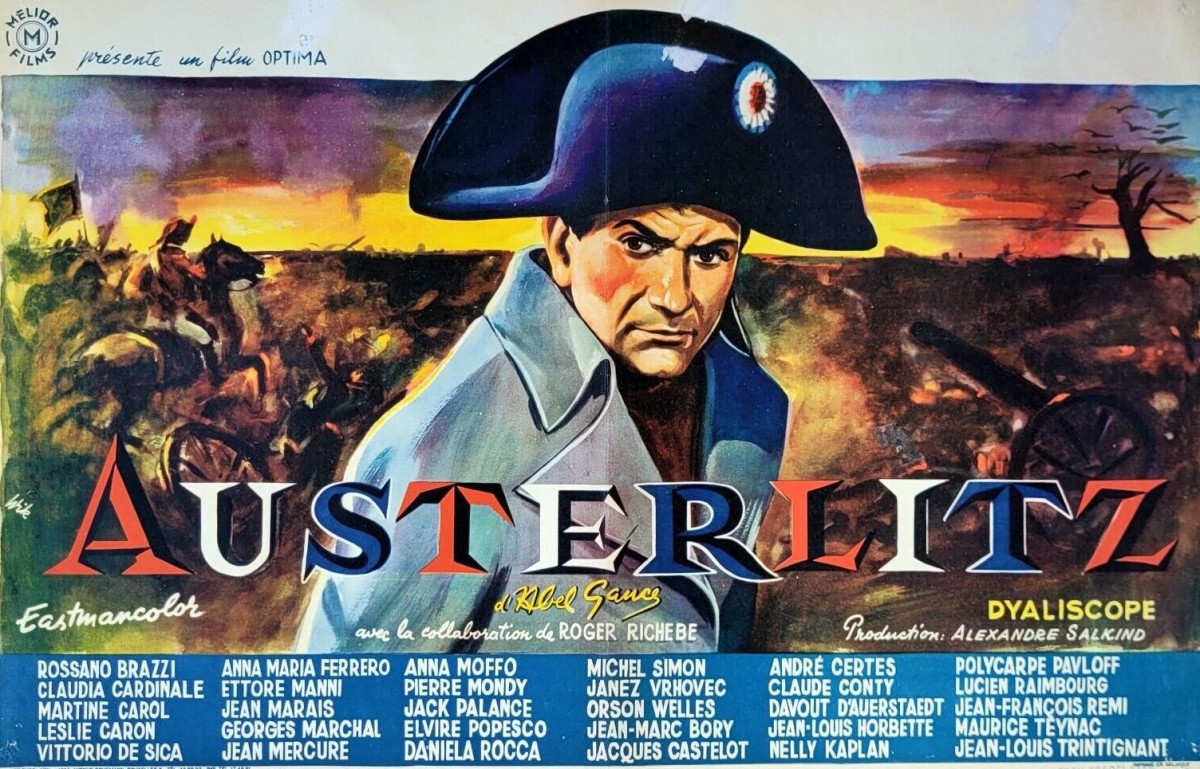
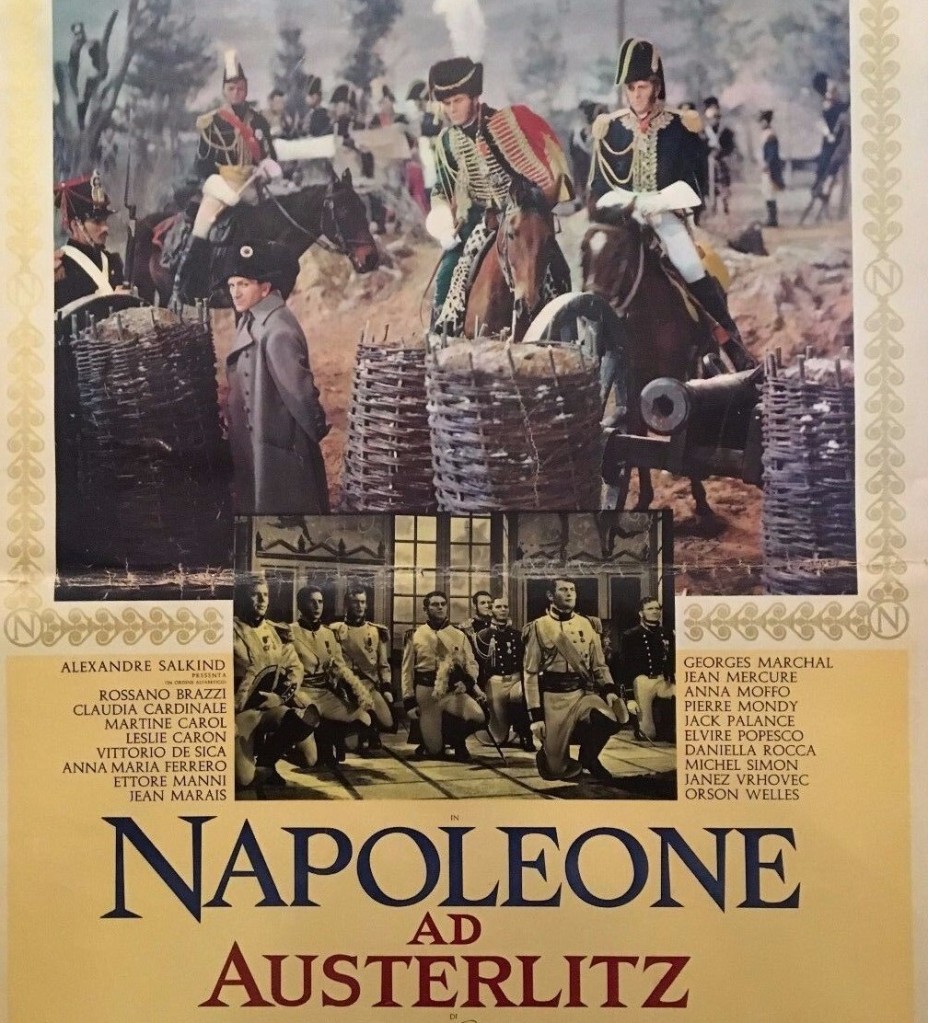
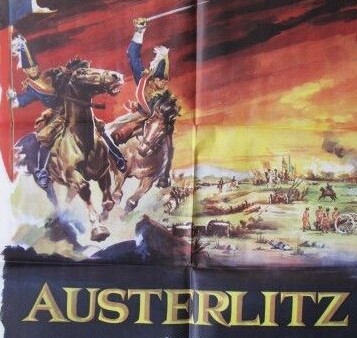
Austerlitz (1960) ***

If I’d seen this first, I might well have resisted the publicity tsunami that welcomed in 1981 the restoration reissue of Abel Gance’s silent epic Napoleon (1927). It’s the equivalent of John Ford following up The Searchers (1956) with something as clunky as Cannon for Cordoba (1970).

Oddly enough, the first few minutes are outstanding in telegraphing the French leader’s myriad insecurities. He forces a flunkey not only to break in his stiff new shoes – for fear the master of all he surveys be seen limping along – but also his new hat and then cheats when he undergoes the self-imposed ritual of being measured, pushing up on his toes to elevate his height by two inches from its genuine five foot two inches.

After that splurge of exquisite exposition, it goes not so much downhill as up and down ever narrative pathway possible. No wonder Ridley Scott felt that encompassing this particular life required at least four hours (the length of the planned streaming version) and that Steven Spielberg aims to devote seven hours to the subject when he revisits Stanley Kubrick’s script for HBO.

Mercifully, this part of the Napoleon legend is truncated to just three years, from the Treaty of Amiens in 1802, which purportedly brought peace to Europe, to the Battle of Austerlitz in 1805 when the French commander-in-chief demonstrated his military genius and shredded his opponents. But that battle is an almighty time coming.

In between, we have to put up with endless balls and endless characters shuttling through doors, although following the protocol of the time at least we have a clue who they are since they are announced by another flunkey in advance of their appearance. You would need Google open to check out who exactly they all are and what part they play.

Roughly, the story goes: Napoleon (Pierre Mondy) is attempting to achieve the “unification of Europe” (as would occur by more peaceful means over a century and a half later). The rest of Europe, naturally, isn’t in agreement so when foreign countries are not despatching assassins or reneging on treaties they’re lining up armies against him. Things are just as tough domestically. Even though, by overwhelming public vote, he has been named Consul for Life, he hankers after reviving the old title of Emperor, despite the last owner having his head chopped off.   

Plus, there are problems on the romantic front, wife Josephine (Martine Carole) has taken a lover and is jealous of the imminent arrival of his former Italian lover. All in all, it’s a pretty busy affair with countless sub plots, including an attempt to dupe the English into thinking he plans to invade their country via Ireland, and American inventor Robert Fulton (Orson Welles) trying to sell him on the notion of an ironclad steamship and submarine. Even when he gets to war, it’s nothing but chatter and subterfuge, various underlings almost rebelling at his, according to them, lack of military skill and troops disobeying orders.

The battle also lacks that essential ingredient, of the audience being told exactly what’s going on and understanding just how clever a maneuver might be, and although there are thundering horses aplenty it comes nowhere near the scale and grandeur he achieved with Napoleon, nor, it has to be said, the later Waterloo (1970), except for the horses and men disappearing under the frozen lake.

It was the fate of Abel Gance to be ruthless edited, his monster Napoleon chopped by two-thirds for original U.S. release, this one losing one-third of its running time, though I suspect what was cut out was no great loss, assuming it was just more rigmarole and costume drama set around his court, although it might have helped in working out what part his sister Pauline (Claudia Cardinale) and Mlle de Vaudey (Leslie Caron) play in the proceedings. Though we could have done with less of the Austrian General Weirother (Jack Palance with an execrable accent). Pauline has the best line in the whole endeavour, refusing to sit on a couch because its color clashes with her outfit.

Nestling among the all-star cast you’ll find – or not, depending on which version you view – names like Vittorio De Sica (The Shoes of the Fisherman, 1968), Rossano Brazzi (The Battle of the Villa Fiorita, 1965) and Jean-Louis Trintignant (Les Biches, 1968).

Nobody does much to earn their crust and Pierre Mondy (The Night of the Generals, 1967) just looks irritated beyond belief that he got mixed up in this.

Far from director Abel Gance’s finest moment. Little more than an elongated information dump.

https://amzn.to/47wvMeA

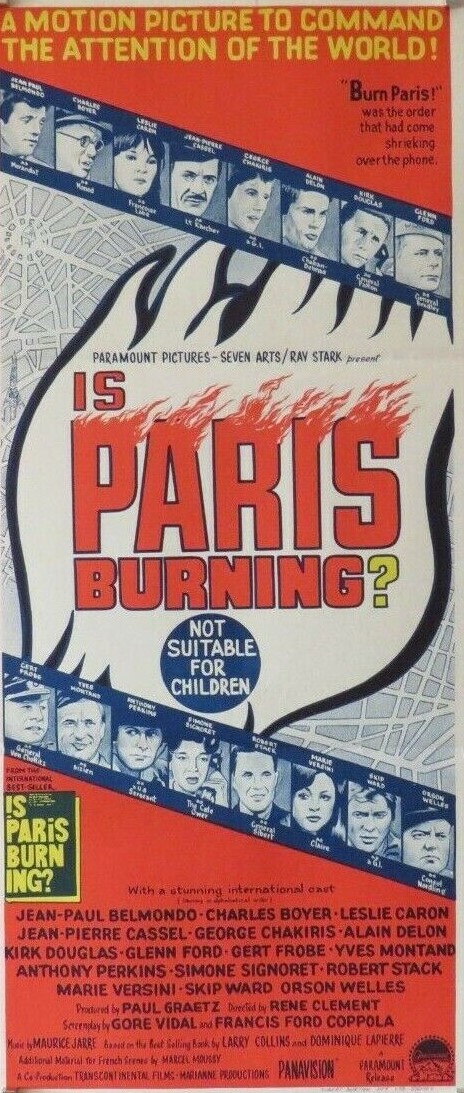
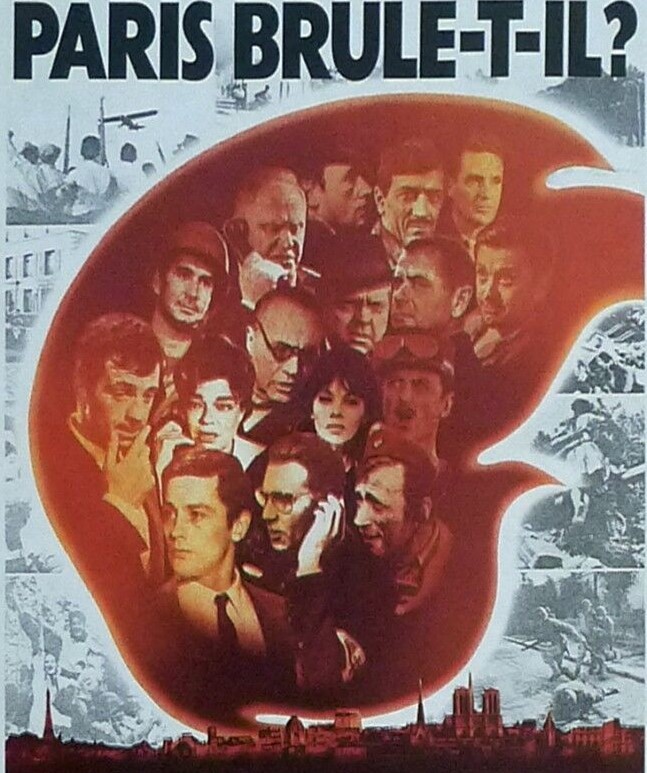
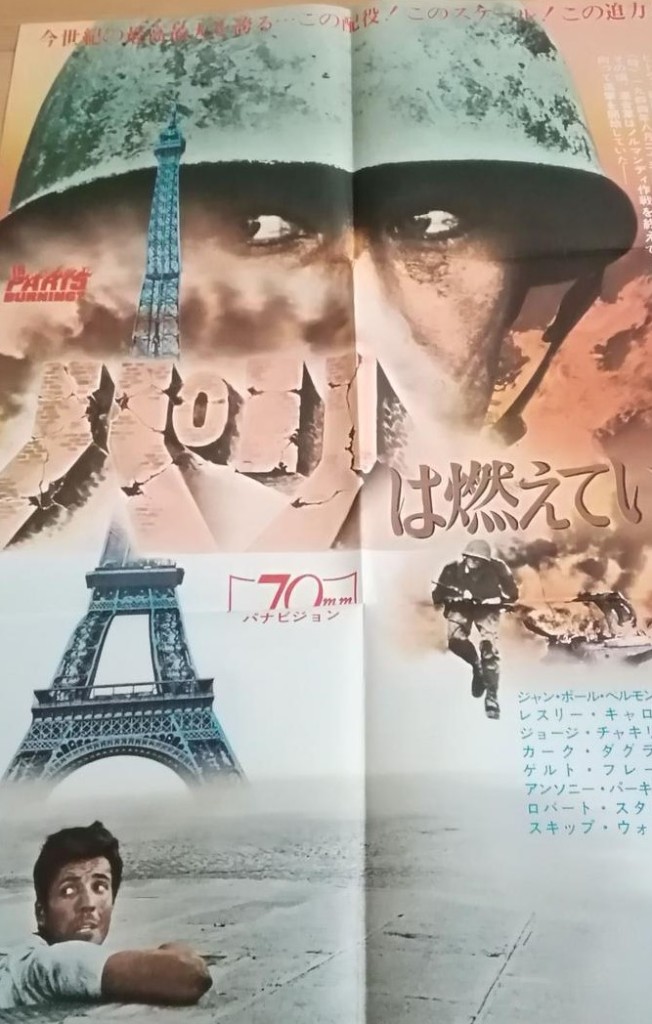
Is Paris Burning (1965) ****

Politics don’t usually play a part in war films of the 1960s but’s it’s an essential ingredient to Rene Clement’s underrated documentary-style picture. Paris has no strategic importance and after the Normandy landings in 1944 the Allies intend to bypass the German-occupied French capital and head straight for Berlin.

Meanwhile, Hitler, in particular vengeful mood after an attempt on his life, orders the city destroyed. Resistance groups are splintered, outnumbered and lacking the weaponry to achieve an uprising. Followers of General De Gaulle, the French leader in exile, want to wait until the Allies send in the troops while the Communists plan to seize control before British and American soldiers can arrive. 

When the Communists begin the fight by seizing public buildings, the Germans retaliate by planting explosives on the Eiffel Tower, the Louvre, and other famous buildings and all the bridges across the River Seine. German commandant Von Choltitz (Gert Frobe), no stranger to slaughter having overseen the destruction of Rotterdam, holds off obeying his orders because he believes Hitler is insane and the war already lost.

The Gaullists dispatch a messenger to persuade General Omar Bradley to change his mind and send troops to relieve the city. Director Clement, aware how little tension he can extract from the question of whether von Clowitz will press the destruct button (history tells us he did not) so he takes another route and documents in meticulous detail the political in-fighting and the actual street battles that ensued, German tanks and artillery against Molotov cocktails and mostly old-fashioned weaponry.

The wide Parisian boulevards provide a fabulous backdrop for the fighting. Shooting much of the action from above allows Clement to capture the action in vivid cinematic strokes. Like The Longest Day (1962) the film does not follow one individual but is in essence a vast tapestry. Scenes of the utmost brutality – resistance fighters thrown out of a lorry to be machine-gunned, the public strafed when they venture out to welcome the Americans – contrast with moments of such gentleness they could almost be parody: a shepherd taking his flock  through the fighting, an old lady covered in falling plaster watching as soldiers drop home-made bombs on tanks.

This is not a film about heroism but the sheer raw energy required to carry out dangerous duty and many times a character we just saw winning one sally against the enemy is shot the next. The French have to fight street-by-street,  corner-by-corner, bridge-by-bridge,   enemy-emplacement-by-enemy-emplacement, tank-by-tank.

And Clement allows as much time for humanity. Francophile Sgt Warren (Anthony Perkins), an American grunt, spends all his time in the middle of the battle trying to determine the location of the sights he longs to see. Bar owner Simone Signoret helps soldiers phone their loved ones.

Like The Longest Day and In Harm’s Way (1965), the film was shot in black-and-white, but not, as with those movies for the simple reason of incorporating newsreel footage, but because De Gaulle, now the French president, objected to the sight of a red swastika.

Even so, it permitted the inclusion of newsreel footage, which on the small screen (where most people these days will watch it) appears seamless. By Hollywood standards this was not an all-star cast, only fleeting glimpses of Glenn Ford (Fate Is the Hunter, 1964), Kirk Douglas (A Lovely Way To Die, 1968), Robert Stack (The Corrupt Ones / The Peking Medallion, 1967), Orson Welles (House of Cards, 1968) and George Chakiris (West Side Story, 1961).

But by French standards it was the all-star cast to beat all-star casts – Jean-Paul Belmondo (Breathless, 1960), Alain Delon (Lost Command, 1966), Yves Montand (Grand Prix, 1966), Charles Boyer (Gaslight, 1944), Leslie Caron (Gigi, 1958), Michel Piccoli (Masquerade, 1965), Simone Signoret (Room at the Top, 1959) and Jean-Louis Trintignant (A Man and a Woman, 1966).  Director Rene Clement was best known for Purple Noon (1960), an adaptation of Patricia Highsmith’s The Talented Mr Ripley starring Alain Delon

At $6 million, it was the most expensive French film ever made, a six-month shooting schedule, shot on the streets of the city including famous locations like Etoile, Madeleine and the Louvre. Big hit in France, it flopped in the United States, its box office so poor that Paramount refused to disclose it.

Discover WordPress

A daily selection of the best content published on WordPress, collected for you by humans who love to read.

The Atavist Magazine

by Brian Hannan

WordPress.com News

The latest news on WordPress.com and the WordPress community.