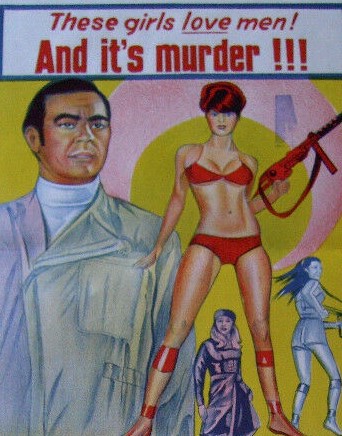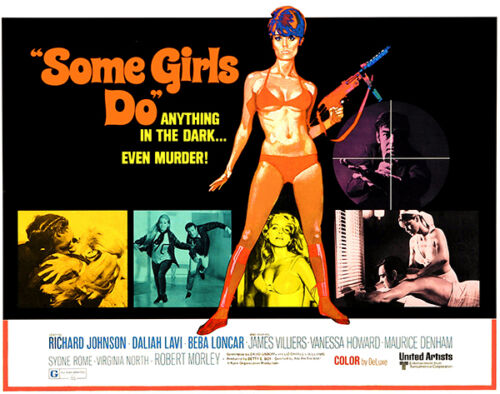
Some Girls Do (1969) ****

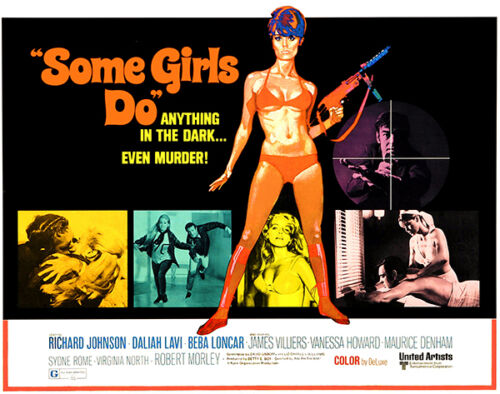
Enjoyed this sequel to Deadlier Than the Male (1967) far more than I expected because it sits in its own little world at some point removed from the espionage shenanigans that dominated the decade. Hugh (nee Bulldog) Drummond (Richard Johnson) is neither secret agent nor involved in espionage high jinks, instead employed in the more down-to-earth domain of insurance investigator, albeit where millions are at stake. Although his overall adversary is male, the smooth-talking Carl Petersen (James Villiers), adopting a series of disguises for most of this picture, the real threat comes from a pair of villainesses in the shape of Helga (Daliah Lavi) and Pandora (Beba Loncar). If anything, this pair are a shade more sadistic than Irma and Penelope from the previous outing.

The sequel doubles up – or doubles down – on the female villainy quotient, Petersen having created a race of lethal female robots who spend their time dispatching scientists working on the world’s first supersonic airliner. Global domination is only partly Petersen’s aim since he also stands to gain £8 million ($134 million today) if the plane doesn’t launch on schedule. Livening up proceedings are Flicky (Sydne Rome), a somewhat kooky Drummond fan who has her own agenda, Peregrine “Butch” Carruthers (Ronnie Stevens), a mild-mannered embassy official assigned bodyguard duties, and chef-cum-informant Miss Mary (Robert Morley).
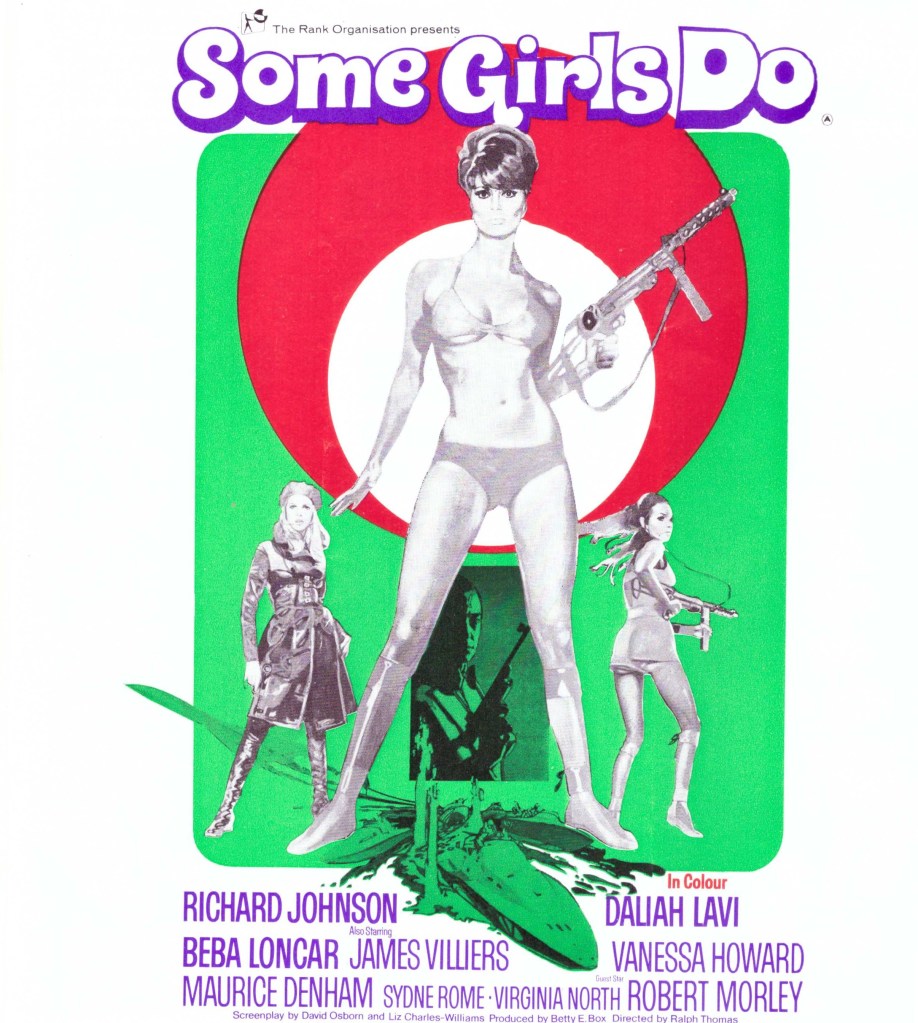
Villiers has found a way of turning an ultrasound device intended originally to aid cheating in a boat race into something far more dangerous. But, of course, for Helga seduction is the main weapon in her armory, and Drummond’s first sighting of her – a superb cinematic moment – is sitting on the branch of a tree wielding a shotgun. Equally inviting are the squadron of gun-toting mini-skirted lasses guarding Petersen’s rocky fortress.

The movie switches between Helga, Pandora and the robots raining down destruction and Drummond trying to prevent it. Dispensing with the boardroom activities that held up the action in Deadlier than the Male, this is a faster-moving adventure, with Drummond occasionally outwitted by Helga and calling on his own repertoire of tricks. Dialog is often sharp with Drummond imparting swift repartee.

The action – on land, sea and air – is a vast improvement on the original. The pick is a motorboat duel, followed closely by Drummond in a glider coming up against a venomous aeroplane and saddled with a defective parachute. And there are the requisite fisticuffs. Various malfunctioning robots supply snippets of humour.
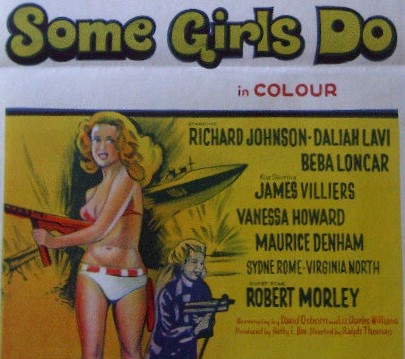
Richard Johnson (A Twist of Sand, 1968) truly found his metier in this character and it was a shame this proved to be the last of the series. Although Daliah Lavi never found a dramatic role to equal her turns in The Demon (1963) and The Whip and the Body (1963) and had graced many an indifferent spy picture as well as The Silencers (1966), she is given better opportunity here to show off her talent. Beba Loncar (Cover Girl, 1968) is her make-up obsessed bitchy buddy. Sydne Rome (What?, 1972) makes an alluring debut. James Villiers (The Touchables, 1968) is the only weak link, lacking the inherent menace of predecessor Nigel Green.

There’s a great supporting cast. Apart from Robert Morley (Genghis Khan, 1965) look out for Maurice Denham  (Danger Route, 1967), Adrienne Posta (To Sir, with Love, 1967) and in her first movie in over a decade Florence Desmond (Three Came Home, 1950). The robotic contingent includes Yutte Stensgaard (Lust for a Vampire, 1971), Virginia North (Deadlier Than the Male), Marga Roche (Man in a Suitcase, 1968), Shakira Caine (wife of Sir Michael), Joanna Lumley (television series Absolutely Fabulous), Maria Aitken also making her debut, twins Dora and Doris Graham and Olga Linden (The Love Factor, 1969).  Peer closely and you might spot Coronation Street veteran Johnny Briggs.

The whole package is put together with some style by British veteran Ralph Thomas (Deadlier than the Male). Screenplay by David Osborn and wife Liz Charles-Williams (Deadlier than the Male) is based on the book by “Sapper”.
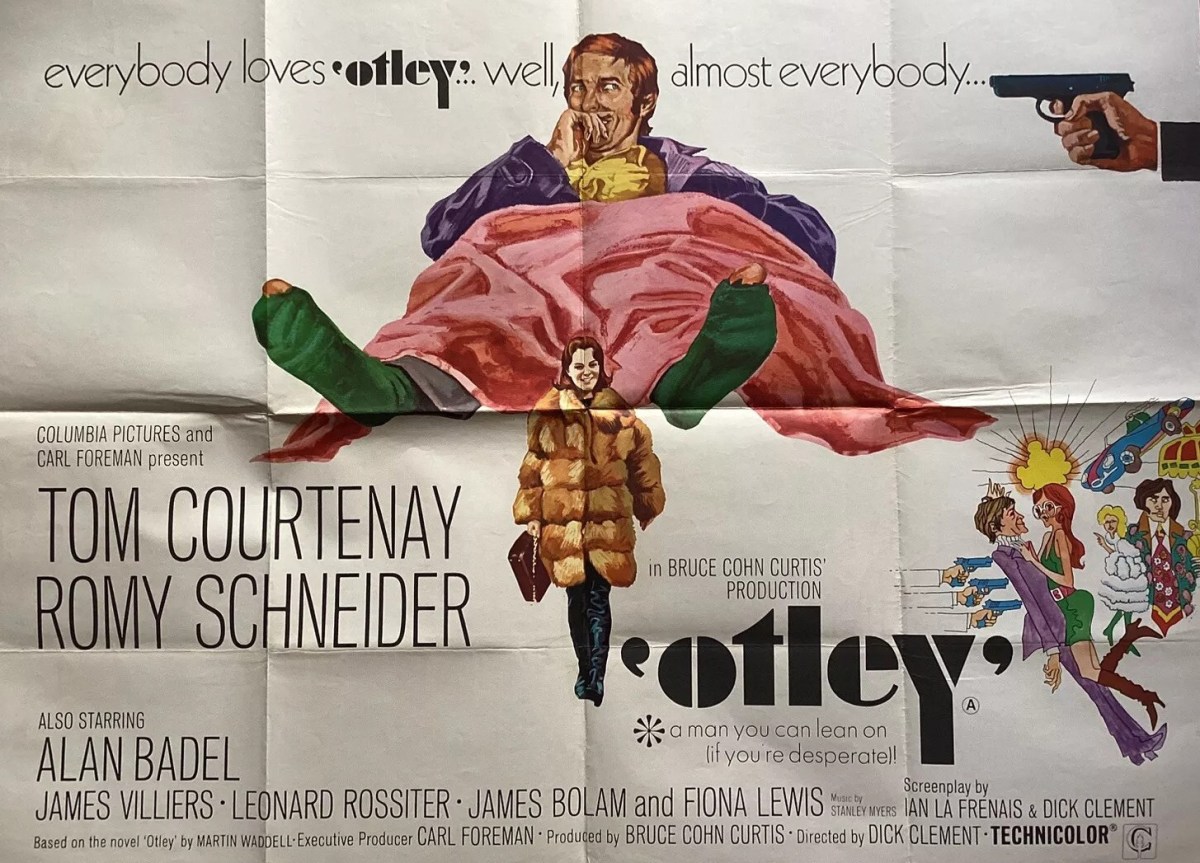
Otley (1969) **

Misguided attempt to play the innocent-caught-up-in-espionage card. And minus the angst on which he had built his screen persona, Tom Courtenay (A Dandy in Aspic, 1968) fails to elicit the spark that would turn himself into a leading man – excepting one other film, this was his last top-billed picture. And anyone hooked by the billing expecting to see a lot of female lead Romy Scheider (The Cardinal, 1963) would equally be in for a surprise.

And that’s a shame because Courtenay can act, not in the Oscar-bait sense, but just in his physical gestures and reactions to whatever else is going on in a scene. Scheider, too, especially in the scene where she more or less laughs in Courtenay’s face when he points a gun at her and in her knowing looks.

But Otley (Tom Courtenay) is such an unappealing character, the movie is on a sticky wicket from the off. Petty thief, largely homeless because of it, his propensity for slipping into his pocket anything that looks valuable in the homes of anyone stupid enough to give him a bed for the night, giving the movie its only sensible piece of narrative drive. Because the rest of the story is a farrago, a series of unconnected episodes dreamed up for their supposed humor, which wants to be pointed and sly but ends up heavy-handed and dreary.

And there’s one of those narrative sleights-of-hand where Otley wakes up on an airport runaway (security impervious to his presence, of course) having misplaced two days of his life. That’s just one of competing narratives – the other being that he’s wanted for the murder of the chap, Lambert (Edward Hardwicke), who was stupid enough to give him a bed for the night. Count in the espionage and there’s a trio of useless narrative hinges that get in each other’s way and largely introduce us to a succession of odd characters.

Pick of these is Johnston (Leonard Rossiter), an assassin who has more lucrative side hustles as a tour coach operator, double-crosser and blackmailer. The only other believable character is the landlady who’s had enough of Otley’s thieving, but only (unbelievable element lurching into view) after she’s bedded him.  

The movie just lurches from one scene to another, a car chase that ends up on a golf course, (“Are they members?” cries one outraged lady), a houseboat, various low-life dives and chunks of tourist tat thrown in, a bustling street market, Carnaby St etc.  I can’t begin to tell you what the espionage element is because that’s so far-fetched and ridiculous you won’t believe me.

This is the kind of low-budget picture that sets scenes, for no particular reason except they’re part of tourist London, in the Underground, but a completely empty Underground, not another person in sight, and not late at night either which would be a saving grace, though clearly it was filmed either late at night or early in the morning when the Underground was closed to ordinary passengers (thus saving on the budget).

Two examples of how heavy-handed the humor is: on a farm having been doused in water by Johnston, Otley remarks that he’s now deep in the proverbial only for the camera to cut to his foot sinking into a cowpat. At the airport, a couple of staff get lovey-dovey behind a counter, the male sneaking a grope, and we cut to a sign “ground handling”. Ouch and urgh!

If you manage to keep going the only reward is to see a handful of familiar names popping up: Alan Badel (Arabesque, 1966), James Villiers (Some Girls Do, 1969), Fiona Lewis (Where’s Jack?, 1969) and British sitcom legends James Bolam (The Likely Lads and sequel) and Leonard Rossiter (The Fall and Rise of Reginal Perrin, 1976-1979).

And where’s Romy Scheider in all this? Looking decidedly classy, but clearly wondering how the hell she got mixed up in it.

Screenwriter Dick Clement (Hannibal Brooks, 1969) made his movie debut on this clunker. He co-wrote the picture with regular writing chum Ian La Fresnais from the novel by Martin Waddell.

What happens when a genre cycle – in this case the espionage boom – gets out of control.

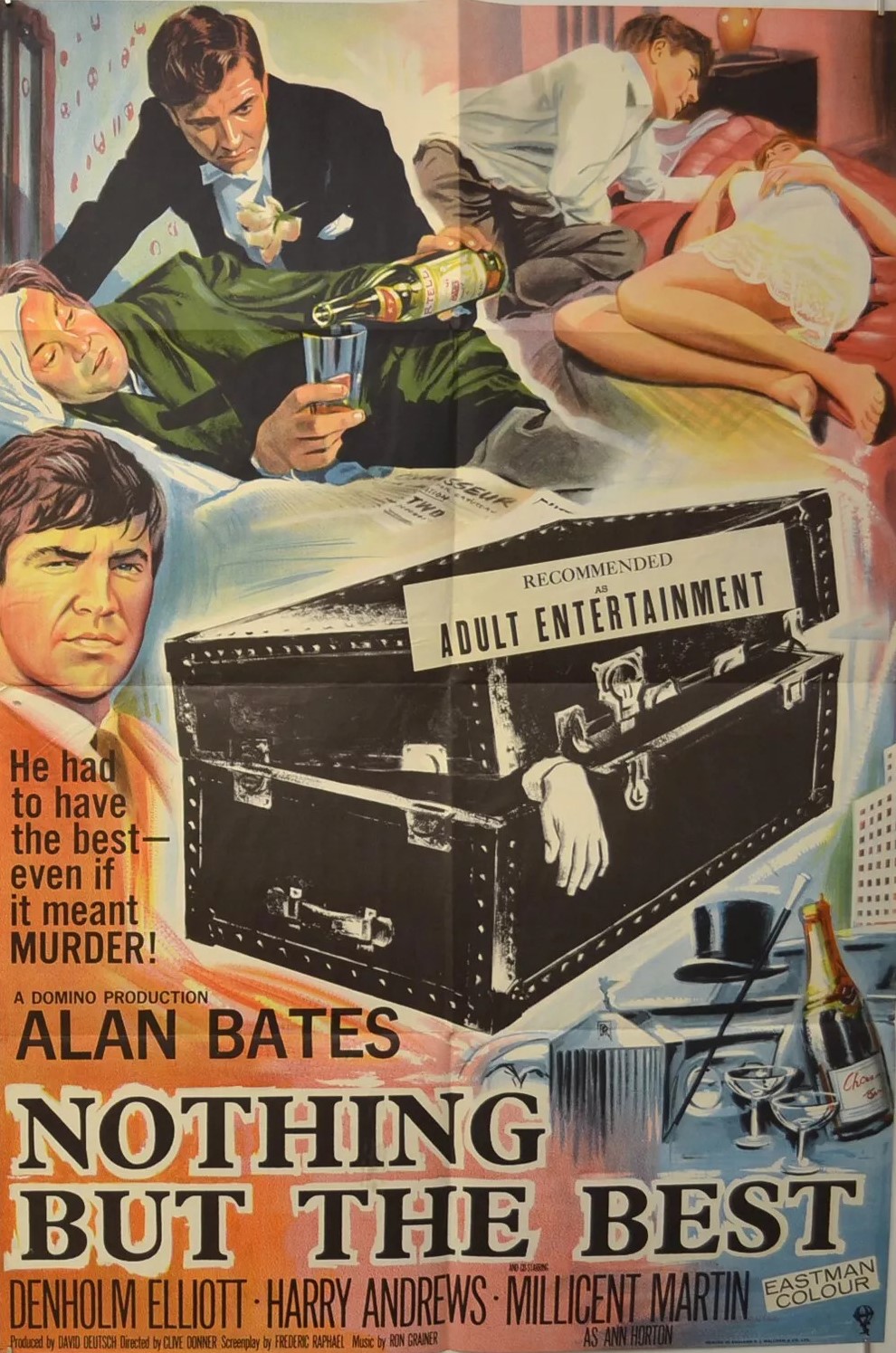
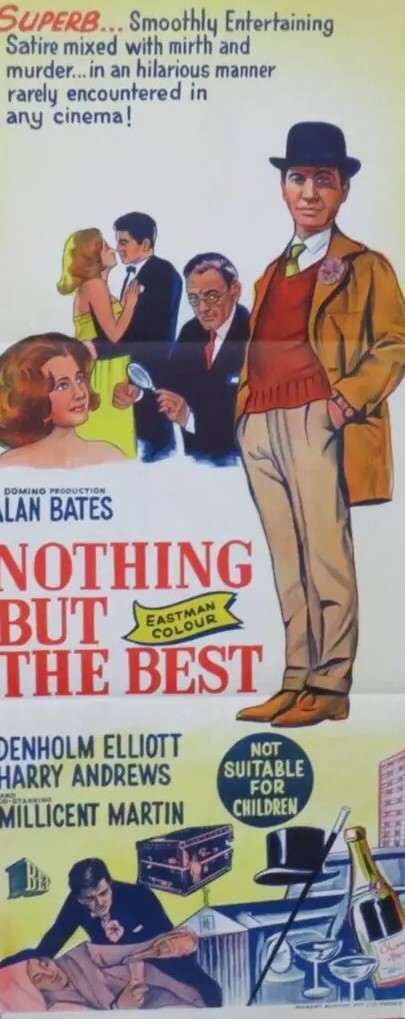
Nothing but the Best (1964) ***

Hardly surprising Denholm Elliott comes a cropper in this delicious British upper class black comedy – he steals the show from denoted star Alan Bates. Had he kept going any longer you would hardly have noticed Bates even featured, such was the clever impact of Elliott’s insiduous playing.

The toff version of Room at the Top (1958) meets Alfie (1966) as “ambitious young yob” Jimmy Brewster (Alan Bates) manipulates his way to the top. Too many people not coming up to scratch for his upwardly mobile purposes are cast aside – or strangled. Arrogance and bluff are the key to getting ahead in the upper-class world towards which he pivots. Doing absolutely nothing at all also works wonders in high society as does dismissing one’s hugely expensive education.

Jimmy is initially helped on his way, given an insider’s guide, by dissolute layabout toff Charles (Denholm Elliott) with a marked predilection for forgery, and other minor criminal schemes, but whose chief skill appears to be sponging off everyone else. Jimmy is a lowly executive in an upmarket estate agent, fighting for promotion against people with silver spoons rattling around every part of their anatomy and who have the genuine class their business appears to call for.

Every now and then the satire still contains contemporary bite, the difference between universities still relevant, as is that most people are not swayed by actual knowledge but by the fact that you can toss out the names of various academics. But, mostly, it’s bluff that opens the doors. Jimmy misses an appointment with an important banker, a dereliction that should have scuppered his chances of negotiating a better deal for his client. But, in fact, the banker takes this as Jimmy having gone elsewhere and immediately offers a better deal.

When confronted by a colleague for ignoring another appointment, Jimmy merely vaguely waffles on about being detained by “Sir Charles,” true identity left shrouded in mystery, contentious colleague silenced by either not being on speaking terms with the person mentioned or unwilling to admit his ignorance.

Having seduced every secretary within reach – none of whom meet his lofty standards – Jimmy manages to wangle his way into catching the eye of wealthy boss Horton (Harry Andrews) and his attractive daughter Ann (Millicent Martin), whom he marries.

While this would have been sharp as a tack in satirical terms back in the day, most of that weaponry is now out-dated. Suffers because none of the upper-class characters show any sense whatsoever – they can’t all be duffers and most seem to have tumbled out of central casting’s idea of an upper class twit. Charles is the exception, but even he is something of an innocent, not quite aware of what ruthlessness he has unwittingly set afire.

The lower classes aren’t much better. Secretaries and switchboard girls fall at Jimmy’s feet, handsome beggar that he is, though his landlady Mrs March (Pauline Delaney) appears to have his measure and is not above indulging in hypocrisy.

The voice-over works to the detriment of the picture. Because that device is doing so much of the heavy lifting, filling in the audience on Jimmy’s true feelings, the actor doesn’t have to do much acting and we’re presented with a kind of wooden figure who hides behind a mask. Of course since he’s masking his feelings, you might be inclined to give Alan Bates the benefit of the doubt.

And it would work very well if there wasn’t Denholm Elliott giving a master class in duplicity. He exhibits genuine charm.

I’m guessing that the voice-over was already there in Frederic Raphael’s script and not added to compensate for Alan Bates’s one-note performance. So if it was, that certainly presented a problem for the actor since most of what made his character interesting was at one remove, not presented in dialog or confrontation as would be the norm.

Alfie solved the problem by breaking the fourth wall – all the rage these days – and having the character directly address the audience, which allowed Michael Caine to present his own case.

So, if Alan Bates felt limited in what he could show on screen, he certainly does a good job of maintaining the façade. But Denholm Elliott (Station Six Sahara, 1963) steals the show. Harry Andrews (The Charge of the Light Brigade, 1968) is permitted no nuance to his normal bluff persona, singer Millicent Martin (Alfie, 1966) sparkles, and a bunch of British character actors including James Villiers (Some Girls Do, 1969) and Nigel Stock (The Lost Continent, 1968) put in an appearance.

Directed with some glee by Clive Donner (Alfred the Great, 1969) from a script by Frederic Raphael (Darling, 1965) adapted from a short story by Stanley Ellin (House of Cards, 1968).

Not as coruscating now as originally intended.

Some Girls Do (1969) ****

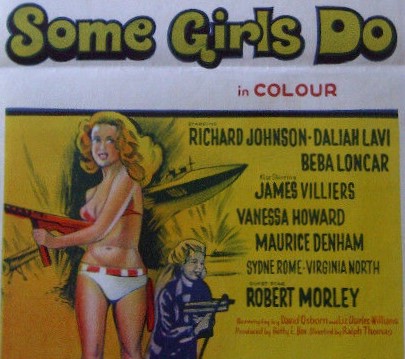
Enjoyed this sequel to Deadlier Than the Male (1967) far more than I expected because it sits in its own little world at some point removed from the espionage shenanigans that dominated the decade. Hugh (nee Bulldog) Drummond is neither secret agent nor involved in espionage high jinks, instead employed in the more down-to-earth domain of insurance investigator, albeit where millions are at stake. Although his overall adversary is male, the smooth-talking Carl Petersen (James Villiers), adopting a series of disguises for most of this picture, the real threat comes from a pair of villainesses in the shape of Helga (Daliah Lavi) and Pandora (Beba Loncar – the latter, yes, having her own deadly Box. If anything, this pair are a shade more sadistic than Irma and Penelope from the previous outing.

The sequel doubles up – or doubles down – on the female villainy quotient, Petersen having created a race of lethal female robots who spend their time dispatching scientists working on the world’s first supersonic airliner. Global domination is only partly Petersen’s aim since he also stands to gain £8 million ($134 million today) if the plane doesn’t launch on schedule. Livening up proceedings are Flicky (Sydne Rome), a somewhat kooky Drummond fan who has her own agenda, Peregrine “Butch” Carruthers (Ronnie Stevens), a mild-mannered embassy official assigned bodyguard duties, and chef-cum-informant Miss Mary (Robert Morley).

Villiers has found a way of turning an ultrasound device intended originally to aid cheating in a boat race into something far more dangerous. But, of course, for Helga seduction is the main weapon in her armoury, and Drummond’s first sighting of her – a superb cinematic moment – is sitting on the branch of a tree wielding a shotgun. Equally inviting are the squadron of gun-toting mini-skirted lasses guarding Petersen’s rocky fortress.

The movie switches between Helga, Pandora and the robots raining down destruction and Drummond trying to prevent it. Dispensing with the boardroom activities that held up the action in Deadlier than the Male, this is a faster-moving adventure, with Drummond occasionally outwitted by Helga and calling on his own repertoire of tricks. Dialogue is often sharp with Drummond imparting swift repartee.

The action – on land, sea and air – is a vast improvement on the original. The pick is a motorboat duel, followed closely by Drummond in a glider coming up against a venomous aeroplane and saddled with a defective parachute. And there are the requisite fisticuffs. Various malfunctioning robots supply snippets of humour.

Richard Johnson (A Twist of Sand, 1968) truly found his metier in this character and it was a shame this proved to be the last of the series. Although Daliah Lavi never found a dramatic role to equal her turns in The Demon (1963) and The Whip and the Body (1963) and had graced many an indifferent spy picture as well as The Silencers (1966), she is given better opportunity here to show off her talent. Beba Loncar (Cover Girl, 1968) is her make-up obsessed bitchy buddy. Sydne Rome (What?, 1972) makes an alluring her debut. James Villiers (The Touchables, 1968) is the only weak link, lacking the inherent menace of predecessor Nigel Green.

There’s a great supporting cast. Apart from Robert Morley (Genghis Khan, 1965) look out for Maurice Denham  (Danger Route, 1967), Adrienne Posta (To Sir, with Love, 1967) and in her first movie in over a decade Florence Desmond (Three Came Home, 1950). The robotic contingent includes Yutte Stensgaard (Lust for a Vampire, 1971), Virginia North (Deadlier Than the Male), Marga Roche (Man in a Suitcase, 1968), Shakira Caine (wife of Sir Michael), Joanna Lumley (television series Absolutely Fabulous), Maria Aitken also making her debut, twins Dora and Doris Graham and Olga Linden (The Love Factor, 1969).  Peer closely and you might spot Coronation Street veteran Johnny Briggs.

The whole package is put together with some style by British veteran Ralph Thomas (Deadlier than the Male).

CATCH-UP: Chart through the Blog how  Richard Johnson’s career went from supporting player to star via The Pumpkin Eater (1964), Operation Crossbow (1965), Khartoum (1965) Deadlier than the Male (1967), Danger Route (1967) and A Twist of Sand (1968). Conversely, see how Daliah Lavi went from European star of The Demon (1963) and The Whip and the Body (1963) to Hollywood supporting player in Lord Jim (1965).

Network has this on DVD currently at a bargain price in a double bill with Deadlier Than the Male.

And you can also catch Some Girls Do on YouTube.

Discover WordPress

A daily selection of the best content published on WordPress, collected for you by humans who love to read.

The Atavist Magazine

by Brian Hannan

WordPress.com News

The latest news on WordPress.com and the WordPress community.