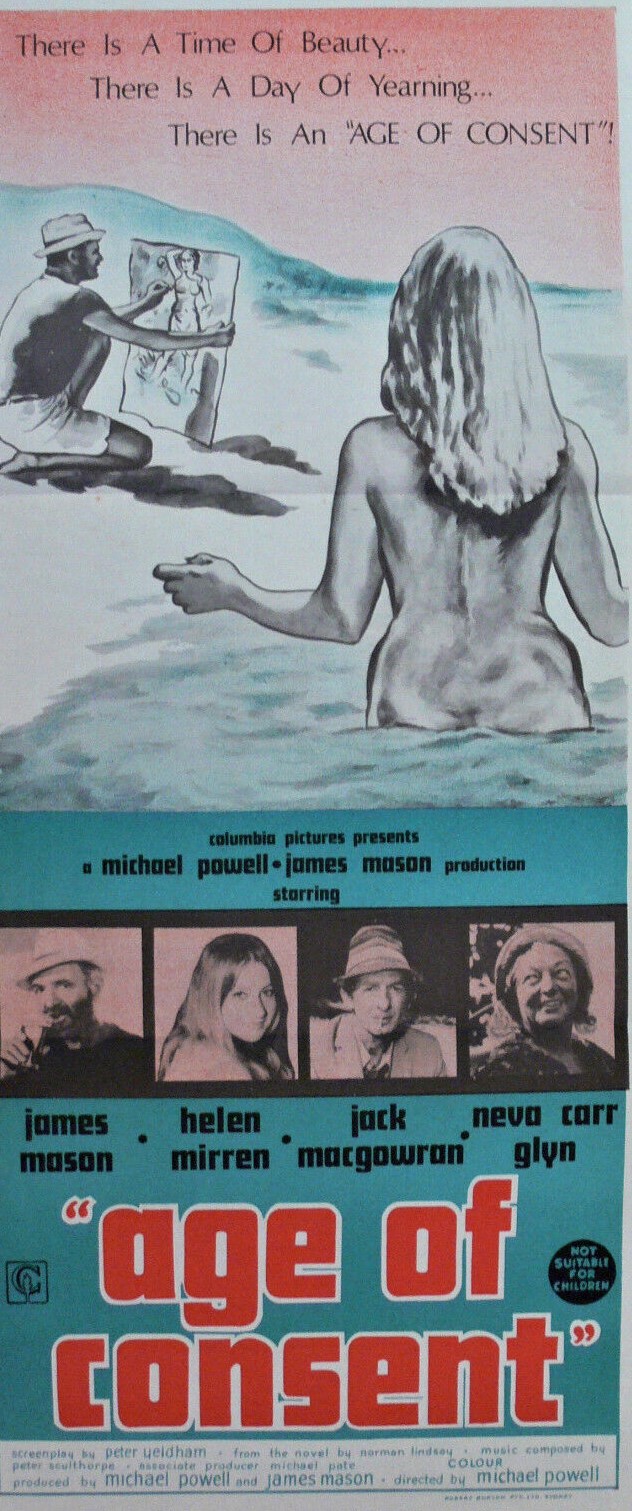
Age of Consent (1969) ***

Reputations were made and broken on this tale of a jaded artist returning to his homeland to rediscover his mojo. Director Michael Powell had, in tandem with partner Emeric Pressburger, created some of the most acclaimed films of the 1940s – A Matter of Life and Death (1946), Black Narcissus (1947) and The Red Shoes (1948) – but the partnership had ended the next decade. Powell’s solo effort Peeping Tom (1960) was greeted with a revulsion from which his career never recovered. Age of Consent was his penultimate picture but the extensive nudity and the age gap between the principals left critics shaking their heads.

For Helen Mirren, on the other hand, it was a triumphant start to a career that has now spanned over half a century, one Oscar and three nominations. She was a burgeoning theatrical talent at the Royal Shakespeare Company when she made her movie debut as Mason’s muse. It should also be pointed out that when it came to scene-stealing she had a rival in the pooch Godfrey.

You would rightly be concerned that there was some grooming going on. Although 24 at the time of the film’s release, Cora (Helen Mirren), an under-age nymph, spends a great deal of time innocently cavorting naked in the sea off the Great Barrier Reef in Australia. But there are a couple of provisos. In the first place, Cora was not swimming for pleasure, she was diving for seafood to augment her impoverished lifestyle. In the second place, she was so poor she would hardly have afforded a bikini and was the kind of free spirit anyway who might have shucked one off.

Thirdly, and more importantly, artist Bradley Morahan (James Mason) wasn’t interested. He wasn’t the kind of painter who needed to perve on young girls. An early scene showed him in bed with a girlfriend and it was clear that he was an object of lust elsewhere. Morahan, fit and tanned, obsessed like any other artist about his talent, and was in this remote stretch not to hunt for young naked girls but to find inspiration. As well as eventually painting Cora, he also transforms the shack he rents into something of beauty.

Morahan is vital to Cora’s self-development. The money he pays her for modelling goes towards her escape fund. Her mother being a useless thieving alcoholic, she has little in the way of role model. And the world of seafood supply is competitive. She is lost in paradise and the scene of her buying a tacky handbag demonstrates the extent of her initial ambition. Although her physical attributes attract male attention, it is only on forming a relationship with the painter that Cora begins to believe in herself. There’s not much more to the central story than the artist rediscovering his creative spark and helping Cora’s personal development along the way.

Morahan is a believable character. He is not an impoverished artist. Far from being self-deluded, he is a questing individual, turning his back on easy money and the temptations of big city life in order to reinvent himself. He isn’t going to starve and he has no problems with women. And he is perfectly capable of looking after himself.  A more rounded artist would be hard to find. Precisely because there is no sexual relationship with Cora, the movie, as a film about character development, is ideally balanced.

The movie is gorgeously filmed, with many aerial shots of the reef and underwater photography by Ron and Valerie Taylor. 

What does let the show down is a proliferation of cliched characters who over-act. Nat Kelly (Jack McGowran), sponging friend, ruthless seducer and thief, leads that list closely followed by Cora’s grandmother (Neva Carr-Glynn) who looks like a reject from a Dickens novel. There’s also a dumb and dumber cop and a neighbor so bent on sex that she falls for Kelly. It’s not the first time that comedy has got in the way of art, but it’s a shame it had to interrupt so often what is otherwise a touching film.

At its heart is a portrait of the artist as an older man and his sensitive relationship with a young girl. In later years, Powell married film editor Thelma Schoonmaker and after his death she oversaw the restoration of Age of Consent, with eight minutes added and the Stanley Myers score replaced by the original by Peter Sculthorpe. 

Unusually sensitive screenplay from Peter Yeldham who, as my readers will know, is more usually associated with Harry Alan Towers productions like Bang! Bang! You’re Dead / Our Man in Marrakesh (1966), based on the novel by Norman Lindsay.  

Intriguing, occasionally moving, superb debut from Mirren plus it works.
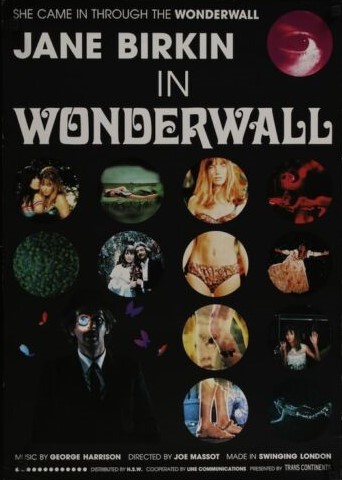
Wonderwall (1968) **

While psychedelic forays were all the rage in the late 1960s it’s hard to see how that excuses a movie that appears to exalt a peeping tom. Or at the very least appear to give him a free pass because he’s a barmy scentist and, more likely, because he saves the object of his spying from suicide. And you have to wonder what prompted George Harrison (at the time still a Beatle) to volunteer to provide the soundtrack.

Of course, the title has been popularised by the catchy Oasis song and star Jane Birkin achieved notoriety also on the musical front when her single “Je T’Aime” was banned by the BBC the following year (censorship having the opposite effect and sending it to the top of the charts, as any good marketing analyst could have predicted).

But there’s not much going on here that purports to be narrative and the psychedelics and fantasy sequences fail to remove discomfort over the context.

Professor Collins ( a wild-haired Jack MacGowran) spends his days glued to a microscope studying amoebas and perhaps in a nod to other less than savoury literary characters (Lolita, 1962 and The Collector, 1965, in case you haven’t guessed) collects butterflies and spends the evening in a chaotic apartment stacked high with old magazines (their content, given his later behavior, not what you might expect).

Disturbed by the noise of a party upstairs, he throws something at the wall, knocks something loose and finds a hole-sized light streaming into the darkness of his apartment. With nothing else to keep himself occupied, he peers through and is entranced by the long legs of model Penny Lane (Jane Birkin). Soon, he is checking out a photo shoot, a party, Penny making love to boyfriend (Iain Quarrier), the model rejecting her lover’s suggestions of a threesome with another equally lithe model (Anita Pallenberg), and later discovering she is pregnant.

In between, Collins has various fantasies about challenging the boyfriend to a duel. Initially, this is in the formal manner, with duelling pistols or rapiers, but soon takes the form of giant fountain pens or giant cigarettes. Occasionally, there’s a butterfly motif. Once, he imagines Penny as a mermaid swimming among the amoebas. His dead mother appears in a puff of smoke to tell him off.

And he didn’t get to being a professor without showing some initiative. So when he realises that a tiny hole limits his viewing pleasure, he starts to knock the wall down and watch the woman in widescreen, though somehow the wall is made of glass, thus preventing him intruding, and equally somehow the neighbors never seem to notice.

Of course, you could take it all as fantasy, that a lonely old man just wants to befriend a young woman, as if there was anything less creepy about that.

Naturally, if you’re inclined to ignore the creepiness, you might be tempted to start to praise the psychedelic, but I’m not sure that’s a very good starting point. If you’re into sitar music or George Harrison you will probably enjoy the score.

Jack MacGowran (Age of Consent, 1969) didn’t seem to feel he needed to do any more with the character than dress him as an eccentric. There’s certainly no sense of shame. If anything, thanks to the ending, he is afforded redemption. Jane Birkin (Blow-Up, 1966) isn’t called upon to do anything except appear soulful, and, of course, from time to time, nude. British character actors like Irene Handl and Richard Wattis appear in stock roles.

Joe Massot (The Song Remains the Same, 1976) directed and Gerard Brach (Repulsion, 1965) and Guillermo Cain (Vanishing Point, 1971) wrote the screenplay. But while Massot was a debutant, Brach’s involvement would have indicated something perhaps creepier still but with a more relevant outcome. A case study on how this got the green light in the first place would be most appreciated.

The Ceremony (1963) ***

Actors taking the hyphenated route were quite a fad in the 1960s. Mostly, primarily for tax purposes, they turned themselves into actor-producers. But some went all-out for artistic glory, saddling themselves with the task of directing the movies in which they starred, by this point in the decade John Wayne (The Alamo, 1960) and Marlon Brando (One-Eyed Jacks, 1961) the most celebrated examples. Despite lacking that pair’s box office pulling power, Laurence Harvey (Butterfield 8, 1960) threw his hat into the ring with this often compelling, atmospheric, but occasionally pretentious, offering.

Irishman Sean McKenna (Laurence Harvey) is in prison in Tangiers – “a city of money” – for one crime he did commit (bank robbery) and one he did not (shooting a guard dead during the robbery). Although facing an imminent death penalty for the murder, he refuses to name the killer. Local prosecutor Le Coq (Ross Martin)  is intent on making him an example while the prison warden (John Ireland) pleads for clemency, especially as it is suspected the inmate is innocent.

Astonishing to imagine now but this went out on general release in Britain
as the lead film in a double bill with “Lilies of the Field.”

Meanwhile, McKenna’s girlfriend Catherine (Sarah Miles) and his brother Dominic (Robert Walker Jr) plan an audacious escape. The brother is not altogether altruistic. His price is half the hidden loot and Catherine, that part of the deal sealed when she submits to sex with him.

Dominic gains entry to the prison disguised as a priest, swapping clothes with his brother, so that when sirens sound to announce potential intrusion by Dominic’s sidekick Nicky (Lee Patterson), Sean can simply walk out unharmed. However, when Seans learns of the price to be paid he doesn’t thank Catherine for her noble sacrifice but turns against both. Dominic, now on the run and chased by the police, is virtually burned alive when his car explodes.

My apologies but in order to properly discuss this picture I’m going to have to take you through to the end. So SPOILER ALERT.

Dominic is so badly burnt in fact that he is unrecognizable and the police (decades before DNA would disprove such an assumption) believe he is actually his brother. Dominic is faced with  “the ceremony” – an ironic tittle if ever there was one – in which he is strapped to a wooden throne and shot by firing squad. Despite his brother’s betrayal, and the fact that his death would set Sean free, Sean decides it would better to “prevent the unjust killing of an innocent man” and gives himself up, too late, as it happens, to spare Dominic, but allowing Sean, in a Pieta-style gesture, to carry the corpse into the prison courtyard and announce “my brother died for me.”

Not quite the ending you would expect, not least because religious allegory has been distinctly missing from the proceedings unless you count the somewhat dotty Father O’Brian (Jack MacGowran) who spends most of his time delivering soliloquies unless you count cars, cows and mules as potential conversationalists.

You get the impression the ending was what attracted the director to the tale, and though it is quite a stunning climax, cinematically as well as thematically, Harvey has, like so many debutants, determined to make a big point. “There’s a little bit of God in everyone,” pronounces Fr O’Brian with a saintly air, which would beg the question of when the Good Lord channelled his inner bank-robber.

For all the film’s flaws there are several pluses. The atmosphere “of chilly hell” (to steal a quote about another book) is well done, footsteps echo off stone floors and cobbles, nobody in this black-and-white feature is seen without a dose of noir lighting, resulting in long shadows and aerial shots of tiny figures swarming. While everyone else over-acts for no apparent reason except directorial inexperience, when Sarah Miles (Term of Trial, 1962) overacts, lips constantly a-quiver, words delivered in gasps, she has every right to, since her character has succumbed to the most evil kind of temptation for the best sort of reason.

The only other interesting character, beyond the stock ones populating the prison, is lonely landlord Ramades (Carlos Casaravilla) who has outlived his four lives and whose rooms abut the prison and where Catherine takes refuge while the escape is going on. He senses her tension, but mistakes the cause, assuming she is here to wait for the shots announcing her husband’s death as a means of “sharing his punishment,” quite a piece of psychological insight for an ordinary guy. And there’s also a creepiness about the whole scene, a sense that she might have to give herself to him as well in order to prevent him wandering too far from the bedroom where he might discover Dominic putting into action a crucial part of the escape plan.

Among the flaws: no real tension, especially in terms of the escape, not enough directorial understanding that much more could be gained from greater focus on Catherine’s dilemma, the obvious lack of a body in the burning car, the fact that the Irishman shows no signs of an Irish accent, the priest’s scenes which provoke hilarity more than reverence, and as much as it is a strength the ending appears out of nowhere.

Robert Walker Jr (The Happening, 1967) is too much of a lightweight for this role, but John Ireland (55 Days at Peking, 1963) and Ross Martin (Experiment in Terror, 1962) excel. Look out for Fernando Rey (The French Connection, 1970).

Valiant effort by Harvey who only directed one other time, on his last film Welcome to Arrow Beach / Yellow-Head Summer (1973), plus a stint filling in for Anthony Mann who died during the filming of A Dandy in Aspic (1968). For The Ceremony Harvey was a quadruple hyphenate –  actor-producer-writer-director – for he also contributed enough dialogue to claim a screen credit along with Ben Barzman (The Blue Max, 1966) who adapted the novel by Frederic Grendel.

Discover WordPress

A daily selection of the best content published on WordPress, collected for you by humans who love to read.

The Atavist Magazine

by Brian Hannan

WordPress.com News

The latest news on WordPress.com and the WordPress community.