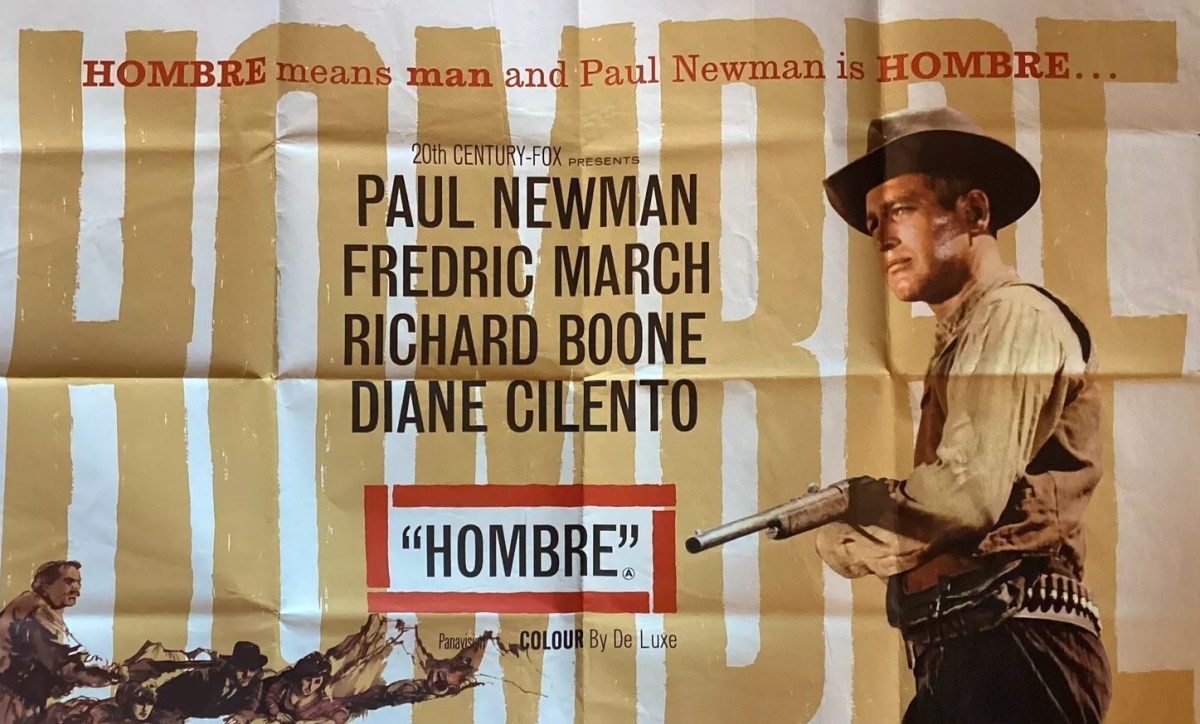
Hombre (1967) ****

Shock beginning, shock ending. In between, while a rift on Stagecoach (1939/1966) – disparate bunch of passengers threatened by renegades – takes a revisionist slant on the western, with a tougher look at the corruption and flaws of the American Government’s policy to Native Americans. Helps, of course, if you have an actor as sensitive as Paul Newman making all your points.

The theme of the adopted or indigenous child raised by Native Americans peaked early on with John Ford’s The Searchers (1956) but John Huston made a play for similar territory in The Unforgiven (1960) and, somewhat unexpectedly, Andrew V. McLaglen makes it an  important element of The Undefeated (1969).
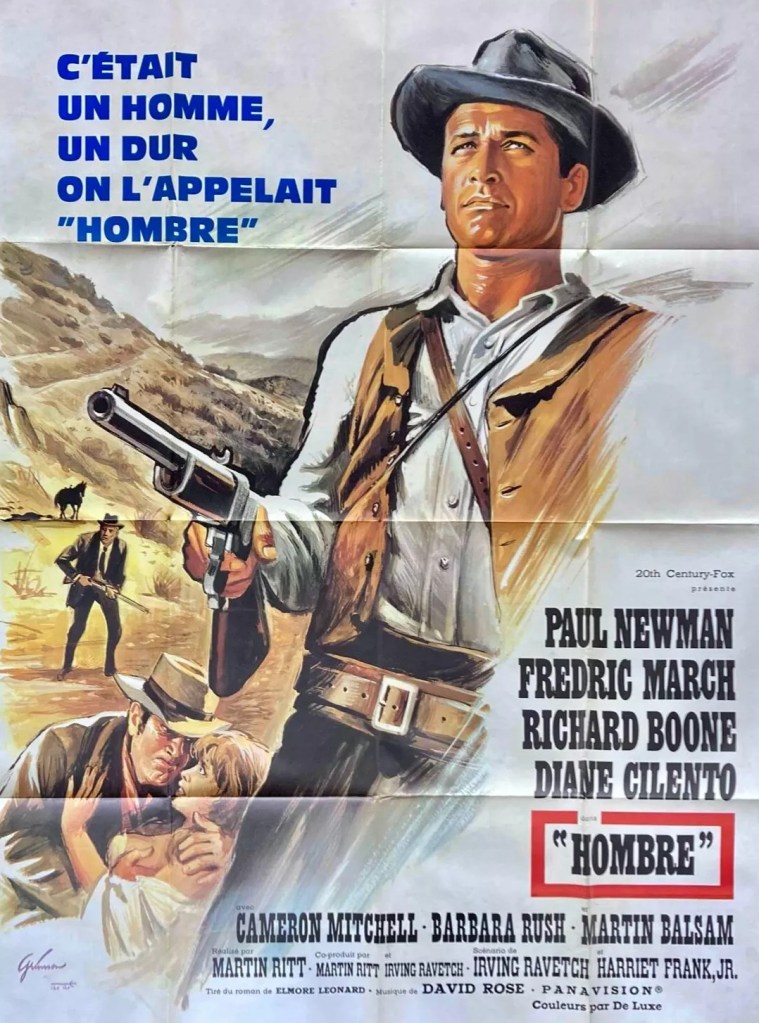
This begins with a close-up of a very tanned (think George Hamilton) Paul Newman complete with long hair and bedecked in Native American costume. Apache-raised John Russell (Paul Newman) returns to his roots to claim an inheritance – a boarding house –  after the death of his white father. That Russell is a pretty smart dude is shown in the opening sequence where he traps a herd of wild horses after tempting them to drink at a pool. He decides to sell the boarding house to buy more wild horses.

That puts him on a stagecoach with six other passengers – Jessie (Diane Cilento), the now out-of-work manager of the boarding house, retired Indian Agent Professor Favor (Fredric March) and haughty wife Audra (Barbara Rush), unhappily married youngsters Billy Lee (Peter Lazer) and Doris (Margaret Blye), and loud-mouthed cowboy Cicero (Richard Boone). Driving the coach is Mexican Henry (Martin Balsam).

Getting wind that outlaws might be on their trail, Henry takes a different route. But the cowboys still catch up and turns out Cicero is their leader. He takes Audra hostage, though she appears quite willing having tired of her much older husband, steals the thousands of dollars that the corrupt Favor has stolen from the Native Americans, and, also taking much of the available water, leaves the stranded passengers to die in the wilderness.
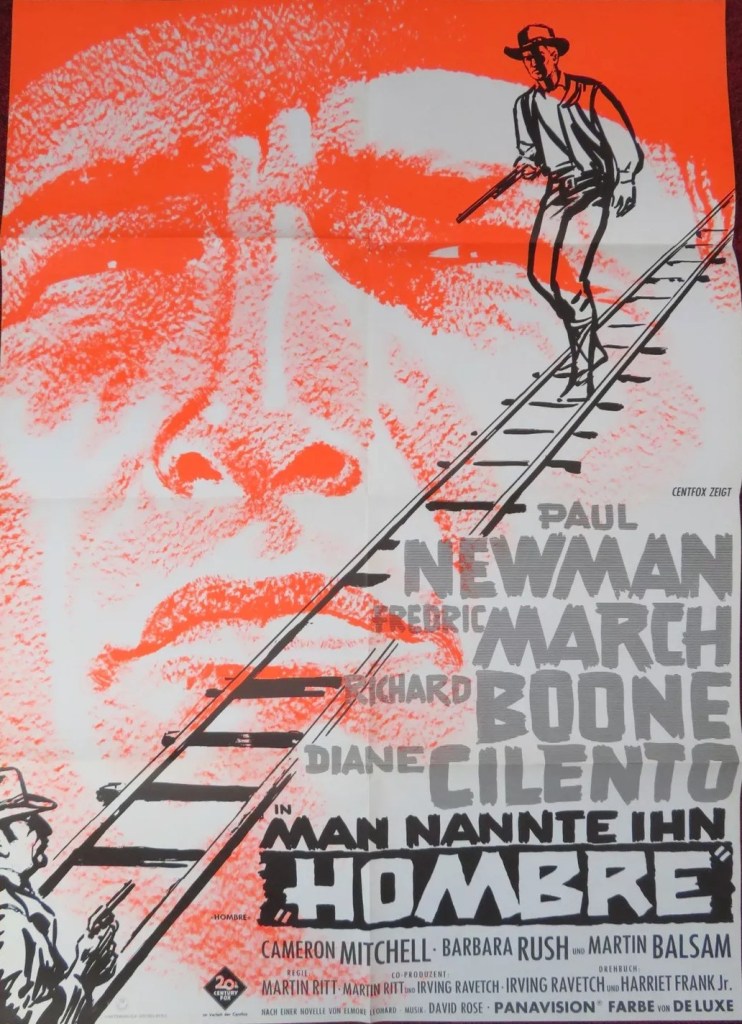
The passengers might have lucked out given Russell is acquainted with the terrain but they’ve upset the Apache by their overt racism, insisting he ride up with the driver rather than contaminate the coach interior. And the outlaws, having snatched the loot, and Cicero his female prize, should have galloped off into the distance and left it to lawmen to chase after them.

But Russell, faster on the uptake than anyone expects, manages to separate the gangsters from the money, forcing them to come after it. Russell wants the cash to alleviate the plight of starving Native Americans as was originally intended, but he has little interest in doing the “decent thing” and shepherding the others to safety. Ruthless to the point of callous, he nonetheless takes time out from surviving to educate the entitled passengers to the plight of his adopted people.

A fair chunk of the dialog is devoted to Russell explaining why he’s not going to do the decent thing and giving chapter and verse on the indignities inflicted on his people, and that alone would have given the picture narrative heft, especially as the corrupt Favor is more interesting in retrieving the money than his wife.

But in true western fashion, Russell is also a natural tactician and manages to pick off the outlaws when they come calling, impervious to the cries of Audra staked out in the blazing sun as bait. Eventually, against his better judgement, Russell gives in to the entreaties of Jessie and attempts to rescue the stricken women only to be cut down by the gunmen. I certainly didn’t expect that.

So, it’s both action and character-led drama. Paul Newman (The Prize, 1963) is superb (though not favored by an Oscar nod), especially his clipped diction, and oozing contempt with every glance, and the whiplash of his actions which is countered by shrewd judgement of circumstances. But Diane Cilento (Negatives, 1968) is also better than I’ve seen her, playing the foil to Newman, sassy enough to deal with him on a male-female level, but with sufficient depth to challenge his philosophy. Strike one, too, for Martin Balsam (Tora! Tora! Tora!, 1970) in a lower-keyed performance than was his norm. Richard Boone (Rio Conchos, 1964) and the oily Fredric March (Inherit the Wind, 1960) are too obvious as the bad guys. Representing the more calculating side of the female are Barbara Rush (The Bramble Bush, 1960) and movie debutant Margaret Blye.

The solid acting is matched by the direction of Martin Ritt (The Spy Who Came in from the Cold, 1965). Prone to preferring to make picture that make a point, he has his hands full here. But the intelligent screenplay by Irving Ravetch and Harriet Frank Jr. (Hud, 1963), adapting the Elmore Leonard novel, make the task easier, offsetting the potentially heavy tone with some salty dialog about sex and married life.

Thought-provoking without skimping on the action.    

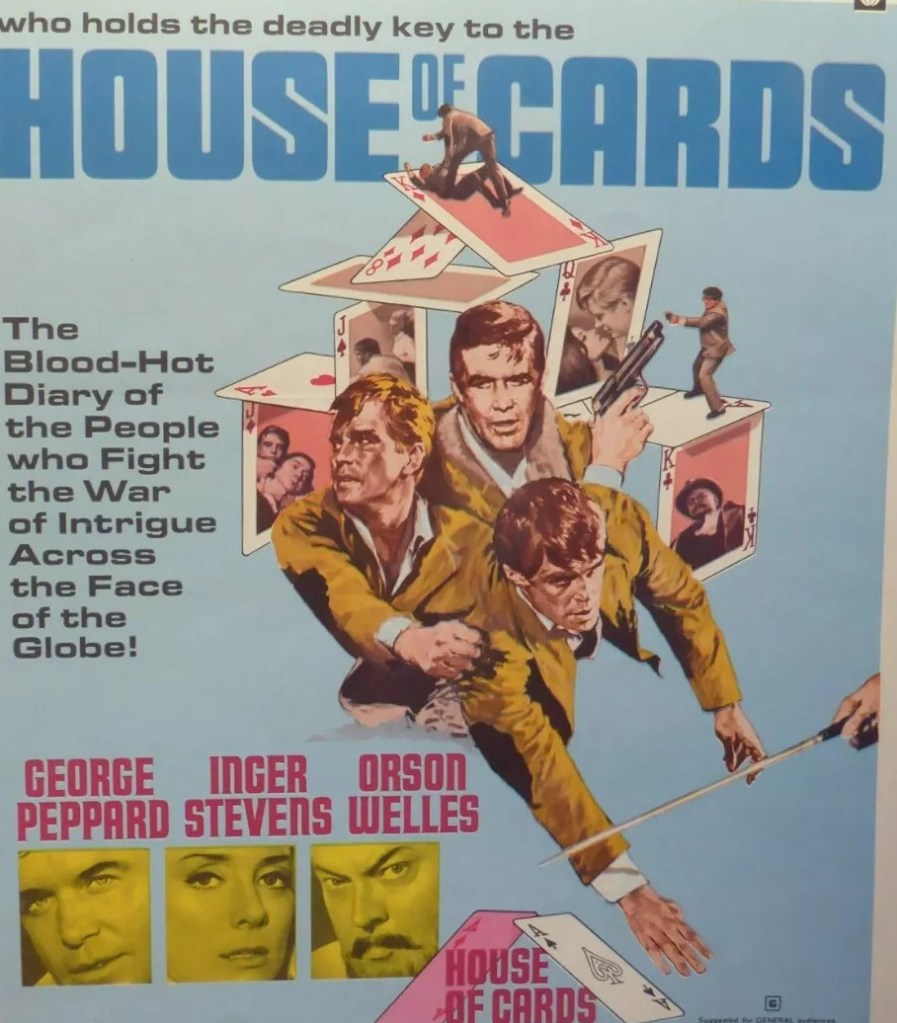
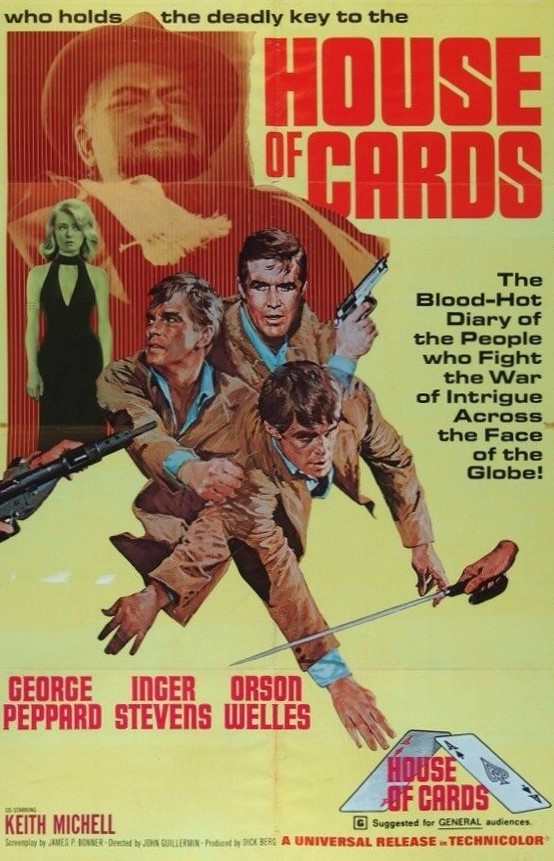
House of Cards (1968) ***

American boxer Reno Davis (George Peppard) stumbles on an international conspiracy when hired by rich widow Anne de Villemont (Inger Stevens) in Paris to look after her eight-year-old son Paul (Barnaby Shaw). All roads eventually lead to Rome and a showdown with arch-conspirator Leschenahut (Orson Welles) in this thriller which throws in a couple of measures of Gaslight (1944) and, more obviously, North by Northwest (1959), to the extent of Anne being an icy blonde of the Eva Marie Saint persuasion and the couple, on the run, sharing a compartment on a train.

The boy’s previous tutor has been murdered. After months in a sanatorium, Anne, paranoid about her son being kidnapped, is in virtual house arrest in the family mansion, watched over by arrogant psychiatrist Dr Morillon (Keith Michell) who has diagnosed her as unstable, neurotic and a danger to the boy.

After an assassin on a bridge on the Seine takes potshots at Reno and Paul, Reno is framed for murder but escaping from the police returns to the mansion to find it empty, the furniture covered in dust sheets. I half-expected Reno to be told that the job was all in his imagination and that Anne did not exist, but instead finds out that mother and son have been taken to a castle in Dijon, in reality a fortress with a platoon of armed guards. Only Paul has been already been transported to Italy. So it’s attempted rescue, imprisonment, escape, fistfights, chase, clever moves and countermoves, twists and double twists as Reno and the still icy Anne head for Rome.

In among the mayhem are a few humorous moments, a play on the Trevi fountain scene from La Dolce Vita, a monk mistaken for a killer, a bored girl only too happy to be taken hostage, an over-familiar American who gives away valuable secrets because he mistakenly believes Reno is a co-conspirator, Dr Morillon making the error of treating Reno as a servant. And characters involved in assisting escape extract a high price, one seeking financial reward, another that her husband be killed in the process. There is also a flirtatious but spiky maid Jeanne-Marie (Perette Pradier) and a couple of excellent reversals.

Reno is somewhat innovative in the weaponry department, the hook of a fishing rod, for example, while the son is rather handy with a pistol. But given the opposition are armed with machine guns, knives and swords that seems only fair.

George Peppard seems to have found his niche in this one, dropping the innate arrogance of The Blue Max (1965) and Operation Crossbow (1965), no chip on the shoulder, a good bit more attractive as a screen presence, a nice line with the ladies, more than able to take care of himself, a sprinkling of wit, completely at ease. Inger Stevens comes off well though her psychological problems and concerns for her son get in the way of any burgeoning romance with Peppard. But she has quite a range of emotions to get through, from wondering if she is mad, to dealing with the controlling family, and letting go of her son enough to allow the boy to bond with Reno, and despite her vast wealth down-to-earth enough to see a toothbrush as an essential when on the run.

Orson Welles (Is Paris Burning?, 1966), as ever, looms large over everything, with dialog so good you always have the impression he improvised on the spot. Keith Michell, a couple of years away from international fame in BBC mini-series The Six Wives of Henry VIII (1970), does a very good turn as the psychiatrist.

John Guillermin, who directed Peppard in The Blue Max, has a lot to do to keep the various balls in the air, especially keeping track of a multiplicity of characters. The screenwriting team of Harriet Frank Jr. and Irving Ravetch (Hud, 1963) pulled this one together from the novel by Stanley Ellin. Francis Lai’s memorable score is worth a mention, with distinctive themes for various parts of the story.

Eva Renzi (Funeral in Berlin, 1966) was originally down for the part of Anne and Italian actress Rosemary Dexter (Romeo and Juliet, 1964) has a small part.

Doesn’t quite come off .

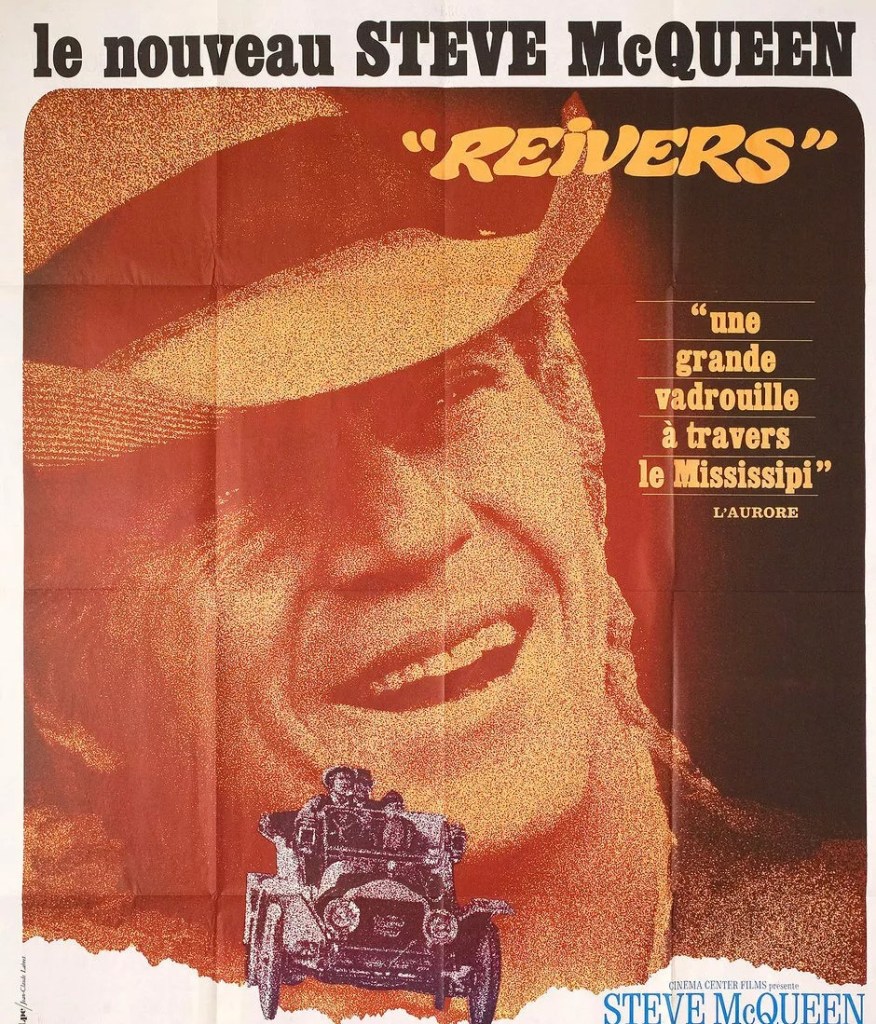
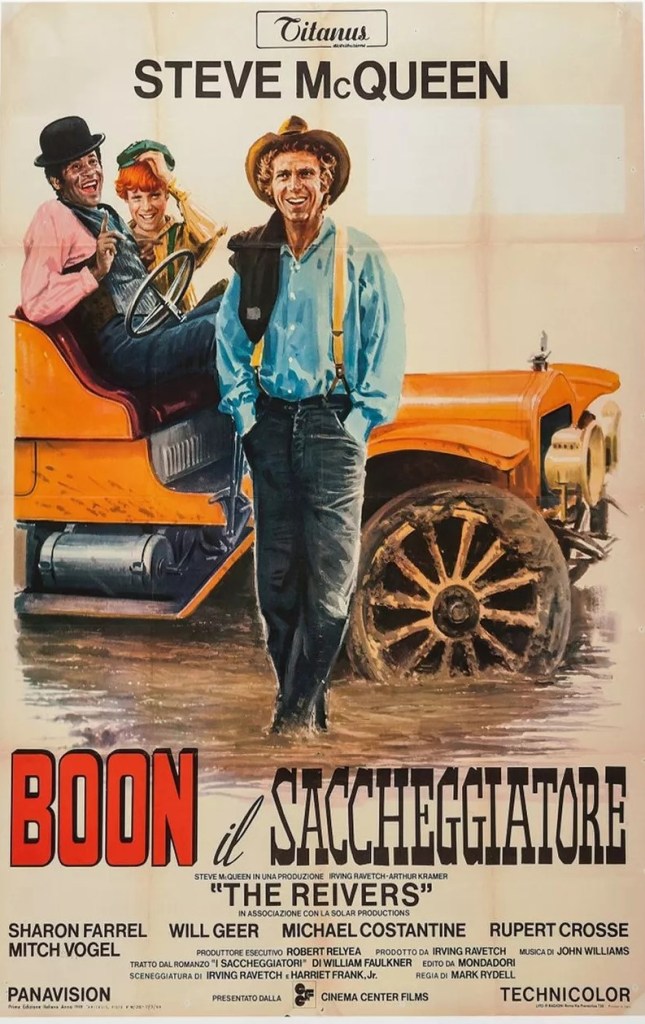
The Reivers (1969) **

Vanity project. Two words to strike fear into the heart of a studio executive. Generally means a star has got the worthy itch. Determined to attach himself to a movie of Shakespearian proportions. Something with literary heft. Wants to break clean away from the persona that made him a star.

Experienced studio honcho, scenting red ink a mile off, rejects the proposal, or agrees to it on the condition said star first makes two, maybe even three, of the studio’s more straightforward movies. (Warner Bros had Steve McQueen on a six-picture contract). On the other hand, out there, in the Hollywood hinterland, there’s always some less well-known producer willing to pony up an enormous fee as the price of making his name. Or, in this case, a nascent mini-major, the kind that thinks it will become an ”instant major” should it sign a contract with the biggest name on the planet after the rip-roaring box office of Bullitt (1968). Step forward Cinema Center, the movie arm of CBS television, desperate to make a Hollywood splash.

Am sure the pitch wasn’t: “comedy about a thief and a sex worker.” More likely the plus point was William Faulkner, America’s most famous living writer (along with John Steinbeck), winner of the biggest award in literature, the Nobel Prize, whose short story provided the source material. Faulkner also, as it happened, had a decent movie pedigree having adapted Bogart-Bacall vehicles To Have and Have Not (1944) and The Big Sleep (1946) while an adaptation of his short stories into The Long, Hot Summer (1958) hit the box office jackpot.

Admittedly, The Sound and the Fury (1959) and Sanctuary (1961) had been less successful, but Fox had also turned The Long, Hot Summer into a television series that ran for two seasons, so the author’s name would be fresh in the audience mind.  

It’s always a worry when an actor changes his hair style. Means he’s going method or “acting.” Here, Boon (Steve McQueen) sports a bushy blond barnet. And spends most of the time in “aw shucks” mode, whirl-winding his arms, contorting his features, doing most of the things a decent director would have told any other actor to cut it out. It would take a lot more acting talent than Steve McQueen, pushing 40, can tap into to successfully convince as a guy in his 20s

At least, he’s acting enough to allow himself to be covered head-to-toe in mud, something a major star would generally avoid. The comedy is as broad as you can get and director Mark Rydell (The Fox, 1967) shows little aptitude for it, not least in knowing when to stop milking a scene.

Biggest problem is that Boon, in narrative terms, is not the star, merely the conduit. The story actually concerns 11-year-old Lucius (Mitch Vogel) growing up, as he’s lured into a scheme hatched by Boon to borrow his employer’s spanking new automobile (this is 1909, by the way) and head off for the local whorehouse. Along the way, the child becomes a jockey riding a race Boon must win.

Sex worker Corrie (Sharon Farrell) has the other major story strand and the biggest element here is the relationship between herself and the boy. When he brings out her mothering instincts, she is ashamed of her profession and she plans to quit. The boy sees a naked woman for the first time – a painting, not in person – loses his worship of Boon and doesn’t “quit” as if he’s in a hard-tack B picture.

Pretty much glossed over is the rape. You can’t have rape in a comedy, can you? But for various reasons Boon and his black buddy Ned (Rupert Crosse) and the ladies from the whorehouse have ended up in jail. Price of freedom is Corrie having sex with corrupt cop Butch (Clifton James). Corrie has the best scene, the look of humiliation on her face, when released from the cell to be raped by the cop. And this was a film sold as “a lark.”

And, of all things, Boon is purportedly in love with Corrie, but not so much that he doesn’t plan on having sex with one of the other girls, given he visits the whorehouse three times a week and Corrie, in a bit of a tizz, has turned him down.

Small wonder this has never been the subject of an anniversary revival. Hard to see how the attitudes reflected here would connect with the contemporary audience. Scarcely believable that McQueen could get himself involved, even for the privilege of being linked, at some remove, with William Faulkner.

Chances are what originated from the Faulkner pen as a more somber coming-of-age tale was altered by screenwriters Irving Ravetch (doubling up as producer) and Harriet Frank Jr (The Dark at the Top of the Stairs, 1960) to fit in with McQueen’s ambitions. The star had not wanted to make Bullitt, having an aversion to cops, and this looks like his attempt to make up for it.

Actually, it did well at the box office, Rupert Crosse and composer John Williams nominated for Oscars and McQueen and Mitch Vogel for Golden Globes.

A different McQueen, to be sure, but the subject matter is objectionable and the comedy is forced.  

The Dark at the Top of the Stairs (1960) ****

Surprisingly frank, for the times, exploration of a failing marriage that tackles sexuality, racism, bullying, teenage angst. In those days there was no such concept as midlife crisis, so the general attitude of grin-and-bear-it results in a melancholy that suffuses the picture. Adapted from the Broadway hit by William Inge (Splendor in the Grass, 1961), provides more insight into American family life than the more souped-up soap operas of the Peyton Place variety. Except for crisis escalating action, could well have been misery memoir.

Opens with a surprisingly tender scene that’s again pretty raw for the period. In the morning, salesman husband Rubin (Robert Preston) strokes the arms and face of waking wife Cora (Dorothy McGuire), clearly hoping to initiate sex, when she abruptly rebuffs him. Before he sets off on a week-long business trip he tries to toughen up bullied friendless overly-mothered son Sonny (Robert Eyer), afraid of the dark, and bolster the flagging confidence of inhibited teenage daughter Reenie (Shirley Knight), only succeeding in inadvertedly punching his son in the face and triggering a row with his wife.   

But, without warning, he’s fired from his job and not equipped to compete in the employment arena with a flood of younger people with college degrees and greater stamina. Pride prevents him owning up to Cora, rejection sends him to the bottle and a lady friend, hairdresser Mavis Pruitt (Angela Lansbury) who scandalizes the town by (and this dates it) always leaving the top button of her blouse open. Cora plans escape, hoping to go and live, temporarily until she can find a job, with bossy sister Lottie (Eve Arden) in Oklahoma City.

Meanwhile, following an accidental meeting, the hesitant shy Reenie strikes up a rapport with the more outgoing confident Sammy (Lee Kinsolving). Lottie isn’t so keen to help out her beleaguered sister. When Rubin finally returns after a four-day absence it’s to a welter of home truths.

He still can’t bear to admit the loss of his job. The uneasy truce is shattered when Sammy is chucked out of a party he attends as Reenie’s escort at the country club for being a Jew. Subsequently, he attempts suicide and dies, leaving Reenie in shock. Cora determines to find out for herself the rumors concerning Rubin’s affair. But it turns out, although Mavis is deeply in love with Rubin, they’ve never slept together, providing Cora with a second chance to make her marriage work.

What distinguishes the movie is the revelatory dialog you’d expect from an award-winning playwright like Inge. Characters reveal their inner selves, not always with prompting, and not always in argument, and such lines often bring characters to life. Included in that are some of the subsidiary characters.

For example, Ralston (Ken Lynch) whom Rubin openly dislikes because he successfully got away with an insurance scam that turned him into a millionaire, hides away in the back room of a pharmacy, drinking away his guilt. “I know what I am. Who I am,” says Ralston, “the town scandal.” And you think this is maybe just a passing character, but this is the guy, guilt or no guilt, who enforces the country club ban on admitting Jews.

The controlling Lottie suspects her husband’s need for a long walk in the evening is to get away from the sound of her voice. Unusually, the sisters broach the subject of intimacy. Lottie confesses, “I never enjoyed it the way most women say they do.”

What’s keeping Cora and Rubin apart is their lack of intimacy, caused by their battles over money, the husband refusing to get into debt to satisfy his wife’s yearnings not necessarily for the finer things of life, but to avoid the endless scrimping and saving, getting maximum wear from a dress for the growing Reenie by turning it into a skirt.

Rudin laments, “Was a time you liked what I had…If you can’t remember sowing all those wild oats with me, I just plain give up.” Finally, they get to the crux of the matter (again bold language for the times). Rubin asks, plaintively, “How come you don’t enjoy sleeping with me any more?” Retorts Cora, “I can’t fight with you all day and then go to bed with you at night.”

If there is a flaw it’s some attitudes that will jibe with contemporary audiences. “If I had a real wife,” argues Rubin, “I wouldn’t have to go high-tailing it to Mavis Pruit.” And I winced at this particular line: “I wished someone loved me enough to hit me,” says a wistful Lottie hearing that, for the first time in his life, Rubin slapped his wife. Lottie clearly equates manliness and ardor with such violence.

But on the whole, the dialog is a cut above. I’m not sure how much came directly from the play itself and how much was added by screenwriters Harriet Frank Jr and Irving Ravetch (Hud, 1963). The opening certainly, such a situation might be mentioned in the play but a bedroom scene like that would never be staged.

More at home in the theater than on screen Robert Preston (he only appeared in five pictures the whole decade including The Music Man, 1962) exudes such energy as the salesman that you can see how denial of sex would destroy his self-confidence. Dorothy McGuire (Swiss Family Robinson, 1960) is excellent as the wife trying her best not to end up as a put-upon stereotype. Shirley Knight (Petulia, 1968) was Oscar-nominated, Angela Lansbury (The Manchurian Candidate, 1962) came across as too wise to be a loose woman, and Eve Arden (in her only movie of the decade) impresses as the bossy sister.

With such terrific material and an excellent cast, Oscar-winning director Delbert Mann (Buddwing/Mr Buddwing, 1966) doesn’t need to do much to guide this one home.

Well worth a look.

House of Cards (1968) ***

American boxer Reno Davis (George Peppard) stumbles on an international conspiracy when hired by rich widow Anne de Villemont (Inger Stevens) in Paris to look after her eight-year-old son Paul (Barnaby Shaw). All roads eventually lead to Rome and a showdown with arch-conspirator Leschenahut (Orson Welles) in this thriller which throws in a couple of measures of Gaslight (1944) and, more obviously, North by Northwest (1959) to the extent of Anne being an icy blonde of the Eva Marie Saint persuasion and the couple, on the run, sharing a compartment on a train.

The boy’s previous tutor has been murdered. After months in a sanatorium, Anne, paranoid about her son being kidnapped, is in virtual house arrest in the family mansion, watched over by arrogant psychiatrist Dr Morillon (Keith Michell) who has diagnosed her as unstable, neurotic and a danger to the boy.

After an assassin on a bridge on the River Seine takes potshots at Reno and Paul, Reno is framed for murder but escaping from the police returns to the mansion to find it empty, the furniture covered in dust sheets. I half-expected Reno to be told that the job was all in his imagination and that Anne did not exist, but instead finds out that mother and son have been taken to a castle in Dijon, in reality a fortress with a platoon of armed guards. Only Paul has been already been transported to Italy. So it’s attempted rescue, imprisonment, escape, fistfights, chase, clever moves and countermoves, twists and double twists as Reno and the still icy Anne head for Rome.

In among the mayhem are a few humorous moments, a play on the Trevi fountain scene from La Dolce Vita, a monk mistaken for a killer, a bored girl only too happy to be taken hostage, an over-familiar American who gives away valuable secrets because he mistakes Reno for a co-conspirator, Dr Morillon making the error of treating Reno as a servant. And characters involved in assisting escape extract a high price, one seeking financial reward, another that her husband be killed in the process. There is also a flirtatious but spiky maid Jeanne-Marie (Perette Pradier) and a couple of excellent reversals.

Reno is somewhat innovative in the weaponry department, the hook of a fishing rod, for example, while the son is rather handy with a pistol. But given the opposition are armed with machine guns, knives and swords that seems only fair.

George Peppard continues the excellent run of acting form that started in Tobruk (1967) and P.J. / New Face in Hell (1968), developing his own niche, dropping the innate arrogance of The Blue Max (1965) and Operation Crossbow (1965), no chip on the shoulder. Here he is a good bit more attractive as a screen presence, a nice line with the ladies, more than able to take care of himself, a sprinkling of wit, completely at ease. Inger Stevens comes off well though her psychological problems and concerns for her son get in the way of any burgeoning romance with Peppard. But she has quite a range of emotions to get through, from wondering if she is mad, to dealing with the controlling family, and letting go of her son enough to allow the boy to bond with Reno, and despite her vast wealth down-to-earth enough to see a toothbrush as an essential when on the run.

Orson Welles (Is Paris Burning?, 1966), as ever, looms large over everything, with dialogue so good you always have the impression he improvised on the spot. Keith Michell, a couple of years away from international fame in BBC mini-series The Six Wives of Henry VIII (1970), does a very good turn as the psychiatrist.

John Guillermin, who directed Peppard in The Blue Max and P.J., has a lot to do to keep the various balls in the air, especially keeping track of a multiplicity of characters. The screenwriting team of Harriet Frank Jr. and Irving Ravetch (Hud, 1963) pulled this one together from the novel by Stanley Ellin. Francis Lai’s memorable score is worth a mention, with distinctive themes for various parts of the story.

Eva Renzi (Funeral in Berlin, 1966) was originally down for the part of Anne and Italian actress Rosemary Dexter (Romeo and Juliet, 1964) has a small part.

Catch-up: The Blog previously reviewed George Peppard in Breakfast at Tiffanys (1961),The Blue Max (1965), Operation Crossbow (1966), Tobruk (1967), P.J (1968) and Pendulum (1969); John Guillermin directed The Blue Max (1965) and P.J; Orson Welles was seen in Is Paris Burning? (1966) and The Southern Star (1969).

Discover WordPress

A daily selection of the best content published on WordPress, collected for you by humans who love to read.

The Atavist Magazine

by Brian Hannan

WordPress.com News

The latest news on WordPress.com and the WordPress community.