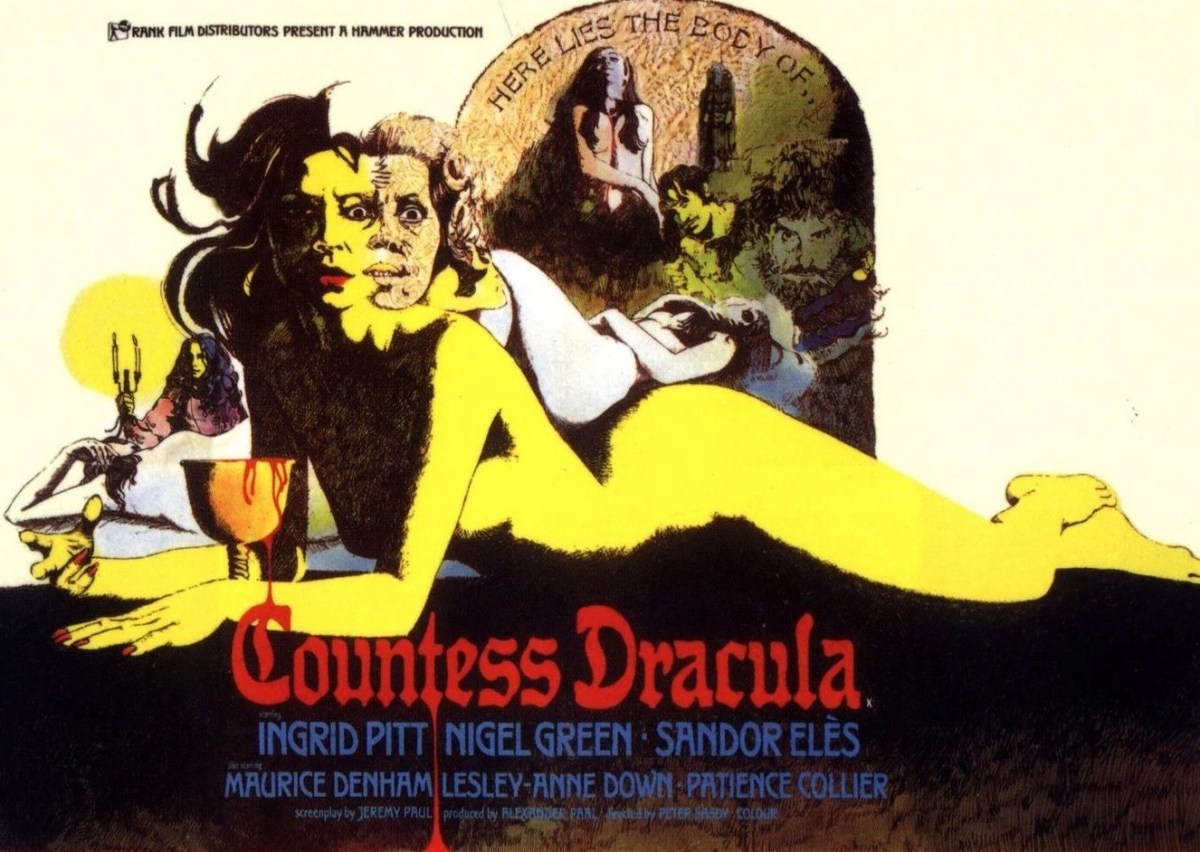
Countess Dracula (1971) ****

You wouldn’t go looking to British studio Hammer for a subtle treatise on the perils of ageing. Nor might  you expect a predator to be so cruelly, and consistently, punished. Nor, for that matter, for a mirror to provide revelation given that in the traditional vampire movie one of the signs you have a bloodsucker in your midst is that a mirror does not show their reflection.

The title is something of a misnomer: while there’s bloodletting aplenty there’s zero actual bloodsucking. Hammer had taken a sideways shift into female empowerment and more obvious sexuality and gender twist with the introduction of the female vampire – beginning with The Vampire Lovers (1970), sequel Lust for a Vampire (1971) and, completing the trilogy, Twins of Evil (1972). For that matter it also pre-empted, in perverse fashion, the body swap genre of Freaky Friday (1976 etc.).
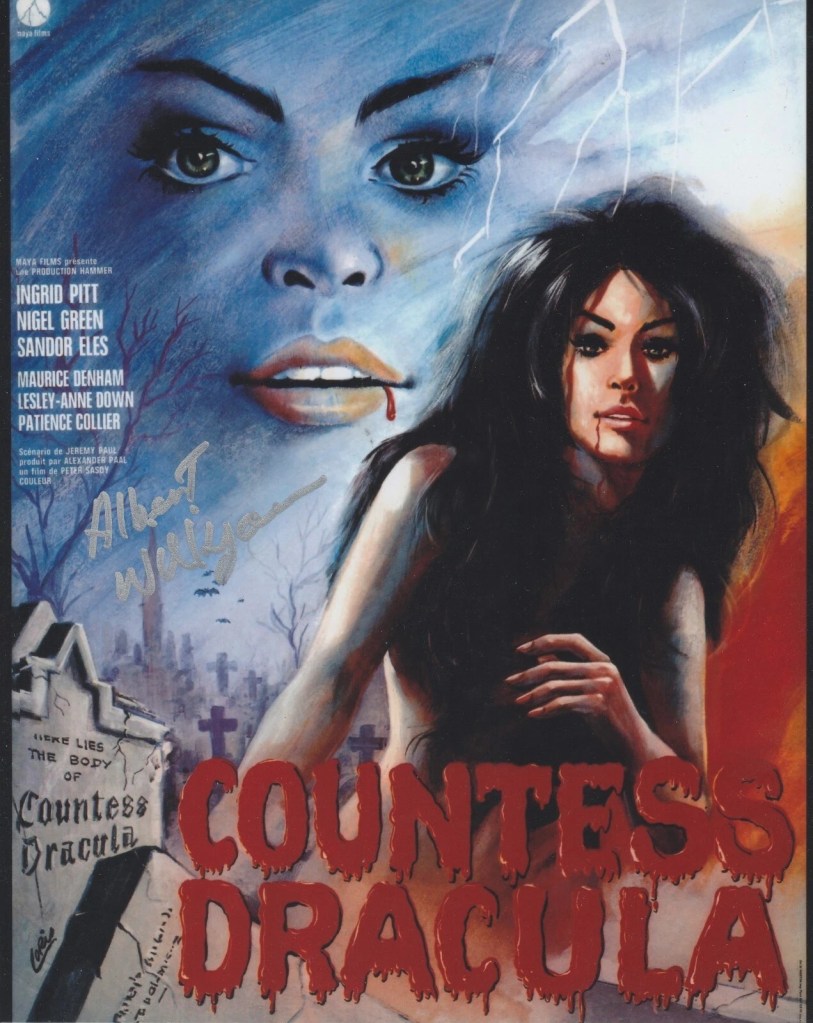
These days this would be termed the expansion of a “horrorverse” or a “Hammerverse” as the studio developed its IP since it had not abandoned the traditional Christopher Lee version, doubling down in 1970 with Taste the Blood of Dracula and The Scars of Dracula and following up with Dracula A.D. 1972 (1972).

While Countess Dracula doesn’t fall into the vampiric category, neither does it so obviously exploit the sexuality and rampant nudity of the female vampire trinity. But there are other shocks in store. Be prepared for emotional punch, not something normally associated with Hammer.

The ageing beauty had been a 1960s trope as Hollywood had come to terms with finding starring roles for 1940s/1950s stars past their box office best but names – Lana Turner and Vivien Leigh among others- with still some marquee lure. And this follows a similar trajectory, older woman falling in love with younger man.
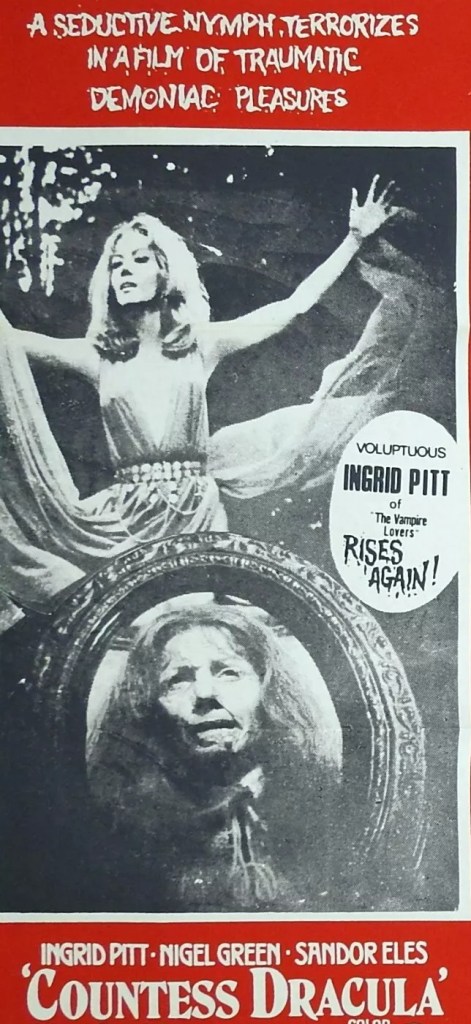
Set in Hungary in the seventeenth century, widowed Countess Elisabeth Bathory (Ingrid Pitt) discovers by accident that a touch of virgin blood rejuvenates her skin and tempts her into stealing the suitor Toth (Sandor Eles) of her 19-year-old daughter Ilona (Lesley-Anne Down).  But that means kidnapping Ilona and keeping her imprisoned so Bathory can impersonate her, finding a ready supply of virgins to murder and exsanguinate, enlisting in her scheme lover Capt Dobi (Nigel Green) and maid Julie (Patience Collier).

The ruse appears to work well – at first. Believing Bathory is actually her daughter, Toth is easily seduced. But there’s a downside which is quickly apparent. What spell blood casts, it doesn’t last long. And there’s a sting in the tail. Having acted as a rejuvenating agent, when the virgin blood has run its course transformation goes the other way and turns her into an old crone.

So now, Bathory and her team enter serial killer territory, the disappearances and deaths arousing suspicion among the locals and historian Fabio (Maurice Denham), and her daughter threatening at any minute to escape her captor and turn up at the castle. And Bathory cannot give up the fantasy, not least because when the blood runs out, she’ll be unrecognizable as an old crone.

You can see where this is headed, so that’s not much of a surprise. What is astonishing is how well director Peter Sasdy (Taste the Blood of Dracula) handles the emotion. You might think the special effects do all the work that’s required, but that’s not the case. It’s Bathory’s eyes not her crumpled skin that make these scenes so powerful and in between, apart from the initial transformation, Bathory shifts uneasily between exultation that she is living the fantasy and terror that it will come to a sudden end.

Ingrid Pitt (The Vampire Lovers, 1970) has the role of her career, superbly playing a woman bewitched by her fantasy and the prospect of literally turning back the years. None of the ageing actresses that I previously mentioned manage to so well to portray that specific female agony of a beauty losing her looks. Sandor Eles (The Kremlin Letter, 1970) looks the part and Nigel Green (Fraulein Doktor, 1968), while shiftier than usual, also has to scale more emotional heights than normal, in not just having to countenance his lover going off with another man but helping her to do so. Lesley-Anne Down (The First Great Train Robbery, 1978) makes a splash.

More than ably directed by Sasdy, from a screenplay by Jeremy Paul in his debut based on the book by Valentine Penrose.

I’m not sure how well this went down with vampire aficionados and suspect there was audience disappointment, but there is more than enough depth to make up.
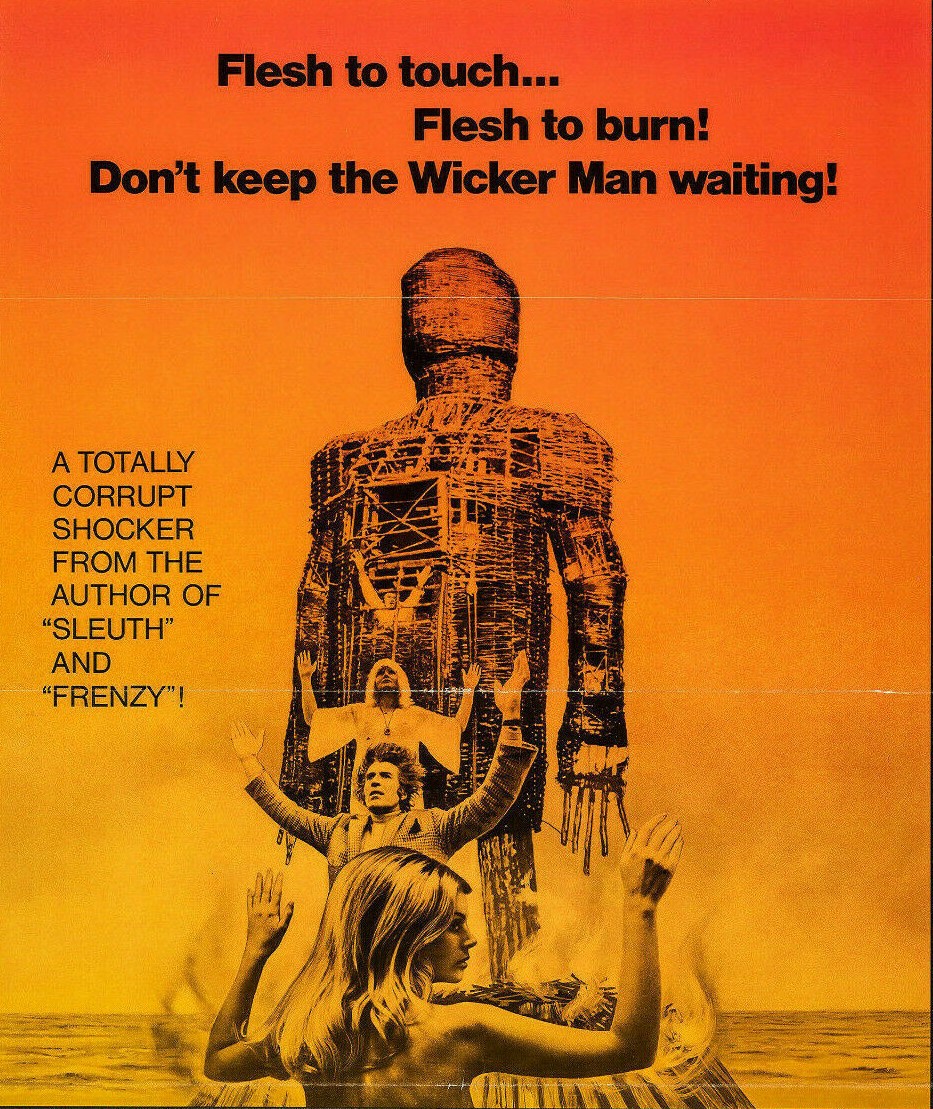

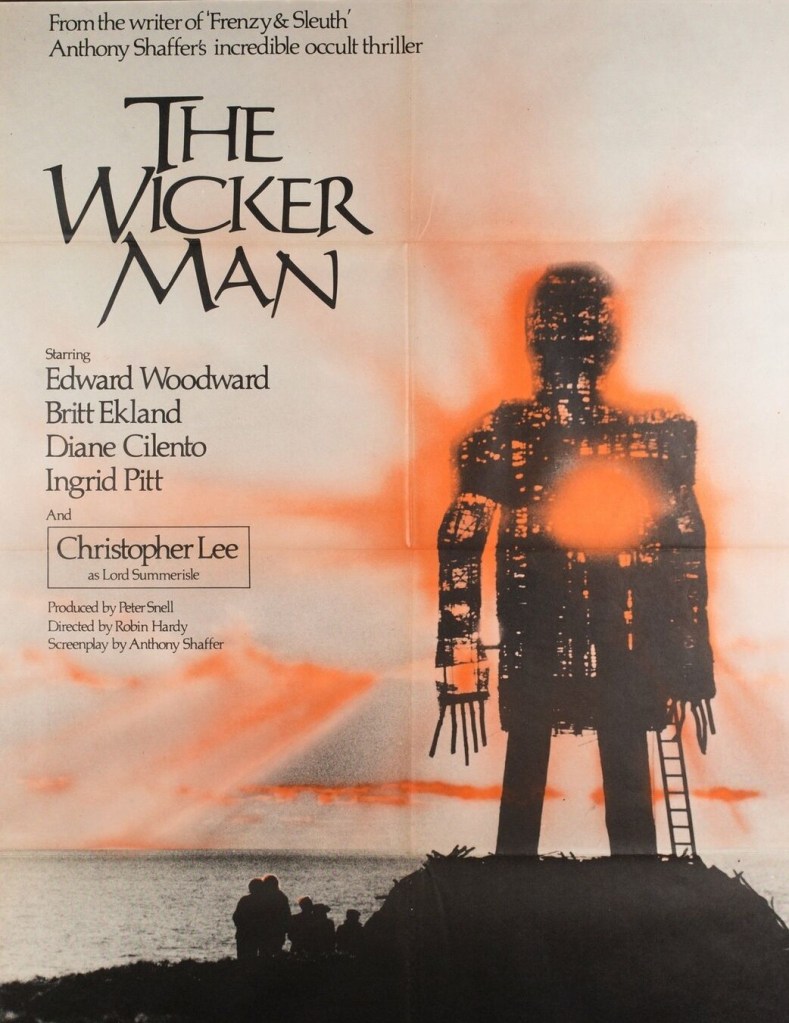
The Wicker Man (1973) **** – Seen at the Cinema

I first saw The Wicker Man in 1973, dismissed by critics on release, on the lower half of a double bill with Nicolas Roeg’s ecstatically-reviewed Don’t Look Now (1973), the films connected less by the horror elements than that they both made by British Lion. t’s now rubbing shoulders with the most superior kind of cult picture, the ones that the public will actually fork out hard-earned cash to see on the big screen, as was my experience this week. Some clever marketing person had the bright idea, given the picture concerns May Day activities of a dark nature, of running a special revival on May Day. What surprised me more was that the cinema was full (on a Monday night, no less), the audience was 20- and 30-year-olds and younger, and judging from overheard chatter afterwards they clearly enjoyed the experience.

What struck me most when watching this was the clarity of the pagan worship, compared to, for example, The Northman where I had no idea what they were worshipping beyond a rough notion. The procreation element was very well thought-out, the idea that such paganism should be taught in schools the way in the era when the film was made religion was on the curriculum. Most horror films do not take religion seriously, But here, even if it’s not your idea of true religion, the entire community invested in the symbolism of animals and trees and fertility rites such as jumping over a fire naked (otherwise your clothes would catch fire) in order to become pregnant. A naked woman weeps over a headstone in a graveyard. You can cure a cough by letting a toad sit in your mouth. And the entire soundtrack, often performed by folk singers in the pub, is filled with songs where the emphasis is on sex. But the detail is really quite extraordinary. Beyond The Wicker Man itself which I understand comes from the Druids, I’ve no idea if this is patchwork of other religions imbued with fictional elements, but it doesn’t matter because, no matter how fantastical it appears, it all rings true.

Policeman Sgt Howie (Edward Woodward) pilots a small seaplane to Summerisle to investigate the disappearance of a young girl, Rowan Morrison. At first the villagers deny knowing about the girl’s existence, and then provide conflicting reports, even going so far as to claim she is dead, or has transmogrified into the hare that lies in her supposed coffin. The villagers appear to either discreetly or openly mock him and certainly find much humor in his steadfast Christian beliefs. The schoolteacher Miss Rose (Diane Cilento) denies that the empty desk in her classroom belongs to Rowan. Island chieftain Lord Summerisle (Christopher Lee) debates Christianity. Landlord’s daughter Willow (Britt Ekland) and the librarian (Ingrid Pitt) are on seduction duty.

Frustrated, and threatening to return with more officers, Howie intends to leave but his airplane engine has broken down and soon he is convinced Rowan has been kept alive for ritual sacrifice on May Day as a way of providing rebirth for the island’s failing crops and fruit. In disguise as Punch, he joins the villagers in their parade only to discover that is the hunter who is hunted and that he has been tricked into coming onto the island.  The climax is horrifying, in part because the lack of CGI or a bigger budget, in part down to the delight of the observers, has meant that most of what occurs is left to the imagination.

What at one point appeared an idyllic spot populated by relatively harmless if somewhat wayward people with a highly-developed sense of community and none of the infighting that might common in such a remote location. In another reversal to audience expectation there was none of the bloodlust surrounding the burning of a witch or monster. The smile on the face of a killer indeed!

The audience is brilliantly enmeshed. The investigation appears to drive the narrative, the various obstacles in the way of  the policeman just par for the course in this kind of mystery. Just as we are beginning to become more enchanted by this community’s open attitude to sex especially when compared to Howie’s repressed Christianity, the story takes a sudden switch as the deeper level of meaning is revealed, that fertility actually means rebirth and that the ancient ways of achieving that are not for the faint-hearted.

Edward Woodward (File of the Golden Goose, 1969), making a debut as the star after hitting the television ratings heights as Callan (1967-1972), is excellent as the stern God-fearing policeman who gradually loses his power in a community where there is no tolerance for his kind of law. Christopher Lee (The Devil Rides Out, 1968) breaks out of his typecasting, especially with the wigs, with a very affable performance as a benevolent landlord. It’s hard to view him as an outright villain his actions are for perceived betterment.  Britt Ekland (The Night They Raided Minsky’s, 1968) is convincing as the free-as-a-bird aphrodisiac-on-legs damsel with vulnerability to the fore. Diane Cilento (Negatives, 1968) and Ingrid Pitt (Where Eagles Dare, 1968) have little to do but keep the plot ticking.

Robin Hardy, on his debut, does a remarkable job of setting the seductive atmosphere although the film’s box office failure meant he only made two further films. Anthony Shaffer (Sleuth, 1972) adapted the novel Ritual by David Pinner.

The movie celebrates its 50th anniversary next year so look out for more showings especially if it becomes inextricably linked to the May Day festival the way Casablanca had been adopted by St Valentine’s Day marketeers.

You can catch this on Amazon Prime.

Discover WordPress

A daily selection of the best content published on WordPress, collected for you by humans who love to read.

The Atavist Magazine

by Brian Hannan

WordPress.com News

The latest news on WordPress.com and the WordPress community.