The Long Duel (1967) ****

Surprisingly thoughtful action-packed “eastern western”  with obvious parallels to the plight of the Native American. Here, the British attempt to shift nomadic tribesmen from their traditional hunting grounds in north-west India to “resettlements.” Set in post World War One India, the duel in question between tribal chief Sultan (Yul Brynner) and police chief Young (Trevor Howard) brims over with mutual respect.

Unusually intelligent approach for what could otherwise have been a more straight forward action picture, more critical of the British, whose idea of civilization is to turn everything into “a bad replica of Surrey,” than you would have expected for the period. Ruthless pursuit in large part because the British “can’t afford local heroes.”   
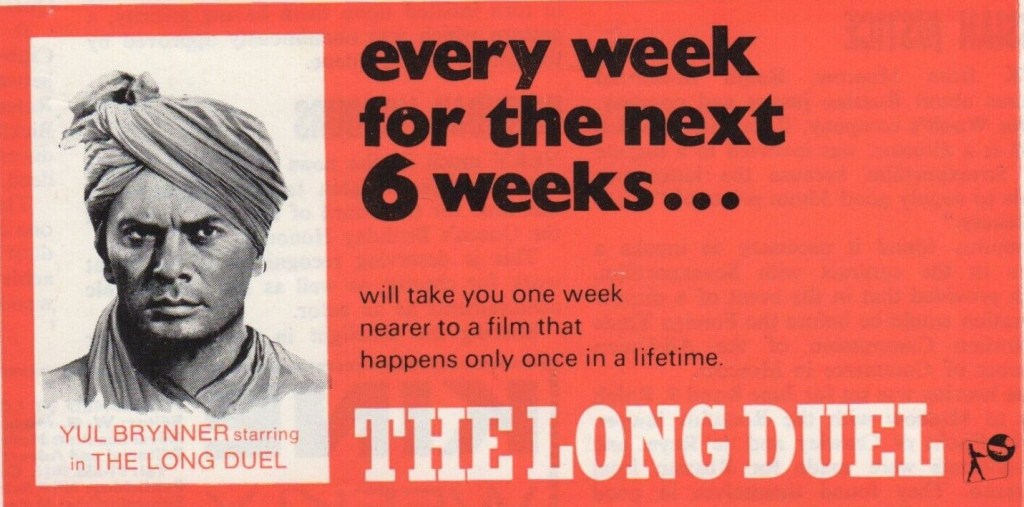
After his tribe is taken captive with a view to forced repatriation by boorish police superintendent Stafford (Harry Andrews), Sultan organises a breakout, taking with him heavily pregnant wife Tara (Imogen Hassall) who dies while on the run. The Governor (Maurice Denham) of the province brings in Young – who knows the territory and is more familiar, through a previous career as an anthropologist, with the nomadic lifestyle, and largely sympathetic to their cause – to head up an elite force and bring to justice Sultan, whose men are now murderers.

Young seems lacking in the stiff upper lip department, condemned for “misplaced chivatry,” unwilling to just do his job, and certainly not to blindly obey the more ruthless ignorant Stafford. Aware he is unable to stop what the British would like to call progress, hopes he can ease the transition, avoid driving the tribesmen into the ground and prevent a noble leader like Sultan ending up a despised bandit, the kind who were forever presented as the bad guys in films like North West Frontier / Flame over India (1959).

Young has the sense not to be dragged all over the country searching for his quarry, and sets up his team in more sensible fashion, but still, is largely outwitted by Sultan, especially as Stafford, who later gets in on the act, is too dumb to fall for obvious lures. Adding  complication is the arrival of Stafford’s equally intelligent daughter Jane (Charlotte Rampling), a Cambridge University graduate, who falls for Young.

Thankfully, there’s no need for the British hero to transition from brute into someone more appreciative of the way of life he is forced to destroy – a trope in the American western – and equally there’s no corrupt businessman selling the tribesman weaponry and there’s no savage attack either on innocent women and children, and removal of these narrative cliches allows the movie more freedom to debate the central questions of freedom. The tribesmen acquire rifles and the occasional Gatling gun simply by stealing them from the more inept British soldiers.

Anyone expecting a shoot-out or more likely a swordfght between Sultan and Young will be disappointed, the title, as with the entire picture, is more subtle than that, especially as each, in turn, have the opportunity to save each other’s lives. Eventually, Young’s sympathetic approach is deemed ineffective and Stafford is put in charge, leading to a superb climax.

While Sultan’s nomadic lifestyle is eased by dancing girl Champa (Virginia North), whose loyalty to her lover is soon put to the test, and who is not, surprisingly, necessarily looking for love, his emotions center more around his younger son, whom he doesn’t want to grow up wearting the tag of bandit’s son. The solution to that problem seems a tad simplistic, but still seems to work.

With the feeling of western with splendid use of superb mountainous locales, and excellent widescreen, an astute script opts as much for intelligence as adventure.

One of Yul Brynner’s (The Double Man, 1967) last great roles before he turned into a parody of himself and certainly more than matched by Trevor Howard (Von Ryan’s Express, 1967), given a role with considerable depth and scope. Charlotte Rampling (Three, 1969) also impresses while Virginia North (Deadlier than the Male, 1967) and Imogen Hassall (El Condor, 1970) provide support. Harry Andrews (The Night They Raided Minsky’s / The Night They Invented Striptease, 1968) has played this role before. You can catch Edward Fox (Day of the Jackal, 1973) in a tiny role.

Superbly directed by Ken Annakin (Battle of the Bulge, 1965) from a script by Peter Yeldham (Age of Consent, 1969), Ernest Borneman (Game of Danger, 1954) and Ranveer Singh in his debut.

Well worth a look.

El Condor (1970) ****

Highly under-rated western, directed with some style by a Britisher, bolsters Jim Brown’s marquee credentials and twists and turns every inch of the way. The basic story couldn’t be more cliché: outlaw Luke (Jim Brown), after escaping from a chain-gang, hooks up with gunslinger Jaroo (Lee Van Clef) and his gang of Apaches to steal the gold bullion hidden inside a Mexican fortress.

It just doesn’t work out that way. Any time a cliché rears its ugly head, director John Guillermin (The Blue Max, 1966) treats it as narrative obstacle and finds a neat way round it. Luke’s attitude doesn’t help either. Looking at a woman the wrong way, not showing Apaches sufficient respect, failing to rein in his larcenous partner, all lead to trouble. But at the right time and the right place, the pair show – almost show off – their respective skills, permitting escape when necessary and finding a way into the citadel.

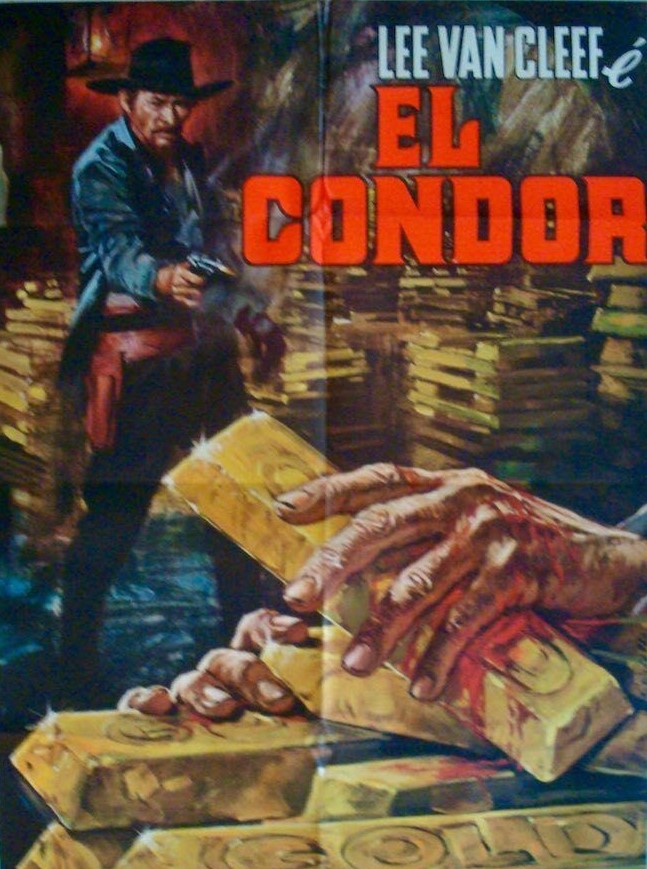
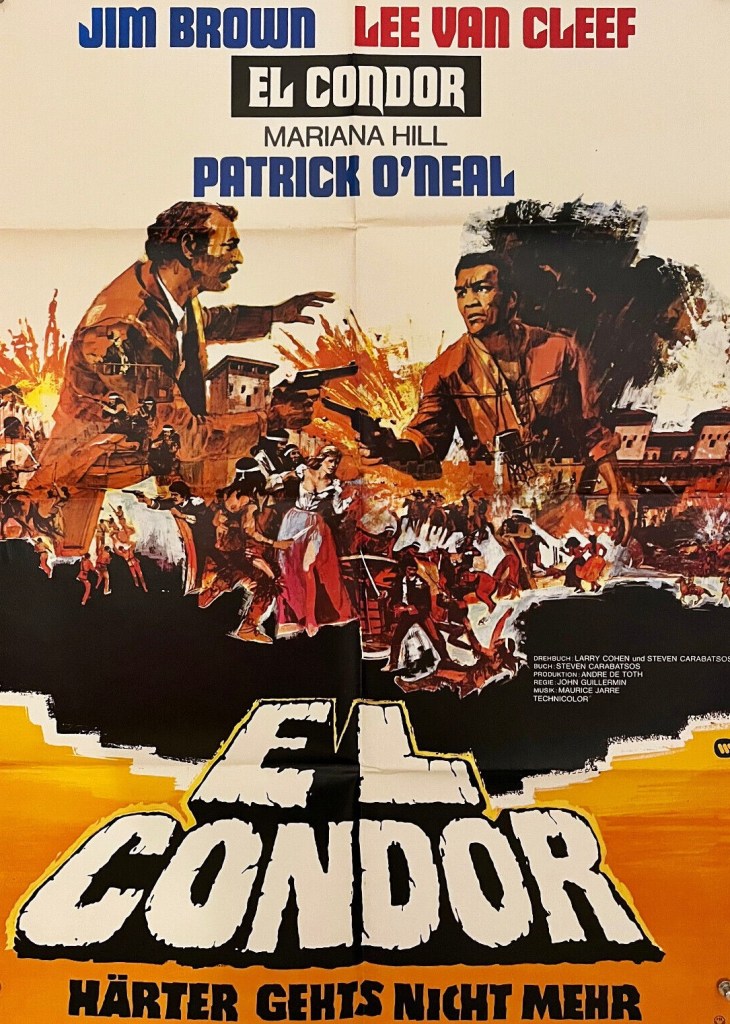
Lee Van Cleef takes top billing in the Italian poster which adopts a more thematic approach than the normal action-oriented marketing.

Did I mention there was a bullfight with fort commander Chavez (Patrick O’Neal), wielding a saber, dancing around the animal on horseback, or that at one point Luke becomes the bull substitute. Or that, in the picture’s most notorious scene, shades of Raquel Welch taking an impromptu shower in 100 Rifles (1969), the invaders are helped by Chavez’s disgruntled mistress Claudine (Marianna Hill) distracting the defending soldiers by disrobing.

And, though minus such distractions, this is probably where the white walkers in Game of Thrones learned to scale a mighty wall. Even so, it’d be a pretty big ask to infiltrate a fortress almost medieval in its construct with an outer and an inner wall, so Luke evens the odds by subjecting the inmates to involuntary thirst, having destroyed their water tower and poisoned all nearby wells.

Given the heist involves gold, it’s no surprise that the weaselly Jaroo is overcome by greed, taking any opportunity to help himself to more than his fair share, encouraged of course by the even wilier Chavez who has the measure of the potential thief. Luke might have been cautioned about entering into a partnership with such a character after witnessing a couple of Jaroo’s schemes backfire. In one of them, in just about the cleverest and most audacious cut you will ever see, we go from Jaroo in a store stuffing illicit goods under his coat to the pair emerging tarred and feathered from a pond.

And this ain’t The Dirty Dozen, nobody appears to understand a command structure, or even stick to orders, Apache chief Santana (Iron Eyes Cody), left to his own devices, liable to attack a wagon train despite that giving due warning of their presence in the vicinity. But then Luke doesn’t show due respect either, resulting in the pair being staked to the ground in the boiling sun, and finding it impossible to dislodge an Apache clinging to his back.

As you might expect, it’s a bloody affair, but without dwelling on gore, none of the visceral exploding body parts of The Wild Bunch (1969). And there is a surprisingly touching moment when, shades of Charles Bronson in The Magnificent Seven (1960), the hard-nosed Jaroo bonds with a young boy on the grounds that they are both illegitimate and parts with one of his two precious gold nuggets to give the child a start in life.

Harsh reality intrudes. Unspoken racism on the part of Chavez sets him against Luke. And that women are prizes of war provides an uneasy undercurrent. Claudine is Chavez’s lover because he offers safe haven, a security not afforded other Mexican woman, forcibly parted from husbands to provide soldiers with sexual playthings.

Jim Brown (100 Rifles) and Lee Van Cleef (The Good, the Bad and the Ugly, 1967) are an inspired teaming, both playing against type, incurring more laughs than you might expect, and less inclined to play their previous stock characters, the former just a tough guy, the latter a ruthless professional. Patrick O’Neal (Stiletto, 1969) is a formidable opponent, perfectly capable of outwitting the more easily-duped Jaroo.

Despite, perhaps unfairly being remembered more for her nudity than her acting, Marianna Hill (Medium Cool, 1969) exhibits vulnerability as well as a tough core. Iron Eyes Cody (Nevada Smith, 1966) has a very refreshing take on an Apache war chief.  And you might spot British starlet Imogen Hassall (The Long Duel, 1967) and veteran Elisha Cook Jr (Welcome to Hard Times, 1967).

But this movie really belongs to director John Guillermin who takes a fairly routine western and turns it on its head, extracting reversals at every opportunity, and clearly delighting in the several twists in the tail. Larry Cohen (Daddy’s Gone A-Hunting, 1969) and in his movie debut Steven Carabatsos (The Revengers, 1972) wrote the screenplay and the presence in the producer’s chair of Andre de Toth (Play Dirty, 1968) might account for some of the movie’s subversiveness.

There’s a historical footnote to El Condor. In a revision of the certificates issued by the censor, the British Broad of Film Classification in 1970 introduced the “AA” certificate, permitting people aged over 14 to view material that would previously have been restricted to the X-certificate. Admission to that category was raised to 18. So for a whole generation of teenage boys, hormones going wild, the first glimpse they had of a naked woman was in El Condor. (In the US it was an “R”.)

Not only well worth seeing but free to view on YouTube.

And when that source dries up you can find it on the Warner Archive.

https://amzn.to/46FBZn8

Discover WordPress

A daily selection of the best content published on WordPress, collected for you by humans who love to read.

The Atavist Magazine

by Brian Hannan

WordPress.com News

The latest news on WordPress.com and the WordPress community.