Sitting Target (1972) ****

Forms a neat trilogy with British Noir New Wave gangster pictures Get Carter (1971) and Villain (1971) both with topline stars attached in the form of Michael Caine and Richard Burton. Laden with atmosphere and intrigue, this carries hefty emotional power as a very tough guy struggles to show his gentler side. The moral of the story is that brains always trump brawn. And it’s one of these movies where the truth only unravels when you hit the twist at the end and every character is shown in quite a different light.

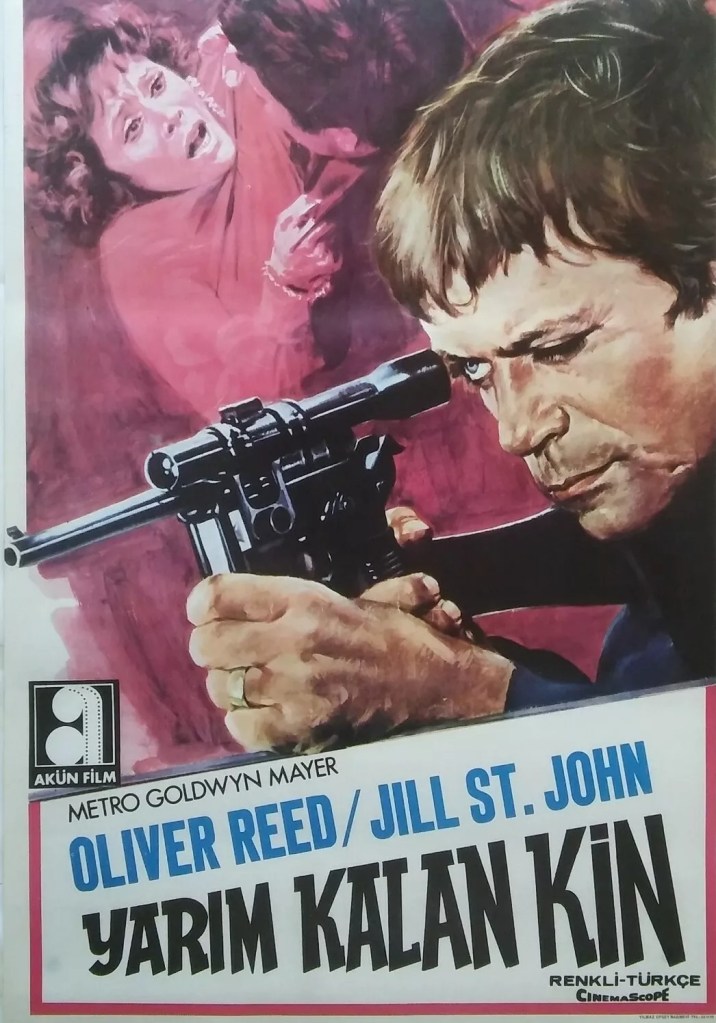
Like Get Carter, this is a revenge picture. Discovering girlfriend Pat (Jill St John) is pregnant by another guy, imprisoned bankrobber Harry (Oliver Reed), serving a 15-year stretch for murder, is turned into a “lethal weapon” by the very thought and determines to break out and kill her. And at the same time collect the loot from his last bank robbery.
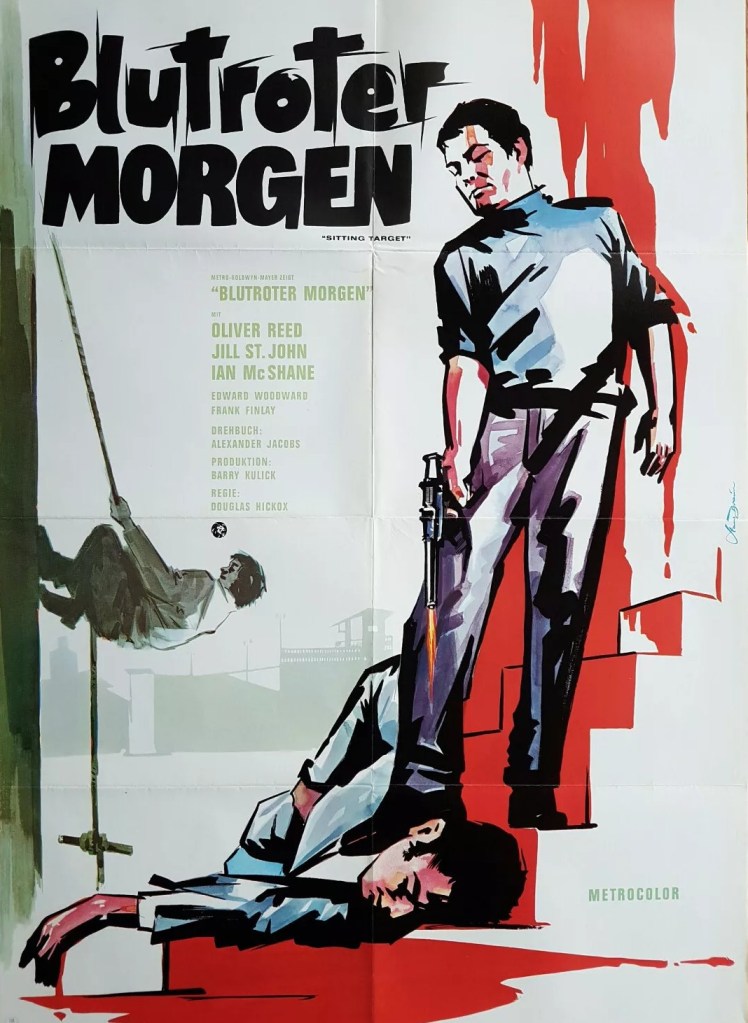
His escape, masterminded by the gentlemanly MacNeil (Freddie Jones) and accompanied by long-time buddy Birdy (Ian MacShane), is a tense, exciting sequence. First stop outside is to strongarm another gangster into supplying a Mauser that can be turned, a la Day of the Jackal, into a long-range rifle.

And while the movie brings into play the standard trope of villains seeking their share of the loot, it also hangs on another standard wheeze of the 1960s B-picture of the woman as bait. Anticipating that Harry will make a beeline for his loved one, but unaware of his nefarious intent, Inspector Milton (Edward Woodward) has her under police guard. But the likes of Harry always finds a way to sneak in, which triggers police pursuit, in the course of which Harry commits the unpardonable crime of shooting a cop – the villain world only too aware of the severe repercussions.

There’s a stop-off at the apartment of the moll (Jill Townsend) of Mr Big, Marty (Frank Finlay). That doesn’t go as planned, but still they manage to uncover a hidden sack of cash leaving Harry to knock off, sharpshooter style, the unfaithful girlfriend.

And then the pair make a getaway….Not quite. Birdy turns out to be greedy and wants all the robbery cash for himself and attempts to shoot Harry. That would be enough of a twist to be getting on with but there are a few stingers to come. Pat’s not dead – Harry (too far away to identify  her face) just shot a policewoman on protection duty standing in her window. Pat’s not  pregnant either, just stuffed a cushion down her jumper to complete the pretense. And she and Birdy are an item. And it’s clear that Birdy simply purloined Harry’s rage to get him to do the dirty work involved in the escape and dealing with the other gangsters.

Except in the case of being willing to knock off his longtime business partner, Birdy, you see has always been averse to violence, cowardly not to put too fine a point on it, though quite capable of pouring a bowl of urine down a captured guard’s throat, or rape.

Villains are as conflicted as anyone else, otherwise how to explain that Harry climbs into the burning car containing his dead girlfriend, gives Pat a gentle kiss and waits for the car to explode and take him to a fiery grave. We’ve seen the softer side of Harry in flashes. He turns down the chance to bed a sex worker in the getaway lorry, doesn’t take advantage of the moll, and buries his face in the moll’s fur coat. The furthest he gets to expressing his feelings is to explain to Birdy that he was very happy with Pat. He’s almost – perish the thought – got a feminist side. And presumably it takes a lot for a tough gangster like him to open up to a woman, which explains why he takes her betrayal so badly.
The fact that he still kills her is somehow beside the point. As I said, gangsters are complex, witness the gay Richard Burton in Villain.

This is Ian MacShane (The Wild and the Willing, 1962) still in matinee idol mode, minus the gravitas and husky tones of John Wick (2014). Once the twists kick in, you look back and realize he’s stolen the film, a weaselly charmer, able to bend Harry (not that hard, mind you) to his will, which was to help him escape, lead him to the money and send him off to live happily ever after with Pat. Where Harry clearly believes in true love, Birdy has no moral scruples. Even with a beauty like Pat waiting for him, he’s happy to indulge in sex with the sex worker and help himself to the helpless moll. (MacShane was equally dubious in Villain).

Oliver Reed’s Thug we’ve seen countless times before, Oliver Reed’s Softie less so. Jill St John (Tony Rome, 1967) manages a British accent and proves herself capable of a better  role than usual. Actors often say they build up a character from their walk. Watch Edward Woodward (The Wicker Man, 1973) for a classic example of it.

Douglas Hickox had essayed delicate romance via his debut Les Bicyclettes des Belsize (1968) and it’s to his credit that he touches on Harry’s sensitivity in such subtle fashion. Otherwise, some terrific standout sequences – Harry’s fist battering through the glass into the prisoner’s visiting room, the escape, the duel with motorcycle cops through a fog of washing strung out on lines, the final car chase.

Written by Alexander Jacobs (Point Blank, 1967) from the bestseller by Lawrence Henderson. Superb score by Stanley Myers.

Not quite in the league of Get Carter or Villain but not far short.
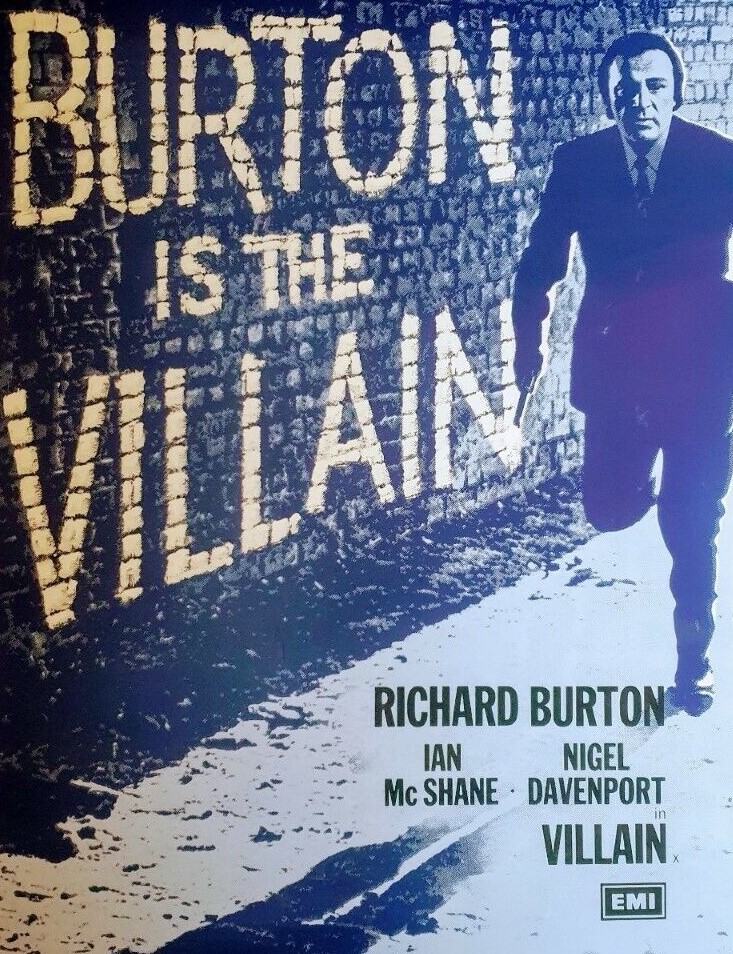
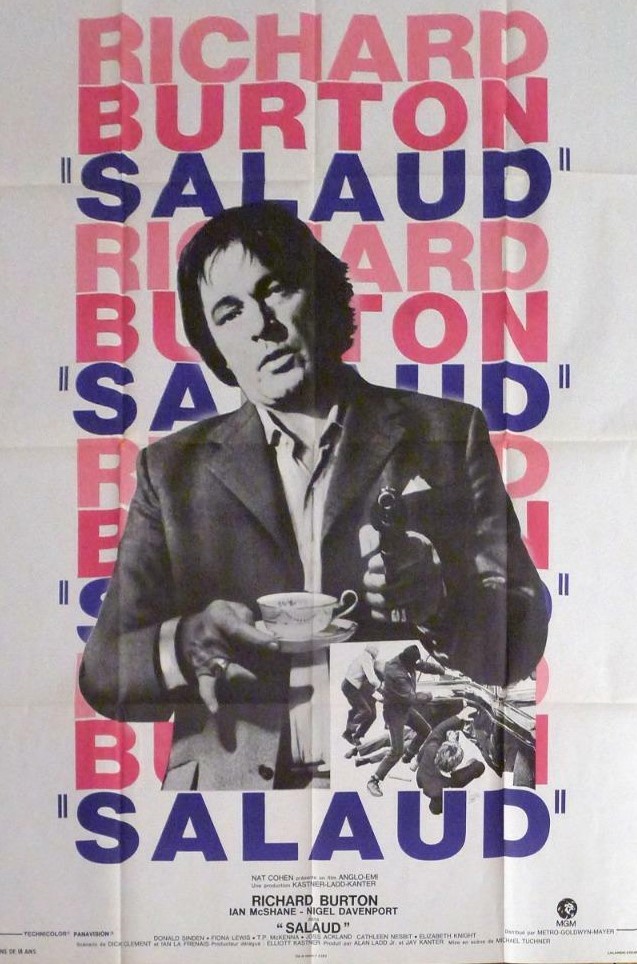
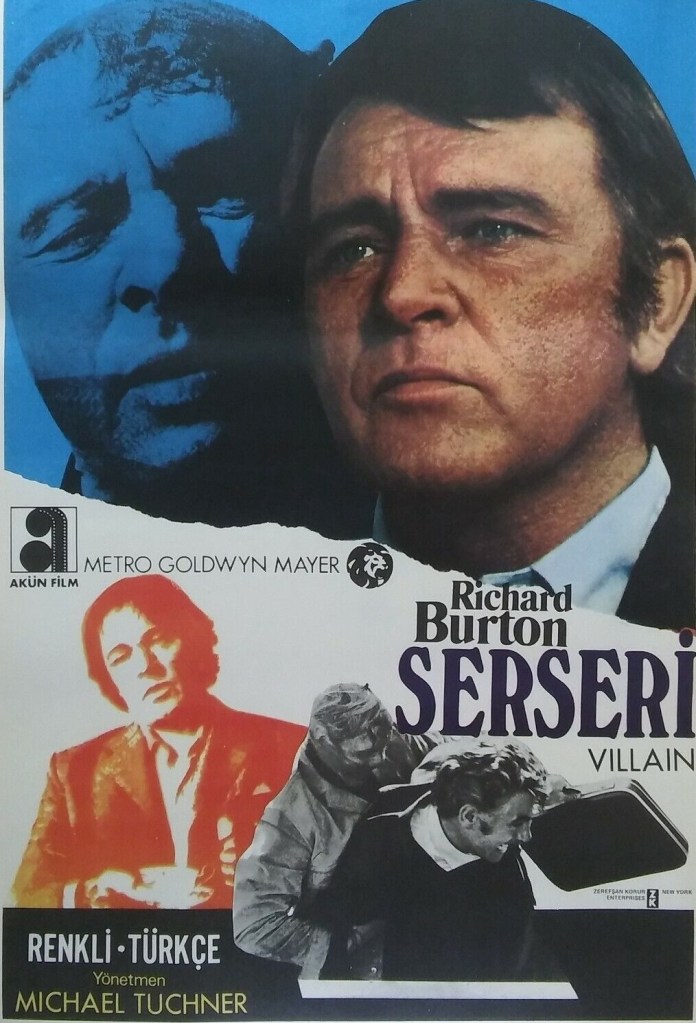
Villain (1971) *****

Get Carter, out the same year, tends to get the critical nod over Villain, but I beg to differ. Not only do we have the most realistic robbery yet depicted on screen, but Richard Burton (Becket, 1964), delivering one of his greatest performances, is nearly matched by Ian McShane, flexing acting muscles that would come to fruition in Deadwood (2004-2006) and John Wick: Chapter 4 (2023), and Nigel Davenport’s cop, as cool under pressure as Frank Bullitt.

Where Michael Caine in Get Carter is primarily the avenging angel, Burton’s Vic Dakin is every bit as complex as Michael Corleone. Way ahead of its time in portraying Dakin as a gay gangster in sympathetic fashion, he also has a moral code akin to that of Don Corleone. While the Mafia chieftain drew the line at selling drugs, Dakin despises MP Draycott (Donald Sinden) for his corruption and views with contempt sometime boyfriend Wolfe (Ian McShane) for small-time drugs and girl peddling.

He reveres (as did Don Corleone) family values, bringing his aging mother tea in bed, kissing her affectionately on the forehead, treating her to a day out at the Brighton. But he also rejoices in violence as much as any of Scorsese’s gallery of thugs.

Complexity is the order of the day. Every dominant character, whether operating on the legal or illegal side of the street, receives a come-uppance verging on humiliation. Dakin himself is arrested in full view of his mother. The bisexual Wolfe, who otherwise dances unscathed through the mire, is beaten up by Dakin and humiliated when his male lover shows his female lover, the upmarket Venetia (Fiona Lewis), the door. Top gangster Frank (T.P. McKenna), who attempts to lord it over Dakin, ends up whimpering in agony in the back seat of a car.

Maverick cop Mathews (Nigel Davenport) is brought to heel by internal politics and frustrated at home when his wife is indifferent to the late night shenanigans of his son. Even cocky thug Duncan (Tony Selby), with a quip to terrify victims, is reduced to a quivering wreck under the relentless stare of Dakin.

Unlike The Godfather, mothers excepted, wives and girlfriends are complicit. Little chance of a shred of feminism here. Women are chattels, Venetia is traded out as a “favor” to Draycott, terrified gangster’s moll Patti (Elizabeth Knight) also used in that capacity by Wolfe. Draycott professes little interest in whether the women, procured in this fashion, enjoy sex with him.

So, to the story. Tempted by a tasty payroll robbery, Dakin steps out of his usual line of work, a protection racket, and joins up with two other leading hoods, Frank (T.P. McKenna) and his brother-in-law, the belching Edgar (Joss Ackland). But the robbery goes wrong. The tail is spotted by the payroll car and the victims almost evade capture. But stopping the payroll car renders the getaway vehicle virtually useless, a flat tyre soon flies off and they drive for miles on a wheel rim.

The payroll is well-guarded and several of the villains emerge badly scathed. Worse, the cases containing the cash have anti-theft devices, equipped with legs that spring out and red clouds of smoke. And there are ample witnesses. Edgar is quickly apprehended, and the movie enters a vicious endgame.

Contemporary audiences were put off by the obvious references to the Kray Twins and the Profumo Affair and American audiences had long shown an aversion to Cockneys (though that is not so apparent here) and critics gave it a mauling, the general feeling being that after Performance (1970) and Get Carter, the British public was entitled to the more genial criminal as exemplified by The Italian Job (1969), incidentally another U.S. flop.

There are many superb moments: Dakin’s affectionate stroke of Wolfe’s shoulder, Dakin and his sidekick’s nonchalant stroll over a footbridge as they make their escape, Dakin pushing Draycott into a urinal, Wolfe abandoning Venetia at a country house party so that Draycott can avail himself of the “favor,” Dakin’s love for his mother. Throwaways point to deeper issues, a country stricken by strikes and political corruption.

Dakin, unaware he has made a target for his own back by the unnecessary brutal treatment of an associate, comes up against a cool implacable cop, as confident as Dakin without the arrogance or recourse to brutality, easy with the quip.

A modern audience might appreciate the violence more than the acting, given that a la Scorsese we are supposed to revel in criminal behavior, but it’s the performances that lift the film. Burton had entered a career trough, sacked from Laughter in the Dark (1969), involved in a quartet of financial and critical turkeys – Boom! (1968), Candy (1968), Staircase (1969) and Raid on Rommel (1971) – with only another Oscar nomination for Anne of the Thousand Days (1970) to alleviate the gathering gloom that would see him strike out in his next nine pictures before another nomination for Equus (1977) restored some stability.

So this is a superb character, suited and booted he might be, doting on his mother, but underneath stung by insecurity and unable to rein in his sadistic streak. A marvellous addition to the canon of great gangster portrayals.

Ian McShane, too, provides a performance of great depth, in his element when skirting around the small-time world, out of his depth with the big time, the charm that can hook a vulnerable upper-class lass like Venetia as likely to attract a malevolent mobster, the former under his thumb, the latter controlling. To see him go from cheeky chappie with a winning grin to penitent lover forced to dismiss Venetia is quite an achievement.

Nigel Davenport (Sands of the Kalahari, 1965) is on top form and the supporting cast could hardly have been better – T.P. McKenna (Young Cassidy, 1965), plummy-voiced Donald Sinden (Father, Dear Father TV series, 1969-1972) playing against type, Joss Ackland (Rasputin: The Mad Monk, 1966). Throw in a bit of over-acting from Colin Welland (Kes, 1969) plus Fiona Lewis (Where’s Jack?, 1969) at her most accomplished.

Michael Tuchner (Fear Is the Key, 1972) directs with some style from a screenplay by Dick Clement and Ian La Fresnais (Hannibal Brooks, 1969) working from the novel by al Lettieri.

Ripe for reassessment.

https://amzn.to/3GQS6Uo

Discover WordPress

A daily selection of the best content published on WordPress, collected for you by humans who love to read.

The Atavist Magazine

by Brian Hannan

WordPress.com News

The latest news on WordPress.com and the WordPress community.