
The two-fisted trigger-happy cops that had changed the Hollywood landscape since Clint Eastwood burst onto the scene hadn’t found much correlation in the small-screen. Television producers were particularly averse to violence and even a new generation of sleuths were only a tad above the cosy crime of previous decades. Since James Bond easily covered the random killing aspect in British movies, there seemed little room for anyone else.
Sweeney! (1977), a speedy spin-off from a successful British independent television series, proved them wrong, the movie censor permitting considerably more leeway on the violence front. These cops are just itching to lay a hand on gangsters and, as if transplanted from Chicago, bring baseball bats and pistols to a fight.
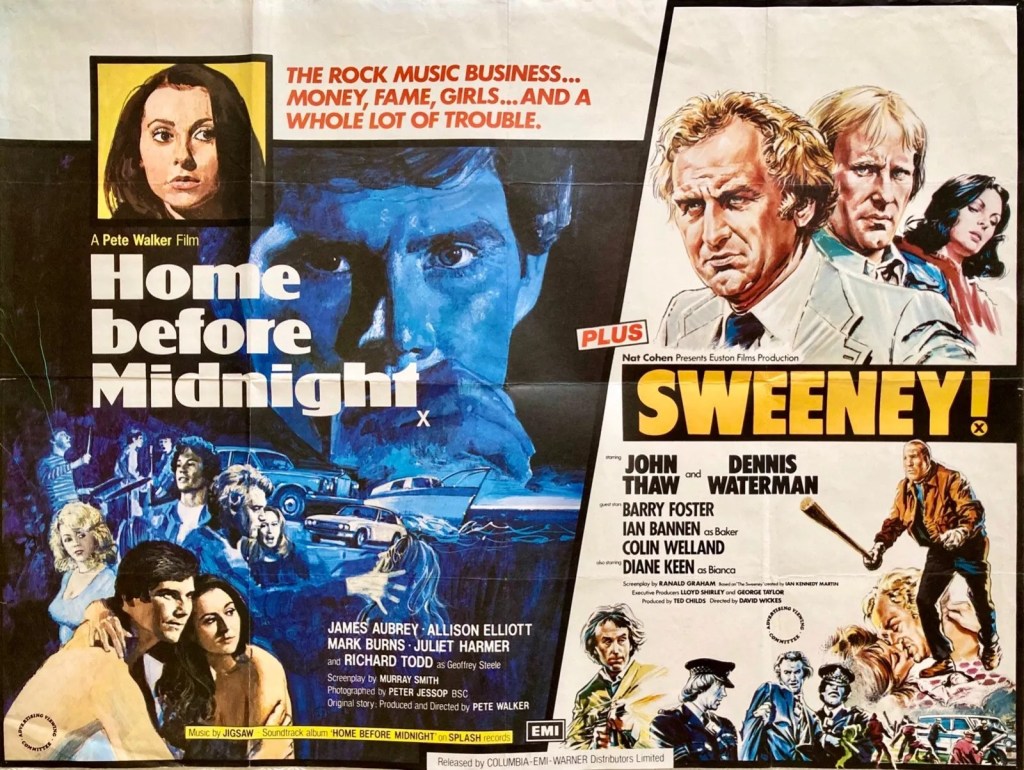
The action only slows down when the subplot gets mired in delivering a political message about big business and corruption or when one of the characters has to take time out to explain the meaning of the title. Turns out there’s a sneaky high-end operator Elliott McQueen (Barry Foster) who runs a string of high-class sex workers to hook politicians like Charles Baker (Ian Bannen). When Baker’s girlfriend Janice (Lynda Bellingham) ends up in the mortuary – suicide the official verdict – McQueen applies pressure to get an oil deal done.
Baker’s gals are expert in what these days would be known as providing the “Girlfriend Experience” though the blokes they service aren’t the ones paying. But a police informant, soft on Janice, believes she was murdered and calls in Detective Inspector Jack Regan (John Thaw) to informally investigate.
When Regan treads on McQueen’s toes it triggers a spate of violence. First the informant is blown away by a machine gun from thugs disguised as coppers. Then a nosy journalist (Colin Welland) is blown up. Then Regan is stitched up and suspended from duty. Naturally, Regan persists with a surreptitious investigation. But the thugs aren’t so covert and he interrupts a gangland hit on Bianca (Diane Keen), another of the “girlfriends” who knows too much.

Not much detection required, really, when the criminals are so open about their criminality and even the most high-ranking politician or sanctimonious cop is going to find it hard to let machine-gun-toting gangsters roam through London. So there’s plenty bloody action and quite a clever pay-off.
The rampant violence in British cinema earlier in the decade had been confined to the gangsters of Get Carter (1970) and Villain (1971) and to pictures wrapped in halos of critical protection such as A Clockwork Orange (1971) and Straw Dogs (1971). Sweeney! ushered in a new era, when cops could adopt the same methods as criminals.
Regan was the rumpled cop, his sidekick Det Sgt Carter (Dennis Waterman) theoretically the more handsome, except his boss had as much success with women. What both were best at was riling superiors and arguing with everyone. You’d need a good grasp of the various policing departments to keep up – here we have Special Branch and The Flying Squad (The Sweeney) and ordinary coppers.
The predilection for selective use of Cockney rhyming slang was a feature of the British crime picture. Flying Squad translated as Sweeney Todd and was then truncated to The Sweeney. Oddly enough there was no rhyme for Special Branch and Scotland Yard, despite the advent of The Shard, has not made its way onto the rhyming dictionary.
British studios had increasingly turned to television as production levels tumbled, but generally in the comedy genre, Up Pompeii (1971), On the Buses (1971) and Steptoe and Son (1972), plus vaious sequels, registering the biggest box office.
John Thaw and sidekick Dennis Waterman proved to be long-term stalwarts of British television, the former heading up Redcap (1964), The Sweeney (1975-1978), Inspector Morse (1987-2000) and Kavanagh QC (1995-2001), the latter following The Sweeney with Minder (1979-1989) and New Tricks (2003-2015). Diane Keen starred in The Feathered Serpent (1976-1978), The Cuckoo Waltz (1975-1980), Rings on their Fingers (1978-1980), Foxy Lady (1982-1984), You Must Be the Husband (1987-1988) and various others. Lynda Bellingham, in a bit part as a naked corpse, would become a favorite through a long-running commercial.
By this time Britain had also produced a core of strong supporting actors, not of the quality of the previous generation of Laurence Olivier or John Gielgud, but with a considerable portfolio behind them, Barry Foster second-billed in Frenzy (1972), Ian Bannen Oscar-nominated in The Flight of the Phoenix (1966).
Directed with huge enjoyment by David Wickes in his movie debut from a screenplay by Ranald Graham (Shanks, 1974) and Ian Kennedy Martin (Mitchell, 1975).
Gotcha!
 The Magnificent 60s