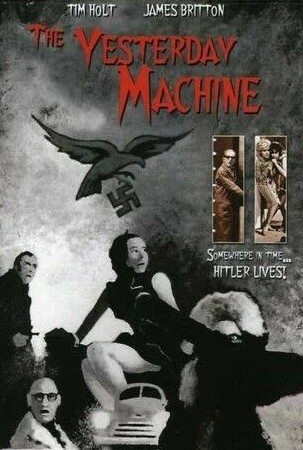
The Yesterday Machine (1965) ***

Some big-name director, especially these days, would have seen the potential, injected some action and jeopardy, a good dose of awe and maybe more of a hint of a romance. You can’t help but feel this would be exactly the kind of enterprise that might get a more favourable hearing from a contemporary audience that’s sucked up even worse baloney in the multiverse and beyond.

Despite you might thinking concentration camps should not be used for superpower fiction, they were essential to the Magneto narrative in the X-Men Files, a set-up which also involved Captain America and Wolverine. So you can’t really show revulsion at attempts by a low-budget sci-fi B-picture to shoehorn in a concentration camp element. This doesn’t have the budget to “show” and must rely simply on “tell” to get over the essential story element. But we’re also bouncing around the time universe to the extent of the American Civil War and the French Revolution.

When the car of college kids Ellison (Jay Ramsay) and drum majorette Margie (Linda Jenkins) breaks down on a dirt road on the way to a football match, they end up confronting soldiers from the Civil War. The boy is shot and taken to hospital, but the girl disappears, plain vanishing, sniffer dogs finding the trail suddenly stops.
In the absence of another poster of the movie reviewed I’ve opted for something with the word “machine.” This at least concerns time travel.

Journalist Jim (James Britton), investigating, discovers the Civil War link because Ellison has been shot by a bullet from that war and the uniform of the Civil War soldiers couldn’t be mere replicas worn by historical re-enactors because the uniform manufacturer went out of business in 1869. Jim hooks up with Margie’s sister, nightclub singer Sandy (Ann Pellegrino). Soon, thanks to a cop, they are on the trail of a time machine created by Professor Von Hauser (Jack Herman) who experimented on inmates in concentration camps, ageing young people and the reverse.

Jim and Sandy fall into the time machine’s orbit and are teleported to Von Hauser’s lab. The professor, a contemporary of Einstein, aims to go back in time and prevent his hero, Adolf Hitler, from committing suicide. Jim and Sandy are imprisoned until freed by an Egyptian serving girl, also teleported from a couple of millennia back, and the professor’s heinous plan is scuppered.

Occasionally, writer-director Russ Marker (Night Fright, 1967) allows himself a bit of visual leeway, a jackboot appears in the undergrowth to stamp out a cigarette, Jim and Sandy running down a hill vanish only to reappear seconds later in a different time zone, Margie practizing her moves while the car is being fixed.

But mostly, it’s dogged detective work, Jim helped along by people who favor the odd interpretation of events, a doctor who collects Civil War memorabilia, the cop whose outfit liberated the camp with the time machine. There’s enough mystery to keep you hooked and if you imagine the likes of Tom Hanks in Da Vinci Code mode uncovering this bizarre collection of facts you’d be far more inclined to go along with the presentation rather than treating it as the kind of baloney that had “cult” written all over it.
See above but no time travel.

I’m not sure I agree with the “dreary pace” – while progress was stately to say the least, it took that length of time to establish the groundwork – and the second half is enlivened not so much by the professor defending Hitler as the look on his face when Jim delivers a coruscating critique on the Fuhrer. I’m always partial to scientists explaining their barmy notions and jargon – nobody balked at James Cameron’s “unobtainium” in Avatar (2009).

This is what comes of trawling YouTube in an idle moment.

Sure, it really is nothing more than two-star material but I enjoyed it more than I expected, and, these days, worse notions have been served up to unsuspecting audiences.
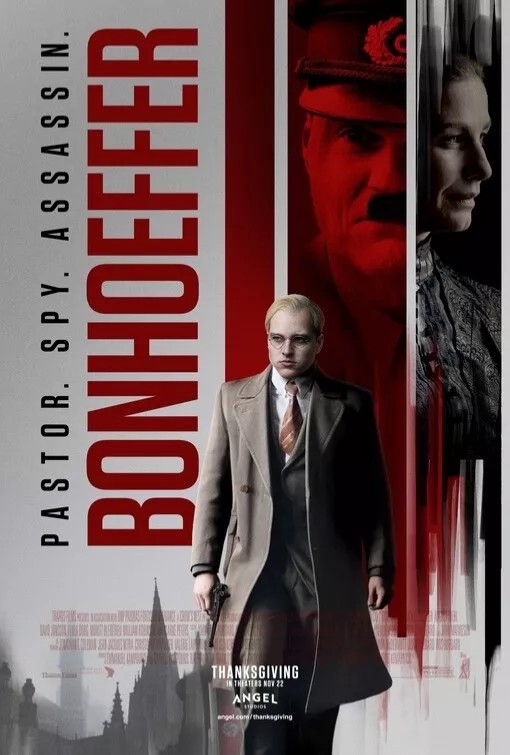
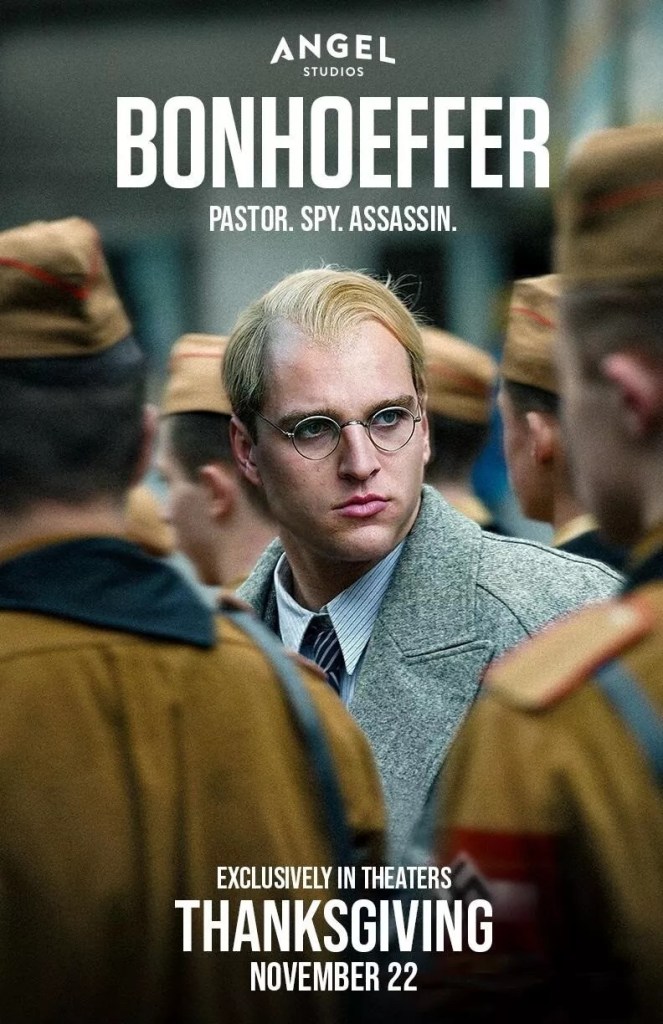
Bonhoeffer (2024) ***

I had forgotten all I knew about Dietrich Bonhoeffer, the German theologian who was hanged three weeks before the end of the war for his part in the failed assassination of Hitler. I hadn’t realized, either, that there was a virtual spate of biopics, three in the last two years and two more since the turn of the century. The name of writer-director Todd Komarnicki didn’t mean much to me either, except, to counter that obstacle, he pops up before the movie begins to remind us of his credentials, director of World War Two picture Resistance (2003), producer of Elf (2003) and writer of Sully (2017), the latter involving, he is at pains to point out, Hollywood royalty in the shape of director Clint Eastwood and star Tom Hanks.

While this is workmanlike rather than, until virtually the very last scene, inspiring, and, until the final credits, pivots on virtually a handful of his writings – from the millions of words he wrote, many that have become the kind of pithy sayings that people are apt to quote.

There’s a sense that this is for the converted and that there’s little need to remind an audience of what it should already know. While the narrative doesn’t meander, it does oscillate through various timeframes and for those unacquainted with the life it could have done with more attention to detail.

Except for one detail that resonates at the end, the childhood sequences could have been eliminated, though they reveal that his elder brother died in the First World War. Then we are pretty much pitched straight into Harlem where a colleague, Frank (David Jonsson), attending the same New York theological college, introduces him to Baptists who expound gospel music, sassy preacher Rev Powell Sr (Clarke Peters) and the devil’s music, jazz. Bonhoeffer (Jonas Dassler) gets sharp reminder of the pervasive racism when he tries to book a hotel room for his African American buddy and gets whacked in the face with a shotgun for his troubles. This makes him realize piety isn’t enough and that action is required to stand up for your principles.

He becomes one of the first to report on Hitler’s victimization of the Jews and a leader in the dissident movement at a time when the German church is supportive of the Fuhrer. He was a published author from 1930 and became a significant public figure. He promoted the ecumenical movement and spent two years as a pastor in London. He was jailed for his opposition to the Third Reich.

As I said, this is mostly a straightforward affair, and you might struggle to keep up with church politics and it’s a guarantee you won’t have any idea who the other clerics are, and none of them come alive enough for us to care about them.

The best scene, and key to his beliefs, comes at the end. The night before he is due to be hanged, a prison guard offers to help him escape. But Bonhoeffer, fearing repercussions for both of their families, turns him down. He holds an imitation of the Last Supper for the other inmates, including, much to the initial fury of the assembled prisoners, the guard. He dies not just with considerable dignity but welcoming death.

Jonas Dassler (Berlin Nobody, 2024) is stolid more than anything and it’s very much a one-note performance. Frankly, none of the acting will take your breath away. However, placed against the current political climate, this resonates more than the film possibly deserves. It’s a worthy biopic and a timely reminder that “not to act is to act.”

However, if the name Bonhoeffer has ever entered your consciousness and you want to know more this is as good an introduction as any (though in fairness I haven’t seen the other biopics and I suspect the one starring Klaus Maria Brandauer will carry more emotional heft).

This was surprisingly busy when I saw it at my local multiplex on Monday, so the name has not been forgotten.

Discover WordPress

A daily selection of the best content published on WordPress, collected for you by humans who love to read.

The Atavist Magazine

by Brian Hannan

WordPress.com News

The latest news on WordPress.com and the WordPress community.