The concept of “national treasure” – perhaps in itself a purely British conceit – wasn’t invented back in the day but if it had Dame Edith Evans would fall into the same coveted category as Maggie Smith and Judi Dench do today. She was certainly among the most honored of British thespians in the 1960s – Oscar nominations for Tom Jones (1963), The Chalk Garden (1964) and The Whisperers (1967) – so what she’s doing in this unfunny mess is anybody’s guess. She was 80 at the time and while easily the best thing in it, the switch between battiness and cleverness is hardly new.
Everyone is oh so British, including the gangsters led by Frank (Harry H. Corbett), and it should be the old trope of Yanks not coming to grips with English life and customs, which sometimes can strike a note, but instead the set-up is so dire and the acting so uninspiring. Warren Oates (The Thief Who Came to Dinner, 1973) is at his worst – when I tell you his best scene is his discomfort at having to hold a plate and cup-and-saucer at the same time, you’ll guess why. Telly Savalas attempts to be charming but it just comes off as an overheated version of his usual thug.
Story is lame. Herbie (Telly Savalas), just out of the slammer, finds he is in hock to mob boss Nick (Cesar Romero), so with buddy Marty (Warren Oates) sets off for England to fleece Lady Sophie Fitzmore (Edith Evans) only to discover that her stately pile is also in hock (you want to discover about British death duties, this is the one for you). British mob boss Frank doesn’t like the idea of the Yanks infringing on his territory, so is keeping a close watch and in the end decides to raid Sophie’s joint himself, by which time the Yank villains have become so enamored of Sophie that they’re on her side and set up the kind of defense that would have been axed from cockanamie comedies like The Great Race (1964) for not being funny enough. Sure, Edith Evans in goggles and racing in on a biplane looks good on paper but not when the thugs scatter like the Keystone Cops.
Edith Evans was exceedingly wary of the movies. She only made 14 – and just six pre-1960 and two of those in the silent era – in all those decades when she was otherwise devoting her time to the theater and best remembered by movie audiences for The Importance of Being Earnest (1952). According to Sir Laurence Olivier she only gave the movies another bash when her memory started failing her and the notion of only having to remember a few lines at a time exerted its attraction.
While she’s good fun here, she’s saddled with mutton for co-stars. Telly Savalas (The Assasination Bureau, 1969) theoretically wins his first leading role, but in fact that went to Edith Evans and better actors than him had faded away in Dame Edith’s slipstream. Quite what Warren Oates thought he could do with the part is anybody’s guess because he does nothing.
Written and directed by Jim O’Connelly (The Valley of Gwangi, 1969).
Marvellous little drama. Succession the old-fashioned way when promotion was determined by interview, the process not clogged up by internecine family warfare. Doesn’t, either, go for the easy target of the English class system, instead exploring the universality of office politics, the quite different attitudes taken by individuals to superiors and inferiors, the determination to find someone who is not your equal, and the ways of dodging responsibility or simply indulging in dodgy behaviour.
It’s lit up by four superb performances, Donald Pleasance (Soldier Blue, 1970) as the dull accountant, Colin Gordon (Subterfuge, 1968) – usually a comedy foil – as the Machiavellian boss, Harry H. Corbett (pre-Steptoe and Son) as a weaselling manager and Andree Melly (The Brides of Dracula, 1960) as a secretary skirting scandal. The narrative is simple. Prior to the interview we dip into the lives of the three candidates – Victor (Donald Pleasance), high-flying sales manager Selkirk (William Franklyn) and transport manager Harry (Harry H. Corbett) who happens to be the brother-in-law of George (Colin Gordon) the boss.
Donald Pleasance and Andree Melly let fly when the jig is up.
Each has a deficiency, Selkirk inclined to show too much initiative, Harry running his department by the seat of his pants, Victor with no initiative whatsoever, a plodder. Each is caught out in an error of judgement, Selkirk striking a deal with a dodgy customer, Harry operating a driver logbook scam, Victor having an affair with his secretary Nina (Andree Melly). And a most unlikely relationship that is, the young self-possessed girl madly in love with a middle-aged man riddled with self-doubt.
When she first appears, in frankly one of the most erotic scenes capable of passing the British censor at the time, I had assumed this was a financial arrangement. That Victor would be reaching into his pocket. It’s only later we discover she’s his secretary and nourishes no ambitions for him to climb the corporate ladder, just believing that at a suitable juncture he will jettison wife and children. Mostly, what they all have to lose is pride. Hen-pecked Harry terrified of reporting failure to his domineering wife, Selkirk already planning how to spend the expected salary increase, Victor desperate to justify his existence by having his name on the letterhead.
Everyone has ideas above their station; everyone gets put in their place. Even the backroom staff jockey for position, Selkirk’s secretary Madge (Marianne Stone) tearing into Nina for her loose morals, in return being hit by bitchy comments about her spinsterhood. Both make a point of wishing the other’s boss “good luck” on the day of the interview in case they win. Madge often refuses to carry out work she considers too menial and seems always on the point of resigning over a minor issue. There is envy over the size of one’s office.
The two secretaries previously at war bond over male inhumanity. Madge (left) comments that two people should bear the consequences of an affair not one.
The best elements of the script are how plans go awry, how conversations turn as new information enters the equation and especially how the boss uses any opportunity to destabilize his staff, pitting them against each other, turning triumph into disaster, deftly fending off any threat to his position. George employs a wonderful phrase, “I’ve called you in to tell you why you’ve NOT got the job,” softening the blow by a small salary increase.
And it’s indicative of failings in his personality that he hands the job to the person least likely to challenge his authority – Victor – and that the promotion comes with the rider that the accountant get rid of Nina. And, suddenly, Victor comes into his own, the mouse roaring like a lion, although triumph is temporary. The last scene one of the saddest committed to celluloid, Victor alone, huge pile of work to get through and no solace anywhere.
It’s short, too, would have been intended as a “quota quickie,” release guaranteed by the Eady system, and should really have been lost in the slush pile. Instead, without any of the brutality of Succession, dissects the office mind-set. Donald Pleasance is the standout, but Colin Gordon and Andree Melly run him close. Support from Susan Shaw (Carry On Nurse, 1960) and Roddy McMillan (The View from Daniel Pike series, 1971-1973).
Director Peter Graham Scott (Father Came Too!, 1964) keeps his foot on the narrative pedal, focus never wavering, brooking no diversions. Bill MacIlwraith (The Anniversary, 1968) delivers a tight script bristling with terrific lines. given it only cost £22,300 (about $70,000) it’s quite astonishing.
NOTE: In the absence of a poster, the main photo is by Allan Warren.
Producer Joseph E. Levine (The Graduate, 1967) would be cancelled these days for his treatment of Michael Caine back in 1964. Levine had stumped up (along with Paramount) the $1.7 million budget for what was assumed to be the actor’s breakout picture, Zulu (1964), and signed him up to a seven-year contract. Caine would receive $75,000 – his fee for Zulu had been just $10,000 – in his first year, with increments every following year.* But before the film was released Levine rescinded the contract on the basis that Caine “looked like a queer on screen.”
While Zulu was a box office smash in Britain, in the United States it was a big flop despite the marketing dollars thrown at it by Levine. And nobody needed a younger version of the British stiff- upper-lip. And despite the buzz before the film opened, producers were not clamouring at Caine’s door, the only options on the table a small part in a television production of Hamlet at Elsinore (1964) and the leading role in The Other Man (1964), a television drama about Britain succumbing to the Nazis in 1940.
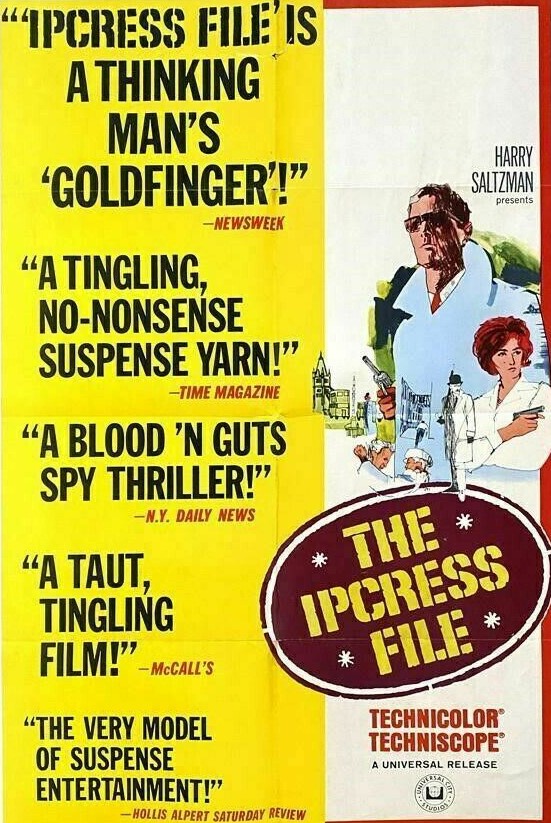
That is, until Bond producer Harry Saltzman summoned him to his table in a restaurant and in a conversation that lasted all of two minutes offered him The Ipcress File and a seven-year contract. Aged 32 at this point, Caine was mature enough to be ranked a proper rising star, the casualty rate among the twenty-somethings accorded that status alarmingly high mostly due to their screen immaturity.
However, Saltzman owed his involvement in the picture to another chance meeting. He had been in the United Artists offices in New York when hair product entrepreneur Charles D. Kasher arrived to pitch Len Deighton’s novel The Ipcress File as a potential movie. Saltzman was looking for an alternative to James Bond that would appeal to international audiences with the emphasis on low-cost. He put together the picture on a budget of only $460,000. But the project looked dead in the water when original Hollywood backers Columbia pulled out shorlty before shooting was due to star. Universal saved the day.
Hammer director Jimmy Sangster recommended Canadian director Sidney J. Furie (Wonderful Life/Swingers’ Paradise, 1964) who had just turned down A Hard Day’s Night (1964) and just signed up to do indie horror movie Devil Doll (1964) before managing to ease himself out of that contract.
Caine was far from first choice. Christopher Plummer had chosen The Sound of Music (1965) instead and Richard Harris, a bigger name in Hollywood after MGM roadshow Mutiny on the Bounty (1962) and a critical success after This Sporting Life (1963) turned it down in favour of Sam Peckinpah western Major Dundee (1965). In a bid to give the character the ordinariness he required Harry H. Corbett (Rattle of a Simple Man, 1964) was also considered. Caine had been sharing a flat with Terence Stamp (The Collector, 1963) but when Stamp decamped to America moved in with composer John Barry and was thus the first to hear the music Barry had dreamed up for Goldfinger (1964).
Aware how easily contracts could be dissolved Caine “stuck to him (Saltzman) like a drowning man to a straw.” Thus, he was present when discussions arose over naming the spy – anonymous in the book which was written in the first person. It was decided the character should have a dull name. “Harry” was chosen before everyone present realized the producer might just take offence. However, Saltzman’s real first name was Herschel, so he laughed it off.
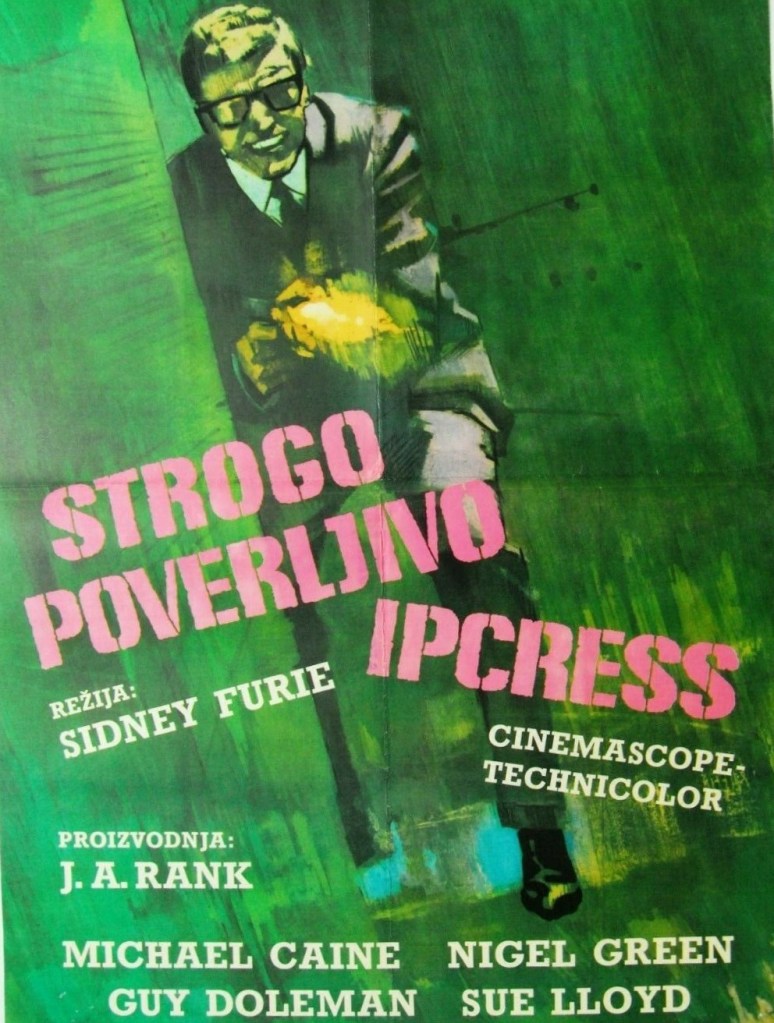
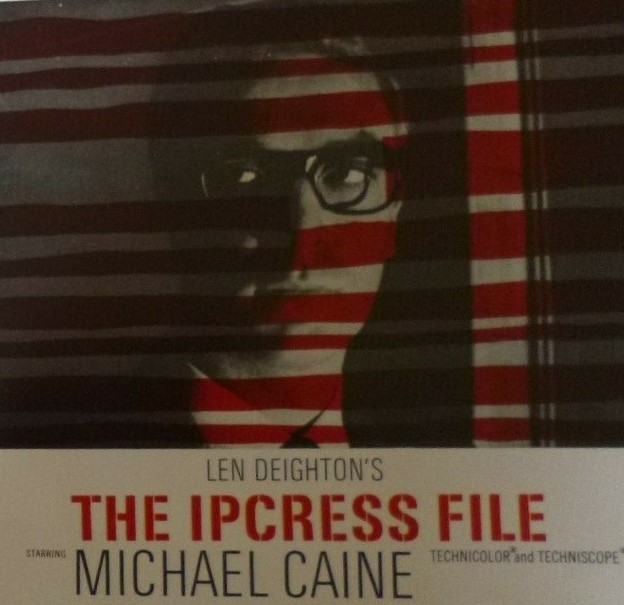
Saltzman also came up with idea of the character wearing glasses to make him look more ordinary. Caine was short-sighted in real life and always wore glasses and Saltzman noticed how comfortable he was with them, knowing how to handle them properly, unlike clear-sighted actors given spectacles for roles without having any idea what to do with them. It was surprising how fragile the spectacles were, though, Caine getting through the allocated three pairs and new supplies having to be commandeered. Saltzman took the ordinariness too far, suggesting a duel with supermarket trolleys as one of the big fight scenes.
Even though Furie had never met Caine, he disliked him, having come across the actor and his friend Terence Stamp at the White Elephant Club in London. “I’d see Terence Stamp always there with this other blonde guy who wore glasses,” recollected Furie, “and they were rather chummy and always had these pretty girls at their table, and they were always laughing. And I sort of hated him at the time. Sometimes, I would get a bit drunk and tell whomever I was with, ‘I want to punch that guy in the face.’ I guess I was jealous.”
Joan Collins, completely out of favour in Hollywood and with no roles since The Road to Hong Kong (1962), auditioned – as did the unknown Carol White (Poor Cow, 1967) – for the part of Jean that went to Sue Lyons, in her first featured role. Otherwise, the main roles went to established British character actors including Nigel Green (Zulu), Gordon Jackson (The Great Escape, 1963) and Guy Doleman (Thunderball, 1965)
Interestingly, laughable though it is now, a character who cooked was considered to be gay, even though Palmer clearly used his cooking skills for female seduction. Unfortunately, no great cook himself, Caine was unable to crack two eggs with one hand and the movie used the hands of author Len Deighton, so excellent a cook he had written a cookbook. That explains why the hands that picked up the eggs on screen had blond hairs but the hands that cracked them had black hairs. The cooking scene remained the cause of macho concern, with one U.S. studio executive demanding the scene be re-shot with the woman cooking the meal.
Director Sidney J. Furie (Wonderful Life/Swingers’ Paradise, 1964) hated the script and demonstrated his loathing by gathering cast and crew together on the first morning of filming and burning the script on the studio floor. While sticking to the basis of the screenplay, characters were encouraged to improvise. The poor script – Kasher had called it “garbage” – was the reason for introducing this kind of style, the script being rewritten as production proceeded.
Furie recalled, “All day there were two writers writing our scenes for the next day…We knew where we had to get to because Harry Saltzman, the producer, had ordered the set for the climax built, so we were stuck with it.” If the pages didn’t turn up, Furie found ways to instigate delay, getting the cameramen spending an inordinate amount of time lighting a scene. Furie sipped whisky in his Scotch all day, not enough to be inebriated but “it would help me go with my gut.” The full complement of writers involved in the script were James Doran and W. H. Canaway plus uncredited contributions from Lukas Heller (The Dirty Dozen, 1967) , Lionel Davidson (source author for Agent 8 ¾, 1964) , Ken Hughes (The Trials of Oscar Wilde, 1960) and Johanna Harwood (Dr No, 1962).
Furie’s style on The Ipcress File was very distinctive – “scenes where you had someone’s shoulder blocking the screen and you could only see three quarters of the screen…If you try to use the screen the way a painter uses a canvas, somehow it’s not considered acceptable.”
Furie and Saltzman did not get on, the producer loathing what he saw as the director’s stylistic excesses and was convinced he required editor Peter Hunt to rescue the project once shooting was complete. For his part, Furie’s definition of producers was “the people who tried to wreck the movie.” Explained the director, “I was very depressed always when we started shooting, thinking that it was going to be really lousy and I didn’t know what to do, so I told myself I would come up with a style of shooting that is different. I put shoulders across the screen, I shot up at things, I shot down, just to make it different, to give it ambiance. It was done out of insecurity.”
At one point the director quit the set, resulting in a chase through London with the producer’s Rolls Royce in pursuit of the London bus on which the director had escaped. However, Furie conceded, “The movie would not have gotten made without him (Saltzman) and his devotion to seeing it through, considering the problems with Universal, no matter how much I fought with him during the making of it.
To Saltzman’s astonishment when Peter Hunt arrived and examined the dailies he told the producer “this is the most brilliant footage I’ve ever seen” In order to convince the producer that it was all going to work, Hunt edited together the sequence where, with a marching band in the background, Nigel Green marches in step to the tempo followed by “dialogue between Green and Guy Doleman, carefully intercut with their closed umbrellas stepping with them in motion…Once I assured him (Saltzman) it would be a good film, he started getting confident.”
While British critics lauded the picture, its reception Stateside was mixed, “though the public weighed in heavily with its money” – Variety noting not just that it was “short on thrills,” over-stylised, and could do with being a “a trifle more lively,” the overall verdict being that it was “so soft-pedalled that the audience will be screaming for more kicks” of the Bond kind.
*NOTE: In his autobiography Caine stated his $75,000 annual salary would double every year. That doesn’t sound right. A second year of $150,000 and even a third of $300,000 might be acceptable for a rising star. But if you were looking at $600,000 for his fourth year and $1.2 million for his fifth up to $4.8 million for the final year, that would make him by the end of the decade easily the highest-paid star in Hollywood. Caine would need to be working like a Trojan, four or five films a year, to come anywhere close to earning such sums and his movies would all have to be big hits. Of course, to cover his costs, Levine could farm him out to other studios, but even so, it was a disproportionate amount for any actor to earn. Even John Wayne and Steve McQueen would not pull in such a salary by 1971.
SOURCES: Daniel J. Kremer, Sidney J. Furie: Life and Films (University of Kentucky Press, 2015), p74-84; Michael Caine, What’s It All About? (Arrow Books, 1993) p189-190, 195-210; Michael Caine, The Elephant to Hollywood (Hodder and Stoughton, 2010), p85-90; Paul Rowlands, Interview with Sidney J. Furie, Money into Light website, 2017.


 The Magnificent 60s