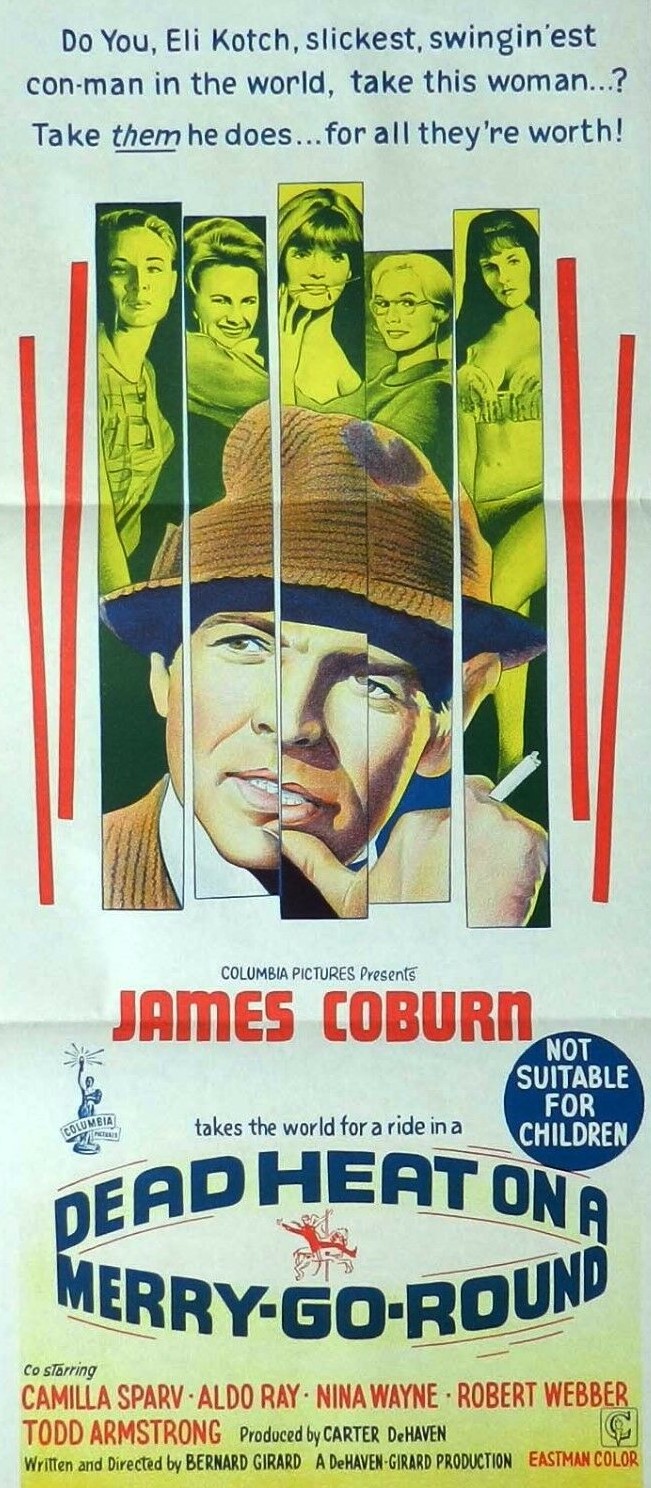
Dead Heat on a Merry Go Round (1966) ****

Highly entertaining woefully underrated heist picture with an impish James Coburn (Hard Contract, 1967), Swedish Camilla Sparv (Downhill Racer, 1969) in a sparkling debut and at the end an outrageous twist you won’t see coming in a million years. This is the antithesis of capers of the Topkapi (1964) variety. Not only is it an all-professional job, it takes a good while before you even realise the final focus is robbery or even the actual location. There are hints about the that event and glimpses in passing of material that may be used, and although the theft is planned to intricate detail, none of that planning is revealed to the audience.

The paroled Eli Kotch (James Coburn), who has seduced the prison psychiatrist, immediately skips town and starts fleecing any woman who falls for his charms. He changes personality at the drop of a hat, fitting into the likes of the mark, and in turn is burglar, art thief, car hijacker, in order to raise the loot required to buy a set of bank plans, and yet not above taking on ordinary jobs like shoe salesman to meet the ladies and coffin escort to get free travel across the country. So adept at the minutiae of the con he even manages to impersonate a hotel guest in order to get free phone calls.
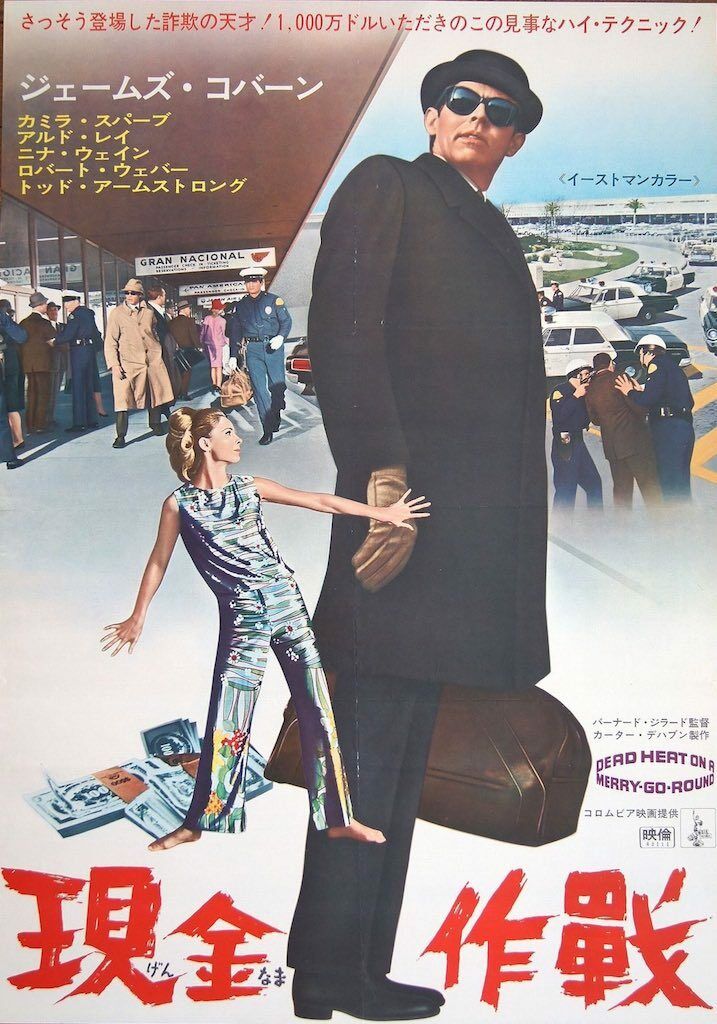
He enrols girlfriend Inger (Camilla Sparv) to act as an amateur photographer working on a “poetic essay on transient populations” to get an idea of sites he means to access. He manages to have the head of a Secret Service detail blamed for a leak. Everything is micro-managed and his final masquerade is an Australian cop with a prisoner to extradite which provides him with an excuse to linger in a police station, privy to what is going on at crucial points.

If I tell you any more I’m going to give away too much of the plot and deprive you of delight at its cleverness. The original posters did their best not to give away too much but you can rely on critics on Imdb to spoil everything.

This is just so much fun, with the slick confident Eli as a very engaging con man, the supreme manipulator, and almost in cahoots with writer-director Bernard Girardin (The Mad Room, 1969) in manipulating the audience. There are plenty films full of obfuscation just for the hell of it, or because plots are so complex there’s no room for simplification, or simply at directorial whim. But this has so much going on and Kotch so entertaining to watch that you hardly realize the tension that has been building up, not just looking forward to what exactly is the heist but also how are they going to pull it off, what other clever tricks does Kotch have up his sleeve for any eventuality, and of course, for the denouement, are they going to get away with it, or fall at the last hurdle. There is a great twist before the brilliant twist but I’m not going to tell you about that either.
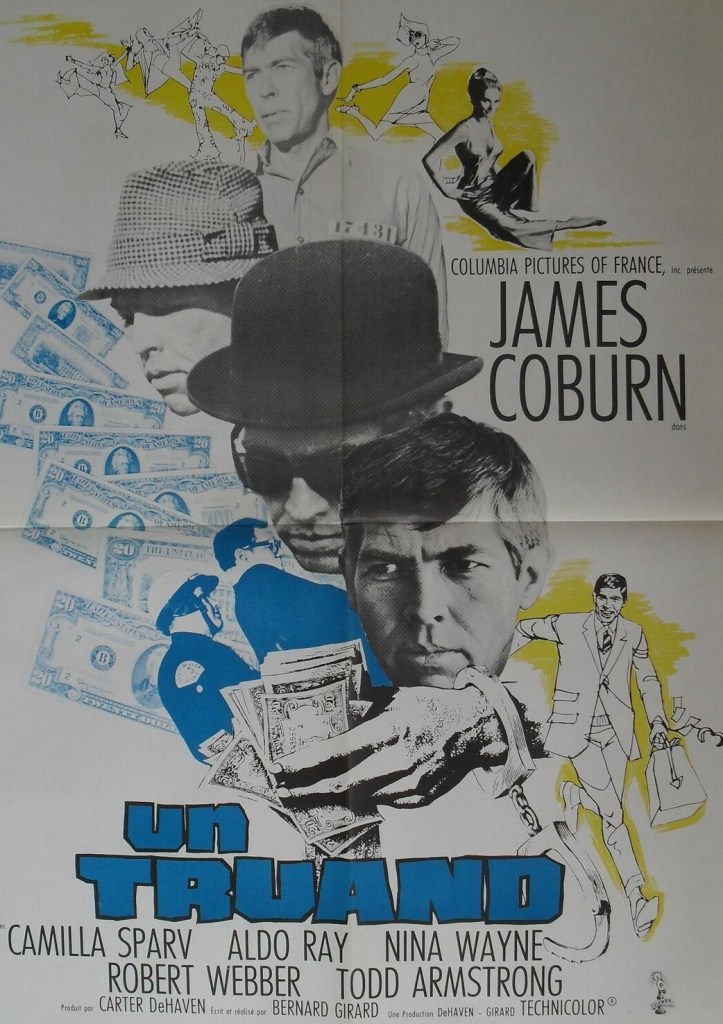
There’s plenty Swinging Sixties in the background, the permissive society that Kotch is able to exploit, and yet the film has some unexpected depths. You wonder if the memories Kotch draws upon to win the sympathy of his female admirers have their basis in his own life. You are tempted to think not since he is after all a con man, but the detail is so specific it has you thinking maybe this is where his inability to trust anyone originates.

Bernard Giradin was not a name known to me I have to confess, since he was more of a television director than a big screen purveyor – prior to this he had made A Public Affair (1962) with the unheard-off Myron McCormick – and Coburn was the only big star he ever had the privilege to direct. But there are some nice directorial touches. The movie opens with a wall of shadows, there are some striking images of winter, a twist on bedroom footsie, and jabbering translators. But most of all he has the courage to stick to his guns, not feeling obliged to have Kotch spill out everything to a colleague or girl, either to boast of his brilliance, or to reveal innermost nerves, or, worse, to fulfil audience need. There’s an almost documentary feel to the whole enterprise.

James Coburn is superb. Sure, we get the teeth, the wide grin, but I sometimes felt all the smiling was unnecessary, almost a short cut to winning audience favour, and this portrayal, with the smile less in evidence, feels more intimate, more seductive. This may well be his best, most winning, performance. Camilla Sparv is something of a surprise, nothing like the ice queen of future movies, very much an ordinary girl delighted to be falling in love, and with a writer of all the things, the man of her dreams.

The excellent supporting cast includes Marian McCargo (The Undefeated, 1969), Aldo Ray (The Power, 1968), Robert Webber (The Dirty Dozen, 1967), Todd Armstrong (Jason and the Argonauts, 1963) and of course a blink-and-you-miss-it appearance of Harrison Ford as the only bellboy (that’s a clue) in the picture. You might also spot showbiz legend Rose Marie (The Jazz Singer, 1927).
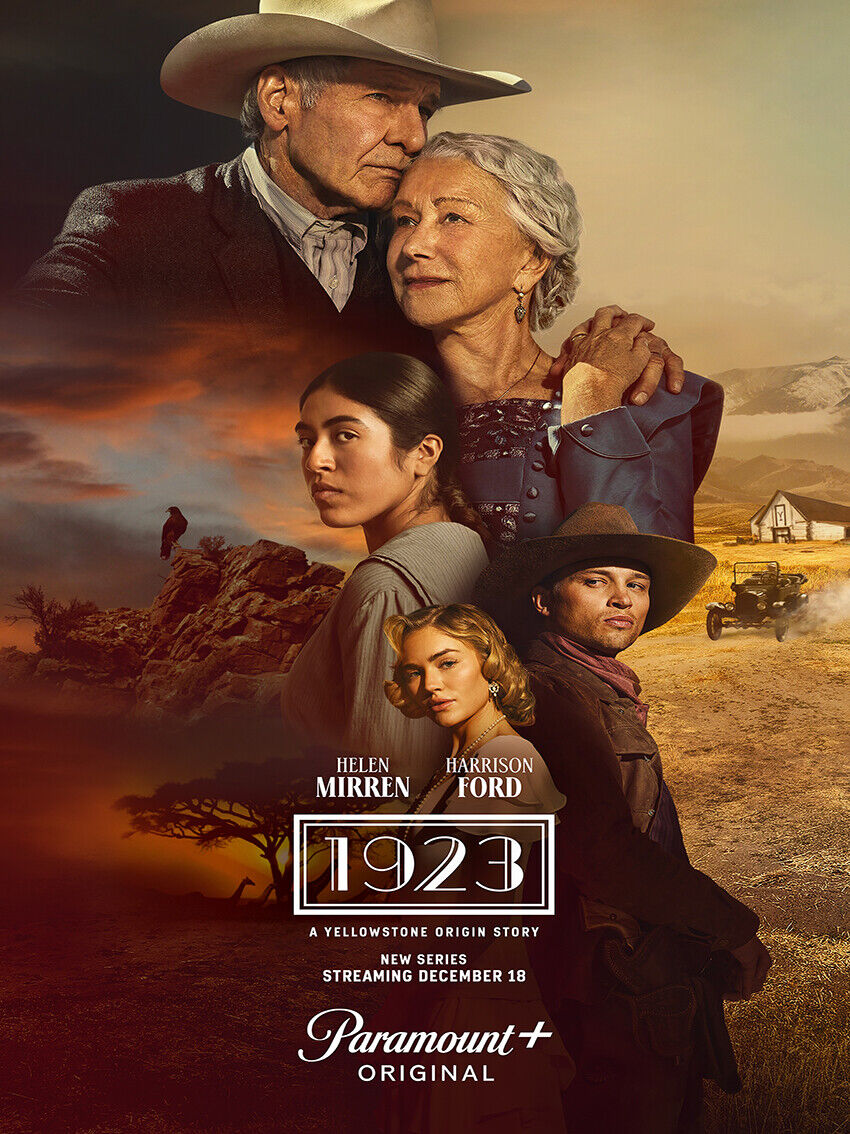
1923 (2023) ***

“The herd comes first,” says matriarch Cara Dutton reading the riot act to a rancher’s daughter. Except it doesn’t. We’ve got umpteen diversions before herd matters lumber into frame. We’ve got dodgy accents, dodgy sheep, dodgy big-game hunters, even dodgier priests and nuns, and you have the feeling that the opening episodes are trying to cram in as many characters (and narrative arcs) as possible at the same time as deciding which ones, for dramatic effect, to kill off or fatally wound.

Some whose purpose remains obscure get beaten half to death anyway, in a quite bizarre segment, Native American Teonna Rainwater (Amina Nieves) has her hands beaten to a pulp by hardass nun Sister Mary (Jennifer Ehle), who in turn receives the same treatment from headmaster Father Renaud (Sebastian Roche) before he thrashes the young lass until she bleeds. Then we’ve got Spencer (Brendon Sklenar) whose only way to put out of his mind the horror of machine-gunning half the German army in the trenches of World War One is to head off to Africa and start knocking off elephants, leopards and lions, who have the temerity to get in some rich guy’s way. He’s not even that good a tracker, failing to notice that it’s two leopards not one who have been picking off humans. Presumably, the leopards had some clever way of masking their footprints.

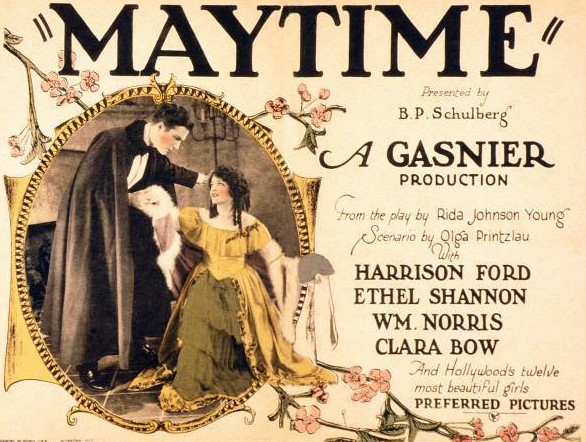
The original Harrison Ford in 1923 picture “Maytime.”

Because of his failing he doesn’t notice the other leopard creeping up on some dumb rich blonde who’s stupid enough to venture out of her tent for late night ablutions. Even more surprising, nobody digs him up for this and, in fact, instead, another far more intelligent blonde Alexandra (Julia Schlaepfer) takes a shine to him – perhaps because he has the temerity to call her Alex – and soon they are sharing a tree to escape marauding lions and hyenas.

And while I’m being picky, what kind of rancher’s daughter, Liz Stafford (Michelle Randolph), doesn’t know that “the herd comes first” and kicks up a ruckus when cattle take precedence over her impending marriage to Jack Dutton (Darren Mann).

You’ll probably be aware that this is a prequel-sequel (taking place before Yellowstone but after 1873) so I suppose you can expect some confusion as the series struggles to get all its ducks in a row. Throw in Prohibition, possibly to explain why machine guns are so easy to come by.

Anyway, the central narrative, once you’ve managed to put all these interruptions to one side, is that there’s a drought and tough ornery patriarch Jacob Dutton (Harrison Ford) isn’t inclined to share his lush pastures with the neighboring sheep farmers led by Banner Creighton (Jerome Flynn). But if in Yellowstone the ranchers occasionally had to abide by the law, here they take advantage of more lawless times and it’s not long before sheep farmers are being lynched. And it’s not long before revenge becomes the order of the day, the various Duttons ambushed in episode three, some so badly you might have believed this was the kind of horror film where you had to guess who lived and died. If Cara is anything to go by, nobody crosses the Duttons, as witnessed in the opening scene where she brutally guns down a fleeing wounded man.

I caught the first three episodes courtesy of British Airways when I was returning on the red eye from a trip to Los Angeles and had enjoyed what I had seen of Yellowstone (catching it on DVD rather than Paramount Plus) so I was looking forward to some slow-burn drama with electrifying acting.

What I got was a mini-series-by-numbers, unlikely development heaped on unlikely development, characters with no room to maneuver and closed-off from any arc and nothing of the freshness of the original. I’m so used to Harrison Ford turning off the charm by now and reverting to his grumpy old man persona and to Helen Mirren going tough that this almost seemed like routine. The two other love duets were just cliché. The white hunter and the English grand dame, and the spoiled rancher’s daughter with little to do but wail about how the cattle that brought her such prosperity were spoiling her life.

I had expected that I would enjoy such a tantalising glimpse of a new series that I’d be obliged to sign up for the streamer the minute I got home. But I think I can just as easily do without.

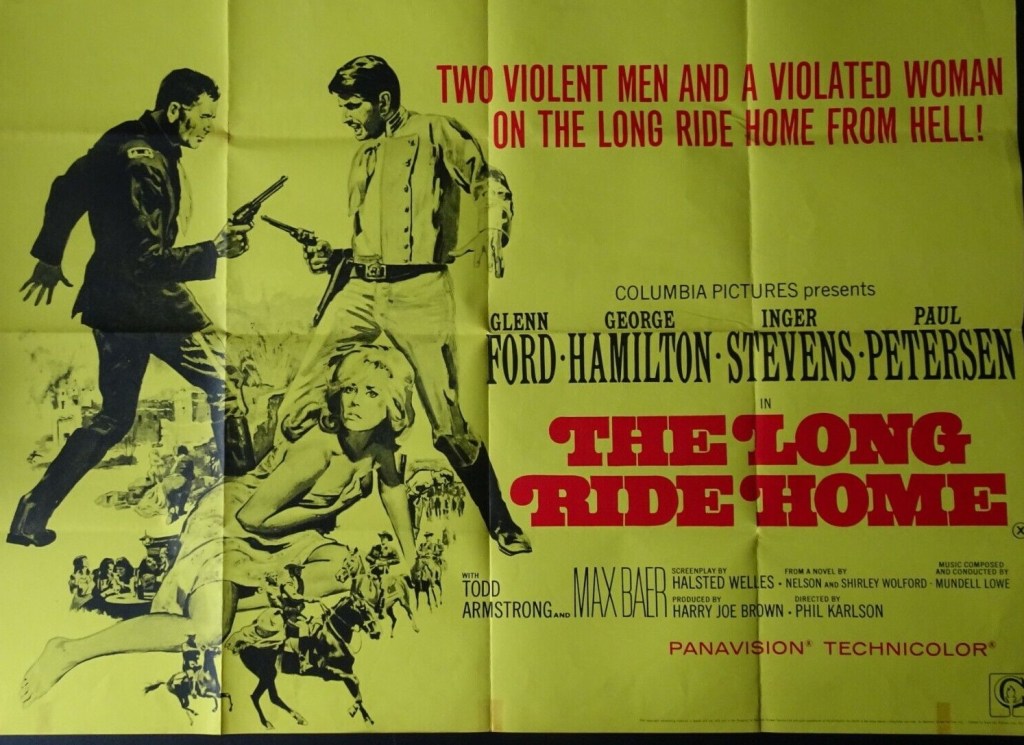
A Time for Killing / The Long Ride Home (1967) ****

The American Civil War is often slotted into the wrong genre. It is not a western. It is a war, with all the inherent wrongheadedness, viciousness and atrocity. We begin with senseless execution and end on a note of humiliating barbarity. Along the way we witness easily the greatest performances in the careers of George Hamilton (The Power, 1968) – a wonder after this how he was ever associated with playboy characters – and Inger Stevens (Firecreek, 1968).

At the tail end of the war in a Confederate POW camp, the disciplinarian commander orders raw recruits to execute an escapee. When they fail to find to the target Major Wolcott (Glenn Ford), witnessed by appalled missionary fiancée Emily (Inger Stevens), steps in to finish the job. In the wake of this Wolcott sends Emily away under escort.

POW leader Captain Bentley (George Hamilton), fully aware the war might end in days, but determined to escape to Mexico and continue the fight, organises a breakout. Instead of sneaking out quietly, in revenge he turns the Union cannons on his captors. And despite being better informed how close the war is to an end, the dutiful Wolcott sets off in pursuit.

Bentley ambushes Emily’s escort, killing the soldiers and stealing their mounts, but promising Emily that as befits a Southern gentleman he will respect her honor. She’s not so innocent of war, anyway, begging Bentley to kill a fatally wounded Union soldier rather than leaving him to the buzzards or, one assumes, marauding Apaches.

Unfortunately, his comrades don’t share that sentiment and when Emily makes the mistake of unloosing her blouse to wet her neck at a stream it inflames their lust. Equally, unfortunately, Emily doesn’t keep to her part of the deal and in attempting to escape hits Bentley a humiliating blow with his own saber.

While unfamiliar with the territory, Wolcott is a pretty good soldier, taking a shortcut over the mountains to cut off their retreat. “How come he knew what we were gonna do before we done it,” wails a Confederate soldier. “Before you even thought it,” snaps the over-confident Emily.

A few miles from the border, the Confederates hole up in a bordello where Bennett finds a despatch announcing the war is over. Ignoring the fact that for the ordinary soldier you couldn’t find a better place to celebrate peace than in a whorehouse, and determined to continue the war, Bennett conceals the information.

In revenge for losing face in front of his soldiers, he (luckily off camera) rapes the half-stripped and bloodied Emily. In the manner of every savage taking advantage of wartime conditions, Bennett tells her, “You think nothing like this can ever happen to you. But you’re lucky because your humiliation will be over soon. You and your major are going to know I won.”

Rape, as currently in the Ukraine and as in many previous conflicts, used as a weapon.

When Wolcott arrives, it’s obvious what has happened and while holding a lid on his own emotions (a Glenn Ford hallmark), once he has proof the war is over, he refuses to give chase. Brutally, he tells her,  “I can see (witness) men die for their country but I can’t see them die for your honor.” It’s Bennett who, oddly, comes to her rescue, opening fire on the Union soldiers, compelling Wolcott, in breach of the rules of war, to cross the border into Mexico in pursuit.

This isn’t a typical Glenn Ford (The Pistolero of Red River/The Last Challenge, 1967) picture where he plays the central character and is scarcely off screen. Here, he disappears for long stretches as the camera focuses on George Hamilton, his squabbling gang and the growing tension between him and Inger Stevens. If you’ve only seen Hamilton in his screen playboy persona, this is a revelation as honor and misguided duty turn into repulsive action.

And this is by far the best performance by Inger Stevens. What she achieved here launched her career, although admittedly as a female lead rather than top-billed star. The emotion her face portrays without the benefit of dialog is quite astonishing. Expecting to be an innocent bystander, unexpectedly thrown into the tumult, physically abused, and then, contrary to her Christian beliefs, she goes from stalwart to victim to, against her Christian principles, showing no sign of turning the other cheek but in full Old Testament mode urging revenge.

The scene when Emily enters a room full of soldiers, attempting to retain some dignity in the face of torn clothes and bloodied face, while acknowledging her humiliation, is stunning. The only scene that comes close to matching its power is at the end, the sequence shot from above, light streaming into a darkened cellar, when, having killed Bennett, Wolcott abandons his potential bride.  

Phil Karlson (The Secret Ways, 1961), a stand-in for original director Roger Corman, does an excellent job of focusing on the brutalities of war, not just the rape and violence, but the recruits, as dumb as they come on both sides, who fail to cope with the pressures. You would have to be fast to spot Harrison Ford (billed as Harrison J. Ford) making his screen debut, but Harry Dean Stanton (Cool Hand Luke, 1967) has a bigger role. Halstead Welles (The Hell with Heroes, 1968) wrote the screenplay based on the novel The Southern Blade by Nelson and Shirley Wolford.

A couple of later westerns might have raided this picture for ideas: continuing the fight in Mexico was the focus of The Undefeated (1969); a constantly carping pair who delight in slaughter evidenced in The Wild Bunch (1969); relentless pursuit a constant theme of 1969 westerns as diverse as Butch Cassidy and the Sundance Kid, True Grit, The Wild Bunch, Mackenna’s Gold and Once Upon a Time in the West.

Regard this as a western and you will be disappointed. Take it more seriously as a war picture and it offers far more. I’m probably being a tad generous in giving it four stars but I was knocked out by the performances of Hamilton and Stevens and a number of excellent scenes, the two in particular mentioned above for example, and the dialogue.

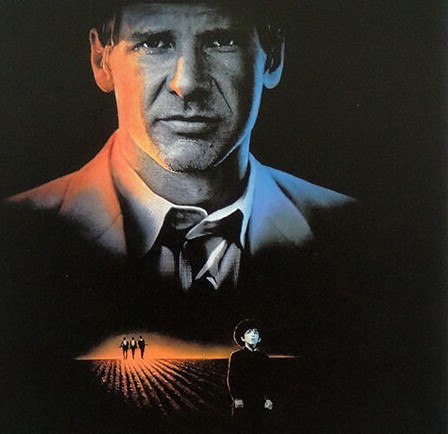
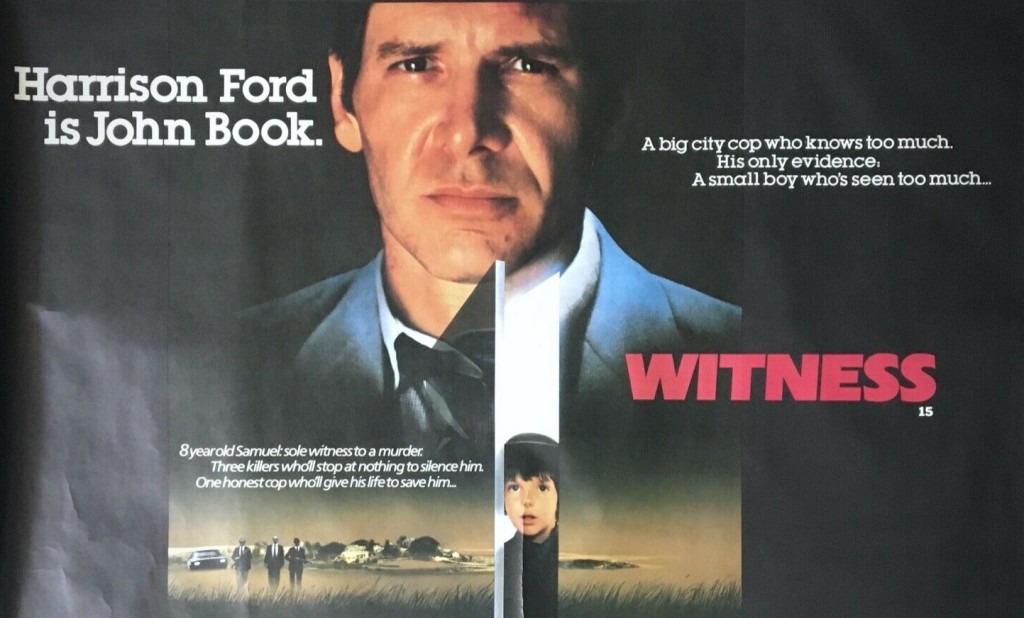
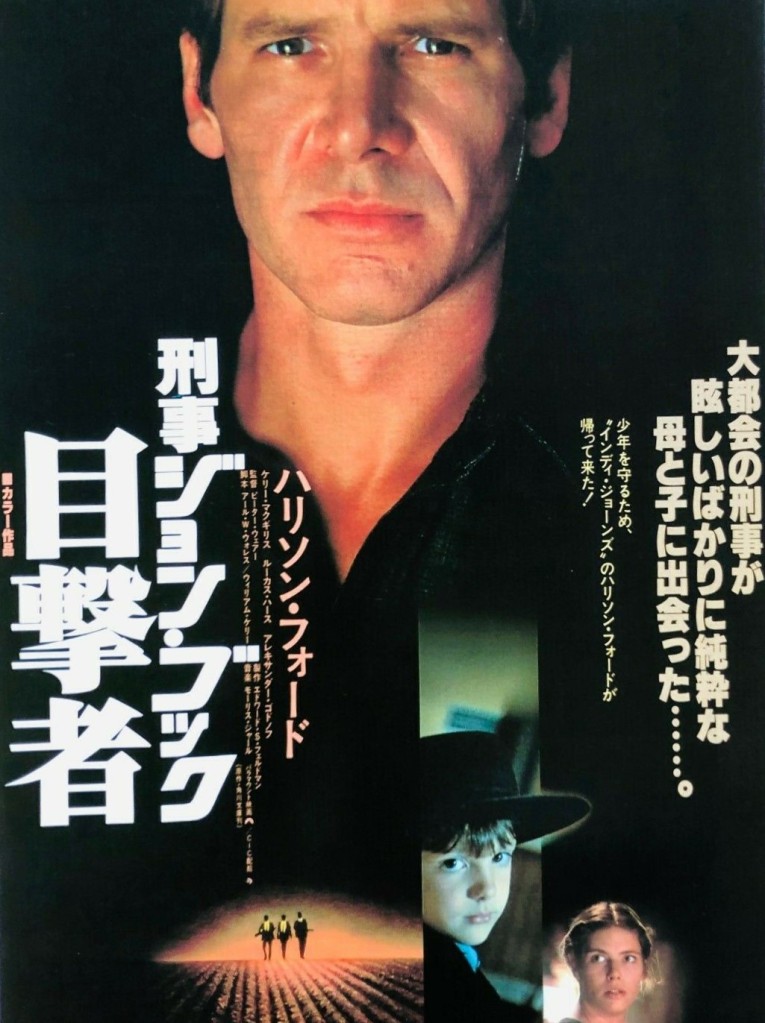
Witness (1985) *****

The Casablanca of the crime thriller, a stone cold classic in which impossible love takes precedence over unusual situation. In the Bogart-Bergman picture it is expatriates in war-torn North Africa, here a cop protecting an innocent boy hides out among the Amish. Like The Rock, this is so good the director makes the audience wait for a first sighting of the star while exploring the other main characters and the unique backdrop, in this case the customs and dress code of a religious cult that shuns the modern.

Adding to the paranoia rampant in American cinema in the 1970s/1980s is a further element – the hunted man or, in this case, boy. There’s no mystery in this thriller, 20 minutes in we know the culprit, involved in a criminal conspiracy so powerful it cannot be fought. And unlike the bulk of cop movies it’s not set in a city but in the country.

Just-widowed Rachel Lapp (Kelly McGillis) and eight-year-old son Jacob (Lukas Haas) set out by train to Philadelphia where the boy witnesses a brutal murder. Questioned by  Detective John Book (Harrison Ford), we discover by accident the killer is cop Lt McFee (Danny Glover). Reaching out to trusted mentor Police Chief Paul Schaeffer (Josef Sommer) only to discover he is implicated, Book flees back to Amish country, where a gunshot wound prolongs his stay.  

Distrusted as an uncouth “English,” liable to violence the Amish abhor, Book, with a range of carpentry skills, soon finds himself at home. Drawn to Rachel, passions simmer, but in this collision of cultures she cannot leave and he cannot stay. Without the cop background this would be a beautifully rendered love story, but the daily danger of the hidden being located  heightens already tense emotions.

The examination of the Amish lifestyle is faultless. Transport is horse and cart, though sometimes that is with almost balletic assurance, there is no electricity, the community works together but threatens exclusion for disobeying strict rules. In compliance, Book dons the typical Amish outfit of plain black jacket and straw hat, buttons forbidden. And it is only when he breaks out of such strictures that his charges are threatened.

While the violence is powerful and when the time comes Book has a ruse or two up his sleeve, the most memorable scenes are as far removed from the crime thriller genre as  possible. First is when Rachel enjoys a tentative forbidden dance with Book. Then there is the love scene where he watches her wash her naked torso, desire written over each face. Finally is building the barn where in quiet but obvious ways Rachel reveals her growing feelings for Book while with hammer and saw he helps put together the structure to the soaring strains of Maurice Jarre’s most magnificent composition.

Director Peter Weir (Dead Poets Society, 1989) excels in observation, a scene between Rachel and wooing farmer (Alexander Gudonov) takes place in silence, women whispering declaim attitudes to Rachel, her father Eli (Jan Rubes) waking Book before dawn, and several scenes of meals. Since restraint is the watchword, Weir draws exceptional performances from both principles, Harrison Ford (Blade Runner, 1982) receiving his only Oscar nomination, McGillis (Top Gun, 1986) nominated for a Bafta, likewise her only recognition at this rarified strata. Josef Sommer (Silkwood, 1983) is good as the ruthless but tormented corrupt cop, and both ballet dancer Alexander Gudonov and Viggo Mortensen (Green Book, 2018) make Hollywood debuts. Lukas Haas is as wide-eyed as they come.

Although nominated for eight Oscars, including Best Picture, Director and Music, it only picked up two, for editing and for an outstanding screenplay by William Kelley and Earl W. Wallace, both known almost exclusively as television writers.

An authentic, heartbreaking, multi-layered, adult picture like this is very hard to come by.

Discover WordPress

A daily selection of the best content published on WordPress, collected for you by humans who love to read.

The Atavist Magazine

by Brian Hannan

WordPress.com News

The latest news on WordPress.com and the WordPress community.