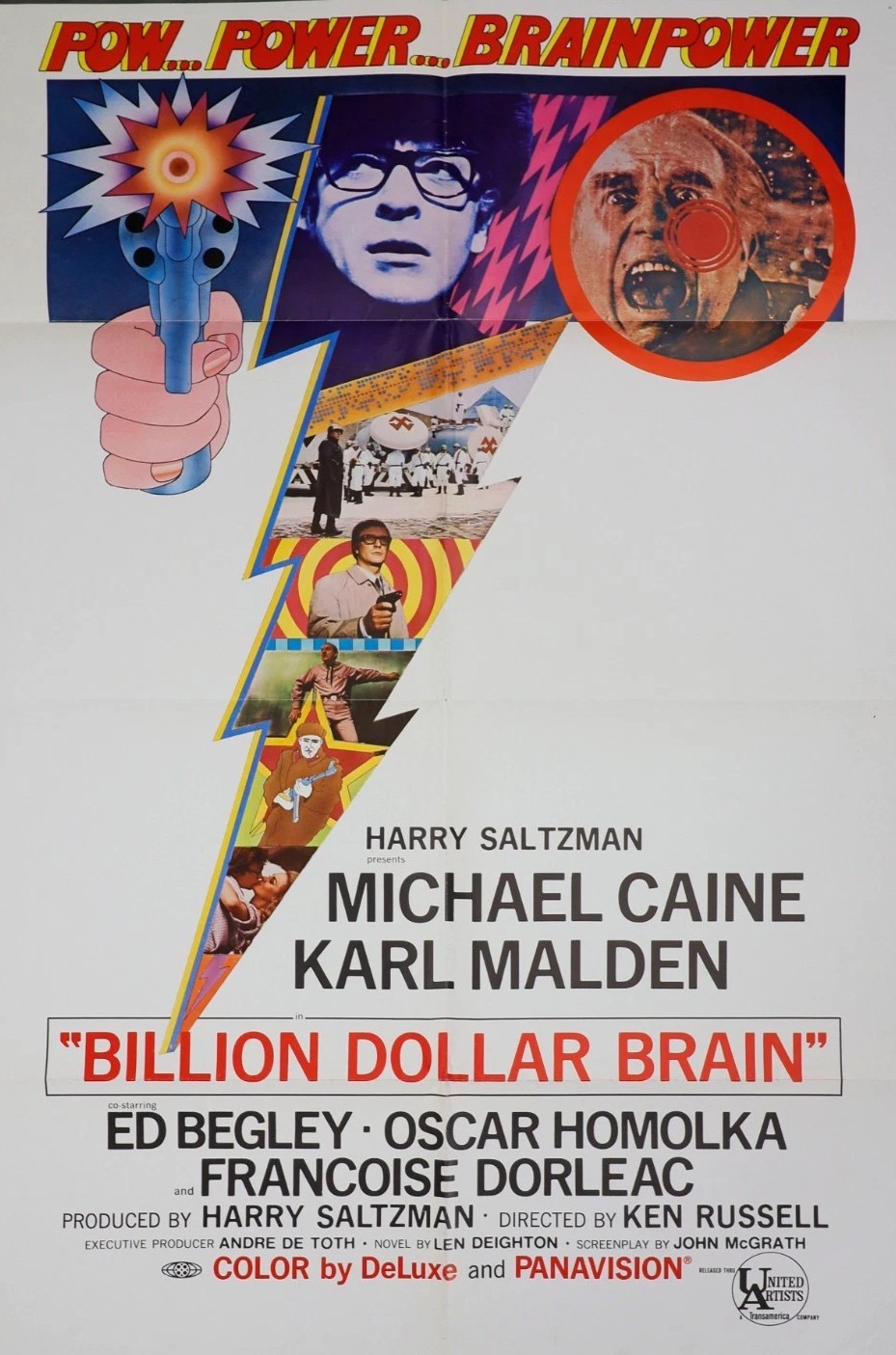
Billion Dollar Brain (1967) ***

Could have been the greatest espionage movie of all time except for one thing – excess. Now director Ken Russell would soon make his reputation based on sexual excess – Women in Love (1969), The Devils (1971) etc – but here he takes self-indulgence in a different direction. The plot is labyrinthine to say the least, and Finland proves to be dullest of arctic locations, no submarine emerging from the ice to liven things up as in Ice Station Zebra (1968), just endless tundra.

Setting that aside, there are gems to be found. Author Len Deighton ploughed a different furrow to Ian Fleming (Goldfinger, 1964) and John le Carre (The Spy Who Came in from the Cold, 1965), none of the glitz of the former nor the earnestness of the latter. He was more likely to trip a narrative around human foibles. And so it is here.
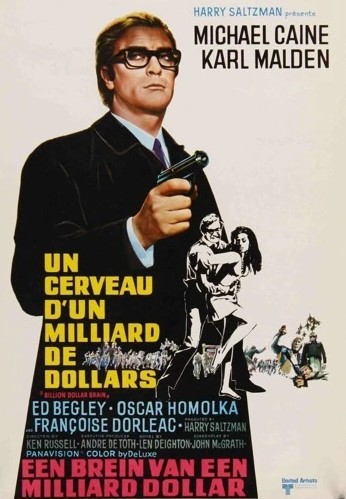
For a start, our hero Harry Palmer (Michael Caine) is the MacGuffin and then is duped – three times. Firstly, he is the reason we end up in Finland in the first place, having responded to an anonymous message and the promise of easy money. Then, in the most foolish action ever to befall a spy, he falls in love with the mistress Anya (Francoise Dorleac) of old buddy Leo (Karl Malden). Finally, he is shafted by former employer Col Ross (Guy Doleman) and generally given the runaround by Russian Col Stok (Oscar Homolka), reprising his role from Funeral in Berlin (1966).

Unlike the previous Harry Palmer iterations, that began with the splendid The Ipcress File (1965), there’s a techie megalomaniac on the loose, General Midwinter (Ed Begley) – think Dr Strangelove on speed – who’s not so intent on world domination as flattening the Soviets, which more or less amounts to the same thing.

Midwinter provides the movie with considerable technological foresight, his billion-dollar computer prefiguring the way in which we have allowed technology to rule our lives, and, unlikely though  it seems, perhaps provided the inspiration for the serried ranks of Stormtroopers from Star Wars (1977).
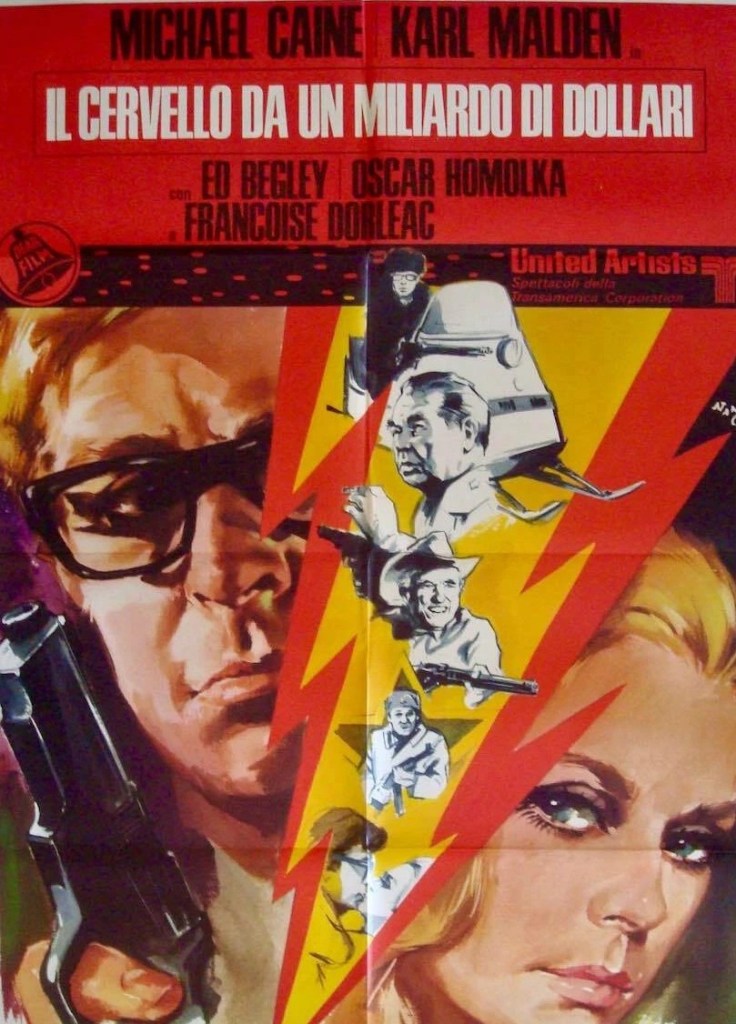
For the most part, lovelorn Palmer is led a merry dance and relies on a deus ex machina in the shape to Col Stok to put an end to Midwinter’s potential Russian uprising. A rebellion was always going to be a tad dicey because Leo has stolen all the money Midwinter provided for him to set up an army of Russian dissidents. Leo thought it made more sense for the cash to be put to better use, namely investing in high living and a glamorous mistress. There we go with the old human foible. But Palmer can match him there, not quite having the brains to realize that a beautiful woman who can play Leo so well could also play him.

There’s a marvelous pay-off where we discover that in the middle of the male-dominated espionage shenanigans, it’s Anya who turns out to be the clear winner. In a terrific scene she takes the case containing the secret McGuffin from Leo rushing to board her train then, with her hands on the valuable cargo, kicks him off the train. And once she has trapped a foolish British spy, who has let his emotions get the better of him, is apt to poison him.

There’s some distinct Britishness afoot. Complaints about salary and endless bureaucracy abound. And there’s a piece of pure Carry On when, in a sauna scene, the camera manages to put objects or bodies in the way of Anya’s nudity. One-upmanship doesn’t get any better than Col Ross smirking when he tricks Palmer into returning to work for him.

Smirking is in the ascendancy here. Palmer smirks at the folly of Leo in believing that the young beauty is after him for anything but his money and his access to potentially dangerous toxin. Anya doesn’t need to laugh behind the backs of the two men she has so easily duped when she can enjoy sweet revenge right to their faces.

Once you get to the end, you can more appreciate the content, although, like me, you probably wished the director could have got a move on, and thought he should have done a lot better in the climactic scene than toy trucks falling into Styrofoam blocks of ice.

The tale isn’t on a par with the previous two, Deighton being more at home with cunning adversaries rather than overblown megalomaniacs, but everyone, with the exception of Anya and Col Stok – i.e. the bad guys – are too easily taken in. Technically, Palmer wins the day, but that’s only to fulfil the requirement that the good guy must appear to win even if the good guy in this instance is smeared all over with impotence and folly.

The camera loves Michael Caine (Gambit, 1966) so there’s no problem there especially as by and large he’s wearing his cynical screen persona. Karl Malden (Nevada Smith, 1966) has a ball, especially as this must be the only time he gets the girl. Ed Begley (Sweet Bird of Youth, 1962) and Oscar Homolka over-act as they should, but Francois Dorleac (The Young Girls of Rochefort, 1967), in her final role, steals the picture from under all of them.

Directed by Ken Russell as if he kept his editor at bay and written by Scottish playwright John McGrath (The Bofors Gun, 1968) in his big screen debut.

So a very interesting twist on the spy picture but be warned before you go in that it takes quite a while to get there.

The Ipcress File (1965) *****

Stylish take on the espionage genre when it was still in its infancy and could accommodate stylish directors like Sidney J. Furie (The Appaloosa, 1966). Eschewing the bombastic effects and villains of the James Bond series, relying more on intrigue and the elements of betrayal that other practitioners of the dark arts such as John Le Carre espoused, this is as much a character study and presents in some cases a fairer picture of the class struggle in Britain than most kitchen-sink dramas. So it’s either going to put you off entirely or make you appreciate the film more when I tell you that my favorite scene is the fistfight between Harry Palmer (Michael Caine) and shaven-headed thug Housemartin (Oliver MacGreevy) outside the Royal Albert Hall in London that is shot entirely through the windows of a traditional red telephone box. You can’t say bolder than that.

The credit sequence, more famously ripped off by William Goldman for private eye saga Harper/The Moving Target (1966), is equally inspired. An alarm clock wakes Palmer, he reaches out for the girl who shared his bed last night to discover she is gone and then punctiliously and as if time-shifted to the twenty-first century when it would be the norm proceeds to grind fresh coffee beans, fill a cafetiere with only as much liquid as would constitute a small espresso, dresses and last but not least searches among the disturbed bedclothes for his gun.

Palmer is transferred from dull surveillance duties to a team hunting for missing scientists. Given both his insolent and insubordinate manner, he is not expected to fit in to a service riddled with the upper-classes. His new superior Dalby (Nigel Green), a “passed-over major,” owes his present situation to Palmer’s former boss Colonel Ross (Guy Doleman) and both sport three-piece suits, bowler hats and umbrellas and speak in those clipped tones that invariably carry undertones of menace. Where James Bond’s front, the import-export business, is rather more upmarket, here the background is considerably downmarket, Dalby masquerading as the owner of an employment agency and distributor of fireworks. It is insatiably bureaucratic, reams of forms to be filled in. What Palmer has in common with James Bond, beyond fisticuffs, is the ability to think outside the box and in this case picks the brains of a policeman friend to track down the wanted villain, code-named Bluejay (Frank Gatliff)  

As in the best post-Bond espionage, there are traitors everywhere, and the departments employing spies tend to employ other spies to spy upon them, though in this case Palmer has the luck to draw the sexy Jean (Sue Lloyd). When Palmer picks up the trail of Ipcress, the plot thickens. There is no shortage of action, a gun battle, fisticuffs, but it presents a different approach to modern espionage, with a properly rounded hero – one who can cook (as did author Len Deighton who wrote a cookery column) for a start – while the ladies, with whom he shares a roving eye with Bond, are not required to turn up in bikinis.

There is deft employment of that favorite British cultural emblem – irony – and one wonderful scene takes place in a park where Dalby taps his cane in appreciation of a brass band. Throw in a bit of brainwashing and it’s a completely different proposition to Bond who could escape such a dilemma in a trice. There is a clever ending.

Michael Caine (Hurry Sundown, 1967), complete with spectacles, is superb as Palmer, making enough of an impression that the series ran for another  four episodes. The stiff-upper-lip brigade have a field day in Nigel Green (Jason and the Argonauts, 1963) and Guy Doleman (Thunderball, 1965), the latter shading it with his purported sense of humor. Sue Lyon (Corruption, 1968) is excellent as the seemingly unattainable gal who falls within Palmer’s purvey but not entirely due to his charm. The villains, too, are not from the James Bond school of cut-outs, but come across as equally human, and the chief rascal you could argue has the most finely developed sense of humor of the lot. Throw in Gordon Jackson (Danger Route, 1967) and Freda Bamford (Three Bites of the Apple, 1967) as the bureaucratic attack-dog Alice and you have a very well cast movie.

Sidney J. Furie divided critics. Some believed he was ahead of his time, others that he was in thrall to arty French directors, and a reasonable number who didn’t give a stuff as long as he delivered the goods. But his predilection for odd angles here proves a strength, his  compositional excellence also spot-on, one scene in particular where in a library Palmer looks down on the villain with Housemartin on a landing between. And he takes great delight in emphasizing the class distinctions, both bosses have huge offices with a small desk in the corner, and when Ross places briefcase, umbrella and bowler hat on the desk of Dalby it could not be a more clear invasion.

And you can’t forget the score by espionage doyen John Barry (Goldfinger, 1964). W.H. Canaway (A Boy Ten Feet Tall, 1963) and James Doran, making his movie debut, adapted Len Deighton’s classy bestseller but a fair amount of polish was added by thriller writer Lionel Davidson (Hot Enough for June, 1964), Johanna Harwood (Dr No, 1962), Lukas Heller (The Dirty Dozen, 1967) and Ken Hughes (Arrivederci, Baby, 1966).    

A spy classic.

Discover WordPress

A daily selection of the best content published on WordPress, collected for you by humans who love to read.

The Atavist Magazine

by Brian Hannan

WordPress.com News

The latest news on WordPress.com and the WordPress community.