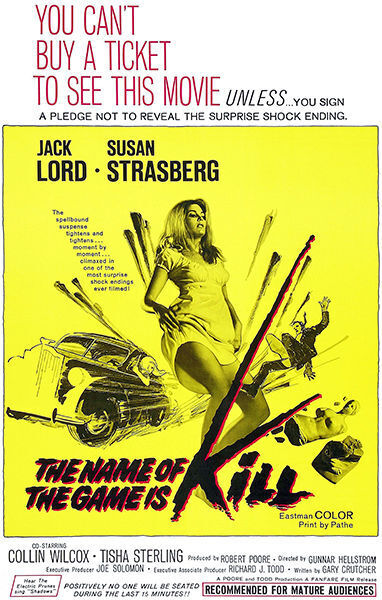
Surprisingly effective thriller headlined by Jack Lord (Dr No, 1962) and providing Susan Strasberg (The Sisters, 1969) with a more complex role than hitherto.
Hungarian drifter Symcha (Jack Lord) hitches a lift in the desert with Mickey (Susan Strasberg), one of three sisters living with their mother (T.C.Jones) and running a filling station in a backwater. And before you can say Bates Motel, it’s clear not all is right. Youngest sister Nan (Tisha Sterling) keeps a rattler and a tarantula as pets and has the awkward personality trait of tending to set cats on fire.

Oldest sister Diz (Collin Wilcox Patton) eyes up the visitor for herself, even though Mickey is clearly hell-bent on him and is short in the fiancé department, her last boyfriend mysteriously disappearing. There’s more than a hint of the later The Beguiled (1970) in that each of the girls, Nan the most blatant, Diz the most persistent, shows keen sexual interest in the visitor.
And there’s some mystery, too, about the dead father. Everyone has a different tale to offer: he was murdered and incinerated by the mother; he committed suicide; he was run over by Nan. It’s this take-your-pick element that throws Symcha, though, admittedly, his brain might be addled after surviving a hit-and-run. Three days in a coma and all he has to show for it is a plaster on his head. He would need to be dumb, or just lusting after Mickey, to return to the house after that.
He makes no bones about being incapable of love, after witnessing friends and family slaughtered after the Hungarian Revolution of 1956. He “wants” her, but doesn’t commit to love. Mickey, in the manner of such romantics, reckons he’ll soon fall into a swoon over her. “Don’t let your past ruin our future,” she opines, in one of several good lines in the picture. “You have a sick mind,” Mickey tells Diz. “No,” she retorts, “I have a sick sister.” The bulk of the good lines are the family taking verbal chunks out of each other so tension is kept high.
Mostly, Symcha’s job is to act like an involuntarily detective, getting close enough to each of the women to let them spill their secrets, though he’s less adept at working out what’s the truth. Is Mickey a “cheap lay” or virginal? Did Julio, the aforementioned fiancé, disappear once he realized what he was letting himself in for, or was he done away with?
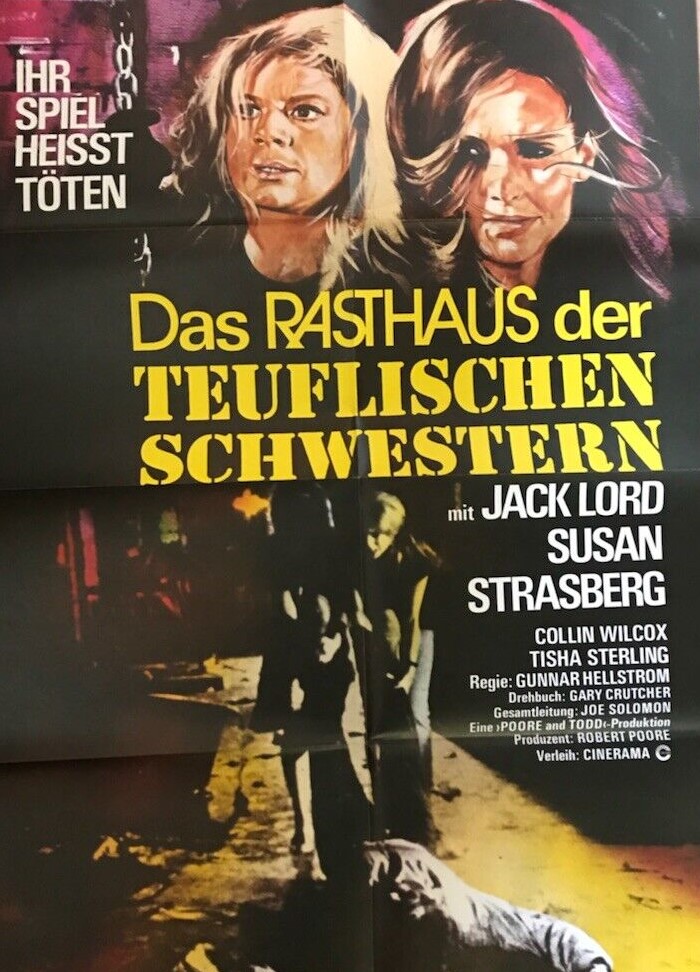
And Symcha’s even less adept at looking after himself. There’s a kind of clever gender switch here. It’s usually the girl who’s foolish enough to return to the haunted house, or who doesn’t recognize danger, or who lets love (in this case, lust) get in the way of rational decision.
Family here is the disturbing element. Anyone attempting to break it up – by heading for San Francisco for example with one of them – is viewed as a threat.
You’ll probably guess the ending from two unnecessary giveaways at the beginning and a flaw in the make-up department, but, in fact, though the poster pleads with you not to give away the ending, it doesn’t say which ending it’s referring to. For this ends with a bang, three twists in quick succession. And don’t be tempted to switch off before the final freeze-frame (I always did wonder where Butch Cassidy and the Sundance Kid, 1969, got that idea).
Swedish director Gunnar Hellstrom (Just Once More, 1962) cleverly plays with expectations. He has you thinking, from the way Symcha makes his intentions clear, and from his wandering eye, that he’s the predator descending on a bunch of vulnerable women. He’s got that strong masculine air. He’s soft-voiced, too, and that carries a greater aura of confidence (ask Clint Eastwood) than a loud-mouth more physically-dominant specimen. But it soon becomes clear he might have stumbled into a web.
Jack Lord is more impressive than I expected and if he hadn’t gone straight from this into a dozen years of Hawaii Five-O (1968-1980) he might have blossomed into a decent male lead in the movies. Susan Strasberg gets to run up an entire scale of acting notes, showing that she is far more accomplished and deserved more than just supporting roles.
But everyone gets their moment in the sun. Tisha Sterling (Coogan’s Bluff, 1968) is good, a mixture of temptation personified and dangerous instinct. Collin Wilcox Paxton (The Baby Maker, 1970) as the dominant sister sometimes overacts to express that character trait, but that’s not to the movie’s detriment as sometimes it is a bit too low-key. Screenwriter Gary Crutcher (The House of Zodiac, 1969) ran with the rattler notion in Stanley (1972).
Would have been more suspenseful minus the early give-aways.
Damn good for a B-picture.
Catch it on Amazon Prime.
 The Magnificent 60s