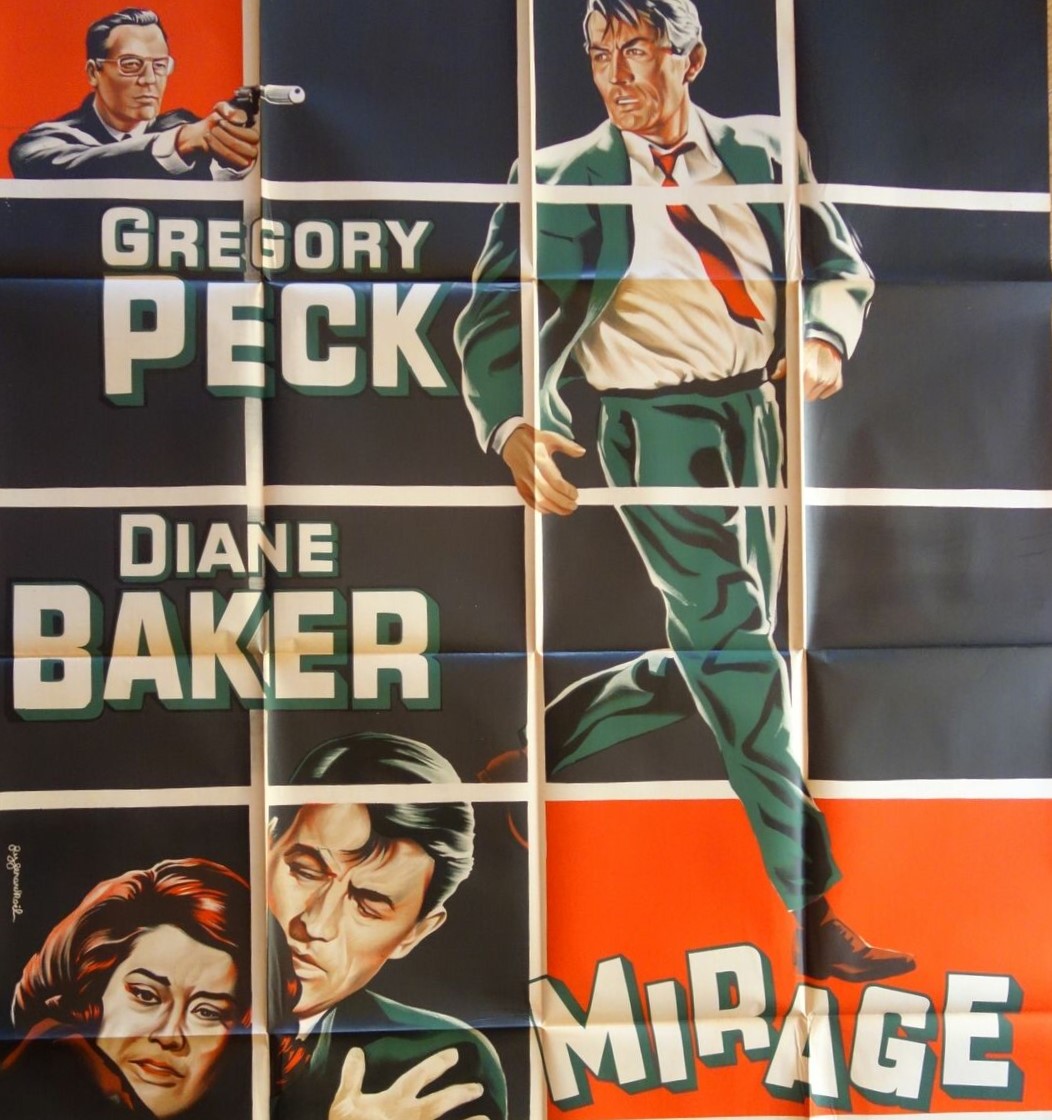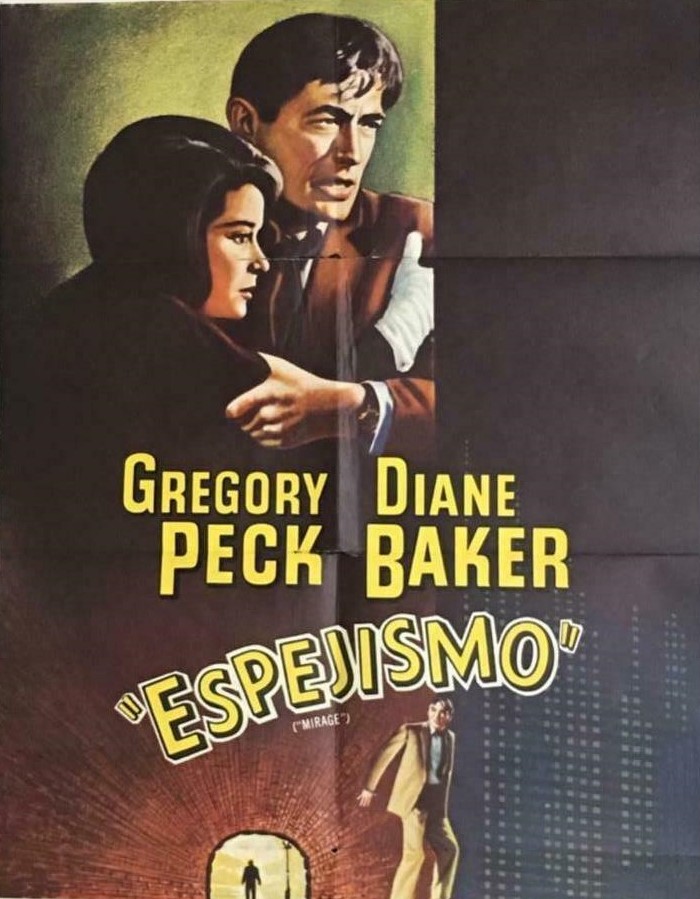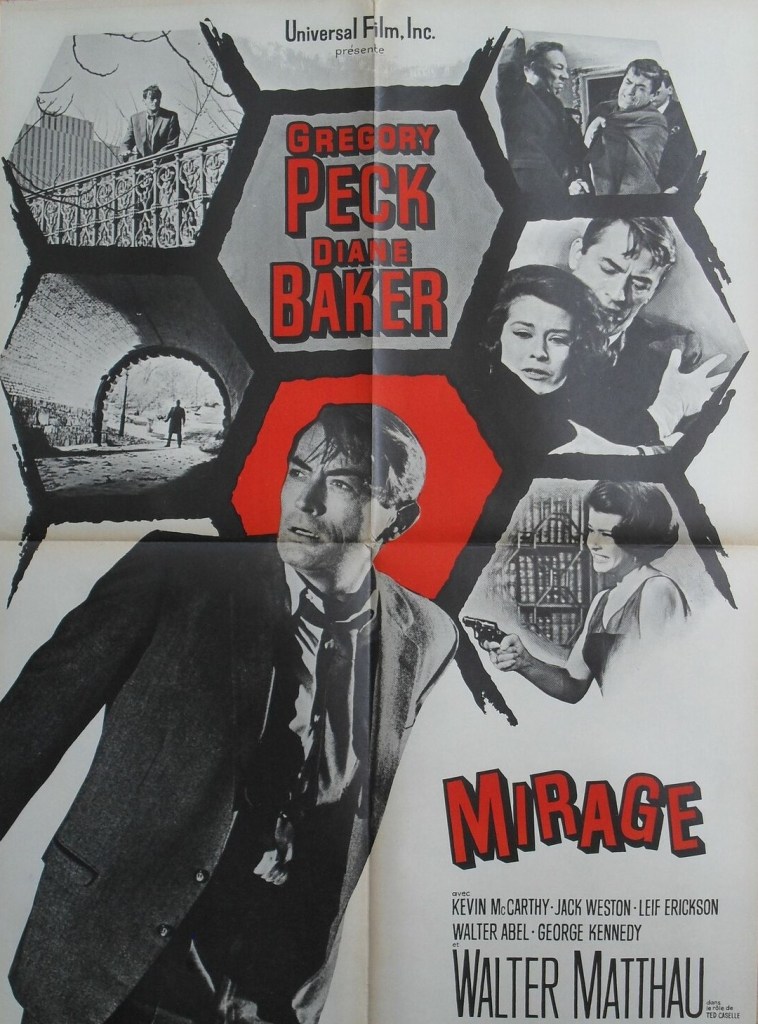
Mirage (1965) ****

“I owe you some pain,” barks the heavy to hero in one of the memorable lines in this classy thriller with surprisingly contemporary overtones. Underlying this tale of amnesiac David Stillwell (Gregory Peck) recovering his memory are themes of personal commitment, commitment to cause (“if you’re not committed to anything you’re just taking up space”), of individuals taking a stand against powerful forces seeking to thwart democracy, and of malevolent pandemic, the oldest of them all, greed, that infects even the most philanthropic enterprises.

The structure is brilliant. To every question David Stillwell (Gregory Peck) asks in trying to establish his identity, the answers are mystifying. He doubts his sanity and is plunged into a  life-threatening conspiracy.   

The film opens superbly. The camera pans across a New York skyline at night, every skyscraper lit up. Suddenly, one of the buildings goes dark. Cut to confusion inside as workers deal with the electricity cut-out. Among them Stillwell who is surprised to meet a woman on the stairs, Shela (Diane Baker), who not only recognizes him but seems to know a lot about him that is unfamiliar to him. They end up in the fourth level of the basement and on leaving discover that Charles Colvin (Walter Abel), a name that’s only vaguely familiar to Stilwell, has committed suicide by jumping from the building.

When he gets home to his apartment he is accosted by gunman Lester (Jack Weston) who tells him “The Major” wants to see him. Stillwell escapes but on reporting the incident to the police can’t remember his date of birth. After his amnesia being rejected by a psychiatrist he turns to private eye Ted Caselle (Walter Matthau) who takes up the case. But in Stillwell’s apartment a fridge he recalls as being empty is now full, the same with a dispatch case, the opposite with a closet, and in the building where he thinks he works there is now a wall where his office should be.

Stillwell believes he was employed as a cost accountant without a notion what that job entails. The building has no fourth level. Another gunman Willard (George Kennedy) is also in pursuit. Corpses pop up with increasing regularity. To add to the mystery, nobody actually wants him dead. He is too valuable alive. He has a secret only he doesn’t know what. The police connect him to the suicide.

And so the movie plays out brilliantly, with the audience only knowing what Stillwell knows, as confused as he, until piece by piece the jigsaw comes together although at times with cunning sleight-of-hand the pieces are the wrong shape or, worse, don’t fit the jigsaw in hand. There’s an emotional jigsaw to be put back together too, one that requires proper commitment, Shela’s “togetherness is not enough” could have been a mantra for today’s generation.

All the time Shela bobs in and out, hard to tell whether she is a victim or conspirator, whether to be trusted or merit suspicion, and she has an interesting philosophy of her own in terms of the trapped and caged.

As in the best thrillers we have been given the clues all the time, just not realized them for what they were, and in a series of brilliant scenes you cannot help but applaud the entire mystery is carefully stitched together. You will never in a million years guess the cause of Colvin’s mysterious death.

The ending is satisfying on a variety of levels. Yes, mystery solved, the secret Stillwell holds a good one, but the climax involves characters taking sides, displaying commitment, challenging their consciences, circumstances reflecting very much the world in which we find ourselves now.

One of the beauties of the movie is how it plays with our expectations. Peck has done amnesia before in Hitchcock’s Spellbound (1945) but since then his screen persona has been men of upstanding character, Atticus Finch in To Kill a Mockingbird (1962) the personification, confusion not a trait readily identified with him. Equally, the heavies look anything but,  Jack Weston small and rotund, George Kennedy bespectacled and slim.

Diane Baker, enigmatic throughout, far from the glamorous thriller female lead (think Audrey Hepburn in Charade or Sophia Loren who partnered Peck on Arabesque or Claudia Cardinale in Blindfold teamed with Rock Hudson), describes herself as a “lonely woman with a low opinion of herself due to many mistakes.” In the middle of the high tension, with Stillwell being pursued by cops, there is a wonderful scene where a little girl lets him hide in her apartment and on making him coffee it turns out to be the pretend coffee little girls make.

Gregory Peck (Arabesque, 1966) is superb, his face absorbing shock at his condition, at once welcoming unravelling mystery at the same time as doubting its source, wending his way through a past he cannot believe is true, a personality that occasionally appears abhorrent, and having to make the same decisions that he feared making in the past. Diane Baker (Marnie, 1964) has a difficult role, introspective where most heroines in this kind of film are more voluble, and frightened of her own vulnerability.

You can see from here how much George Kennedy bulked up for his breakthrough movie Cool Hand Luke (1967). Walter Matthau, too, was a stage away from interesting supporting roles to full-blown star in The Fortune Cookie (1966). Jack Weston might have been rehearsing his role as the stalker in Wait until Dark (1967). I am not going to mention the other sterling supporting players since that will give the game away.

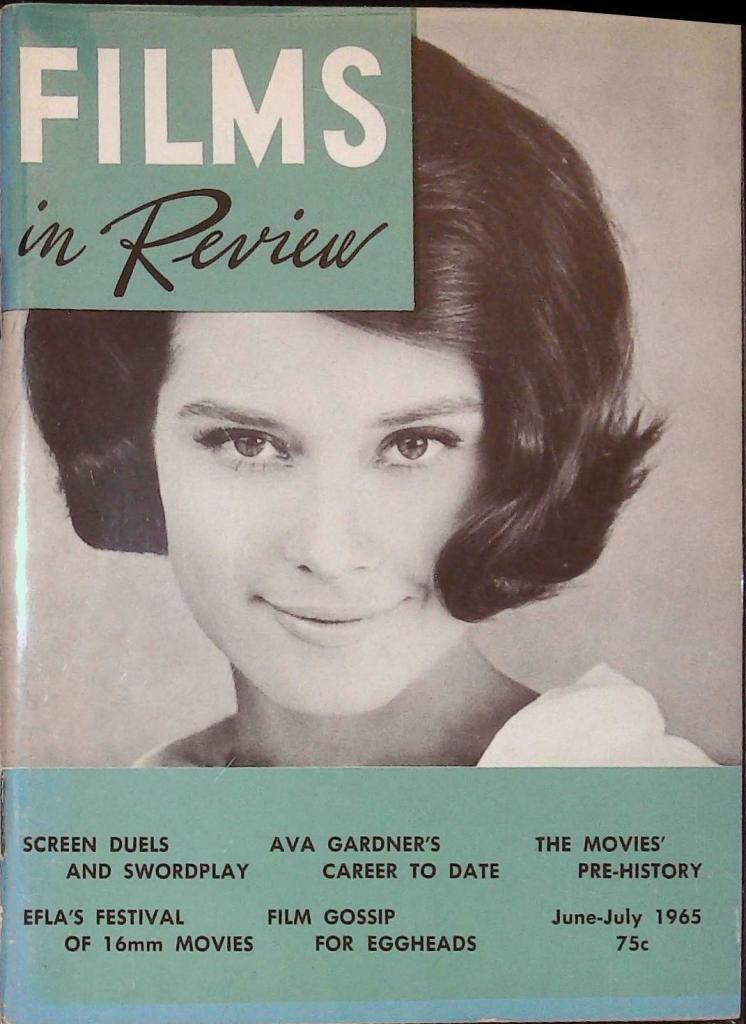
Diane Baker makes the cover of Films in Review magazine.

Veteran director Edward Dymytryk (Alvarez Kelly, 1966) is on song, stringing the audience along beautifully, extracting wonderful performances, not frightened to give the film deeper meaning. The theme of commitment, of standing up to malevolent forces, seems an odd one for a straightforward thriller but it reflected Dmytryk’s experience as a victim of the anti-Communist witch-hunt of the 1950s.  

On the debit side, I can’t see any reason why this was made in black-and-white and it certainly served to put off the public, the film’s box office poor, but I dispute the criticism of what appeared too-frequent flashbacks. Rather than re-emphasizing plot points for the audience, I saw this instead as Stillwell holding up a mirror to a memory he doubted he could trust.  

Top-notch screenplay by Peter Stone who knows his way around this genre, having previously written Charade and with Arabesque round the corner, from the novel called Fallen Angel by ,surprisingly, given he is best known for Spartacus, Howard Fast under the pseudonym Walter Ericson. At least a dozen quotable lines included this cracker relating greed to a pandemic: “You’re a carrier, you infected him and he died from it.”

All told, an excellent thriller with modern resonance.

Oddly enough, Mirage was remade a couple of years later as Jigsaw (1968), directed by James Goldstone and starring Harry Guardino.

P.S. I see you that the “I owe you” line was adapted for use by Willow in the Buffy, The Vampire Slayer TV series. There’s even a link to that scene on YouTube. Glad to see it has found some kind of immortality. It’s the kind of line that should be a gimme for t-shirt manufacturers.  

The Jackals (1967) **

A hoot. Definitely a contender for that most sought-after of categories – the cult movie.

When I tell you it’s Vincent Price in a western you’ll see how much fun this could be. Price spent virtually a whole decade locked into horror typecasting, those distinctive tones dealing out doom. But like all typecast actors, no doubt he was desperate to show what he could do when the horror shackles were removed.

Trouble is – he does too much. This a lollapalooza performance, so wild and barmy it will have you in stitches, at the same time as wondering what the hell was going on in his head, and why he thought such barnstorming was required, as if he felt he had to steal a picture of which he was the denoted star.

Though effectively a western with all the tropes of that genre, and a remake to boot of Yellow Sky (1948), this, adding further hilarity and extending the cult status, is set in South Africa, with variable attention paid to accent.

Stretch Hawkins (Robert Gunner) is leader of a gang of outlaws robbing banks in the Transvaal during a gold strike. They escape the pursuing posse by heading into desert territory and eventually, parched, exhausted and suffering from heat stroke, seek refuge in a ghost town, former mining town Yellow Rock abandoned except for two inhabitants, Oupa Decker (Vincent Price) and his grand-daughter Willi (Diana Ivarson).

Naturally, on spotting the lone woman, the outlaws get the wrong ideas. But she soon puts them right. When she’s not holding them at bay with a rifle she’s decking Stretch with a neat right hook. Refusing to offer them any hospitality whatsoever seems particularly mean given the poor chaps are starving and this area is bereft of the animal population- lions, elephants, hogs – that had popped up previously in the way of the random stock inserts you found in any picture set in Africa.

So the fellows spread themselves out along the riverbank which provides the only water in the vicinity and where Willi must come calling, leading to further episodes of predatory sexual behaviour. By now Stretch has taken a liking to Willi, which is eventually reciprocated, and he tends to leap to her defence.

For no apparent reason, the outlaws surmise that the only reason the old man and his daughter are still hanging around this deserted spot is because they have found gold. Instead of doing the obvious and holding the younger woman hostage, Stretch attempts to strike a deal, agreeing to take only half the old man’s £20,000 stake in return for letting them go free.

This doesn’t go down so well with the rest of the gang and the shoot-out, when it occurs, sees Stretch siding with the good guys and turning over such a good leaf that he returns the money he stole to the bank.

Despite Vincent Price threatening to ruin the picture with his mugging there are some nice touches. After Stretch’s romantic overtures are derisively dismissed for him being too smelly, he smartens himself up, coming a-courting (or a rough version of it) in fresh shirt, armpits washed and hair combed. Stretch had a touch of religion in the past when a law-observing farmer. And you can tell what a change is wrought in him when at the end he buys rather than steals a pretty hat for Willi.

It’s true there is a transformation in Vincent Price (The Oblong Box, 1969). But not for the better. The lugubrious delivery is toned down, the iconic full beard reduced to a wisp, he wears a floppy hat, cackles like a madman and every time he looks at the camera it’s with a one-eyed leer. There’s something of the country bumpkin in his interpretation of the part, and that might just be a show put on to fool the outlaws. Whatever it is, it comes across as the barmiest performance this side of the Razzies.

On the other hand Diana Ivarson (Macho Callahan, 1970), in her debut, makes a pretty good stab at the feisty independent western women, channelling her inner Barbara Stanwyck, or in those tight jeans Jane Fonda in Cat Ballou (1965). She’s a sharpshooter, capable of missing “that close on purpose.” Robert Gunner (Planet of the Apes, 1968) is scarcely a decent substitute for Gregory Peck in the original.

Director Robert Webb (The Cape Town Affair, 1967) can do little to rein Price in. Written by Harold Medford (The Cape Town Affair), adapting the original by Lamar Trotti and W.R. Burnett.

But, really, there’s little to save it from being awful except that cult pictures are judged by different criteria and this has all the making of a cult.

Must-see for all the wrong reasons.

Behind the Scenes: “The Chairman / The Most Dangerous Man in the World” (1969)

Had things run according to the original plan, we could have seen Frank Sinatra return to a Communist country for the first time since The Manchurian Candidate (1962). But if you had wanted to write a script about the guy who wrote The Chairman, you couldn’t have invented a more interesting character than Samuel Richard Solomonick. He was one of those guy who held every job under the sun before reinventing himself as an anticommunist going by the name of Jay Richard Kennedy and subsequently entering the fields of real estate, radio and brokerage, then landing a gig managing Harry Belafonte and writing the screenplay for I’ll Cry Tomorrow (1955).

By the time he ended up as an executive at Sinatra Enterprises he had a couple of ideas to sell. Forming Jade Productions in 1966 with director Richard Quine (How To Murder Your Wife, 1965), the pair hooked Sinatra’s interest in two projects, Follow the Runner (which would have co-starred Sammy Davis Jr) and The Chairman plus William Holden eyeing the lead in The Wordlings about the population explosion.

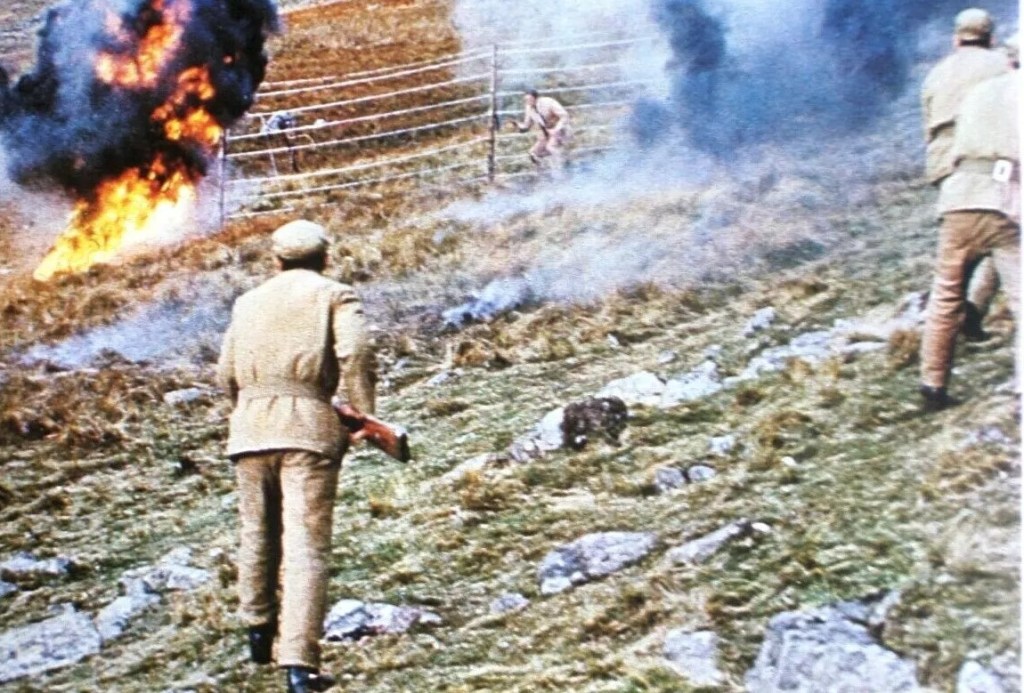
That’s Gregory Peck trapped on the wrong side of the Russian border with Chinese soldiers closing in.

Sinatra was known for falling out with directors, shunting Mark Robson off The Detective (1968), so whether Quine would have lasted the pace is anybody’s guess. After success with Tony Rome (1967), Twentieth Century Fox briefly toyed with the prospect of pairing Sinatra and new wife Mia Farrow in The Chairman. Originally scheduled to begin shooting on January 1967, that later shifted to early 1968. The notion that the movie also had parts for Spencer Tracy and Yul Brynner was one of those puff pieces that some journalists swallowed.

Despite some enticing projects – he was first name down to direct Catch 22, after Columbia had spent $150,000 buying the novel, and to helm the screen translation of Broadway hit The Owl and the Pussycat – Richard Quine’s career teetered after the flop of Hotel (1967). Making no headway with Sinatra he made instead another flop, Oh Dad Poor Dad (1967) and was effectively put on furlough for three years after failing to finance a movie to star Alex Guinness and Lee Radziwill.

Quine exited The Chairman in May 1967 when former PR bigwig Arthur P. Jacobs took over the production and with Sinatra in absentia turned to British director  J. Lee Thompson who had helmed the producer’s debut picture What a Way to Go (1964).  And that proved a lucky break for Thompson who had yet to match the success of The Guns of Navarone (1961).  

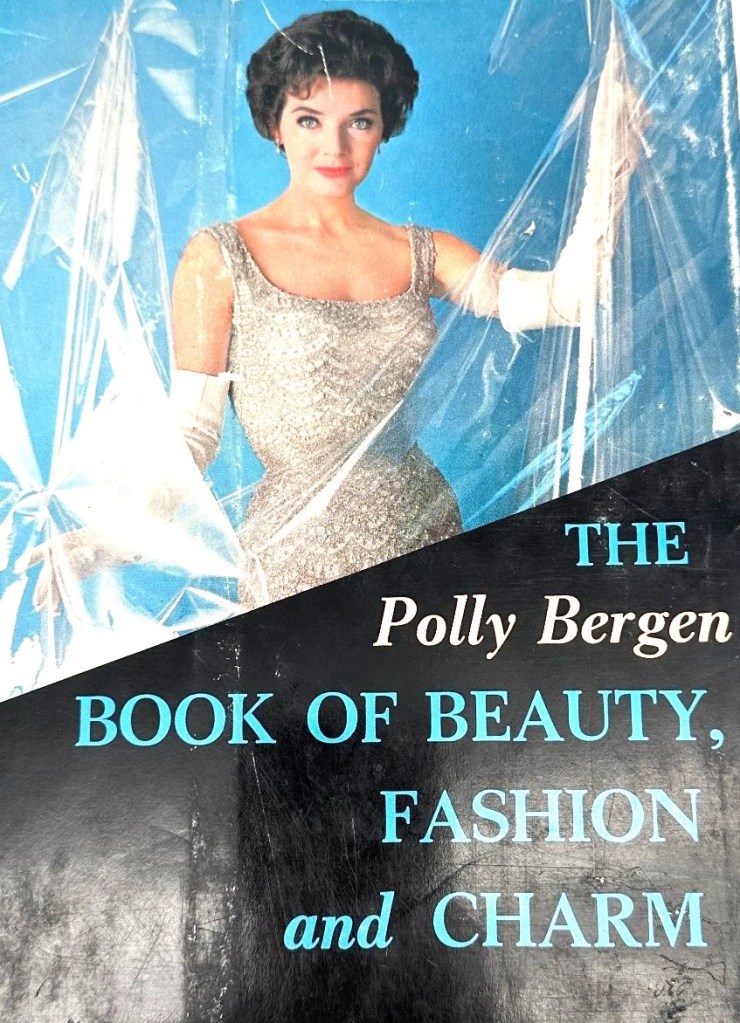
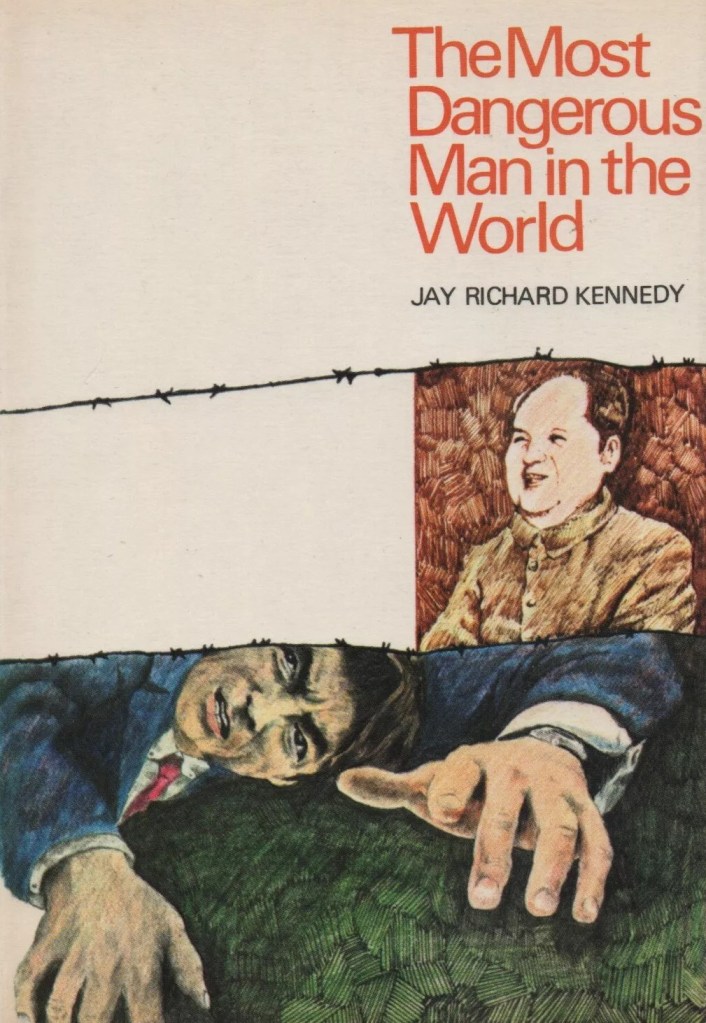
The book cover.

After successive flops – Return from the Ashes (1965) and Eye of the Devil (1966) – Thompson had plenty projects on the boil including a musical remake of Alexander Korda’s The Private Life of Henry VIII (1933) with a score by Richard Rodgers and Peter Ustinov playing the lead. Also on his slate was High Citadel based on the Desmond Bagley bestseller; The Harp That Once for Columbia; an adaptation of James Clavell bestseller Tai Pan; a sequel to The Guns of Navarone called After Navarone that would reunite the director with star Gregory Peck and writer-producer Carl Foreman; and Planet of the Apes (1968) to which he and Jacobs held the rights.

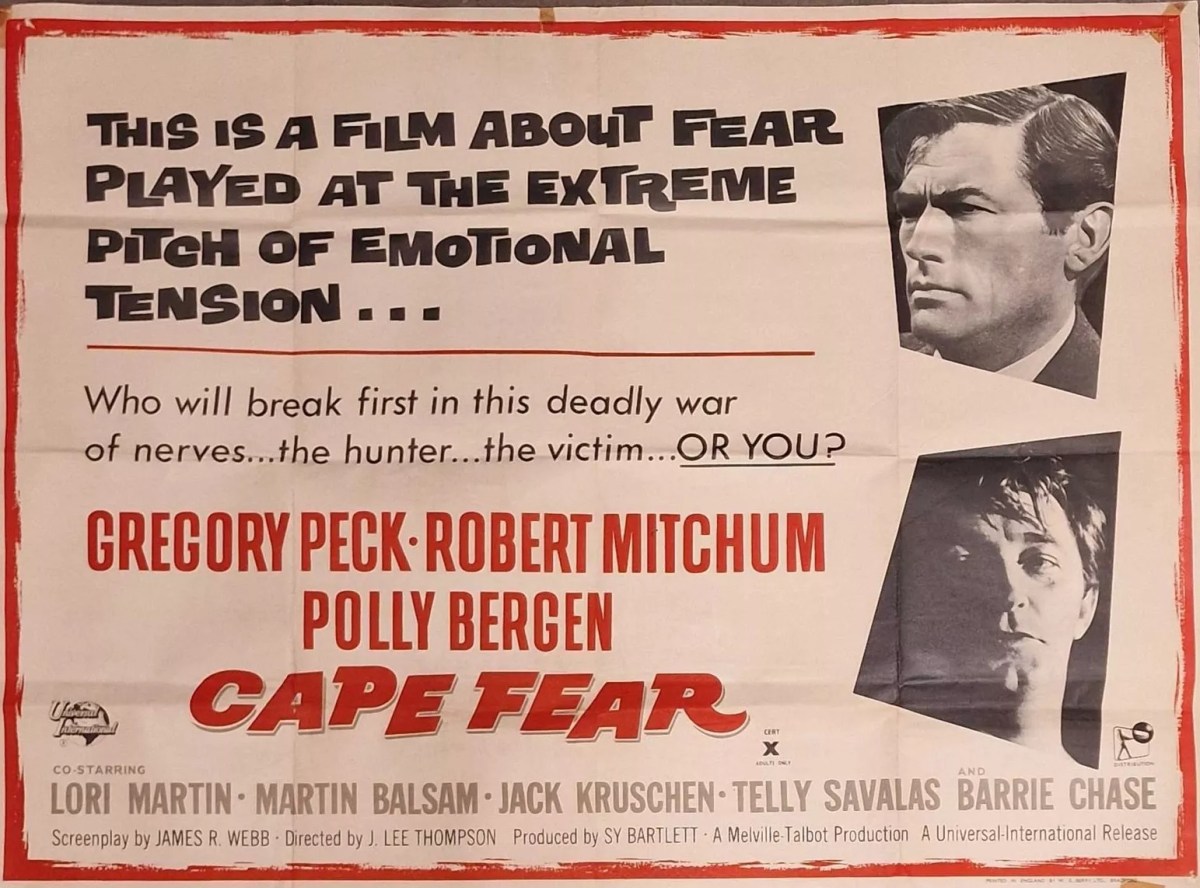
While none of these projects – except Planet of the Apes and minus Thompson – came to fruition, the Navarone connection would lead to Mackenna’s Gold for Foreman. In the meantime he had helmed a modest drama, Before Winter Comes (1968) starring Broadway star Topol. When Arthur P. Jacobs greenlit The Chairman, he hired Thompson who looked no further than Peck, connection re-established via the Navarone sequel.  They were a four-time pairing – Cape Fear (1962) and Mackenna’s Gold and The Guns of Navarone. Peck was a controversial choice from the Twentieth Century Fox perpsective given he had broken a contract with the studio in 1960 to star in Let’s Make Love. But Jacobs smoothed ruffled studio feathers and paid his star $500,000 plus a percentage. With Jacobs on hands-on duty with Planet of the Apes (1968) –  Mort Abrahams oversaw the production of The Chairman  and immediately engaged in a budget dispute with the director. Jacobs had initially stipulated $4 million, Thompson believed he required another million. They didn’t quite split the difference, Fox had the film come in at $4.9 million.

Thompson recognized the problems of the script, pointing out that “the hardest thing for Americans about the film’s concept is accepting that China has some competent scientists.” Rather ingenuously, he averred that the movie would have “no political overtones,” while Abrahams retorted that it might have “some political overtones.” It would been obvious to anyone that a picture featuring Mao was bound to have political repercussions, his Little Red Book a massive bestseller on the campus, an album cut of recitations from the book and Edward Albee in 1968 premiering a play called Quotations from Chairman Mao Tse-Tung.

Denied access to China, the production team spent four months “reading everything we could get our hands on.” At one point they considered dropping the scene featuring Chairman Mao and lengthening the sequence relating to Peck’s arrival in Hong Kong. In any case, different versions of the Hong Kong environs were shot, some with nude shots of girls in a house of pleasure.

The British Colonial Office in Hong Kong blocked filming there after fears of riots due to the production daring to portray Mao Tse-Tung on screen. Taiwan substituted for China although the locals there were also incensed, so much so they burned an effigy of Peck. Wales, funnily enough, was another location as was London University. Filming began on August 28 and finished on December 3.

Although it might appear that Ben Maddow (The Way West, 1967) wrote his script based on Jay Richard Kennedy’s novel, in fact the novel appeared after the screenplay with Kennedy writing the novelizaton, and it’s more likely that what Maddow adapted was the original Kennedy screenplay. Interestingly enough, around this time Maddow had first crack at the Edward Naughton western novel that became McCabe and Mrs Miller (1971).

It wasn’t the first time Variety got a prediction wrong: “powerful box office attaction” fell far short of the actual results. This proved an annus miserabilis for Gregory Peck. In fact, he had four films, not three, released in 1969. By release date The Stalking Moon technically belonged to the previous year, but it only played a handful of cinemas in 1968, its general release taking place in 1969.

Despite pocketing a total of over $2 million, Peck’s marquee value was in clear decline. Of the Peck quartet, Marooned did best, placing 33rd on the annual box office chart, with $4.1 million. Mackenna’s Gold (31st) took $3.1 million in rentals (the amount returned from the gross once a cinema has taken its cut), The Stalking Moon (38th) on $2.6 million, and The Chairman (41st) with $2.5 million.

SOURCES: Gary Fishgall, Gregory Peck (Scribners, 2002) p267; James Caplan, Sinatra: The Chairman, (Doubleday, 2015), p724;  “7 from 7 Arts,” Variety, March 3, 1965, p4; “Richard Quine,” Variety, July 7, 1965, p20; “Return of Advances,” Variety, October 6, 1965, p7; “Form Jade Prods,” Variety, December 15, 1965, p4; “J Lee Thompson Nearly Finished on 13,” Variety, February 2, 1966, p28; “Catch As Catch 22 Can,” Variety, February 23, 1966, p4; “Rodgers and Hammerstein’s Musical Henry VIII,” Variety, Mar 16, 1966, p1; “Inside Stuff – Pictures,” Variety, March 30, 1966, p22; “Lee Thompson Busily Blueprints His Musical Version of Henry VIII,” Variety, April 27, 1966, p17; “Jay Kennedy Script,” Variety, July 6, 1966, p5; “After Navarone,” Variety, April 19, 1967, p14; “Scripting Red Chinese,” Variety, May 21, 1967, p4; “”Personality Chemistry,” Variety, May 24, 1967, p4; New York Soundtrack,” Variety, Sep 20, 1967, p27; “Pat Hall Noel to Col,” Variety, December 27, 1967, p5; “N.Y. Indie Label Grooves Chairman Mao’s Thoughts,” Variety, April 10, 1968, p56; “Man About Town,” Variety, July 17, 1968, p68; “Jas Clavell to Roll Siege,” Variety, August 21, 1968, p7; “Thompson Wraps Up,” Variety, August 28, 1968, p29; “New York Soundtrack,” Variety, October 23, 1968, p18; “British Bar Fox’s Chairman,” Variety, December 4, 1968, p17; Big Rental Films of 1969,” Variety, January 7, 1970, p15; “Big Rental Films of 1970,” Variety, January 6, 1971, p11.

The Chairman / The Most Dangerous Man in the World (1969) ****

The sci-fi elements in this tidy paranoia thriller set in Communist China are not the only issues overlooked at the time and worthy of reconsideration now. Anyone who blasted it for supposedly political jingoism conspicuously failed to read a subtext that chimed with young left-wingers for whom Chairman Mao was not, as now, perceived as a tyrant du jour but as a political god. There’s a distinct whiff of Philip K. Dick in the implanting in a spy’s head of not just a tracking/listening device but one laced with explosive that can be remotely triggered for suicidal or murderous gain. Needless to say, the spy, ignorant of this fact, was a de facto sacrificial lamb. And a key plot thread about genetically modified crops as a means of solving world hunger came about four decades too early.  

Widowed Nobel prize winning scientist Dr Hathaway (Gregory Peck) is despatched into China via Hong Kong to contact a missing scientist with a revolutionary formula for an enzyme. A series of crisp flashbacks set up the scenario of the tracking device and a reverse echo of Marooned (1969) where Army chiefs back at base, led by one-eyed Shelby (Arthur Hill,) can listen in but are helpless to intervene – except in sinister manner. Shelby considers Hathaway “the wrong brilliant man” for the task and that they have sent in “a civilian to do a soldier’s job.”

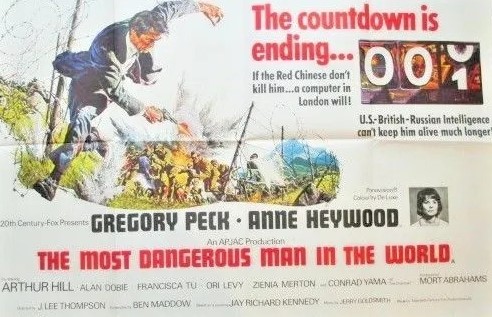
Not able to trust the Brits to know who the title referred to, they came up with a lame alternative. The taglines reveal way too much of the plot.

The hidden transmitter allows Hathaway to keep his superiors posted but the listening device also picks up a creaking bed as Hathaway almost falls into a honey trap in Hong Kong. Amazingly, he doesn’t have to sneak into China but is welcomed with open arms and hustled along to a meeting, and a game of ping-pong (the real thing and the verbal equivalent) with Chairman Mao (Conrad Yama). While spouting some propaganda, Mao is surprisingly open about sharing the secret of the enzyme rather than blackmailing a starving world. Meanwhile, it’s the Americans who are more interested in the double cross, Shelby itching to blow up Hathaway’s head in the assumption the explosion would dispose of the Chinese leader.

Emissions from the transmitter are tangling up the airwaves, making the Chinese secret police highly suspicious of Hathaway as he heads for the secret scientific compound housing Professor Soong Li (Keye Luke), creator of the enzyme, and his daughter Chu (Francesca Tu).

Turns out Hathaway has been summoned by the professor to help find a missing link in molecular chains. Hathaway has to burgle his way to steal the formula, but fails to find it, but when the professor commits suicide and is denounced by his daughter and the Chinese secret police close in, Hathaway has to scarper and head for the Russian border, that country, oddly enough for a spy movie, being on the same side as the Yanks. Meanwhile, Shelby’s trigger finger it itching to blow his man sky high for fear he might give away details of his mission.  

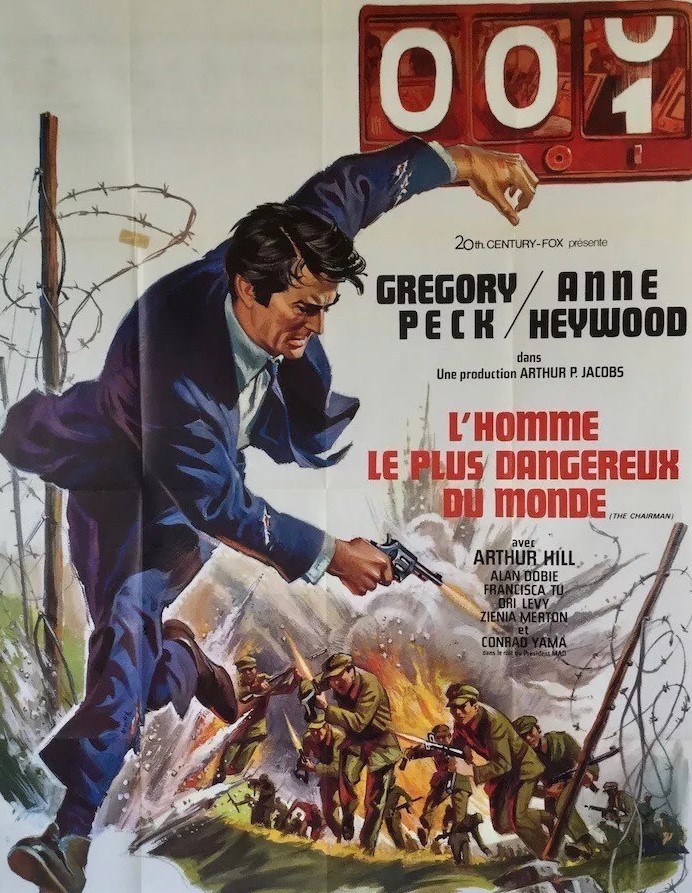
The French, too, had trouble with the original title.

Turns on its head many of the spy film’s truisms: firstly that Hathaway effectively fails in his mission; secondly that patriotism doesn’t blind him to his country’s greed or folly; thirdly that’s he not in constant seduction mode.

Political argument that one point seemed to excessively delay the narrative thrust, now, at half a century’s move, seems more considered and providing an interesting balance between opposing views.

Gregory Peck (Marooned, 1969) is at his quizzical best, deeply-rooted scepticism helping to anchor his character. But if you were attracted by seeing Anne Heywood (The Fox, 1967) second-billed you’re in for a disappointment as she just tops and tails the picture. Arthur Hill (Moment to Moment, 1966) is good value as always.

But it’s testament to J. Lee Thompson (Mackenna’s Gold, 1969, also starring Peck) that his direction brings together diverse political/sci fi/spy/thriller elements in a winning formula, ignoring the obvious. Some interesting detail: someone handing out coffee on a tray to the inmates of the command station; Hathaway’s guilt at his role in the death of his wife barely touched upon, but it explains a lot; Mao’s famous Little Red Book provides a twist.

Occasional flaw: surely the Chinese would have bugged Hathaway’s room and catching him, however soft voiced, filling in his superiors. The idea that the Chinese could be technologically more advanced than the U.S. would have had John Sturges in a fit of fury, but Thompson takes it in his stride. Screenplay by Ben Maddow (The Way West, 1967) and Jay Richard Kennedy (I’ll Cry Tomorrow, 1955).

Reassessment overdue.

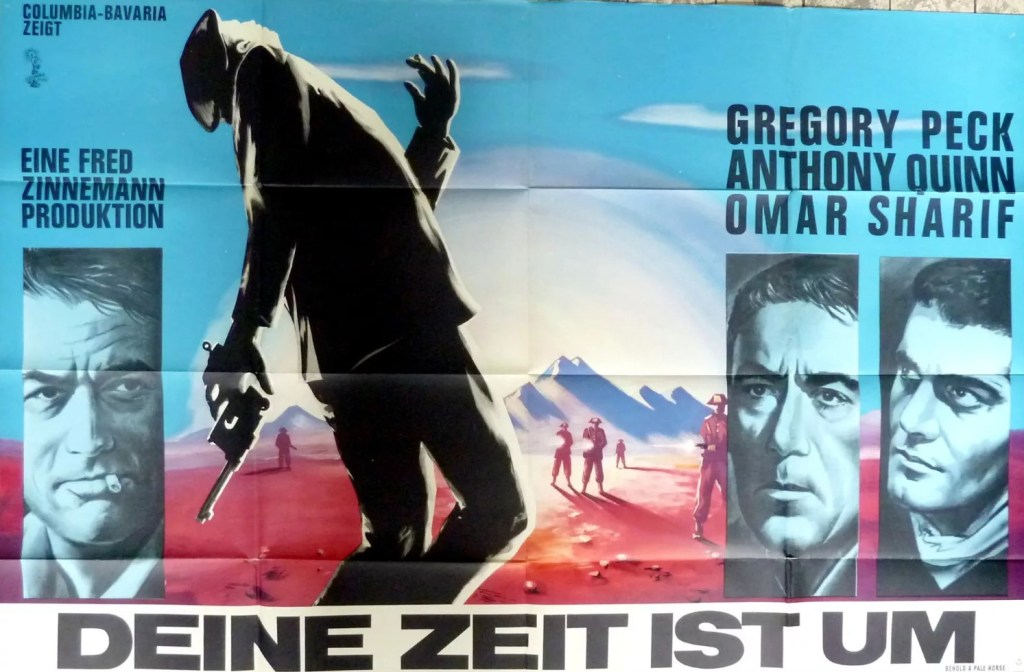
Behold a Pale Horse (1964) ***

Old causes never die but they do go out of fashion and interest from movie audiences in the issues surrounding the Spanish Civil War had fallen from the peak when they attracted artists of the caliber of Ernest Hemingway and Pablo Picasso. But passions surrounding the conflict remained high even 20 years after its conclusion as indicated in this Fred Zinnemann (The Sundowners, 1960) drama.

Manuel Artiquez (Gregory Peck) plays a disillusioned guerilla living in exile in France, who has ceased raiding the Spanish border town under the thrall of corrupt Captain Vinolas (Anthony Quinn). Artiguez has two compelling reasons to return home – a young boy Paco asks him to revenge the death of his father at the hands of Vinolas and his mother is dying. But Artiquez is disinclined to do either. Heroism has lost its luster. He has grown more fearful and prefers to live out his life drinking wine and casting lustful glances at young women.

In France he enjoys a freedom he would be denied in Spain. He is not hidden. Ask anybody in the street where he lives and they will tell you. This is a crusty old soldier, unshaven, long past finding refuge in memories, but not destroyed either by regret. There is a fair bit of plot, some of it stretching incredulity. The action sequence at the end, conducted in complete silence, is very well done, but mostly this is a character piece.

This is not the upstanding Gregory Peck of his Oscar-winning To Kill a Mockingbird. He is a considerably less attractive character, burnt-out, shabby, grizzled, lazy, easily duped, unwilling to risk his life to see his mother. We have seen aspects of the Anthony Quinn character before but he brings a certain humanity to his villain, bombastic to hide his own failings, coarse but occasionally charming, suitably embarrassed when caught by his wife visiting his mistress and praying earnestly to God to deliver Artiquez into his hands. Omar Sharif has the most conflicted character, forced by conscience to help an enemy of the Church.

However, two elements in the picture don’t make much sense. Paco tears up a letter (critical to the plot) to Artiquez which I just cannot see a young boy doing, not in an era when children respected and feared their elders. And I am also wondering what was it about Spain that stopped directors filming it in color. This is the third Spain-set picture I have reviewed in this blog after The Happy Thieves and The Angel Wore Red. For the first two I can see perhaps budget restrictions being the cause, but given the stars involved – Rex Harrison and Rita Hayworth in the first and Ava Gardner and Dirk Bogarde in the second – hardly facing the production dilemmas of a genuine B-picture.

But Behold a Pale Horse was a big-budget effort from Columbia and while black-and-white camerawork may achieve an artistic  darkness of tone it feels artificial. This was never going to be the colorful Spain of fiestas and tourist vistas but it would have perhaps been more inviting to audiences had it taken more advantage of ordinary scenery.

J.P. Miller (Days of Wine and Roses, 1962) adapted the film from the novel Killing a Mouse on Sunday by Emeric Pressburger who in tandem with Michael Powell had made films like Black Narcissus (1947) and The Red Shoes (1948). The film caused calamity for Columbia in Spain, the depiction of Vinolas with a mistress and taking bribes so upset the authorities that all the studio’s movies were banned.   

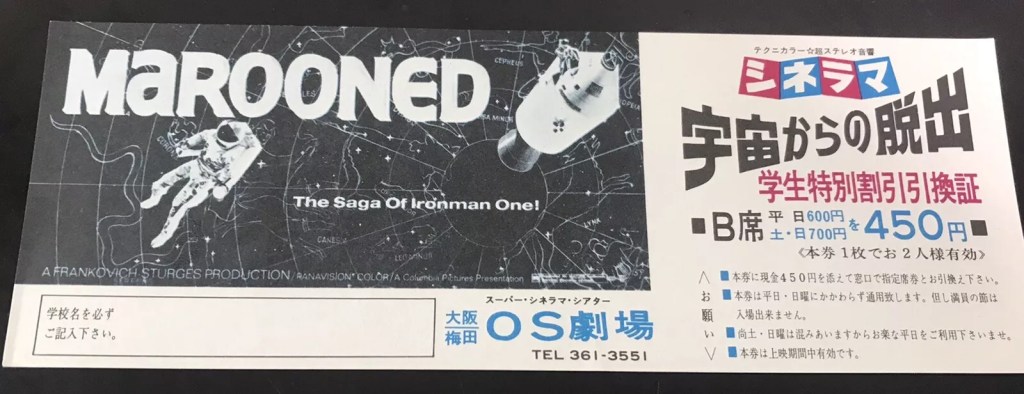
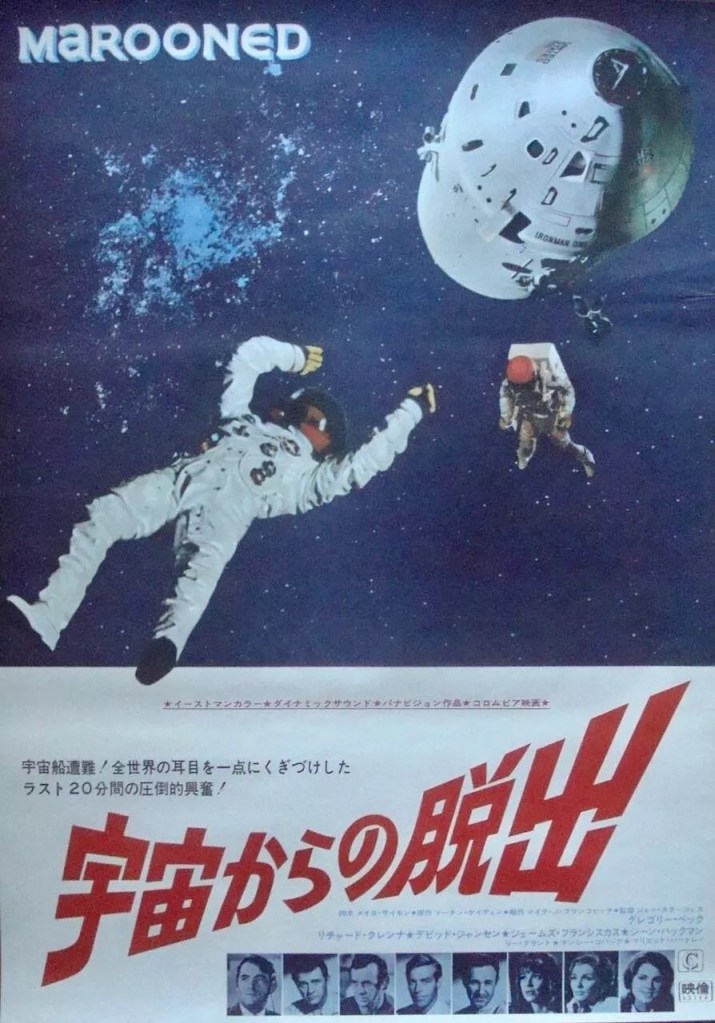
Behind the Scenes: Selling Jeopardy in Space – Pressbook for “Marooned” (1969)

You could come away from the Pressbook/Exhibitors Manual wondering if some of the actors were in the wrong profession, given the number of accomplished pilots on the roster.  James Franciscus held a commercial license for multi-engine planes and had logged three thousand flying hours in three years. Gene Hackman not only had a private flying license but was in the process of building his own biplane.

Producer Mike Frankovich had flown with the US Air Force during World War Two, clocking up 7,000 hours flying time and ending up a colonel. Technical expert George Smith had ejected at 6,000 feet from a plane flying at 800 mph.

Another less well-known fact, Natalie Wood (who was appearing in producer Mike Frankovich’s Bob and Carol and Ted and Alice, 1969) was fluent in Russian and was brought in to translate for a showing of the movie to visiting Russian spacemen. Nancy Kovack, by the way, was equally talented, speaking Persian and other languages.

As much as the main function of the Pressbook was to provide exhibitors with a range of adverts in every conceivable size that they could cut out and take along to their local newspaper, its secondary function was to provide cinema owners with promotional ideas and to provide snippets and articles that could be passed on to a local friendly reporter.  But pickings were slim for jouranlists. Not surprisingly, Gregory Peck didn’t have much say, since whatever he did have to say he’d said already as promotion work for the two other features preceding Marooned this year. And nobody’s spilling the beans on the special effects.

Due to the bulkiness of their space suits, the three actors playing astronauts couldn’t sit down between takes and instead the production employed “the slanted boards usually leaned against by elaborately-gowned female stars to protect their costumes.” (You learn something new about the business every day!). Never mind the bulkiness, the actors spent a chunk of their time in the air and the one day James Franciscus expected to meet acting hero Gregory Peck (they had no scenes together) it proved impossible as when the star visited the capsule set Franciscus was 60 ft in the air.

Richard Crenna got a better response from his young son, who had little concept of what an actor did. But after seeing his dad floating around in space high above him, he reckoned his father was actually a hero

For such a male-oriented picture, Columbia made a big play for the female audience. “The Ladies Love Marooned,” boasted one advert in the 16-page A2 Pressbook/Campaign Manual aimed at exhibitors. Pulling on quotes from critics nobody had really heard of, it managed to present the notion that the picture was as exciting, fascinating, “ingeniously-devised,” and suspenseful for women as much as men, at the same time as focusing on the feminine aspects of the movie – “Lee Grant is a knockout.”

The Pressbook itself allocated editorial space to the three female stars. For Lee Grant the slant was that her talent had been recognized by a host of awards – Emmy, Obie, Best Actress at Cannes plus an Oscar nomination (she would later win an Oscar for Shampoo, 1975). But you have to wonder how an actress would respond to be called, in print, “an egg-head with sex” as was the case with Nancy Kovack. In between turning out such pictures as Tarzan and the Valley of Gold (1966) and this, Kovack had been resident in Iran where she made Diamond 33 (1967) and Night of the Angels (1968). By comparison, Mariette Hartley got off lightly, thanks to her Shakespearian training.

A separate 4-page A2 insert promoted the three Oscar nominations for cinematography, sound and visual effects. “Nominated for 3 Academy Awards,” was the slug accompanying the ads. Never mind the reviews from female critics, much bigger space was devoted here to a rave review form Rex Reed, one of the most famous critics of the day (and star, if that’s the right word, of Myra Breckenridge, 1970), who claimed Marooned was “as exciting, spirited and suspenseful as any spy movie or any cops-and-robbers movie ever made.”

As you might expect, the bulk of the promotional ideas were science-based. Exhibitors were told to target the country’s 2,500 science clubs, the armed forces, the industries that supported the space program and, of course, schools and colleges. Tie-ins had been achieved with 4,500 A&P stores, Jane Parker Donuts, and Philco-Ford dealers.

From a contemporary marketing standpoint, the surprising tie-in was with Omega watches, tagged “the first watch on the moon,” the company’s Speedmaster brand not just worn by the astronauts who did land on the moon in July 1969 but seen in the picture on the wrists of Gregory Peck, Richard Crenna, David Janssen, Gene Hackman and James Franciscus. Over 4,000 dealers were backing the movie.

Model kit manufacturer Revell was offering space suits as prizes in a competition. It distributed more than 42,000 standees and posters and printed five million entry forms. Bantam books was promoting the original novel by Martin Caidin.  That exhibitors would be eager to equip a staff member with an astronaut’s garb and have him/her parade through the streets went without saying. Using lift-off sound effects in a cinema lobby was another idea or turning the entire lobby into a space set.

Rather disconcertingly, the marketing bigwigs thought it would be a clever idea to propose a discussion program on radio or local television on the subject of what would happen if spacemen were marooned, a rather tetchy subject when that became reality.

Unusually, but not surprisingly, the posters stuck with the one tag line: “Three marooned astronauts. And only 55 minutes left to rescue them. While the whole world watches and waits…” and buttressed by some thumbs-up quotes from the likes of reviewers from the New York Times, Redbook, Los Angeles Times and Los Angeles Herald Examiner. In fact, the advertising department took such a shine to Charles Champlin of the LA Times that they cut up his review and stuck snippets of it in three separate ads.

You’ll have seen from the variety of adverts I’ve used to support the review and the Behind the Scenes article earlier in the Blog, that there was a wider range, initially, of adverts, some showing the capsule stuck out in the middle of space. By the time it came to printing this Pressbook, the one for the picture’s general release, all of those were jettisoned in favor of the insipid “thumbs-up” poster with faces to the foreground and the launch in the background, attendant quotes and the “3 Academy award Nominations” slug.

Marooned (1969) ****

The forgotten one. Left out in the cold by audiences and critics alike in the late 60s sci fi boom by the more audacious 2001: A Space Odyssey (1968), Barbarella (1968) and Planet of the Apes (1968). And that’s a shame because it’s by far the most realistic (to the nth degree) of the space movies. Audiences growing up with astronauts saving their own skins with ingenious maneuver – sling shot and whatnot – in Apollo 13 (1995) and The Martian (2015)  might be shocked by the harsh reality of space travel as evidenced here. Astronauts are little more than helpless creatures in a tiny box with ground control in obsessive control. It’s salutary that escape was the audience mindset even after the Challenger Space Shuttle disaster of 1986.

Nobody thought to tell audiences to buckle up because they were in for a hell of a ruthless ride back in the day, but this one really should come with a warning.

Casting makes this work – when it shouldn’t. It’s full of those kind of actors who scarcely move their lips and rarely engage in extraneous facial movement. You can hear director John Sturges issuing instructions: to Gregory Peck, keep those brows knitted; to David Janssen, keep your head lowered and keep with the muttering; to Richard Crenna, don’t move a muscle; to Gene Hackman, limit that trademark chuckle to just once. Why this shouldn’t work is because the big star isn’t in the goldfish bowl of the shuttle cockpit, and since there’s none of the get-to-know-the-crew backstory of The Right Stuff (1983) or Apollo 13 there’s nobody to really root for, especially as the crew is just siting there, doing (by instruction) nothing and awaiting their fate. Which, by the way, which is constantly spelled out, is to suffocate from lack of oxygen.

But there’s a reason Gregory Peck’s on the ground and not in space. Because he’s the one making the life-and-death decisions.

This is by far Gregory Peck’s toughest role. He pulled out of Ice Station Zebra (1968) because he didn’t like the slant of the character, and since then he’d been in typical upstanding heroic mode in The Stalking Moon (1968), Mackenna’s Gold (1969) and The Chairman (1969). Here he’s the king of data management and crisis control, the most ruthless, heartless sonofa you’d ever encounter, not willing to take a risk on greenlighting a rescue mission because the computer says no. The weaselling PR-speak that’s all about saving the space program and making allowance for collateral damage is nothing compared to his terrible delivery of news to one of the wives that her husband is dead. She collapses with emotion, he puts the phone down.

If you’re geek-minded, you’ll give this five stars because there’s information overload. “Go” and “Mark” are the most commonly used words. And in case you can’t judge from the visuals what’s going on, there’s usually some television commentator voice-over to help you out.

So, the Ironman One mission hits trouble when its retro rockets refuse to ignite for return to Earth after several months in space. They’ve got 40 hours or so to effect a rescue before the oxygen runs out for crew members Jim Pruett (Richard Crenna), Buzz Lloyd (Gene Hackman) and Clayton Stone (James Franciscus). The crew are forbidden to try any stunts themselves because any exertion will use up valuable oxygen.

Plan by chief astronaut Ted Dougherty (David Janssen) to mount a rescue operation via an untried spaceship XRV (smaller than a helicopter, by the way) is vetoed as too risky by NASA boss Charles Keith (Gregory Peck) until the President, terrified of public reaction, overrules him. With time running out the impending launch is hindered by an approaching hurricane. But then, in the only nod to ingenuity, someone suggests taking off in the eye of the hurricane, when wind force will be zero.

Meanwhile, up in space, the three stalwarts are slowly coming apart. Buzz, the toughest-looking of the trio, is worst affected, screaming his head off as the prospect of dying looms. Then they are faced with a terrible decision. With the rescue delayed, there’s not enough oxygen to see them through, so one has to sacrifice himself.

I told you it was brutal stuff. About the last 30 minutes are not about whether they can be saved, but who will die and how, the impact of asphyxia on the brain spelled out by resident boffin Clayton. By this point anything they do will almost certain sabotage any rescue and they’re in cloud cuckoo land as Keith tries to keep them in line.

While there’s certainly information overload and a few questionable scientific decisions (can you really open a hatch straight into space?), the reality of the drama more than holds the enterprise together. The realpolitik, the callous use of the wives to go along with the company line as they watch their husbands suffer before their very eyes, the management of potentially bad news, was perhaps a shock for audiences back in the day but would be accepted more easily by contemporary moviegoers.

The acting is first class. Gregory Peck never attempts to lighten his load, to make his character less unattractive and appease his following. David Janssen (Warning Shot, 1966) is as solid as ever. Gene Hackman (The Gypsy Moths, 1969) is the pick of the crew but Richard Crenna’s (Midas Run, 1969) less showy disintegration packs a punch. Lee Grant (The Big Bounce, 1969) is the standout among the wives.

Much as Sturges lets the computerspeak run away with itself, he doesn’t flinch when it comes to the really tough scenes. Written by Mayo Simon (I Could Go On Singing, 1963) from the Matt Caidin source novel.

Under-rated. Worth a look.

Behind the Scenes: The Box Office Bump Part Two – Foreign Saves the Day

In previous decades, box office outside of the U.S., while a growing part of the ancillary equation, only in very rare circumstances outscored domestic. The general expectation, in part due to tougher competition for screens and extra distribution costs, was on average studios could expect to earn about half of domestic revenues.

There was one obvious exemption to this rule. James Bond overseas blew all the competition out of the water. And so it proved in the early 1970s from an examination of United Artists books for the period. Live and Let Die (1973) was the standout performer, knocking up $27 million in rentals (the studio share of the overall box office gross) from foreign cinemas compared to $16.4 million at home. Diamonds Are Forever (1971) did equally well – $22 million abroad, $20 million domestic.

James Bond was such a cash cow that surprised no one. Last Tango in Paris (1973) was considered an anomaly, controversy stoked by UA four-walling the picture when it couldn’t find enough screens. It came in third in the foreign market league, adding $16 million to domestic $21 million.

What did take Hollywood’s breath away was how often under-performers – flops even – at the U.S. ticket wickets did gangbusters elsewhere. The biggest winner was the aptly-named Michael Winner, director of westerns Lawman (1971) and Chato’s Land (1972), hitman thriller The Mechanic (1972) and spy drama Scorpio (1973). Total American rentals a shade over $7 million, total foreign rentals three times as much a colossal $21.8 million.

There was hardly a greater example of the disparity between American audience tastes and the rest of the world. And it made Hollywood studios more adventurous when it came to choosing subject matter, and in backing stars, aware that they could make their investment back – and more – from foreign markets.

It was probably astonishing to any studio executive that Burt Lancaster – for over two decades a high-flying marquee name from action-oriented fare like The Crimson Pirate (1952) and controversial drama From Here to Eternity (1953) to his Oscar-winning turn as Elmer Gantry (1960) and hardnosed western The Professionals (1966) – had lost his domestic audience especially after he had fronted up disaster movie smash Airport (1970).

But Lancaster could only scrape up $1.35 million at home for Scorpio, $2.1 million for Lawman and $2.8 million for another western Valdez Is Coming. Scorpio was the biggest hit abroad, with a massive $7 million, over five times domestic, while Lawman shot up $3.2 million (50 per cent above domestic) and Valdez Is Coming $2.65 million.

Charles Bronson was another beneficiary of foreign largesse. The Mechanic, too, targeted $7 million abroad, nearly three times the domestic tally of $2.6 million. Chato’s Land (1972) only delivered $1.27 million in the U.S. but $4.6 million abroad.

Westerns were a mixed bag. Oliver Reed-Candice Bergen-Gene Hackman number The Hunting Party (1971) was an almighty flop at home, just $800,000 in the kitty, but rallied somewhat abroad, not enough to turn profit but at least add a sheen of respectability, with $2.4 million elsewhere, three times domestic. The Magnificent Seven Ride! (1972), proof the sequels had outstayed their welcome, brought in just $750,000 domestically but again did triple the business abroad with $2.15 million and given the paltry budget enough to sit in the black.

Revisionist effort Billy Two Hats (1974) starring Gregory Peck added $900,000 abroad to a miserable $440,000 at home – foreign revenues not enough to save it from flop. But foreign couldn’t save the second remake of the Gunfight at the OK Corral legend, Doc (1971) with Stacy Keach and Faye Dunaway which moseyed along to $1.35 million abroad to add to $1.8 million domestic. And another western sequel Support Your Local Gunfighter (1971) notched up just $970,000 abroad compared to $2.1 million. Modern western The Honkers (1972) with James Coburn managed just $550,000 abroad and $1 million at home.

It didn’t really matter that Michael Caine comedy thriller Pulp (1972) did better abroad, figures everywhere nothing to write home about, $600,000 in total, five-sixths of that abroad. Fiddler on the Roof (1970), for other reasons, underwhelmed but nobody was going to complain too much when foreign audiences stuck $10 million in till, about a quarter of domestic.

There were some conundrums in the foreign-domestic share-out. Typically, American comedies didn’t travel. But Billy Wilder’s Avanti! (1972) starring Jack Lemmon, perhaps because of the Italian setting, did better abroad – $2.5 million to $1.6 million. Glenda Jackson British-made menage a trois Sunday, Bloody Sunday (1970) not surprisingly did better abroad, but only just, $1.8 million to $1.77 million.

Sidney Poitier in second sequel The Organization (1971) tapped into $2.9 million abroad and $2.45 million at home but generally too-specifically-American features struggled overseas, The Hospital (1971) snaring only $1.9 million compared to $9 million, White Lightning (1973) snagging $1.8 million compared to $6.9 million, Fuzz (1972) holstering $1.7 million against $3.1 million.

Behind the Scenes: “Mackenna’s Gold (1969)

I should mention the George Lucas connection right away because, for some, that is the movie’s main contemporary connection.

Mackenna’s Gold was originally intended as a three-hour movie[i] for roadshow release to be shot in early 1966 for Columbia Pictures by writer-producer Carl Foreman (Guns of Navarone, 1961) who would also be in the director’s chair.[ii] But outside of How the West Was Won (1962) westerns had foundered in roadshow. The Alamo (1960), John Ford’s Cheyenne Autumn (1964) and John Sturges The Hallelujah Trail (1965) were surprising roadshow flops. Foreman persuaded Columbia to increase the budget to $5 million – and then beyond – and film the movie in Cinerama, (over 25 percent of the budget was allocated to Cinerama to license the name and use the equipment – $1.35 million in total of initial negative costs[iii]).

In January 1967 Columbia launched the marketing campaign with full page advertisements in the trade papers promoting the fact that the movie would be filmed on location in the USA in Cinerama and that it would bring together the “creators of The Guns of Navarone,” meaning, at this point, Foreman and director J. Lee Thompson.  The advertisement also highlighted author Will Henry, on whose novel the film was based (as the “author of San Juan Hill and From Where the Sun Now Stands”) and plugged the book as “a novel of Apache gold and Apache revenge based on the search for the fabulous Lost Adams Diggings.” By the following year, Foreman’s star was in the ascendant after the Parisian revival of High Noon[iv] and Columbia had another two major roadshows planned for the 1968-1969 season: Barbra Streisand’s movie debut in William Wyler’s Funny Girl also starring Omar Sharif and Carol Reed’s Oliver! [v]

By this time, Columbia had reshaped its marketing effort to provide the specialist support required for promoting roadshows. In early 1967, it had poached sales guru Leo Greenfield from Buena Vista with the express aim of setting up an effective unit to market hard-ticket product – “first assignment Mackenna’s Gold, Oliver! and Funny Girl[vi] – to the record number of Cinerama theaters[vii] and those desperate to accommodate roadshow. By the end of 1968, both Cinerama and Columbia had reported record revenues and profits, the former turning a $290,000 loss into a $679,000 profit,[viii] the latter on an unprecedented streak of success with a gross profit of  $9.3 million profit on a gross income of $239 million.[ix] Columbia soon added another roadshow prospect to its slate, Sydney Pollack’s World War Two drama Castle Keep starring Burt Lancaster, and was so confident about the two non-musicals, for example, that it expected the western and the war picture to run consecutively from late spring 1969 well into the following year at Loews Hollywood in Los Angeles.[x] Funny Girl hit $550,000 in advance sales – $80,000 was the usual figure.[xi] Mackennas’s Gold’s was scheduled to premiere in Phoenix, Arizona, on February 15, 1969, with the roadshow launch set for the DeMille theater in New York five days later.

Within the next month, however, the world premiere was called off, work began on editing down the near-three-hour running time, and plans, two years in the making, for an ambitious roadshow release were quietly dropped.  Public reaction to The Stalking Moon – also starring Gregory Peck – was one reason. Two other Cinerama movies, Custer of the West (1967) and Krakatoa – East of Java (1968) had also flopped. If Mackenna’s Gold was to be marketed as a drama in a western setting rather than a shoot-out in the tradition of 100 Rifles, then Columbia looked worryingly at Isadora, boasting a 177-minutes running time, whose roadshow run in Los Angeles was swiftly truncated, and the movie butchered in a bid to find an audience.[xii]

The studio took a different tack. The world premiere shifted to Munich, West Germany, in March[xiii] with most of the rest of the European capitals holding gala premieres (and running it as roadshow or at least 70mm) before the picture made its U.S. debut in Phoenix on May 10.   But the picture unveiled in Phoenix was a ghost of the original. The running time technically came in at 128 minutes, but, in effect, was under two hours long, the introductory narration lasting eight minutes and the end credits accounting for further  time. However, what was oddest of all was the 18-month gap between completion and world premiere. Filming had begun on May 16, 1967 and wrapped on September 29.  Columbia had shelved one of its biggest budgeted movies for nearly 15 months.  

The movie had a troubled history. For a start, Foreman didn’t own the rights to the Will Henry source novel. Dmitri Tiomkin, after a debilitating eye condition restricting his composing career, had in 1964 purchased the rights.  Tiomkin agreed to sell the rights to Foreman in April 1965 in return not just for a fee and an agreement to compose the music[xiv] but also the vital producer’s credit necessary to launch him on a new career.[xv]   Foreman was initially keen on filming the movie in Spain to take advantage of generous government subsidies.[xvi] But Foreman was demoted from director. His last picture as writer-producer-director The Victors  (1964) had flopped. The studio did not want to offer the producer any distraction from the complex logistics of a location shoot where much of the time the crew would be 50 miles from the nearest town and where, despite the desert environment, could be subject to storms and flash floods. Instead, J. Lee Thompson (The Guns of Navarone) came on board as director.  (Thompson was also at this point lined up to direct Charlton Heston in Planet of the Apes, whose rights he co-owned.)

However, the Thompson-Foreman relationship did not run smoothly. Foreman recalled: ‘I was not very happy with the work of J. Lee Thompson on that film and entirely apart from that we still got into trouble in terms of scheduling and so forth and our relationship was always a problem.’[xvii] Logistics were always going to be an issue on a picture of this scale, shot almost exclusively on some of the most inhospitable places on Earth. The buzzard section was filmed in Monument Valley on the Arizona/Utah border, and other scenic wildernesses included the Glen Canyon of Utah, Spider Rock in Canon de Schelly in Arizona, Kanab Valley, Sink Valley, the Panguitch Fish Hatchery in Utah, and Medford in Oregon.

Gregory Peck was not first choice for the titular role in Mackenna’s Gold. He only got the part after Steve McQueen and then Clint Eastwood had turned it down[xviii] and even then Peck wavered, only agreeing after pressure from Foreman, and in recognition of their work together on The Guns of Navarone.[xix] Depending on your point of view, Omar Sharif was miscast or cast against type, a matinee idol whose character, in ruthless pursuit of gold, eschewed any element of romance. By the time the movie appeared, Sharif’s marquee appeal had taken a tumble. MGM’s Mayerling and Twentieth Century Fox’s Che had flopped, The Appointment (1969) shelved and Funny Girl’s success rightly attributed to Streisand.

Over the past few years, Telly Savalas had discovered the harsh reality of Hollywood. An Oscar nomination for Best Supporting Actor in The Birdman of Alcatraz (1962) had done less for his career than the odious Maggott in The Dirty Dozen (1967) after which he was promptly promoted to third billing on Sol Madrid (1968), western The Scalphunters (1968) and The Assassination Bureau (1968). Although he retained that billing on Mackenna’s Gold, he did not appear until halfway through, suggesting that his role as Sgt Tibbs had been a casualty of the editing needed to reduce the running length. Camilla Sparv had been leading lady in Dead Heat on a Merry-Go-Round (1966), Assignment K (1968), and Nobody Runs Forever (1968).  Newmar, a decade older, was best known for playing “Catwoman” in the television series Batman (1966-1967). Foreman had given her the leading female role opposite Zero Mostel in Monsieur Lecoq (1967) but the movie was unfinished, although Newmar still attracted attention after stills from the picture appeared in Playboy magazine. Mackenna’s Gold aimed to set a new standard in the quality of actors in supporting roles – the by now requisite roadshow all-star cast including Edward G. Robinson (The Biggest Bundle of Them All, 1968), twice-Oscar-nominated Lee J. Cobb (Coogan’s Bluff, 1968), Burgess Meredith (Skidoo, 1968), Anthony Quayle (The Guns of Navarone), Oscar nominee Raymond Massey (Abe Lincoln in Illinois, 1941), Keenan Wynn (How the West Was Won) and Ted Cassidy (“Lurch” in The Addams Family television series, 1964-1966).

The George Lucas Connection   

In some respects, the involvement of George Lucas (Star Wars) in Mackenna’s Gold has overshadowed that of director J. Lee Thompson. Committed to bringing through a new generation of talent, Foreman had established an internship for the picture. Lucas was one of four winners and his entry was the first version of THX 1138 (1971). The internship funded the winners to shoot a short film on the location. Foreman became immediately a fan because of the quality of Lucas’s effort. Foreman explained: “He did the shortest one of the lot and the most technically accomplished. It ran only one minute and 47 seconds and it had no title – he gave it a date – and then we agreed we’d call it A Desert Poem because he went out on the desert and did a lot of stop-action photography. George really knew his camera and he played with his camera and it was around and about the film – he was doing the desert more than anything else but in the desert was the film company with its parasols and all that shimmering in the distance and he played around with little things where the sun was shining and the film company was working. And then it began to rain, and it rained like hell, and then the sun came out again. It was awfully good. He did a lot of trick stuff with his camera and that’s what the boys resented, that he could just go out by himself and do that.”[xx]  

The “boys” resented Lucas for more than his technical accomplishment but Foreman’s admiration for the neophyte director increased after seeing a display of professionalism that put the other professionals to shame. “We were…in a very difficult location…near the place where we had painted in this great seam of gold…We got to the big scene, the scene where they (the actors) all discovered  it (the gold), and they all started running towards it…But it (the location) was in a kind of ravine and there was a problem about the light – you could only shoot it…at that time of year when the sun was more or less directly overhead or had just begun to go down or had just passed the meridian…(but when Foreman arrived on location) the entire company was just sitting there. Lucas therefore pointed out in an indirect manner that the scene had not been rehearsed because J. Lee Thompson was waiting for the sun to rehearse it during the precious moments when the sun was there instead of being ready for when the sun was there.”[xxi]

Reception

Trade magazine Variety came out in overall favor of Mackenna’s Gold: “splendid western, stars plus special effects and grandeur should insure box office success.”[xxii] Hollywood Reporter predicted, “Audiences should queue up,” and Film Daily proclaimed “a fine, exciting western adventure.”[xxiii] However, Vincent Canby in the New York Times called it a “truly stunning absurdity,” The New York News, while generally positive, nonetheless complained it was “sprawling” and “pretentious.”  New York magazine and the Washington Post were among the nay-sayers.[xxiv] Perhaps, Peck’s own opinion was the most damning: “Mackenna’s Gold was a terrible western, just wretched.”[xxv]

Star fatigue did not occur in the days of the studio system, when releases were carefully spaced out to give the public a breathing space between each release. Actor independence meant timing of releases was removed from studio control – Gregory Peck’s movies in 1969 came from three different studios, Universal (The Stalking Moon), Twentieth Century Fox (The Chairman) and Columbia (Mackenna’s Gold), and Omar Sharif was in the same position with MGM for Mayerling, Twentieth Century Fox for Che and the western from Columbia. As you might expect, releases were not coordinated, studios did not sit down around a table and discuss how to avoid each other’s movies clashing. So in the first six months of 1969 audiences were treated to three pictures apiece from the stars, the earlier ones flops though Mayerlingr was a big hit overseas.[xxvi] Whatever the reason, Mackenna’s Gold did not race out of the gate. Its final rentals tally of $3.1 million – 42nd spot in the annual chart,[xxvii] ahead of The Stalking Moon and Once Upon a Time in the West, but well below the much less expensive Support Your Local Sheriff and 100 Rifles. In budget terms it was close to a disaster. However, it was a huge hit in India, setting a record in Madras for the best showing for a foreign picture.[xxviii]

SOURCES:

This is an edited version of a much longer chapter from my book, The Gunslingers of ’69: Western Movies’ Greatest Year.


[i]  Sheldon Hall has argued that the movie was never intended to be three hours long and that judging from a screenplay of 145 pages the film would have been roughly two-and-half-hours long. He identified a major sequence that was filmed but edited out – of another battle between the Apaches and the gold-seekers (“Film in Focus, Mackenna’s Gold,” Cinema Retro, Issue 43, 40.)

[ii] “Foreman to Start Gold, Delays Churchill Pic,” Variety, September 8, 1965, 4. The Churchill project would eventually become Young Winston made in 1972 for Columbia. The movie was originally postponed due to political unrest in the chosen movie locations.

[iii]  Filmmakers licensing the Cinerama name had to pay $500,000 upfront and Foreman was committed to spend $875,000 for Cinerama camera equipment. The cost might escalate because Columbia also had to agree to pay Cinerama 10 percent of the gross (“C’rama Sets Major Int’l Expansion As More Pix, More Theaters Use Process,” Variety, November 15, 1967, 25).

[iv]  “Junket for Noon Sparks Nostalgia,” Variety, April 24, 1968, 31. Not only was the revival a critical success but it was a box office hit all over again in Paris.

[v] “Leo Greenfield’s Chore,” Variety, May 31, 1967, 8. Wyler, of course, was the king of the roadshow, having directed Ben Hur.  Reed had directed The Agony and the Ecstasy (1965) after an initial chastening  experience with roadshow having pulled out of MGM’s Mutiny on the Bounty (1962) after clashing with star Marlon Brando.

[vi] Ibid.

[vii]  “C’Rama Sets,” Variety.  There were 250 theaters in the U.S. and 2100 worldwide equipped to show Cinerama.

[viii]  “13-Week $679,000 Contrast Year Ago,” Variety, November 20, 1968, 14. The figures compared September 1967 to September 1968.

[ix]  “News in Col Annual Report Is ‘Solid Solvency,’” Variety, November 4, 1968, 3.

[x]   Switching of Isadora from Hard Ducat,” Variety, January 15, 1969, 7

[xi]  “Third Road Show Study,” Variety.

[xii]  “Switching of Isadora,,” Variety. The film, which had opened on December 18, was set to close on February 8 and go straight into continuous performance.

[xiii]  “Col Bows Gold in Munich to Spark Lagging Box Office,” Variety, March 26, 1969, 41; “Mackenna’s Gold Launching Pattern,” Variety, March 5, 1969, 28. While it was true the studios were concerned about falling box office in Europe, the true reason for launching the picture in Europe ahead of America was because Foreman was so much better known there courtesy of his major marketing blitz for The Guns of Navarone and The Victors. It opened in Paris and Rome in March  and in April in London.

[xiv]  By the time the movie came out, Tiomkin had given up composing and the score was done by Quincy Jones.

[xv]  “Tiomkin-Foreman Partners for Col,” Variety, April 21, 1965, 19.

[xvi]  “Cash Advantages,” Variety.

[xvii]  The Carl Foreman Tapes, Transcripts of Tapes between Sidney Cohn and Carl Foreman, Carl Foreman Collection, ITM – 4408, (Tape V – A, December 20, 1977,  British Film Institute, Reubens Library, London).

[xviii]  Avery, Kevin ed, Conversations with Clint, Paul Nelson’s Lost Interviews with Clint Eastwood, 35 ; Neibaur, James L, The Clint Eastwood Westerns, 44.

[xix]  Fishgall, Gary, Gregory Peck, A Biography (Scribner, New York, 2002), 264.

[xx] The Carl Foreman Tapes

[xxi]  Ibid.

[xxii]   Review, Variety, March 26, 1969, 6.

[xxiii]    Advertisement, International Motion Picture Exhibitor, May 7, 1969, 12.

[xxiv]  “Crix Boxscore on New Pix,” Variety, June 25, 1969, 28.

[xxv]  Fishgall, Gregory  Peck, 265.

[xxvi]  Sick Tops Italo ‘68-’69 Box Office,” Variety, July 23, 1969, 31. Mayerling ranked ninth at the box office for this period. .

[xxvii]  “Big Rentals of 1969,” Variety.

[xxviii]  “Gold Sets Madras Record,” Variety, December 2, 1970, 26.

Mackenna’s Gold (1969) ***

The Treasure of the Sierra Madre (1948) set in the West – men driven mad by gold fever. Straightforward plot, however, complicated by an avalanche of characters. And  for a two-hour running time it seemed perverse to waste the first six minutes on scenery, narration – explaining the Apache legend of a fabulous hidden seam of gold – and theme song.

The real film begins with a shoot-out between Marshall Mackenna (Gregory Peck and an Indian. “You will wish you never saw this map,” says the Indian before he dies, but Mackenna burns the map. That doesn’t go down well with villain Colorado (Omar Sharif), whose gang has taken Inga (Camilla Sparv) hostage. Convinced the lawman has memorized the map, Colorado adds Mackenna to his hostage quotient.

At Colorado’s hideout Hesh-Ke (Julie Newmar) has a hostile reaction to Mackenna. Like Colorado, they have history. Mackenna and Inga bond when he fends off an Indian intent on raping her. As if this isn’t a pretty straightforward set-up, old foes reunited, potential romance brewing, a treasure hunt, further complications arise in the shape of a posse led by Ben Baker (Eli Wallach), not hunting renegades but also chasing gold. As if that wasn’t already a complication too far now we have a Cavalry troop, who confuse the posse with outlaws thus mostly eliminating a complication before it gets too complicated – the pursuing Apaches finish them off.  

And in a nearby pool, we get a deadly twist on the naked attraction, as Hesh-Ke, first trying to lure Mackenna then trying to drown the woman she views as her romantic rival. When the Cavalry reappear, they have turned rogue, led by Sgt Tibbs (Telly Savalas). So now we’ve got the narrative ironed out it’s three separate groups – outlaws, Cavalry and Apaches – searching for gold with various individual old scores to be settled. And, just in time, they’ve arrived at Shaking Rock, the tall pillar visualized in the poster, and a sunrise worth waiting for. It is a glorious scene.

After a close-up of the rising sun and the pillar, and the screen changing color, the shadow of the pillar creeps across the canyon floor and points to a crack in the canyon wall. The crack is a tunnel entrance and on the other side the sun is shining on a seam of bright gold. And that leaves only the various denouements to be played out. And some surprises – straightlaced Inga succumbing to gold fever, the supposedly barbarous Apaches revealed as good guys –  treating pillar (and gold) with reverence – and (would you believe it) an earthquake.

The earthquake might just have been too big a temptation given this was filmed in Cinerama. But it’s the least effective use of the process. A fairly standard western trope, crossing a dodgy bridge, is heightened in Cinerama but it’s still a cliché. Much better is the river crossing, the camera’s dizzying effect echoing the rollercoaster ride in This Is Cinerama and the rapids and runaway train of How the West Was Won (1962), audiences pitched headlong into camera point-of-view, racing water, oncoming rapids, thundering waterfall. The final section is triggered by the Cinerama camera racing for two minutes down the  twisting track leading to the gold. So, in Cinerama terms, the audience got its money’s worth.

And there should have been enough conflict to keep the narrative on track – Mackenna vs. Colorado, Hesh-Ke vs. Inga, Inga vs Colorado, Calvary vs. outlaws vs. Apaches, plus various fist, gun, knife and belt fights. The individual conflicts, Inga’s genuine fear over her fate, the romantic triangle and especially ruthless Colorado revealed (ditto Butch Cassidy) as a dreamer, imagining life in faraway lands (swap Butch’s Bolivia and Australia for Colorado’s Paris) were more than enough to be going on with without being drowned out by a simplistic message about greed. This is nothing more – or nothing worse – than a decent western wrapped up in the bloated shadow of a roadshow.

Gregory Peck (Arabesque, 1966) and Omar Sharif (Mayerling, 1969) are both pretty good in roles that play against type, both female roles are well-written and well played by Camilla Sparv (Downhill Racer, 1969) and Julie Newmar (The Maltese Bippy, 1969) but the film is overloaded with way too many cameos. As he had proven in The Guns of Navarone (1961) J. Lee Thompson was excellent at handling large casts especially in scenes featuring a host of characters and his visual and aural skills are superb but not so good at putting writer-producer Carl Foreman in his place.

Take away the Cinerama effects and the roadshow elements, and trim another 20 minutes off the picture, and you would have had a tight character-driven picture.

Discover WordPress

A daily selection of the best content published on WordPress, collected for you by humans who love to read.

The Atavist Magazine

by Brian Hannan

WordPress.com News

The latest news on WordPress.com and the WordPress community.