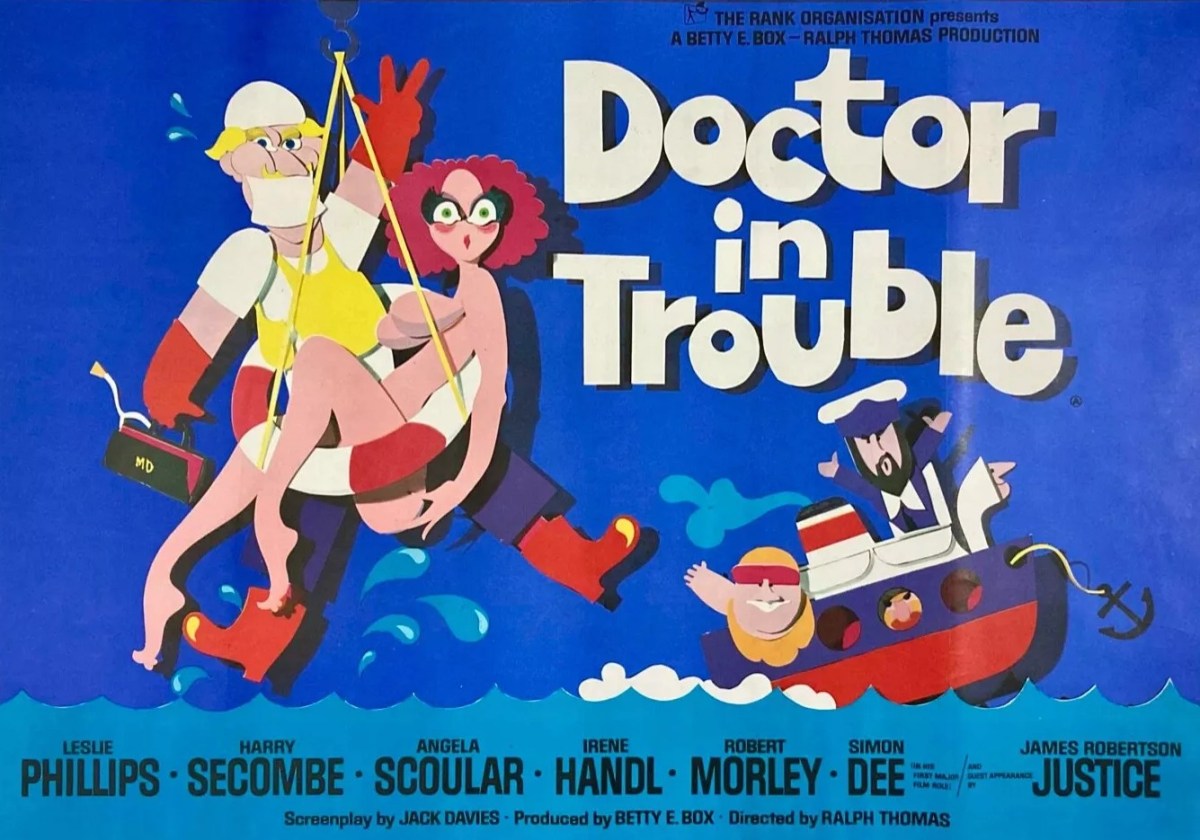
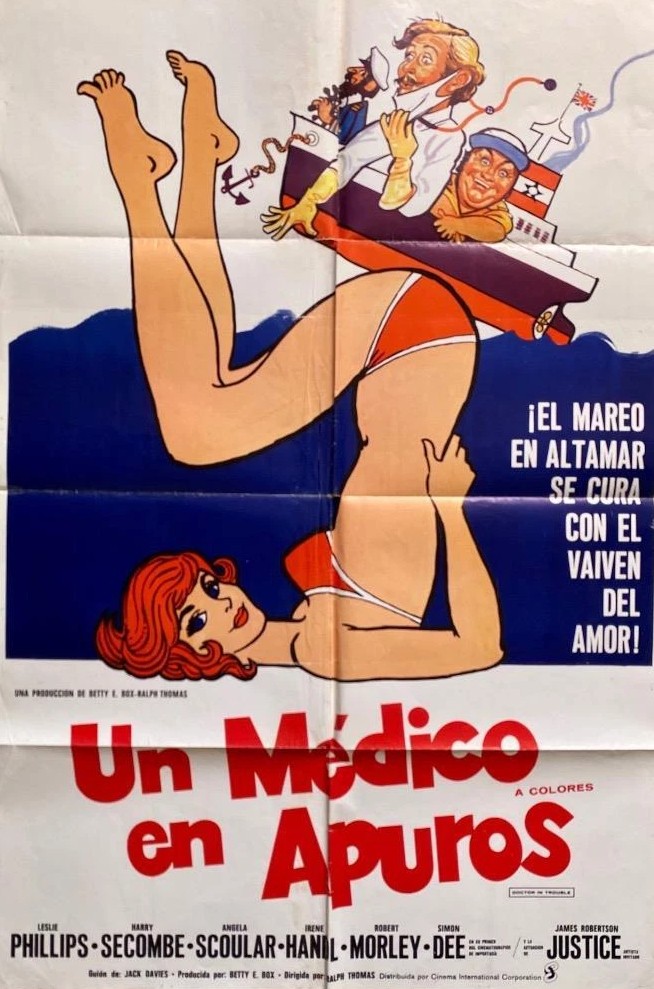
Doctor in Trouble (1970) **

Limp ending to a fine series. Torpedoed by too many oddities. Leslie Philips returns in the top-billed role, but he’s not playing the suave Dr Gaston Grimsdyke of the previous iteration, but instead a more hapless version of Dr Paul Burke, the character he played a decade before in Doctor in Love (1960).

Confused? You will be. It’s clearly set up for James Robertson Justice to play two characters, a la Sinners (2025), his usual Sir Lancelot Spratt and his presumably identical brother, ship’s captain George Spratt. But Justice fell ill and the naval part was taken by Robert Morley, of similar bombastic ilk, but in diction more long-winded and fluffy and lacking the bite of the surgeon.
In the last two episodes I’d seen there had been an obnoxious salt-of-the-earth character who turned out to be surprisingly artistic. Here, we have to settle for the nouveau riche Pools-winner (a gambling game of the era) who is channeling his inner Sidney James, all leer and not much else. And if you want proof that it’s never a good idea to hire a television personality merely because he has a large following, look no further than Simon Dee.

Several notions will not endear themselves to the contemporary audience – the cross-dressing, the cliché gays, and the Englishman in brownface playing an Indian. That’s not to mention the pratfalls and endless falling into swimming pools.

There’s even less of a plot than in the last outing. Dr Burke (Leslie Philips) accidentally stows away on a cruise ship after pursuing model girlfriend Ophelia (Angela Scoular) who’s working there. He also comes up against actor Basil Beauchamp (Simon Dee), an old school bete noire, who plays a doctor in a television soap.
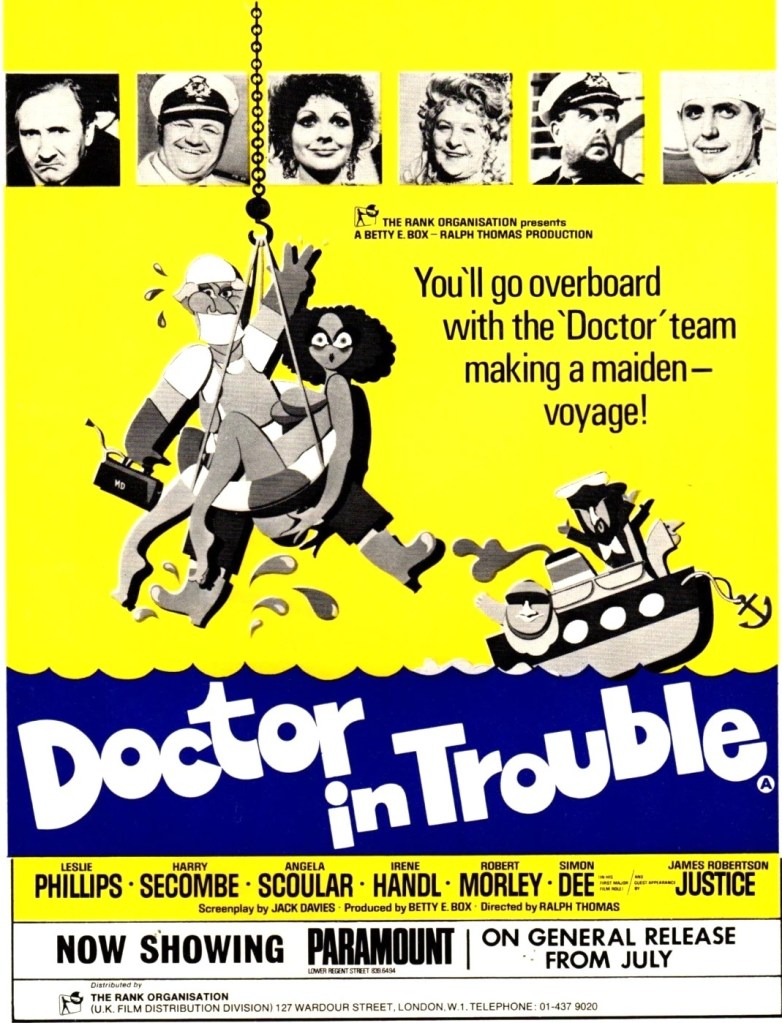
Dr Burke is hounded by the ship’s Master-at-Arms (Freddie Jones) so occasionally it lurches into farce. And there’s any number of sexy debutantes either desperate to climb into bed with the TV star or hook the gambler.

If it had settled on one tone – slapstick, sex comedy or farce – it might well have worked even in the face of the poor script. Cor blimey, there’s even some fleeting nudity from Ophelia and Leslie Philips and a striptease that’s way out of place for what was originally a much gentler comedy than the Carry Ons. In terms of style it’s all over the place and not a single member of the cast is appealing enough to rescue it.

Had Leslie Philips been in traditional “ding-dong” comfort zone it might have passed muster but here he’s just the butt of all the jokes without generating an ounce of sympathy. Robert Morley (Some Girls Do, 1969) isn’t a patch on James Robertson Justice. Angela Scoular (On Her Majesty’s Secret Service, 1969) seems off-key, Freddie Jones (Otley, 1969) as if he’s in a different picture while the constantly leering Harry Secombe (Oliver! 1968) belongs in a Carry On. Graham Stark (The Picasso Summer, 1969) is deplorable as the Indian waiter Satterjee.

The only person to rise above their station is Joan Sims (Doctor in Clover, 1966) who makes a cameo appearance as a Russian nurse. In bit parts you might spot Yutte Stensgaard (Zeta One, 1969) and Janet Mahoney in her debut.

Directed as usual by Ralph Thomas. Script by Jack Davies based on a Richard Gordon bestseller.

After this, the series was reimagined for television and returned to its gentle comedy roots.

For completists only – and even then…
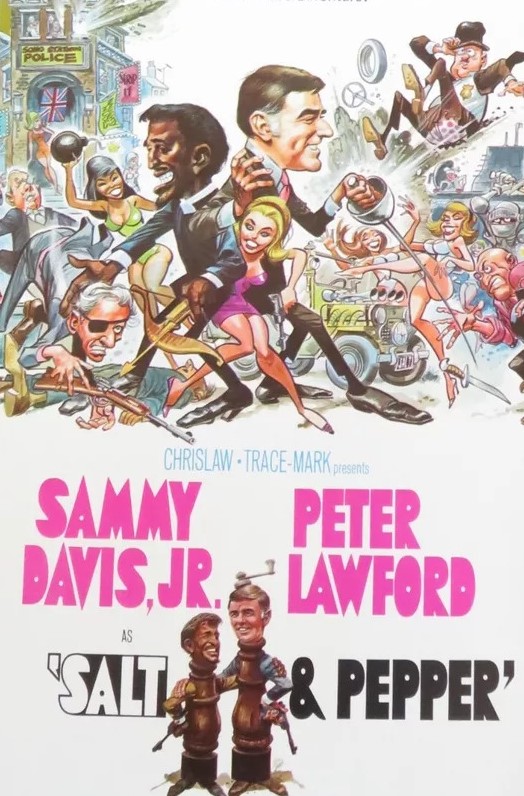
Salt and Pepper (1968) ***

Dry run for the director Richard Donner’s later Lethal Weapon? A cautionary tale about what might have happened to the revered Rat Pack series had it spluttered on into the vestiges of the  “groovy” Sixties? An attempt to emulate the Bob Hope-Bing Crosby joker-crooner concoction? Or Morecambe and Wise, two idiots on the loose? Spy movie spoof? Stuffy Brits in the firing line?

All of the above. If you are comfortable with the sexist agenda that was almost de rigeur for the times, don’t mind the movie’s lurching tone, or the scattergun gag approach, the glib approach to violent death, and don’t cringe at the running racist jokes (making fun of racism, you understand) you might well find enough to like.

Especially as this was something or an audition. A way to check whether, in Hollywood marquee terms, stars Sammy Davis Jr. and Peter Lawford could cut it. For such a renowned celebrity, this was one of only two films where Sammy Davis Jr. was top-billed. And for Peter Lawford, an eternal supporting actor, this was the highest billing he ever achieved outside of the Italian-made The Fourth Wall (1969).

Salt (Sammy Davis Jr.) and Pepper (Peter Lawford) – that’s your first joke, right there, the names, work it out – are under investigation by the London cops for their Soho night club, which doubles as a gambling joint where the croupiers are not only, unusually, female (strike one for feminism) but topless (strike out for feminism). Both consider themselves lotharios and have a running bet on who will be the more successful (so that’s all right then).

But they’re not that bright when it comes to women (so one in the eye for those James Bond types), as neither could spot a femme fatale is she had those words branded on her forehead (the forehead the last female feature they’re interested in), and the prospect of an inert female lying on the office floor is so inviting to them that it doesn’t occur to them they’re trying to chat up a corpse.

Anyways, the dead woman Mai Ling (Jeanne Roland) is a spy and soon our boys are caught up in an espionage tale that dithers between hard-nosed Soho thugs with requisite scars (and a twitch), posh villain with piratical eye-patch, Downing St and duff British officialdom, real and fake Prime Ministers and Home Secretaries, public schools (and a gag about “fags”) and car chases in a Mini-Moke stacked with standard 007 extras like machine guns and oil-spraying devices.  

So it’s one wildly imaginative situation after another, interrupted by stage turns by Sammy Davis Jr. (presumably to remind people this was a Rat Pack rip-off), with the cream of the British character acting fraternity being permitted to go way outside the stiff-upper-lip British box.

Fits neatly into the spy spoof, or the Eurospy spoof (which tended to be overloaded one way or another). Shame about the wayward direction and outlandish script because Sammy Davis Jr. and Peter Lawford do make a fine screen comedy pair, matching each other in ineptitude, and with Davis coming top of the Swinging Sixties Fashion Faux Pas Top Ten, with the kind of outfits that only attention-seeking nutjobs or villains would consider wearing.   

Plenty of fun watching the supporting cast play around with their screen personas. John Le Mesurier (Midas Run, 1969), Michael Bates (Hammerhead, 1968), Robertson Hare (All Gas and Gaiters series, 1966-1971), Graham Stark (The Plank, 1967) and Ernest Clark (Arabesque, 1966) are getting paid to have fun. Ilona Rodgers (Snow Treasure, 1968) makes her movie debut.

You kind of get the idea that Michael Pertwee’s screenplay fell into the wrong hands. That it was intended as a vehicle for Morecambe and Wise (Pertwee wrote The Magnificent Two, 1967) and somehow ended up with American stars.

If your familiarity with the 1960s espionage genre runs only to James Bond, Matt Helm, Harry Palmer and that big-budget ilk and your idea of a spy spoof is limited to Casino Royale (1967), this will fill you in on the breadth of inanity tolerated.

Successful enough to generate a sequel, One More Time (1970).

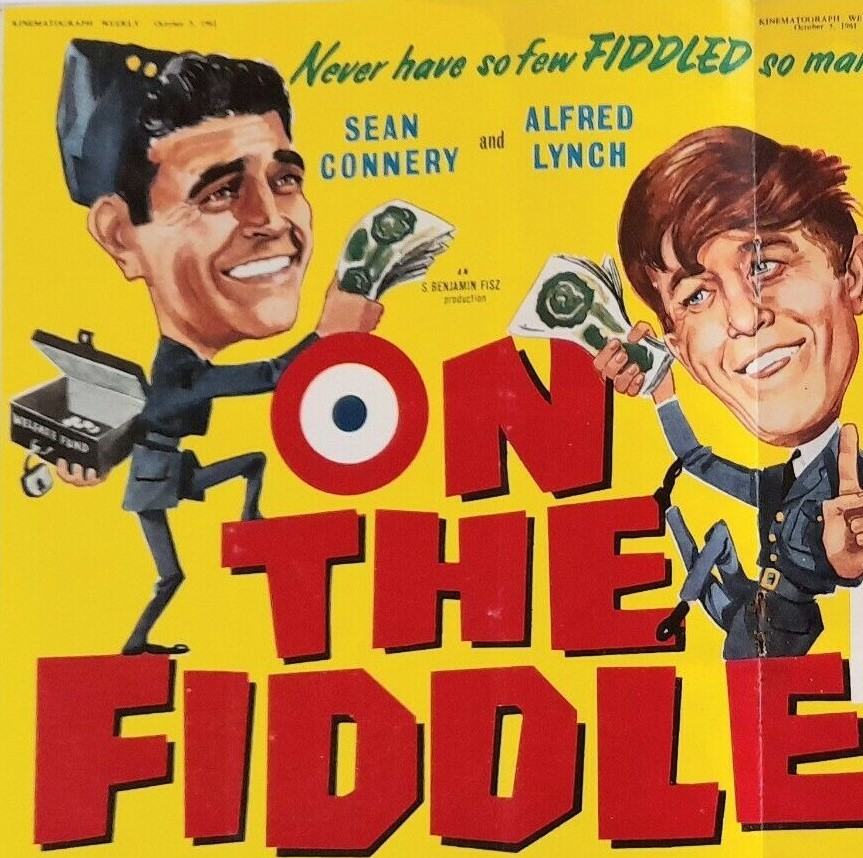
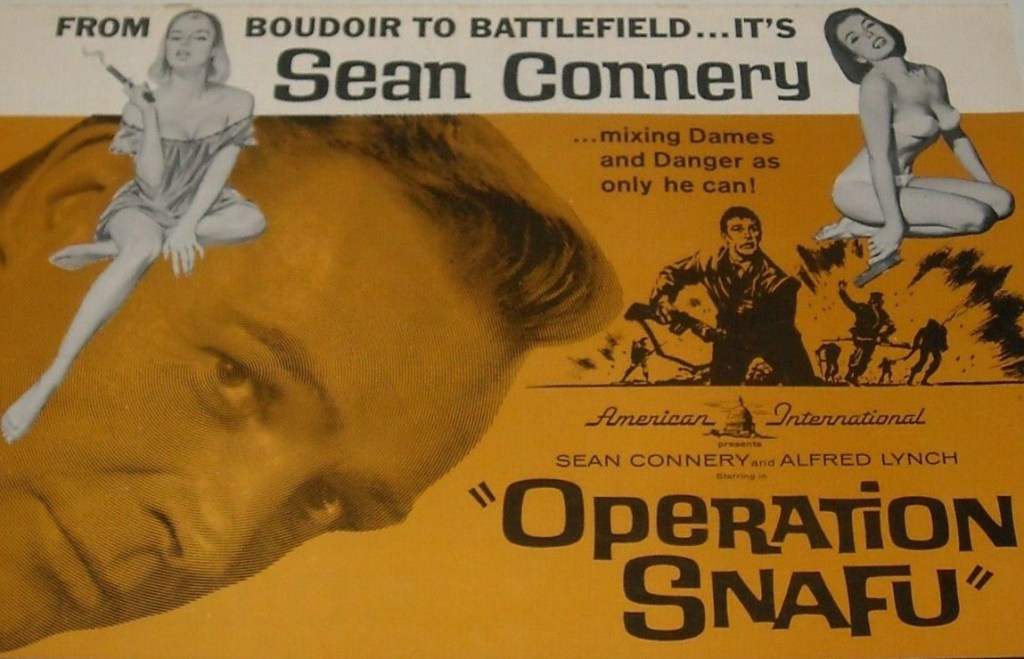
On the Fiddle / Operation Snafu (1961) ***

Unassuming but undeniably charming British World War Two comedy denied U.S. release until four years later when a savvy distributor jumped on the James Bond bandwagon. Primarily of interest these days for the opportunity to see a pre-Bond Sean Connery (Dr No, 1962) in action its merit chiefly lies in ploughing the same furrow, though with a great deal less pomposity and self-consciousness, as the later The Americanization of Emily (1964), of the coward backing into heroism.

Horace Pope (Alfred Lynch) is a scam merchant who only dodges prison by enlisting. Assigned to the RAF he teams up with Pedlar Pascoe (Sean Connery) and they embark on a series of schemes designed to keep them as far away from the front line as possible. It’s hardly an equal partnership, Pope dreams up the fiddles while Pascoe just falls in with them. It’s not dumb and dumber but a collaboration that goes no further back in the annals of movies than brain and brawn.

Needless to say, the movie lacks the the damsels in bikinis which were a prerequisite of the Bond pictures. Sean Connery takes top billing Stateside where he was originally behind Lynch.

It’s certainly a cynical number, reflecting the boredom experienced by many of the Armed Forces backroom staff, the administrators whose inefficiency turns them into easy dupes, and the determination of soldiers to take advantage of every opportunity to bend the rules. It takes the unusual position of presenting the ordinary soldier as smart and every officer as a numbskull, an approach that would only have been possible 15 years after the war ended and in marked contrast to the determined heroism of other British war films – such intrepid stiff-upper-lip behavior a hallmark of the British version of the genre.

First stop is to run an operation issuing leave passes – for a price – and the sheer effrontery exhibited by Pope is a joy to behold. Next up is selling stolen meat on the black market.

While Pedlar is the wide-eyed camp follower, and more likely to forever sit on the sidelines, cheerful but shy, and only a few pratfalls away from being a bumbling idiot, they do make a good team. Being sent to France is more of a heaven-sent opportunity to increase their bankrolls than a hazardous wartime mission as Pope sells rations to the French. Eventually, of course, their various scams are rumbled and they are forced into battle.

The only thing better than one pre-Bond Connery picture is two.

The movie switches a bit more deftly into serious mode than the aforementioned The Americanization of Emily mostly because these are actual soldiers trained to be soldiers rather than an officer who landed a cushy number and whose main effort is to avoid combat. War is presented as horrific rather than comedy and it must have been the same experience for an ordinary soldier at the time, after months of inactivity suddenly thrust into the cauldron.

The picture moves at a brisk pace and is continually amusing if not particularly laugh-out-loud. You’ve probably seen most of the set-ups before but they are reinvented with an appealing freshness and briskness  As a bonus there’s reams of British character actors and comedians – plus token American Alan King (who would appear in Connery starrer The Anderson Tapes, 1971) – along the way. The term “snafu” in case you’re interested, has a similar meaning to the “fubar” of Saving Private Ryan (1998).

Alfred Lynch (The Hill, 1965) doesn’t milk the Cockney patter overmuch and he’s got a greater international screen appeal than the likes of the more English Sid James (Carry On films) or Norman Wisdom. Think a shiftier Sgt Bilko, if the Phil Silvers creation could be any more untrustworthy.

Connery’s performance is well worth a watch as a prelude to what was to come once his roles were tailor-made. He is an effortless scene-stealer, gifted in expressing emotion through his eyes, and although verbally Lynch dominates it’s difficult to take your eyes off Connery.

The roll-call of character actors includes Cecil Parker (A Study in Terror, 1965), Stanley Holloway (My Fair Lady, 1964), John Le Mesurier (The Moon-Spinners, 1964), Graham Stark (The Wrong Box, 1966) and Victor Maddern (The Lost Continent, 1968).

Cyril Frankel (The Trygon Factor, 1966) comfortably cobbles this together from a screenplay by Harold Buchman (The Lawyer, 1970, and who had ironically enough penned the picture Snafu in 1945) based on the novel Stop at a Winner by R.F. Delderfield.

When the box office supremacy of the Bond pictures was underscored by the reissue of the Dr No/From Russia with Love double bill in 1965, distributors, as had been their wont, racked the vaults for anything featuring Connery that could be re-sold to a willing public.    

While there is a readily available DVD, this turns up on a regular basis, in Britain at least, on television.

Discover WordPress

A daily selection of the best content published on WordPress, collected for you by humans who love to read.

The Atavist Magazine

by Brian Hannan

WordPress.com News

The latest news on WordPress.com and the WordPress community.