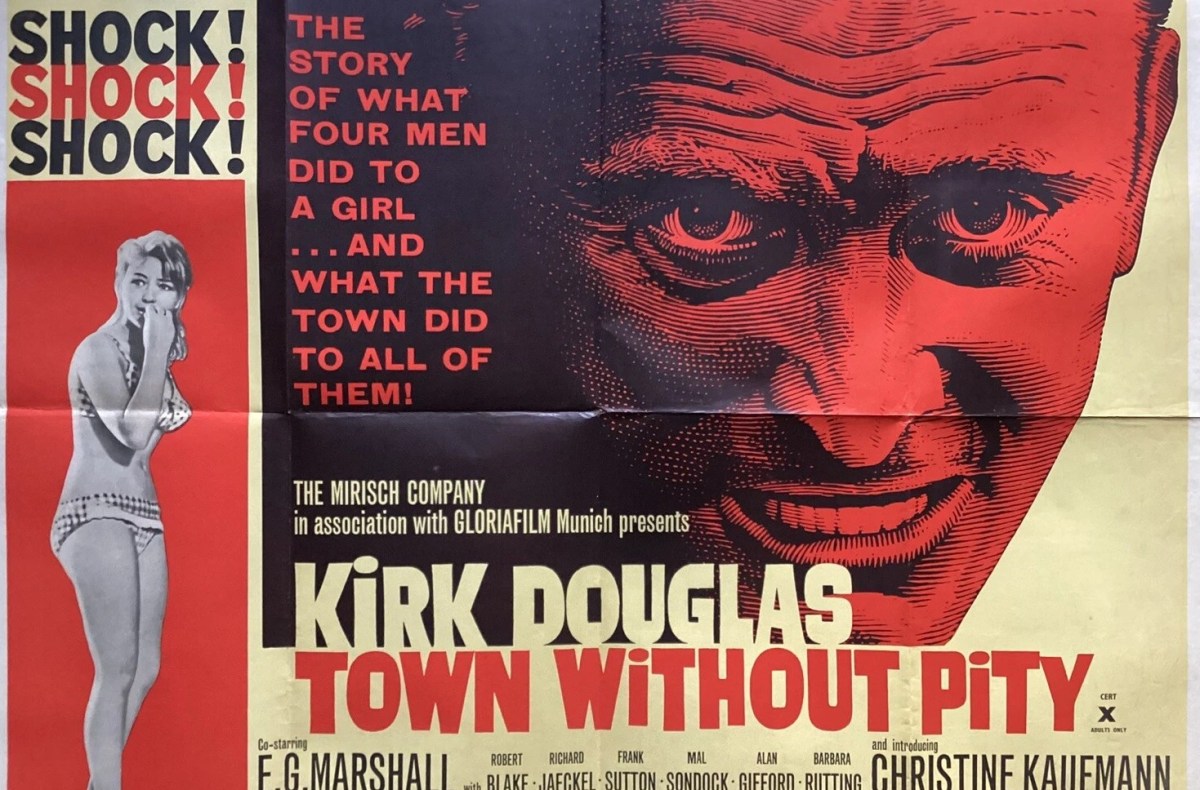
Long-forgotten courtroom picture that deserves urgent reassessment in the wake of Jeffrey Epstein and especially the casual destruction of Virginia Giuffre. We’re so accustomed to attorneys being shown in a good light – defense lawyers rescuing the innocent, prosecutors putting away the evasive guilty – that we forgot just how brutal a trial is for the unprepared. Even a “fair trial” permits a lawyer to brutalize a witness. Until recently, rape trials came apart once the prosecution could prove the victim was “asking for it.”
Four American soldiers rape a young girl in Occupied Germany at the start of the 1960s. Major Steve Garrett (Kirk Diouglas), defending the quartet, goes on the attack, attempting to demolish the reputation of banker’s daughter Karin (Christine Kaufman). Unusually, the stakes are the highest they could be. Under a quirk of German law, the soldiers could face the death penalty. Under another quirk, for that to have any chance of occurring, Karin has to take the witness stand. If Garrett can place her and her family under sufficient pre-trial duress she might excuse herself from court.
Turns out Garrett finds many willing accomplices among the townspeople. It’s not so much a town without pity as a town called malice. Some dislike her father, others feel she has already brought the town into disrepute, and there’s the usual generation clash. A voyeuristic neighbor reports that she stands boldly naked at her window. Another has seen Karin and her boyfriend Frank (Gerhart Lippert) spend a weekend together. Her shamed father Karl (Hans Nielsen) discovers a lot he didn’t want to know about his adored daughter, though, even so, he backs her, willing to suck up the humiliation and finger-pointing.
Everyone knows the men are guilty although one of them, Corporal Larkin (Robert Blake), might be technically innocent because he proves to be impotent. Even so, he was present and did nothing to prevent the assault. The men’s defense is that they came upon her naked and, having quarrelled with Frank, she flaunted herself, desiring the sexual attention of men. Since it would be embarrassing to admit that she stood around naked beside the river, she lies and says she was wearing a bikini at the time.
Kirk Douglas was such a dab hand at playing the action hero – Gunfight at the O.K. Corral (1957), The Vikings (1958), Spartacus (1960) – and the misunderstood, as in Lust for Life (1956), that audiences tended to forget his cynical turn in Ace in the Hole (1951) and that he could transition into mean at the drop of a hat. Here, he has the excuse of only doing his job.
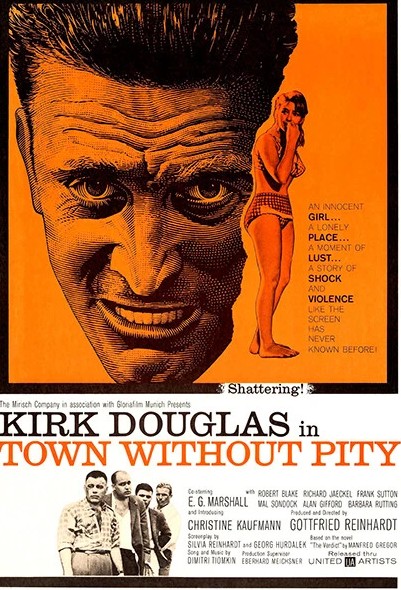
But it’s vicious stuff and once Garrett has Karin in the courtroom there’s only going to be one winner at the expense of destroying the loser. She is torn apart as he sets her up as a woman who enjoys showing men her naked body and proves false her contention that the men ripped the bikini from her.
She can’t take the gruelling attack and faints, her father removing her from the witness box, rendering the death penalty inapplicable. There’s a sad coda, which would not have been unexpected.
German director Gottfried Reinhardt, who had worked with Douglas before on The Story of Three Loves (1953), takes an unusual approach, to some extent shielding the audience from Garrett with a voice-over narration from local reporter Inge (Barbara Rutting), with whom Garret initially flirts. But there‘s little grandstanding, any references to the law are not in recognition of its contribution to justice, but in pointing out that it’s not a good idea to get caught in the legal maw because you will be destroyed one way or another.
There’s one shot at the end where Garrett realizes that he’s been instrumental in driving Karin to suicide, but mostly he views himself as a victor, a legal warrior who will do anything to win. He excuses his behavior because he’s not trying to get his clients off the charge of rape but merely determined to avoid them hanging. But you know he’s still belongs to the tribe of men who can brutalize the innocent on the witness box and never feel remorse.
Kirk Douglas is superb, as is Austrian-born Christine Kaufman (Taras Bulba, 1962) in her debut. And although the rest of the cast has little to do, the collection of wannabes includes Robert Blake (Tell Them Willie Boy Is Here, 1969) and Richard Jaeckal (The Dirty Dozen, 1967). Scripted by George Hurdalek (Tread Softly, 1965) and Sylvia Reinhardt (Situation Hopeless But Not Serious, 1965) from the book by Manfred Gregor.
Watching it now, the case of Virginia Giuffre hangs over this. She was reviled on all fronts before reaching an out-of-court settlement but never recovered from the ordeal and took her own life.
Worth reassessment.
 The Magnificent 60s