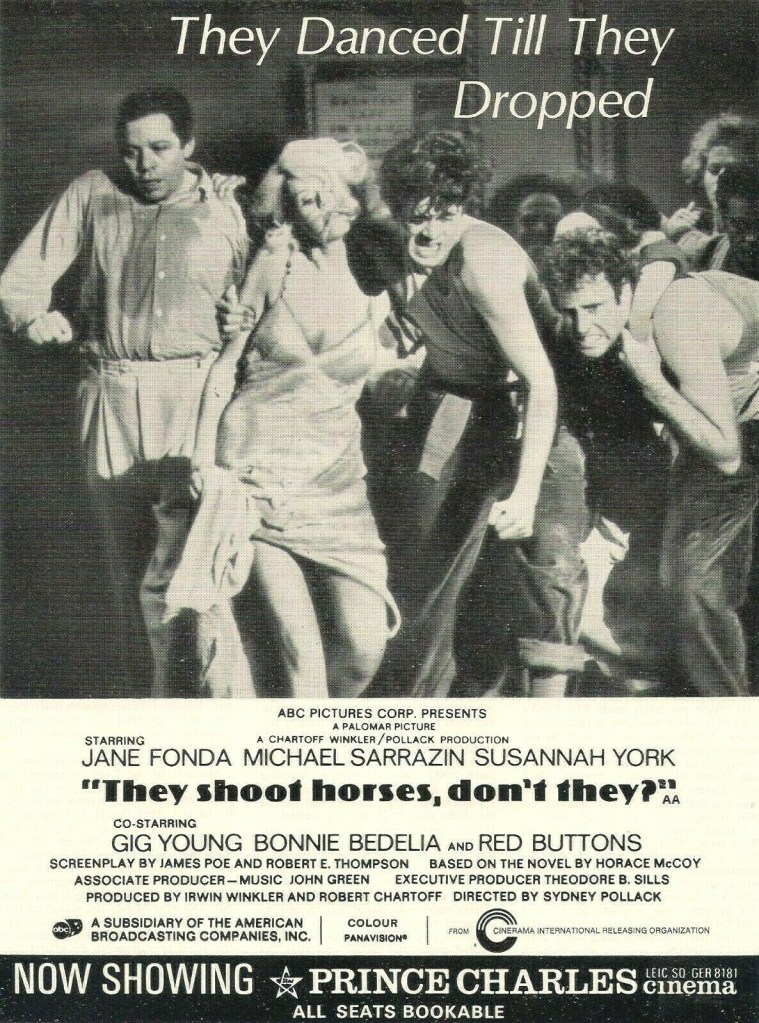
Fans of reality television shows will be only too aware how participants volunteer for ritual humiliation, but swallowing a few locusts and being stuck with a couple of snakes has nothing on the realities facing individuals during the Great Depression who would literally dance non-stop for days on end with a ten-minute break every two hours. It’s impossible to imagine that anybody could think of dreaming up such a degrading circus to take advantage of the desperate. But then this is America, land of opportunity and the MC Rocky (Gig Young) continues to spout aphorisms and continues to promote the American Dream even as it disintegrates in front of him.
When the partner of Gloria (Jane Fonda), out-of-work actress and one of the more physical and cynical of the candidates hoping to scoop the $1,500 first prize (no prizes for coming second, of course), is ruled out through bronchitis – in case he passes it on to others rather than more any humane consideration – she pairs up with dreamer Robert who initially wanders in as spectator rather than participant. Glamorous platinum blonde aspiring actress Alice (Susannah York) is already coming apart. Sailor (Red Buttons) is a former war hero and James (Bruce Dern) drags his heavily pregnant wife (Bonnie Bedelia) around the dance floor.
There is not a great deal of story except to watch everyone grow mentally and physically incapacitated. There is betrayal and lust and survival instinct leads characters into sexual situations. When Alice seduces Robert, in retaliation Gloria dumps him and then has sex with Rocky, while attempting to retain control of that situation, but clearly needing at the very least consolation and confirmation of her attractiveness and at best some sign of favoritism.
As well as non-stop dancing, Rocky throws in stunts to keep the audience, who can sponsor a pair, interested. So there are 10-minute races, the last three to be eliminated. So determined are some of the competitors they will even lug their dead partner over the finishing line. Another of Rocky’s wheezes is to have Gloria and Robert marry, worth $200 in terms of the gifts they will receive from a sentimental audience, in the middle of the dance floor.
They are literally dancing for hours, over 1,000 in over 40 days so gradually the dance floor becomes less crowded as dancers collapse from exhaustion or cannot take it anymore. The spectators, we are reminded, are only there because “they want to see someone worse than them.” Just when you think nothing can shock you any more, it is revealed that the first prize is minus the cost of feeding, sheltering and looking after the winner.
Those who think they are tough find that the demands of mental and physical endurance are beyond them. This is a shocking film and there’s no doubt it will stay with you for a long time. I saw it first when it came out but not again until now and thank goodness for forgetfulness otherwise I doubt if I would have chosen to sit through it again.
It’s doubtful if any actress had achieved such a speedy transition from glamorous leading lady to serious actress as Jane Fonda. From stripping in space in Barbarella (1968) to stripping away the last vestiges of her humanity here. Suddenly, she appears in a brand-new screen persona with the grating voice, the chip on the shoulder, the feistiness and worthy inheritor of father Henry’s acting genes. It’s also a bold role for Susannah York, in an extension of the weak character she essayed in Sands of the Kalahari (1965) but far more delusional, believing in a rainbow that will never appear. Michael Sarrazin (In Search of Gregory, 1969) initially appears out of his league but his character calls for a gentle innocence that is well within his scope.
Gig Young steals the picture, offered the opportunity to bring alive a multi-faceted character, as big a spiel-merchant who ever crossed the screen, but engaging in a marathon of optimism, and at some points, such as when coaxing a demented Alice out of the shower, earning our sympathy. Red Buttons (Stagecoach, 1966), Bruce Dern (Castle Keep, 1969) and Bonnie Bedelia (Die Hard, 1988) also put in sterling work.
The movie received nine Oscar nominations but was ignored in the Best Picture category. Only Gig Young won for Best Supporting Actor. Jane Fonda and Susannah York both received their first Oscar nominations, for Fonda the first of many, for York the one and only. It was also a debut nomination for Pollack, a future winner.
Sydney Pollack directs with simplicity, concentrating on the indignities of the event and focusing mostly on the personalities draining away, and even the drama is undercut, most of those scenes directed in straightforward style. However, Pollack plays around with the innovative fast forward – flashes into scenes that have not yet taken place. James Poe (Lilies of the Field, 1963), at one time down to direct, and Robert E. Thompson, a television writer making his first venture on the big screen, wrote the screenplay from the Horace McCoy novel.
Check out the Behind the Scenes article on this one.
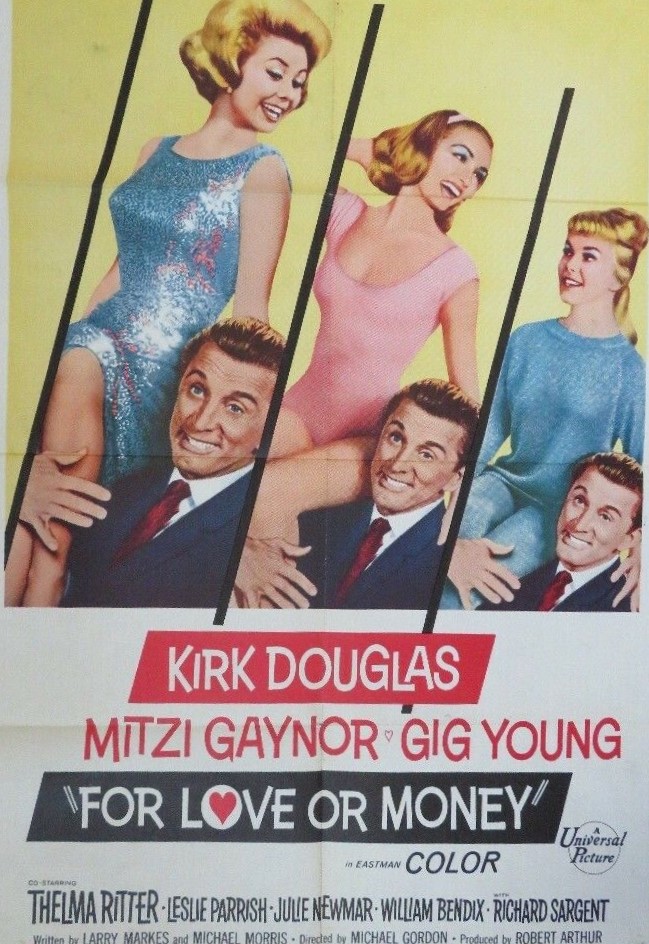
Kirk Douglas (The Brotherhood, 1968) had been so intent on establishing his dramatic credentials as a Hollywood high flier that he hadn’t appeared in a comedy in six years when he was second-billed to Susan Hayward in Top Secret Affair (1957).
So after all the sturm und drang of heavyweight numbers like Strangers When We Meet (1960), Spartacus (1961), and Lonely Are the Brave (1962) it was always going to be interesting to see if he could drop the commanding persona long enough to hit the laugh button. He’s helped by a screenplay that while suggesting he is in control shows him run ragged by a quartet of females.
Millionaire widowed mother Chloe (Thelma Ritter) hires singleton lawyer Deke (Kirk Douglas) for $100,000 – enough to pay off his debts – as some kind of matchmaker, not given the task of finding suitable husbands for her daughters, but to make sure that trio of spoiled women get hitched to men chosen by her.
The plan is for the Kate (Mitzi Gaynor), the most organized, to marry rich playboy Sonny (Gig Young), health nut Bonnie (Julie Newmar) to take up with child love Harvey (Richard Sargent) and hippie art lover Jan (Leslie Parrish) to be landed with dull taxman Sam (William Windom). Sonny is Deke’s best friend, they share a yacht.
Nothing tuns out the way it should in part because Deke is more attractive than any of the other males on offer and in part because the heiresses are disinclined to do what anyone tells them. Deke spends all his time getting into hot water, dashing into another room to take phone calls that inevitably create further confusion, while manfully trying to ensure that the male suitors present their most attractive sides to their potential brides.
There’s not a great deal to it. It’s not exactly farce, but given the daughters live on top of each other, quite easy for Deke to race from one apartment to another, and say the wrong thing at the wrong time. The juggling act is never going to work out, especially as Kate is love struck by Deke, though if she could see how easily he flirts with her siblings she might be less keen. There’s finale on a boat or, should I say, in falling off a boat.
I wouldn’t say it’s a hoot but it’s an excellent lightweight concoction that comes to life by inspired casting. None of the women is your typical Hollywood fluff, all present interesting characters, leaders in their own ways, and with a lifetime of standing up to their domineering mother unlikely to fall over at the sight of any decent male.
Thelma Ritter (Boeing, Boeing, 1965) is easily the pick. The six-time Oscar nominee, generally seen in dowdy parts as a maid or similar, is dressed to the heavens, all glammed up as the millionairess without losing any of her trademark snippiness or drollery. Mitzi Gaynor (South Pacific, 1958), in her final screen role, has a well-written part as an efficient businesswoman and proves more than a match for Deke.
Julie Newmar (The Maltese Bippy, 1969) is a delight as the health nut whose physical demeanor is proof of her regime while Leslie Parrish (The Manchurian Candidate, 1962) bounces along with a coterie of artists. Gig Young (Strange Bedfellows, 1965) can do this kind of role in his sleep but he’s no less effective for having acquired that skill of the guy who never gets the girl. And there’s a rare sighting of Hollywood tough guy William Bendix (The Blue Dahlia, 1946) in a comedy.
But none of this would work without Kirk Douglas. And it works because he plays it straight. He doesn’t give in to the temptation of mugging to the camera, eye-rolling and pratfalls. You could easily get the idea the actor thought he was in a drama, especially as he’s the one in the kind of quandary that we’ve seen him ignore before, when ambition trumps morality or romance, as with Ace in the Hole (1951) or Strangers When We Meet. In some senses, the casting relies on audiences being aware of that sneaky side of his screen persona, the one where he doesn’t always do the right thing. And here, you could easily see him opting for the loot over the girl.
Director Michael Gordon (Texas Across the River, 1966) is adept at winkling out the comedic moments in stories that are played straight. The team of Larry Markes and Michael Morris (Wild and Wonderful, 1964) wrote the screenplay with the emphasis on situation comedy rather than farce.
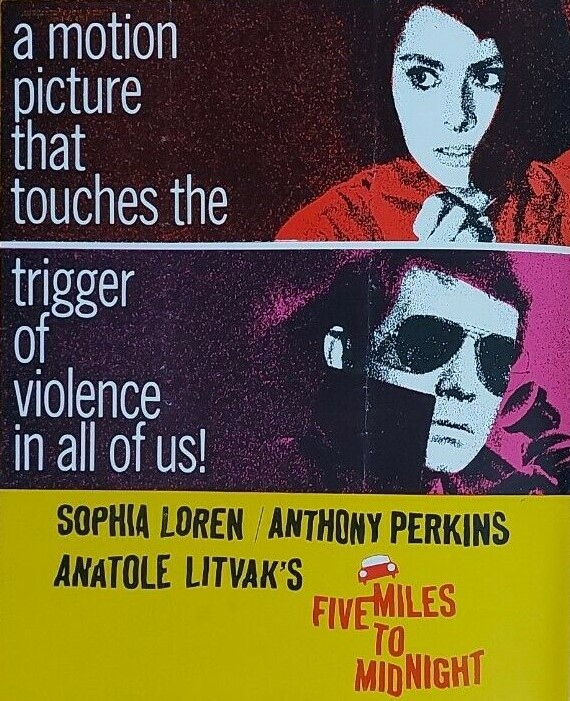
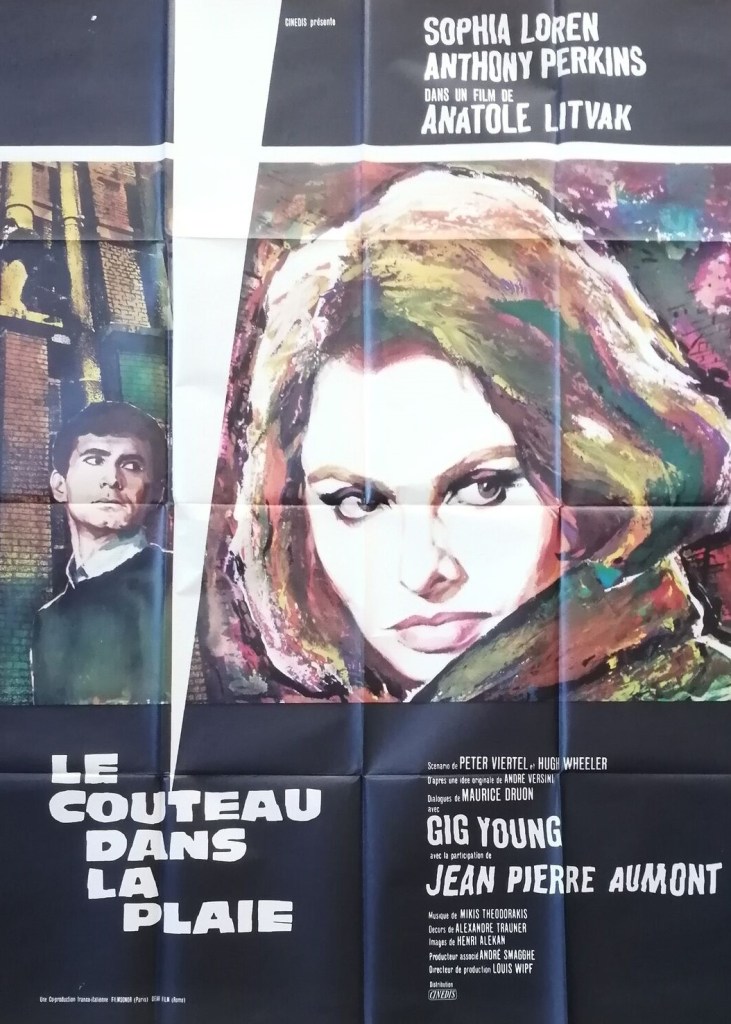
Superb performance by Sophia Loren (Arabesque, 1966) lifts taut Parisian-set thriller into outstanding class. Forced, of narrative necessity, to keep a lid on her emotions, Loren’s eyes betray her feelings. Director Anatole Litvak’s (Lady in the Car with Glasses and a Gun, 1970) camera is relentless, trapping her with almost claustrophobic compulsion, allowing little release, preventing her escaping the eye of truth.
Husband Robert (Anthony Perkins) and wife Lisa (Sophia Loren) embark on major insurance fraud. He’s the instigator, she reluctantly goes along with the plan as she imagines that, with their unlikely marriage already teetering, it will buy her freedom. Robert, sole survivor of a plane crash, rather than announcing he is alive, uses his death to scam the insurance company out of $120,000 (equivalent to $1.2 million today).
Given he is deceased, she has to carry out the formalities of making the claim, dealing with the various authorities, including police and the American consulate. Meanwhile, hiding out, every knock on the door or ring of the telephone creates panic. At various points Robert has to hide in every room in the apartment – remembering to remove any sign of his existence – and on the stairwell and when that proves too dangerous on the roof.
Little things that could give him away. The extra plate or glass could trigger suspicion from the cleaner. Lisa, a non-smoker, has to purchase cigarettes for Robert, the remains of an ashtray a possible reveal. She returns to work much faster than you would expect of a grieving widow.
She attracts an initially unwelcome suitor, David (Gig Young), a doctor, a friend of a friend. Workmates turn up at inopportune moments. A boy in an apartment opposite spots the recluse, at one point, shining a mirror into Robert’s eyes, dazzling him as he hides, precariously, on the roof. A cat, too, threatens to reveal the voluntarily imprisoned man.
You might wonder how why she married the financially dissolute Robert in the first place, more baby than man, a “charming octopus” whose needs would strangle the life out of a wife. He was her meal ticket from post-war Naples. She was so desperate to escape poverty that she would, as Robert acidly (and truthfully) puts it, that she would have gone off with any fellow with “a couple of bucks in his pocket.”
In Britain it was released on the lower part of a double bill to “Taras Bulba.”
He suspects she has a lover. And from random clues in the apartment, David also suspects she has a lover. But mostly it’s nail-biting waiting. And when her nerves are so shredded she is inclined to confess all to the police, and be rid of her husband, she realises she would be jailed as his accomplice. And though going along with the notion that the money will buy both their (separate) freedom, the devious Robert has no intention of letting her go, intending to blackmail her into remaining with him.
As the stakes rise we enter a frankly magnificent endgame, with one twist after another, Lisa barely coherent from overwhelming pressure even as freedom beckons.
It’s splendidly done, chock full of surprises, from the opening credits to the last intense close-up of Lisa. The credit sequence, a long tracking shot following a pair of legs from a bus to a nigh club, jaunty jazz in the background, Lisa exuberantly dancing the Twist, ends in an explosive slap. Where are obstructive insurance agents, the kind that automatically challenge every claim, hoping to whittle down the amount, when you need them? This one couldn’t be more helpful, even easing the path, when she had counted on the opposite in order to scupper the outrageous plan, to getting a death certificate out of the American consulate. It turns out you can easily dupe the police by simply denying that a coat found near the location of the crash does not belong to Robert.
The focus is kept almost evenly on the culprits. Awful husband that he is, Robert’s little-boy-lost persona still extracts audience sympathy – she is a deceiver after all, conning him into marriage, lover on the side – especially as you know that, even though this never occurs to Lisa, that capturing Robert will result in her imprisonment. But Robert already lives on the emotional edge and there’s one terrifying scene where he is clearly tempted to throw the small boy off the roof.
Even when Lisa believes she has found sanctuary in David, his suspicions threaten that. I won’t spoil the endgame for you because it is exceptional, very well worked in terms of action and emotion.
This didn’t get much attention when it appeared despite Loren’s stunning performance, perhaps because insurance fraud suggests little of the inherent tension of a heist. Anthony Perkins, desperately trying to avoid the typecasting triggered by Psycho (1960), successfully develops a more attractive screen persona that would climax in Pretty Poison (1968). Given the set-up, you imagine that the eternally charming Gig Young (They Shoot Horses, Don’t They, 1969) will turn out to be an undercover insurance agent. Even when that is obviously not the case, he is too inquisitive for Lisa’s good.
In contrast to the claustrophobic tension, the movie plays out against the backdrop of fun-filled parties, dancing, nightclubs, cocktails, the high life.
At this point Anatole Litvak was rarely mentioned in dispatches, critics considering his best films (The Snake Pit, 1948, for example) way behind him and that he was more likely to helm lumbering well-meaning vehicles like The Journey (1959). But, opening credits and a couple of scenes making using of perilous shadow apart, he is primarily an actor’s director. And when he gives a star of the skill of Sophia Loren such leeway, the script not permitting her self-justification, he is truly rewarded.
Superb performance by Sophia Loren (Arabesque, 1966) lifts taut Parisian-set thriller into outstanding class. Forced, of narrative necessity, to keep a lid on her emotions, Loren’s eyes betray her feelings. Director Anatole Litvak’s (Lady in the Car with Glasses and a Gun, 1970) camera is relentless, trapping her with almost claustrophobic compulsion, allowing little release, preventing her escaping the eye of truth.
Husband Robert (Anthony Perkins) and wife Lisa (Sophia Loren) embark on major insurance fraud. He’s the instigator, she reluctantly goes along with the plan as she imagines that, with their unlikely marriage already teetering, it will buy her freedom. Robert, sole survivor of a plane crash, rather than announcing he is alive, uses his death to scam the insurance company out of $120,000 (equivalent to $1.2 million today).
Given he is deceased, she has to carry out the formalities of making the claim, dealing with the various authorities, including police and the American consulate. Meanwhile, hiding out, every knock on the door or ring of the telephone creates panic. At various points Robert has to hide in every room in the apartment – remembering to remove any sign of his existence – and on the stairwell and when that proves too dangerous on the roof.
Little things that could give him away. The extra plate or glass could trigger suspicion from the cleaner. Lisa, a non-smoker, has to purchase cigarettes for Robert, the remains of an ashtray a possible reveal. She returns to work much faster than you would expect of a grieving widow.
She attracts an initially unwelcome suitor, David (Gig Young), a doctor, a friend of a friend. Workmates turn up at inopportune moments. A boy in an apartment opposite spots the recluse, at one point, shining a mirror into Robert’s eyes, dazzling him as he hides, precariously, on the roof. A cat, too, threatens to reveal the voluntarily imprisoned man.
You might wonder how why she married the financially dissolute Robert in the first place, more baby than man, a “charming octopus” whose needs would strangle the life out of a wife. He was her meal ticket from post-war Naples. She was so desperate to escape poverty that she would, as Robert acidly (and truthfully) puts it, that she would have gone off with any fellow with “a couple of bucks in his pocket.”
He suspects she has a lover. And from random clues in the apartment, David also suspects she has a lover. But mostly it’s nail-biting waiting. And when her nerves are so shredded she is inclined to confess all to the police, and be rid of her husband, she realises she would be jailed as his accomplice. And though going along with the notion that the money will buy both their (separate) freedom, the devious Robert has no intention of letting her go, intending to blackmail her into remaining with him.
As the stakes rise we enter a frankly magnificent endgame, with one twist after another, Lisa barely coherent from overwhelming pressure even as freedom beckons.
It’s splendidly done, chock full of surprises, from the opening credits to the last intense close-up of Lisa. The credit sequence, a long tracking shot following a pair of legs from a bus to a nigh club, jaunty jazz in the background, Lisa exuberantly dancing the Twist, ends in an explosive slap. Where are obstructive insurance agents, the kind that automatically challenge every claim, hoping to whittle down the amount, when you need them? This one couldn’t be more helpful, even easing the path, when she had counted on the opposite in order to scupper the outrageous plan, to getting a death certificate out of the American consulate. It turns out you can easily dupe the police by simply denying that a coat found near the location of the crash does not belong to Robert.
The focus is kept almost evenly on the culprits. Awful husband that he is, Robert’s little-boy-lost persona still extracts audience sympathy – she is a deceiver after all, conning him into marriage, lover on the side – especially as you know that, even though this never occurs to Lisa, that capturing Robert will result in her imprisonment. But Robert already lives on the emotional edge and there’s one terrifying scene where he is clearly tempted to throw the small boy off the roof.
Even when Lisa believes she has found sanctuary in David, his suspicions threaten that. I won’t spoil the endgame for you because it is exceptional, very well worked in terms of action and emotion.
This didn’t get much attention when it appeared despite Loren’s stunning performance, perhaps because insurance fraud suggests little of the inherent tension of a heist. Anthony Perkins, desperately trying to avoid the typecasting triggered by Psycho (1960), successfully develops a more attractive screen persona that would climax in Pretty Poison (1968). Given the set-up, you imagine that the eternally charming Gig Young (They Shoot Horses, Don’t They, 1969) will turn out to be an undercover insurance agent. Even when that is obviously not the case, he is too inquisitive for Lisa’s good.
In contrast to the claustrophobic tension, the movie plays out against the backdrop of fun-filled parties, dancing, nightclubs, cocktails, the high life.
At this point Anatole Litvak was rarely mentioned in dispatches, critics considering his best films (The Snake Pit, 1948, for example) way behind him and that he was more likely to helm lumbering well-meaning vehicles like The Journey (1959). But, opening credits and a couple of scenes making using of perilous shadow apart, he is primarily an actor’s director. And when he gives a star of the skill of Sophia Loren such leeway, the script not permitting her self-justification, he is truly rewarded.
The screenplay, for once not drawn an another source like a novel or Broadway play, is an original drawn out of the combined minds of Peter Viertel (The Old Man and the Sea, 1958), Hugh Wheeler (Kaleidoscope, 1967) and Andre Versini (Mission to Venice, 1964).
Loren is the true star. In a peach of a performance, her eyes constantly reveal inner turmoil.
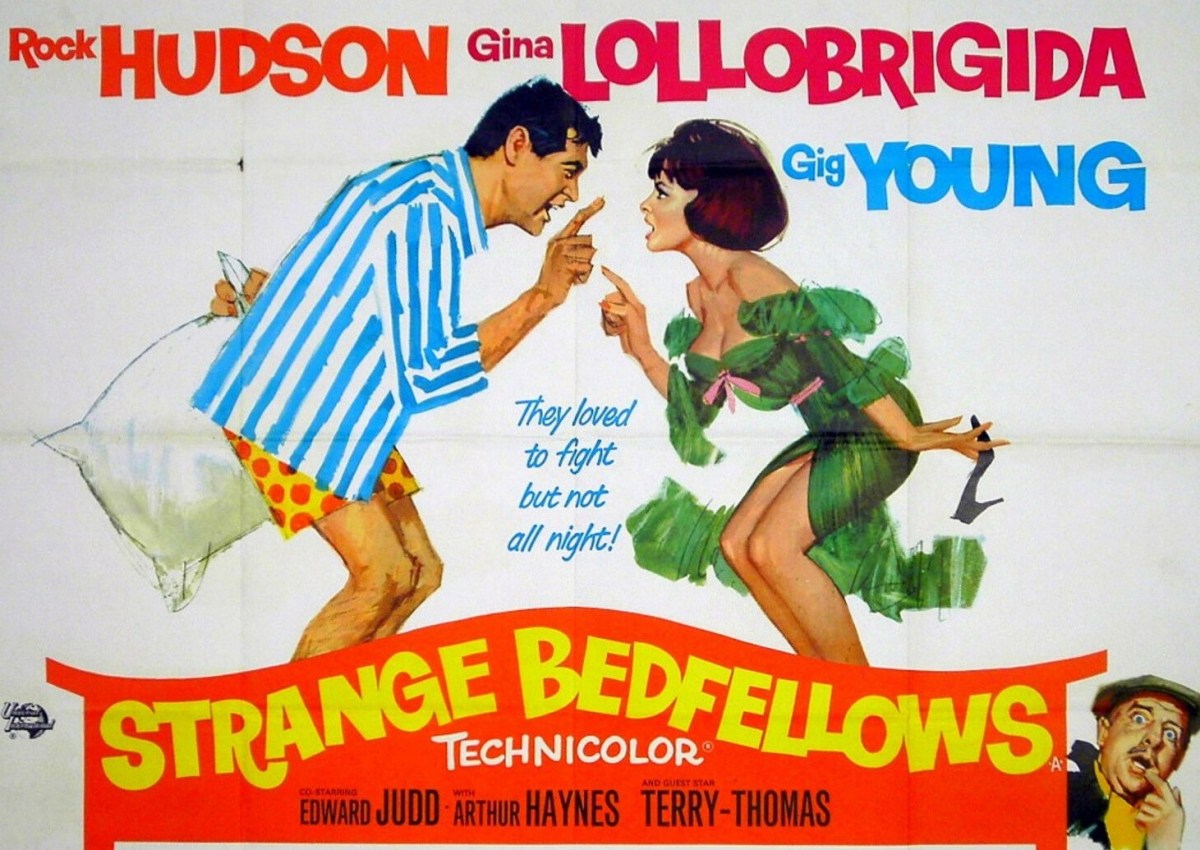
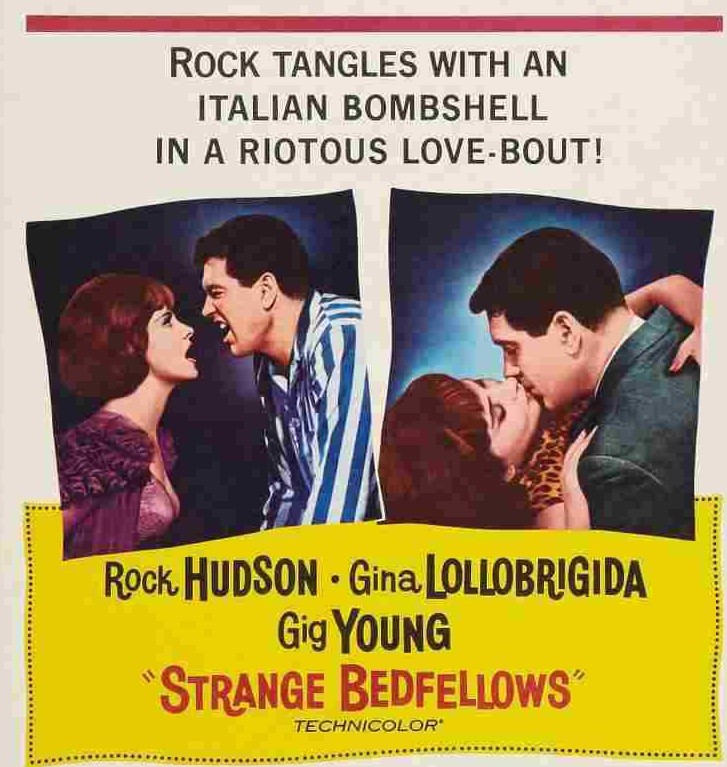
I had my first belly-laugh within seconds, a wonderful sight gag, and was chortling all the way through this London-set battle-of-the-sexes comedy. Rock Hudson is a high-flying businessman who needs to win back long-estranged wife Gina Lollobrigida in order to gain promotion in a family-conscious oil company. Initially, Hudson re-discovers the reasons he had first fallen in love with her but then, of course, only too bitterly, why they split. Hudson and La Lollo had previously teamed up for Come September (1963) and Hudson had spent most of the early 1960s in romantic mishap with Doris Day so he could call on an extensive range of baffled and enraged expressions. Lollobrigida is an artist-cum-political-firebrand which sets up hilarious consequence. Gig Young is on hand to act as referee.
There’s some marvelous comic invention, a conversation between the two principals relayed through taxi controllers turns into a masterpiece of the misheard and misunderstood. Complications arise from Lollobrigida’s fiance Edward Judd (First Men on the Moon, 1964), also an activist, but on the pompous side, and an Italian lothario. Taking advantage of the less than congenial London weather, there are jokes aplenty about umbrellas and in a nod to farce occasions for Hudson to lose his trousers and share a bed with the fiance. Smoldering sexual tension also kindles many laughs. By the time the film enters its stride it’s one comedic situation after another. It being England, naturally enough Lady Godiva is involved.
Hudson in suave mode trying to cope with the feisty Lollobrigida is an ideal comedy match. Costume designer Jean Louis has swathed the actress in a stunning array of outfits, some of which leave little to the imagination. When Doris Day got angry you tended to laugh, not quite believing this was anything more than a moderate hissy fit, but if you crossed Lollobrigida you were apt to get both barrels and it never looked like acting, she was a very convincing when she switched on the fury engine, plus, of course, whatever she threw added both to the comedy and her character’s conviction. Both have terrific comic timing.
Writer-director Melvin Frank was something of a comedy specialist, a dab hand at suiting comedy to screen persona having previously set up Road to Hong Kong (1962) and Mr. Blandings Builds a Dream House (1948). Terry-Thomas makes an appearance as a comic mortician and there are parts for English comedian Arthur Haynes and Dave King. Hudson and Lollobrigida exude screen charisma and while not in the class of Come September this delivers enough laughs to make you wonder why they don’t make them like that anymore.





 The Magnificent 60s