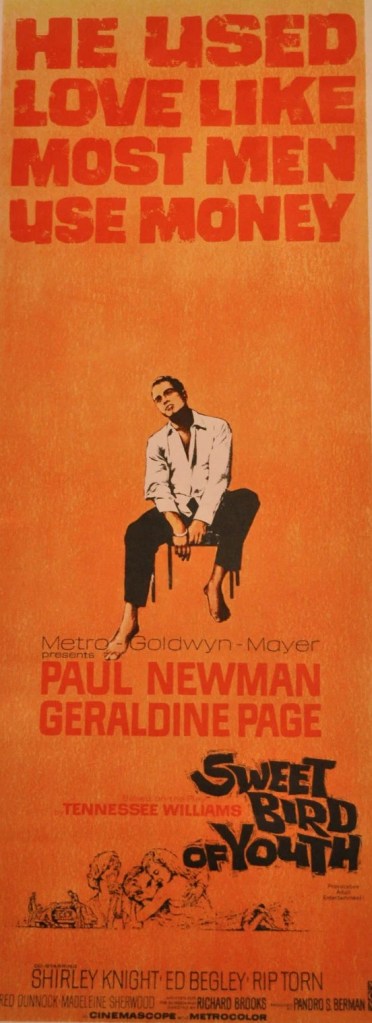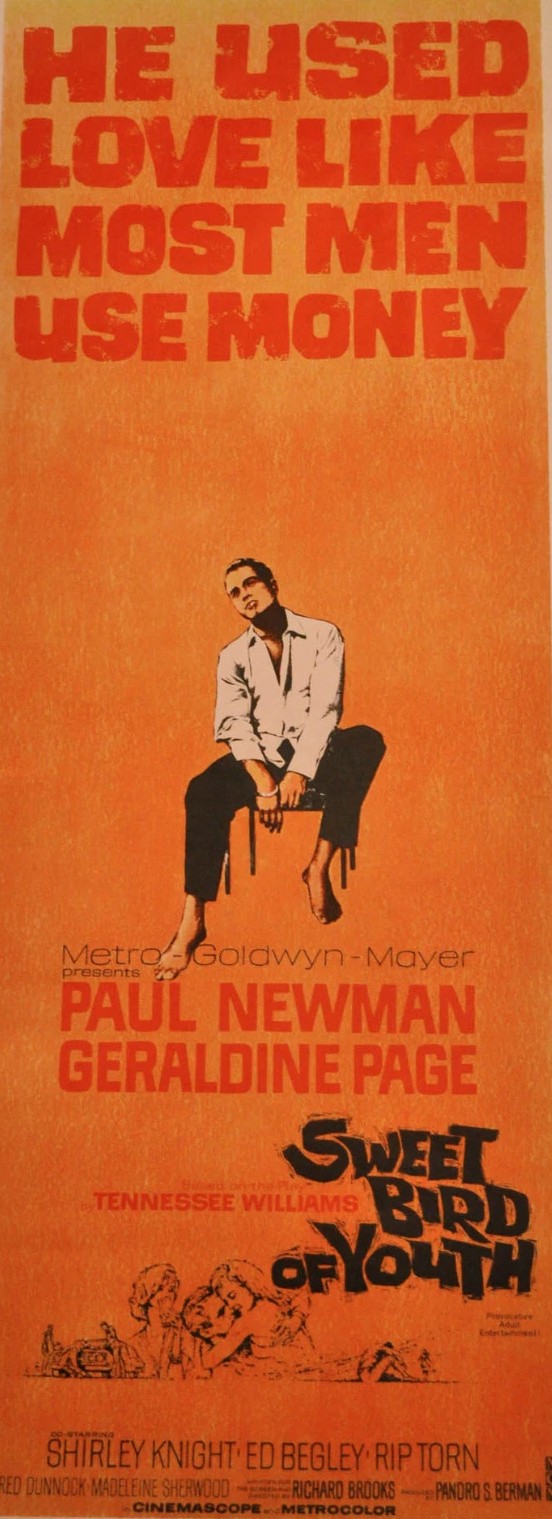
Behind the Scenes: “Sweet Bird of Youth” (1962)

Writer-director Richard Brooks had built a reputation adapting heavyweight literary works – ranging from Dostoevsky’s The Brothers Karamazov (1958), Tennessee Williams play Cat on a Hot Tin Roof (1958) and Sinclair Lewis’s evangelism opus Elmer Gantry (1960) – the last two box office and critical hits –  and though he had Joseph Conrad’s Lord Jim in his sights he had a hankering after more simple fare. He planned to go out on his own and had paid $30,000 to acquire Arthur Woolson’s Goodbye, My Son focusing on mental health and $70,000 on The Streetwalker, written anonymously by a sex worker, and more nitty-gritty than the current stream of high-end good-time-girl pictures. The Streetwalker would take a semi-documentary approach. Brooks aimed for budgets around the $700,000 mark.

But in the end, he fell for the blandishments of producer Pandro S. Berman, for whom he had made Cat on a Hot Tin Roof, one of MGM’s biggest hits, and Paul Newman, who had played the part of Chance in the original Broadway play. It had run for nearly a year and the cast included Geraldine Page, Rip Torn and Madeleine Sherwood who reprised their roles in the film. Ed Begley had worked with Brooks on Deadline USA (1952).
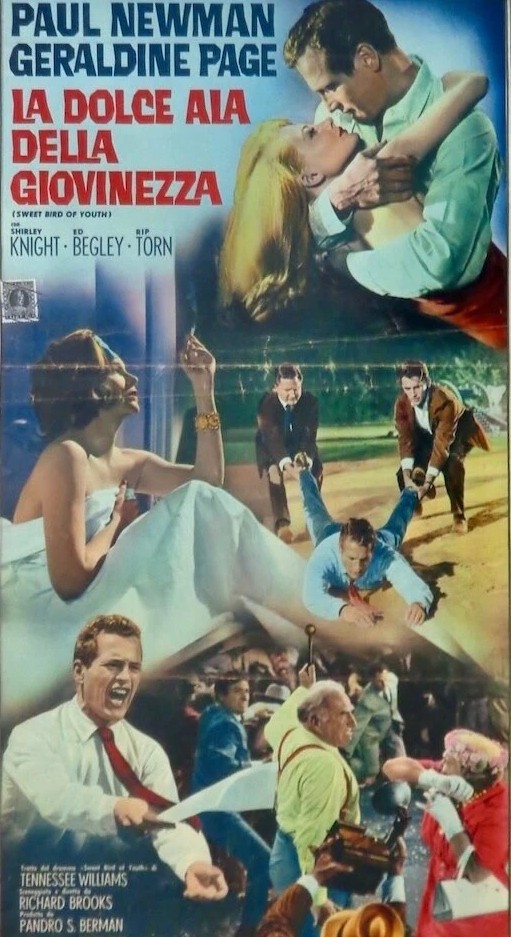
By this point Newman was rid of the shackles of his Warner Bros contract and spread his wings artistically and commercially, following up Exodus (1960) with Martin Ritt’s Paris Blues and the first of his iconic roles in Robert Rossen’s The Hustler. Newman was paid $350,000, half the total sum allocated to the cast. The play cost a total of $600,000 against a budget of $2.8 million. Even so, Newman’s stock was not as high as later in the decade and even with his name attached a film based on John Hersey’s The Wall about the Warsaw Uprising failed to get backing.

Brooks was reluctant to get back into the ring with Tennessee Williams, still smarting from the “repeated sniping” that followed Cat on a Hot Tin Roof. Brooks recalled that “during filming I talked with Tennessee on the phone a number of times and all was peachy.” But later the author complained Brooks had “butchered” the play. He was especially incandescent because Williams pocketed $1.4 million while the director made do with just $68,000. Brooks demanded “a signed letter written by Williams and published in Variety to the effect that he (Williams) liked the film version” before he agreed to helm Sweet Bird of Youth.
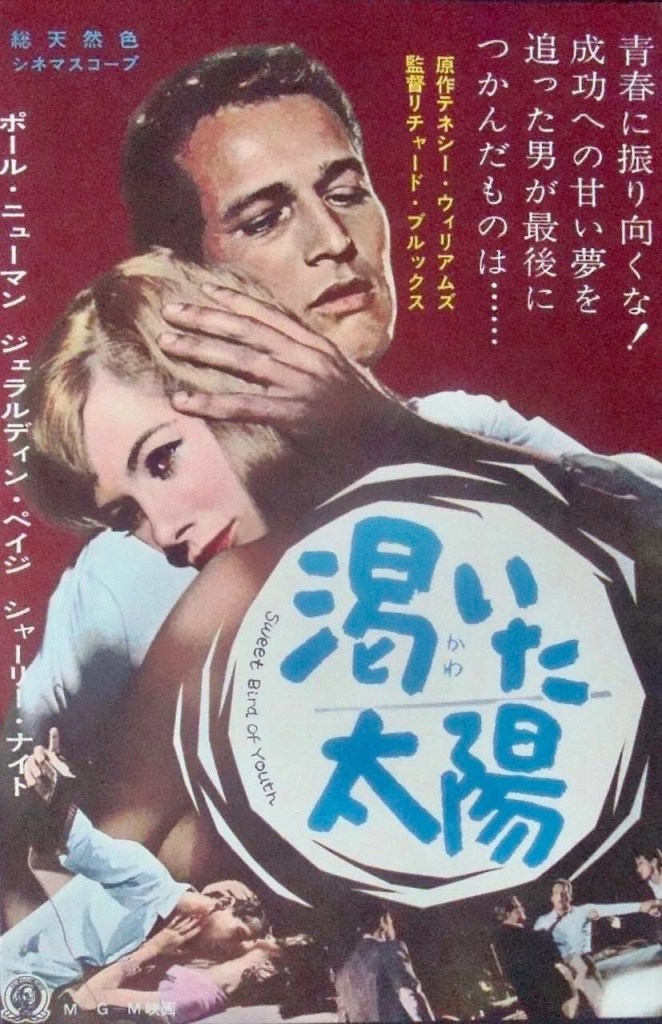
There’s no sign that Williams acquiesced and Brooks proceeded with his version which turned into flashbacks some of the incidents dealt with on stage through dialog.

“Most people go out to Hollywood with a seven-year contract to work,” noted female lead Geraldine Page, wryly, “It looks like I had a seven-year contract to stay away.”  A rising star when selected for the female lead for John Wayne 3D western  Hondo (1954), she didn’t make another movie for seven years, largely as the result of not being considered photogenic enough. For Hondo, a scene had been added, “in which she was called upon to acknowledge that she was not beautiful,” and that designation, although intended purely to reflect a self-deprecating character, stuck. Although another explanation for her absence was that she was blacklisted for her association with Uta Hagen, but it’s unlikely that noted right-winger Wayne would have employed her in the first place has that been the case.

Despite an Oscar nomination for Hondo, she made her way on the stage instead, to critical approval, New York Drama Critics Award and Tony nomination for Sweet Bird of Youth. After an Oscar nomination for another Williams adaptation Summer and Smoke (1961), her career was revived, after the industry “found out how to employ one of the top performing talents of the last decade.” No surprise, however, that she wasn’t MGM’s first choice. The studio preferred the likes of Ava Gardner, Lana Turner and Rita Hayworth, who would be doing little acting to portray themselves as fading stars.

“When I saw how they fixed me up (for Sweet Bird),” said Page, “I said, look at me I’m gorgeous.” Brooks made her get rid of “those fluttering gestures” that he reckoned “subconsciously were efforts to cover her face.”

Shirley Knight didn’t have to audition. She and Brooks met at the Oscar ceremony. All he asked of her was that she lighten and grow her hair.

“He was a man who really knew what he wanted,” recalled Knight, “He wanted you to do a certain thing and was clear about the look of it.” She was so in thrall to the director that she followed his instruction to the steer a boat in one direction even though she knew it would lead her to smash straight into a dock.

Given the controversial nature of the play, there were concerns the entire project would be blocked by the Production Code, the U.S. censorship body. But Berman was quick with the reassurance. He claimed it would be “the cleanest picture ever made…clean as any Disney film.”  To achieve that would require considerable trimming as the play involved abortion, hysterectomy and castration. Berman ensured these elements were eliminated. Brooks changed the ending.

Commented Williams, “Richard Brooks did a fabulous screenplay of Sweet Bird of Youth but he did the same f…ing thing (as Cat on a Hot Tin Roof.) He had a happy ending. He had Heavenly and Chance go on together which is contradictory  to the meaning of the play. It was a brilliant film up to that point.”

Actually, Brooks was undecided about the ending. He wanted to shoot two endings, one as unhappy as the play. “But once the ending was on film – the one the studio wanted – production was shut down.”

Newman was more relaxed about any changes. “You have to make peace with the idea when you make a motion picture version of a play, it’s so difficult and it’s no sense struggling with things that were in the play.” With enough controversy riding on the picture, the studio banned the actors from talking to the media.

Initially, box office expectations were high when the movie hit first run. A $72,000 first week take in New York was considered “boffo.” It scored “a lusty” $28,000 in Chicago, a “bang-up” $15,000 in Buffalo, a “brilliant” $28,000 in Los Angeles, a “lush” $14,000 in Pittsburgh, a “bright” $16,000 in St Louis, and a “wow” $17,000 in Detroit. It generated a “loud” $4,500 in Portland, a “wham” $15,000 in Minneapolis and was “sockeroo” in Washington DC with $21,000.

But once it left the rarified atmosphere of the big cities, it stumbled. There was precent, the touring production of the play had also flopped once it left the environs of Broadway. Variety reckoned the timing was to blame as audiences showed “more aloofness to this type of fare” than they did a couple of years before.

The movie limped to $2.7 million in rentals – and a lowly 30th spot on the annual rankings – at the U.S. box office though foreign was more promising, ninth overall in France and 10th in Italy.

SOURCES: Douglass K. Daniel, Tough as Nails, The Life and Films of Richard Brooks (University of Wisconsin Press). pp146-154; Daniel O’Brien, Paul Newman (Faber and Faber, 2005), pp86-7; Shawn Levy, Paul Newman, A Life  (Aurum Press, 2009), pp169-171; “Folks Don’t Dig That Freud,” Variety, May 9, 1960, p1; “Metro Hot for Brooks,” Variety, June 15, 1960, p2; “Sweet Bird of Youth Will Be Ok for Kiddies,” Variety, September 13, 1961, p5; “Brooks Prostie and Psycho Indies,” Variety, September 13, 1961, p4; Vincent Canby,  “Seven Years After Her Film Discovery, Geraldine Page May Be Accepted,” Variety, November 15, 1961, p2; “Picture Grosses”, March-May 1962, Variety; “Fun-Sex Plays, ‘Sick’ Slowing,” Variety, August 8, 1962, p11; “Big Rental Pictures of 1962,” Variety, Jan 9, 1963, p13; “Yank Films,” January 23, 1963, p18.
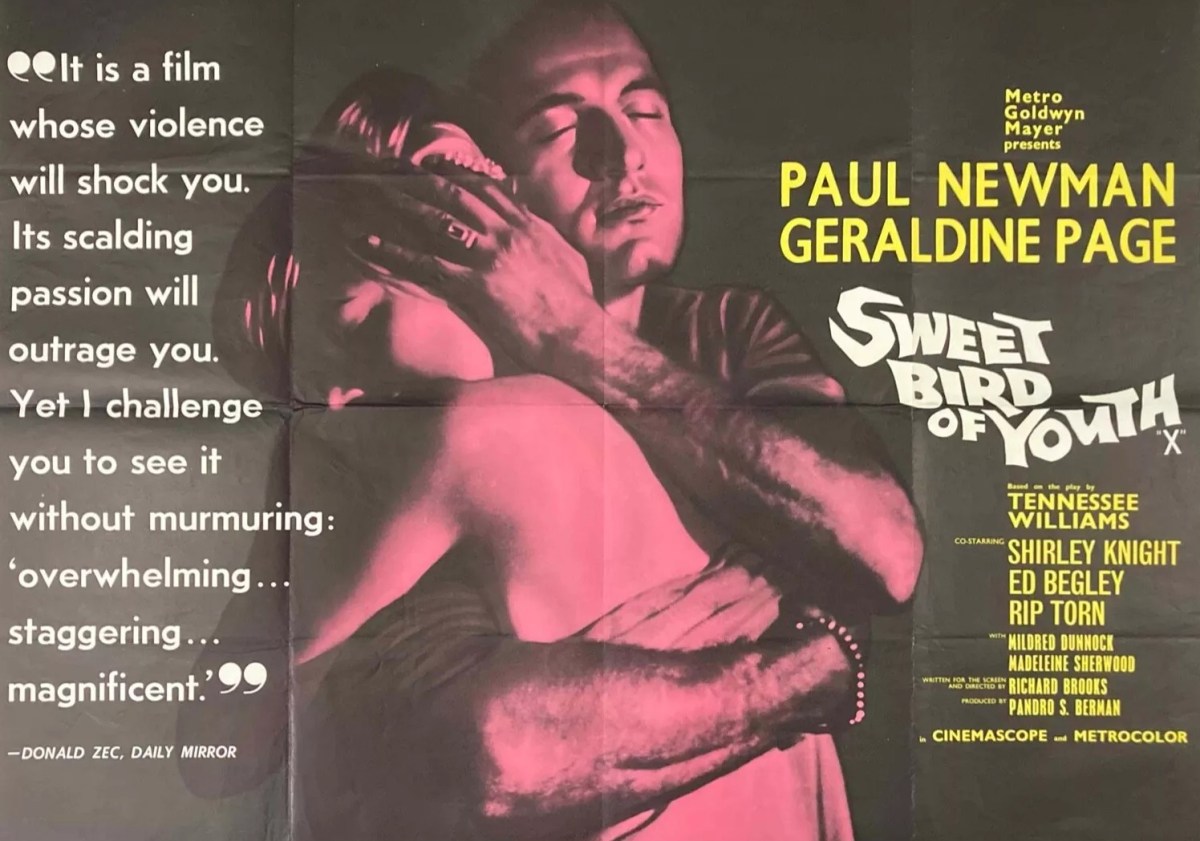
Sweet Bird of Youth (1962) ***

Tennessee Williams wrote better parts for women than he did for men. You can start with Vivien Leigh, Oscar-winner for A Streetcar Named Desire (1951) – Marlon Brando only nominated – and Anna Magnani Oscar-winner for The Rose Tattoo (1955) with Maria Pavan nominated and star Burt Lancaster left out of gong consideration. Carroll Baker and Mildred Dunnock were nominated for Baby Doll (1956) with star Karl Malden ignored. Paul Newman did receive an Oscar nomination for Cat on a Hot Tin Roof (1958) as did Elizabeth Taylor.

Montgomery Clift was frozen out of Oscar consideration for Suddenly, Last Summer (1959) while both Elizabeth Taylor and Katharine Hepburn scored nominations.  Marlon Brando received no Oscar recognition for The Fugitive Kind (1960). Ditto Laurence Harvey for Summer and Smoke (1961) though Geraldine Page and Una Merkel received nominations. Lotte Lenya was recognised with a nomination for The Roman Spring of Mrs Stone (1961).

So the omens were not particularly good for Paul Newman when he repeated the role he had essayed on Broadway of Chance Wayne in Sweet Bird of Youth. In the stage version, while he received respectable notices, it was Geraldine Page who picked up the glory, winning the New York Drama Critics Award and nominated for a Tony.

So it was going to be a long shot that Newman could outshine her in the film version, even though he received considerably more screen time – Page and Shirley Knight were nominated, Newman was not.

The flaws in the tale are more obvious in the screen version. On stage, sheer force of personality can win over an audience, on screen that’s more difficult. And in truth Chance was another of Williams’ male losers. The main difference between Williams’ male and female characters is that not only are the women more reflective and aware of their shortcomings while the men simply bulldoze ahead but they are more able to express their feelings without dialog.

Chance is a failed actor turned gigolo taking advantage of alcoholic over-the-hill movie actress Alexandra Del Lago (Geraldine Page), running away from what she believes will be her final and calamitous movie, who half the time doesn’t know where she is or who he is. Chance has dreams of using her to hustle his way into the movie business, blackmailing Del Lago over her drugs abuse to front a new picture, and begins knocking on doors, but long-distance, since he’s returned to his home town in the hope of winning back his childhood sweetheart Heavenly Finley (Shirley Knight), planning to set her up as a movie star.

Expectations that there might be a welcome for a young man made good are dashed when everybody continues to treat him as the waitperson he once was or wants to run him out of town. To protect his daughter from such an unworthy suitor, the town’s most prominent citizen and political heavyweight Tom Finley (Ed Begley) had previously managed to pay Chance to leave town. His son Tom Jr (Rip Torn)  shares his father’s aspirations.

Despite the odds Chance determines to woo Heavenly but his Hollywood dream is scuppered when Del Lago realizes that her last picture looks like becoming an unexpected success and she can once again write her own ticket rather than rely on a con man like Chance.

It doesn’t end well though, for reasons best known to him, writer-director Richard Brooks tacked on a happy ending – the play had an unhappy ending – that doesn’t ring true.

There’s nothing wrong with Paul Newman’s acting even if it didn’t attract the attention of the Oscar voters, but there’s not enough meat on the character. On the other hand, Geraldine Page and Shirley Knight (The Group, 1966) in part excel because their characters are better written. Rip Torn (Beach Red, 1967) develops his screen menace. Ed Begley’s (Warning Shot, 1966) over-the-top performance snagged him an Oscar.

The story’s just too thin and the hard edges of the play have been trimmed back so it was less appealing to an audience.

Lacks the usual Tennessee Williams bite but the female performances are well worth a watch.

I’m doing a Behind the Scenes article tomorrow so look out for that.

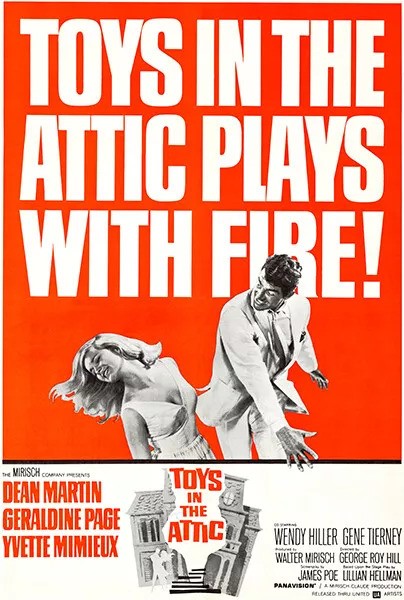
Toys in the Attic (1963) ***

Dean Martin is at his best when he’s not playing the character you expect. Coming over as big and brash came to define his screen persona, and that just wasn’t, unless a comedy job where he was being set up to be taken down a peg or two, as interesting as his quieter, slow-burn performances in Rough Night in Jericho (1967) or Five Card Stud (1967). To some extent Geraldine Page was known for over-the-top performances, generally quivering on the edge of some emotional disaster. Even in Dear Heart (1964), which I adored, despite her lively exterior, that was her character.

So you match that pair with relatively raw director George Roy Hill (Butch Cassidy and the Sundance Kid, 1969) and you can see the problems he has reining them in, especially as the movie is based on a topline Broadway drama written by the highly-venerated Lillian Hellman (The Chase, 1966). Screenwriter James Poe (Riot, 1969) accommodates some scenes outside the smothering atmosphere of the home of sisters Carrie (Geraldine Page) and Anna (Wendy Hiller).

Given it’s set in sweaty muggy New Orleans, the shadow of Tennessee Williams hangs heavily over the picture, though the Deep South twangs are not fully in evidence. Throw in that their brother Julian (Dean Martin) has brought home a child bride Lily (Yvette Mimieux), suspicious not just of her newfound environment but of her possibly already-straying husband, plus that he returns a wealthy man, when normally his entrepreneurship has usually dealt a losing hand, and you have the making of a rather predictable tale of home truths, overheated emotions and a hint of incestuous longing.

This is the kind of tale, reverberating with unhappiness and frustration, that requires an unlikely trigger to get going. It’s not as dumb as the murderer in the recently-reviewed “five-star” so-bad-it’s-good Doctors Wives (1971) who funds an escape from police custody by blackmailing his wife’s extensive band of lovers and getting a colleague to momentarily pretend to take on his identity.

This time it’s an overheard phone call and the conniving Carrie who suggests to the new bride that Julian has taken up with old lover Charlotte (Nan Martin), the source of his newfound wealth by helping him buy up cheaply land that her husband Cyrus (Larry Gates) needs for his business. This not only puts the marriage in danger but, when Cyrus realizes he has been duped by his wife, Julian’s life is threatened.

This is one of those films where the plot threatens to run away with the story which is essentially that the two sisters have come to expect that their wastrel brother is dependent on them and cannot accept it when he is not. Whereas dealing with a depressed loser maintains the family status quo, coming to terms with a winner takes some doing and jeopardizes existing relationships.

The sisters are equally jealous of each other, so there’s constant niggling. Escape is in the offing for too many of the characters. Julian, from his down-at-heel existence, the sisters from their poverty, Charlotte from her clearly over-dominant husband and Lily from what seems like an ill-chosen husband. That, in several instances, escape pivots on revenge makes the situation sweeter.

The sisters have the best scenes, but that’s a limitation. While audiences watching a stage play might remain in rapt awe at actresses dealing with their frustrations, within the confines of a movie, it weighs the picture down, two old maids quarrelling is hardly a concept that would have movie fans signing up.

Stage plays often suffered from translation to screen, if the characters were not sufficiently louder than life. It’s significant that none of the works of Arthur Miller, not even his masterpiece Death of a Salesman, managed this. Tennessee Williams was more successful because of leading characters with explosive temperaments. The Glass Menagerie (1950), A Streetcar Named Desire (1951), The Rose Tattoo (1955), Cat on a Hot Tin Roof  (1958) and Suddenly, Last Summer (1959) were showered with Oscar wins and nominations and generally hit the box office mother lode.

Lillian Hellman was largely in the Arthur Miller category when translating her stage plays to the screen. While The Dark Angel (1935) and These Three (1936) had enjoyed some success, The Children’s Hour (1961) had stumbled at the box office.

Fans of Dean Martin didn’t enjoy him going all hi-hat and in truth he comes up short compared to Wendy Hiller (Sons and Lovers, 1960) and Geraldine Page, both nominated for Golden Globes. Yvette Mimieux (Diamond Head, 1962) continues to show promise and Gene Tierney (The Pleasure Seekers, 1964) puts in an appearance.

For fans of Broadway adaptations.

Dear Heart (1964) ****

Big difference between the manufactured maudlin of a weepie and middle-aged characters so ill-at-ease and discomfited that they are painful to watch, circumstances not redeemed by comedy. Audiences and critics didn’t take too kindly to this because the two stars were way out of their comfort zones. Glenn Ford (Rage, 1966) dropped his take-charge quiet-tough-guy persona, and didn’t even play that for laughs, and Geraldine Page (The Sweet Bird of Youth, 1962) rid herself of the tragic face that sacrificed itself on the altar of Oscar (at this point she was three-eights into her Oscar nominations haul).

The whole unremittingly sad enterprise would have been made for today’s generations, more acceptable of the sour ending and the clunkiness of romance that fails to gell.

Harry (Glenn Ford), a greetings card salesman who falls back on his own profession in his chat-up lines, thinks he has achieved his goal of settling down with widow Phyllis (Angela Lansbury) and becoming father to her young son, enjoying domesticity, extended family round for dinner, playing baseball and larking about with the boy. Evie (Geraldine Page) is too much and not enough, too big in her personality, not enough of whatever it takes to make her a long-term proposition for the opposite sex. They meet at a convention, hers, she’s a postmaster, he’s just staying at the same hotel.

She’s at least the more self-aware, wants more than the one-night stand of convention life, reluctant to take her place among the singletons, can’t work out why if she’s the life and soul of the party that at party’s end she’s still sitting on the shelf. But she also wants recognition – of some kind – makes fictitious calls to hotel reception so that a bellboy will troop round the lobby calling out her name. She brings her own lightbulbs, to replace the low-wattage ones in a bedroom, forever trying to adjust the world o her own vision, teasing bedroom curtains out in a different fashion, mild invention that keeps her sane regardless of how insane some actions are, charging ahead to open every door in the expectation that she shouldn’t count on male gallantry (this is the 1960s after all).

Harry’s the guy who does open doors for women, but cursed with loneliness, caught in embarrassing gaffes, chatting up the dumb kiosk blonde who’s a good bit more savvy. Most of the comedy hurts. He’s late to meet his boss because he stopped off for a martini at the apartment of an occasional lover and when he trips out too many excuses is told, tartly, that while one excuse is acceptable, three or four (train late, weather, can’t get a taxi, taxi stuck in traffic etc) is the sign of a liar. He does the whole unnecessary explanation routine when booking a hotel room for a tryst with the blonde whom he pretends is his wife not noticing the receptionist’s cynical eyebrows, and brought down to earth when said blonde breezes in and calls out a greeting to the receptionist.

Evie works out how to get a table in a packed restaurant, passing onto Harry the clever trick of saying you are waiting for a date and then apologising when they don’t turn up. When he tries this out, the waitress upends him with, “Why not join this lady (Evie), she can’t imagine either what happened to her date.”

There’s nothing cute about either of them so no chance of a meet-cute. She’s continually awkward, independent, and he doesn’t know how to spell out his troubles or work out why he’s walking into an unsuitable marriage. The only room this movie has for comedy is the sudden appearance in Harry’s life of a bearded teenager who usurps his bedroom (girlfriend constantly in the bath). This lad is Phyllis’s grown-up son Patrick (Michael Anderson Jr.) yet Harry’s been led to believe, or thinks he has, that the boy would be much younger, judging by the treasured photo given him by his fiancée. On the one side is a slab of situation comedy, on the other an out-of-his-depth Harry not knowing if he’s been duped and realizing how little he knows of genuine fatherhood. He’s awkwardness grown ten feet tall.

It’s not as if Harry and Evie actually conduct a romance, there’s some kind of attraction that neither can fully recognize, every time it sparks up as likely to wilt, and he’s prone to letting her down, sudden arrangement with son taking precedence over pre-arranged dinner with her, except, she’s mollified because he left her a note at the desk, and she doesn’t get those unless she manufactures them herself  and then in her ungainly way lets everyone know someone has tried to contact her, as if that’s a sign of importance, or explanation for her feeling of being so let-down.

Phyllis turns out not to be the smalltown housewife of whom Harry dreams. She’s had enough of being a housewife. She wants what she sees as the high life, living out of hotels, “From now on I just want to pick up the telephone” and order food, cocktails, laundry, newspapers, whatever. Just what different paths they are on is detailed in a killer of a line. When he complains – it would be an accusatory tone if he could muster up the courage – about why she gave him this particular photo of the boy, as a kid not a man, comes the rejoinder, “Because that’s the best picture of me that’s ever been taken.”

You’d be lucky to find romance in this sullen snarky version of New York, filled with  uncivil, unhelpful staff, bursting with indifference, nary a touch of sympathy for any customer, whether they are seeking a room in a city jam-packed with conventions or just a cup of coffee.

If you believe in the tagged-on happy ending, you’ll believe in anything. This pair are so discordant, so jarring, that they are probably the most realistic couple to ever grace the screen. Ignored as their performances are, they are probably the best of their careers, in part because neither is central to the bigger story that a high-end drama or western or thriller might entail., in part because they go out on an acting limb, light years away from their established screen persona. They are just so darned realistic your heart bleeds because you just know they are doomed into making relationship mistakes, most likely with each other, and will remain among the jittery unfulfilled, wondering how everyone else manages it.

Director Delbert Mann’s been here before – Oscar-winner for Marty (1955), drawing an Oscar-winning performance from David Niven in Separate Tables (1958) and James Garner’s best performance in Buddwing (1966) – and makes acceptable viewing out of what in the hands of a Harold Pinter would be an impossible watch. But even so, it comes close. Tad Mosel (Up the Down Staircase, 1967) wrote the screenplay.

Had this been an an arthouse picture, it would be drenched in awards.

Fabulous performances, heartfelt situation.   

Discover WordPress

A daily selection of the best content published on WordPress, collected for you by humans who love to read.

The Atavist Magazine

by Brian Hannan

WordPress.com News

The latest news on WordPress.com and the WordPress community.