Bye, Bye, Birdie (1963) ***

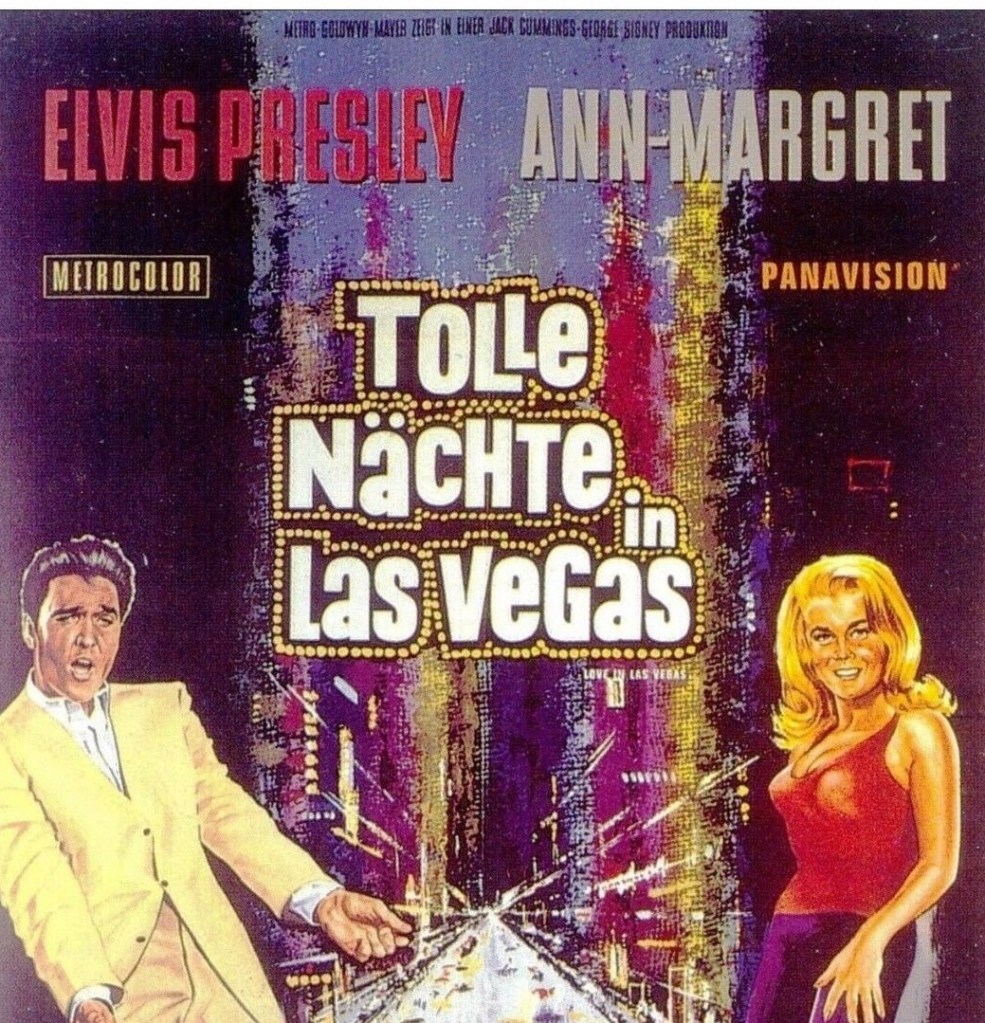
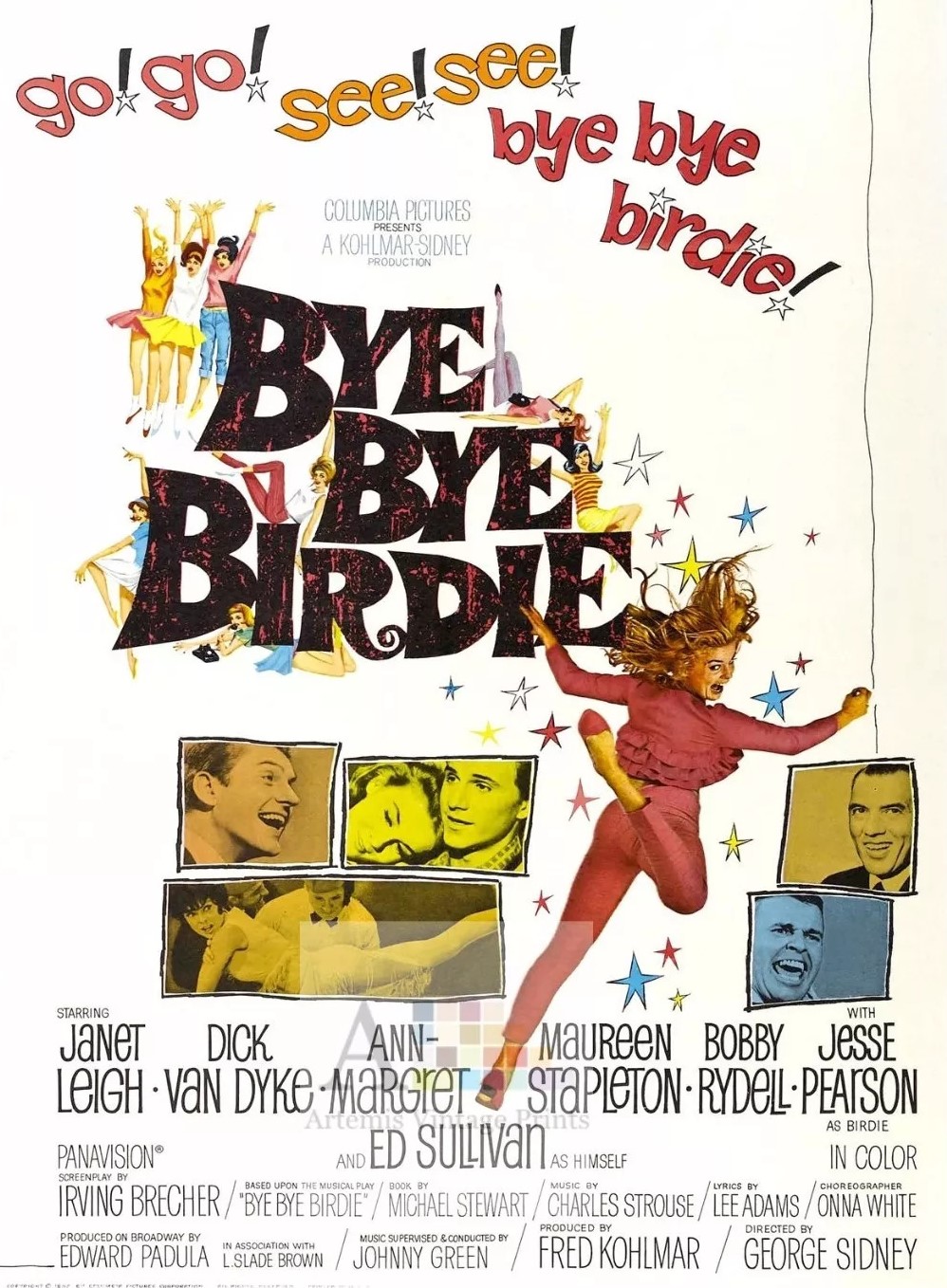
Marketeers employ a cute trick to get round the contractual billing required on movie posters. The position and size of a star’s name in any movie – even now – is stipulated long before a single camera rolls. This is where all the “name above the title” malarkey stems from comes from, that stipulation setting the reals stars apart from the wannabes.

However, whoever was in charge of drawing up the standard boilerplate template was only concerned with names, not images. That left a loophole to be exploited. Should you have a female rising star, whose face or figure might be a darn sight more attractive than the top-billed male, well, by heck, there was nothing to stop you plugging the contractually-less-dominant person all over the poster at the expense of the top-billed star.
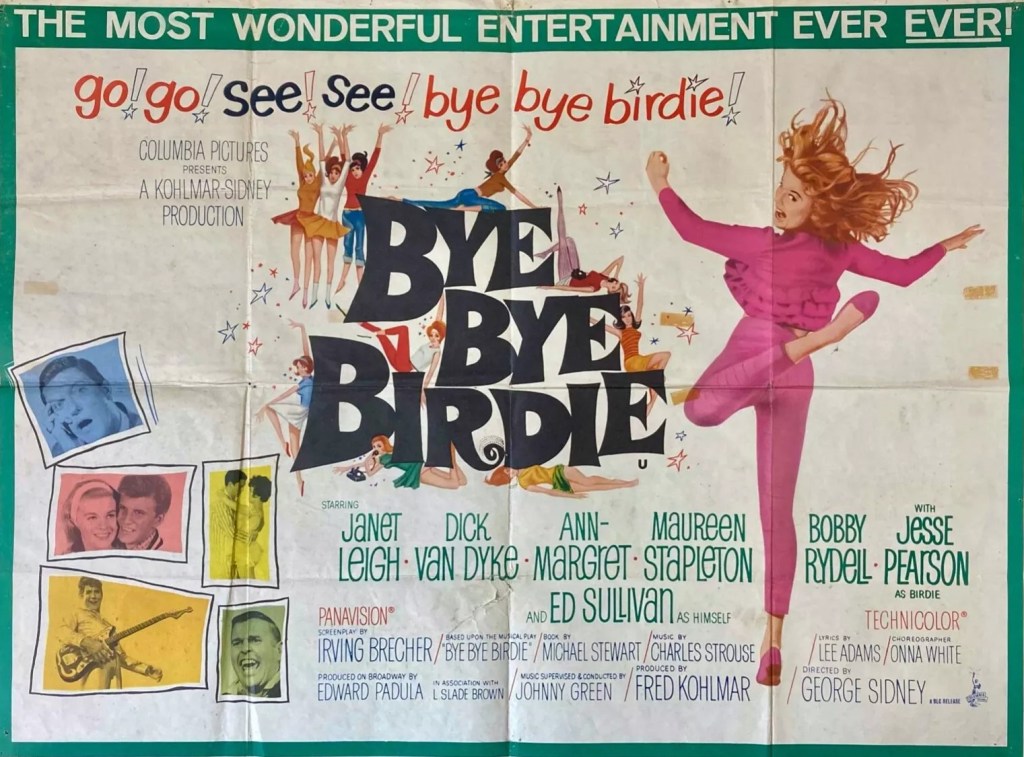
The marketeers did it with Marilyn Monroe, they did it with Audrey Hepburn, and now they’re stooping to the same loophole to promote Ann-Margret as virtually the only star of any importance. Admittedly, this was before top-billed Dick Van Dyke achieved much of a reputation as a hoofer in such spectaculars as Mary Poppins (1964). But his second-billed female lead, Janet Leigh, whose features the camera had very much taken a shine to, was also elbowed out of poster prominence.

And small wonder. Excepting Monroe, no actress ever in the last decade burst onto the screen with such pizzazz. By the time Bye Bye Birdie  – her third movie – opened Ann-Margret’s asking price had zoomed to $250,000 and she had struck a two-picture deal with MGM, was contracted to five for Twentieth Century Fox, three for Columbia and another three for Frank Sinatra’s movie production arm.

So a heck of a lot was in the balance. And, boy, does she deliver. Her energy is untouchable and, excepting again Monroe, there was never a sexier singer.

Shame the musical itself is so trite, at its best in homage to those innocent days of the 1950s, that were a more Technicolor version of those 1940s musicals that invariably were sugary confections. The story rips off the Elvis Presley legend. Conrad Birdie (Jesse Pearson) is a pop singer who has been drafted. Songwriter’s secretary Rosie (Janet Leigh) comes up with a publicity gimmick, Conrad singing a song, “One Last Kiss,” written by Albert (Dick Van Dyke) sung on the Ed Sullivan Show, his last gig before joining the Army, with a specially-chosen gal to be recipient of said smooch.

To fill you in, Rosie has had a tough time getting boyfriend Albert, eight years into their relationship, across the wedding finishing line. Bridie fan Kim (Ann-Margret) also has a boyfriend Hugo (Bobby Rydell) who naturally objects to his beloved kissing the pop singer on air in front of millions even it is a publicity stunt. Meanwhile, Albert’s Mama (Maureen Stapleton) is trying to drive a wedge between Rosie and her son. The out-of-sorts Rosie and Hugo conspire to sabotage the television show.

So pretty much the will-she-won’t-she is delivered in wishy-washy style with the plot (call that a plot!) interrupted every few minutes for a song. The narrative seems out of place for a section involving arrest for statutory rape and racism, but that gives the movie some much-needed muscle.

No question that Ann-Margret (The Swinger, 1966) steals the show. That would hardly be surprising given the lack of competition. But she certainly has the song-and-dance chops, and her energy is second to none. She gets a march on everyone by singing the title number over the credits, the credits themselves very much pushed into the background. The other prospective breakout musical star Dick Van Dyke only has one solo and Janet Leigh (Psycho, 1960) wasn’t going to effect a change of screen persona any time soon.

George Sidney directed from a screenplay by Irving Brecher (Oscar-nominated for Meet Me in St Louis, 1944) and Michael Stewart (Hello, Dolly!, 1969) from the original Broadway hit by Charles Strouse (music), Lee Adams (lyrics) and Stewart (book).

Refreshingly lightweight. Ann-Margret lights up the screen.

Viva Las Vegas (1964) / Love in Las Vegas ***

Screen chemistry, a great racing sequence and some good songs set alight this typical Presley vehicle. Unlike previous recording giants Frank Sinatra and Bing Crosby, Elvis Presley had not made much attempt to be anything other than himself on screen, nor elevated his status by taking on adaptations of hit Broadway shows, so his movies tended to need a certain extra something to set them apart, if only from his other pictures  – he was churning them out at the rate of three or four a year. The certain something, a whole bag of je ne sais quoi, came in the shape of Ann-Margret.

Garage mechanic Lucky (Elvis Presley), a racing driver wannabe, gets the hots for Rusty (Ann-Margret) after he tunes up her car. Chasing her to Las Vegas where she is a swimming instructor rather than a hot-shot performer, he takes a job as a hotel waiter. He has a rival, both in driving and romance, in Count Emo Mancini (Cesare Danova). Initially, Rusty  brushes Lucky and even when they get closer she fears getting too close since the consequences of falling in love with a man who chases danger are obvious.

There’s no danger of a picture like this straying from the most obvious path and helping fill in the screen time are nods to tourism, excerpts from Vegas shows, some water ski-ing and a helicopter ride over the Boulder Dam (Rusty supplying an earnest educational lecture). There is some lackluster comedy and not much in the way of subplot.

The race is well done for the times (i.e. pre-Grand Prix, 1966) with plenty of crashes, and it looks realistic enough although probably the cars were speeded up in the cameras.

But the pairing is dynamite. Rusty, all sizzle, smoky eyes and pout, dances Presley off the screen. She has the curves and she has the moves. Not a great deal of acting is required by either – they were in the early throes of an affair – but Rusty, a homely girl after all, keeps her sexuality in check long enough to hook her suitor.

The title song – shot in one take – is a winner but what lingers in the memory is the dazzling choreography (involving multiple camera) for Lucky’s dance numbers. And Lucky dancing. Only so many ways to say that that woman can shake her booty, but she shakes it in so many different ways the outcome is sensational.

But in the end just as dancing in an Ann-Margret picture was never enough to hit the box office heights so singing, except in his first screen forays, was not enough to create the longest queues for a Presley picture. Although previous Presley movies had featured the likes of Ursula Andress (Fun in Acapulco, 1963) and Stella Stevens (Girls! Girls! Girls!, 1963) none had the impact of Ann-Margret.

Perhaps fearful that audiences might respond more to his co-star, Ann-Margret’s musical contribution was limited. The pair performed a duet on one number, “The Lady Loves Me” – two other duets were recorded but dropped from the film – and she contributed two solo songs. By comparison, Presley was accorded eight solos. The theory being, I suppose, that audiences had come to hear Presley sing. And that might have been correct, in theory, but once the public saw Ann-Margret on screen they would surely have been calling for more.

It was both the shortest film of Presley’s career and the highest grossing. While Ann-Margret was entitled to have her name above the title – not equal billing as some would have it since his name came first (equal would have put them in alphabetical order) – some cinemas took matters into their own hands and on the marquees, over which studios could exert no contractual control, put Ann-Margret’s name first.

Perhaps more interesting was the question of career development. Presley kept on doing the same old stuff until Charro (1969) by which point it was too late to save his career. Within a year, however, she was moving on to more serious roles such as Once a Thief (1965) and The Cincinnati Kid (1965).   

Taking the helm was veteran George Sidney who had directed Ann-Margret in Bye Bye Birdie (1962) and was also responsible for Pal Joey (1957), Show Boat (1951)  and Anchors Aweigh (1945). He could have done this kind of picture in his sleep, so all credit to him that he brought it to such life.

The Swinger (1966) ***

Pure confection. There was a sub-genre of romantic comedy pictures that spun on a simple plot device to throw together actors with terrific screen charisma. Doris Day, Rock Hudson and Cary Grant did little more than meet a potential new partner, fall out with them and then resolve their differences. The importance of actors of this calibre was the difference between a high class piece of froth and mere entertainment. This falls into the latter category, neither Ann-Margret nor Anthony Franciosca reaching the high standards of the likes of That Touch of Mink or Pillow Talk.

That said, this was clearly custom-made for Ann-Margret and her growing fan-base. Despite displaying unexpectedly serious acting chops in Once a Thief (1965) this plays more obviously to her strengths. She gets to sing, dance and generally throw herself around. The face, hair, smile and body combine in a sensational package.

Kelly Olsson (Ann-Margret) plays a budding writer so naïve she tries to sell her stories to Girl-Lure, a Playboy-type magazine, owned by high-class Brit Sir Hubert Charles (Robert Coote) and run by Ric Colby (Anthony Franciosca). When her work is rejected, Olsson writes an imitation sex-novel, The Swinger, purportedly based on her own life. Sir Hubert buys the idea and Ric sets up a series of accompanying photo-shoots using Kelly as the model until he discovers her book is pure fiction.

The setting is an excuse to show an avalanche of young women in bikinis. The slight story is justification enough for Ann-Margret to strut her stuff as a singer and dancer. Since her stage show depended more on energy than singing, this effectively showcases her act.

So two-dimensional are the principals, you are not going to mistake any of these characters for actual characters. The film lacks such depth you would not be surprised if the likes of Elvis Presley or Cliff Richard popped up. The comedy is very lite, an initial attempt at satire soon dropped, the few bursts of slapstick seeming to catch the stars unawares.  

But that’s not to say it’s not enjoyable, Ann-Margret is a gloriously old-fashioned sex symbol and certainly knows how to shake her booty. The standout (for lack of a better word) scene revolves around body painting. She even gets the chance to ride a motorcycle, one of  her trademarks. Anthony Franciosca (Go Naked in the World, 1961) has little to do except smile. Yvonne Romain (The Frightened City, 1961) has a thankless role as Ric’s girlfriend.

Director George Sidney teams up with Ann-Margret for the third time after Bye Bye Birdie (1963) and Viva Las Vegas (1964). This was his penultimate outing in a 20-year Hollywood career whose highlights included Anchors Aweigh (1945), The Three Musketeers (1948), Annie Get Your Gun (1950), Showboat (1951) and Pal Joey (1957). So he certainly had the musical pedigree to ensure the songs had some pizzazz but clearly less impact on the script which was reputedly scrambled together at short notice by Lawrence Roman (McQ, 1974) to fulfil a studio commitment to the star.

The film is available on Youtube.

CATCH-UP: Previous Ann-Margret films reviewed in the Blog are The Cincinnati Kid (1965) and Once a Thief (1965).

Discover WordPress

A daily selection of the best content published on WordPress, collected for you by humans who love to read.

The Atavist Magazine

by Brian Hannan

WordPress.com News

The latest news on WordPress.com and the WordPress community.