Village of the Damned (1960) ****

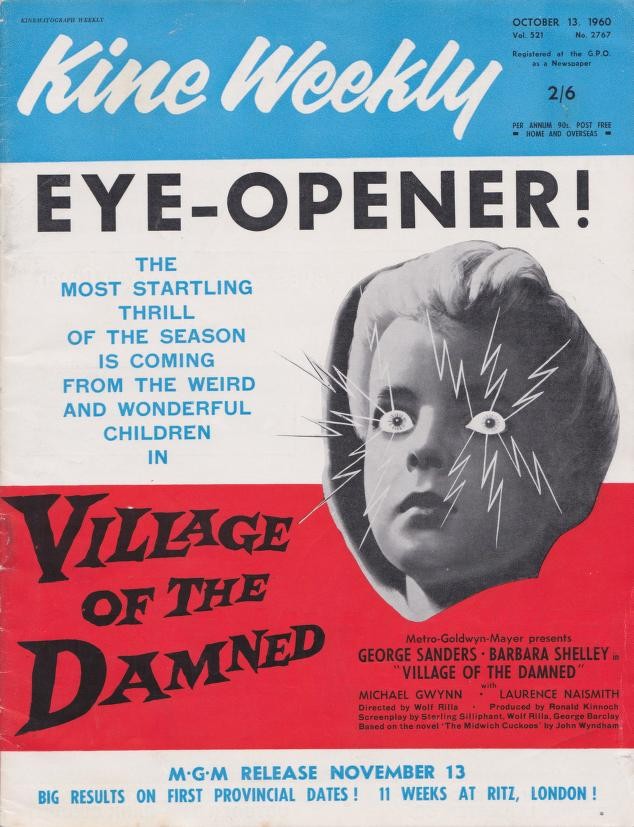
Superb chiller that, unusually, takes time to develop several strands over a longer time frame than is normal for a genre where the immediate takes preference. Opens a new dimension of terror, too, with the brain control sub-genre that would spill over into brainwashing. You could also, if you were of a mind, point to the genuine growing social power of the young as emphasized later in the decade with movies about hippies. It might not be too much of a stretch to point to the “Youthquake” at the end of the 1960s when pandering to a youthful audience nearly destroyed Hollywood.  

Terrific opening sequence of everyone in the small village of Midwich dropping to the ground, the immobilized driver of a bus crashing off the road, the driver of a tractor hitting a tree, taps left running, telephone calls cut off, all manner of accidents ensue. You think everyone’s dead, as do the military, called in to investigate. They cordon off the area, employ canaries and then humans to discover how far the danger spreads. But when a soldier who is dragged out unconscious from the forbidden zone wakes up, they soon realize the population is merely unconscious.
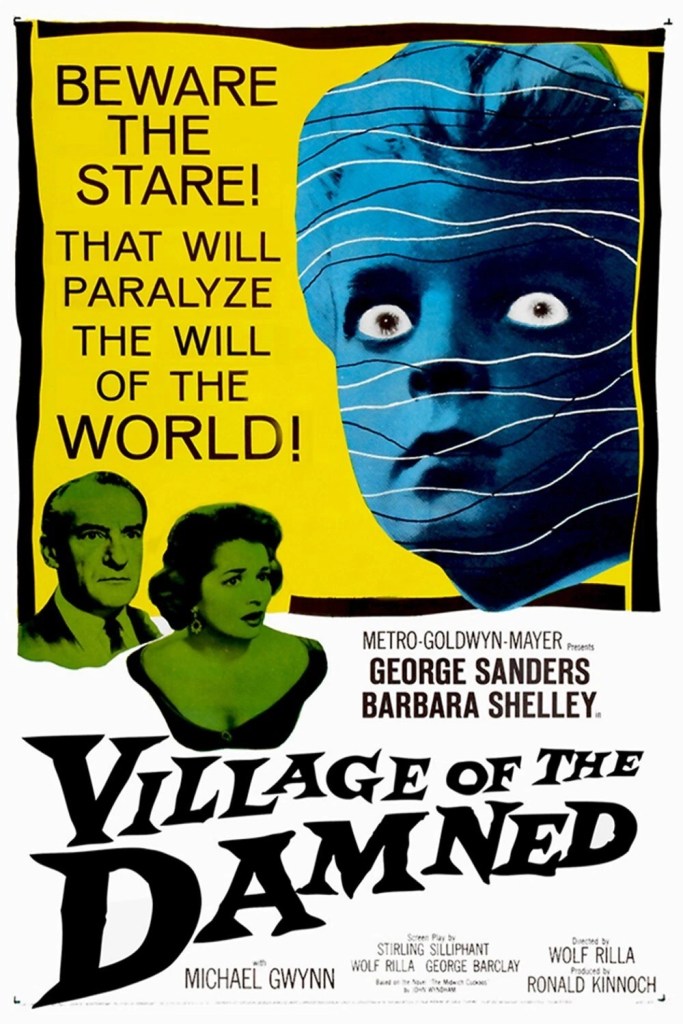
Childless couple Professor Gordon Zellaby (George Sanders) and younger wife Anthea (Barbara Shelley) are among those affected, apparently suffering no side effects for having been knocked out for around four hours. A couple of months later Anthea is delighted to report she’s pregnant. She’s not alone. But for many of the villagers what would be a cause for celebration causes untold grief. One husband returns home after a year away to find his wife is pregnant. In the days when pre-marital sex was frowned-upon, virgins, similarly affected, are shamed.

The pregnancies don’t run to the normal period either, and fully-grown children are born within a few months. What’s more, they all look as if they have inherited the same genes. Their blonde hair and striking eyes suggest they share the same father. Soon it transpires they can not only read minds but control them, causing at least two people to commit suicide.

Turns out this is a global problem, several other communities afflicted with the same condition, the Russians so concerned at the prospect that they bomb one village to oblivion, other cultures simply murdering the children.  Here, being English, where fair play still rules regardless of potential threat, the children are taken under the wing of Professor Zellaby, though the military, having sealed off the area, wait in the wings, itching to wipe out the troublemakers.

Quickly, it becomes a duel for power, the children will do anything to protect their species, Professor Zellaby at first wanting just to study the kids and understand them but soon recognizing the threat.
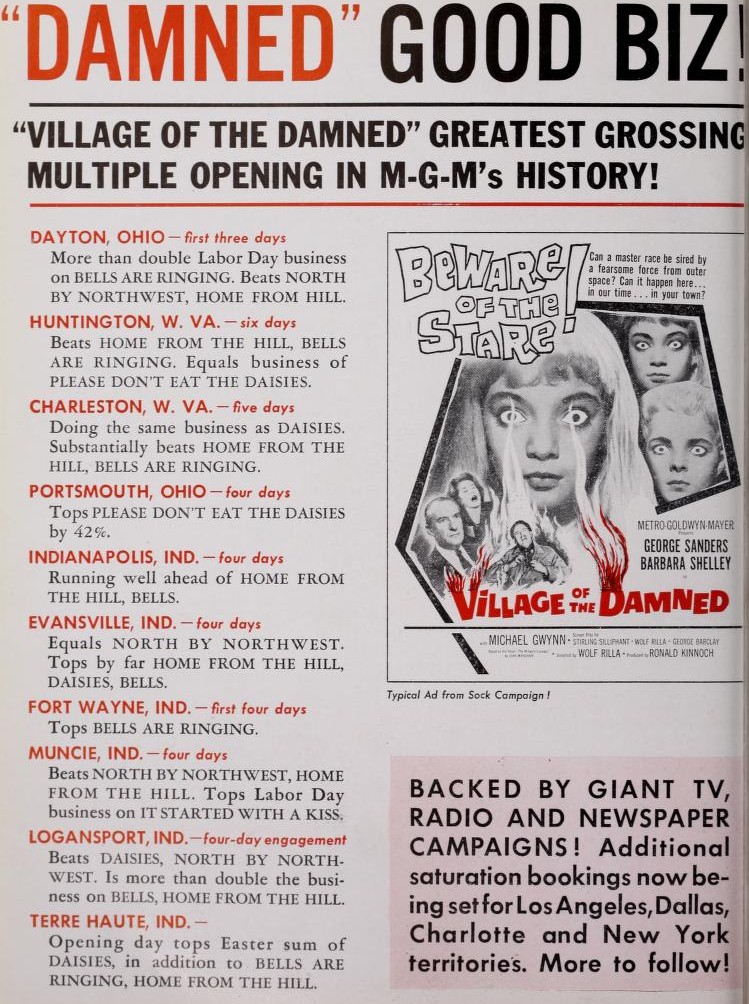
In between bouts of action, most of which is discreetly handled, none of the deliberately shocking scenes that might have emanated from an exploitationer, the authorities have plenty of time to ponder their existence. A leap in genetic mutation, or extraterrestrial origins, are among the options considered.

Eventually the villagers react like terrified Transylvanians confronting Dracula and attempt to set fire to the building where the children are housed but reckon without the brain control that can be exerted. In the end Professor Zellaby comes up with a self-destructive solution.

This is formidable stuff, all the more so, because in the days when most monsters grew fangs or claws or developed huge bodies and were otherwise physically frightening, the worst these kids get up to is to have a striking glow in their eyes, a startling contrast to their blonde hair, calm demeanor and neat uniform clothing.

Tremendously well done and it helps to have cast mainstream actors like George Sanders (Warning Shot, 1967) and Barbara Shelley (only later did she become a Scream Queen) and others who don’t carry the tinge of the horror genre.

Very well paced by German director Wolf Rilla (The World Ten Times Over, 1963) who resists the temptation to overplay his hand, achieving much more by leaving it to your imagination. Stirling Silliphant (The Slender Thread, 1965), George Barclay (Devil Doll, 1964) and the director adapted the groundbreaking novel The Midwich Cuckoos by John Wyndham. Horror maestro John Carpenter remade this in 1995, which only wnent to show how more successful the restraint of the original was.

Top notch.

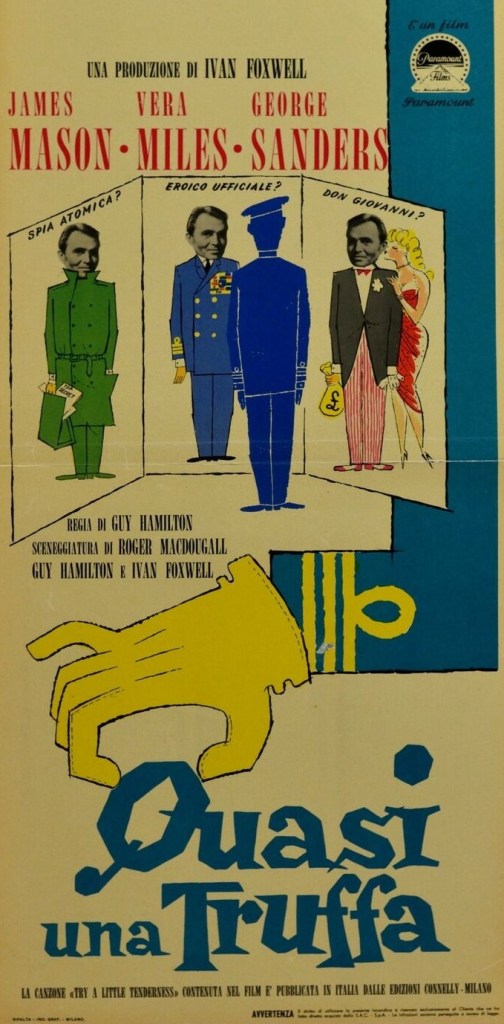
A Touch of Larceny (1960) ****

Magically fits into the “lost” film category that I’ve been banging on about recently, films, for a variety of reasons, denied cinematic release. Or at least that’s according to Rotten Tomatoes which declares “there are no featured reviews…because the movie has not (been) released yet” despite the fact that it was a big hit in cinemas over six decades ago.

Happening upon this nugget of information in a casual trawl of RT I thought I’d see if this “lost” movie was as good as The Appointment (1969) perhaps or Fade In (1969) or whether it should never be seen.

Imagine my surprise to find a highly entertaining picture best described as a one-man caper that takes aim at the Establishment and the Media, wrapped in a very witty rom-com, and helped along by the kind of Whitehall characters making a meal out of doing nothing as lampooned in BBC TV series Yes, Minister

The central conceit sounds so lame from the outset that you think this confection is going to collapse the minute it is put into practice, but, in fact, a good few twists inflate the idea until it floats along quite merrily towards a happy conclusion. And if you only remember James Mason from dour turns in The Deadly Affair (1967) or as the smarmy villain in North by Northwest (1959), you’re in for a treat.

For this is the actor at his most winning, so charming he almost edges into the adorable class, and this while playing a rake, the seducer’s seducer, but with the quickest of quick wits to get him out of any scrape. We begin and end with a demonstration of such speedy thinking.

Surprised by the return of his latest conquest’s husband, Commander Max “Rammer” (the nickname nothing to do with sexual prowess) Easton simply dons his naval uniform, whisks up the woman’s dog, his presence explained as delivering a poor creature lost in the street. As easy as pie.

His life is one of ease. When he says he works at the Admiralty, “working” might be a stretch, although “lolling about” would hardly be in the job description, the sole purpose of his desk somewhere to lay his feet, and has an airy dismissal at hand for any Whitehall buffoon inclined to pepper their language with Civil Service gobbledegook.

Bumping into an old war chum Sir Charles Holland (George Sanders), now an ambassador,  they were submarine commanders in World War Two, allows him brief acquaintance with American widow Virgina (Vera Miles). Naturally, he snaffles one of her gloves so as to have an excuse to return it. Realizing his game, she bats him back with effortless repartee, saving for the last the fact that she is engaged to be married to Sir Charles.

Given he is so practised at this game, he manages to inveigle his way into her life – Sir Charles away on urgent business – determines that her fiance’s main attraction is his dosh, and comes up with a barmy scheme to put himself in the wealthy category. His notion is to pretend to be a spy, drop a top secret document down behind a filing cabinet, vanish to a remote Scottish island, wait for his colleagues to raise the alarm, someone discover the document is missing, and the newspapers to brand him a traitor, at which point he will pop back up and sue the media for libel, and become rich enough to suit Virginia.

Yep, it seems a crazy notion, especially as Virginia, though clearly enjoying his company, has kept him at a decided arm’s length. Unfortunately, once the hue-and-cry is raised, Virginia makes the mistake of telling her husband it’s all a big con. But that puts Sir Charles in a bind, because to fess up might put his fiancé, and by extension himself, in a difficult position.

So they do nothing. Meanwhile, on his deserted tiny island off the coast of Scotland, Easton is living it up, dining off his ample supplies, occasionally catching a fish or a lobster, certainly enough booze to keep up his spirits, tuning into the radio to keep up with the news, waving half-heartedly at any passing ship, rehearsing his lines for when he is rescued. He’s even brought along a canister of petrol so he will have no trouble lighting damp driftwood and seaweed to make the bonfire he will require to attract attention.

So far, so barmy. But now the first twist. He chucks into the sea all evidence of his high living. He slips on a rock, falls into the water and the precious fuel sinks to the bottom. Now, he is a genuine castaway, soaked, starving, freezing. Second twist, the passengers on the boat that turns up to rescue him greet him by name.

So now we’re in for a devilish third act, the cops tipped the nod without getting the full story, Virginia the obvious culprit, Easton, back to the wall, requiring some fiendish ingenuity to get himself out of the mess. After a bundle of twists coming quick and fast, the romantic entanglement is disentangled, Easton still set to be rich by selling his tale (“the real true story” i.e. fictional hogwash) to the media who no doubt toss in a sweetener in gratitude for not being sued.

Not only is it delivered in effortless style by director Guy Hamilton (The Battle of Britain, 1969), and Mason at the top of his game, matched by Vera Miles (Psycho, 1960), but it is very short, clocking in at just over 90 minutes.  Roger MacDougall (The Man in the White Suit, 1951), Ivan Foxwell (Tiara Tahiti, 1962) and the director concocted the screenplay from the novel by Paul Somers.

Great fun, the repartee and the final third an absolute treat while poking gentle fun at the Establishment.

Rather than belonging to the “lost” category, it sits comfortably in the “they don’t make ‘em like that anymore” section.

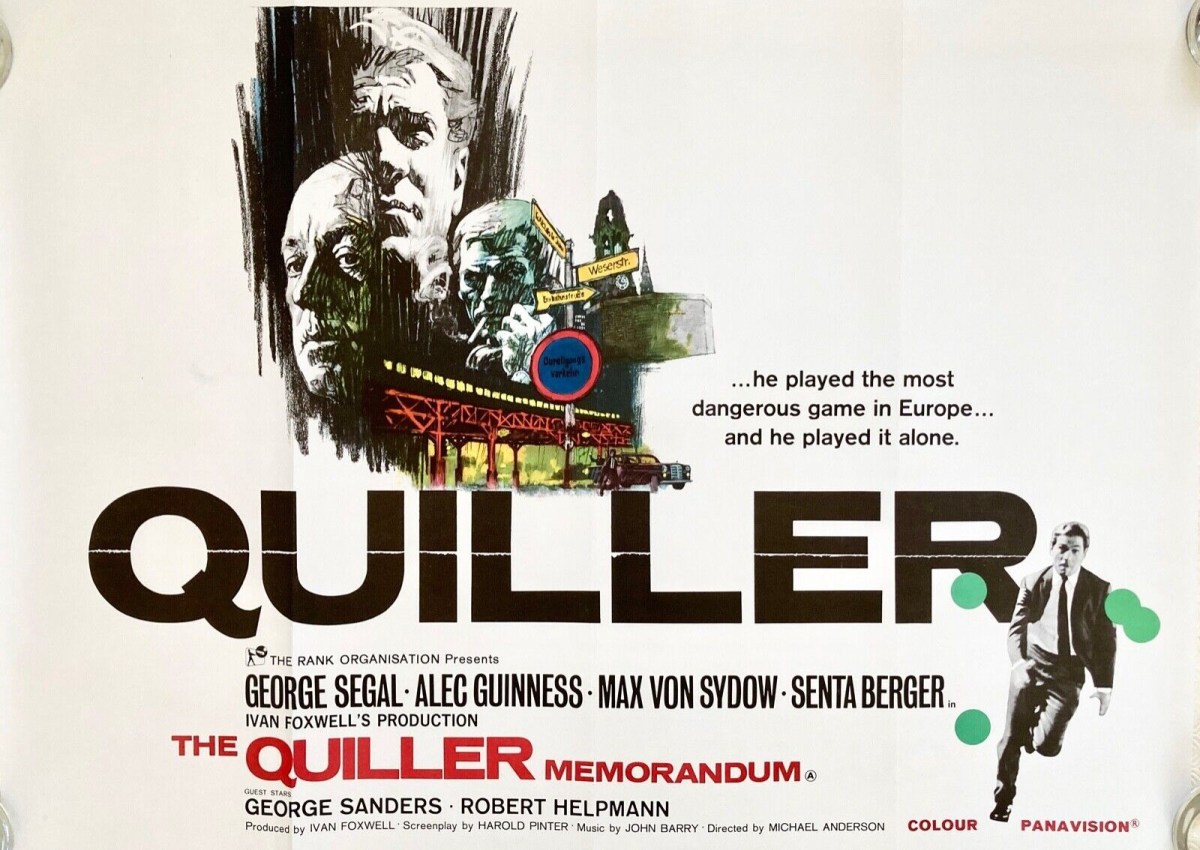
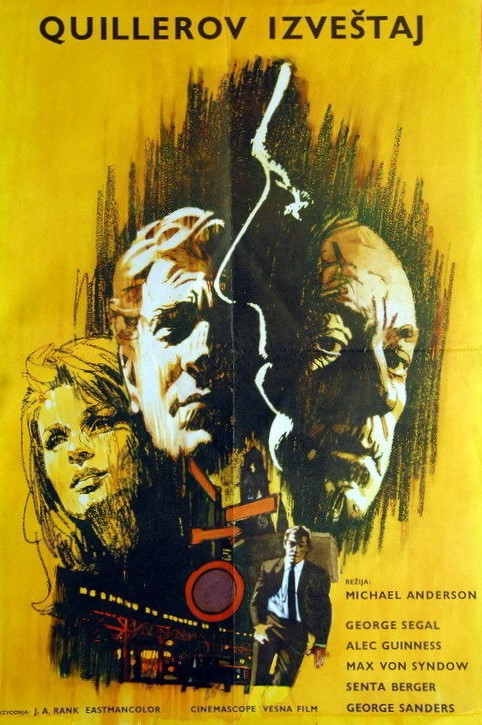
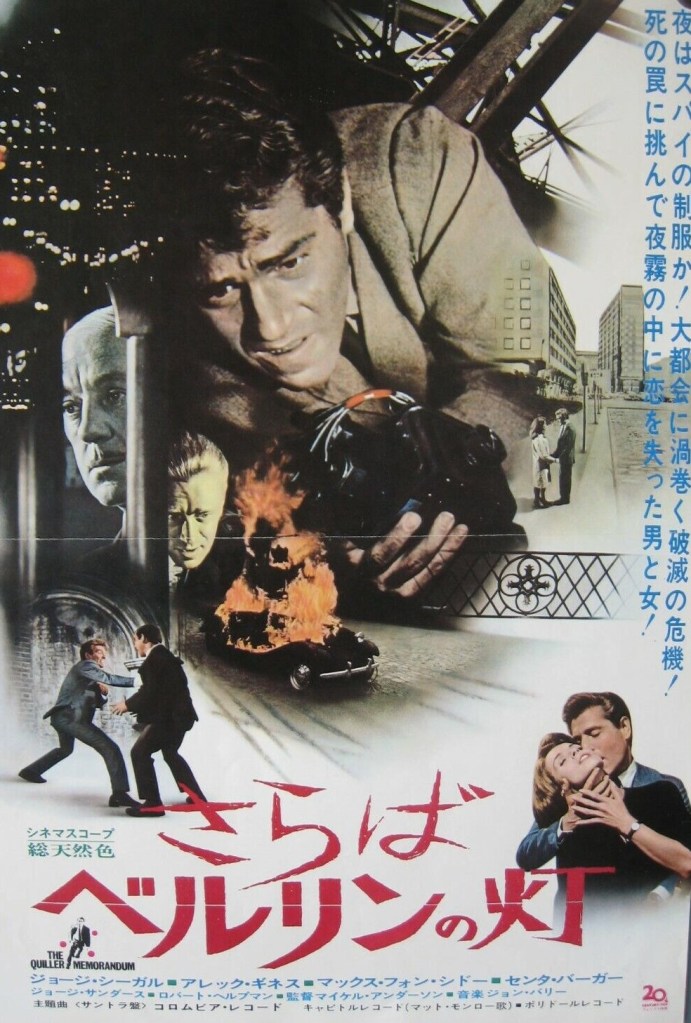
The Quiller Memorandum (1966) ****

Stylish cat-and-mouse thriller that fits into the relatively small sub-genre of intelligent spy pictures. George Segal was a difficult actor to cast. He had a kind of shiftiness that lent credibility to a movie like King Rat (1965), a cockiness that found a good home in The Southern Star (1969) and an earnestness ideal for Who’s Afraid of Virginia Woolf (1966).

But Quiller fit his screen persona like a glove. The part called for charm to the point of smarminess and courage to the point of callousness. A lone wolf for whom relationships were a means to an end, he adopted identities – journalist, swimming coach etc– as the occasion suited. His undercover mission is to expose a neo-Nazi organisation. But just as he seeks to discover the location of this secret enterprise, so his quarry attempts to find out where his operation is based. 

Michael Anderson (The Dam Busters, 1955) had just finished his first spy effort, Operation Crossbow (1966) and that film’s documentary-style approach was carried on here but with a great deal more style. There is consistent use of the tracking shot, often from the point-of-view of one of the protagonists, that gives the film added tension, since you never know where a tracking shot will end. Although the film boasts one of John Barry’s best themes, Wednesday’s Child, there was a remarkable lack of music throughout. Many chase scenes begin in silence, with just natural sounds as a background, then spill out into music, and then back into silence.

But much of the heavy lifting is done by playwright Harold Pinter (The Servant, 1963) in adapting Adam Hall’s prize-winning novel. Hall was one of the pseudonyms used by Trevor Dudley-Smith who wrote The Flight of the Phoenix (1965) under the name Elleston Trevor. The Quiller Memorandum involved wholesale change, from the title (the book was called The Berlin Memorandum) onwards. Quiller is now an American, not British, drafted in from the Middle East.

The book is set against the background of war crime trials; Quiller a British wartime rescuer of Jews now tracking down war criminals; the main female character (played in the film by Senta Berger) had, as a child, been in Hitler’s bunker; and there is a subplot concerning  a bubonic plague; there was a preponderance of obscure (though interesting for a reader) tradecraft; plus the Nazi organisation was named “Phoenix.”

While retaining the harsh realities of the spy business, Pinter junks most of this in favour of a more contemporary approach. Instead of meeting his superior Pol (Alec Guinness) in a theater, this takes place in the Olympiad stadium. Guinness’s upper crust bosses, Gibbs (George Sanders) and Rushington (Robert Flemyng), are more interested in one-upmanship. Berlin still showed the after-effects of the war and Pinter exploits these locales.

One lead takes him to Inge (Senta Berger), an apparently innocent teacher in a school where a known war criminal had worked.

But the core remains the same, Quiller prodding for weaknesses in the Nazi organisation. his opposite number Oktober (Max von Sydow) allows him to come close in the hope of reeling him in and forcing him to reveal the whereabouts of his operation. Quiller plays along in order to infiltrate the Nazis.

There is a lot of tradecraft: “do you smoke this brand” (of cigarettes) is the way spies identify themselves; Quiller followed on foot turns the tables on his quarry; the American is poisoned after being prodded by a suitcase; Quiller employs word associations to avoid giving away real information.

Having flushed out his adversaries, Quiller is now dangerously exposed. But that’s his job. He’s just a pawn to both sides. He’s virtually never on top unlike the fantasy espionage worlds inhabited by James Bond, Matt Helm and Derek Flint.

The structure is brilliant. Quiller spends most of the picture in dogged bafflement. The  supercilious Pol flits in and out, as if such work is beneath him.Quiller is stalked and stalks in return. There are exciting car chases but the foot chases (if they can be called that) are far more tense.

But the core is a bold thirteen-minute interrogation scene where Quiller s confronted by Oktober. As an antidote to the thuggery and danger to which he is exposed, Quiller becomes involved with Inge.

Segal is a revelation, grown vastly more mature as an actor after Who’s Afraid of Virginia Woolf (1966) for which he was Oscar-nominated, confident enough to abandon the showy carapace of previous pictures. This is a picture where he sheds layers, from the opening brashness to the sense of defeat in surviving the interrogation ordeal, knowing the only reason he is still alive is to lead the enemy to his own headquarters, buoyed only by inner grit. He hangs on to his identity by his fingertips.

And it’s a revelation, too, or perhaps a backward step for Max von Sydow, who presented a less clichéd character in The Reward (1965). While dangerous enough, it looks like he is already slipping into the category of foreign villain.

Senta Berger (The Secret Ways, 1961) is hugely under-rated as an actress. She was in the second tier of the European sex bombs who came to prominence in the 1950s and 1960s, the top league dominated by Brigitte Bardot, Sophia Loren and Gina Lollobrigida. On screen she is not as lively as those three, but the quiet intensity of her luminous beauty draws the camera in.

Here, she is utterly believable as the innocent women who, in falling for Segal, is dragged into his dangerous world.  She was criminally under-used by Hollywood, often in over-glamourous roles such as The Ambushers (1967) or as the kind of leading lady whose role is often superfluous.

Discussion of Alec Guinness as a spy inevitably turns to his role as George Smiley in the BBC series Tinker, Tailor, Soldier, Spy (19790 and its sequel three years later, but this is a less dour portrayal, almost whimsical in a way.  

A must-see for collectors of the spy genre.

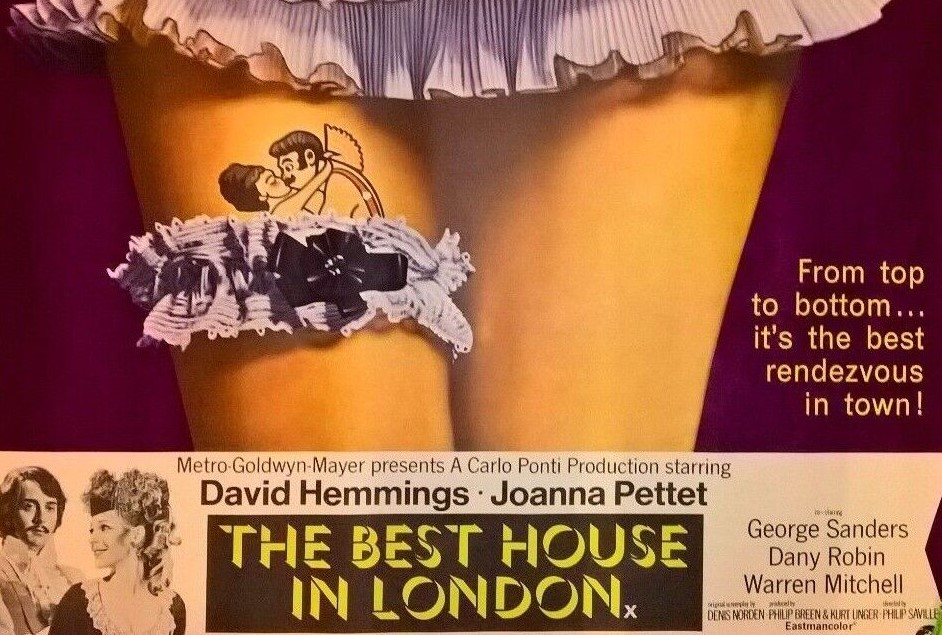
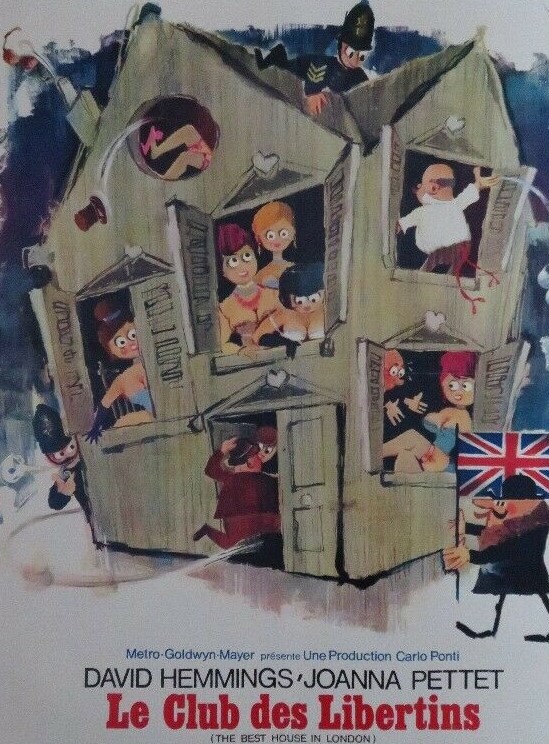
The Best House in London (1969) *

One of the worst – and certainly among the most repellent – films ever made. A hymn to misogyny under the guise of the not very difficult task of exposing Victorian hypocrisy, it labors under the bizarre thesis that all women want to be prostitutes. Screenwriter Denis Norden’s befuddled sense of history is awash with the same kind of contempt for audiences. Elizabeth Barrett (of Wimpole St fame) rubs shoulders with Lord Alfred Douglas (Oscar Wilde’s illicit lover) even though they lived half a century apart, the Chinese Opium Wars and The Indian Mutiny feature despite being separated by 15 years.

Sex workers had proved the basis for many good (and occasionally excellent) pictures in the 1960s ranging from Butterfield 8, Never on Sunday, Irma la Douce and Go Naked in the World at the start of the decade to Midnight Cowboy at its end, but these all featured well-rounded characters facing understandable dilemmas. But here the cynical and demeaning plot –  more Carry On Up the Brothel than political satire – makes you wonder how this concept was perceived as either plausible or an acceptable subject for comedy

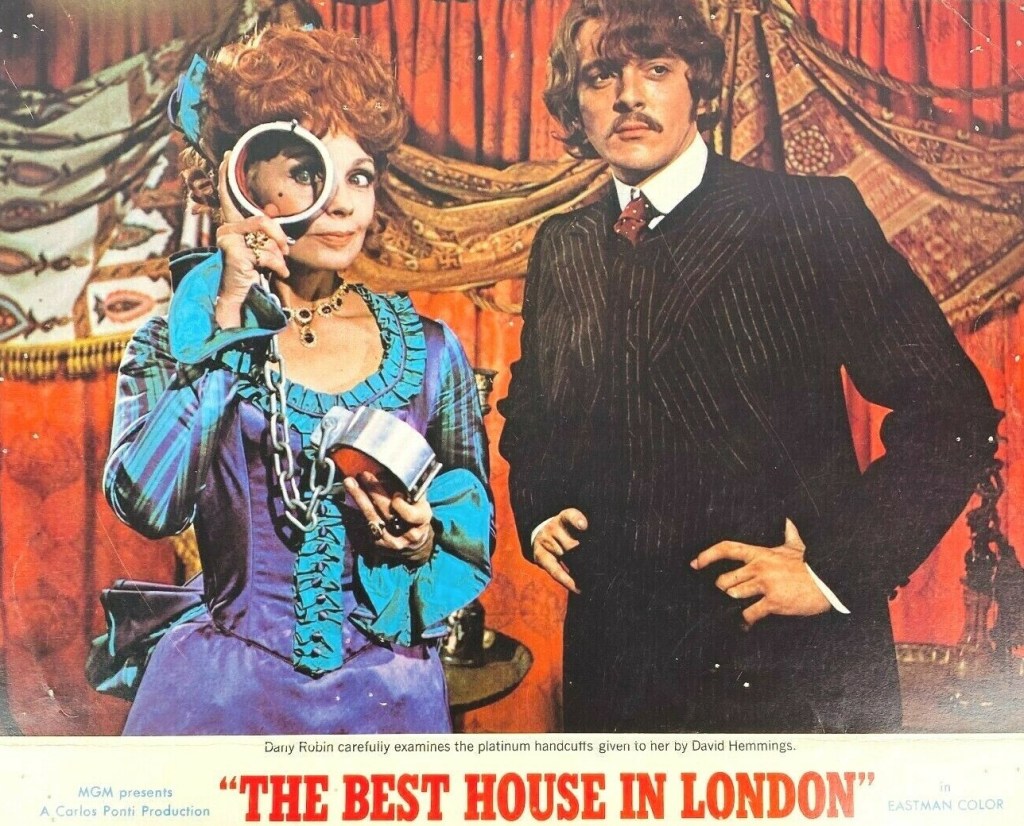
The monocle joke. Dany Robin sports the manacles her idiotic girls were supposed to wear rather the monocles they did wear.

Feminist philanthropist Josephine Pacefoot (Joanna Pettet) – a character based on the real-life campaigner Josephine Butler – has set up the Social Purity League to rescue fallen women. Walter Leybourne (David Hemmings) is hired as a publicist to bring the issues raised to a wider audience. When Josephine inherits the fortune of Uncle Francis (George Sanders) the pair come up against the nefarious Benjamin Oakes (also played by Hemmings), her cousin and his half-brother, who has purloined his uncle’s mansion in Belgravia as the premises for London’s first brothel – The Libertine Club. This venture is backed by the Home Secretary (John Bird) as a way of getting streetwalkers away from upmarket shopping streets where their presence discourages wealthy females. Josephine also has to deal with a caricatured “evil” Chinaman (Wolfe Morris) through her uncle’s investment in opium. There’s also for no particular reason apoplectic airship inventor Count Pandolfo (Warren Mitchell).

All the women rescued from the oldest profession by Josephine are soon recruited by Oakes and a good chunk of the middle section of the movie involves various excuses to give the viewers intimate glimpses of what goes on in the brothel, involving an abundance of nudity.  Oakes also aims to seduce Josephine while the shy Walter struggles to entice her into romance.

Excepting Josephine and Oakes’ mistress Babette (Dany Robin), the women are uniformly stupid. The story begins with Oakes’ duping a woman in a hot air balloon into removing her clothes on the grounds that it was the only way to reduce height enough to land. And it does not get any better. Women supposedly forced onto the streets after bad experiences with men turn out to be the seducers. Walter has the devil’s own job getting any of the girls to agree they had been raped. Walter, hoping to sell a story to The Times, is no less crass: “I can get five columns for a good rape.” Flora (Carol Friday), rescued much to her displeasure, is “gagging” for it. And there’s just an awful scene where a young girl sings about her “pussy” which even in the 1960s surely raised adverse comment.

The humor is largely of the sniggering variety. The brothel girls wear monocles instead of manacles, the only game on display in the Card Room is strip poker, and naturally there is a peeping tom, lawyer Sylvester (Willie Rushton).

As if to display his erudition, but without raising the laughter quotient, Norden chucks in literary cameos by the score – Charles Dickens (Arnold Diamond), Alfred Lord Tennyson (Hugh Burden), the aforementioned Elizabeth Barrett (Suzanne Hunt) and Lord Alfred Douglas (George Reynolds), Sherlock Holmes (Peter Jeffrey) and Dr Watson (Thorley Walters), plus explorer David Livingstone (Neil Arden) and department store entrepreneurs Fortnum (Arthur Howard) and Mason (Clement Freud).  

That the movie actually gets one star is thanks to a number of excellent visual jokes: one scene of Uncle Francis defying the mutineers by raising the Union Jack cuts to the blood-splattered flag decorating his coffin; Sylvester frustrated at the keyhole but still hearing the moans of seducer-in-chief Oakes is followed by the sight of the wannabe lover struggling to get out of his bonds, having been attacked by Chinamen.

There’s not much difference, beyond hair color, between the characters essayed by David Hemmings (Alfred the Great, 1969). Both are one-dimensional, the pop-eyed virgin astonished by the goings-on at the brothel, the suave villain who might as well be twirling his moustache for all the depth he brings to the role. Thankfully, Joanna Pettet (Blue, 1968) is at least believable though even she could not act her way out of scenes where she was suspended by the Chinaman above a vat of boiling acid.

George Sanders (Sumuru, Queen of Femina aka The Girl from Rio, 1969) has a ball as the hypocrite-in-chief who knows how to monetize vice while Dany Robin (Topaz, 1969) brings some finesse to an otherwise one-dimensional part. But everyone else is a cipher which is a shame given the talent on show – John Bird (A Dandy in Aspic, 1968), John Cleese (A Fish Called Wanda, 1988), Warren Mitchell (The Assassination Bureau, 1969), Bill Fraser (Masquerade, 1965) and Maurice Denham (Some Girls Do, 1969). Among the girls, you might spot Veronica Carlsen (Dracula Has Risen from the Grave, 1968) , Margaret Nolan (Goldfinger, 1964) and Rose Alba (Thunderball, 1965).

Director Philip Saville (Oedipus the King, 1968) should have known better and certainly made amends later in his career with among other projects BBC series Boys from the Blackstuff (1982). But Denis Norden (Buona Sera, Mrs Campbell, 1968) never wrote a more misguided piece in all his life.

For sure, a film like this is not going to do down well in these times but I was surprised how vilified it was on release, critics like Roger Ebert insulted by its endless attacks on women, the public no less hostile and it died a death at the box office.

Sumuru, Queen of Femina / The Girl from Rio / Mothers of America (1969) ***

Cult fans assemble. Sci fi crime thriller with for the time a fair sprinkling of nudity, and channelling psychedelic turns like Barbarella (1968) and Danger: Diabolik (1968) and one step up from the ultra-confident gals of Deadlier than the Male (1967) and Some Girls Do  (1969). It would have helped if there was a decent plot, and not just a barrage of double-crossing halfway in, but you can’t have everything and director Jess Franco seems to believe that the presence of a tribe of women decked out in red capes, white knee-length boots and not necessarily much in between, goes some way to compensate.

Crook Jeff Sutton (Richard Stapley) holes up in Rio with $10 million in stolen cash, unaware that his presence has already been noted by gang boss Masius (George Sanders) and local ultra-feminist Sununda (Shirley Eaton). After hooking up with manicurist Lesley (Maria Rohm), Sutton is set upon by Masius’ henchmen but escapes in a plane to Femina, “the capital city of the world of women,” a female fortress along the lines of the Bulldog Drummond pictures.

Turns out Sununda is partial to men with piles of cash, kidnapping and torturing them until they hand it over. So she can’t believe her luck when millionaire Jeff walks into her lair. Except Jeff is a bit of a fibber, having made up the story about the ten million, and instead landing at Femina in order to rescue Ulla (Marta Reves).

The plot only really kicks in when he escapes. Masius agrees to help Jeff in return for the pretend-thief helping him hijack Sununda’s vault of gold. In reality, Masius is using Jeff as bait, to tempt Sununda down from the clouds, and then turn him over in exchange for just half her gold. And so it’s back to Femina for all concerned.

There’s no real pretence at the kind of sci-fi that enthralled Barbarella audiences and none of the slick campness of Danger:Diabolik, and most of the ideas seem still-born and occasionally contradictory – in order to enslave men women must first be taught how to be irresistible to them – torture is accomplished either by whispering or kissing, and the ray-guns employed looked like cast-offs from the 1950s, but the regiment of women, with spies infiltrating everywhere, led by the ruthless Sununda, have the makings of a warrior nation.

The movie has far better luck with Masius, a splendidly-drawn character who doodles on restaurant tablecloths, enjoys reading Popeye comic books, and – a bit of drawback for a man in his profession – can’t stand the sight of blood. While his sidekicks are mostly incompetent, they do drive around in hearses that resemble pagodas or dress in unnecessary masks and while his girlfriends appear docile they are in fact spies. And there’s a spot of waterboarding in case you ever wondered where the American secret services got the idea.

The source material was from Sax Rohmer but Sununda lacks the inherent obvious evil of the author’s more successful Fu Manchu series, Shirley Eaton no match for Christopher Lee, the most recent Fu Manchu, nor Richard Shapley on a par with Fu Manchu nemesis Nayland Smith, regardless of whether played by Nigel Green (The Face of Fu Manchu, 1965),  Douglas Wilmer (The Brides of Fu Manchu, 1966) or Richard Greene (The Blood of Fu Manchu, 1968, and The Castle of Fu Manchu, 1969).

And anyone attracted to the picture by director Jess (Jesus) Franco is going to be disappointed by the lack of sleaziness he exhibited in pictures like Succubus (1968), 99 Women (1969) and  Marquis De Sade’s Justine (1969) and there’s not enough style, though abundant campness, to make up.  It’s hard to say quite why it did not have a harder edge, perhaps producer Harry Alan Towers, responsible for 99 Women, felt it should err in the softer direction of Fu Manchu than the overt sex-and-violence of the nascent women-in-prison genre.  

Franco and Towers (24 Hours to Kill, 1965, and Bang! Bang! You’re Dead!, 1966) had collaborated on The Blood of Fu Manchu and The Castle of Fu Manchu as well as Venus in Furs (1969) and Marquis De Sade’s Justine so presumably knew how far they could go and decided that here it was better to rein in Franco’s tendencies. Whether a tougher-edged approach would have made much of a difference given the indifferent playing – neither Shirley Eaton (The Scorpio Letters, 1967)  nor Richard Stapley (Two Guns and a Coward, 1968) bring much to the leading roles and George Sanders (Warning Shot, 1967) is not in it enough to save it. Maria Rohm, Franco’s wife, appeared in many of his films.  

Towers appeared on surer ground in the likes of 24 Hours to Kill (1965), Bang! Bang! You’re Dead! (1966) and Five Golden Dragons (1967) when he could draw on a more interesting cast, better stories and more colourful locations. This was a sequel to The Million Eyes of Sumuru (1967) again with Shirley Eaton and plum role for Klaus kinski.

Despite the film’s potential, the director and George Sanders it does not fit into the so-bad-it’s-good category nor has enough going for it to be labelled a true cult film. But I could be wrong in both those assumptions.

The Amorous Adventures of Moll Flanders (1965) ***

The Husband-Hunting Adventures of Moll Flanders” might have been a more accurate title and if you were seeking a template for a multi-character eighteenth-century Olde English picturing majoring on sexual shenanigans here would be a very good place to start, rather than the shambolic recently-reviewed Lock Up Your Daughters (1969). Of course, Tom Jones (1963) was the precursor but told the story from the male perspective and here it is from the more vulnerable female point-of-view. Despite the hilarity and the sexual proclivities on show, it remains abundantly clear that marriage remains a refuge, where the un-titled can gain either security or status, but also a contract, a means of further enrichment for the already wealthy.

So orphan housemaid Moll Flanders (Kim Novak) has a difficult time of persuading the elder brother (Daniel Massey) of her wealthy employer to marry her. Instead, he takes her as his mistress, leaving her no option but to marry the drunken fool of a younger brother (Derren Nesbitt) and instantly regret her decision. When he drowns, you would have thought that would solve her problems. But this was the eighteenth century and a widow with no fortune (and therefore power) of her own can easily be tossed out penniless.

A widowed banker (George Sanders) might be a prospect especially as she has the wits to prevent him being entirely robbed by highwayman Jemmy (Richard Johnson). Plans to marry him thwarted, she takes a job for food and lodgings with Lady Blystone (Angela Lansbury) and her husband, an impoverished Count (Vittorio De Sica), who are constantly pursued by debt collectors. Meanwhile Jemmy has taken the decision to marry a rich woman and become a kept man.

But this set of characters becomes enmeshed, rather than going off in sundry directions as with Lock Up Your Daughters, so the tale unfolds in classic fashion. Assuming Moll to be moneyed, Jemmy masquerades as the owner of three ships. Nothing, of course, works out for anybody, certainly not those pretending to be something they are not while aspiring to wealth beyond their reach, but it all concludes in propitious fashion as the actions of the various principals become embroiled.

While certainly having an inclination towards the amorous, Moll wishes for that within the context of true love, rather than selling her physical wares to the highest bidder. So for a picture sold on immorality – the “rollicking ribaldry” of the poster – there is an unsung moral standpoint. Finding safe passage into affluence proves very tricky indeed. And what appears at first glance to be merely a picaresque episodic tale turns out to be very well structured indeed. And those looking for cleavage will find it here in abundance, as if some kind of rationing had been imposed on clothing, or that it was matters of economy that dictated that the area around the bosom be left unclothed. Being the lusted-after heroine it falls to Moll Flanders to shed even more of her attire from time to time.

You are more likely to laugh out loud at the moments of offbeat humour – a flotilla of ducks heading in Moll’s direction when she cries for help in a lake, the Count while acting as a butler demanding a tip – but it is more of a gentle satire. There is some of the expected bedroom farce but, mercifully, no recourse to a food fight. It is handsomely-mounted and meets the highest expectations of the costume drama.

Kim Novak (Of Human Bondage, 1964) easily passed the English-accent-test and carries the picture with ease. Richard Johnson (Deadlier than the Male, 1967) reveals a rakish side so far hidden in his more dramatic works to date. And there is a fine supporting cast including George Sanders (The Quiller Memorandum, 1966), Angela Lansbury (Harlow, 1965), Vittorio De Sica (The Shoes of the Fisherman, 1968), Lili Palmer (The Counterfeit Traitor, 1962) as Jemmy’s mistress, Leo McKern (Assignment K, 1968) as Jemmy’s sidekick going by the name of Squint, Daniel Massey (Star!, 1968) and Derren Nesbitt (Nobody Runs Forever/The High Commissioner, 1968). In bit parts looks out for Cecil Parker (Guns at Batasi, 1964), Dandy Nichols later of Till Death Us Do Part television fame and Carry On regular Peter Butterworth.

All directed with some style by Terence Young (Mayerling, 1968) and adapted from the lengthy Daniel Defoe novel by Denis Cannan (A High Wind in Jamaica, 1965) and Roland Kibbee (Valdez Is Coming, 1971).

An old-fashioned romp with, if you can bothered to look, a moral center. You catch this on Amazon Prime. I’m not sure why they have chosen a black-and-white illustration since the film is shot in glorious color.

Discover WordPress

A daily selection of the best content published on WordPress, collected for you by humans who love to read.

The Atavist Magazine

by Brian Hannan

WordPress.com News

The latest news on WordPress.com and the WordPress community.