Do Not Disturb (1965) ***

Takes a good while to come to the boil, perhaps as a result of trying to find the right chemistry between Doris Day and her latest 1960s partner Rod Taylor, after her highly successful pairings with Rock Hudson in three films. Her turn with Cary Grant (That Touch of Mink, 1962) was also successful, but finding another pairing proved dificult. There was a single outing with David Niven (Please Don’t Eat the Daisies, 1960),  a pair with James Garner (The Thrill of It All and Move, Over Darling, both 1963) plus a couple of ventures outside the comedy genre, thriller Midnight Lace (1960) with Rex Harrison and musical Billy Rose’s Jumbo (1962).

One of the curiosities was her billing status, credited below Rock Hudson and Cary Grant, but above all the others. Hudson, Grant, Garner and Niven demonstrated a clear knack for comedy, less so the rest. So one of the elements facing any screenwriter or director was how to make a pairing fizzle. With the top-billed stars, there was more of a guarantee of equal playing time so that they could spark off each other. In the remainder, more reliance on the actress’s pratfalls and slapstick and being some kind of fish out of water.

Here, the Ameican fish is let loose in London waters and good chunk of the opening section is taken up with the oddities of England from an American perspective. First of all, it’s the coinage. A simple transaction with a cab driver soon involves a policeman what with her difficulty in getting to grips with “too many coins”, most of which to add to the confusion often have a nickname, resulting in her paying eight shillings and sixpence for every subsequent ride since that’s the one amount she’s mastered.

Then it’s the problems of driving on the wrong side of the road, using a different gearbox, and the peculiar nature of village names, that either result in a crash or getting lost or both. The difference between electrical plugs lends itelf to electrocution jokes, and the inefficiency of the British telegram system tops off a scene. There’s not much magic even a Doris Day in her prime can add to such standard situations.

She comes into her own somewhat by standing up to the masters of a fox hunt and their snarling hounds. But somehow sheltering a fox appears to give her some affinity with animals and before you know it her country house is awash with unsuitable beasts such as goats.

Still with me? That’s kind of the feeling I had about a third of the way into the picture. So here’s the set-up: businessman Mike (Rod Taylor) and wife Janet (Doris Day) have moved to London. He details her to find an apartment, meaning in central London close to his office. Instead, she lands them in a country cottage, and he immediately resents being so remote from the city and with the extra travelling time plus the evening functions (held in the company flat) in his schedule soon the couple are heading towards estrangement.

He has a pretty secretary Claire (Maura McGiveney) in tow and the functions are meant to be wife-free zones, and when Janet tests out her suspicions she is initially brought down to earth with a thump.

But, of course, suspicion grows horns and with the encouragement of interfering  landlady Vanessa (Hermione Baddeley) she decides to play him at his own game. Once handsome Frenchman Paul (Sergio Fantoni) hoves into view she pretends to take up with him to bring her husband to heel. This involves a romantic trip to Paris where, of course, Doris Day is in her comedic element, desperately trying to avoid the advances of her suitor and getting drunk in the process. Day makes an excellent drunk and inebriation cue for many of her best sequences.

Much of the seduction is driven by the foreigner and the secretary so husband and wife find themselves in one compromising position after the other. However, this narrative ploy means the two stars are often apart and the success of the picture depends on two separate individuals rather than the teaming as with the Hudson and Grant movies. To use the old cliché, it’s game of two halves, three-thirds really since the opening section is mostly the fish out of water stuff. They’re an odd combination from the outset, a wife who does the opposite of what her husband wants then complains when, tied down with business, he doesn’t want to live in the country.

There’s an occasional belly laugh but it seems such routine fare that you wonder why Day got involved in the first place – blame husband Martin Melchior for signing her up.

After original director Ralph Levy (Bedtime Story, 1964) – you could view this as a reversal of Bedtime Story with the principals target for seducation rather than doing the seducing – took ill, George Marshall (Advance to the Rear, 1964) finished it off. Written by Milt Rosen (movie debut), Richard L. Breen (Captain Newman M.D., 1963) and William Fairchild (Star!, 1968)

For completists only.

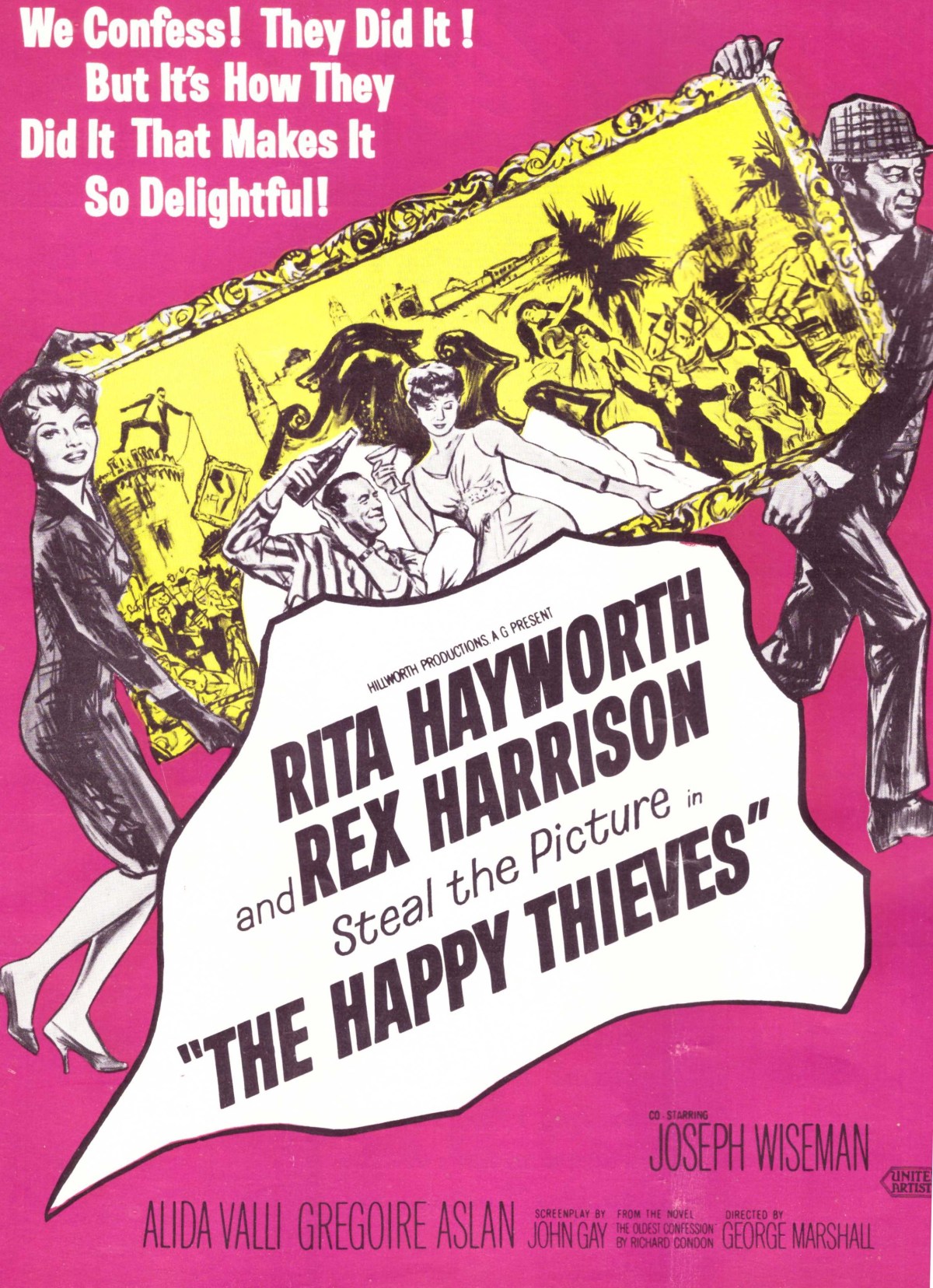
The Happy Thieves (1961) ****

A triumvirate of art thieves are blackmailed into stealing a famous Goya painting from the Prada museum in Madrid. Jimmy Bourne (Rex Harrison) is the actual thief, Eve Lewis (Rita Hayworth) smuggles the artworks out of the country and Jean-Marie (Joseph Wiseman, soon to be more famous as Dr No, 1962) creates the forgeries that replace the stolen masterpieces. Hayworth is the least reliable of the trio, her drinking (she had a problem in real life) jeopardizes their slick operation. Not only has the painting they have stolen slipped through their hands but the thief, Dr Victor Munoz (Gregoire Aslan), is not above a bit of murder on the side

Bourne is always one-step-ahead but  never overbearing, and the thefts are carried out with military precision. Even when let down by colleagues, who are inclined to scarper when threatened, he takes it all in his stride, the calm center of any potential storm. His marriage proposal is just as cool, coming by way of dictation, “the new Mrs Bourne.”

Bourne is the archetypal gentleman thief (“there is a touch of larceny in all successful men”) and Eve does her earnest best to keep up (“I want so much to be a first-class crook for you, I’m trying to be dishonest, honestly I am.”). But there is never the remotest chance of them being confused with real gangsters. “I thought that stealing was the only honest way Jimmy could live with himself,” says Eve.  In truth, their characters set the template for better-known later heist pictures like How to Steal a Million (1966), Gambit (1966) and A Fine Pair (1968) which couple one determined thief with one less so.   

Of course, heist pictures rely for much of their success on the actual heist. And Bourne’s plan for the Prada is brilliantly simple and carried out, as mentioned, with military precision. The get-out clause, which, of course, is how such films reach their conclusion, is more realistic and human than the other movies I have mentioned.

What’s more, there are number of excellent sight gags and great throwaway lines, while Jean-Marie and Dr Munoz are well-written, the villain’s motivation is particularly good. Other incidentals lend weight – their apartment is opposite a prison, the security guards at the Prada are caring rather than the idiots of How to Steal a Million, and a sub-plot involving a bullfighter (Virgilio Teixeira, Return of the Seven, 1966) also sheds light on Bourne.  There is a jaunty whistling theme tune by Mario Nascimbene (One Million Years B.C., 1966) which maintains levity throughout.

The movie does tilt from the gentleman thievery of the initial section into something much darker, but, so too, do the two principals and, unusually, rather than in the usual contrived fashion, Bourne and Eve undergo personal transition by the end.

Rex Harrison (Midnight Lace, 1960) and Hayworth are a delightful pairing. Hayworth has abandoned the sultry in favor of the winsome, Harrison shifted from sarcasm to dry wit. And there is genuine chemistry between them though his character’s matter-of-fact attitude tends to undercut the kind of passionate romance that moviegoers came to expect from top-class players thus paired. It would have been tempting for Hayworth to act as the ditzy blonde (brunette, actually) but instead she plays it straight, which is more effecting.

I found the whole exercise highly enjoyable. It’s very under-rated. My only quibbles are that it is shot in black-and-white, which seems bizarre when Spain is such a colorful location. The title, too, is an oddity. This was the only picture produced by Hayworth in partnership with husband James Hill. They split up before the picture was released which might explain its poor initial box office. 

Hill was an experienced producer, part of Hill-Hecht-Lancaster (The Unforgiven, 1960), but this proved his final film. Hayworth, too, had previously worn the producer’s hat for The Loves of Carmen (1948), Affair in Trinidad (1952) and Salome (1953). Hayworth was still a marquee attraction at this point, taking top billing here, and second billing to John Wayne in Circus World/The Magnificent Showman (1963). But this is quite a different performance to her all-out-passionate persona or the slinky deviousness of Gilda (1946).   

Director George Marshall (Advance to the Rear, 1964) knew how to stay out of the way and let his stars deliver the fireworks. John Gay (Soldier Blue, 1970) wrote the screenplay from the novel by Richard Condon (The Manchurian Candidate, 1962).

The Happy Thieves (1962) ****

A triumvirate of art thieves are blackmailed into stealing a famous Goya painting from the Prada museum in Madrid. Jimmy Bourne (Rex Harrison) is the actual thief, Eve Lewis (Rita Hayworth) smuggles the artworks out of the country and Jean-Marie (Joseph Wiseman, soon to be more famous as Dr No, 1962) creates the forgeries that replace the stolen masterpieces. Hayworth is the least reliable of the trio, her drinking (she had a problem in real life) jeopardizes their slick operation. Not only has the painting they have stolen slipped through her hands but the thief Dr Victor Munoz (Gregoire Aslan) has filmed the original theft and is not above a bit of murder on the side.

Harrison and Hayworth are a delightful pairing. Hayworth has abandoned the sultry in favor of the winsome, Harrison shifted from sarcasm to dry wit. He is always one-step-ahead but  never overbearing, and the thefts are carried out with military precision. Even when let down by colleagues, who are inclined to scarper when threatened, he takes it all in his stride, the calm center of any potential storm. And there is genuine chemistry between Harrison and Hayworth though his matter-of-fact attitude tends to undercut the kind of passionate romance that moviegoers came to expect from top-class players thus paired. His proposal, for example, comes by way of dictation, “the new Mrs Bourne.” It would have been tempting for Hayworth to act as the ditzy blonde (brunette, actually) but instead she plays it straight, which is more effecting.

Bourne is the archetypal gentleman thief (“there is a touch of larceny in all successful men”) and Eve does her earnest best to keep up (“I want so much to be a first-class crook for you, I’m trying to be dishonest, honestly I am.”) There is never the remotest chance of them being confused with real gangsters. “I thought that stealing was the only honest way Jimmy could live with himself,” says Eve.  In truth, their characters set the template for better-known later heist pictures like How to Steal a Million (1966), Gambit (1966) and A Fine Pair (1968) – all reviewed on this blog – which couple one determined thief with one less so.   

Of course, heist pictures rely for much of their success on the actual heist. And Bourne’s plan for the Prada is brilliantly simple and carried out, as mentioned, with military precision. The get-out clause, which, of course, is how such films reach their conclusion, is more realistic and human than the other movies I have mentioned.

What’s more, there are number of excellent sight gags and great throwaway lines while Jean-Marie and Dr Munoz are well-written, the villain’s motivation particularly good. Other incidentals lend weight – their apartment is opposite a prison, the security guards at the Prada are caring rather than the idiots of How to Steal a Million, and a sub-plot involving a bullfighter (Virgilio Teixeira, Return of the Seven, 1966) also sheds light on Bourne.  There is a jaunty whistling theme tune by Mario Nascimbene (One Million Years B.C., 1966) which maintains levity throughout.

The movie does tilt from the gentleman thievery of the initial section into something much darker, but, so too, do the two principals and, unusually, rather than in the usual contrived fashion, Bourne and Eve undergo personal transition by the end.

I found the whole exercise highly enjoyable. It’s very under-rated. My only quibbles are that it is shot in black-and-white, which seems bizarre when Spain, the location, is such a colorful country. The title, too, is an oddity. This was the only picture produced by Hayworth in partnership with husband James Hill. They split up before the picture was released which might explain its poor initial box office.  Hill was an experienced producer, part of Hill-Hecht-Lancaster (The Unforgiven, 1960), but this proved his final film.

Hayworth, too, had previously worn the producer’s hat for The Loves of Carmen (1948), Affair in Trinidad (1952) and Salome (1953). Hayworth was still a marquee attraction at this point, taking top billing here, and second billing to John Wayne in Circus World/The Magnificent Showman (1963). But this is quite a different performance to her all-out-passionate persona or the slinky deviousness of Gilda (1946). Alida Valli (The Third Man, 1949) puts in an appearance and trivia trackers might take note of the debut of Britt Ekland (credited as Britta Ekman).

Director George Marshall was a Hollywood veteran with over a quarter of a century directorial experience including film noir The Blue Dahlia (1946), Jerry Lewis comedy The Sad Sack (1957) and western The Sheepman (1958) with Glenn Ford. In fact, five of his previous six pictures had starred Glenn Ford and his next shift would be on How the West Was Won (1962).

Discover WordPress

A daily selection of the best content published on WordPress, collected for you by humans who love to read.

The Atavist Magazine

by Brian Hannan

WordPress.com News

The latest news on WordPress.com and the WordPress community.