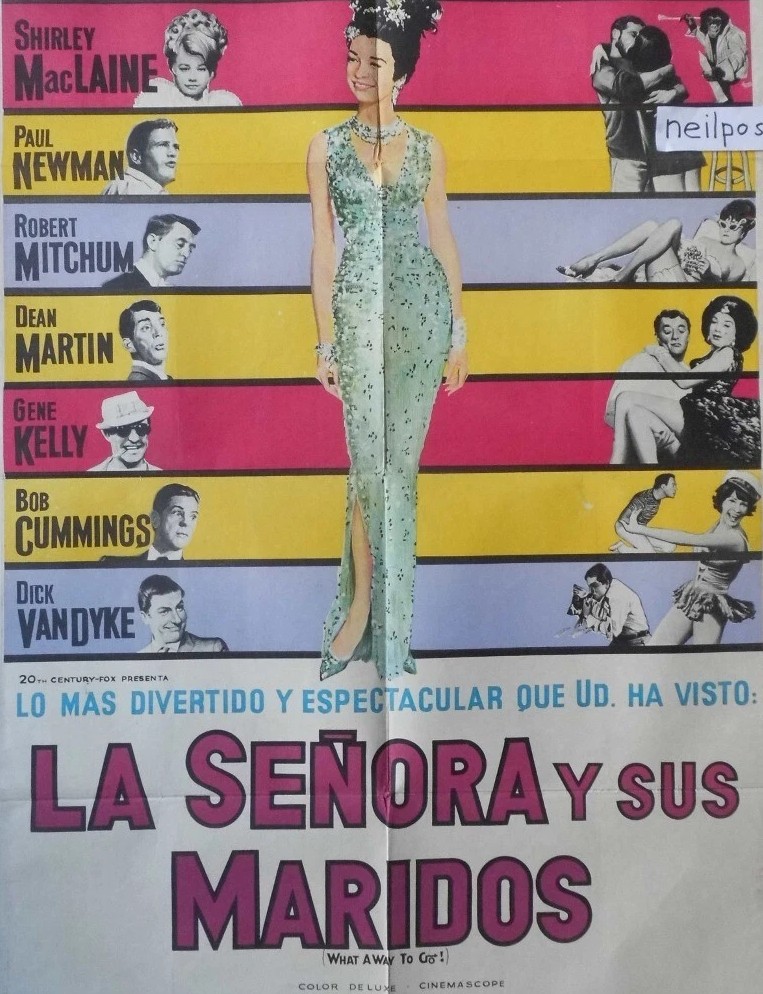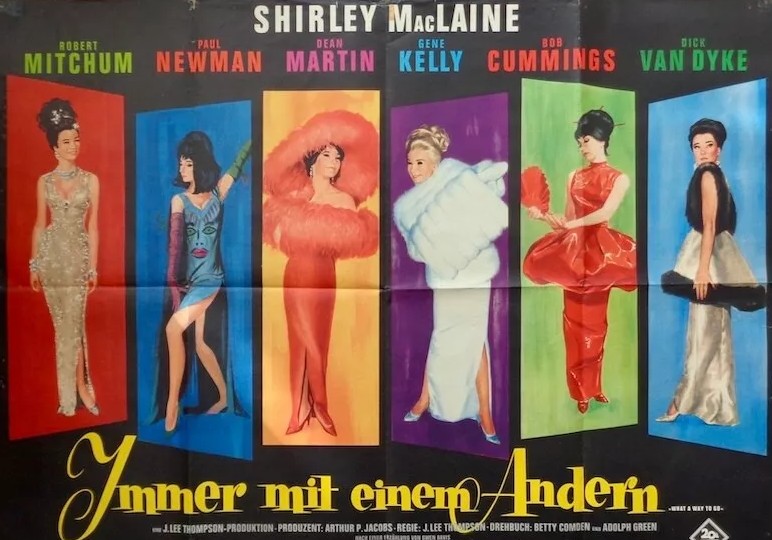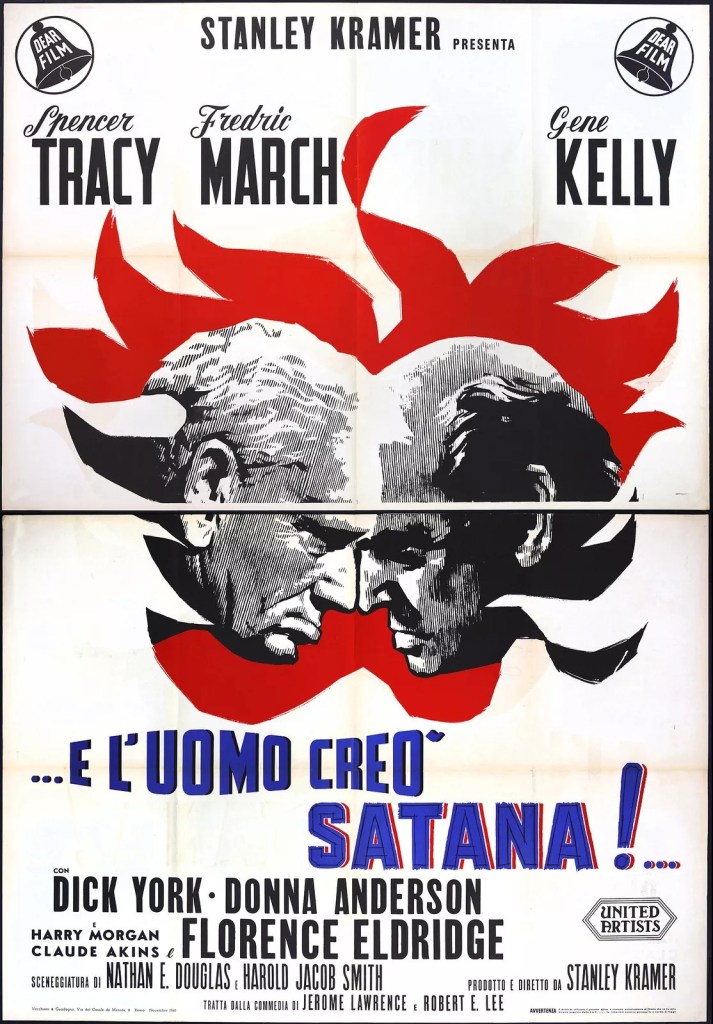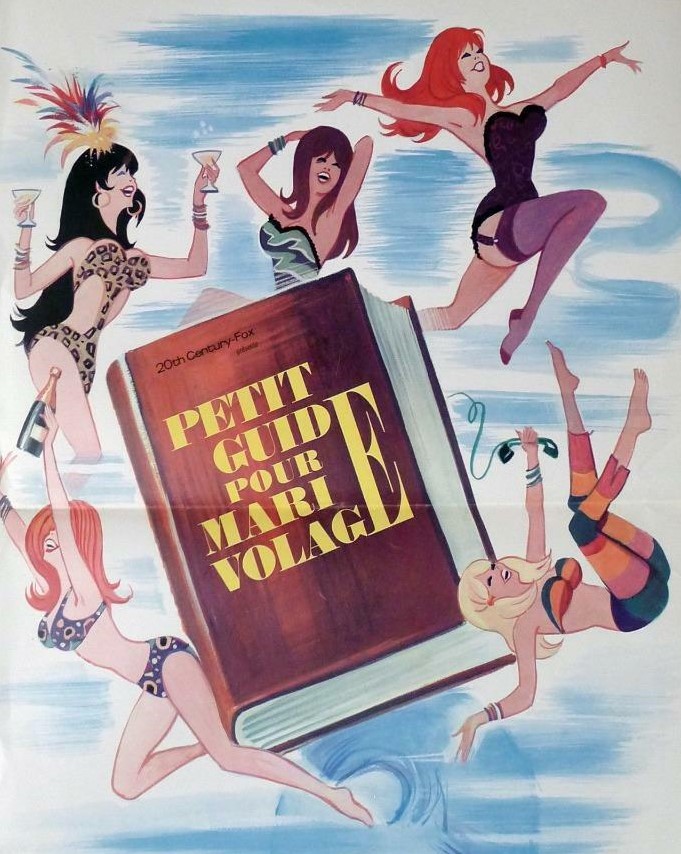
Inherit the Wind (1961) ****

As timely as ever with America seemingly always on the brink of dictating what freedoms people can enjoy. At the time the target was the oppression engndered by McCarthysim, rather than the more basic tale of whether State law could forbid its citizens to talk about evolution. It was set almost a century ago, based on a real-life case, and even now fundamentalists reject Darwin’s theories. Setting aside the context, the principle contested is still the same – not just free speech but the right to be different. You could even argue that scientists and fundamentalists are all agreed these days, that out of nothing came the universe, whether created by a Deity or someone operating a contraption called the Big Bang.

Setting aside the various arguments for and against Darwin’s theory, what we have, nonetheless, is an acting highpoint, a fabulous courtroom battle, of the kind adored by audiences, full of objections sustained, attorneys being warned by the judge, inadmissible evidence, smart remarks and witty rejoinders. This all takes place in a sweltering courtroom, temperature so high that the judge agrees to depart from court procedure and permit the verbal duellists to shed their jackets.

Given further depth because the antagonists, Henry Drummond (Spencer Tracy) and Matthew Harrison Brady (Fredric March), were once the best of pals, political allies, on the same side in the latter’s failed bid for the Presidency, and willing to accept the other’s personal foibles. Probably the first legal drama to accept that outside the courtroom the participants could be friends.

Luckily, most of it isn’t long speeches, but sharp comebacks, plus the detours, twists and turns that come about from concentrating more on the court than on any surrounding action, though there is forbidden romance, pastor’s daughter Rachel (Donna Anderson) defying her father over her love for the accused, schoolteacher Bertram (Dick York) whose teaching is in conflict with the Bible.

The most outraged denizens of the town get into a right tizzy, marches, religious songs, protest, but that’s leavened by commercial interests, a bank manager worrying that the town being ridiculed by those cleverer folks back east will harm his business, hoteliers, sideshow operators licking their lips at the financial bounty of reporters and gawkers descending on the town.

This is as you’d like to see Spencer Tracy, not the silent judge of Judgement at Nuremberg (1961), personality reined in by the weight of his decisions and the need to do right by those accused of even the most heinous of crimes, but the exuberant character, confident, up for battle, able to fend off any criticism and come back to any witticism at his expense with stinging repartee.

Fredric March, too, has a ball with a loudmouth character, convinced of his infallibility (except of course in terms of the Presidential Race), apt to stuff his face at dinner, but still with an intellectual thrust capable of parrying anything Tracy can throw at him. Tucked somewhere in between is weaselly reporter E.K. Hornbeck (Gene Kelly) whose newspaper has hired Drummond to defend Bertram in the hope of filling the front pages for days with the Trial of the Century (taking the prize from Leopold and Loeb the year before – both cases in real-life handled by Clarence Darrow).

Harry Morgan (The Flim-Flam Man/One Born Every Minute, 1967) plays the snipppy judge trying to maintain order while Claude Akins (Claudelle Inglish, 1961) the hellfire preacher. With so many interesting characters on parade, there’s never a dull moment, especially with each actor trying to wring every ounce of drama and/or pathos from their part.

Director Stanley Kramer (Judgment at Nuremberg) looks as if early on he made up his mind to give the actors their sway. There’s no reining in, even in the early scenes, with the populace up in arms and carrying very professionally-made signs and banners (no handwritten scrawls here, no sirree). And once Tracy and March hit their stride, it’s all an audience can do to sit back and admire. Sentiments expressed will still strike a chord, but, mostly it’s a testament to two great actors at the top of their game.

If you only remember March from the likes of The Condemned of Altona (1962) or Seven Days in May (1964) you should know he was a huge marquee attaction in his day, double Oscar-winner (and three nominations besides), as at home in swashbucklers like The Buccaneer (1938) as drama and comedies, leading man who could more than hold his own against top female stars – Greta Garbo (Anna Karenina, 1935), Katharine Hepburn (Mary of Scotland, 1936), Merle Oberon (Dark Angel, 1935) and Janet Gaynor (A Star Is Born, 1937).

Written by Nedrick Young (The Train, 1964) and Harold Jacob Smith (The McMasters, 1970) from the play by Jerome Lawrence and Robert E. Lee.

A terrific watch.

The Young Girls of Rocheforte / Les Damoiselles de Rochefort (1967) **** – Seen at the Cinema at Bradford Widescreen Weekend

In effervescence and color palette a close cousin to Barbie (2023) with the bonus of being able to call on one of Hollywood’s greatest hoofers, Gene Kelly, in a surprise cameo. He swoops and sways like he was Singin’ in the Sun. And he’s just the icing on the cake in this exuberant throwback to 1950s Cinemascope but with the sensibility of a 1940s musical in which dreams are delivered after a few minor setbacks.

Throw in a long-lost love, an affair that literally went south, an artist who has painted his ideal woman, a couple of literal-minded running French jokes – a woman called Madame Dame and a young sailor whose departure is immi-Nantes – and given the overall light-hearted treatment you would have to treat the presence of a sadistic murderer as being in the comedy vein.

Twins blonde Delphine (Catherine Deneuve) and brunette Solange (Francoise Dorleac) make a living running a music class. Delphine dreams of meeting the ideal man, having already rejected gallery owner Guillaume (Jacques Riberolles) and not too keen on itinerant carney (George Chakiris), while Solange wants a career as a composer, befriending music shop owner Simon (Michel Piccoli) who can put her in touch with old buddy and now renowned pianist Andy (Gene Kelly).

As you might expect the narrative is driven by misunderstandings and meetings choreographed by the minute to fail. This is the kind of film where an actor playing the role of a piano player is not expected to learn to play the piano, just stare into space as though channeling an internal muse or glancing at the sheet music.

There are songs by the dozen – possibly too many (27 singing or dancing sequences), more like a continuous ballet than a traditional musical – but none we’re still humming today, not like tunes from West Side Story (1961), The Sound of Music (1968) or Funny Girl (1968) – though “The Twins Song” probably comes closest. That’s not to put down Michel Legrand’s inventive score, but perhaps to suggest a cultural/language divide. Outside of Danielle Darrieux (Loss of Innocence / The Greengage Summer, 1961) , the singing voices were dubbed, even that of Gene Kelly who lacked the range for the material.

And probably you don’t need to worry about the quality of individual songs as you’ll be swept along by Jacques Demy’s infectious direction. Most of the dancing style reflects West Side Story but with a lighter edge. And it takes little or nothing for characters to burst into song or dance, sometimes that activity going on spontaneously in the background of another scene.

Set in the real seaside town of Rochefort in France and making use of genuine locations, the action kicks off on an unique type of bridge as the carnival comes to town. While not strictly a feminist endeavour, men are mostly put in their place, overtures rejected, marriage offers turned down and bad employers shown the door.

The appearance of Gene Kelly, who hadn’t worn his dancing shoes in more than a decade, gives this an enormous fillip as his classic style shows the others just how it’s done. But it’s the lightness of touch, as well as being able to plumb a well of emotion, that gives this film its grounding, Deneuve and Dorleac as well as Darrieux carrying the movie. George Chakiris (Diamond Head, 1962) looks more at home here than in any film other than West Side Story.

Jacques Demy and Michel Legrand had teamed up previously for The Umbrellas of Cherbourg / Les Parapluies de Cherbourg (1964). Catherine Deneuve (Mayerling, 1969) and Francoise Dorleac (Genghis Khan, 1965) were sisters. Tragically, Dorleac was killed in a road accident prior to the film opening.  

But the whole enterprise is so effortless and appealing you can’t help being drawn in.

A Guide for the Married Man (1967) **

Little has dated as badly as this male supremacy sexist hogwash. While Billy Wilder can manage to inject some sophistication and even elegance into the thorny subject of adultery and male philandering (The Apartment, 1960), director Gene Kelly has little to offer but crudity.

Walter Matthau (The Fortune Cookie, 1966), top-billed for the first time, does little more than act as listener to neighbour Ed (Robert Morse), supposed expert on wifely deception and link man to a series of lame unconnected sketches featuring a battalion of cameo stars.

It’s more likely to be remembered for being the final film Jayne Mansfield (Playgirl after Dark/Too Hot to Handle, 1960) made before her premature death. Her episode might well sum up the depths of hilarity this opus stoops to – the compelling issue of what to do when your illicit companion loses her bra in your bedroom.

Perhaps the only amusing note is the notion that this has come from the pen of the Oscar-winning Frank Tarloff (Father Goose, 1964), responsible also for the source novel, drawing on the experiences of a bunch of “swingers” reputedly enjoying to the full the sexual excesses of the decade, a decidedly middle-aged gang intent on not leaving all the fun to the hippies and the liberated young

The women here are straight out of The Stepford Wives template of female docility, existing only to please their men, any passing woman automatically in the stunner bracket intent on demonstrating every wiggle possible. Worse, one is so weak that she can be easily manipulated into believing that she did not, in fact, catch her husband in bed with another woman once the wily man falls back on that old political adage of plausible deniability.

What makes the antics of Paul (Matthau) and Ed so reprehensible is that their wives are trusting knock-outs in the first place. Ruth (Inger Stevens), Paul’s other half, not just a keep-fit fanatic but a fabulous cook, able to present a superb meal on a miniscule budget.

So we are meant, I suppose, to sympathize with Paul’s flawed efforts at beginning an extra-marital affair. Or at the very least laugh at his failures, rather than mock his inadequacies as a husband. Paul’s main target is divorcee Irma (Sue Anne Langdon) but it’s no surprise Ed beats him to the punch. There’s an old-fashioned morality lesson at the end but I was hoping, instead, for a twist whereby smug Paul discovered his wife was playing away from home. Although, admittedly, that would be out of character for Ruth.

You might get through this if cameos are your thing and you want to spent a whole movie waiting for an appearance by It’s A Mad, Mad, Mad, Mad World (1963) alumni Sid Caesar, Jack Benny, Phil Silvers and Terry-Thomas plus the likes of Lucille Ball (Yours, Mine and Ours, 1968), Polly Bergen (Kisses for My President, 1964), Art Carney (Harry and Tonto, 1974), Carl Reiner (The Russians Are Coming, The Russians Are Coming, 1966), Linda Harrison (Planet of the Apes, 1968) and Jeffrey Hunter (Custer of the West, 1967).

Walter Matthau just about keeps this afloat and lucky for his career he had The Odd Couple (1968) up next. Inger Stevens (Firecreek, 1968) is wasted.

This was a box office riot on initial release, but times have changed. Gene Kelly (Hello, Dolly!, 1969) directs with a leaden hand. 

Guide to a Slimeball might be a better title.

Discover WordPress

A daily selection of the best content published on WordPress, collected for you by humans who love to read.

The Atavist Magazine

by Brian Hannan

WordPress.com News

The latest news on WordPress.com and the WordPress community.