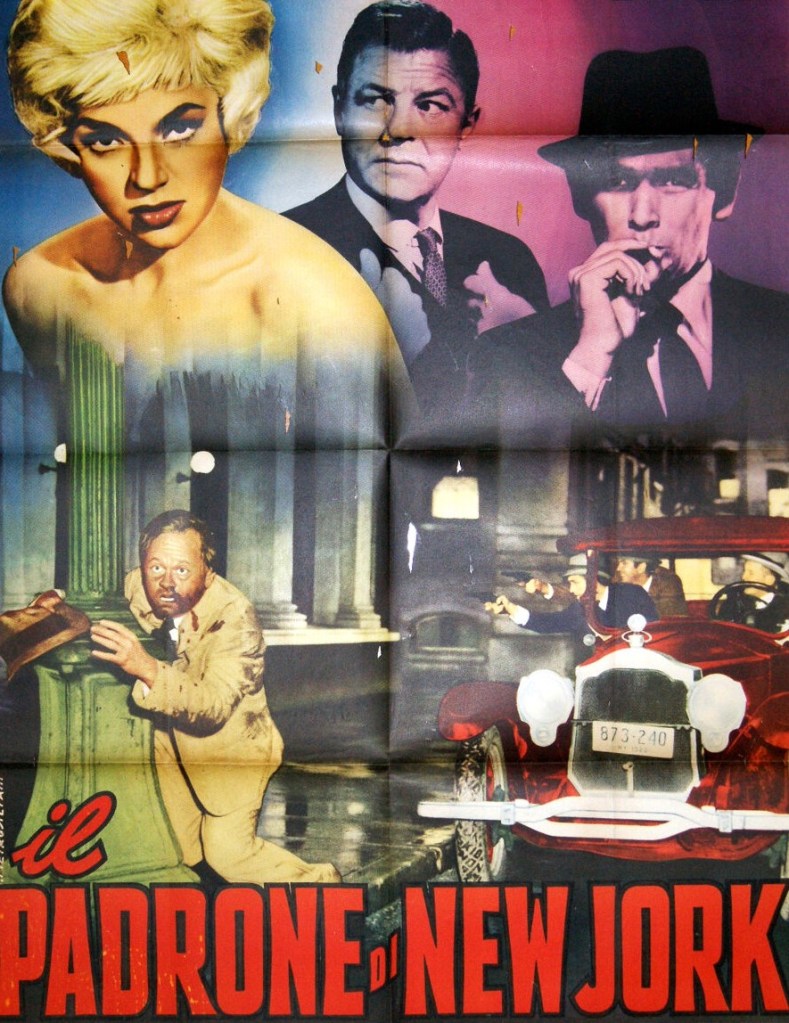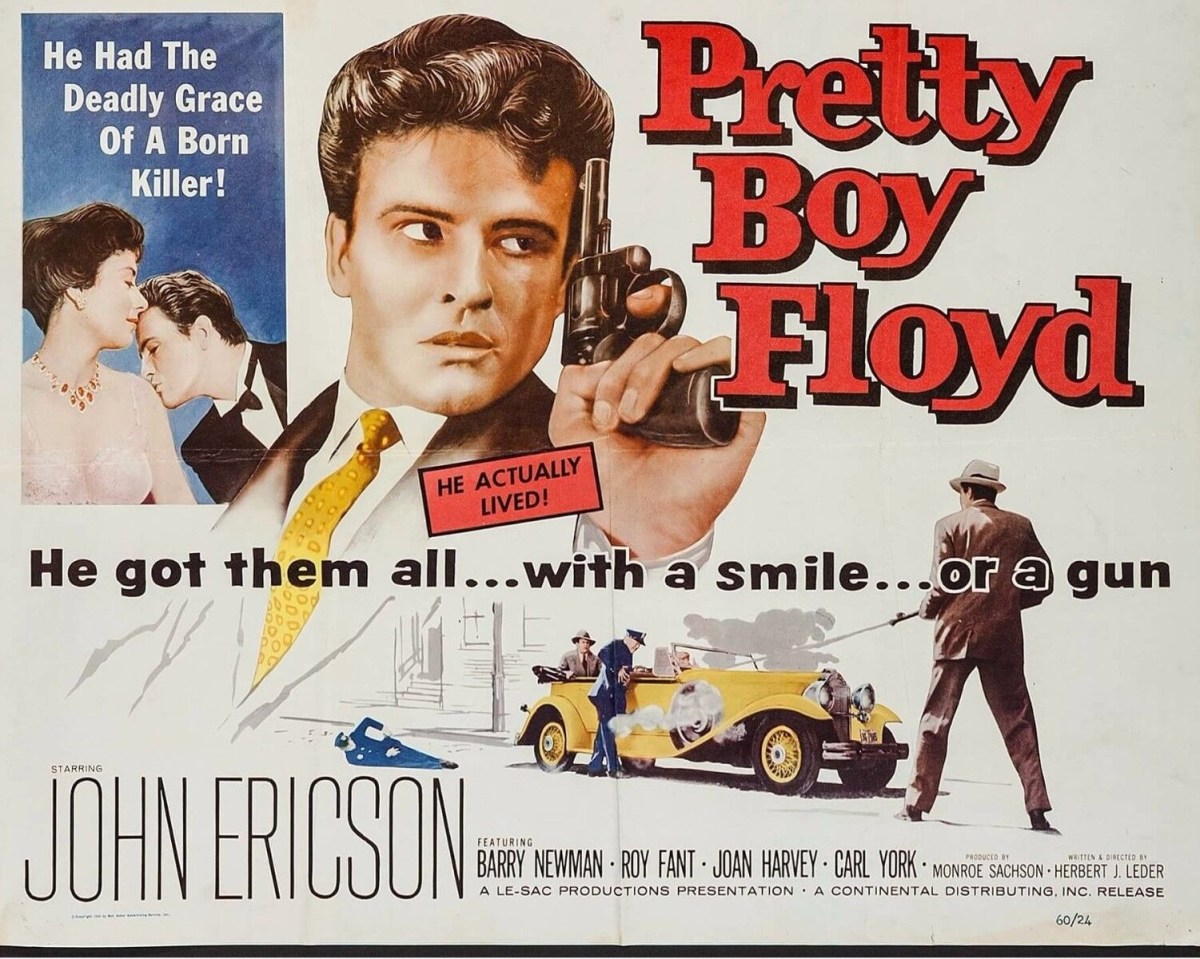
Pretty Boy Floyd (1960) ***

The makers of Oppenheimer (2023) and Napoleon (2023) cast light on the major problem of a biopic – what to leave out. Here, no such problem was actually countenanced. Hell, they just threw everything in – some job given the lean running time. That does mean, however, some mighty info dumps, as we are filled in on the gangster’s past and present. Not much of his life goes unturned.

There was a spate of gangster pictures around the turn of the decade. The success of Machine Gun Kelly (1958) starring Charles Bronson, The Bonnie Parker Story (1958) and Al Capone (1959) spurred a hot lead deluge the following year including Murder Inc (Lepke), Ma Barker’s Killer Brood, Pay or Die, The Rise and Fall of Legs Diamond and Pretty Boy Floyd. In 1961 came Mad Dog Coll, Portrait of a Mobster (Dutch Schulz) and King of the Roaring 20s (Arnold Rothstein).
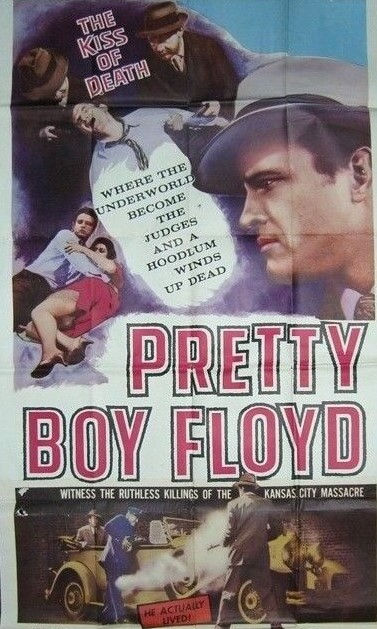
But if you thought this would lead to a noir revival, think again. Nobody would give finesse the time of day. Not with so many facts to pack in. And to explain – love of power and ambition the only psychological insight available – why of all the millions of Americans brought to their knees by the Great Depression Floyd was one of the few who turned to violent crime. His own saving grace – if it can be called that, given the length of the murder sheet – is his Robin Hood-ism, he gives way a lot of his stolen loot

We pick up Pretty Boy Floyd (John Ericson) towards the end of his short-lived boxing career – by which time he’s already been sent away for five years by Sheriff Blackie (Jason Evers), annoyed the gangster had taken up with his sister. Floyd now beats up the husband of his lover, works on the oil rigs but loses his job for concealing his criminal record. Returning to Oklahoma, he discovers his father has just been shot by a character called Grindon, who got away with the crime.
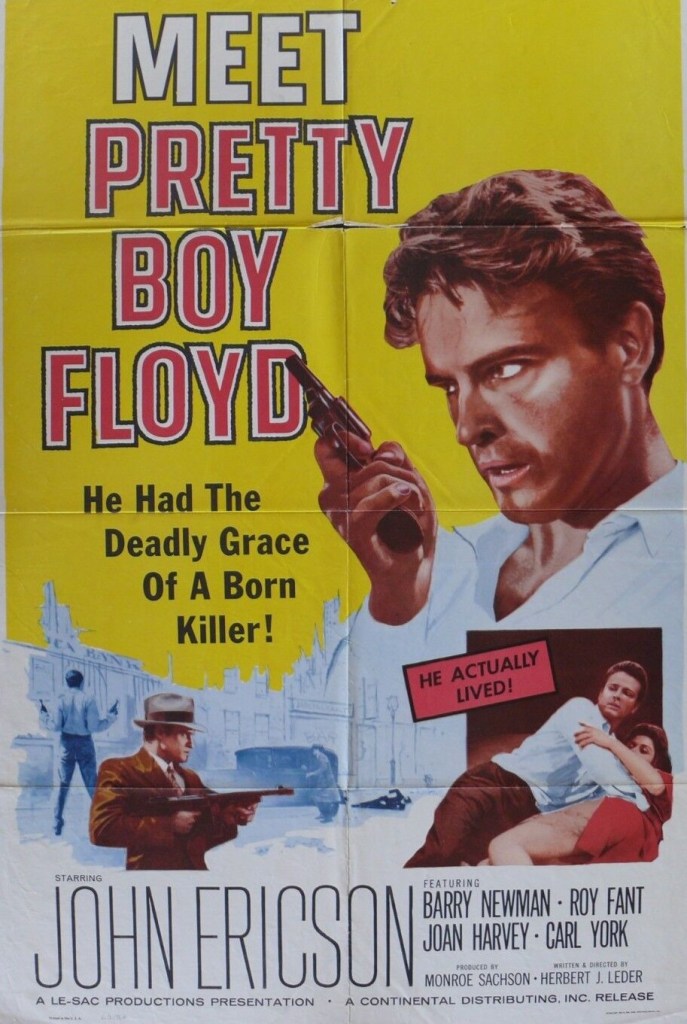
He tries to go straight but is turned down for a loan by the bank. He locates Grindon and ices him. Partnering with hood Shorty Walters (Peter Falk), he enters the bank-robbing business, but Shorty’s loud mouth gets them caught. On the way to prison, they escape and rob the bank that refused him a loan.

He heads for Kansas City because until the FBI came along you could commit a crime in one state and vanish over the border to another knowing you were out of the original jurisdiction and couldn’t be tracked down. He finds another married woman, Lil Courtney (Joan Harvey), to romance, but the husband wants to turn him in for the reward, by now substantial. Returning to Oklahoma and teaming up with the vulnerable childhood pal Curly (Carl York), he gets into his stride, robbing a bank every two weeks.

You get the picture. This is biopic at full throttle. Every “I” is dotted and every “t” is crossed and still we don’t get any real idea what made him tick beyond he was as mad as hell and wasn’t going to take it anymore. I could have got all of this from a book.

The one ace fact I learned was where the term “kiss of death” comes from. Apparently, if you committed a crime against the mob – such as killing someone you were paid to rescue – you were put on trial before three Mob guys. The verdict had to be unanimous and was decided thus: a gun was passed between the three men, if each of them picked up the pistol and kissed it you were a dead duck.

The problem with all the gangster pictures is they all end the same way. Nobody is long for this world and nobody can evade justice.

This is straightforward stuff, shot on a tiny budget, and except for the info dumps and pausing here and there for a spot of philosophy/psychology or sympathy, tears along at a fair old pace. That’s very much on the plus side. On the minus side is the lack of depth and you would have to say lack of acting.

It’s not much of a stretch for John Ericson (The Money Jungle, 1967) to look mean, but he’s closer to James Dean than Charles Bronson. Peter Falk (Machine Gun McCain, 1969) is generally perceived as the standout but my money is on Barry Newman (Vanishing Point, 1970) as Floyd’s trainer and later criminal partner. Shame Joan Harvey (Hand of Night, 1962) only made three pictures, as she excels in a small part.  

The whizz-bang approach from writer-director Herbert J. Leder (It!, 1967) ensures that, like Napoleon, you need Google open to check out the flood of names racing towards you. You might be baffled and confused, but never bored.

Worth it for the “kiss of death.”

Book into Film – “The Godfather” (1972)

Watching King of the Roaring 20s (1961) and Murder Inc (1960) and struck by the number of similarities to The Brotherhood (1968) that could be found in The Godfather (1972) induced me to examine how well the original novel by Mario Puzo survived the often dangerous transition onto the screen.

There could not be a more textbook example of how to turn a big bestseller into a compelling motion picture. Although director Francis Coppola added texture and style to the bestseller, the film owes far more to the memorable characters created by author Mario Puzo. Apart from some slight structural changes and the elimination of a couple of subplots, the movie follows Puzo’s brilliant structure almost to the letter. And except for a few lines, virtually all the dialogue and many of the most unforgettable lines come directly from the book.

The opening wedding feast is an excellent example of the screenplay approach. The order of the action occasionally alters but the novel’s structure is strictly adhered to. The film’s striking opening line “I love America” by the undertaker is a slight but significant adaptation of that character’s line “I believe in America” in the book. But the screenwriters junk the book’s actual opening section which gives the background to the issues the three characters appealing to Vito Corleone (Marlon Brando) for intervention against perceived injustice from Vito Corleone (Marlon Brando) and goes straight to the book’s wedding.  Here, too, the various elements are taken directly from the book with slight changes. For example, to the FBI men taking down car number plates in the novel the screenplay adds in photographers so that, to demonstrate his temper at an early stage, Sonny Corleone (James Caan) can smash a camera.

Straight from the book: fat Clemenza (Richard S. Castellano) dancing, wiping his brow and calling for wine from Paulie (John Martino); Sonny whispering in the ear of bridesmaid Lucy (Jeannie Linero); the frightened undertaker being told off by Vito; the  Luca Brasi story Michael Corleone (Al Pacino) tells Kay Adams (Diane Keaton); Sonny and Lucy having sex and being interrupted by Tom Hagen (Robert Duvall); and the screams that greet  singer Johnny Fontane (Al Fontane) and the subsequent scene where Vito shouts at the singer to act “like a man.” Additions are slight: in the book Sonny’s wife is in the kitchen not at a wedding table in dumbshow making jokes about her husband’s manhood, and Luca Brasi rehearsing his speech.

Indicative of the ruthlessness with which the screenplay treats the book is the elimination of a moving scene at the tail end of the wedding where Vito goes to see his dying partner Genco. As indicative of the author’s brilliance is that he invented degenerate film producer Jack Woltz (John Marley) and the decapitated horse in his bed.  But the storyline, the film’s core, from the attempted murder of Vito, Michael’s assassination of the Turk Solozzo (Al Lettieri) and corrupt cop McCluskey (Sterling Hayden), the exiled Michael struck by the “thunderbolt” falling in love, the ambush of Sonny and the stricken Vito suing for peace, is pretty much exactly that of the book. In some case, it’s clear that actors have drawn from Puzo’s characterizations, the chilling way Michael takes control of the Family, how Fredo goes from useless gangster to hotel dandy.

There are occasional additions. In the book Enzo’s hand outside the hospital is  shaking but Michael lighting his cigarette is the movie shorthand to demonstrate his icy calm, Sonny’s “bada-bing” isn’t in the book nor is Luca Brasi sleeping with the fishes, though there is something similar “Luca Brasi is sleeping on the bottom of the ocean.”

Occasionally, in the novel, for technical reasons, Puzo drifts away from the central characters to provide some more background or detail about a subsidiary person and in this manner we enter into the minds of Paulie, Carlo (Gianni Russo), Kay, Clemenza, McCluskey and Albert Neri just as they are about to play a significant role in forthcoming action.  Other subsidiary characters featured more prominently in the novel, in particular Johnny Fontane whom the book reveals develops from Oscar-winning actor to successful movie producer and from manic seducer to more considerate male.

Fontane also helps revitalize the career of another singer Nino who does not appear in the movie at all and plays a role in developing the Family’s interests in Las Vegas. Lucy, who disappears entirely from the film after the wedding, is more significant in the book, finding romance after Sonny’s death with a surgeon and there’s a part of their relationship that would only now be permissible to film. Sicilian shepherd Fabrizio, instrumental in the attempted assassination of Michael, also reappears in the book. The book also devotes more attention to Michael’s new breed, Alberto (Richard Bright) and Rocco (Tom Rosqui).

The death of Vito in the garden is almost identical to the book with the grandson present except for Marlon Brando’s improvisation of stuffing his cheeks with orange to frighten the boy. And Michael’s betrayal by Tessio and the subsequent mass murder of all his enemies is also drawn from the book except for Moe Green having been killed earlier (Fabrizio the shepherd slotting into his place in the book’s action). Some slight detail is changed – Barzini (Richard Conte) killed beside his waiting car not on the steps, Tattaglia (Tony Giorgio) murdered in a chalet not an apartment block. Somewhat surprisingly the image of acolytes paying homage to Michael as briefly viewed by Kay has its origins in the book. The two final scenes in the book, both concerning Kay, are excluded from the film, in the first, having run away, she is challenged by Hagen and in the second she prays for Michael’s soul in church just as (in the book) Michael’s mother had prayed for his father

A lengthy chapter on Vito’s beginnings, explaining his early relationships with Clemenza, Tessio (Abe Vigoda) and Luca Brasi, was wisely held over for The Godfather Part II.

Having by now read a number of books that were subsequently filmed, my over-riding impression was that in many cases (The Secret Ways, Arabesque) little survived of the original tale or that characters, locations and timescales (The Detective) were substantially altered. In some instances the book’s length precluded a straightforward adaptation. Occasionally, subjects easily dealt with on the printed page were not so welcome on the screen. But, for whatever reason, change appeared inevitable for a bestseller being translated into a movie.

The Godfather almost stands alone as a novel that made the transition with virtually no alterations. All the main characters are present as described by Puzo and the storyline entirely reflects the book. The bulk of the dialogue was originally written by Puzo. While there is no doubting the Coppola’s achievement in putting the book on film, there is equally no doubt that the book leant itself to easier adaptation than most bestsellers.

King of the Roaring 20s (1961) ***

Occasionally stylish B-picture purporting to tell the story of American Prohibition-era gangster Arnold Rothstein. It’s more of drama with various nefarious figures trying to outwit each other rather than a shoot ‘em up in the style of Al Capone (1959). David Janssen (Hell to Eternity, 1960) is ideal casting as the thoughtful, cold, calculating and possibly gambling genius Rothstein, the opposite of an intemperate crook like Capone.

The story is told essentially in two parts, Rothstein’s rise to power in partnership with childhood pal Johnny Burke (Mickey Rooney), initially running dice games in the street and  pulling the odd con before graduating to fly-by-night horse racing operations. When the opportunity arises to move into mainstream illegal gambling, he dumps Burke. Corrupt cop Phil Butler (Dan O’Herlihy) is a constant thorn in his side and showgirl fiancée Carolyn Green (Dianne Foster) views marriage as risky – “he’s the gambler but I’m the one that’s going to be doing the gambling.”

For whatever reason, the movie dodges what was believed to be Rothstein’s biggest coup, the fixing of the baseball World Series, but one long section is devoted to how he wins $850,000 (equivalent to $13 million today) on his horse Sidereal at odds of 30 to 1 at the New York Aqueduct track on July 4, 1921, through insider information and strategic betting. Inevitably, his gambling puts the kibosh on his marriage but by far the most interesting part of the picture is the chicanery as he shakes off one partner, battles another, and without compunction sets up Burke as patsy to settle his score with Butler.

In some respects Rothstein is a template for Vito Corleone (The Godfather, 1972) in terms of his business brain and ability to out-think and out-fox opponents and certainly his facial expressions and innate coldness bear comparison with what Al Pacino brought to his characterization of Michael Corleone. Except that he didn’t trust banks, and carried around wads of cash (hence the title of the biography on which this is based – The Big Bankroll), it’s hard to get a sense of the wealth the gangster generated or, given the minimal violence,  the world of imminent peril he inhabited. 

Period detail is cursory, limited to dancing the Charleston and pouring champagne into teacups. A better idea of the flavor of the times is the wholesale corruption endemic in police departments, untrustworthy lawyers and hypocrisy run wild.  It’s not really Janssen’s fault that it’s hard to warm to such a cold-blooded character, although you could point to The Godfather and The Brotherhood (1968) for that matter as examples of hoods who do elicit audience empathy.

With occasional bravura moments involving long tracking shots and overhead shots, and a terrific image of champagne bubbles seen through a pair of binoculars, director Joseph M. Newman (This Island Earth, 1955) shows stylistic flourishes that eschew his B-movie roots. Given Janssen is called upon to show as little emotion as possible, he does very well. Dianne Foster (The Last Hurrah, 1958), though initially demure, provides the fireworks. Jack Carson (The Bramble Bush, 1960) as kingpin Tim O’Brien matches Janssen in the cool stakes and proves a worthy adversary. Oscar nominee Rooney overacts but another Oscar nominee Dan O’Herlihy (The Night Fighters, 1960) relishes his dirty cop role.

In a rare Hollywood outing British sexpot Diana Dors (Hammerhead, 1968) puts in an unexpected and brief appearance as Carolyn’s cynical flatmate. The tremendous supporting cast includes Keenan Wynn (Point Blank, 1967), Mickey Shaughnessey (North to Alaska, 1960), Regis Toomey (The Last Sunset, 1961), Oscar-winner Joseph Schildkraut (The Diary of Anne Frank, 1959) and veteran character actor William Demerest.

Jo Swerling (It’s a Wonderful Life, 1946) delivers a pointed screenplay focusing on gangster conflict with some excellent observation of the deterioration of the Rothstein marriage and the nervousness of the usually ice-cold Rothstein when confronted by his father. This is one of those pictures that you think deserves a Netflix series, a dozen or so episodes to explore the myriad characters involved and especially to examine Rothstein in forensic detail. The movie gives a hint of that potential and on a tight budget does it well.

Hard to find unless you fancy paying $90 for a DVD or $24 for a VHS video, but you will find copies on the secondhand market.

Discover WordPress

A daily selection of the best content published on WordPress, collected for you by humans who love to read.

The Atavist Magazine

by Brian Hannan

WordPress.com News

The latest news on WordPress.com and the WordPress community.