Hercules and the Captive Women /Hercules Conquers Atlantis (1961) ***

Something of a cult in the peplum vein, Hercules (Reg Park), wanting to enjoy domestic life with his wife and son, is instead drugged by Androcles, King of Thebes (Ettore Manni) and spirited away by ship to Atlantis whose Queen Antinea (Fay Spain) is intent on global domination and the resurrection of the dethroned god Uranus to his rightful place in the heavens.

This isn’t your normal Hercules, either, not that keen on demonstrating his strength, preferring to sleep or lie around. It’s not your normal ship either, Androcles, unable to persuade his senate to properly fund the expedition, has crewed his ship with renegades who are inclined to abandon Hercules on the nearest island  And unbeknownst to Hercules, his son has come along for the ride.
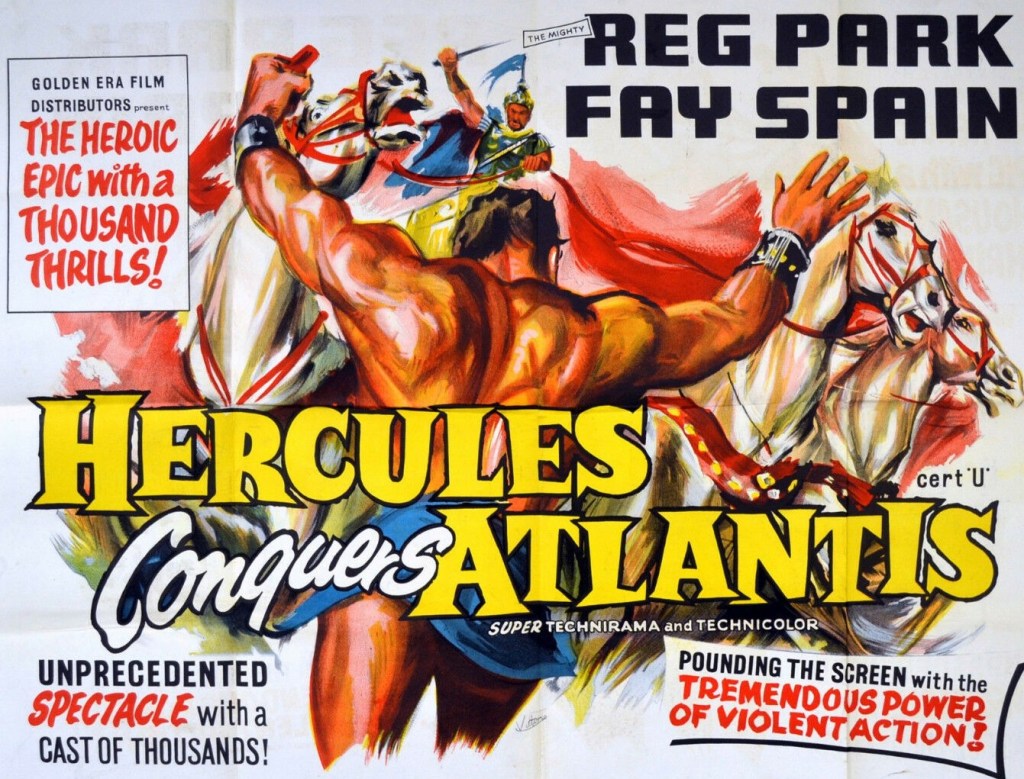
Of course, nothing goes according to plan and Hercules is soon shipwrecked on an island where he finds Ismene (Laura Efrikian) imprisoned on a rock as a sacrifice to the gods. Rescue never being simple, Hercules has to first withstand fire then tackle in quick succession snake, lion, eagle and a giant lizard. Ismene turns out to be Antinea’s daughter and the Queen, rather than being delighted at her return, is appalled for, according to the way the ancient world works with all its prophecies and religious ritual, the girl must be sacrificed to prevent the destruction of Atlantis.

Nor is Atlantis your usual kingdom. Even setting aside the peculiarities that mark the Greek world, this is a place where abnormality rules. Hercules finds Androcles, whom he believed died in the shipwreck, but it turns out to be a vision, or some kind of shape-shifting being. The Queen believes she can subjugate nature and has a tendency to throw those who disappoint her into an acid bath. There is a fiery rock that controls life and death.

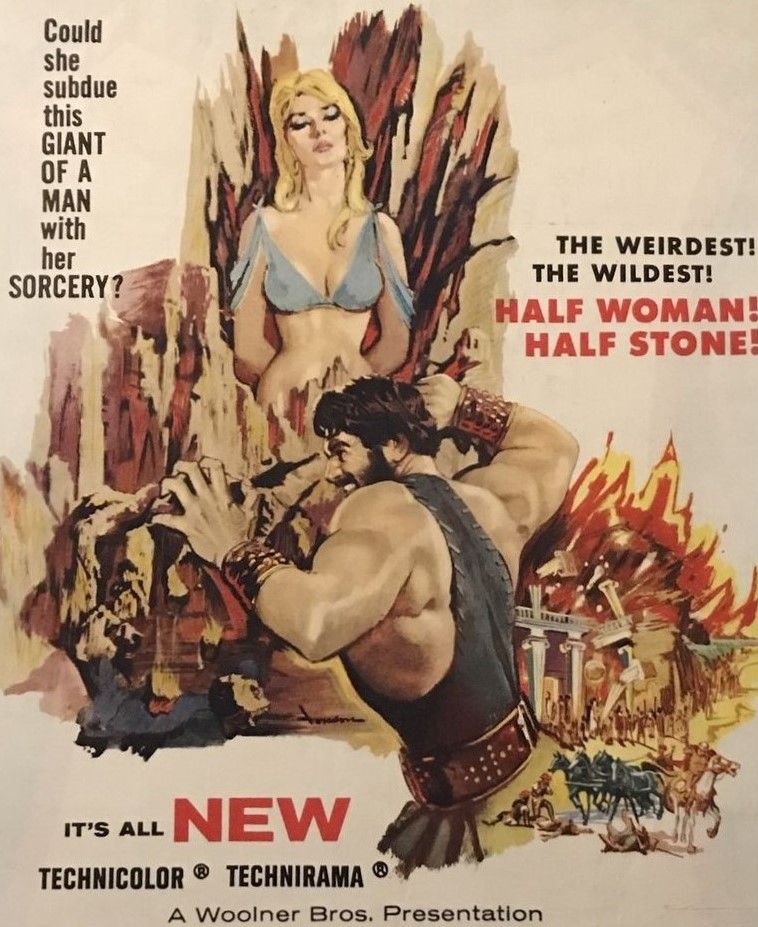
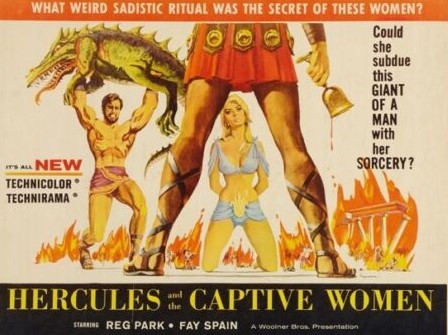
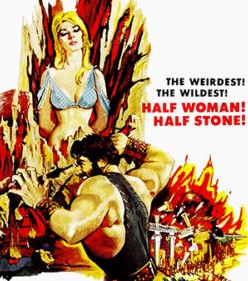
Like most of the peplum output, you have to accept a standard of production lower than the Hollywood norm, and the terrifying beasts sent to test the hero are not at all convincing, but on the plus side are feats of imagination that mainstream American studios would never conjure up, unless it was something that fitted into the swashbuckling genre. You pretty much have to go with the flow and accept what is offered in terms of narrative oddity. Bear in mind, too, that there is no one dressed in as skimpy a costume as suggested by the poster.
You also need to be get hold of a good copy. Several versions are available, some for free, where the colors are so washed out you can hardly determine what is going on never mind enjoy the costumes, creatures and sets as intended. This was filmed in Technirama 70, shot in 35mm but blown up to70mm widescreen for exhibition, so should generally be of a high technical standard – this was the process used by Spartacus (1960).

It’s not a film to fit into the so-bad-it’s-good category, but of course imagination too often exceeds budget which renders the filmmaking somewhat random at times and like the bulk of the peplums acting skill is not at a premium. As you might expect, the British-born Reg Park was a bodybuilder first – three times winner of the Mr Universe title – and an actor second. He played Hercules again another three times and Maciste once but outside this narrow comfort zone made no other films. But he was Arnold Schwarzenegger’s inspiration, so that was probably enough. American Fay Spain (The Private Life of Adam and Eve, 1960) never got  beyond bit parts as a B-movie bad girl and television, although she was seen in The Godfather: Part II (1974). Italian Laura Efrikina made her debut here and cou would later spot her as Dora in the Italian television mini-series David Copperfield (1966).

Director Vittorio Cottafavi was steeped in peplum, from The Warrior and the Slave Girl (1958) to Amazons of Rome (1961) but although he worked consistently in television made only one other picture, 100 Horsemen (1964).
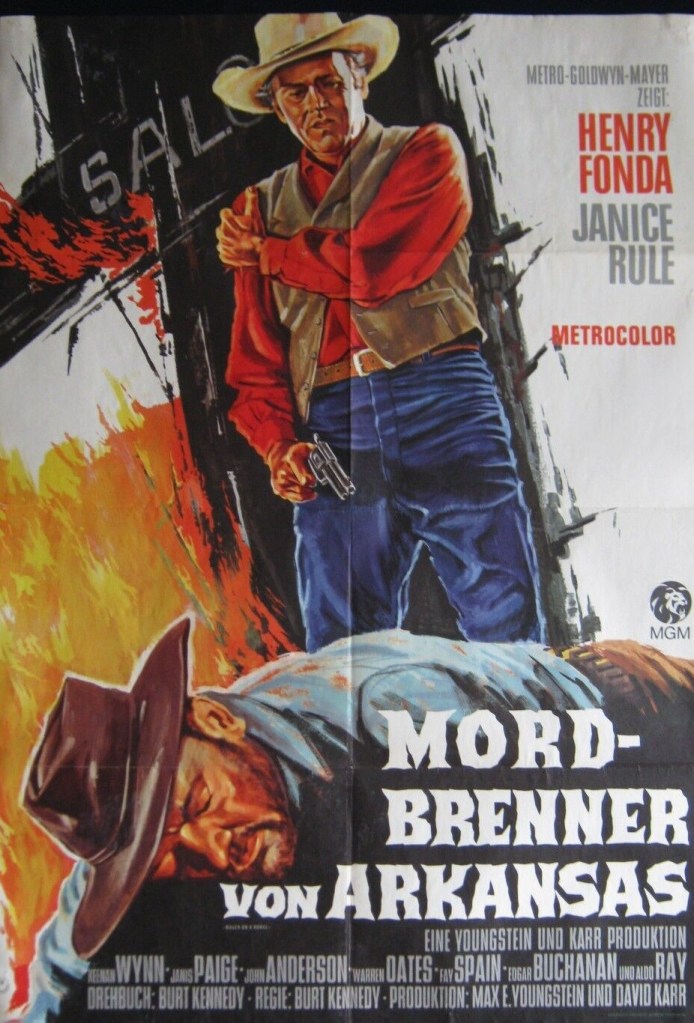
Welcome to Hard Times (1967) ****

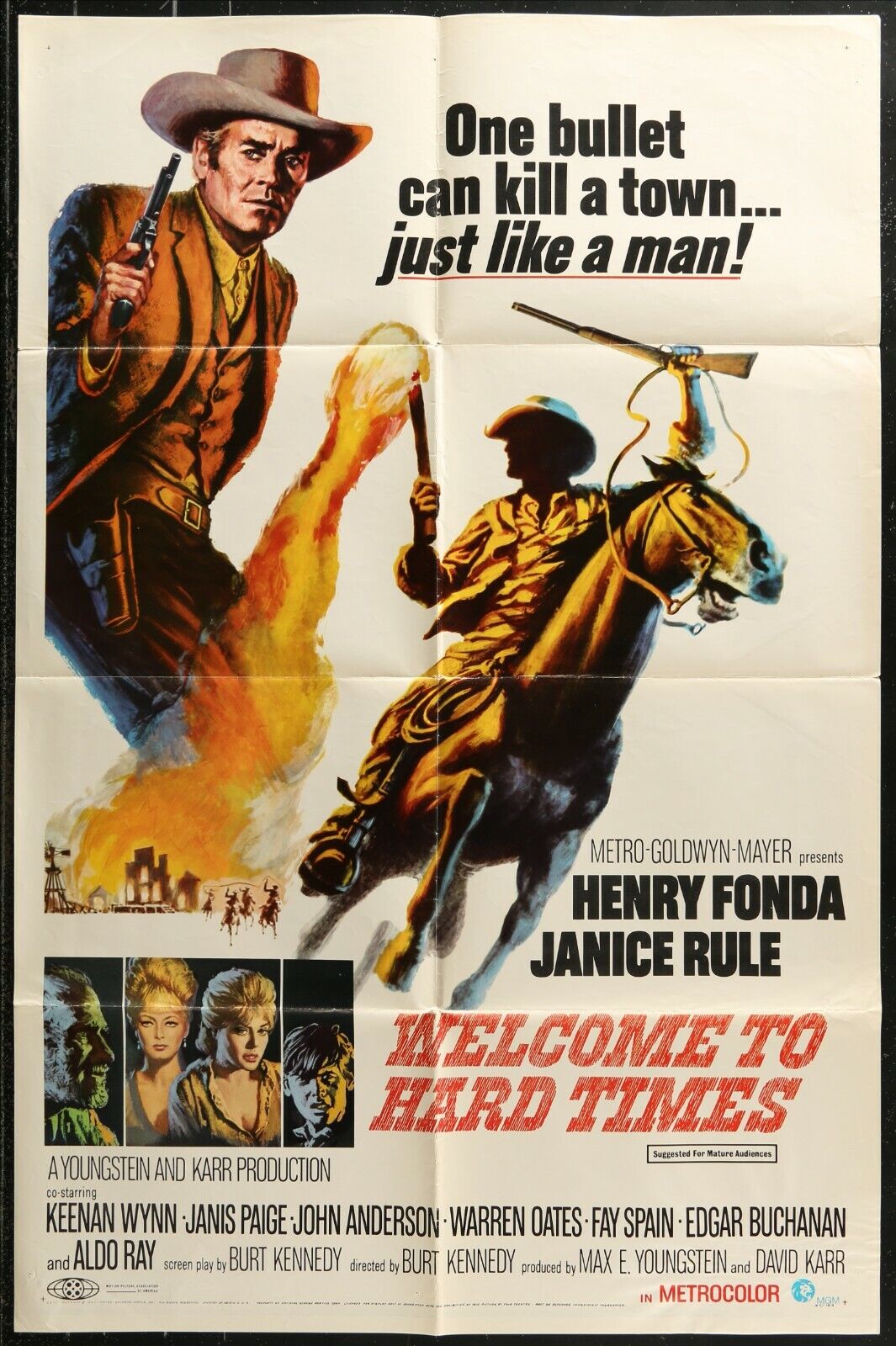
Director Burt Kennedy’s record with westerns was very much hit or miss. This revisionist effort is one of the former though it could as easily tipped into the latter, beginning with a shrill soundtrack that telegraphs every incident and the no-name villain. And you might also wonder if irony had taken such a hold of settlers that they would actually name their town “Hard Times” when there was a gold strike over the hills.

Anyway, this is certainly a town that lives up to its name. Can’t have been more than a dozen houses, a saloon of course, but it’s the muddiest place west of No Name City (Paint Your Wagon, 1969) and the meanest to hove into view since High Noon, with the townspeople in thrall not to an entire gang, but one nameless stranger (where have we seen that before).

The Man from Bodie (Aldo Ray), as he is known, is the bad guy from Hell. He shoots anyone who stands up to him like Fee (Paul Birch) or shows the slightest dissent like undertaker Hanson (Elisha Cook Jr) and rapes Fee’s girlfriend Flo (Ann McCrea) before dumping her corpse on the saloon stairs.  

Will Blue (Henry Fonda), lawyer not lawman, hasn’t the guts to stand up to him, but comes the closest of the cowardly bunch. When The Man has done as much rampaging as a tiny town will allow he burns it to the ground. Most people leave, but Blue,  having done too much running in his life, decides to stay to look after Fee’s orphaned son Jimmy (Michael Shea).

If Blue’s vengeful Oirish girlfriend Molly (Janice Rule) also remains it’s mostly to hate him for abandoning her to the madman – Blue had used her to distract the Man but then retreated when the going got tough leaving her to be raped at will. She sets up her own League of Desperadoes, recruiting new arrival Jenks (Warren Oates) and the orphan, to tackle the bad guy on his inevitable return.

Meanwhile, a mobile unit of sex workers, complete with tent, turns up to service the nearby gold workers.  Their entrepreneurial boss Zar (Keenan Wynn) spots opportunity and helps Blue rebuild the town. Of course, everyone’s just waiting for Bodie Man to return.

Anyone that’s likeable or got anything approaching character is killed off at the start, so we’re left with an unlikeable, ambivalent, but realistic, crew. For all his later hi-falutin’ principles and pioneer spirit, Blue is still a coward who, to save his own skin, sacrificed Molly. Hoping to redeem himself by acting as surrogate father to Jimmy doesn’t result in him winning any respect from Molly.

This is one raped woman who found out the man on whom she was depending was no protector. Why should she ever love him again? And she’d be crazy to put her life in his hands once more. Of course, she could have got herself her own shotgun or pistol and ambushed Brodie Man when he took another shine to her, but instead she plays pretty please with Jenks, which is understandable, and the young Jimmy, which is deplorable.

That the sex worker magnate becomes one of the town’s foremost citizens might cleave closer to the bone than many viewers would like, but corruption was as endemic in America then as it presumably is now.

And it begs the question when all those pioneers headed out West how many of them were scum like Bodie Man? And how did the settlers think law-and-order was going to work out?

On the downside we have a villain, who, not content with killing and raping, demonstrates just how mean he is by smashing whisky bottlenecks because he hasn’t the patience to extract the cork with his teeth. Fee is dumb enough to take on the bad guy with a bit of log. Molly’s Irish accent is all over the place. And we could do with less music. And there’s a climactic twist that belonged to a horror film and is not only completely out of place but undoes the realistic tone by providing a somewhat sanctimonious ending.

But if you are expecting a movie along High Noon lines, with the good guy beating the bad, and winning the town’s respect, then you will be disappointed. On the other hand if you come prepared for one of the darkest westerns of the decade where the terrorizing outlaw exerts such fear that the townspeople, in defending themselves, pull down the shades between good and evil, then you will be amply rewarded.

The boldness of director Kennedy (The War Wagon, 1967) in reimagining the West as a place of venal proportions should be applauded. The direction might take a wrong turn here and there but the aim is effective. Henry Fonda (Firecreek, 1968) is good as ever and although I could do without the awful accent Janice Rule (Alvarez Kelly, 1966) is superb as the vengeful woman refusing Blue forgiveness and willing to use a youngster as a weapon.

A sound supporting cast includes Keenan Wynn (Warning Shot, 1967), Edgar Buchanan (Move Over, Darling, 1963), Janis Paige in her final movie outing, John Anderson (5 Card Stud, 1968) in a double role, Aldo Ray (The Power, 1968) and Warren Oates (The Wild Bunch, 1969).

Kennedy wrote the screenplay form the book by E.L. Doctorow.

Will make you flinch but worth a look.

Hercules and the Captive Women / Hercules Conquers Atlantis (1961) ***

Something of a cult in the peplum vein in which Hercules (Reg Park), wanting to enjoy domestic life with his wife and son, is instead drugged by Androcles, King of Thebes (Ettore Manni), and spirited away by ship to Atlantis whose Queen Antinea (Fay Spain) is intent on global domination and the resurrection of the dethroned god Uranus to his rightful place in the heavens.

This isn’t your normal Hercules, not that keen on demonstrating his physical prowess, preferring to sleep or lie around. It’s not your normal ship either. Androcles, unable to persuade his Senate to properly fund the expedition, has crewed his vessel with renegades who are inclined to abandon Hercules on the nearest island  And unbeknownst to Hercules, his son has come along for the ride.

Of course, nothing goes according to plan and Hercules is soon shipwrecked on an island where he finds Ismene (Laura Efrikian) imprisoned in rock as a sacrifice to the gods. Rescue never being simple, Hercules has to first withstand fire then tackle in quick succession snake, lion, eagle and a giant lizard. Ismene turns out to be Antinea’s daughter and the Queen, rather than being delighted at her return, is appalled, for, according to the way the ancient world works with all its prophecies and religious ritual, the girl must be sacrificed to prevent the destruction of Atlantis.

Nor is Atlantis your usual kingdom. Even setting aside the peculiarities that mark the Greek world, this is a place where abnormality rules. Hercules finds Androcles, whom he believed died in the shipwreck, but it turns out to be a vision, or some kind of shape-shifting being. The Queen believes she can subjugate nature and has a tendency to throw those who disappoint her into an acid bath. There is a fiery rock that controls life and death.

Like most of the peplum output, you have to accept a standard of production lower than the Hollywood norm, and the terrifying beasts sent to test the hero are not at all convincing, but on the plus side are feats of imagination that mainstream American studios would never conjure up, unless it was something that fitted into the swashbuckling genre. You pretty much have to go with the flow and accept what is offered in terms of narrative oddity. Bear in mind, too, that there is no one dressed in as skimpy or revealing a costume as suggested by the poster.

You also need to be get hold of a good copy. Several versions are available, some for free, where the colors are so washed out you can hardly determine what is going on never mind enjoy the costumes, creatures and sets as intended. This was filmed in Technirama 70, shot in 35mm but blown up to70mm widescreen for exhibition, so should generally be of a high technical standard – this was the process used by Spartacus (1960).

It’s not a film to fit into the so-bad-it’s-good category, but of course imagination too often exceeds budget which renders the filmmaking somewhat random at times and like the bulk of the peplums acting skill is not at a premium. As you might expect, the British-born Reg Park was a bodybuilder first – three times winner of the Mr Universe title – and an actor second. He played Hercules another three times and Maciste once but outside this narrow comfort zone made no other films. But he was Arnold Schwarzenegger’s inspiration, so that was probably enough.

American Fay Spain (The Private Life of Adam and Eve, 1960) never got  beyond bit parts as a B-movie bad girl and television, although she was seen in The Godfather: Part II (1974). Italian Laura Efrikina made her debut here and you would later spot her as Dora in the Italian television mini-series David Copperfield (1966).

Director Vittorio Cottafavi was steeped in peplum, from The Warrior and the Slave Girl (1958) to Amazons of Rome (1961) but although he worked consistently in television made only one other piocture, 100 Horsemen (1964).

Discover WordPress

A daily selection of the best content published on WordPress, collected for you by humans who love to read.

The Atavist Magazine

by Brian Hannan

WordPress.com News

The latest news on WordPress.com and the WordPress community.