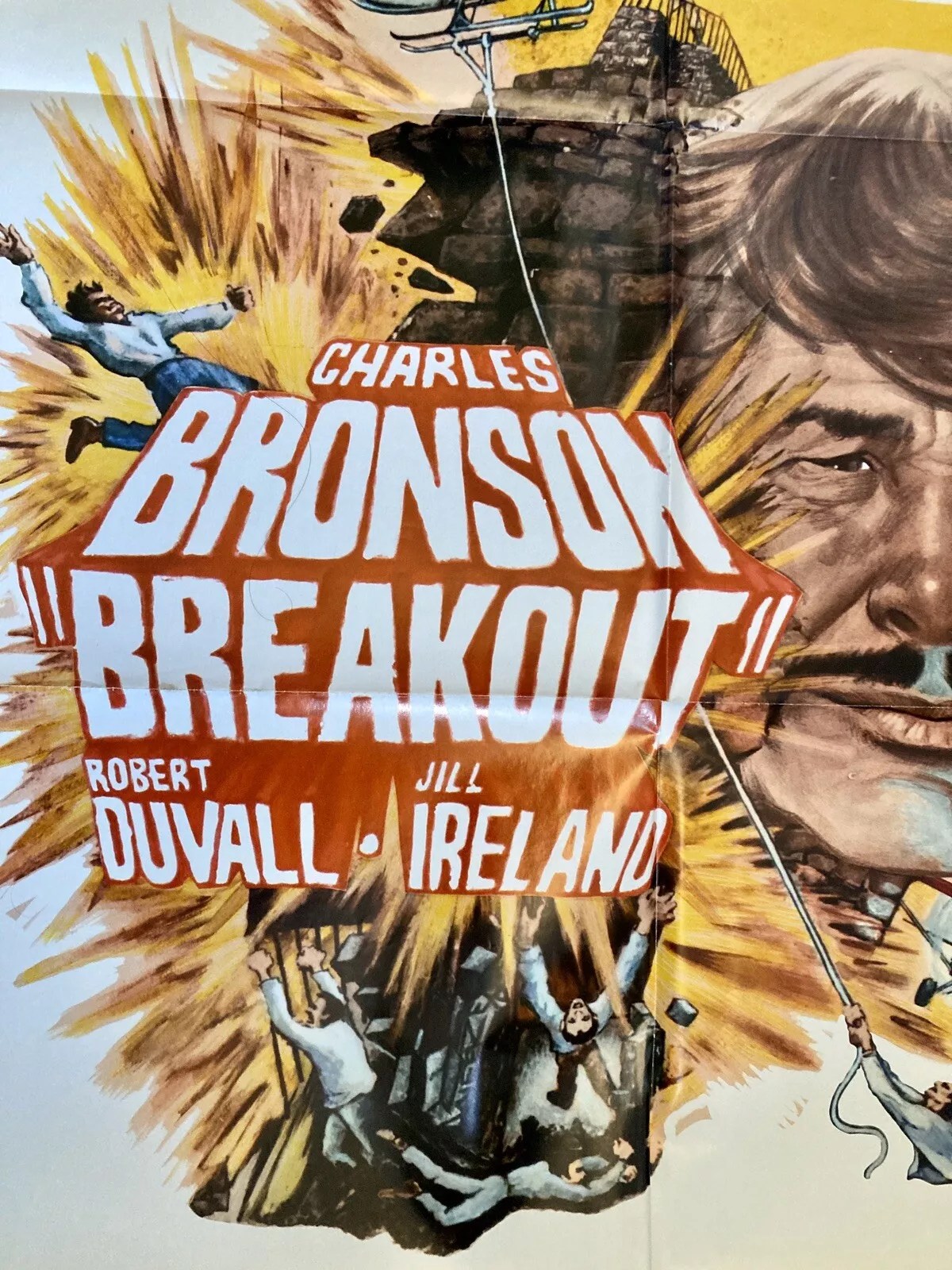
Breakout (1975) ***

The advertising gurus earned their corn on this one because it must have come as a shock for all concerned, studio and audiences alike, to discover that star Charles Bronson (Farewell Friend, Adieu L’Ami, 1968) was engaged in a rapid reversal of his screen persona, an experiment that ended with the poorly received From Noon Till Three (1976). Sold as an action picture, this  struggles to fit into the genre, what with most of the elements of rescue misfiring or D.O.A.

The poster people were so stuck for ways of selling the picture they resorted to using an image of an explosion in a manner that indicated it was key to the actual breakout when  in fact it was related to a random incident. The highlight of the picture, the breakout itself, despite the best efforts to generate tension though the application of a 10-second escape window, is as mundane as all get-out, a helicopter basically loitering in a prison courtyard until the prisoner to be rescued saunters out.

Not only does the movie jettison the Bronson tradition of uncompromising tough guy but it sets up constant screen partner Jill Ireland in a more interesting role than normal while skirting a Casablanca-style romance.

The story itself gets off to a mighty confusing start. Nefarious businessman Harris Wagner (John Huston) arranges, for reasons that are unclear, for grandson Jay (Robert Duvall) to be incarcerated in a Mexican prison. Your first double take as an audience is the purported age gap.  Huston was, in reality, was just past 70 years of age while Duvall was 44 – and never a chance of that actor playing younger –  so you are left wondering how in heck did they contrive to be grandfather and grandson.

Putting that to one side, the first 15-20 minutes of a lean 96 exclude Bronson altogether while director Tom Gries (Will Penny, 1968) builds up the tale of failed rescue attempts by Jay’s wife Ann (Jill Ireland) and the sadistic nature of prison overlord J.V. (Emilio Fernandez) who has a penchant for burying prisoners alive or taking bribes to let them escape before promptly reneging on the deal. Eventually, for reasons unexplained, Ann turns to bush pilot Nick (Charles Bronson) who runs a seat-of-the-pants operation with the kind of plane that looks like it’s held together with string.
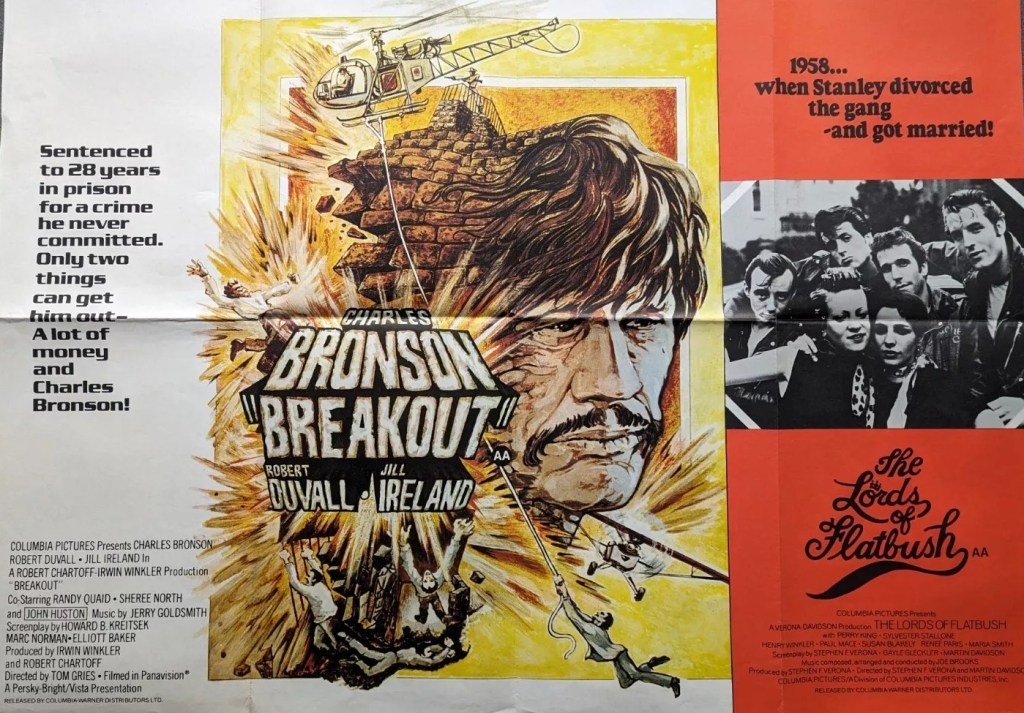
Bronson…Stallone…Together! If only Stallone had been bigger at the time.

He’s not your usual monosyllabic grump, but an overconfident wide boy, the bulk of whose schemes fail to work. A modern audience is going to turn up its nose in any case at one plan that involves faking a rape to create a distraction for the prison guards rather than going down the simpler route of Raquel Welch in 100 Rifles (1969) and Marianna Hill in El Condor (1970) of giving the lascivious guards something to ogle.

And another proposal only works because it’s handed a get-out-of-jail-free card when the guards who make a point of groping every female visitor, in theory to check for contraband or concealed weapons, avoid doing so with Nick’s sidekick Hawkins (Randy Quaid) when he dresses up as a woman.

There’s not enough time for any genuine romance to develop between Nick and Ann, a notion that’s undercut in any case by the fact that she’s trying to rescue her beloved husband, but that does allow for more friction than was normal in their pictures. Takes her a long time, understandably, to trust this untrustworthy fella, what with his schemes that rarely work.

For tension we are almost entirely reliant on the bad guys, J.V. indulging in bits of sadism, someone on the inside always knowing of the plans ahead of time, or of Jay being so debilitated by his stay in prison that he seems too out of it to keep his appointment with freedom. There is a quite barmy assumption that should a stray helicopter land in a prison courtyard that none of the other inmates will think to hitch a lift out.

There is some good value here in the Bronson/Ireland partnership trying to shake off what they saw as the shackles of their joint screen persona, or perhaps wanting to re-validate Ireland’s place in the team after Bronson did exceptionally well in her absence in Death Wish (1974). But the story’s an odd one, a kind of discount-store escape, with Bronson essaying the kind of character usually left to such supporting acts as Warren Oates or George Kennedy.

But there’s just not enough that’s new here – the unfairly underrated From Noon Till Three showed how to ring in the changes – to justify Bronson’s inclusion although the Bronson/Ireland dynamic does undergo interesting change. Robert Duvall (The Rain People, 1969) is also acting against type, devoid of the bluster that was his calling card. Randy Quaid (The Last Detail, 1974) has a quirky part.

Tom Gries did well enough in Bronson’s eyes that he was selected for the follow-up Breakheart Pass. Too many hands on the screenplay tiller – Marc Norman (Shakespeare in Love, 1998), Elliott Baker (A Fine Madness, 1966) and Howard B. Kreitsek (The Illustrated Man, 1969) adapting the book by Warren Hinckle, William Turner and Eliot Asinof – suggested nobody really knew how to make this work. And they were right.

Interesting shift in the Bronson persona but a misnomer on the action front.
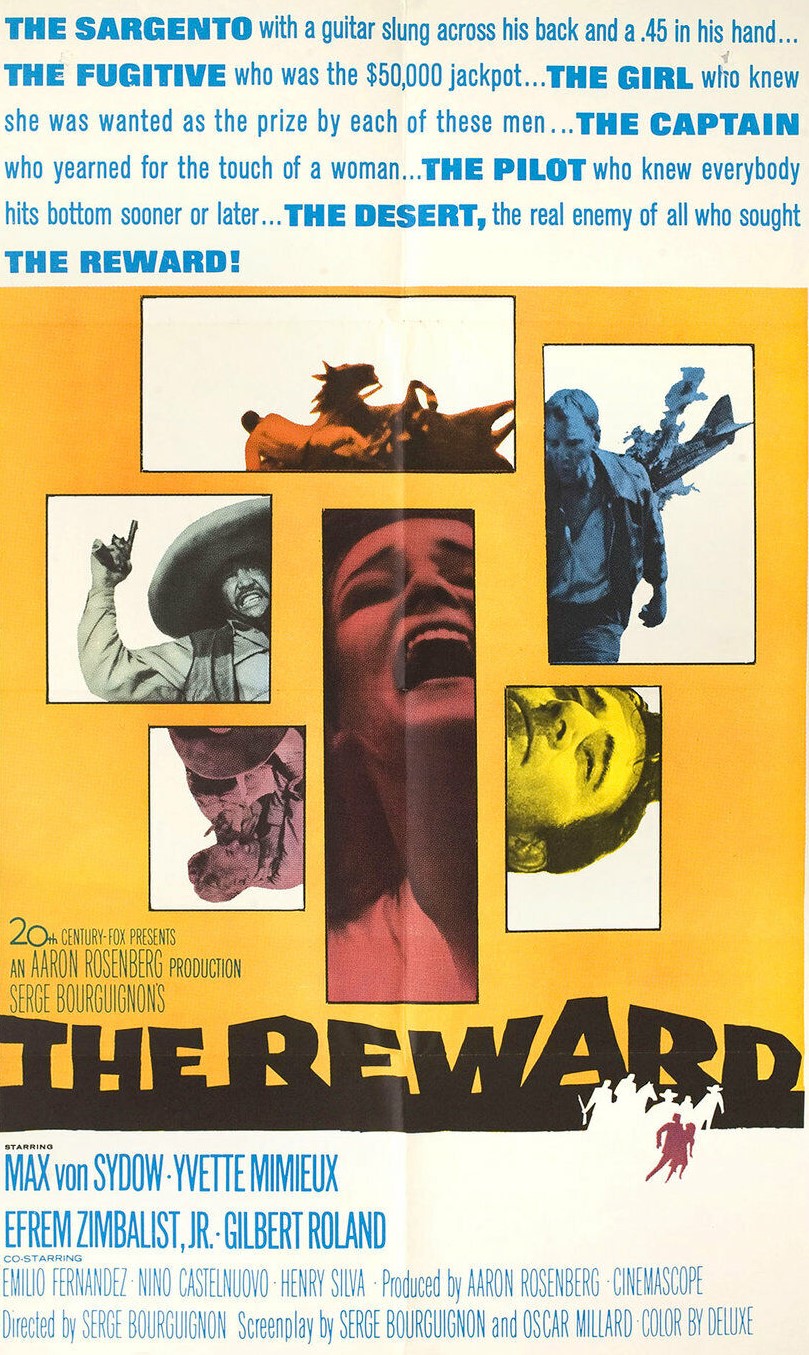
The Reward (1965) ***

Max von Sydow’s Hollywood career might have gone in a different direction had this brooding modern western remake of The Treasure of the Sierra Madre (1948) taken off. Instead of a screen persona as a heavily-accented somewhat awkward foreigner, he would have been viewed as a lean adventurer in the laconic Steve McQueen mold.

There’s no actual gold here, American airline pilot Scott Swenson (Max von Sydow) and his impromptu gang chasing into the Mexican desert human prey worth $50,000. Frank Bryant (Efrem Zimbalist Jr) is wanted for kidnapping and killing his own child. His virtually monosyllabic girlfriend Sylvia (Yvette Mimieux) is viewed as a bonus, clearly rape in the mind of some of his pursuers.

In normal circumstances, Swenson would spend his time dusting crops but he is being held for inadvertently destroying a water tower that will cost $20,000 to repair. But when he spots old buddy Bryant drive into town, he turns bounty hunter, cutting local English-speaking sheriff Capt Carbajal (Gilbert Roland), an exile in this remote town, in on the deal to repay the debt. The rest of the posse, led by his guitar-playing deputy Sgt Lopez (Emilio Fernandez) are initially misled as regards reward. So,when they do find out, greed will out.

When the escapees run out of road, they take to horses, but are located pretty quickly by the posse, also on horseback. Finding them was easy compared to getting them back. In fact, the posse seems to return via a different route that takes them through an abandoned town complete with church bell that Lopez makes ring through the simple device of battering it with his head.

It’s that kind of movie, filled with odd scenes that reflect character. In one episode, at the start of the chase and in a truck, a flat tyre is caused by one dumb occupant chucking his beer bottle in front, rather than to the side, of the vehicle. Flute-playing Joaquin (Henry Silva) tames a wild horse which, when he’s not around, has a bit of a rebellious streak, apt to lead the other mounts astray.

But it’s realistic, too. There’s not enough food to go round and even that seems limited to tortilla. There’s no reason to tie up the prisoners because there’s no escape in the desert hell. But although Swenson has betrayed an old friend in order to get himself out of a hole, there’s none of the guilty dialog you might expect and Sylvia turns out to be more cynical, not intent on building romance out of a brief fling in Acapulco, and only too aware of what captivity might mean. As is pointed out, the reward will be paid out for a decapitated head as much as a complete living person.

Rather than being devastated at killing his son, Bryant wants sympathy. It was an accident. Blame the police for starting a shoot-out that ended with the child dying in the crossfire. Blame his wife for taking the child away in the first place.

Nobody comes out of this well, except Sylvia whose good deed might result in rape, but whose motives you would also question, given she is harboring a child killer, an action not excused as would be the norm by being rapturously in love with him. She is resigned to her fate rather than flirting  with the gang as a way of avoiding it.

So it’s tension all the way, Lopez working on the principle that the fewer claimants of the reward the better. But it’s not just lack of water that’s the most dangerous element in this perilous landscape, but lack of horses. Water isn’t in dramatically short supply anyway not when you can count on the occasional thunderstorm, which, unfortunately, makes Sylvia a more attractive reward when she is soaked to the skin.

The body count, as you might expect, mounts as Lopez takes control, his boss, coming down with a fever, growing weaker by the day.

But it’s not as noir as you might imagine. Mostly, it’s just characters trudging through the desert, enlivened by some flute- and guitar-playing, heading into a doom of their own making. There’s very little in the way of heated dialog and there’s a very bold decision to dispense with subtitles – only the sheriff and Swenson are bilingual, helping them devise a  conspiracy to keep the reward to themselves  – but it’s easy enough to work out what’s going on with the Spanish-speaking Mexicans and it does explain why Sylvia says so little.

If you managed to get hold of The Picasso Summer (1969) – reviewed earlier in the Blog – this is for you since it has the same director Serge Bourguignon whose style is elliptical to say the least. But cutting down on expository consequence is spot-on. We don’t need characters bewailing their fate to know the potential outcome. Circumstance makes menace implicit rather than explicit.

The actors are good enough not to be laden down with overwrought dialog. This is certainly presents a refreshing aspect of Max von Sydow (The Quiller Memorandum, 1966). Yvette Mimieux (The Picasso Summer) is mostly a bewildered fragile beauty. Emilio Fernandez (The Wild Bunch, 1969) would be at his scene-stealing best except he has to contend with Henry Silva (Secret Invasion, 1964) in one of his few heroic parts. Veteran Gilbert Roland (Cheyenne Autumn, 1964), who made his name as The Cisco Kid, is the surprise turn, authority sapped as illness takes hold.

If you want a peek at a curiosity, it might as well be this one.

Discover WordPress

A daily selection of the best content published on WordPress, collected for you by humans who love to read.

The Atavist Magazine

by Brian Hannan

WordPress.com News

The latest news on WordPress.com and the WordPress community.