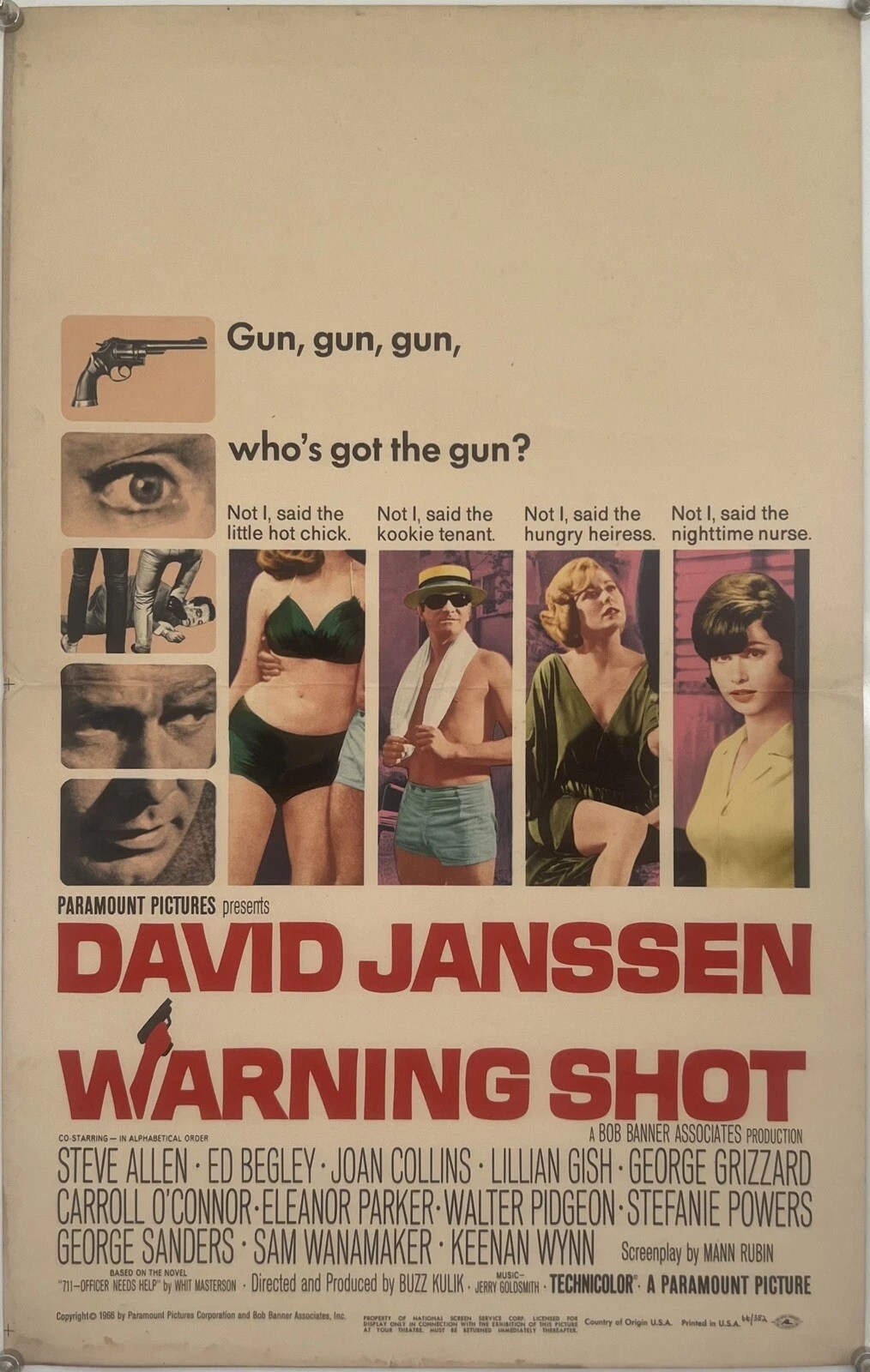
Warning Shot (1967) ****

So underrated it doesn’t even feature on Wikipedia’s chart of 1960s crime pictures, this tight little gem, with an early reflection on police brutality, dream cast, violence in slow motion  (prior to The Wild Bunch, 1969, mind you)  and stunning score from Jerry Goldsmith is definitely in need of resurrection.  Astonishing to realize that cop pictures had fallen so out of fashion, that this was the first Hollywood cop film of the decade – outside of a drama like The Chase (1966) – the entire previous output focusing on gangsters with a rare private eye (Harper, 1966) thrown in. With none of the vicious snarl of Madigan (1968) or the brutality of Coogan’s Bluff (1968), this was more in keeping with the later In the Heat of the Night (1967) in terms of the mental and physical barrage endured by the cop.

In thick fog on a stakeout for a serial killer at an apartment block Sgt Tom Valens (David Janssen) kills a potential suspect, wealthy Dr Ruston. Valens claims the suspect was reaching for his gun. Only problem – nobody can find the gun. Up on a potential manslaughter charge, Valens is pressured by boss (Ed Begley), lawyer (Walter Pidgeon) and wife (Joan Collins) to take the rap and plead guilty.  The public and media rage about police brutality. Putting Valens’ testimony in doubt is a recent shooting incident, which left Valens with a stomach wound, and which may have clouded his judgement.

Although suspended, Valens has no alternative but to investigate, interviewing elderly patient Alice (Lillian Gish) whom the doctor was visiting, patient’s neighbour playboy pilot Walt (George Grizzard), doctor’s assistant Liz (Stefanie Powers), doctor’s wife   Doris (Eleanor Parker), doctor’s stockbroker (George Sanders) with nothing to show for his efforts but a savage beating, filmed in slow motion, inflicted by the doctor’s son and pals, and an attempt on his life. He gets into further trouble for attempting to smear the doctor as an abortionist (a crime at the time).

The missing gun remains elusive though the direction at times suggests its existence is fiction. The detection is superb, red herrings aplenty, as Valens, the odds against him cheating conviction lengthening by the day, a trial deadline to beat, everyone turning against him, openly castigated as the killer cop, struggles to uncover the truth. And it’s clear he questions reality himself. He has none of the brittle snap of the standard cop and it’s almost as if he expects to be found guilty, that he has stepped over the line.

Along the way is some brilliant dialogue – the seductive drunk wife, “mourning with martinis” suggesting they “rub two losers together” and complaining she has to “lead him by the hand like every other man.”  Cinematography and music combine for a brilliant mournful scene of worn-down cop struggling home with a couple of pints of milk. The after-effects of the stomach injury present him as physically wounded, neither the tough physical specimen of later cop pictures nor the grizzled veteran of previous ones.

David Janssen (King of the Roaring 20s, 1960) had not made a picture in four years, his time consumed by the ultra-successful television show The Fugitive, but his quiet, brooding, internalized style and soft spoken manner is ideal for the tormented cop. This is also Joan Collins (Esther and the King, 1960) first Hollywood outing in half a decade.

Pick of the supporting cast is former Hollywood top star Eleanor Parker (Detective Story, 1951) more recently exposed to the wider public as the Baroness in The Sound of Music (1965) whose slinky demeanor almost turns the cop’s head. The cast is loaded with simialr sterling actors.

In the veteran department are aforementioned famed silent star Lillian Gish (The Birth of a Nation, 1915), veteran Brit  George Sanders (The Falcon series in the 1940s), Walter Pidgeon (Mrs Miniver, 1942) also in his first film in four years,  Ed Begley in only his second picture since Sweet Bird of Youth (1962) and Keenan Wynn (Stagecoach, 1966). Noted up-and-coming players include Stefanie Powers (also Stagecoach), Sam Wanamaker (The Spy Who Came in from the Cold, 1965), George Grizzard (Advise and Consent, 1962) and  Carroll O’Connor (A Fever in the Blood, 1961). American television star Steve Allen (College Confidential, 1960) plays a hypocritical pundit.

A sophomore movie for noted television director Buzz Kulik (Villa Rides, 1968), this is easily his best picture, concentrating on character with a great eye for mood. Screenwriter Mann Rubin (Brainstorm, 1965) adapted the Whit Masterson novel 711  – Officer Needs Help. The score is one of the best from Jerry Goldsmith (Seconds, 1966).

Has this emanated from France it would have been covered in critical glory, from the overall unfussy direction, from the presentation of the main character and so many memorable performances and from, to bring it up once again, the awesome music.
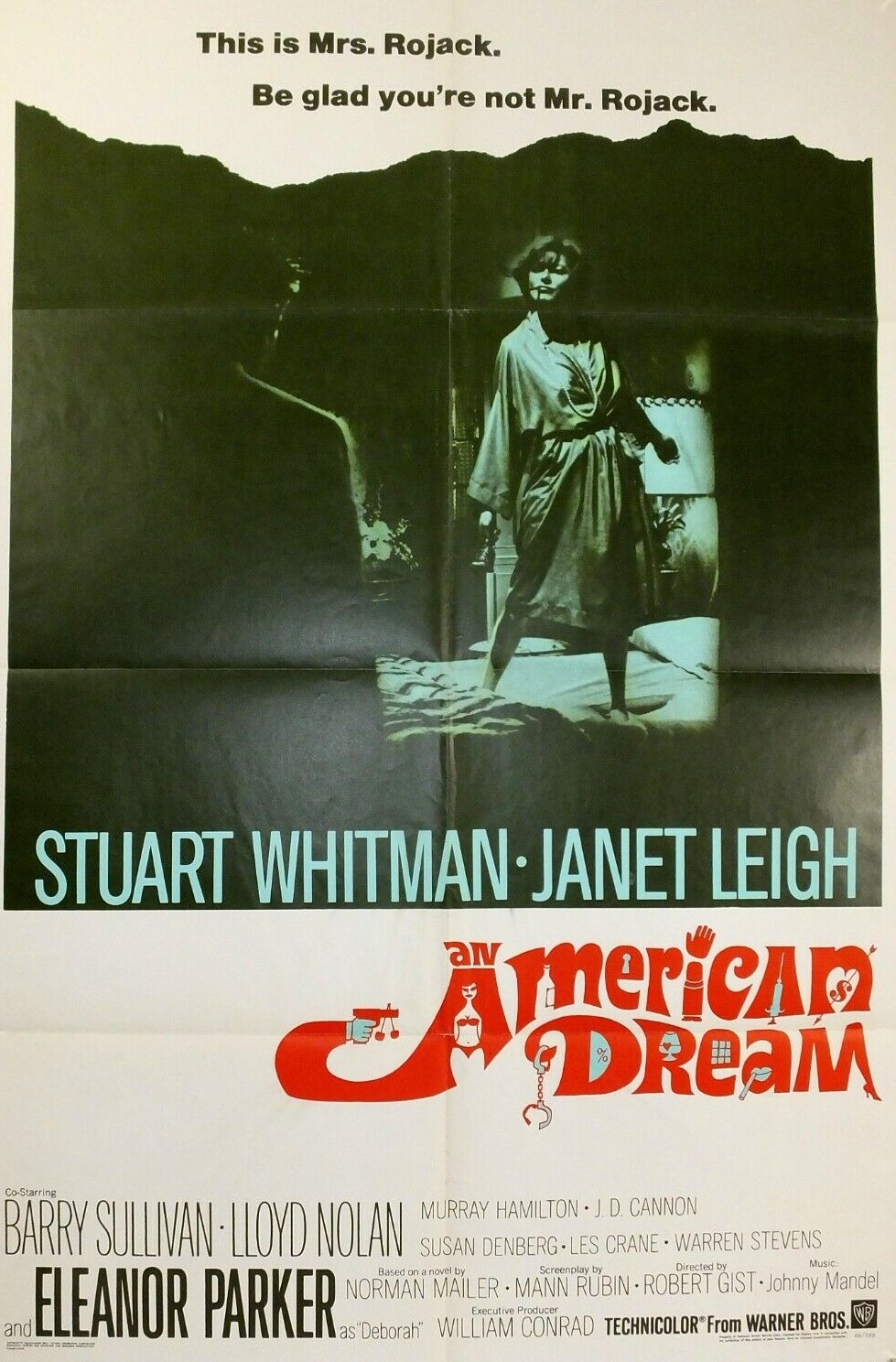
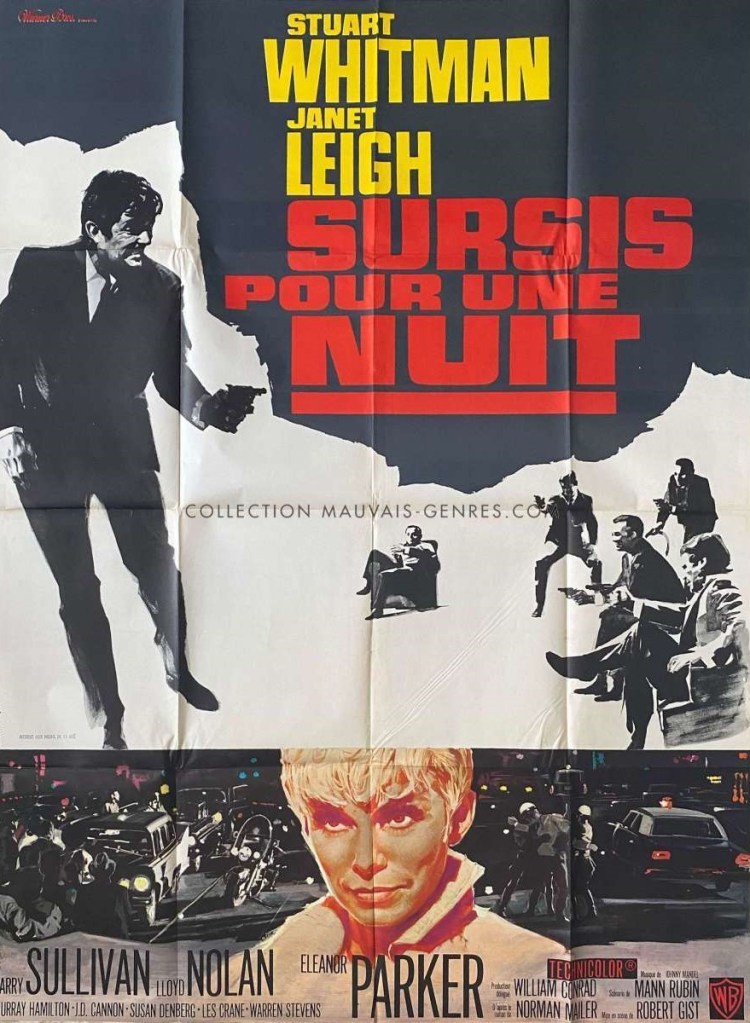
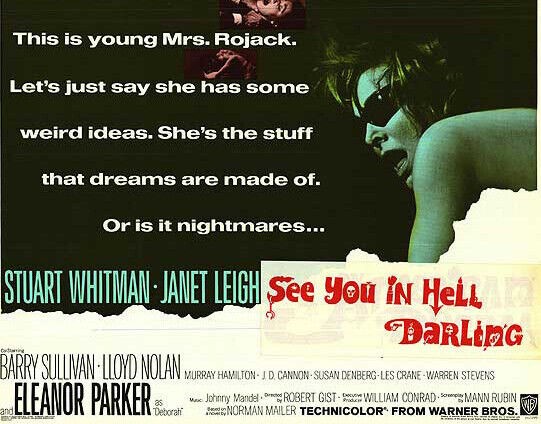
An American Dream / See You in Hell, Darling (1966) ****

The Stuart Whitman Appreciation Society kicks into high gear with this under-rated drama. A huge flop and critically savaged at the time, its bitterly sardonic existentialist center will appeal more to contemporary audiences.

Norman Mailer, author of the source novel, was a hugely controversial public figure. A magnet for alimony, writer of sledgehammer prose, his filmed bestsellers (The Naked and the Dead, 1958) hit the box office with a heavy thud, climaxing in the disastrous Tough Guys Don’t Dance (1987). Politician, avant-garde film-maker (Maidstone, 1970) and leading exponent of the “new journalism” (The Armies of the Night, 1968), his works were exceptionally tricky to translate onto the screen.

This one picks its way through a flotilla of heavyweight themes – corruption, entitlement, the Mafia – by focusing on a trio of flawed characters dogged by ideals amd let down by reality. War hero crusading journalist and television’s version of a “shock jock”, Stephen Rojack (Stuart Whitman) is weary of beating his head against a legal brick wall in his bid to bring to justice Mafia lynchpin Ganucci (Joe de Santis). But he’s also extremely done in coping with adulterous alcoholic heiress wife Deborah (Eleanor Parker).

When he asks for a divorce she retaliates with violence and scathing verbal abuse. In the scuffle that follows she teeters off the ledge of their penthouse apartment. In his defence Stephen might well have claimed self-defence given she tried to crown him with a huge rock, or at the very least relief (although admittedly that has little legal standing), but instead opts for suicide. In revenge for Stephen’s ongoing slating of the police and because the deceased is daughter to exceptionally important entrepreneur Kelly (Lloyd Nolan), the eighth richest man in America, the cops try to pin on him a murder rap. The charge is really a moral one, and equally as ruinous to a fast-rising career, that while he may not have pushed her he didn’t act to save her.

As it happens, and apparently coincidentally, Ganucci happens to be passing the penthouse at the time the woman hits the deck. Equally, coincidentally, riding with him is his moll Cherry (Janet Leigh) a wannabe singer whose only gigs are in Mob-owned night clubs.

But Ganucci’s presence turns out not to be coincidental after all. He was on his way to straighten Stephen out, possibly intending to use blackmail since Cherry is a stain on Stephen’s supposedly unblemished past. The cops are ferocious in their grilling, and adopt an unusual amount of forensic evidence for the time. Stephen would probably have come apart quicker had it not been for rekindling romance with Cherry, which, unexpectedly, provides the hoods with a lure to reel him in.

The satire is mostly reined in – cops unable to catch the real murderous Mafia pick on the guy who’s picking on them, Stephen’s business partners latch on to his sudden publicity/ notoriety to negotiate a multi-million-dollar pay rise with, natch, a rider in the contract negating it should he be found guilty. The drama is characters racing headlong towards fleeting happiness, the tiny morsels of hope that might filter down from the unacheivable American dream.

The performances carry it. What was it in Stuart Whitman (Shock Treatment, 1964) that drew him towards characters given a hard time? Whatever it was, he rode it in spades and here he presents his most complex character to date, oozing suspicion, suffocated by guilt, believing that all will come right in the end if he has a good woman by his side, not realizing that Kelly knows only too well which side her bread is buttered on. Janet Leigh (Grand Slam, 1967) plays very much against type as the hard-eyed chanteuse but Eleanor Parker (Warning Shot, 1966) essays one of the best – and most vicious – drunks (and lost souls drowning in a sea of wealth) you will ever see.

Not to be outdone, director Robert Gist (Della, 1965), pulls off some neat scenes, opening with a shot of a naked Eleanor Parker clad only in dark sunglasses watching television, using camera movement to put claustophobic heat on Whitman during interrogation scenes (Christopher Nolan’s interrogator in Oppenheimer apes his trick of pushing his chair close to his victim), portraying the flimsy sexiness of Parker in flimsy negligee, all the time not letting Whitman escape from his internal demons.

Perhaps, more boldly, rather than, as would be the contemporary temptation, treating Deborah’s death as a mystery, the details only unfolding bit-by-bit and leading to a hairy climax, Gist shows her death and lets the audience make up its mind what part Stephen played in it. The downbeat ending, too, would sit more easily with the contemporary audience. Mann Rubin (The Warning Shot, 1967) knocked out the screenplay.

This finished off Whitman’s career – he didn’t make another movie for four years and then ended up in B-picture limbo, directors more interested in his square jaw than the inner confusion he was so deft at portraying.  

Well worth a look.  

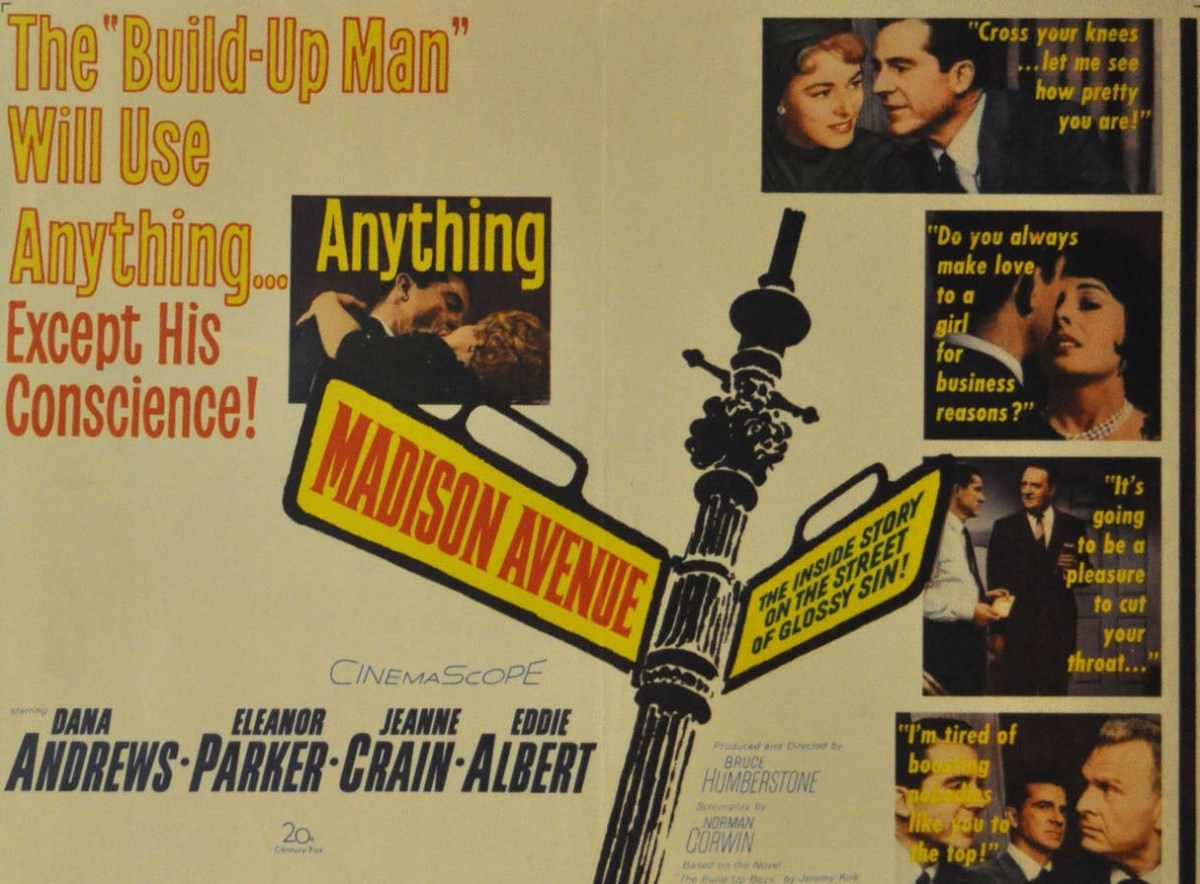
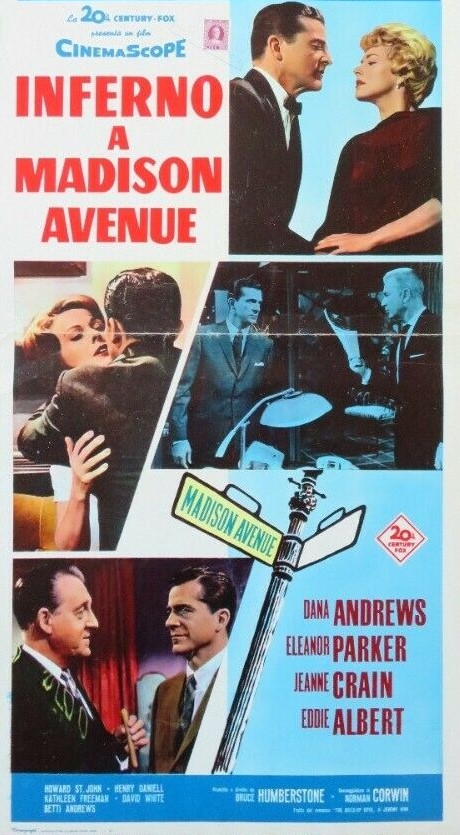
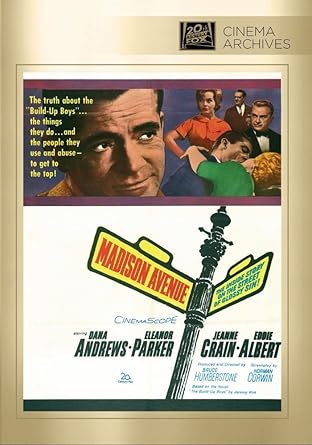
Madison Avenue (1961) ***

Surprisingly effective feminist angle. Unusual for the suave salesman to get his come-uppance from two vulnerable women, but that’s the case here, in an expose of the “build-up” (what we’d call “hype” these days) techniques of the public relations business, an area of advertising generally considered one step below the Mad Men of popular television. Fancy bars and cocktail dresses put in an appearance but, mostly, this deals with the grittier end.

This was pretty much the end of the mainstream Hollywood career for Dana Andrews. Still best-known for Laura (1944) and The Best Years of Our Lives (1946) and for some key film noir titles, this was his last major top-billed role. He wouldn’t make another movie for four years and anyone coming to him in this decade would associate him with supporting roles in the likes of The Satan Bug (1965) and Battle of the Bulge (1965).

So this is, possibly unexpectedly, a performance to savor, for he is hardly the hero, more the kind of character who might turn up in a contemporary movie, with questionable motives to go along with his decided charm (look no further than Leonardo DiCaprio in Killers of the Flower Moon). Though hardly murderous, he is ruthless and doesn’t care who he brings down in achieving his objectives.

After losing his job for purportedly (an accusation unproven but going with the territory) trying to steal the major client, Associated Dairies, of his boss, J.D. (Howard St John), top executive Clint (Dana Andrews) plans to get his revenge in rather sneaky fashion, by turning round its poorly-performing subsidiary Cloverleaf. He targets the dowdy owner, Anne Tremain (Eleanor Parker), of its failing advertising firm, promising her client a big editorial splash in a big newspaper courtesy of journalist girlfriend Peggy (Jeanne Crain).

Anne’s the first beneficiary of his PR skills, reinventing her as a glamorous, power-dressing, more confident advocate of the persuasion industry. He inveigles himself into her arms, at the expense of Peggy. He aids the idiotic owner of Cloverleaf, Harvey (Eddie Albert), who spends all his time in the office playing with model airplanes. (From today’s perspective, he’s something of a savant, predicting these machines – think drones – could one day form part of the delivery contingent.)  

To show just how damn clever he is, Clint “builds up” Harvey into the kind of self-made-man that has politicians purring, and brings Clint back into the winners circle. Unfortunately, the only way to get right in is through deviousness, a bit of back-stabbing here and there, dropping anyone who’s outlived their usefulness. But he’s not as clever as he thinks, lacks the business acumen of Anne, who’s denied him a share of her growing business, and therefore any real power base.

The women take unkindly to being used, Anne now the one doing the tossing-aside. For her revenge, Peggy writes an article that digs the dirt on him. Neither of these women would fall into the femme fatale category, though once all glammed-up Anne could pass for one had she required violence rather than business dexterity to exact her revenge.

Though both, unusually for the times, hold top positions in their businesses – Peggy’s a high-flying journalist working the Washington beat – they are presented initially as easy meat for a man capable of exploiting their vulnerabilities. Clint keeps Peggy on the back foot by failing to turn up for dates or presenting Anne as a rival for his affections.

This is an era where, purportedly, all women wanted was a ring on their finger, and to hang with being landed with an unsuitable man. But both Anne and Peggy upend that stereotype, seeing through the creature who’s come calling. In a western, audiences would have the satisfaction of seeing this kind of despicable character being shot. Here, they get to see him cringe, and be humiliated by women who have come to their senses. Albeit there’s a “happy” ending, that only occurs after some begging by the predator.

It suffers from too many long sequences, and by its determination to go down the satire route in exposing the seamier side of the public relations business. But there are some classic moments, such as when Harvey, tumbling through a prepared speech, has to suddenly wing it and finds his real voice.

But watching Anne get the measure of Clint and seeing him brought to heel by both women suggests the kind of ahead-of-its-time come-uppance that sets this up as an early feminist venture.

Eleanor Parker (The Sound of Music, 1965) and Jeanne Craine (Queen of the Nile, 1961) are both superb as women coming to their senses and this is a quite superb last top-billed hurrah from Dana Andrews. This was also the final outing for director H. Bruce Humberstone (Desert Song, 1953). Former newspaperman Norman Corwin (The Story of Ruth, 1960) and Richard P. Powell (Follow That Dream, 1962) based the screenplay on the best seller by Jeremy Kirk.

Resonates on the feminist front.

The Oscar (1966) ****

Don’t you just love a really good bad movie? Where redemptive character is outlawed. When over-acting is the key. In which everyone gets the chance to spout off about someone else, generally to their face, and then is permitted, in the cause of balance, a quiet moment of bitter self-reflection. And even the most minor character gets a zinger of a line. Welcome to Hollywood.

Tale of an actor’s rise and not exactly fall because we leave Frank Fane (Stephen Boyd) at a pinnacle of his career, though, don’t you know, he’s empty inside and deserted by all his faithful companions. Lucky Frank has some kind of charisma or that he just fastens onto losers who see in him what they need because from the outset he is one mean hombre, living off stripper girlfriend Laurel (Jill St John), so dumb she switched to him from his so dependable best pal Hymie (Tony Bennett – yes, that Tony Bennett, the singer).

He hooks up with Kay (Elke Sommer), a designer who happens as a sideline to make costumes for off-Broadway productions. When King of Lowlife Punks Frank shows a pusillanimous stage actor what you do in a knife fight he strikes a chord with theater producer Sophie (Eleanor Parker), who happens to have a sideline as a talent scout for the movies.

She fixes him up with an agent Kappy (Milton Berle – yes that Milton Berle, the loudmouth comedian) and together they sell him to studio boss Regan (Joseph Cotten). The only good deed Frank does in the entire movie is to stand witness – not for marriage, but for divorce – for an ordinary couple, private detective Barney (Ernest Borgnine) and Trina (Edie Adams), he meets at a bullfight, huge fans, and thank goodness that action comes back to bite him.

The picture goes haywire in the third act. Fane’s career is crumbling in the face of audience indifference, exhibitor displeasure and, don’t you know it, a chance for revenge for Regan, who was stiffed in a previous contract. But instead of taking the traditional tumble into the forgotten category, his career is revived by an Oscar nomination.

From top to bottom – a fully-clothed Stephen Boyd, then in various states of undress, Elke Sommer, Jill St John and Eleanor Parker. That’s how to sell a picture apparently.

But that’s not enough for the ruthless Fane. Earlier in his life a corrupt sheriff had stuck him with charges of pimping. Using Barney, who seems to have the ear of the media, he plants a story about himself, hoping that Hollywood being the cesspool it is, everyone will assume one of his rivals did the dirty. “I can’t rig the votes,” rationalizes our poor hero,”  but I can rig the emotions of the voters.”

What a scam. I was chortling all the way through this section and almost laughing out loud when it transpires Frank had misjudged how deep the cesspool is, because Barney then blackmails him. This gives everyone he has treated heinously over the years the chance to stick it to him. Nobody will lend him the dough to get this grinning monkey off his back. Salvation comes in the oldest of Hollywood maneuvers. Trina, who has always wanted to get into pictures, and is the kind of person who embodies A Grievance Too Far, supplies the information that will sink her ex-husband, in exchange for Frank using his influence to get her a small role.

There’s a brilliant climax. I should have said spoilers abound but I can’t resist telling you the ending it’s such a cracker. So there is Frank at the Oscars with Bob Hope (yes, that Bob Hope) as master of ceremonies and the audience studded with real stars like Frank Sinatra (yes, that…). Like an evil chorus – you can almost hear them hissing under their breath and they all fix him with baleful looks – are all those he treated badly.

The winner is announced. “Frank…” Assuming victory, Fane gets to his feet. “Sinatra.” The only way he can rescue his embarrassment is to make it look as he is giving the winner a standing ovation. But when the rest of the audience follows suit, he slumps to his chair, and in the only true cinematic moment in all the sturm and drang the camera pulls back from him sitting bitter, twisted and defeated in his seat.

Stephen Boyd (Shalako, 1969) is terrific because even when he was top-billed he tended to over-act and when he became a co-star or supporting player he was an inveterate scene-stealer, of the sharp intake of breath / vicious tongued variety. Here he shows both his charming and venomous side. If he was playing a gangster he couldn’t be more menacing – or charismatic. It’s a peach of a role – he can dish it out, dump women at will, and still embrace victimhood as “170lb of meat.”

Luckily, most of the rest of the cast take the subtle route. Although all disporting in various negligible outfits at one time or another, Jill St John (The Liquidator, 1965), Elke Sommer (The Prize, 1963) and Eleanor Parker (Eye of the Cat, 1969) and giving Frank his comeuppance wherever possible – St John slings him out – the performances are generally nuanced, Parker in particular evoking sympathy.

Tony Bennett is miscast, especially as he has to do double duty as an unwelcome voice-over, filling in bits of the narrative that, thankfully, has been skipped. But Milton Berle is pretty good as  a quiet-spoken agent.

In the over-the-top stakes, Boyd has his work cut out to hold his own in scenes with Ernest Borgnine (The Wild Bunch, 1969) who revels in his scam, and Edie Adams (The Honey Pot, 1967) who is anything but a dumb blonde and delivers the most stinging of zingers.

Doesn’t tell us anything we didn’t know about Hollywood except in one delicious scene where, early in his career, Frank has to squire around a female star who relishes putting him in his place.

It’s not badly made just pell-mell and over-the-top. Russell Rouse (The Caper of the Golden Bulls, 1967) directs from a screenplay by himself and Harlan Ellison (yes that Harlan Ellison, the sci fi author) from the bestseller by Robert Sale.

An absolute hoot.   

Eye of the Cat (1969) ***

If I hadn’t watched The Woman Who Wouldn’t Die (1965) I wouldn’t have been so well up on the intrigue of the modern film noir so I guessed where this was going pretty quickly but that did not detract from the enjoyment of watching it reach its stylish denouement. A perfect antidote to the cute cats as personified by Disney in The Three Lives of Thomasina (1963) and That Darn Cat! (1965). 

Realizing that wealthy client Danny (Eleanor Parker), suffering from emphysema, might only need a nudge or two to hasten her death, hairdresser Kassia (Gayle Hunnicutt) enrolls the sick woman’s wayward nephew Wylie (Michael Sarrazin) in a plot to kill her off and inherit her money. There are two obstacles, possibly three.  Danny has a houseful of cats, close to a hundred at the last count, and Wylie, after a childhood feline encounter, is terrified of the four-legged creatures. Upset at his previous behavior, Wylie has been cut out of the old lady’s will and needs reinstated pronto. The last element is that Wylie has a younger brother, Luke (Tim Henry) who acts as Danny’s gofer, who may take exception to the scheme.

Needless to say, the otherwise imperious Danny is so delighted at the return of the prodigal nephew that she demands her lawyer Bendetto (Linden Chiles) amend the will immediately. She sleeps in an oxygen tent and simply switching off her supply will be enough. But, of course, it would be foolhardy to murder her before the will is signed, sealed and delivered. Unfortunately, Wylie is a high-spirited selfish young man and comes close to offing her unintentionally.

While Wylie takes up residence in Danny’s vast house, Kassia is kept in the cellar and there is a suspicion that he will blackmail her into having sex with him since she sees their relationship as strictly business. Wylie has a whole string of abandoned girlfriends and seems to have capacity for preying on the most vulnerable if “Poor Dear” (Jennifer Leak), the nickname he assigns one is anything to go by.

Meanwhile, Wylie’s childhood fears return. He doesn’t need to see a cat, or even smell it, just sensing its presence is enough. His terrified reaction makes him want to abandon the scheme, despite the amount he might inherit. Desperate to prevent him from leaving, Danny agrees to get rid of her army of cats. Unfortunately, Luke is not as assiduous as he ought to be and a couple escape the round-up.

As the deadline for her demise nears, the tension is ratched up, seeds of suspicion sown among the conspirators, complications with the will and of course the cats hidden from Wylie’s view – but not ours. A fabulous scene with a runaway wheelchair nearly puts paid to the entire endeavor.

The under-rated Michael Sarrazin (In Search of Gregory, 1969), given a more complex character than before, switches through the gears of terror, charm and predation. Gayle Hunnicutt  (P.J./New Face in Hell, 1968) is a less obvious femme fatale, relying far more on brain than obvious physical attributes. And what a delight to see 1950s box office queen Eleanor Parker (Warning Shot, 1967) handling a much larger role than was normal at this point in her career. Tim Henry made his movie debut. You might also spot Laurence Naismith (Jason and the Argonauts, 1963) and one of Judy Garland’s husbands Mark Herron (Girl in Gold Boots, 1968).

From the atmospheric credit sequence featuring silhouettes of cats through a rash of twists and turns director David Lowell Rich (A Lovely Way to Die, 1968) guides this unusual thriller with considerable expertise, knowing just when to add another layer to the suspense, and drawing excellent performances from the two principals. The original screenplay is by a master of the macabre Joseph Stefano of Psycho (1960) fame. Unlike me, who had a head start, this chiller will keep you guessing.

Discover WordPress

A daily selection of the best content published on WordPress, collected for you by humans who love to read.

The Atavist Magazine

by Brian Hannan

WordPress.com News

The latest news on WordPress.com and the WordPress community.