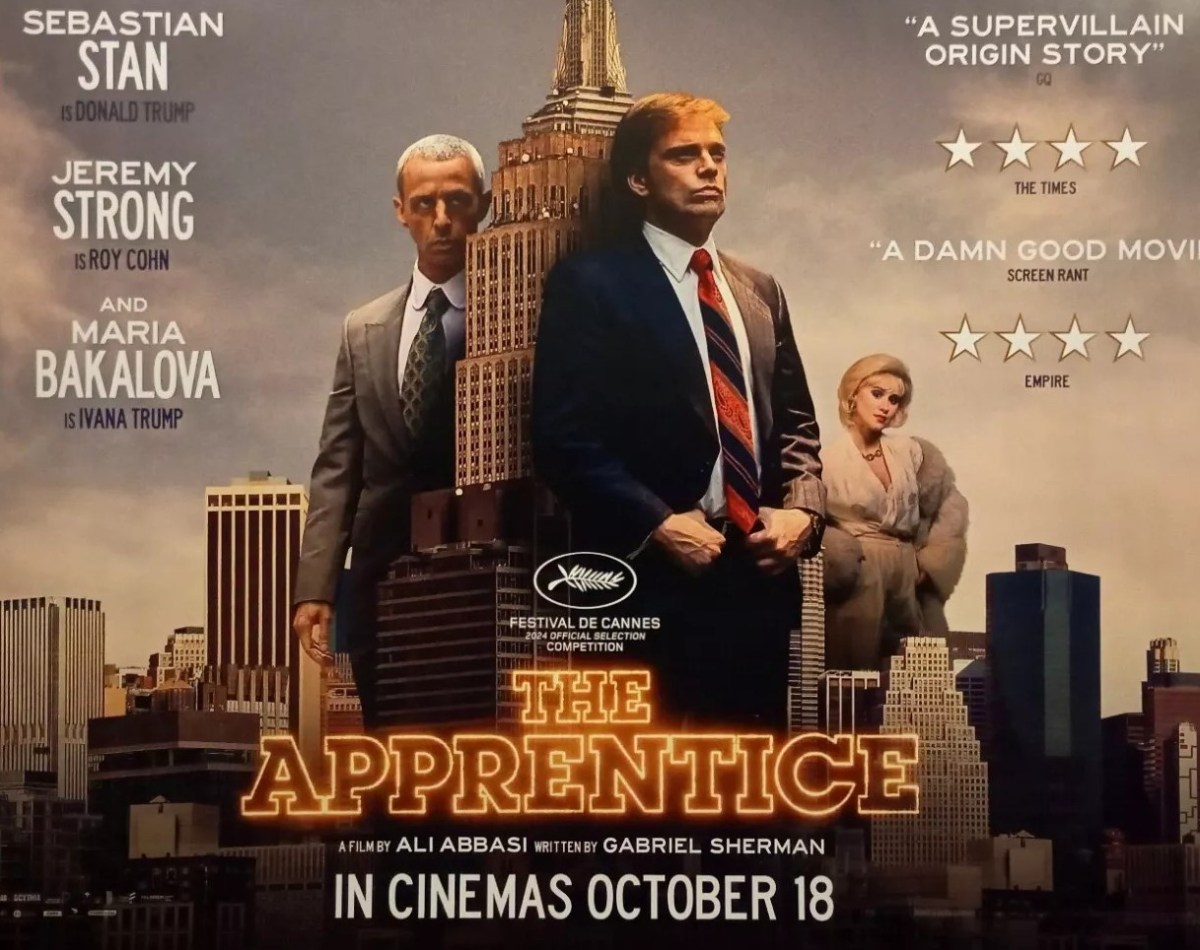
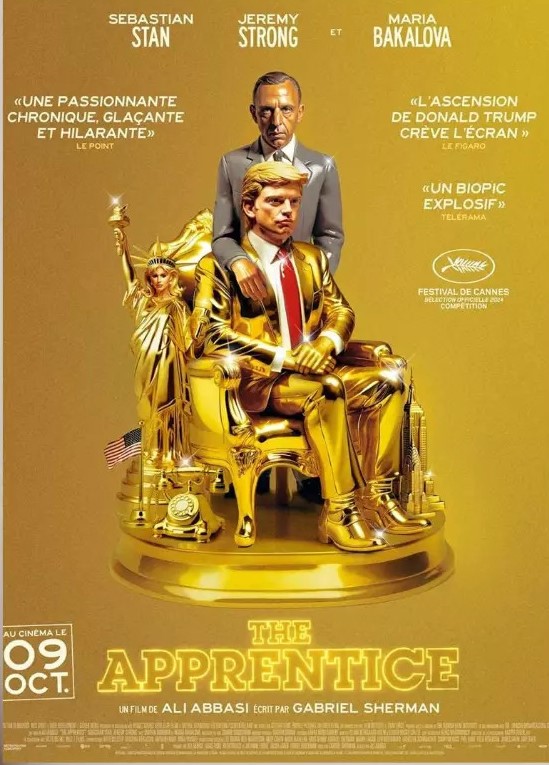
The Apprentice (2024) ***

Allow me a digression. Let me take you back to the 1950s-1960s and the construction of the Lincoln Center in New York. That was seen as a “good thing” because although it drove out an entire community, the end result was an arts center that helped redevelop a rundown area of Manhattan while at the same time driving up the price of what had now become prime real estate. Sure, thousands of poor people lost their homes, but what was that in relation to a haven for the arts? No counting how many made huge profits.

The Lincoln Center didn’t send a left-wing press howling for the blood of Robert Moses, the urban planner who reshaped pretty much the whole of New York for decades but ripped the heart out of a vibrant Puerto Rican community and a bustling jazz scene in the name of slum clearance. The 7,000 inhabitants and 800 business in San Juan Hill couldn’t afford the rent in the 4,000 apartments that replaced their homes and the promised urban relocation came to nothing. Nobody was knocking on the door of the Metropolitan Opera or the Philharmonic, among the Lincoln’s tenants, berating them for causing such catastrophic social damage. Middle-class values took precedence over working class need.
I’m familiar with Moses and the Lincoln Center story because I read Robert Caro’s scathing biography of him, The Power Broker. But the makers of The Apprentice appear to have no knowledge of how much political machination and corruption it took to get the Lincoln Center constructed and the damage it inflicted on thousands of lives.

So, the building of Trump’s first hotel, in an equally rundown area of New York, where, incidentally, no inhabitant was displaced, is apparently the opening gambit for a game of hypocrisy. I’ve no doubt Trump has a lot to answer for, but this picture doesn’t go anywhere near asking the right questions.

I’m not particularly convinced by Sebastian Stan’s (The 355, 2022) portrayal either. About the only thing he gets right is that moue he does with his upper lip. The thing that typifies Trump, the way it does hundreds of entrepreneurs, is energy. And that’s totalling lacking here, in a bid, I guess, to diss Trump. It feels like director Ali Abbassi (Holy Spider, 2022) has already made up his mind the character he wants to see portrayed.

But think of The Wolf of Wall Street (2013). To a man, these characters are heinous, but somehow Scorsese makes us want to watch them. Or Spielberg’s Catch Me If You Can (2002), a sleazy counterfeiter cast in a more interesting light by the playing of Leonardo DiCaprio.

I’m not saying Trump should be deified, far from it, but any business movie that’s attracted any decent box office has done so by investing a lot more in character and narrative structure. Wall Street (1987) comes to mind. This Trump doesn’t look as if he could win a prize at a state fair let alone have any chance of grabbing the golden ring.

All the best business films are able to show you the inner workings of business without boring you to death. This goes quite a way to boring you to death without going anywhere near the more interesting aspects of business.

There’s also an unusual narrative structure. Even if the portrayal of Roy Cohn (Jeremy Strong), Trump’s lawyer, rings true, it presents him as a more corrupt character than Trump. Sure, Trump uses him to get ahead, but that’s mainly because Cohn has so many corrupt politicians in his pocket.

I wasn’t convinced by Jeremy Strong (Succession) either. He came across as a Glasgow ned about to demonstrate the Glasgow kiss or one of those puppets with the wobbling heads you saw on British television series Thunderbirds.

For all the critics who felt this might just give Trump a bloody nose, my guess is he would revel in the portrayal, the buccaneering spirit, the win at all costs mentality.

Robert Caro would have got him spot on. Unfortunately, biography-wise, he’s too busy putting the final touches to his monumental biography of LBJ.

A missed opportunity.
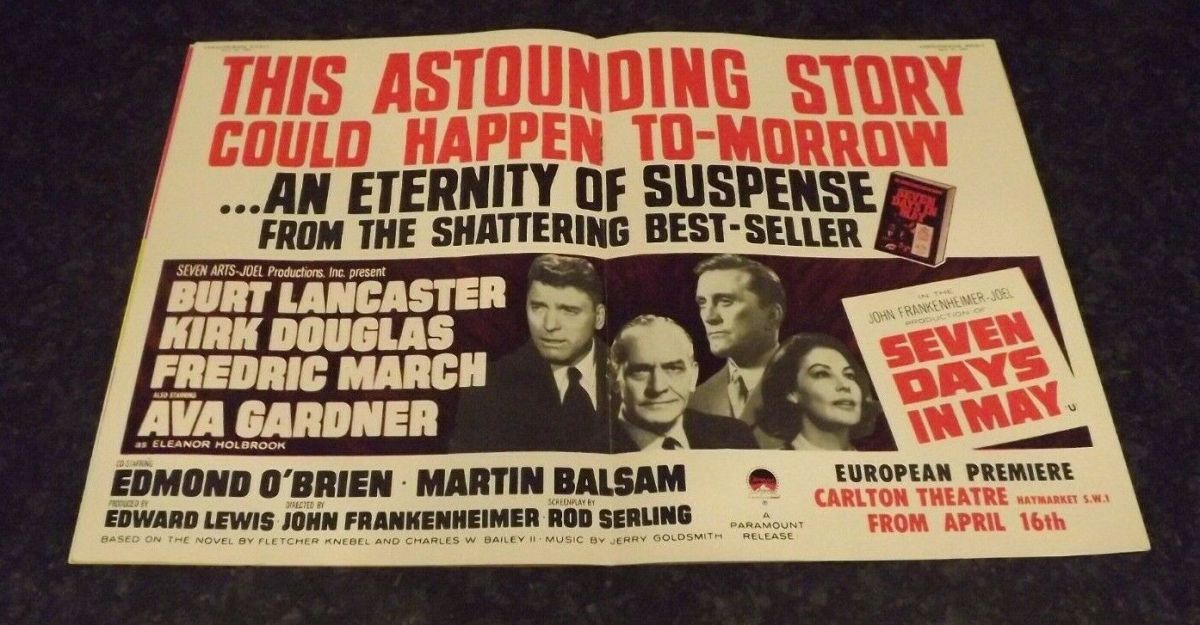
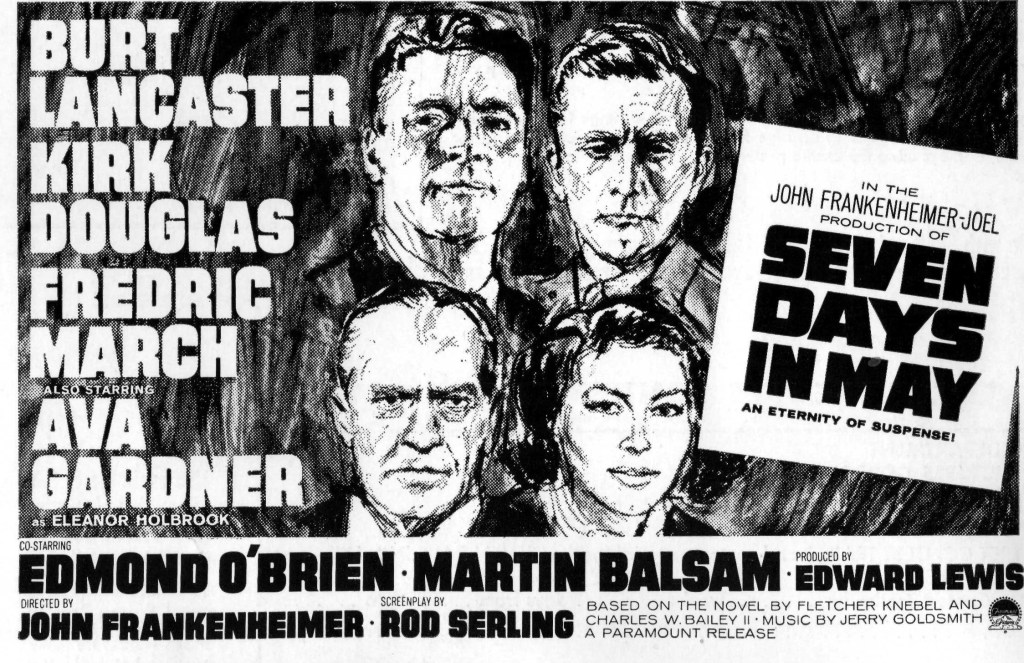
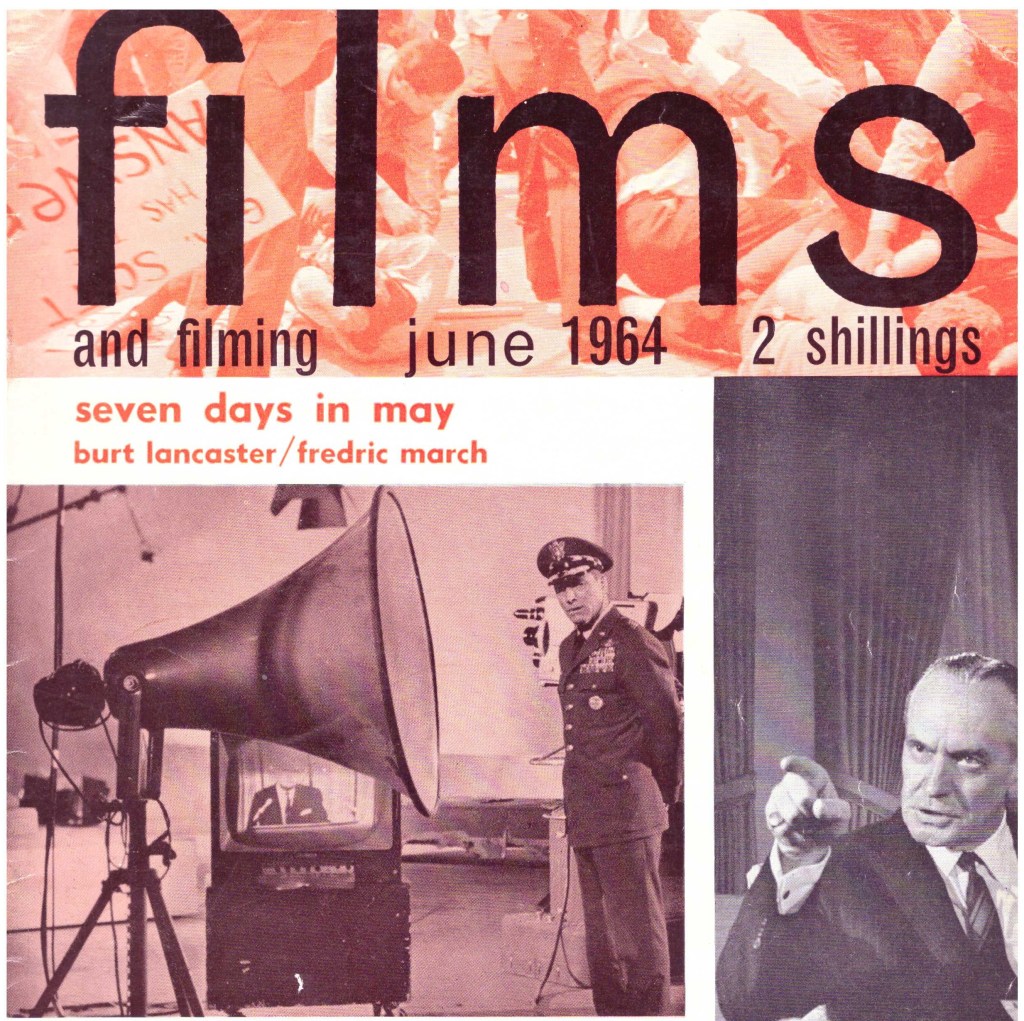
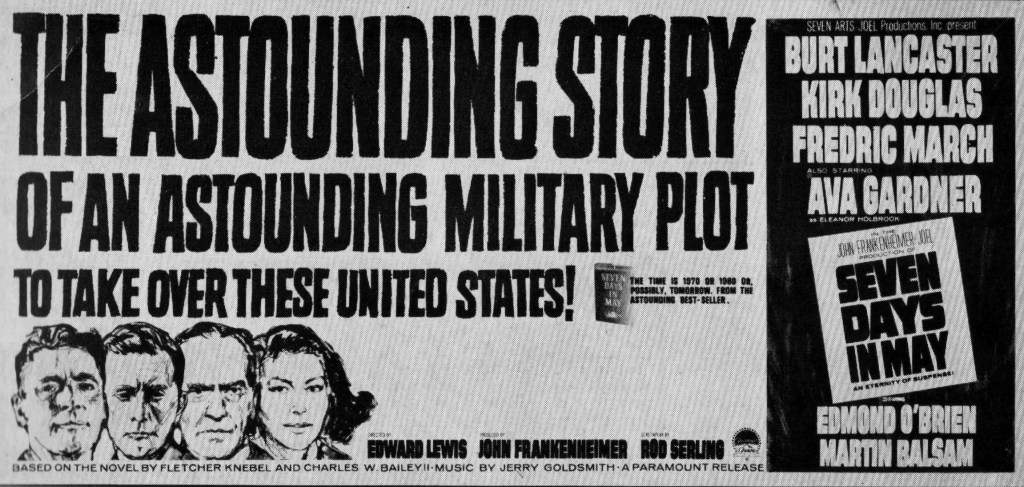
Seven Days in May (1964) ****

Donald Trump and the recent insurrection bring this picture bang up to date. Democracy is a dangerous weapon in the hands of the people. Can they be trusted to make the correct decision? That’s in part the thematic thrust of this high-octane political thriller that pits two of the greatest actors of their generation in a battle to decide the fate of the world. This was the era of the nuke picture – Dr Strangelove (1962), Fail Safe (1964), The Bedford Incident (1965) – all primed by the real-life Cuban Missile Crisis and the growing threat of the Cold War. But since that threat has never gone away – if anything it has worsened – the movie is as relevant today.

Promoting a male-oriented film about politics was always going to be a hard sell despite the distinguished cast. One route Paramount marketeers went down was a massive tie-in with publisher Bantam’s bestseller paperback . Over 1.5 million copies of the book had been rolled out and Bantam had arranged cross-over publicity in supermarkets, five-and-dime stores, booksellers and wholesalers stocking the book. “Look” magazine ran a six-page article by one of the book’s authors Fletcher Knebel.

Just as the President (Fredric March) is about to sign a nuclear treaty with the USSR, much to the fury of the majority of Americans judging by opinion polls, Colonel Jiggs Casey (Kirk Douglas) uncovers signs of a military coup headed by hawk General James Mattoon Scott (Burt Lancaster).

The movie divides into the classic three acts. In the first, Douglas investigates the existence of a secret army unit in El Paso comprising 3,600 men trained to overthrow the government and needs to persuade the President the country is in danger. The second act sees the President hunting for proof of the imminent coup and identifying the conspirators. The third act witnesses showdowns between March and Lancaster and Lancaster and Douglas.

About $65 million out of the U.S. national budget of $90 million was allocated to the military, according to director John Frankenheimer writing in the above magazine. Frankenheimer combined with Kirk Douglas’s company to purchase the book and hire writer Rod Serling. The original script was too long so, without losing a scene, the director went through it cutting phrases and sentences here and there till it was down to the required two-hour length. Paramount put up extra money to get Ava Gardner join the cast.

At the heart of the story is betrayal – Lancaster of his country’s constitution, Douglas of his friend when he takes on the “thankless job of informer.” Douglas proves rather too ruthless, willing to seduce and then betray Ava Gardner, Lancaster’s one-time mistress. Both Gardner and March prove to have higher principles than Douglas. For both Douglas and Lancaster who operate at a high threshold of intensity and could easily have turned in high-octane performances the tension is even better maintained by their apparently initial low-key confrontations. Douglas has a trick here of standing ramrod straight and then turning his head but not his body towards the camera.   

As a pure thriller, it works a treat, investigation to prove there is a conspiracy followed by the the vital element to conspiracy theory – the deaths and disappearances of vital people – and finally the need to resolve the crisis without creating public outcry. The only flaw in the movie’s structure is that Douglas cannot carry out all the investigations and when presidential sidekicks Martin Balsam and Edmond O’Brien are dispatched, respectively, to Gibralter and El Paso the movie loses some of its intensity. But the third act is a stunner as March refuses to take the easy way out by blackmailing Lancaster over his previous relationship with Gardner.   

Of course, there is a ton of political infighting and philosophizing in equal measure and speeches about democracy (“ask for a mandate at the ballot box, don’t steal it”), the American Constitution and the impact of nuclear weapons on humanity. But these verbal volleys are far from long-winded and pack a surefire punch. The coup has been set up with military precision and must be dismantled by political precision.

A hint of the future: one unusual aspect of the picture was the use of closed-circuit television which was seen as being used as method of general communication between politicians and the Pentagon.

The film is awash with Oscar talent – Burt Lancaster, Best Actor for Elmer Gantry (1960) and, at that point, twice nominated; thrice-nominated Kirk Douglas; Fredric March, twice Best Actor for Dr Jekyll and Mr Hyde (1931) and The Best Years of Our Lives (1946) plus  three other nominations besides; Ava Gardner nominated for Best Actress (Mogambo, 1953); and Edmond O’Brien named Best Supporting Actor for The Barefoot Contessa (1954).

None disappoint. March is especially impressive as a weak President tumbling in the polls who has to reach deep to fight a heavyweight adversary. Lancaster and Douglas both bristle with authority. Although Lancaster’s delusional self-belief appears to give him the edge in the acting stakes, Douglas’s ruthless manipulation of a vulnerable Ava Gardner provides him with the better material. Edmond O’Brien as an old soak whose alcoholism marks him out as an easy target is also memorable and Ava Gardner in recognizing her frailties delivers a sympathetic performance.

Fashion might have seemed to offer limited marketing opportunities for such a picture but that did not stop Paramount’s publicists. On the back of one of the subsidiary characters being seen combing her hair with an Ajax comb the manufacturer was inveigled into a nationwide campaign. Director John Frankenheimer was pictured wearing a custom-made Cardinal suit in an advert in “Gentlemen’s Quarterly” and designer Mollie Parnis created a suit for women which could be simply altered every day to provide enough outfits for seven days.

Rod Serling (The Twilight Zone) does a terrific job of distilling a door-stopper of a book by Fletcher Knebel and Charles W. Bailey II.  But the greatest kudos must go to director John Frankenheimer – acquainted with political opportunism through The Manchurian Candidate (1962) and with Burt Lancaster through The Birdman of Alcatraz (1962) – for keeping tension to the forefront and resisting the temptation to slide into political ideology.

Many of the films from the 1960s are to be found free of charge on TCM and Sony Movies and the British Talking Pictures as well as mainstream television channels. But if this film is not available through these routes, then here is the link to the DVD and/or streaming service.

Discover WordPress

A daily selection of the best content published on WordPress, collected for you by humans who love to read.

The Atavist Magazine

by Brian Hannan

WordPress.com News

The latest news on WordPress.com and the WordPress community.