
As timely as ever with America seemingly always on the brink of dictating what freedoms people can enjoy. At the time the target was the oppression engndered by McCarthysim, rather than the more basic tale of whether State law could forbid its citizens to talk about evolution. It was set almost a century ago, based on a real-life case, and even now fundamentalists reject Darwin’s theories. Setting aside the context, the principle contested is still the same – not just free speech but the right to be different. You could even argue that scientists and fundamentalists are all agreed these days, that out of nothing came the universe, whether created by a Deity or someone operating a contraption called the Big Bang.
Setting aside the various arguments for and against Darwin’s theory, what we have, nonetheless, is an acting highpoint, a fabulous courtroom battle, of the kind adored by audiences, full of objections sustained, attorneys being warned by the judge, inadmissible evidence, smart remarks and witty rejoinders. This all takes place in a sweltering courtroom, temperature so high that the judge agrees to depart from court procedure and permit the verbal duellists to shed their jackets.
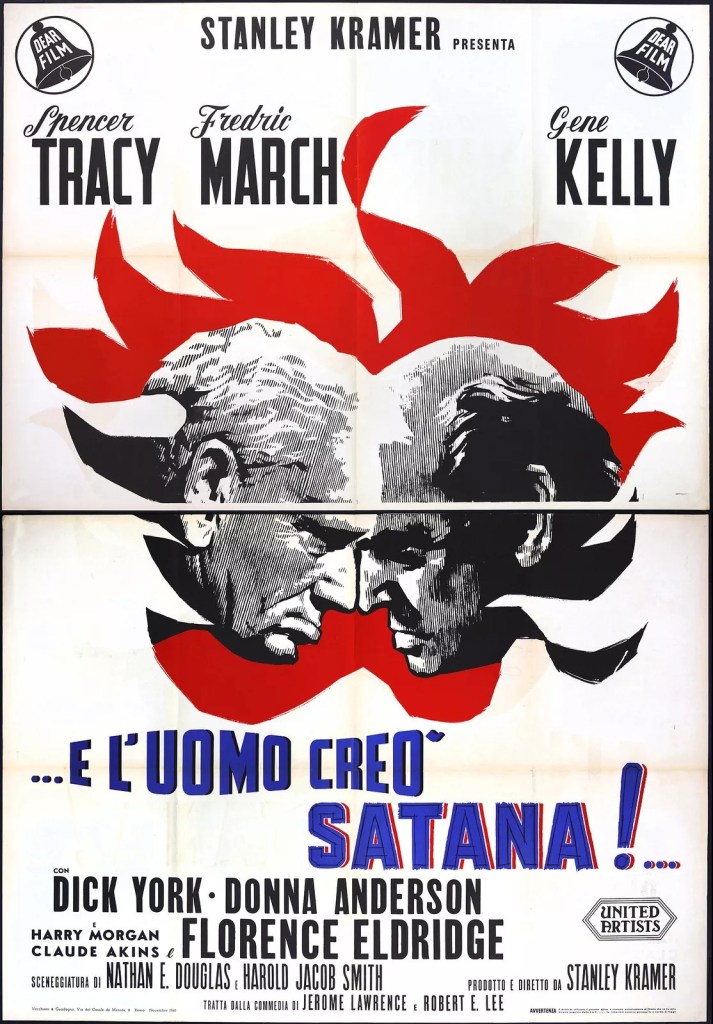
Given further depth because the antagonists, Henry Drummond (Spencer Tracy) and Matthew Harrison Brady (Fredric March), were once the best of pals, political allies, on the same side in the latter’s failed bid for the Presidency, and willing to accept the other’s personal foibles. Probably the first legal drama to accept that outside the courtroom the participants could be friends.
Luckily, most of it isn’t long speeches, but sharp comebacks, plus the detours, twists and turns that come about from concentrating more on the court than on any surrounding action, though there is forbidden romance, pastor’s daughter Rachel (Donna Anderson) defying her father over her love for the accused, schoolteacher Bertram (Dick York) whose teaching is in conflict with the Bible.
The most outraged denizens of the town get into a right tizzy, marches, religious songs, protest, but that’s leavened by commercial interests, a bank manager worrying that the town being ridiculed by those cleverer folks back east will harm his business, hoteliers, sideshow operators licking their lips at the financial bounty of reporters and gawkers descending on the town.

This is as you’d like to see Spencer Tracy, not the silent judge of Judgement at Nuremberg (1961), personality reined in by the weight of his decisions and the need to do right by those accused of even the most heinous of crimes, but the exuberant character, confident, up for battle, able to fend off any criticism and come back to any witticism at his expense with stinging repartee.
Fredric March, too, has a ball with a loudmouth character, convinced of his infallibility (except of course in terms of the Presidential Race), apt to stuff his face at dinner, but still with an intellectual thrust capable of parrying anything Tracy can throw at him. Tucked somewhere in between is weaselly reporter E.K. Hornbeck (Gene Kelly) whose newspaper has hired Drummond to defend Bertram in the hope of filling the front pages for days with the Trial of the Century (taking the prize from Leopold and Loeb the year before – both cases in real-life handled by Clarence Darrow).
Harry Morgan (The Flim-Flam Man/One Born Every Minute, 1967) plays the snipppy judge trying to maintain order while Claude Akins (Claudelle Inglish, 1961) the hellfire preacher. With so many interesting characters on parade, there’s never a dull moment, especially with each actor trying to wring every ounce of drama and/or pathos from their part.
Director Stanley Kramer (Judgment at Nuremberg) looks as if early on he made up his mind to give the actors their sway. There’s no reining in, even in the early scenes, with the populace up in arms and carrying very professionally-made signs and banners (no handwritten scrawls here, no sirree). And once Tracy and March hit their stride, it’s all an audience can do to sit back and admire. Sentiments expressed will still strike a chord, but, mostly it’s a testament to two great actors at the top of their game.
If you only remember March from the likes of The Condemned of Altona (1962) or Seven Days in May (1964) you should know he was a huge marquee attaction in his day, double Oscar-winner (and three nominations besides), as at home in swashbucklers like The Buccaneer (1938) as drama and comedies, leading man who could more than hold his own against top female stars – Greta Garbo (Anna Karenina, 1935), Katharine Hepburn (Mary of Scotland, 1936), Merle Oberon (Dark Angel, 1935) and Janet Gaynor (A Star Is Born, 1937).
Written by Nedrick Young (The Train, 1964) and Harold Jacob Smith (The McMasters, 1970) from the play by Jerome Lawrence and Robert E. Lee.
A terrific watch.
 The Magnificent 60s