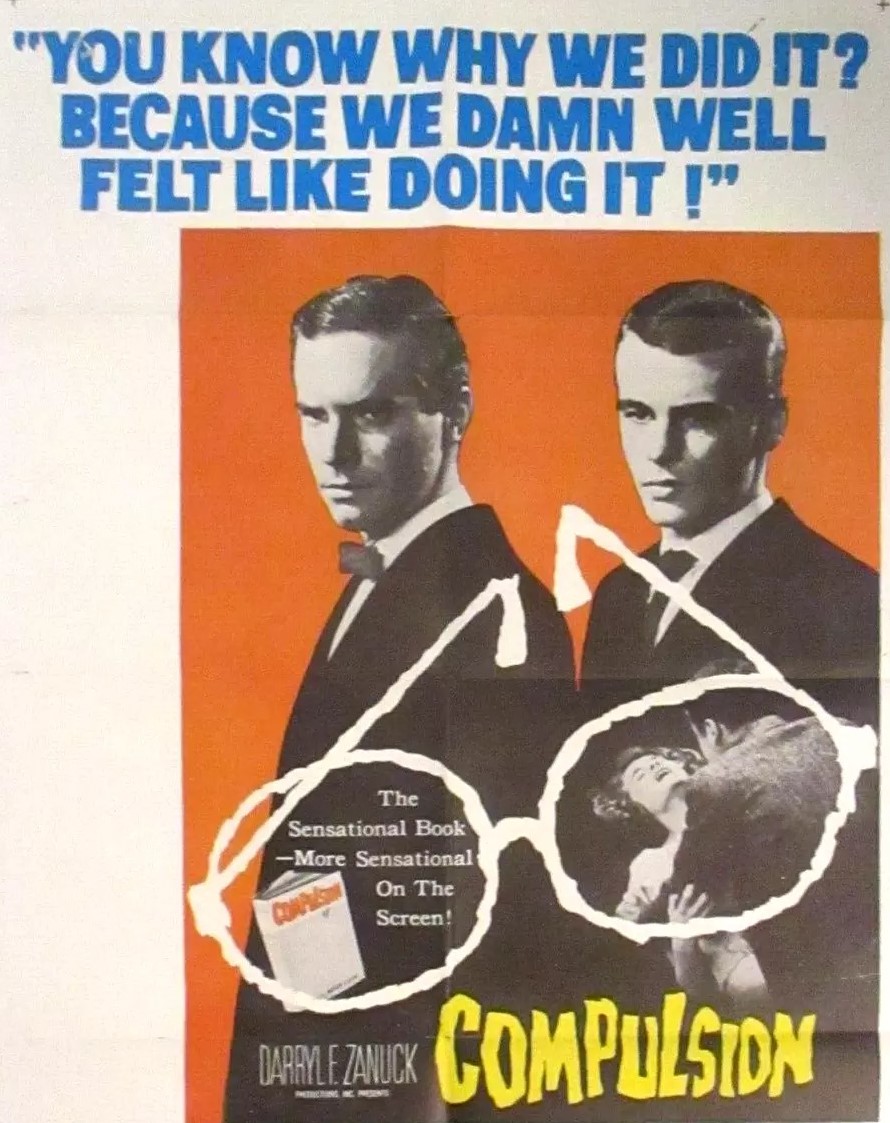
One movie that didn’t need Orson Welles to ride in and save the day and in some senses he gets in its way. Not because he’s – as was often his wont if lacking strong direction – over-acting but because his presence shifts the narrative imperative from motive and psychiatric investigation to a plea against passing the death sentence. A fictionalized version of the “crime of the century,” the kidnapping and killing of a young boy by Leopold and Lowe, a pair of intellectually arrogant wealthy young men, in Chicago 1924, it would make ideal fodder for a Netflix true crime slot, especially as there was no contesting the evidence.
Until the arrival of woebegone defense attorney Jonathan Wilks (Orson Welles) – Clarence Darrow in the real case – this has been given a low key docu style treatment even if it only touches upon what might have caused Arthur (Bradford Dillman) and Judd (Dean Stockwell) to embark on their terrible deed. They have intellectualized murder, believing that they are beyond mortals in their cranial superiority and therefore not only capable of committing the perfect crime, but relishing the prospect of getting away with it and rubbing their inferiors’ noses in the dirt.
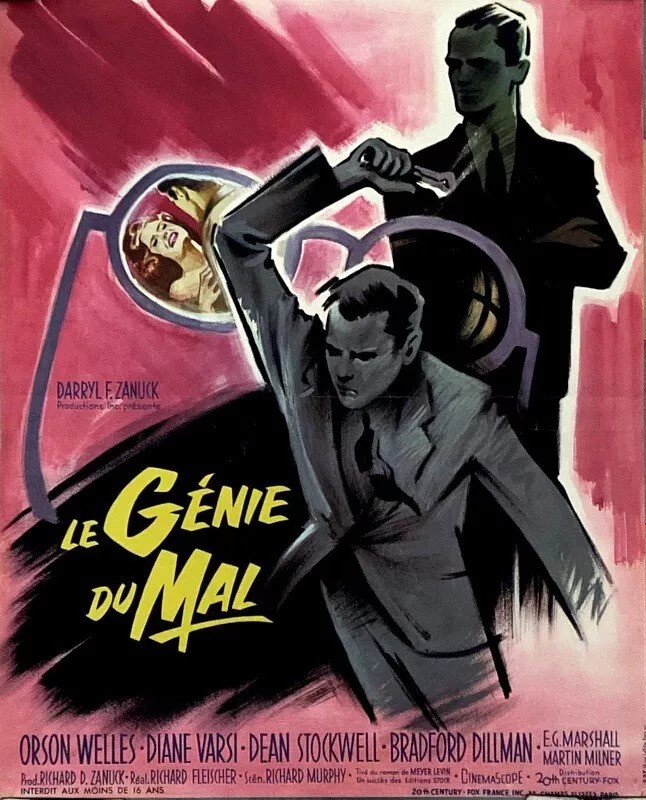
Cocky sexually confident Arthur is the dominant one, constantly tormenting his friend for his social deficiencies, Judd the more vulnerable, astonished to find that someone can interpret the loss of his mother as impinging on his emotional security. We enter the tale post-crime and the narrative assumes the audience is already familiar with the Leopold and Lowe case, which proves a distraction now because I had to look them up to fill in the blanks.
Setting aside their superiority, the movie brings to the fore aspects of criminal behavior only familiar to us from more recent analysis. For example, Arthur wants to remain close to the investigation, offering the police advice, and taking malicious enjoyment out of pointing out possible suspects. Police procedure, which would still have been in its infancy, nonetheless turns upon tracing 4,200 purchases of a very common type of spectacles which, in an unexpected twist, is suddenly whittled down to three thanks to this particular pair containing an unique advanced design element.

However, alibis only fall apart by accident as the pair stick to their rehearsed stories even in the face of intense interrogation, especially Judd’s contention that his spectacles could have fallen from his jacket pocket close to where the body was discovered by pure coincidence. The pair have already confessed when Wilks rides to the rescue, or at least save them from corporal punishment. Most of this is via a legal trick. He places the onus of deciding their fate on the thoughtful judge who can follow legal argument more easily than a bloodthirsty jury appalled at the crime and out for revenge.
In his deployment of Orson Welles, director Richard Fleischer (The Boston Strangler, 1968) plays a blinder. Audiences expecting to see Welles in full bombastic oratory flow were blindsided by the almost apologetic tone taken. There’s virtually none of the usual courtroom sparring and there’s no last-minute witness final twist as was de rigeur for the genre. But, then, you’ve got Orson Welles, the greatest American actor never to win an Oscar, given what he could do with words, glances, whispers and silence. He’s always going to get the last laugh in an exchange of banter, but with a life a stake this isn’t the time for bluster.
It’s an incredibly well-judged performance. Setting aside the monologue, the kind actors would kill for, it’s his general demeanor, almost self-effacing, nothing swanky in his dress, and yet not resorting either to actor gimmicks like wiping sweat from his head with a handkerchief nor even raising his voice. Compare this to the Oscar-winning performance of Gregory Peck in To Kill a Mockingbird (1962) and you’ll wonder why the Academy chose to overlook Welles.
But he’s not the only standout. Bradford Dillman (Circle of Deception, 1961) has the showiest role, oozing icy charm and indifference, but the more obviously emotionally-crippled Dean Stockwell (Psych-Out, 1968) has the more difficult. Perhaps Diane Varsi (Wild in the Streets, 1968) has the toughest part, convincing as the girl who finds something worth caring about inside a killer.
Richard Fleischer has always been unfairly tabbed as the not-great director who made a number of great films. Whichever way your sympathy falls on this issue, this is one of his great movies, steering clear of the sensational, cleverly keeping Welles out of sight until virtually the final third of the movie and then, courtesy of how well he has managed the material, not allowing the actor to steal the show.
Hardly dated at all given the death penalty is still practised in many U.S. states and countries around the world. The plea for clemency isn’t so much the driving force as the acceptance that money doesn’t buy immunity from psychiatric disorder and may well be its cause. Despite his arrogance, Arthur seeks the approval of “Mumsy”, while Judd has no mother. With a host of servants to carry out the parenting, the actual parents can go off and enjoy themselves, ignorant of the dangers of lack of attachment.
It’s still hard to feel any sympathy for the pair, indulging in a thrill kill because wealth protects them and at the mercy of intellect, and while Fleischer makes no attempt at exoneration or mitigation a contemporary audience would intuit more about the family imperfections or lack of parental care or psychiatric awareness that drove them to this.
Unmissable.


 The Magnificent 60s