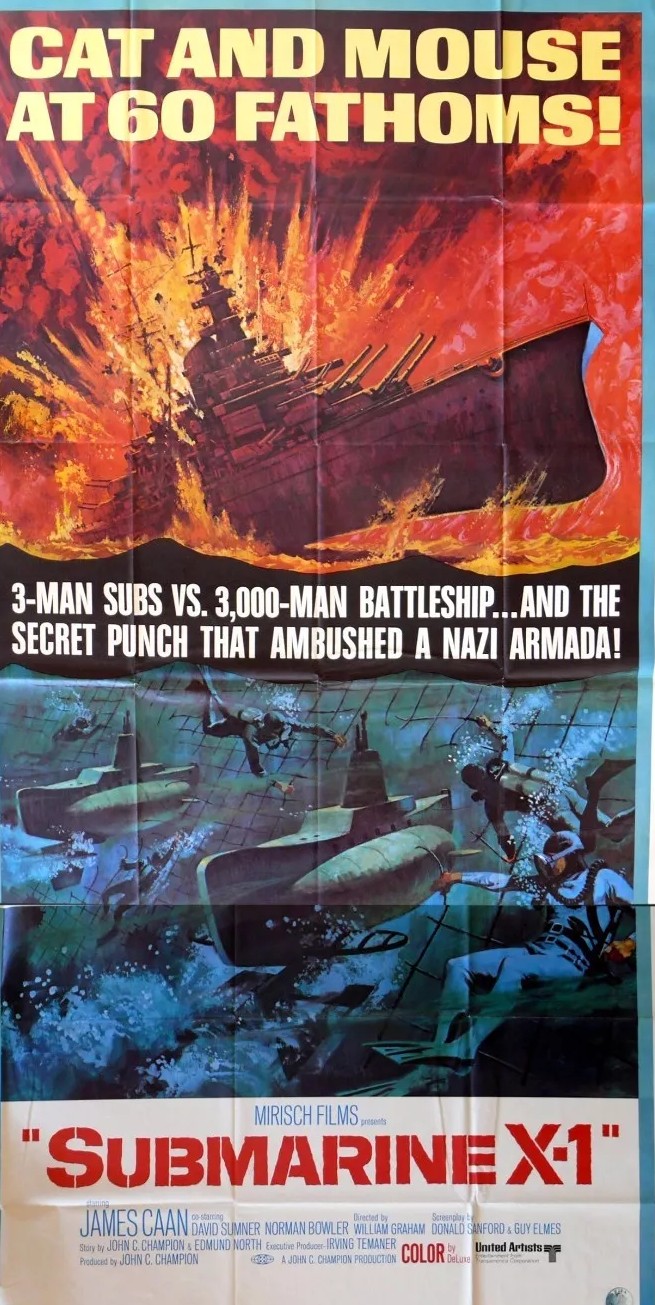
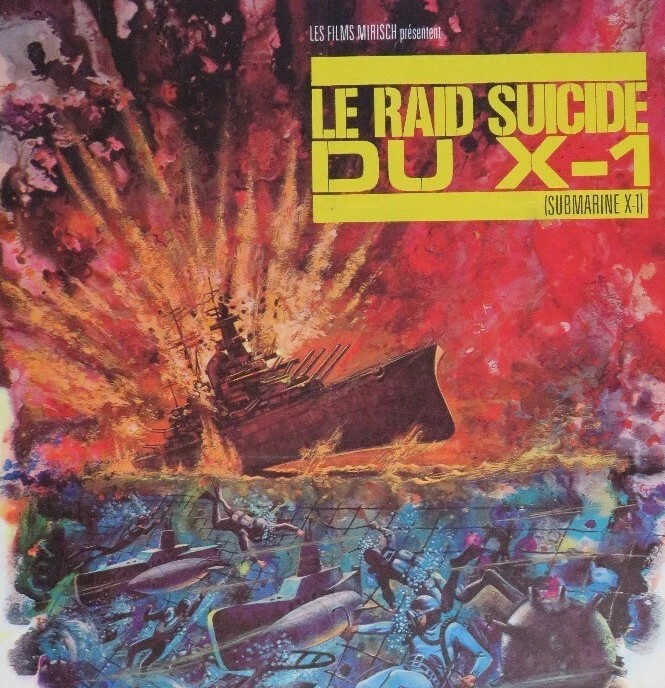
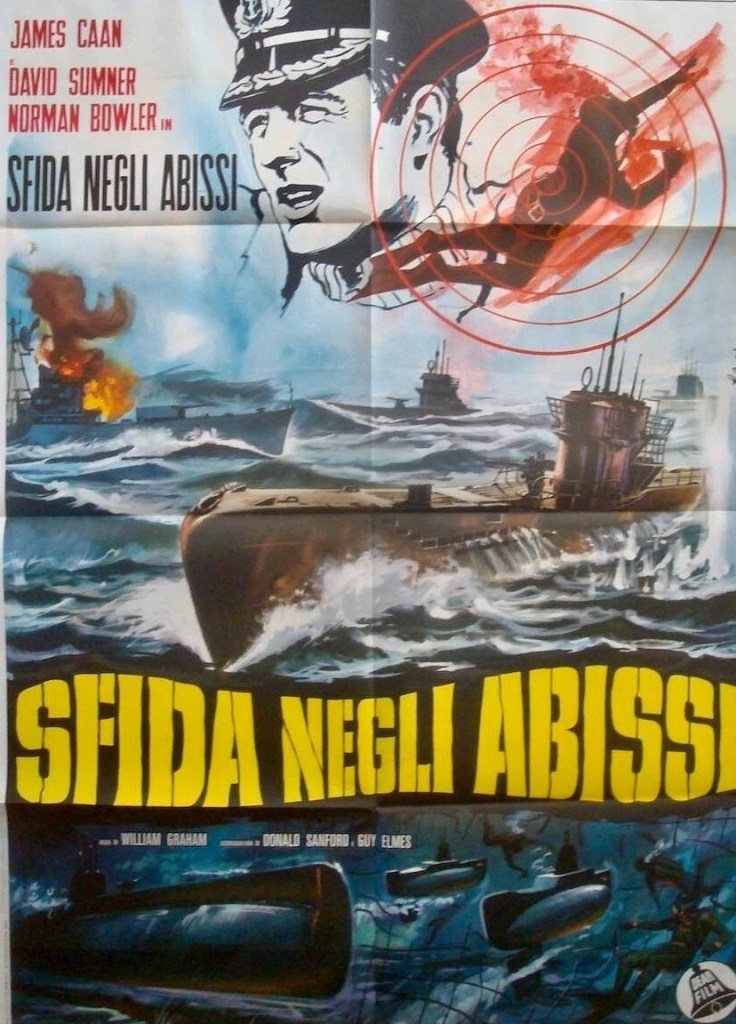
Submarine X-1 (1968) ***

One of the tropes of the World War Two mission picture was that it afforded plenty scope to boost the careers of supporting players – The Dirty Dozen (1967) being the best example given it boasted Charles Bronson, Ernest Borgnine, Donald Sutherland (the denoted breakout star), Jim Brown (another breakout) and Telly Savalas.  Never mind that here you could hardly find an interesting face, never mind well-written character in this one, you were struggling to find the James Caan as defined by The Godfather (1972).

Even with production shrinking and the industry throwing more and more money at the actors who supposedly guaranteed box office, Hollywood was still trying to blood new talent. But most failed to connect – Burt Reynolds was another who took a helluva long time, by movie standards, to find a fanbase.
Though Caan had been chosen by Howard Hawks to headline Red Line 7000 (1965) that had sunk without trace and a supporting role in the director’s El Dorado (1967), while exposing him to a larger audience, had not, as yet, pushed him that far up the Hollywood tree, top billing in neither Robert Altman’s Countdown (1967) nor Games (1967) doing much to bolster his marquee credentials.

His career could go either way – fizz and pop in a part that provided the opportunity to create a defined screen persona or fizzle and die after using up too many Hollywood lives. We all know which way it went so this could be considered a testing ground. And he reins in his screen persona so much he could almost qualify for a Stiff Upper Lip Award.

As ever, Yanks in many World War Two pictures set in Britain had to come in disguise.  Commander Bolton (James Caan) is acceptable in the Royal Navy if he’s Canadian and a volunteer rather than American, though you’d be hard put to distinguish the nationalities by Caan’s accent.
It was also a given of this type of war picture that the recruits hated their leader with a vengeance – Lee Marvin in The Dirty Dozen leading the field, though you could equally point to Frank Sinatra in Von Ryan’s Express (1965) – “why did 600 Allied prisoners hate the man they called Von Ryan more than they hated Hitler” ran the tagline – and William Holden in The Devil’s Brigade (1968). .

Here, Bolton is in hot water for obvious reasons. He was a poor leader, causing the deaths of the majority of his crew on the 50-man submarine Gauntlet after an ill-chosen attack on the German battleship Lindendorf. The movie starts with him and the remainder of the crew staggering out of the water onto dry land. Even when he’s cleared at a tribunal, the stench of incompetence sticks. So it’s any wonder that he’s put in charge of a secret operation with many of the survivors, unless of course it’s the kind of suicide mission that offers redemption.

As it takes forever to reveal, the British have built mini-subs, manned by three men, for a second go at the Lindendorf safely stowed out of the way in the Norwegian fjords. So apart from simmering resentment and mutterings everywhere, the first section is the standard training where, as is par for the course, Bolton is a hard-ass, forcing men dying of exhaustion back into the freezing water to complete the designated exercise.  

Except for incipient rebellion, there’s not much else in the way of plot before we head for the fjords, not even a romance which might make an audience more sympathetic to Bolton. The Germans, somehow, have got wind of this secret mission taking place in a remote part of Scotland (Loch Ness, actually) and send in a parachute team.

On land it’s as dull as ditchwater, but once we head to sea, it’s a more than competent action picture.

If James Caan has learned anything from his first four pictures, it’s not obvious, as mostly what he does is grimace. The supporting stars look as if they knew from the outset that this wasn’t going to do anything for their careers – and with the exception of David Sumner (Out of the Fog, 1962), they made barely a scratch on the movie business.

It didn’t help that the naval operation had been filmed before as Above Us the Waves (1955) starring John Mills (S.O.S. Pacific, 1960) and directed by Ralph Thomas (Deadlier than the Male, 1967).

Directed by William Graham (The Doomsday Flight, 1966) who had just scored a surprising hit with Waterhole #3 (1967). Written by Donald Sanford (The 1,000 Plane Raid, 1969) and Guy Elmes (Kali-Yug, Goddess of Vengeance, 1963).

Torpedoed by the acting, only partially rescued by the action.
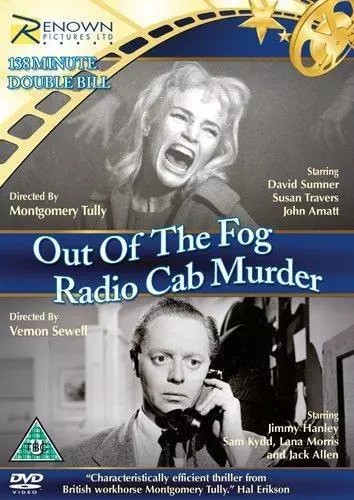
Out of the Fog / Fog for a Killer (1962) ***

Unusual and unusually effective entry into the low-budget British B-film crime category. Teeters for a time on the bittersweet before plunking for ending on a  more realistic sour note. Surprising, too, in being issue-driven – the problem of the rehabilitation of criminals, or the way such efforts are blocked by the general populace wanting nothing to do with thieves and villains, especially when it comes to employment or romance.

On release from prison, George (David Sumner) is given the chance of a new life from do-gooder Tom Daniels (James Hayter) who runs a halfway house for ex-cons. George isn’t particularly grateful, since he sees life stacked up against him. But he’s making an effort and turns down the chance to join the other residents in setting up an illegal scheme. Instead, Tom finds him work as a driver for a furnishings manufacturer where he meets Muriel (Mela White). But their nascent romance is scuppered when the cops come calling, investigating a murder on the “Flats”, an area of wildland close to both the factory where he works and the pub he frequents.

When the killer strikes again, and again, the cops Det Supt Chadwick (John Arnatt) and Sgt Tracey (Jack Watson) realize the murderer is striking at the full moon. Luckily, neither of the detectives is apt to go down the werewolf route, especially as the killer tends to strike when a full moon would be of little assistance because the “Flats” are covered in thick fog (for no apparent reason except the script says so).

George becomes the chief suspect and the cops decide to set up Sgt June Lock (Susan Travers) as bait – odd how often this became a trope in these B-pictures. She’s to befriend George and, come the full moon, prevent herself being killed (the cops are keeping tabs on her) long enough to trap George as the killer.  

There’s generally little time to waste in these running-time-conscious thrillers (this only lasts 68 minutes) on any characterization beyond the obvious but here we discover George has been disowned by his mother, a rather well-off character who lives in a good-sized house in middle-class Chiswick. When he asks to be allowed home, she turns him away and when the cops come calling her first words are, “I don’t have a son.” She’s a cold fish for sure, and hardly the entire reason he’s turned to crime, but it would go some way to explain his general bitterness.

George also appears to have an artistic bent and June encourages him, going so far as lining him up for some work. Before we get to the finale, there are other treats in store, the shrewish mother Mrs Foster (Hilda Fenemore) of the sulking Lily (Coral Morphew) who escaped attack by the killer. The other occupants of the house are also well-drawn, with a villainous hierarchy in operation, and clearly much more likely than George to re-offend.

The cops, too, are more ready than usual to admit defeat. Clues are non-existent what with the fog and any attempt at forensics limited to wondering why George cleaned his shoes so assiduously, the obvious deduction being the existence of mud or grass would have put him close to the crime scene.

In truth, there’s not much to the detection, but at least, as I said, nobody falls for the werewolf line and the idea of the date bait seems to come too easily to the cops.

As it stands, it’s mostly a character study, of a young man who can’t get a break, of society’s attitude to criminals, the lack of redemption available and little chance of a second chance once your past is discovered. I’m not sure how much this was an issue at the time but George exhibits a more understandable seam of bitterness than the likes of the surly Arthur Seaton in Saturday Night and Sunday Morning (1960). The movie only scratches the surface of the affect of a child on the lack of a mother’s love, and since we don’t know what triggered George’s first crime it’s hard to go any deeper.

There’s the chance of a happy ending. June is clearly smitten with George and determined to prove him innocent rather than, as her superiors require, guilty. But bitterness wins out in the end.

Directed by Montgomery Tully (The Terrornauts, 1967) who had a hand in the screenplay along with producer Maurice J. Wilson (Master Spy, 1963) based on the novel by Bruce Graeme.

David Sumner (The Long Duel, 1967) gets his teeth into a peach of a part. Career-wise Jack Watson (The Hill, 1965) fared best though Susan Travers (Peeping Tom, 1960) had a running role in TV series Van der Valk (1972-1973)

Interesting twist on the genre.

Discover WordPress

A daily selection of the best content published on WordPress, collected for you by humans who love to read.

The Atavist Magazine

by Brian Hannan

WordPress.com News

The latest news on WordPress.com and the WordPress community.