Tarzan and the Valley of Gold (1967) ***

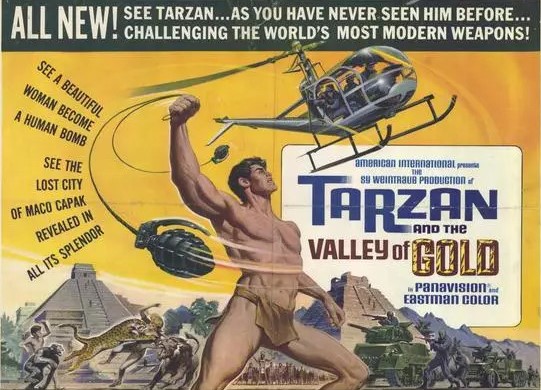
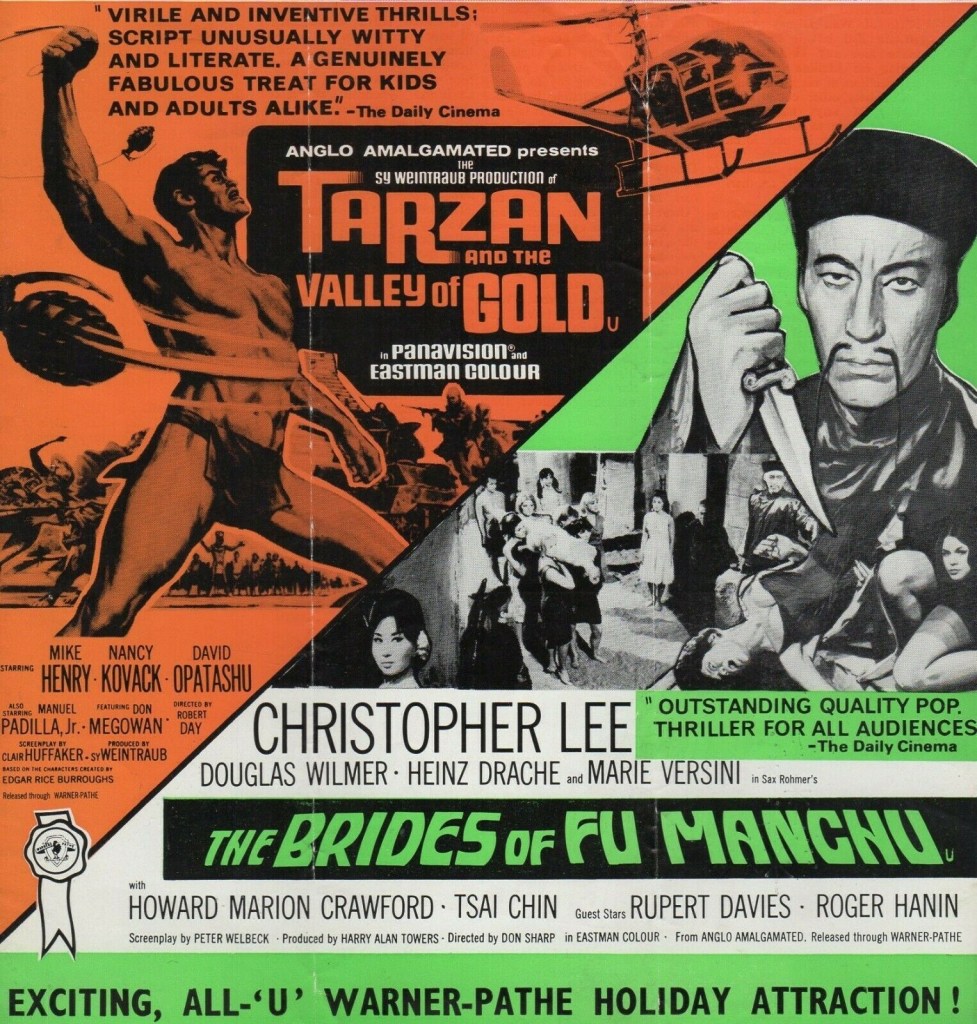
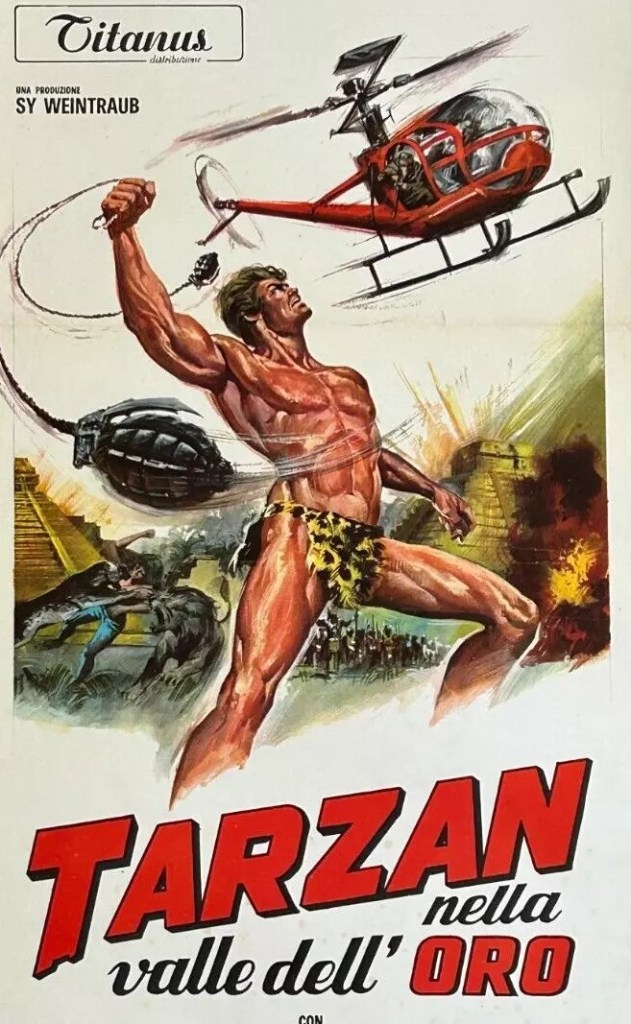
Hooray for hokum. What should have been termed Tarzan: The Next Generation takes our hero temporarily out of loincloth but equips him with a hefty Browning machine gun and rudimentary grenade launcher, not to mention the neat tricks of  repurposing a giant Coca-Cola bottle and bringing stalactites down on the heads of pursuers. Hardly surprisingly he’s toting such weaponry given he’s not just, as was more common, wrestling pesky crocodiles and punching the living daylights of any villain stupid enough to get in his way.

Sadistic evil mastermind Vinero (David Opatashu), has raided the Army Surplus stores for a World War Two M5A1 Stuart light tank, an M3 half track and a Bell 47 helicopter to augment his battalion of 40-odd mean-looking mercenaries. Though he hardly requires them since his favored device is an exploding watch.

Vinero has kidnapped a small native boy Ramel (Manuel Padilla Jr. who reputedly knows the way to an ancient El Dorado complete with Aztec pyramid. Yep, we’re in Mexico, which, incidentally, should screenwriter Clair Huffaker so require, does boast crocodiles as well as jungle. Tarzan is called in to rescue the lad.

He only wears a suit long enough to dispatch an assassin who has dumped him in a football stadium. Once he smells the wild it’s into the traditional loin cloth. He teams up with a Dirty Quarter Dozen comprising chimp Dinky (recruited for his scouting skills, you understand, and his three wise monkeys impersonation), lion Major (specialty: human flesh) and the boy’s pet leopard who will lead our merry crew to the child.

Quite how Ramel was found wandering in the jungle is never explained though it’s perfectly believable that, once lost, he wouldn’t know his way back and would rely on that well-known human compass Tarzan to help him find the way.

There’s quite a lot of trekking one way or another, but, thankfully, that’s interrupted by spurts of sadistic behaviour, an entire village gunned down by Vinero’s henchmen and the big bad guy only too delighted to take time out to demonstrate his incendiary ability in despatching unworthy lieutenants.

To be honest, the jungle doesn’t provide much cover, helicopter ferreting out Tarzan with little problem, only to be downed by his inspired trick of throwing a home-made hand-grenade bolus at the aircraft.

You won’t be surprised to find there’s a fair maiden involved. Her task, unlike previous incursions into this kind of  jungle, is not to be discovered deshabille swimming in a pool. Instead, she’s bait. It’s hard to get a precise fix on Sophia (Nancy Kovack) since for most of the picture she’s Vinero’s mistress. It’s taken her quite some time to become disgusted by his sadistic tendencies. Probably, her rescue is to demonstrate Tarzan’s inherently gentle nature, given he’s got to separate her from a deadly necklace that will explode, so we have been led to believe, by the slightest tremor.

When they reach the lost city – who am I to quibble that a pyramid that can be seen for miles around hardly qualifies as a valley – they discover it is of a distinctly pacific nature, the chief willing to give away all their gold rather than sacrifice a single life, the kind of attitude that conspires against the traditional Hollywood notion of collateral damage.

Chief’s not much trusting of Tarzan and Sophia either and locks them up. Oddly enough, there could easily be an exquisite zero-sum-game at work, a winners-take-all scheme where everyone is a winner, except Tarzan has no truck with the chief’s notion of letting the bad guys get away with as much as they can carry, and Vinero literally digs his own grave by insisting on taking more than he can carry (though I doubt if this is where the makers of Witness, 1985, found their silo death scene).

Mike Henry (The Green Berets, 1968) hulks up pretty well, Nancy Kovack (Marooned, 1969) – replacing Sharon Tate – adds to the scenery, David Opatoshu (Torn Curtain, 1966) underplays the villainy to good effect. Clair Huffaker (Hellfighters, 1968) sufficiently updates Tarzan to a James Bond world. Robert Day (She, 1965) – who had also directed Gordon Scott in the role – delivers the goods.

Enjoyable matinee fare.

The Defector (1966) ***

How often does a government hoodwink a morally upright citizen into deceitful action for the cause of the greater good? In this case physicist Professor James Bower (Montgomery Clift) doesn’t need a great deal of urging because what’s at stake are Russian space race secrets and the man selling them is a Russian scientist he knows from translating his books. It’s apparent from the outset that in setting out to make contact in East Germany, he is walking into a trap. It’s moody, and drab in the vein of The Quiller Memorandum (1966), shot in soulless German streets, and of course it is the final performance, after a four-year screen absence, of a frail-looking Clift, an iconic Hollywood star for nearly two decades.

But genres can be confusing. Although tagged as a spy picture it’s not really a spy film. It’s a character study. In fact, two character studies, the other being a far-from-typical communist. And when you get to the end and realize the sacrifice made in order not to compromise principle, it turns into quite a different movie, one with considerably more depth than you might have imagined.

Bower is a rather adept amateur spy, neatly dodging being followed, and capable of nipping between two moving trams to evade pursuit. His instructions lead him to asking for a particular prescription and being sent in apparent haphazard fashion to an intended meeting with Dr Salter (Hans Messemer), his contact. Instead he is led to Counselor Peter Heinzmann (Hardy Kruger). His hotel room is not merely bugged but fitted with electronic instruments to prevent sleep and distort his mind. Meanwhile Heinzmann is engaged in a hawk-vs.-dove battle with  Orlovsky (David Opatoshu) to determine whose methods, the latter preferring torture and brainwashing, would prove the more successful in forcing Bower to betray the whereabouts of the would-be defector. And there is also a doctor’s receptionist Frieda (Macha Meril), with whom romance so obviously beckons your natural moviegoer instinct is to regard her as lure rather than friend.

It’s a chess game, Bower a pawn, with the net growing tighter, imprisoned in more ways than one, being groomed for defection himself. Although there is double cross, triple cross, murder and an excellent Hitchcockian escape/chase, and a final unexpected, very human, twist, it’s far from your typical spy thriller, in general subtle in tone except for the nightmarish hotel scenes. Heinzmann is also a pawn, fighting a system that sees degradation as its most potent weapon and even while a danger to Bower displays humanity.

Clift’s physical state, skin drawn tight over his face, works to the movie’s advantage, turning him into more of a Glenn Ford-type actor, the staunch man-next-door with steely resolve, but not the kind of character you would imagine Elizabeth Taylor or Marilyn Monroe giving a second glance. In fact, since the story calls for him to be suffering from a mysterious malady – hence the need to seek out a pharmacy and doctor in a foreign country – his features endorse this plot point far better than if he had been fit and well.

Quite what the set was like is anybody’s guess given that not only was Clift dead by the time of the film’s release but that Belgian director Raoul Levy (Hail, Mafia, 1965) – better known as the producer of many Brigitte Bardot films and now helming only his second film – had committed suicide.  

If ever there was proof of star power, this is it. Even when the film is meandering and the plot at times impenetrable, Clift exerts an almost hypnotic hold on the viewer. Despite his clear infirmity, the intensity that enraptured audiences from films as disparate as Red River (1948), From Here to Eternity (1953) and The Misfits (1961) has not vanished. Since many scenes are just meetings that scarcely progress the story, it is quite a feat to keep audiences interested. Far from his greatest performance, he still displays screen presence.

He is helped along by Hardy Kruger (Flight of the Phoenix, 1965) in one of his more measured performances, both men sharing the knowledge that in doing good for their country they are betraying themselves. David Opatashu (Guns of Darkness, 1962) is excellent as his  quietly ruthless superior and there should be mention of  Karl Lieffen as the constantly complaining Major. Even as a dowdy East German, Macha Meril (Une Femme Mariee, 1964) still captivates.  Serge Gainsbourg contributed the music.

Guns of Darkness (1962) ***

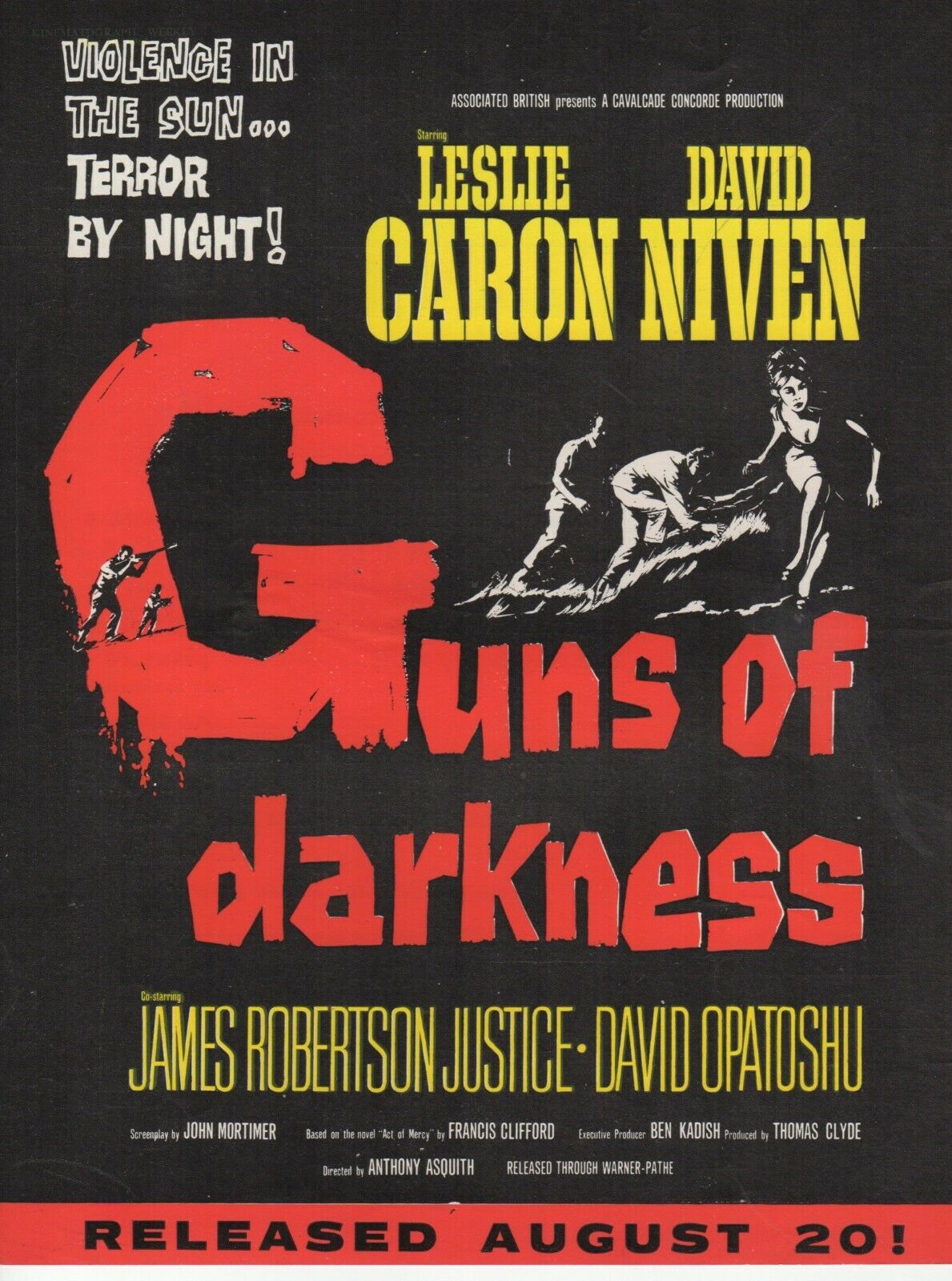
You might think David Lean in Lawrence of Arabia (1962) had cornered the market in startling transitions involving light (from Peter O’Toole’s match to the rising sun) and gut-wrenching scenes involving quicksand but nearly six months prior Anthony Asquith (The Millionairess, 1960) in the less-heralded Guns of Darkness had adopted similar techniques. He cuts from a nightclub singer blowing out a candle to a man lighting a candle in a church and since his film is in black-and-white it cannot hope to match Lean’s fabulous color transition. However, the quicksand scene in the Asquith, I would argue, lacking color or not, is far superior to that of the desert epic.

Thanks to Pygmalion (1938) and The Winslow Boy (1948) Asquith was one of a handful of British directors – Lean, Powell/Pressburger and Carol Reed the others – with an international reputation. Stars David Niven and Leslie Caron had topsy-turvy careers. Niven’s box office cachet had almost disappeared in the mid-1950s before an unexpected Oscar for Separate Tables (1958) and a starring role in The Guns of Navarone (1961). Although Caron had An American in Paris (1951), Lili (1953) and Gigi (1958) on her dance-card she was not an automatic big-name star. It reflects their respective positions that Caron has star billing.

Niven and Caron are an unhappily married couple caught up in a revolution in a fictional South American country. His boyish charm has long worn thin, his employment record is spotty and he is inclined, when drunk, to insult bumptious boss (James Robertson Justice). On New Year’s Eve while an enclave of pampered Brits is counting down to the bells, rebels  are preparing to storm the presidential palace and seize power. Niven seems the last person to give shelter to a fugitive from the revolution, especially when the runaway turns out to be the ex-president Rivero (David Opatoshu, Exodus, 1960). Caron, who has been planning to leave Niven the next day, finds herself involved in the escape.

The couple are both quickly disabused of notions of the saintliness of presidents and peasants, Rivera nearly strangling a child who discovers his hiding place, Caron stoned by villagers, pacifist Niven forced into a horrific act of violence.  

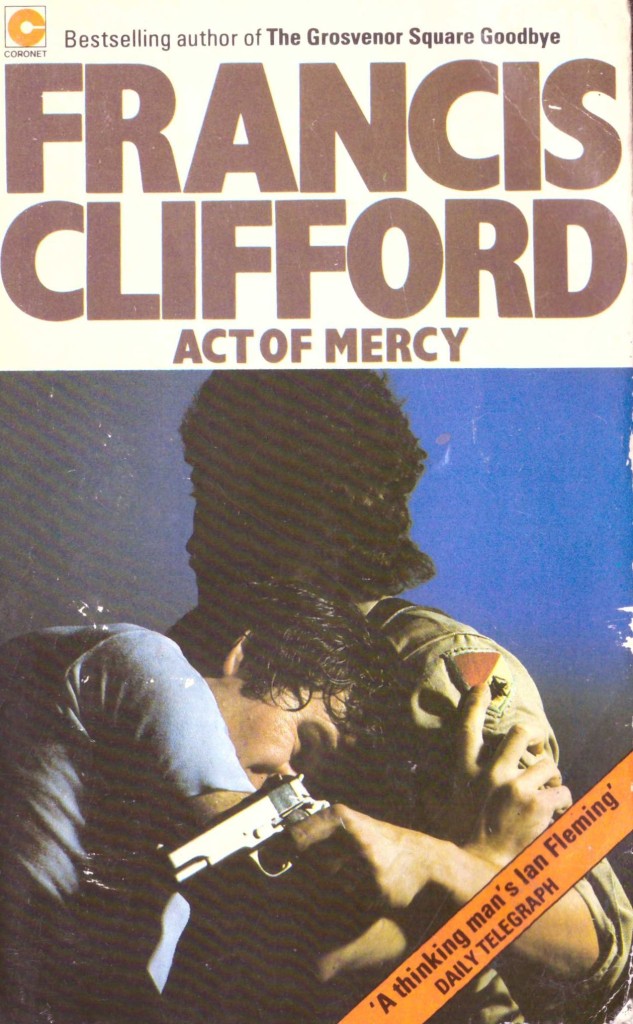
If you ever wondered what screenwriters do to earn their money, this film is a good place to start. It was based on a book “Act of Mercy” by British thriller writer Francis Clifford, who also wrote “The Naked Runner,” also later filmed. The screenwriters changed the David Niven character from the happily married committed businessman of the book to the dissatisfied dilettante of the film. As a happy couple, there are none of the marital tensions in the film. The revolution in the book has already started but in the film it is moved to New Year’s Eve and about to begin. The quicksand scene is a screenwriter’s invention as is the incident with the boy and the massacre in the village.

The pace is brisk from the outset, Asquith cross-cutting between revolutionaries and the Brits and as the manhunt steps up a gear the three escapees face a succession of perilous incidents. Not least is a river that has turned to quicksand. This six-minute scene is a standout, the mud closing in on their heads, Niven having to crawl back to rescue Rivera. As you would expect with this kind of picture there is a fair bit of philosophizing, moralizing and sheer brutality. As the couple flounder towards reconciliation, the script spends some time trying to ascertain Niven’s motives. Had the film stuck to the source book’s title, Act of Mercy, that would not have been necessary.

A taut film with, once the revolution has begun, the British put in their place rather than acting as imperialist overlords. There are a couple of unexpected twists at the end and Asquith finished with a technical flourish of his own, the camera tracking back from people walking forward. Both Niven and Caron are excellent, James Robertson Justice at once cuddly and ruthless, and the picture comes out as a tidy character-driven thriller.

Many of the films from the 1960s are to be found free of charge on TCM and Sony Movies and the British Talking Pictures as well as mainstream television channels. But if this film is not available through these routes, then here is the link to the DVD and/or streaming service.

Discover WordPress

A daily selection of the best content published on WordPress, collected for you by humans who love to read.

The Atavist Magazine

by Brian Hannan

WordPress.com News

The latest news on WordPress.com and the WordPress community.