The Young Girls of Rocheforte / Les Damoiselles de Rochefort (1967) **** – Seen at the Cinema at Bradford Widescreen Weekend

In effervescence and color palette a close cousin to Barbie (2023) with the bonus of being able to call on one of Hollywood’s greatest hoofers, Gene Kelly, in a surprise cameo. He swoops and sways like he was Singin’ in the Sun. And he’s just the icing on the cake in this exuberant throwback to 1950s Cinemascope but with the sensibility of a 1940s musical in which dreams are delivered after a few minor setbacks.

Throw in a long-lost love, an affair that literally went south, an artist who has painted his ideal woman, a couple of literal-minded running French jokes – a woman called Madame Dame and a young sailor whose departure is immi-Nantes – and given the overall light-hearted treatment you would have to treat the presence of a sadistic murderer as being in the comedy vein.

Twins blonde Delphine (Catherine Deneuve) and brunette Solange (Francoise Dorleac) make a living running a music class. Delphine dreams of meeting the ideal man, having already rejected gallery owner Guillaume (Jacques Riberolles) and not too keen on itinerant carney (George Chakiris), while Solange wants a career as a composer, befriending music shop owner Simon (Michel Piccoli) who can put her in touch with old buddy and now renowned pianist Andy (Gene Kelly).

As you might expect the narrative is driven by misunderstandings and meetings choreographed by the minute to fail. This is the kind of film where an actor playing the role of a piano player is not expected to learn to play the piano, just stare into space as though channeling an internal muse or glancing at the sheet music.

There are songs by the dozen – possibly too many (27 singing or dancing sequences), more like a continuous ballet than a traditional musical – but none we’re still humming today, not like tunes from West Side Story (1961), The Sound of Music (1968) or Funny Girl (1968) – though “The Twins Song” probably comes closest. That’s not to put down Michel Legrand’s inventive score, but perhaps to suggest a cultural/language divide. Outside of Danielle Darrieux (Loss of Innocence / The Greengage Summer, 1961) , the singing voices were dubbed, even that of Gene Kelly who lacked the range for the material.

And probably you don’t need to worry about the quality of individual songs as you’ll be swept along by Jacques Demy’s infectious direction. Most of the dancing style reflects West Side Story but with a lighter edge. And it takes little or nothing for characters to burst into song or dance, sometimes that activity going on spontaneously in the background of another scene.

Set in the real seaside town of Rochefort in France and making use of genuine locations, the action kicks off on an unique type of bridge as the carnival comes to town. While not strictly a feminist endeavour, men are mostly put in their place, overtures rejected, marriage offers turned down and bad employers shown the door.

The appearance of Gene Kelly, who hadn’t worn his dancing shoes in more than a decade, gives this an enormous fillip as his classic style shows the others just how it’s done. But it’s the lightness of touch, as well as being able to plumb a well of emotion, that gives this film its grounding, Deneuve and Dorleac as well as Darrieux carrying the movie. George Chakiris (Diamond Head, 1962) looks more at home here than in any film other than West Side Story.

Jacques Demy and Michel Legrand had teamed up previously for The Umbrellas of Cherbourg / Les Parapluies de Cherbourg (1964). Catherine Deneuve (Mayerling, 1969) and Francoise Dorleac (Genghis Khan, 1965) were sisters. Tragically, Dorleac was killed in a road accident prior to the film opening.  

But the whole enterprise is so effortless and appealing you can’t help being drawn in.

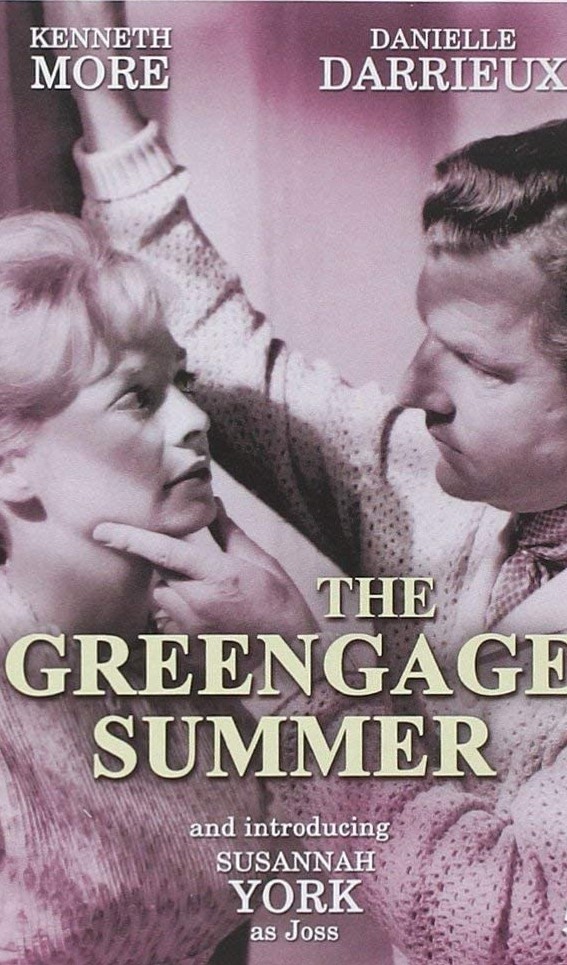
Loss of Innocence / The Greengage Summer (1961) ***

The alternative title assumed nobody in America knew what a greengage was – it’s a type of plum – but the new title was actually pretty apposite. Until then director Lewis Gilbert had been known mostly for Second World War pictures like Reach for the Sky (1954) and Carve Her Name with Pride (1955) so this was a considerable change of pace, and filmed on location in France.

Joss (Susannah York) takes center stage as a girl on the brink of womanhood who experiences powerful emotions for the first time – love and its perpetual bedfellow jealousy – as well as rite-of-passage experiences like getting hammered on champagne. She is the oldest of four siblings stranded in a French chateau when their mother takes ill.

Left to her own devices, she promptly falls for the suave and much older Eliot (Kenneth More) who has interceded on their behalf when the hotel owner is against putting up with a bunch of motherless children. Matters are complicated because Eliot is having an affair with chateau owner Zizi (Danielle Darrieux) and by Joss attracting the attention of Paul (David Saire), a hotel worker closer to her own age. In short time, the situation is brimming over with suppressed emotion.

Hester (Jane Asher), suddenly aware of the romantic havoc being wreaked by her older sister, is going through her own transformation, jealous that the unrequited love of Paul is not directed towards her, her emotions flying off the handle when she triggers a violent altercation with a local lad.

Despite the distributor’s best efforts – the tagline promises “A Summer of Evil” – by modern standards this is a gentle tale, but not without a harsh undercurrent. York is superb as she undergoes a transformation from uncertain schoolgirl to a woman realizing the power her beauty can exert. She flares from child to adult and back again in seconds.

The main U.S. poster and this one seem determined to add seediness to the tale.

Susannah York (They Shoot Horses, Don’t They, 1969) had won her big break after a sparkling performance in a small role in Tunes of Glory (1960) and she floats effortlessly between chalet school pranks and more serious misdemeanors including drunkenness.

Sometime child actor Jane Asher (still better known as Paul McCartney’s girlfriend or for her cakes rather than stunning turns like Deep End, 1970) also achieves a career breakthrough and you could argue that she edges out York in a role that calls for more balance.

Kenneth More (Sink the Bismarck!, 1960) was at his charming best in the kind of affable role he had generally moved away from, but his character has a darker side. More importantly, as an older adult infatuated with a young girl, he manages to steer well clear of any inherent  creepiness. There is no sense of him exploiting the situation, rather trying to guide the young woman in the art of love.

The dialogue is surprisingly good and Danielle Darrieux (better known as one of Darryl F. Zanuck’s girlfriends rather than for the likes of Romain Gary’s The Birds Go To Die in Peru, 1968) is convincing as an aging beauty willing to do anything to hold onto her man.  There is an interesting under-developed subplot too dangerous to explore at this point in the decade of the hotel manager Madame Corbet (Claude Nollier) clearly being in love with Zizi.

The young Elizabeth Dear (The Battle of the Villa Florita, 1965), making her debut, also enhances her career and British character actor Maurice Denham (Danger Route, 1967) has a small role. 

Lewis Gilbert’s subtle direction set his career on a new course that would ultimately deliver an Oscar nomination for Alfie (1966).  The Howard Koch (The Fox, 1967) screenplay draws heavily on the source novel by Rumer Godden, an expert in the suppressed complexities of female life, best displayed in Black Narcissus (1947) and The Battle of the Villa Florita

The scenery is a bonus as are the snatches of provincial French life. All in all, an engaging piece of work, with Susannah York delivering a star-is-born kind of turn.      

The Greengage Summer (1961) *** aka Loss of Innocence

The alternative title assumed nobody in America knew what a greengage was – it’s a type of plum – but it was actually pretty apposite.

Until then director Lewis Gilbert had been known mostly for Second World War pictures like Reach for the Sky (1954) and Carve Her Name with Pride (1955) so this was a considerable change of pace, and filmed on location.

Susannah York, who had sparkled in a small role in Tunes of Glory (1960), now took center stage as a girl on the brink of womanhood who experiences powerful emotions for the first time – love and its perpetual bedfellow jealousy – as well as rite-of-passage experiences like getting hammered on champagne.

She is the oldest of four siblings stranded in a French chateau when their mother takes ill. Left to her own devices, she promptly falls for the suave and much older Kenneth More who is having an affair with chateau owner Danielle Darrieux (another of Darryl F. Zanuck’s girlfriends).

By modern standards, this is a gentle tale, but not without some harsh moments and York is superb as she undergoes a transformation from uncertain schoolgirl to a woman realizing the power her beauty can exert. She flares from child to adult and back again in seconds. York was headstrong in real life and insisted on being drunk during the drunken scene, which ruined a day’s work.

That was not the only crisis – there were no greengages due to poor weather so they had to be flown in from Britain and sewn onto the trees. Jane Asher plays the more sensible younger sister who is not above violent emotion herself such as fisticuffs with a local lad. Kenneth More is at his charming best in the kind of affable role he had generally moved away from.

The dialogue is surprisingly good and Darrieux is convincing as an aging beauty willing to do anything. The scenery is a bonus as are the snatches of provincial French life. All in, an engaging piece of work, with York delivering a star-is-born kind of turn.      

https://www.amazon.co.uk/Greengage-Summer-DVD-Kenneth-More/dp/B002X7TXDS/ref=sr_1_1?crid=38KFOWT9944AW&dchild=1&keywords=the+greengage+summer+dvd&qid=1593761026&s=dvd&sprefix=the+greengage+summer+%2Cdvd%2C172&sr=1-1

Discover WordPress

A daily selection of the best content published on WordPress, collected for you by humans who love to read.

The Atavist Magazine

by Brian Hannan

WordPress.com News

The latest news on WordPress.com and the WordPress community.