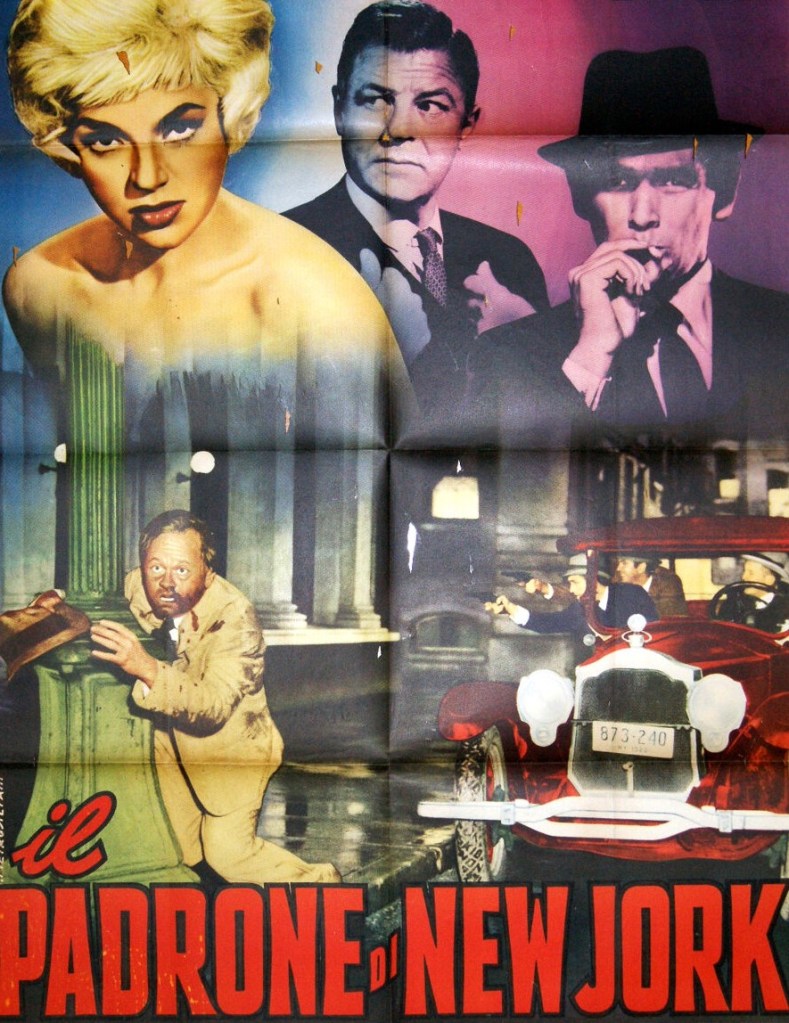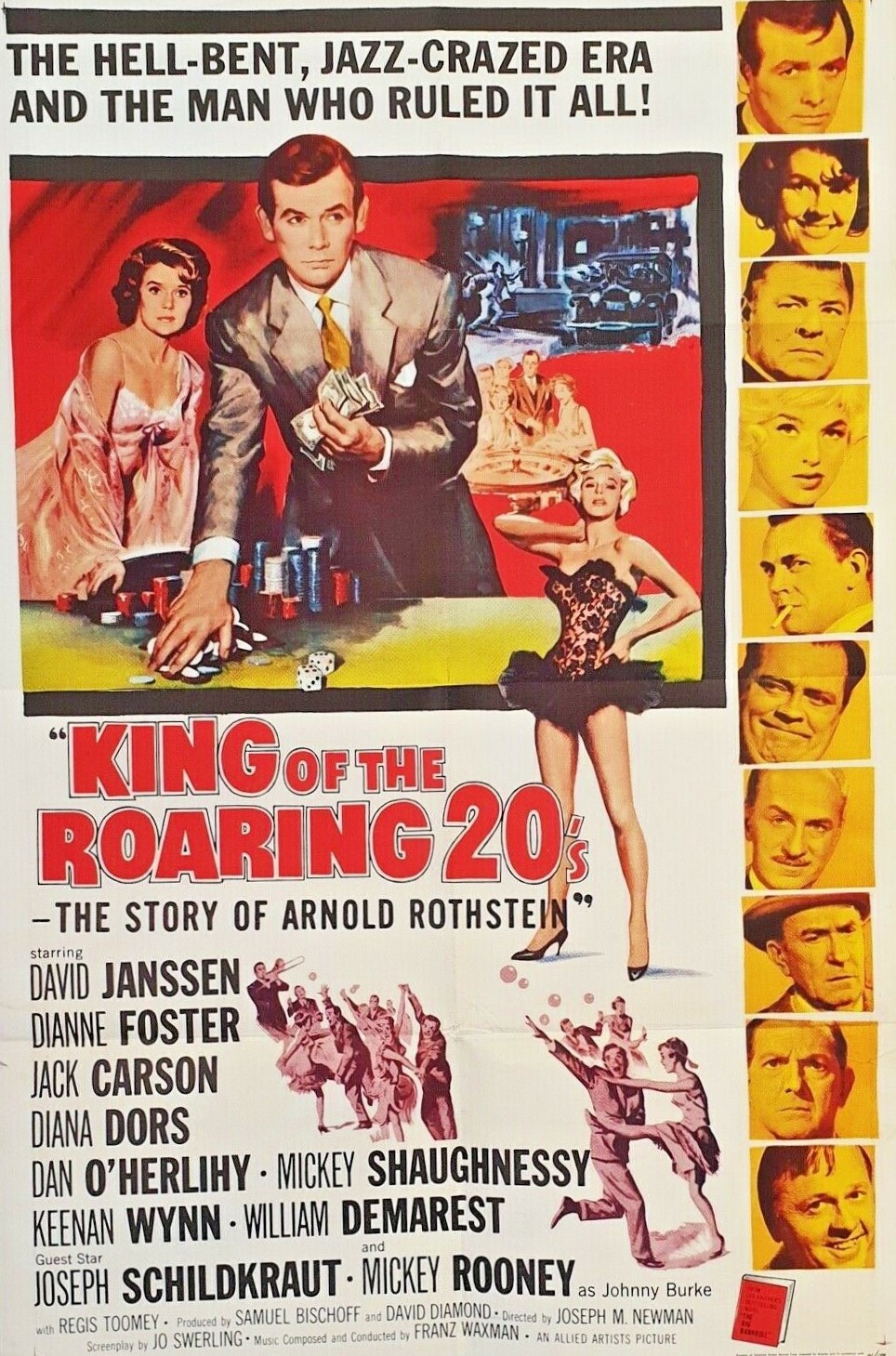
King of the Roaring 20s (1961) ***

Occasionally stylish B-picture purporting to tell the story of American Prohibition-era gangster Arnold Rothstein. It’s more of drama with various nefarious figures trying to outwit each other rather than a shoot ‘em up in the style of Al Capone (1959). David Janssen (Warning Shot, 1967) is ideal casting as the thoughtful, cold, calculating and possibly gambling genius Rothstein, the opposite of an intemperate crook like Capone.

The story is told essentially in two parts, Rothstein’s rise to power in partnership with childhood pal Johnny Burke (Mickey Rooney), initially running dice games in the street and  pulling the odd con before graduating to fly-by-night horse racing operations. When the opportunity arises to move into mainstream illegal gambling, he dumps Burke. Corrupt cop Phil Butler (Dan O’Herlihy) is a constant thorn in his side and showgirl fiancée Carolyn Green (Dianne Foster) views marriage as risky – “he’s the gambler but I’m the one that’s going to be doing the gambling.”

For whatever reason, the movie dodges what was believed to be Rothstein’s biggest coup, the fixing of the baseball World Series, but one long section is devoted to how he pulls off a massive horse racing win where he ends up placing a $100,000 bet through insider information and strategic betting. Inevitably, his gambling puts the kibosh on his marriage but by far the most interesting part of the picture is the chicanery as he shakes off one partner, battles another, and without compunction sets up Burke as patsy to settle his score with Butler.

In some respects Rothstein is a template for Vito Corleone (The Godfather, 1972) in terms of his business brain and ability to out-think and out-fox opponents and certainly his facial expressions and innate coldness bear comparison with what Al Pacino brought to his characterization of Michael Corleone. Except that he didn’t trust banks, and carried round wads of cash (hence the title of the biography on which this is based – The Big Bankroll), it’s hard to get a sense of the wealth the gangster generated or, given the minimal violence,  the world of imminent peril he inhabited. 

Period detail is cursory, limited to dancing the Charleston and pouring champagne into teacups. A better idea of the flavor of the times is the wholesale corruption endemic in police departments, untrustworthy lawyers and hypocrisy run wild.  It’s not really Janssen’s fault that it’s hard to warm to such a cold-blooded character, although you could point to The Godfather and The Brotherhood (1968) for that matter as examples of Mafia hoods who do elicit audience empathy.

With occasional bravura moments involving long tracking shots and overhead shots, and a terrific image of champagne bubbles seen through a pair of binoculars, director Joseph M. Newman (This Island Earth, 1955) shows stylistic flourishes that eschew his B-movie roots. Given Janssen is called upon to show as little emotion as possible, he does very well. Dianne Foster (The Last Hurrah, 1958), though initially demure, provides the fireworks. Jack Carson (The Bramble Bush, 1960) as kingpin Tim O’Brien matches Janssen in the cool stakes and proves a worthy adversary. Rooney overacts but Dan O’Herlihy (The Night Fighters, 1960) relishes his dirty cop role.

In a rare Hollywood outing British sexpot Diana Dors (Hammerhead, 1968) puts in an unexpected and brief appearance as Carolyn’s cynical flatmate. The tremendous supporting cast includes Keenan Wynn (Point Blank, 1967), Mickey Shaughnessey (North to Alaska, 1960), Regis Toomey (The Last Sunset, 1961), Oscar-winner Joseph Schildkraut (The Diary of Anne Frank, 1959) and veteran character actor William Demerest.

Jo Swerling (It’s a Wonderful Life) delivers a pointed screenplay focusing on gangster conflict with some excellent observation of the deterioration of the Rothstein marriage and the nervousness of the usually ice-cold Rothstein when confronted by his father. This is one of those pictures that you think deserves a Netflix series, a dozen or so episodes to explore the myriad characters involved and especially to examine Rothstein in forensic detail. The movie spells out that potential and on a tight budget does it well.

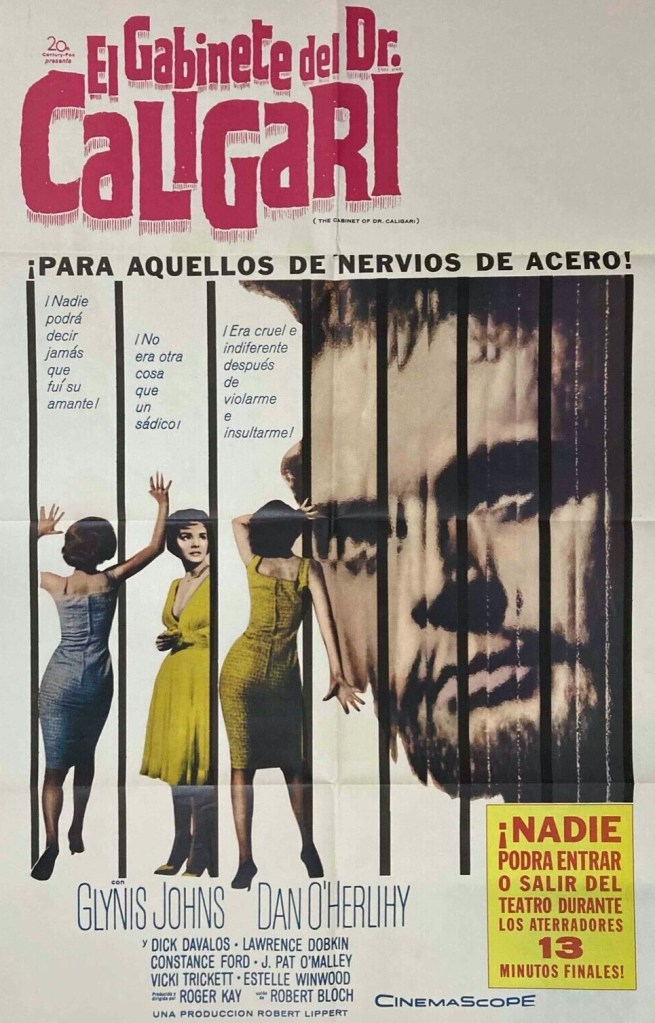
The Cabinet of Caligari (1962) ***

If you’re going to put an English rose through the mill who better than husky-voiced Glynis Johns and except for the giveaway title you might expect from her previous screen ventures that when her car breaks down in a foreign country we’re all set for romance. But you’re probably on the alert anyway after realizing Robert Bloch (Psycho, 1960) wrote the script. The narrative engine runs on twists and the chances would be poor of audiences comprehending the psychiatric devices involved so it’s pretty much a contemporary haunted house mystery with our heroine trapped in an ever-worsening situation and most of the terror emanating from her own mind.

After her tire blowout, and exhausted from trudging along country roads, Jane (Glynis Johns) seeks help from Swede Caligari (Dan O’Herlihy) who owns a large estate in the country. But when she wakes up in the morning, she is unable to leave or telephone for help. There follows a series of disturbing events including (a la Psycho) a peeping tom (bath not shower), being presented with pornographic photographs, interrogated, witnessing torture and being chased by revolving glass. Other images are terrifying, babies baked in ovens, people buried up to their necks, a torture rack. Nothing and nobody are what they seem.

The twist is that she’s in a mental asylum, the car breakdown a fiction to make acceptable to herself her presence there, the other incidents all explained as various versions of psychiatric treatment including electric shock. The central conceit, that she’s trapped, is well-maintained what with other guests dressing in glamorous fashion for dinner and none behaving like inmates. But when Jane tries to make friends with them in order to organize a breakout or escape, she doesn’t know who to trust, and even attempts seduction.

It kind of works and kind of doesn’t. When the camera explains seconds later the reality behind her crazy visions, it ruins the effect. The expressionistic approach helps in presenting the visuals but can’t provide proper insight into her state of mind. The images are odd rather than helping the story. There’s a disjointed feel to the whole thing, as if director and star were on different planets. And there’s a major plot flaw suggesting Jane must be truly out of her mind if she can’t recognize that Caligari and inmate Paul are the same person, give or take a false beard.

It was a bold career choice for Glynis Johns (Dear Brigitte, 1965), generally the sassiest of heroines, to be so out of control. In his only movie, television director Roger Kay makes a bid for the big time with his visuals but too often loses sight of the characters. Of course, it was always going to be a tough ask to match the original German The Cabinet of Dr Caligari (1920) though I doubt many who saw the loose remake would be aware of its existence.

Interesting for the visuals and Glynis Johns losing the rag.

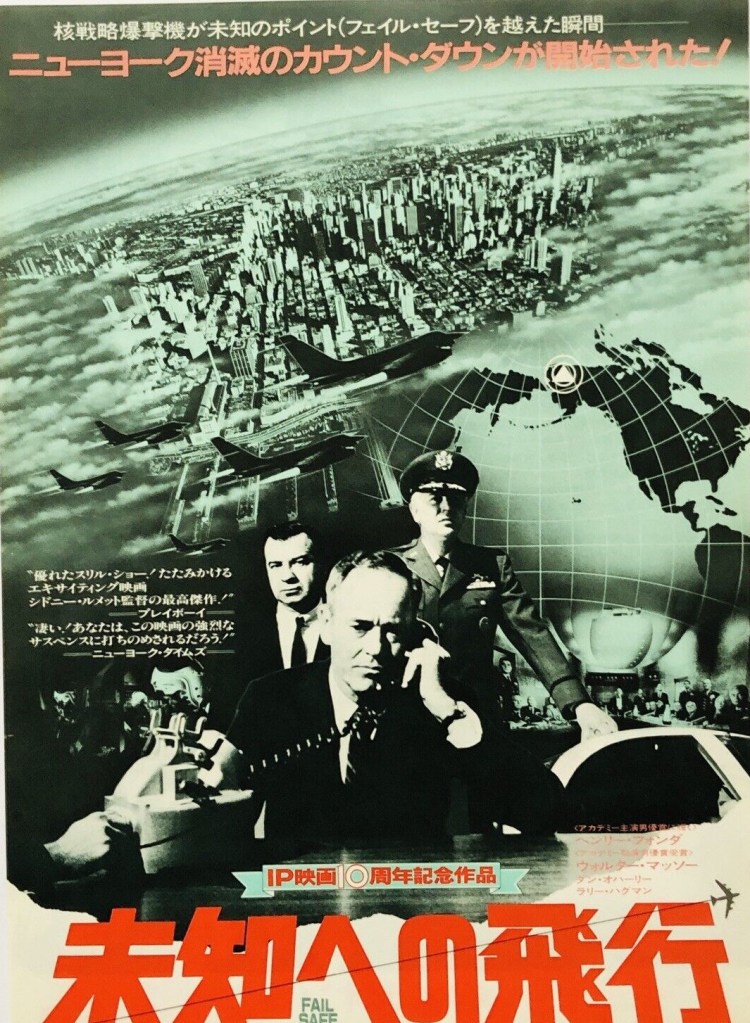
Fail-Safe (1964) *****

Given unexpected heft by current concerns over AI. Human error, it appears, is more simple to correct than computer malfunction. Once a course of action commences, machines have no way of checking it. And paranoia is the first casualty of truth. Bear in mind this was shockingly contemporary at the time it was made, the world in constant fear of nuclear war, the Cold War, that seemingly endless stalemate doing little to pacify terror.

Those whose job it ease the best outcome in the event of nuclear war were always inclined to rationalize staggering death tolls. So we begin with a late night discussion in which political analyst Dr Groeteschele (Walter Matthau) makes the argument that in the event of war, the country with the fewest casualties is the winner and in a nod to the ironic suggests the most likely survivors would be the worst type of convict, imprisoned underground, and office workers protected from the blast by being surrounded by filing cabinets crammed full of paper.

Just before the real drama begins there’s a neat scene where a women, turned on by a powerful man, makes a move on the doctor only to be slapped into place, sternly told by the prim analyst that he’s not of “her kind.” That’s not the only human element in the tale. the highest levels of secrecy may force top-level Army and Government executives to sacrifice families.

For no accountable reason, jets with nuclear warheads shift into an attacking position on the Russian border, the target if not stopped Moscow. The planes are unstoppable once they commence attack, unable to turn away from a strict sequence of pre-determined action. Not even the personal intervention by the President (Henry Fonda) of the United States can affect the outcome, the pilots already trained to ignore such an action on the grounds that the  enemy could be imitating the President’s voice.

When the planes fail to turn back, the only option is for the Americans to blow their own planes out of the sky, an action that appears not just inconceivable to the Army personnel but treasonable. High-rankings officers ruthless trained for battle and to observe the protocol of obeying orders find this unconscionable.

Three dramas take place at once. On the ground the Army chiefs try to explore every option to avoid the unthinkable while battling with their own consciences at what appears to be the only way out. The President on the hotline to the Russian premier has to circumvent natural suspicion that this is a cunning ploy by the Yanks and then come to some agreement with the Russians on the assumption that Moscow may yet come under attack. We, the audience, are playing out the third element in our minds, a series of terrifying what if scenarios with indescribable consequence.

I’m not going to reveal the shock ending because it came as a hell of a shock to me, given I’d not seen the picture in decades.

It’s brilliantly-made with almost futuristic sets and noir lighting and the President effectively physically imprisoned, and not just by his conscience, stuck in a featureless cell presumably in the pits of the White House arguing the toss with the Russian chief, his only companion the translator (Larry Hagman) whose face seems to get greyer and greyer as he transmits worse and worse news.

Dr Groeteschele makes matters worse, at least to a pacifist left-wing viewer (though an opposite view would be taken by the hawks), by urging the President to take advantage of computer error and “first strike” and blow Russia to pieces, assuming that indulging in the attack option will result in fewer casualties in America, and thus, following his earlier projections, not just win the war but rid the word of the fear of nuclear war.

While the style is documentary, it’s a riveting watch. The tension is unbearable. Some like Col Cascio (Fritz Weaver) succumb to the pressure while the commanding General Black (Dan O’Herlihy) retains a stolid soldierly presence.  

Sidney Lumet (The Pawnbroker, 1964) doesn’t put a foot wrong. Taking the line – rather than in The Bedford Incident (1965) of the wrong man with his finger on the button – of the right man trying to make the best of a botched job, he delivers a just superb picture. Walter Bernstein (The Magnificent Seven, 1960) does a terrific job in delivering a taut screenplay from a more meandering novel by Eugene Burdick and Harvey Wheeler.        

There probably couldn’t be a more prescient movie for today.

King of the Roaring 20s (1961) ***

Occasionally stylish B-picture purporting to tell the story of American Prohibition-era gangster Arnold Rothstein. It’s more of drama with various nefarious figures trying to outwit each other rather than a shoot ‘em up in the style of Al Capone (1959). David Janssen (Hell to Eternity, 1960) is ideal casting as the thoughtful, cold, calculating and possibly gambling genius Rothstein, the opposite of an intemperate crook like Capone.

The story is told essentially in two parts, Rothstein’s rise to power in partnership with childhood pal Johnny Burke (Mickey Rooney), initially running dice games in the street and  pulling the odd con before graduating to fly-by-night horse racing operations. When the opportunity arises to move into mainstream illegal gambling, he dumps Burke. Corrupt cop Phil Butler (Dan O’Herlihy) is a constant thorn in his side and showgirl fiancée Carolyn Green (Dianne Foster) views marriage as risky – “he’s the gambler but I’m the one that’s going to be doing the gambling.”

For whatever reason, the movie dodges what was believed to be Rothstein’s biggest coup, the fixing of the baseball World Series, but one long section is devoted to how he wins $850,000 (equivalent to $13 million today) on his horse Sidereal at odds of 30 to 1 at the New York Aqueduct track on July 4, 1921, through insider information and strategic betting. Inevitably, his gambling puts the kibosh on his marriage but by far the most interesting part of the picture is the chicanery as he shakes off one partner, battles another, and without compunction sets up Burke as patsy to settle his score with Butler.

In some respects Rothstein is a template for Vito Corleone (The Godfather, 1972) in terms of his business brain and ability to out-think and out-fox opponents and certainly his facial expressions and innate coldness bear comparison with what Al Pacino brought to his characterization of Michael Corleone. Except that he didn’t trust banks, and carried around wads of cash (hence the title of the biography on which this is based – The Big Bankroll), it’s hard to get a sense of the wealth the gangster generated or, given the minimal violence,  the world of imminent peril he inhabited. 

Period detail is cursory, limited to dancing the Charleston and pouring champagne into teacups. A better idea of the flavor of the times is the wholesale corruption endemic in police departments, untrustworthy lawyers and hypocrisy run wild.  It’s not really Janssen’s fault that it’s hard to warm to such a cold-blooded character, although you could point to The Godfather and The Brotherhood (1968) for that matter as examples of hoods who do elicit audience empathy.

With occasional bravura moments involving long tracking shots and overhead shots, and a terrific image of champagne bubbles seen through a pair of binoculars, director Joseph M. Newman (This Island Earth, 1955) shows stylistic flourishes that eschew his B-movie roots. Given Janssen is called upon to show as little emotion as possible, he does very well. Dianne Foster (The Last Hurrah, 1958), though initially demure, provides the fireworks. Jack Carson (The Bramble Bush, 1960) as kingpin Tim O’Brien matches Janssen in the cool stakes and proves a worthy adversary. Oscar nominee Rooney overacts but another Oscar nominee Dan O’Herlihy (The Night Fighters, 1960) relishes his dirty cop role.

In a rare Hollywood outing British sexpot Diana Dors (Hammerhead, 1968) puts in an unexpected and brief appearance as Carolyn’s cynical flatmate. The tremendous supporting cast includes Keenan Wynn (Point Blank, 1967), Mickey Shaughnessey (North to Alaska, 1960), Regis Toomey (The Last Sunset, 1961), Oscar-winner Joseph Schildkraut (The Diary of Anne Frank, 1959) and veteran character actor William Demerest.

Jo Swerling (It’s a Wonderful Life, 1946) delivers a pointed screenplay focusing on gangster conflict with some excellent observation of the deterioration of the Rothstein marriage and the nervousness of the usually ice-cold Rothstein when confronted by his father. This is one of those pictures that you think deserves a Netflix series, a dozen or so episodes to explore the myriad characters involved and especially to examine Rothstein in forensic detail. The movie gives a hint of that potential and on a tight budget does it well.

Hard to find unless you fancy paying $90 for a DVD or $24 for a VHS video, but you will find copies on the secondhand market.

Discover WordPress

A daily selection of the best content published on WordPress, collected for you by humans who love to read.

The Atavist Magazine

by Brian Hannan

WordPress.com News

The latest news on WordPress.com and the WordPress community.