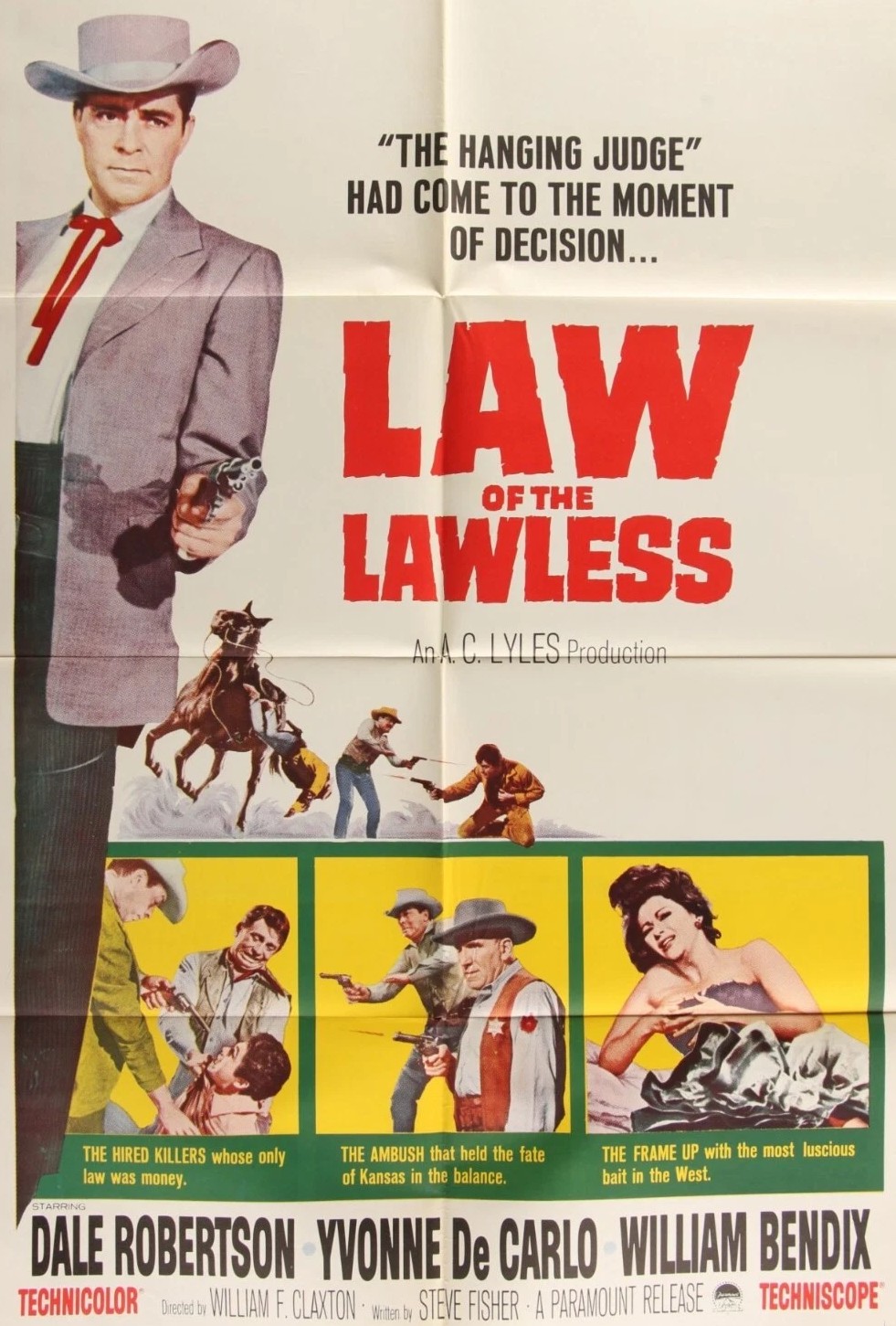
Law of the Lawless (1964) ***

I’m rescuing another low-budget western from critical oblivion. While this can’t boast existentialism to boost its credentials or claim to belong to the cult fraternity and, technically, doesn’t belong to the revisionist sub-genre which was beginning to gather pace, and while you won’t go to this for visual style or striking composition, there is more than enough going on for it to be worthy of reassessment.

For a start it majors on remorse. You might come across a western hero who bitterly regrets the woman cast aside or the family abandoned (though more likely such actions will sit lightly), but you’ll virtually never find anyone who regrets using the gun, whether for righteous reasons or not. But here you’ve got the two main characters, one on the side of the law and the other of a criminal disposition, who both show remorse for their actions. And had the director been more disposed to the visual he would have made a great deal more of the scene where the black-garbed widows arrive in town, victims of both gunslingers who killed their husbands and of the judges who pronounced the death sentence on their gunslinging husbands.
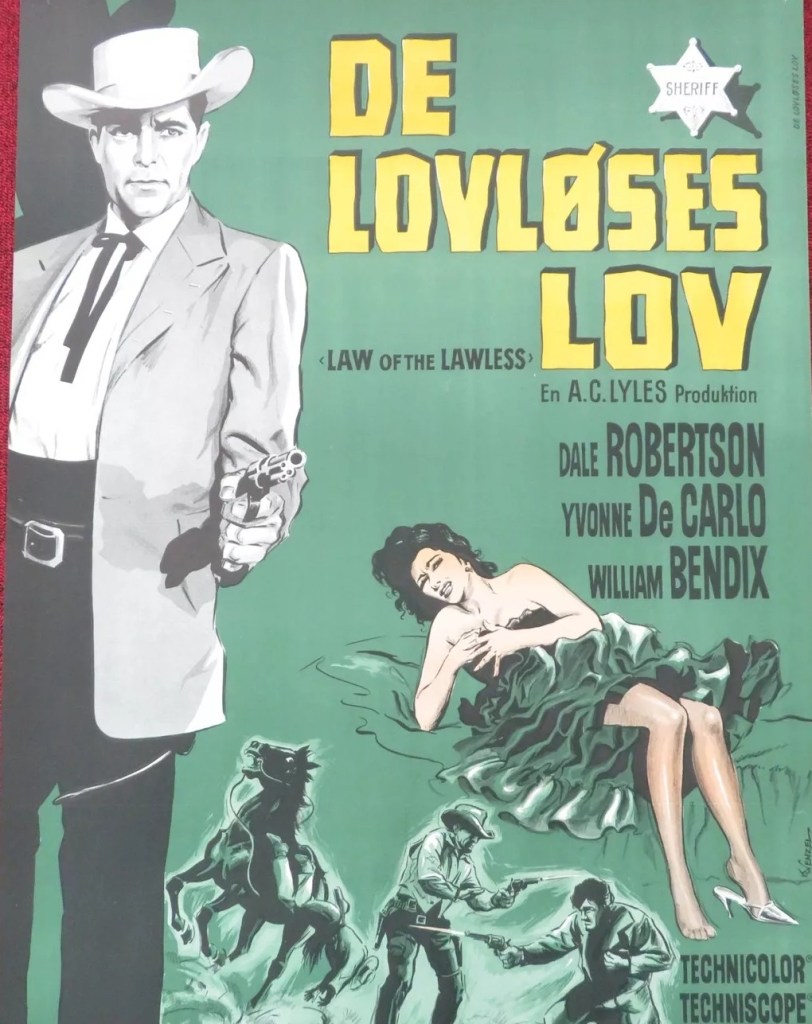
And there’s considerable pause to imagine what happens to such widows. Unless they can find a benefactor, perhaps an older unmarried rancher or a widower, they are going to end up working in saloons and selling their bodies. On top of that we have a cracker of a courtroom drama where the exceptionally clever lawyer can twist the facts to suit his client.

This could also have been another kind of western altogether, the one where the hero is constantly beset by a variety of enemies, and the narrative therefore one of tension. But Judge Clem Rogers (Dale Robertson) has four separate outfits baying for his blood and still director William F. Claxton manages to also fit in all these ideas about remorse, the law, widows, conniving lawyers, the entitled of that era, and failed romance.

Rogers is in town for the trial of former friend Pete (John Agar), son of Tom (Barton McClane) the biggest rancher around, for killing someone in cold blood. Tom, a piece of work, has various plans to tilt the odds in his favor, first planning to blackmail Rogers over being caught in a honeytrap with Pete’s fiancée Ellie Irish (Yvonne DeCarlo) and whichever way the trial goes he has hired gunslinger Joe Rile (Bruce Cabot) at a fee of $10,000 to kill the judge. Rile and Clem have history, the gunslinger killed the judge’s father. And it’s Tom who hits on the scheme of embarrassing the judge by flooding the town with widows, many of whom are widows thanks to Rogers.
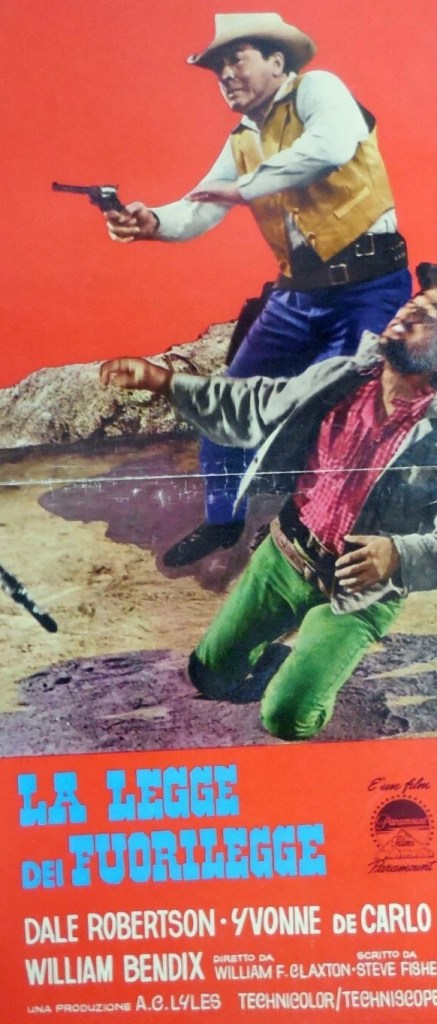
And there are four other dudes, three brothers and an outsider, also intent on killing Rogers. While Sheriff Ed Tanner (Wiliam Bendix) isn’t inept he lacks the force of personality to keep the bad guys in check and when he’s wounded his inexperienced deputy Tim (Rod Lauren) foolishly steps up to the plate.

You can’t help but feel sorry for Ellie, forced to play the part of the lure to dupe Rogers, especially when it’s clear she has more feelings for him than she does for Pete, whom she admits she doesn’t love but needs his security. There’s an interesting power struggle between Tom and Rile with the gunslinger refusing to kowtow to his employer. The court case is riveting because it turns on various twists. And climax is a knockout that you won’t see coming.

This isn’t one like The Shooting (1966), rescued from oblivion by critics and cultists – Paramount issued it as a second feature so it’s not unseen – and it’s not trying to rewrite the Hollywood history of Native Americans, and as I said it’s not distinguished visually, but it does pack an awfully thoughtful punch, tackling areas that the bulk of western film directors have ignored.

Dale Robertson (Coast of Skeletons, 1965) heads a good B-picture cast with veterans William Bendix (Oscar-nominated for Wake Island, 1943), Yvonne De Carlo (career revived by The   Munsters, 1964-1966), Lon Chaney Jr (The Wolf Man, 1941) and Bruce Cabot (King Kong, 1933).

William F. Claxton (Desire in the Dust, 1960) is to be commended for cramming in so much interest. Script by Steve Fisher (Rogue’s Gallery, 1968).

An unexpected treat.

Behind the Scenes: “A Swingin’ Summer” (1965)

Might be a stretch to imagine A Swingin’ Summer has anything of note to add to the momentous cinematic history of the decade except for it falling into a booming phenomenon – the actor-producer. John Wayne (The Alamo, 1960), Paul Newman (Rachel, Rachel, 1968), Jack Lemmon (Cool Hand Luke, 1967) and Kirk Douglas (Lonely Are the Brave, 1962) led the way in actors taking complete control of their careers and putting together the movies they wanted to make rather than pitching up as hired hands.

Dale Robertson was an unexpected entrant into the hyphenate business, never having achieved the marquee clout of others, best known for string of B-westerns and the television series Tales of Wells Fargo (1957-1962). Television could be lucrative, especially if you were the star of a long-running show, but the longer you worked on the small screen the more you jeopardised the continuation of a big screen career. Law of the Lawless (1964) was his first movie for six years.

Advert in “Variety” heralding the arrival of Dale Robertson’s new business.

But Dale took an unusual approach to the production business, planning even more control than his predecessors, by setting up a distribution company, United Screen Arts (“USA” a useful acronym”). He had a simple credo, the “clean family film” seen as niche market worth exploiting at a time when only Disney paid it any continuous attention and when Hollywood stood accused of eroding family values with salacious product.

He had teamed up with Earl Collins, intending to release a dozen pictures a year, claiming their operation would be “the salvation of the independent producer.” On top of that, they spent $200,000 acquiring for U.S. television syndication rights to 39 foreign films starring the likes of Elke Sommer and Bebe Loncar.  There was talk of The Redeemer, a low-budget rival to The Greatest Story Ever Told, of handling British film The Quare Fellow and Tom Laughlin’s debut The Young Sinner which had been languishing in distribution limbo for four years.

But the company’s first move was, as trumpeted, into the family market, straight into the lion’s den with The Man from Button Willow (1965), an animated feature, Robertson lending his voice to the main character. And while the family market could offer substantial returns as Mary Poppins (1964) had proved, there was an even more attractive subgenre awaiting exploitation: the teen market.

Your face looks familiar – Dale Robertson with “billboard girl” Raquel Welch in tv show “Hollywood Palace.”

It was estimated that U.S. teenagers had $11 billion in pocket money to spend on records, clothes and movies. Teenagers assumed to have outgrown the Disney animated features were too young to be permitted entrance to more racy fare. But the Britpop explosion, headlined by The Beatles, had emphasised this market’s buying power.

From just a handful of pictures targeting the older young, there were now close on 20 features heading its way, split almost evenly between beach movies and those featuring pop stars – The Dave Clark Five, The Mersey Beats among other British exports along with Elvis Presley – or movies with little attempt at narrative, no more than a “filmed variety show with little variety.”

These movies exhibited acceptable anomalies, one of which was that the pop stars playing the lead roles retained their own first names in order “to speed up and simplify teener identification with their roles.” Remove parents and the threat of a morals clause, and it was a fresh approach to sexuality, and with nudity never an option well within the Production Code definitions of harmless fun.

AIP had successfully segued from its Edgar Allan Poe line of horror movies to beach pictures. Beach Party (1963), with over 10,000 bookings so far, had kick-started the mini-genre, and another half-dozen AIP offerings had entered the movie food chain. Along the way it made stars of Frankie Avalon and Annette Funicello who acted as a junior version of Doris Day and Rock Hudson, bedroom shenanigans reimagined as more innocent beach shenanigans, and instead of being dressed to kill the main characters were as undressed as much as possible, bikinis and shorts the order of the day.

Dale Robertson set out to tap into this market, A Swinging Summer “custom-tailored for the vast teenage audience.” USA lacked the $500,000-$700,000 budget of AIP which permitted the presence of older stars like Dorothy Malone, Vincent Price and Peter Lorre. USA’s aim was, effectively, a C-picture with sunshine and music. Record companies were happy for screen exposure for their artists, so guest spots, which might otherwise have stopped the narrative dead in its tracks, turned into highlights.

With a no-name cast – Robertson knew Raquel Welch from television variety show Hollywood Palace – and a simple location at Lake Arrowhead in California, the movie was quickly filmed in summer 1964 but held back a year. USA managed tie-ups with Suzuki and Yamaha motorbikes, the former promising a free ride to anyone brandishing a ticket stub, and with record company Moonglow, which offered prizes of the latest album by The Righteous Brothers. A press conference and screening was held for 300 high school newspaper editors and Robertson managed to put together a nationwide tour with some of the participants, although its biggest piece of publicity came from a woman who got her finger stuck in the spoke of a steering wheel during a drive-in screening in Milwaukee.

A few years before or a few years after, A Swingin’ Summer would have been support material, speedily in and out of theaters. But riding a short-lived zeitgeist and taking advantage of the unexpected rise in popularity of Raquel Welch it did much better.

There was a saturation release in 71 houses in North Carolina, “impressive grosses” at the Pacific Drive-In circuit, topped by a record-breaking opening in the Crest Theater in Bakersfield, a good $7,500 at the Twin Drive-In in Cincinnati, a very healthy $28,000 in a New Orleans break, and $26,500 from five cinemas in Kansas City. First-run proved hard to come by but it still snapped up $7,500 at the 2,432-seat Fox in Denver. Supporting features included Major Dundee and Wild in the Country.

There were sightings through 1967, no doubt on account of Raquel Welch’s growing popularity. And if it wasn’t a shoo-in for big city center palaces, it found a hearty welcome in smaller operations in small towns. “The best beach picture ever played,” was the opinion of the Fayette Theater in Fayetteville while at the New Theater in Arkansas it was considered “one of the smaller pictures” that outgrossed bigger-budgeted efforts.

But this was a short-lived phenomenon, and within a few years a beach picture would be a rawer affair like The Sweet Ride (1968) and music would have segued from pop into drugs and rock’n’roll.

Dale Robertson’s foray into production was equally short-lived, moving back into television and developing a night club act. The beach genre generated not one long-term talent outside of Raquel Welch.

SOURCES: “Swingin’ Summer Release To United Screen Arts,” Box Office, February 22, 1965, p10; “Advert,” Variety, February 24, 1965, p21; “Teenagers And Their Pocket Money, A Film Market Unto Themselves,” Variety, March 10, 1965, p4; “Kansas City,” Box Office, May 31, 1965, pC4; “Dale Robertson’s Distribution Credo,” Variety, June 16, 1965, p11; “A Swingin’ Film,” Box Office, June 27, 1965, pNC2; “USA’s Summer Starts Strong in Bakersfield,” Box Office, June 27, 1965, pW5; “Swingin’ Summer Set for Pacific Drive-ins,” Box Office, August 9, 1965, pW5;  “Honolulu,” Box Office, September 13, 1965, pW4; “USA’s Swingin’ Summer Opens in 71 NC Dates,” Box Office, September 20, 1965, pSE4; “USA Sets Record Tie-Up for Swingin’ Summer,” Box Office, September 20, 1965, pB1; “USA, KFWB Host Schools To Promote Summer,” Box Office, November 1, 1965, pA3; “The Exhibitor Has His Say,” Box Office, October 24, 1965, pB4; “The Exhibitor Has His Say,” Box Office, September 11, 1967, pA4. Variety box office figures: June 9, 1965, p9; August 4, 1965, p9; September 22, 1965, p9.

Discover WordPress

A daily selection of the best content published on WordPress, collected for you by humans who love to read.

The Atavist Magazine

by Brian Hannan

WordPress.com News

The latest news on WordPress.com and the WordPress community.