The Jackals (1967) **

A hoot. Definitely a contender for that most sought-after of categories – the cult movie.

When I tell you it’s Vincent Price in a western you’ll see how much fun this could be. Price spent virtually a whole decade locked into horror typecasting, those distinctive tones dealing out doom. But like all typecast actors, no doubt he was desperate to show what he could do when the horror shackles were removed.

Trouble is – he does too much. This a lollapalooza performance, so wild and barmy it will have you in stitches, at the same time as wondering what the hell was going on in his head, and why he thought such barnstorming was required, as if he felt he had to steal a picture of which he was the denoted star.

Though effectively a western with all the tropes of that genre, and a remake to boot of Yellow Sky (1948), this, adding further hilarity and extending the cult status, is set in South Africa, with variable attention paid to accent.

Stretch Hawkins (Robert Gunner) is leader of a gang of outlaws robbing banks in the Transvaal during a gold strike. They escape the pursuing posse by heading into desert territory and eventually, parched, exhausted and suffering from heat stroke, seek refuge in a ghost town, former mining town Yellow Rock abandoned except for two inhabitants, Oupa Decker (Vincent Price) and his grand-daughter Willi (Diana Ivarson).

Naturally, on spotting the lone woman, the outlaws get the wrong ideas. But she soon puts them right. When she’s not holding them at bay with a rifle she’s decking Stretch with a neat right hook. Refusing to offer them any hospitality whatsoever seems particularly mean given the poor chaps are starving and this area is bereft of the animal population- lions, elephants, hogs – that had popped up previously in the way of the random stock inserts you found in any picture set in Africa.

So the fellows spread themselves out along the riverbank which provides the only water in the vicinity and where Willi must come calling, leading to further episodes of predatory sexual behaviour. By now Stretch has taken a liking to Willi, which is eventually reciprocated, and he tends to leap to her defence.

For no apparent reason, the outlaws surmise that the only reason the old man and his daughter are still hanging around this deserted spot is because they have found gold. Instead of doing the obvious and holding the younger woman hostage, Stretch attempts to strike a deal, agreeing to take only half the old man’s £20,000 stake in return for letting them go free.

This doesn’t go down so well with the rest of the gang and the shoot-out, when it occurs, sees Stretch siding with the good guys and turning over such a good leaf that he returns the money he stole to the bank.

Despite Vincent Price threatening to ruin the picture with his mugging there are some nice touches. After Stretch’s romantic overtures are derisively dismissed for him being too smelly, he smartens himself up, coming a-courting (or a rough version of it) in fresh shirt, armpits washed and hair combed. Stretch had a touch of religion in the past when a law-observing farmer. And you can tell what a change is wrought in him when at the end he buys rather than steals a pretty hat for Willi.

It’s true there is a transformation in Vincent Price (The Oblong Box, 1969). But not for the better. The lugubrious delivery is toned down, the iconic full beard reduced to a wisp, he wears a floppy hat, cackles like a madman and every time he looks at the camera it’s with a one-eyed leer. There’s something of the country bumpkin in his interpretation of the part, and that might just be a show put on to fool the outlaws. Whatever it is, it comes across as the barmiest performance this side of the Razzies.

On the other hand Diana Ivarson (Macho Callahan, 1970), in her debut, makes a pretty good stab at the feisty independent western women, channelling her inner Barbara Stanwyck, or in those tight jeans Jane Fonda in Cat Ballou (1965). She’s a sharpshooter, capable of missing “that close on purpose.” Robert Gunner (Planet of the Apes, 1968) is scarcely a decent substitute for Gregory Peck in the original.

Director Robert Webb (The Cape Town Affair, 1967) can do little to rein Price in. Written by Harold Medford (The Cape Town Affair), adapting the original by Lamar Trotti and W.R. Burnett.

But, really, there’s little to save it from being awful except that cult pictures are judged by different criteria and this has all the making of a cult.

Must-see for all the wrong reasons.
Unwelcome (2022) ***- Seen at the Cinema

Cult contender, assuming some basis in Irish legend. Otherwise, Straw Dogs (1971) meets Yoda with a side order of Barbarian (2022) and a touch of Se7en (1995). Someone’s definitely got it in for the Irish this year, but those finger-chopping Banshees have nothing on this little number.

After enduring a home invasion in the city, heavily pregnant Maya (Hannah-John Kamen) and cowardly husband Jamie (Douglas Booth) head for the Irish countryside, having inherited a rundown cottage from his odd aunt. Only thing is, warns neighbor and local publican Maeve (Maimh Cusack). you have to leave out a bit of bloody liver every day beside the back gate to assuage the Redcaps aka little people aka leprechauns aka goblins aka anything else you want to make up.

The story goes said aunt sacrificed her baby to save her dying husband, but it turns out the baby went missing, aged two, and was never found. Frosty reception at the local inn, a la An American Werewolf in London (1981), is a prank but the family of builders headed by a gobby Daddy (Colm Meaney), and his three kids, the gobby one from Derry Girls (Jamie-Lee O’Donnell), a thin gobby lad (Chris Walley) – with “the brain of a rocking horse” – and a peeping tom of a giant (Kristian Nairn) are on the malevolent side.

Not content with stealing any spare cash, Jamie’s stash of chocolate biscuits and his beer, and stirring up anti-English sentiment, smoking joints when they should be working and generally acting like workshy cliches, they constantly challenge the milksop Englishman who can thump a punchbag to his heart’s content but finds it hard to raise a finger in anger.

Beyond the gate there’s some kind of magical silent wood and a stone house. And feral creatures, Yoda-shaped, with shark-like teeth who might be able to fly and might have something to do with a nearby castle. A drunk man might have gone missing. Maya might be seeing what isn’t there. It’s that kind of film, mostly suggestive until it suddenly catches fire. Then it’s an onslaught.

And if you can take the Redcaps as being covered in Boy Scout badges and displaying some neat dance moves and a climax that seems relentless with Maya forced to become Final Girl since Jamie is about as helpful as having Jack Whitehall on your team. There’s more rain than in the Seven Samurai, though, to be fair, we were warned it rains 365 days a year in Ireland, Jamie treated as punchbag, the creepy giant trying his hand at rape, the thin one about to make his bones as a murderer, childbirth, the girl full of sexual swagger, decapitated heads in shopping bags, slicing, dicing, shotguns and shillelaghs and, you guessed, it a frying pan, and ending with the barmiest, although to some extent logical, image imaginable.

Like any cult contender, your first reaction might well be to laugh your head off at the preposterous goings-on but strangely enough it does work. While continuing to proclaim his manly abilities, and his sworn duty to defend his wife, Jamie is very much the modern husband, that is to say useless, completely lacking the protection gene, leaving it to the gutsier woman to clean up the mess that his unnecessary bravado creates.

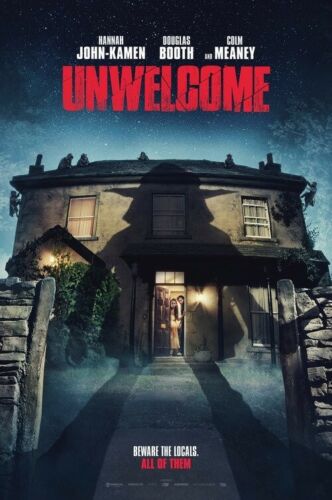
Had I seen this poster which gives the entire game away I wouldn’t have gone.

To her credit, Hannah-John Kamen (Resident Evil: Welcome to Raccoon City, 2021) goes the whole nine yards, continually playing the supportive wife to a weakling, turning the paranormal to her advantage, not averse to pulling the trigger should the occasion demand. There’s little backstory to hang her character on, apart from a desperation to conceive given a previous abortion. But she has to deal with a continually changing scenario, negotiation with the wayward family, calming the giant, taking narrative center stage.

And it might be better going into it without cinematic preconception. If you’re of the age of the target audience you might have never seen Straw Dogs, therefore the villainous quartet might not appear descendants of the previous film, and, like Barbarian, you might happily accept the importance of babies to the modern horror picture.

A bit too long perhaps, and at times you might not know whether to laugh or applaud, but in the great tradition of The Evil Dead (1981) you might come back for more. Not a horror film in the gore/splatter league, and not that thoughtful either, but still capable of exerting a cinematic spell.

Discover WordPress

A daily selection of the best content published on WordPress, collected for you by humans who love to read.

The Atavist Magazine

by Brian Hannan

WordPress.com News

The latest news on WordPress.com and the WordPress community.