The Pawnbroker (1964) *****

Director Sidney Lumet (The Group, 1966) could have made an excellent film just about the customers of a pawn shop, the haunted individuals haggling for more cash than they will ever be paid, the sad sacks, junkies, lost souls and general losers whose stories are told in the items they pawn or redeem – candlesticks, lamps, radios, musical instruments, occasionally themselves. You don’t need to be a pawnbroker to know that three tough guys turning up with a pricey lawnmower are dealing in stolen property.

And it comes as something of a surprise to learn that the pawnbroker is involved in some kind of money-laundering scam for a local gangster. Clearly shot on location on a bustling low-rent area, north of 116th St in East Harlem, New York, there’s enough going on in the streets – the markets, the tenements, poolrooms, the bustle, the eternal noise – to keep you hooked.

But you might think twice about positing as your hero an “absolute bastard” as Lumet himself described shop owner Sol Nazerman (Rod Steiger). He is more haunted than any of his clientele, a Holocaust survivor, plagued by flashbacks to the concentration camp where he witnessed his son die and his wife raped. He is devoid of life, completely shut down to any emotion, rejecting overtures of friendship, and his life is played out in tiny elliptical shreds.

He does not even derive any enjoyment out of his affair with a widow and although he claims to worship money – according to him the only absolute outside of the speed of light – that brings no fulfillment either. He is accused of being among “the walking dead.” It is surprising he has lasted so long without imploding After his war experience, you would have to wonder at a man who spends his life behind the bars of the grille in his shop and just in case he considers escaping from his predicament designer Richard Sylbert (Chinatown, 1973) incorporates other visual aspects of imprisonment into the production.

Around Sol are a set of very lively characters, his ambitious assistant Jesus (Jaime Sanchez) trying to go straight and his girlfriend (Thelma Oliver), a very smooth and wealthy gay gangster (Brock Peters), and a trio of small-time hoods with whom the assistant is friendly. But also the deranged and the lonely. A widowed social worker Marilyn (Geraldine Fitzgerald) who suffers from the “malady of loneliness” offers him friendship but is rejected.

There is little plot to speak of but just enough to teeter him on the brink of self-destruction. So it is primarily a character study. Unusually, Lumet observes without any sentimentality those around Steiger. “Sol has buried himself in this,” Lumet wrote in Films and Filming magazine (October 1964, p17-20) “because he needs to be with people that he can despise…This is a man who is in such agony that he must feel nothing, or he will go to pieces.” There is no redemption and he lacks the courage to commit suicide. It’s a stunning, bold picture, as raw as you can get without turning into a bloodsucker.

The film had a few firsts. It was the only mainstream American picture to deal with the Holocaust from the perspective of a survivor (although films like Judgement at Nuremberg, 1961, had shown aspects of the camp victims). It broke mainstream conventions on nudity, bare breasts being seen for the first time. Lumet experimented with incredibly short cuts – just one-frame and two-frames in places (a technique he had first used in television)- when the standard assumption was that audiences required three frames to register an image.

Rod Steiger (No Way to Treat a Lady, 1968) gives a very restrained performance, especially for an actor known for his volubility and over-acting. He seems to sink into the role. Brock Peters (Major Dundee, 1965) plays not just the first openly gay person in a mainstream picture, but the first gay African American.

Excellent support includes Jaime Sanchez (The Wild Bunch, 1969), Thelma Oliver (Black Like Me, 1964) and Geraldine Fitzgerald (Rachel, Rachel, 1968). Quincy Jones made his debut as a movie composer. If you listen closely you might detect a piece of music later made famous by the Austin Powers pictures and if you look closely to might spot a debut sighting of Morgan Freeman. Screenplay by the writing team of David Friedkin and Morton Fine (The Fool Killer, 1965) based on the bestseller by Edward Lewis Wallant.

Unmissable.

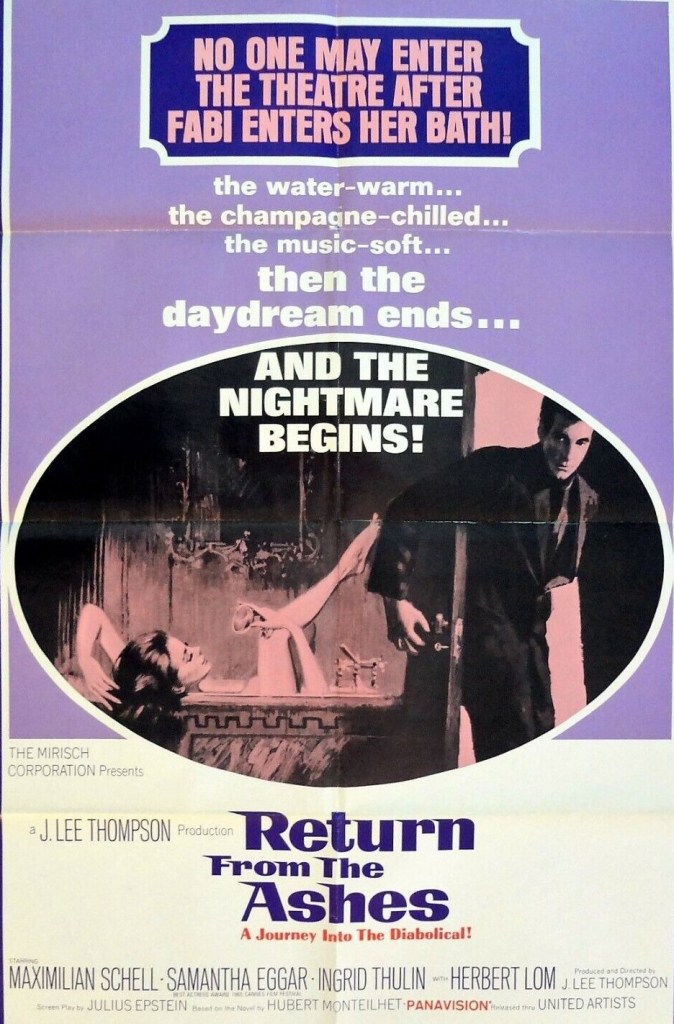
Return from the Ashes (1965) ****

When your starting point is an arcane French inheritance law and the plot revolves around swindling a concentration camp survivor you are immediately on “icky” ground. Throw in a relationship between an adult male and the step-daughter of his deceased wife and the audience might already be backing off.

So it’s a tribute to the acting and that each character is not so much unlikeable as both vulnerable and predatory that this turns into a very involving drama. On the eve of World War Two in Paris Dr Michele Wolf (Ingrid Thulin) buys the love of penniless Polish chess player Stanislaus (Maximilian Schell) but at the cost of abandoning her step-daughter Fabi (Samantha Eggar). For him, love is contingent on wealth, but he marries Michele, a Jew, in a (failed) bid to save her from the clutches of the Nazis. Fabi, shorn of maternal love finds turns to a paternal variation, but is capable of coming up with an ingenious murder plot.

Just quite how hollow Michele has become is demonstrated in a brilliant opening scene set after the end of the war. In a railway carriage, a bored small boy endlessly kicks a door. Pretty much for 90 seconds we either see or hear that door being kicked. Foolishly, his hands wander from the window to the door handle. Next thing, he has fallen out. Cue screams, chaos, shocked passengers racing out of the carriage.

But when the conductor turns up to investigate the incident he finds Michele still sitting in her seat, oblivious to any death, even that of a child. When she returns to Paris, she takes a room in a hotel under a pseudonym, fearing that her ravaged looks make her unattractive, guilty at surviving (by volunteering to work in the camp brothel) when all her relatives were wiped out, unaware that she has unexpectedly inherited all their combined wealth.

So the story begins in a different way. When Stanislaus meets her accidentally under her false name, he immediately assumes she is just a dead ringer for his deceased wife and enrols her in a scheme to win the millions currently held in escrow under this inexplicable French law.

Since she continues to play the part of a different woman, she hears the truth about her relationship with Stanislaus, that although he committed the only unselfish “gallant act” in his life in marrying her nonetheless his prime reason was money. Already Fabi, in full femme fatale mode, is planning to rid the couple of Michele once the money has been legally acquired.

To his credit, Stanislaus initially balks at this notion, but when Michele reveals her true identity and scuppers his relationship with Fabi while at the same time trying to win back the affection of her step-daughter, matters take a deadly turn.

For the most part what we have is a menage a trois, equal parts driven by money and love, but in each instance propelled by innermost desire. Stanislaus is adept at pulling the wool over Michele’s eyes, she only too willingly blinding herself to his sexual deception. But Michele is equally willing, even when she knows his true feelings, to use her money to win him back while Fabi, aware that for her lover money will always trump romance, is determined to use her body to achieve the same effect.

What makes this so compelling is that, unusually, it avoids sentiment. It would have been easy to load each character up with such vulnerability that an audience would not condemn them. Instead, in addition to their individual weaknesses, we are shown their inherent predatory natures.

What makes it so enjoyable is the acting. So often Maximilian Schell is called upon to play stern characters, often typecast from his accent as a villainous German of one kind or another (Judgement at Nuremberg, 1961, The Deadly Affair, 1967), rather than allowing him to invent a more rounded character as he did in Topkapi (1964). This is a wonderfully involving performance,  the wannabe chess grandmaster who uses his considerable charm to buttress his fears of poverty, and is only too aware of his failing, full of joie de vivre, bristling at being a kept man yet at the same time only too ready to financially exploit the situation.  

Where in The Collector (1965) Samantha Eggar was constrained by circumstance and in Walk, Don’t Walk (1966) saddled with an initially cold character, here she is permitted greater freedom to develop a conflicted personality, loving and deadly at the same time, drawn to and hating her step-mother, attracted by the thought of the money that would secure Stanislaus but repulsed by the cost.  

Ingmar Bergman protégé Ingrid Thulin (Wild Strawberries, 1957) is given the least leeway, another of the tormented characters in her intense portfolio. Herbert Lom (Villa Rides, 1968) puts in an appearance as a friend trying to warn her off Stanislaus.  

Director J. Lee Thompson (The Guns of Navarone, 1961) takes the bold approach of allowing characters and situation to develop before moving into thriller mode. There are a couple of quite superb scenes, running the opening segment close is the much-vaunted scene of Fabi in the bath (“No one may enter the theater once Fabi enters her bath” was a famous tagline). It is brilliantly filmed in film noir tones, bright light slashed across eyes rather than through windows, and Johnny Dankworth provides an interesting score. Julius J. Epstein (Casablanca, 1942) wrote the screenplay based on the bestseller by Hubert Monteilhet.

Discover WordPress

A daily selection of the best content published on WordPress, collected for you by humans who love to read.

The Atavist Magazine

by Brian Hannan

WordPress.com News

The latest news on WordPress.com and the WordPress community.