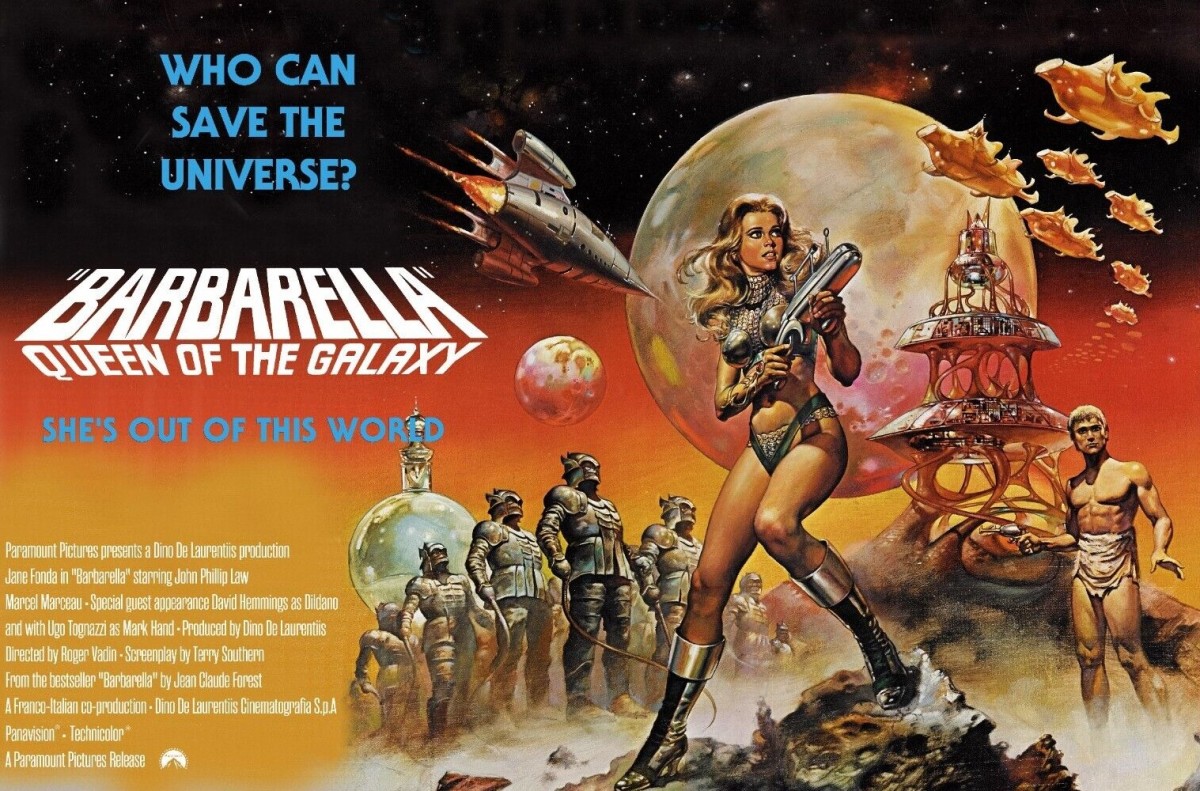
While sci-fi was being viewed through a serious glass darkly what with Fantastic Voyage (1966), 2001: A Space Odyssey (1968) and Planet of the Apes (1968) along came Roger Vadim’s little number to set up an alternative universe of camp fun. Had this been a box office smash in the nature of The Odd Couple ($18.5 million in U.S. rentals) rather than under a third of that there might have been less of the po-faced doomladen sci fi in the following decade.
But if you wonder where Star Wars got its vibe, setting aside the overt sexiness portrayed here, this is as good a place to start. Naïve adventurers, check. Ice planet, check. All sorts of weird creatures in strange otherworldly locales, check. A doomsday weapon, check.

It’s kind of newsworthy to be rewatching this given that star du jour Sydney Sweeney (Anyone But You, 2023) is going to be donning the Barbarella costume for a remake next year. And who knows to what Oscar-winning fare that might lead, if she were to follow the Jane Fonda template, given it was La Fonda’s follow-up that brought her serious attention from the Academy.
But it would be remiss of me if I didn’t bring up the testy matter of director Roger Vadim’s uncanny obsession with getting his myriad girlfriends to shed their clothes for the movies, Fonda being the latest example, and in no uncertain terms, the striptease performed during the opening credits certainly rivaling Kubrick and Spielberg for the most jaw-dropping opening to a sci-fi movie.
Whether it was Fonda or someone else and whether it was Vadim or someone else you couldn’t get away from the fact that Barbarella as a sci-fi icon was most definitely on the sexy side as determined by her creator Jean-Claude Forest, sharing like British comic strip heroine Jane a predilection for losing her clothes.
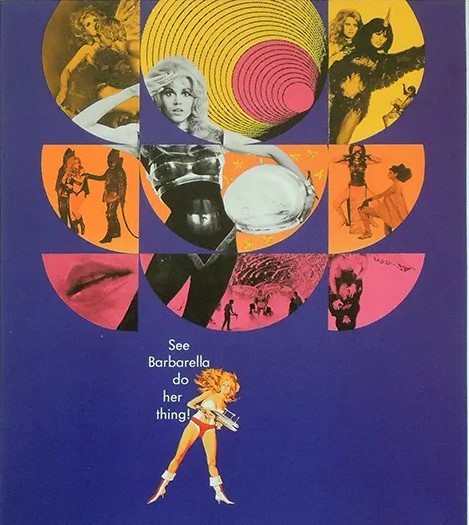
Barbarella shares something of the same innocent abroad personality, the kind who gets into one unexpected scrape after another, after being despatched from peace-loving Earth to save the world by finding Durand Durand (the pop band making homage to the movie dropped the final letter of this character’s name) and his doomsday machine.
So mostly, it’s one imaginative character or scene after another, delivered in disconnected episodic manner, and it sometimes has the feel of a jukebox movie, of the greatest hits of the comic strip writer strung together, with an occasional comment on the problems created by sex and a climactic gender-spinning twist. You’d have to remember what Pop Art was to chuck it into that short-lived category but if you think it belongs on the same planet as the more earthbound Modesty Blaise (1966) and Danger: Diabolik (1968), think again.
The best sections are truly terrific. The sharp-teethed menacing robot dolls are exceptionally scary as they nip chunks out of our heroine’s flesh and leave her blood-soaked. There’s a homage to The Birds (1963) where our plucky heroine is trapped in a cage with a flock of sparrows. You’ve also got the The Catchman, performing the same function but considerably scarier than the same year’s Child Catcher from Chitty Chitty Bang Bang. But no wonder the kids need caught because they are full of evil intent.
You’ve got a blind angel (John Phillip Law) who can’t fly, a problem mysteriously solved by sex with the ever-gracious Barbarella who, previously, has discovered, courtesy of The Catchman, the immense pleasure of the art of making love the old-fashioned way rather than just popping a pill. The angel also has no memory, permitting an ironic twist ending. You’ve got an incompetent rebel (David Hemmings). Sex is pretty much top of everyone’s agenda, even the villain (Milo O’Shea) who uses it to kill people via his own invention, which proves not much cop, since rather than murdering Barbarella with excessive pleasure, she makes it blow up.
Along the way there’s any number of interesting inventions: a manta-ray acts as the skis for a futuristic sailing ship, hollow robotic soldiers, a labyrinth.
Some of the special effects wouldn’t pass muster these days, but that’s a minor flaw compared to the rest of what’s on show. It’s not exhilarating in the real sense, but if you’re unfamiliar with the source material, it retains an endless fascination, more like a sexed-up version of the Ray Harryhausen world than anything that would have interested Kubrick. And, heck, just fun. What’s not to like.
Jane Fonda (They Shoot Horses, Don’t They, 1969) holds it all together, innocent rather than naïve, even her sexuality is innocent not exploitative, and possibly for a film deemed sexy makes greater comment on the dangers of lust than many a more self-important movie.
Great supporting cast with David Hemmings (Blow-Up, 1966), John Philip Law (Danger: Diabolik), Anita Pallenberg (Performance, 1970), Milo O’Shea (Ulysses, 1967) and Marcel Marceau.
Roger Vadim’s best film. Written by a huge squad of writers, nine in total, headed up by Vadim and Terry Southern (Candy, 1968).
Will probably be yanked out of circulation at the approach of the remake so now’s your chance to catch up on a fun sci fi.


 The Magnificent 60s