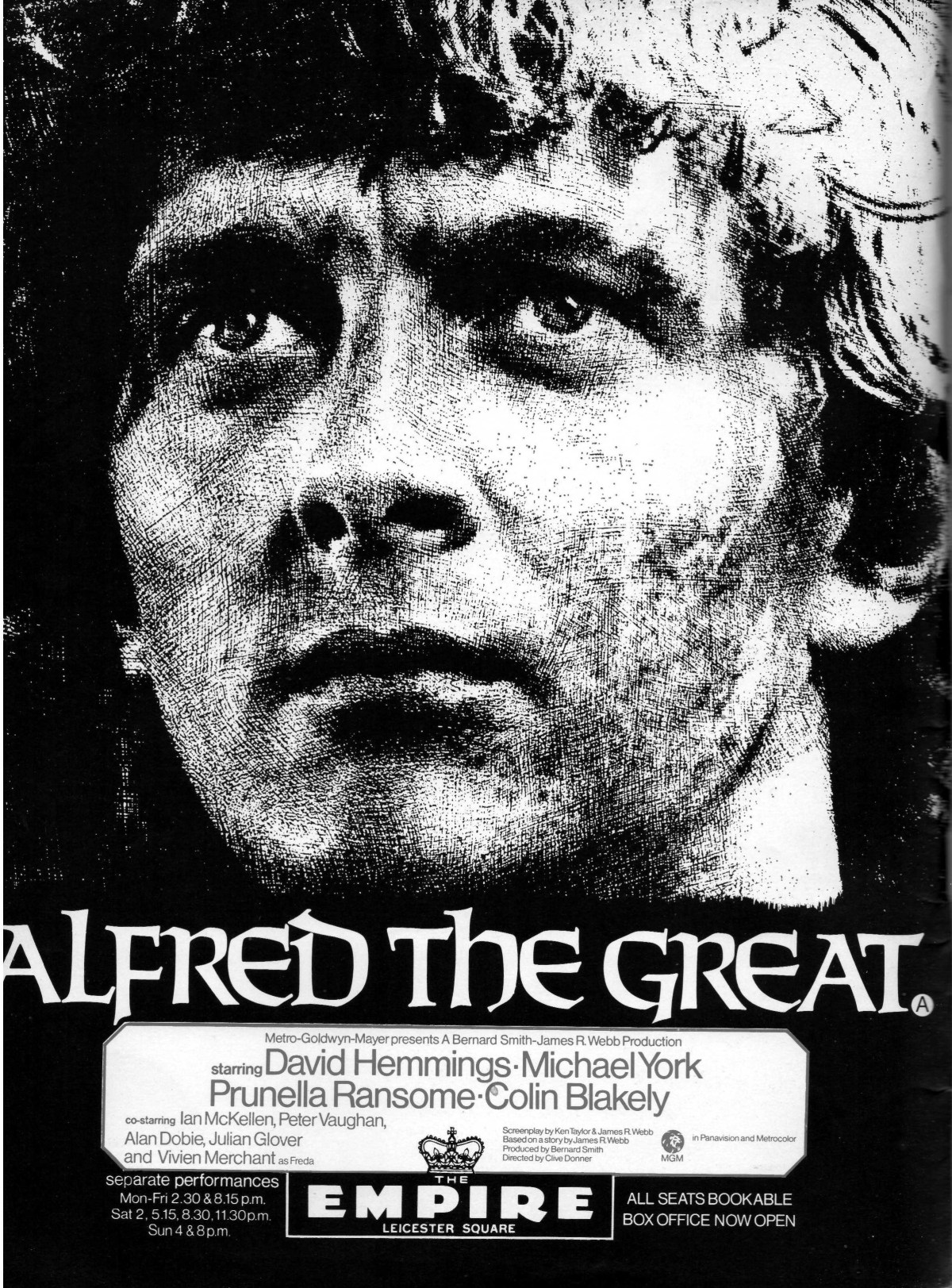
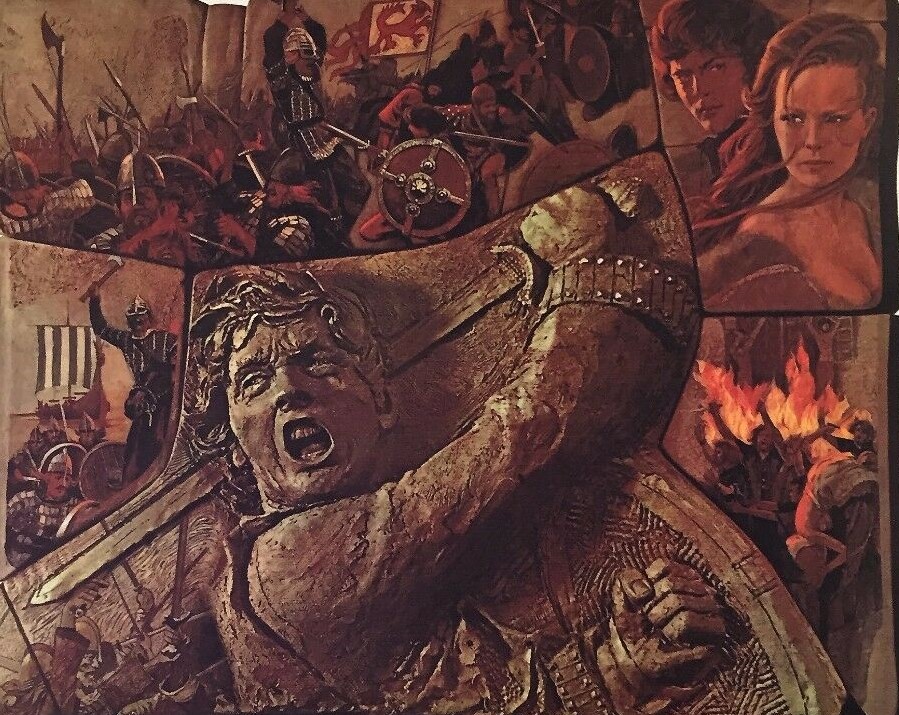
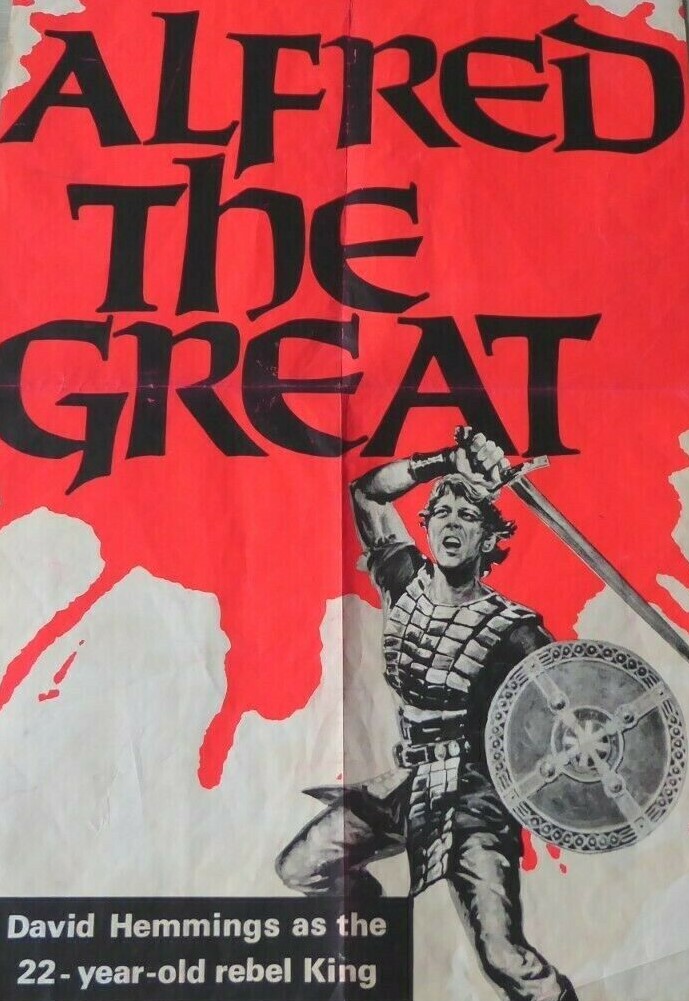
Alfred the Great (1969) ****

The Prince Who Wanted To Be A Priest. The King Who Didn’t Want To Fight. The Husband Who Raped His Wife.

Not exactly taglines in the grand tradition of Gladiator (1999), but a succinct analysis of a Film That Wanted To Be A Roadshow. This is almost an anti-epic, a down-n-dirty historical movie far removed from El Cid (1961), Lawrence of Arabia (1962) and The Fall of the Roman Empire (1964). And one element that has to be taken into consideration when making a historical picture set in Britain in AD 871, if you are aiming for realism, is the rain. The battles in the three movies mentioned, as with virtually every historical movie of the decade, took place in bright sunshine on hard ground, not in the rain on mud-soaked fields. Director Clive Donner lacks the genius of an Akira Kurosawa who turned rain into a glorious image in Seven Samurai (1954) or even Ridley Scott whose first battle in Gladiator took place in a snowstorm. But he does make a battleground reflect the grim reality.

Alfred (David Hemmings) was fifth in line to the throne – and just to a small region of England called Wessex – and as was common practice all set, quite happily, for a career in the priesthood. So it was not surprising, envisioning religion as a mark of civilization, and the priesthood guaranteeing an education, that he was loathe to become a warrior just because his brother King Ethelred (Alan Dobie) was a useless leader. The price of taking on the warrior’s mantle and, after his brother’s death, of ascending to the throne is that Alfred must not only cast away his priestly ambition but his chastity in order to get married to unify rival kingdoms and produce an heir. So there’s a good deal of the religious quandary of El Cid and the sexual ambivalence of Lawrence of Arabia.

So repelled by what he is forced to do, that on his wedding night Alfred rapes new wife Aelhswith (Prunella Ransome) and when the marauding Vikings win a decisive battle and the price of peace is the wife taken in hostage Alfred offers no great protestation. So Alfred is hardly an appealing character. His wife hates him so much that she conceals her pregnancy from him. If you were an Englishman you might well prefer the straightforward lustful Viking leader Guthrun (Michael York) whose men are not restrained by Christianity – “it’s a strange religion,” he mulls, “ that wars with everything your flesh and your blood cries out for” – who makes a better fist of wooing Aelswith, whom he could as easily rape, than Alfred.  

Eventually, of course, Alfred gets it together, rallies a bunch of outlaws and steals back wife and son (now four years old). However, there is no romantic reunion. Instead, he plans to imprison her for life, “the whore shall rot in silence.” Nonetheless, Alfred has acquired some tactical skills, adopting the old Roman infantry tactic of forming his troops up in a phalanx behind a wall of shields. His battlefield address is to promise ordinary people a set of laws that will give them equality with the wealthy and powerful.

Given there are no castles and this is indeed the Dark Ages as far as costume and interior design is concerned and that therefore the camera cannot, for respite, be turned onto some glorious image, Clive Donner (Here We Go Round the Mulberry Bush, 1968) concentrates on character rather than scenery. There are a couple of inspired touches. For a start, in permitting various characters to offer prayers to God, he introduces a number of soliloquies which take us to the heart of troubled souls, and then he does a clever split-screen number to effect a transition. You can’t blame him for British weather and the battles are well-staged. He does show the courage of his convictions in making the film concentrate on conflicted character rather than going along the easier heroic route of underdog rallying people to a cause.

David Hemmings (Blow-Up, 1966) is both the film’s strength and weakness. He is excellent at capturing the torment, the soul divided, and the inherent arrogance as well as the preference for peace instead of war. But in terms of his leadership skills he is on a par with Orlando Bloom in Kingdom of Heaven (2005). That part was originally intended for Russell Crowe and Peter O’Toole was first choice for Alfred and you can’t help thinking both would have been a substantial improvement. On the other hand, Alfred was just 22 when he became king and for someone intent on the priesthood there would be no need for him to develop his physique or political skills. So this is a far cry from your typical Hollywood hero and in that regard the casting makes perfect sense and Hemmings a bold actor to take on such an unlikeable character.

Prunella Ransome (Man in the Wilderness, 1971) does well in her first leading role, suggesting both vulnerability and independence and while virtually imprisoned by both Alfred and Guthrun remaining principled. Michael York (Justine, 1969) was a definite rising star at this point and plays the Viking with considerably more gusto than his tendency towards passive characters would suggest.  

There’s virtually a legion of excellent supporting players in Colin Blakely (The Vengeance of She, 1968), Alan Dobie (The Comedy Man, 1964), Ian McKellen (Lords of the Rings and X-Men), Peter Vaughan (A Twist of Sand, 1968), Vivien Merchant (Accident, 1967),  Barry Evans (Here We Go Round the Mulberry Bush, 1968), Sinead Cusack (Hoffman, 1970), Christopher Timothy (All Creatures Great and Small, 1978-1990) and Robin Askwith (Confessions of a Window Cleaner, 1974).

Oscar-winner James R. Webb (How the West Was Won, 1963) was an improbable name to be attached to a British screenplay. But this was a pet project he had been trying to get made since 1964. Ken Taylor (Web of Evidence, 1959) was brought in to lend a hand.

Not being a student of English history but familiar with the ways of the movie business, I am sure the picture has many historical inaccuracies, but it does present one of the most complex individuals ever to feature in a historical film of the period, when audiences preferred their heroes more black-and-white. So it is a significant achievement in the canon.

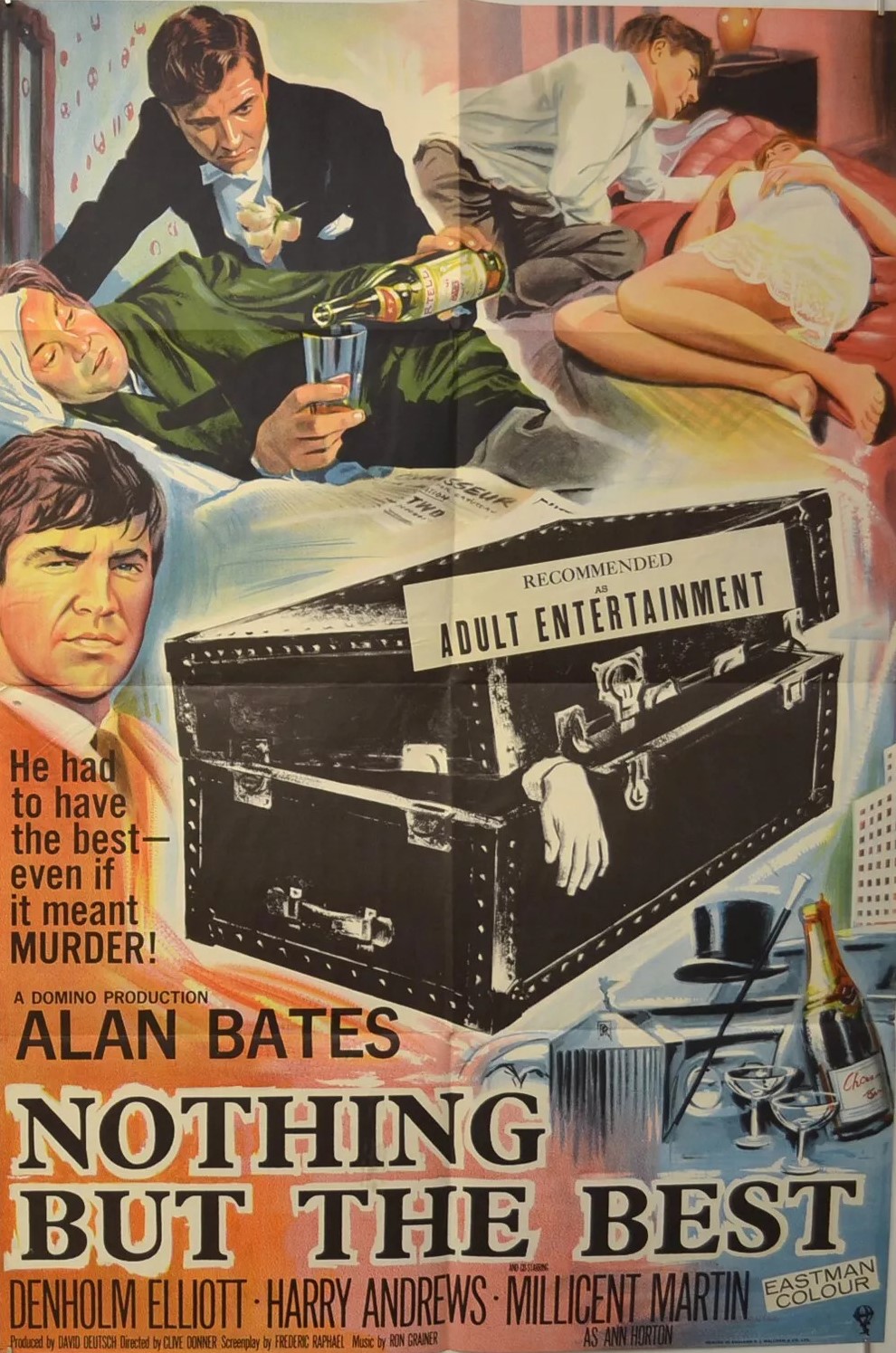
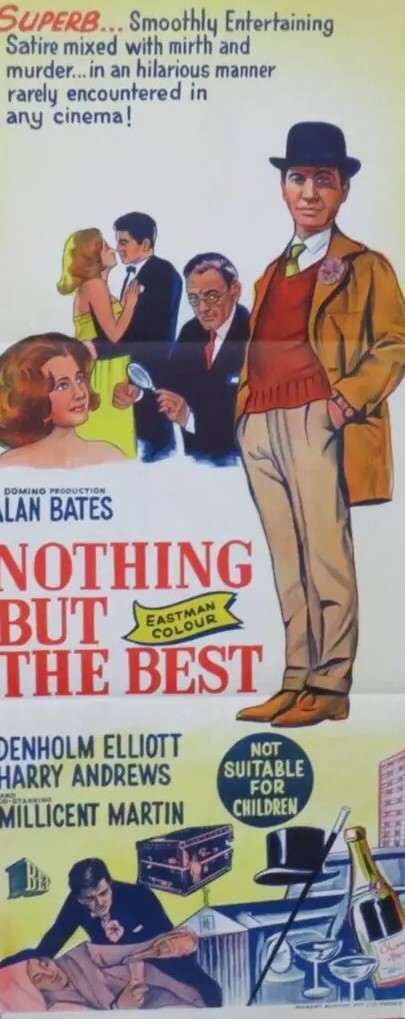
Nothing but the Best (1964) ***

Hardly surprising Denholm Elliott comes a cropper in this delicious British upper class black comedy – he steals the show from denoted star Alan Bates. Had he kept going any longer you would hardly have noticed Bates even featured, such was the clever impact of Elliott’s insiduous playing.

The toff version of Room at the Top (1958) meets Alfie (1966) as “ambitious young yob” Jimmy Brewster (Alan Bates) manipulates his way to the top. Too many people not coming up to scratch for his upwardly mobile purposes are cast aside – or strangled. Arrogance and bluff are the key to getting ahead in the upper-class world towards which he pivots. Doing absolutely nothing at all also works wonders in high society as does dismissing one’s hugely expensive education.

Jimmy is initially helped on his way, given an insider’s guide, by dissolute layabout toff Charles (Denholm Elliott) with a marked predilection for forgery, and other minor criminal schemes, but whose chief skill appears to be sponging off everyone else. Jimmy is a lowly executive in an upmarket estate agent, fighting for promotion against people with silver spoons rattling around every part of their anatomy and who have the genuine class their business appears to call for.

Every now and then the satire still contains contemporary bite, the difference between universities still relevant, as is that most people are not swayed by actual knowledge but by the fact that you can toss out the names of various academics. But, mostly, it’s bluff that opens the doors. Jimmy misses an appointment with an important banker, a dereliction that should have scuppered his chances of negotiating a better deal for his client. But, in fact, the banker takes this as Jimmy having gone elsewhere and immediately offers a better deal.

When confronted by a colleague for ignoring another appointment, Jimmy merely vaguely waffles on about being detained by “Sir Charles,” true identity left shrouded in mystery, contentious colleague silenced by either not being on speaking terms with the person mentioned or unwilling to admit his ignorance.

Having seduced every secretary within reach – none of whom meet his lofty standards – Jimmy manages to wangle his way into catching the eye of wealthy boss Horton (Harry Andrews) and his attractive daughter Ann (Millicent Martin), whom he marries.

While this would have been sharp as a tack in satirical terms back in the day, most of that weaponry is now out-dated. Suffers because none of the upper-class characters show any sense whatsoever – they can’t all be duffers and most seem to have tumbled out of central casting’s idea of an upper class twit. Charles is the exception, but even he is something of an innocent, not quite aware of what ruthlessness he has unwittingly set afire.

The lower classes aren’t much better. Secretaries and switchboard girls fall at Jimmy’s feet, handsome beggar that he is, though his landlady Mrs March (Pauline Delaney) appears to have his measure and is not above indulging in hypocrisy.

The voice-over works to the detriment of the picture. Because that device is doing so much of the heavy lifting, filling in the audience on Jimmy’s true feelings, the actor doesn’t have to do much acting and we’re presented with a kind of wooden figure who hides behind a mask. Of course since he’s masking his feelings, you might be inclined to give Alan Bates the benefit of the doubt.

And it would work very well if there wasn’t Denholm Elliott giving a master class in duplicity. He exhibits genuine charm.

I’m guessing that the voice-over was already there in Frederic Raphael’s script and not added to compensate for Alan Bates’s one-note performance. So if it was, that certainly presented a problem for the actor since most of what made his character interesting was at one remove, not presented in dialog or confrontation as would be the norm.

Alfie solved the problem by breaking the fourth wall – all the rage these days – and having the character directly address the audience, which allowed Michael Caine to present his own case.

So, if Alan Bates felt limited in what he could show on screen, he certainly does a good job of maintaining the façade. But Denholm Elliott (Station Six Sahara, 1963) steals the show. Harry Andrews (The Charge of the Light Brigade, 1968) is permitted no nuance to his normal bluff persona, singer Millicent Martin (Alfie, 1966) sparkles, and a bunch of British character actors including James Villiers (Some Girls Do, 1969) and Nigel Stock (The Lost Continent, 1968) put in an appearance.

Directed with some glee by Clive Donner (Alfred the Great, 1969) from a script by Frederic Raphael (Darling, 1965) adapted from a short story by Stanley Ellin (House of Cards, 1968).

Not as coruscating now as originally intended.

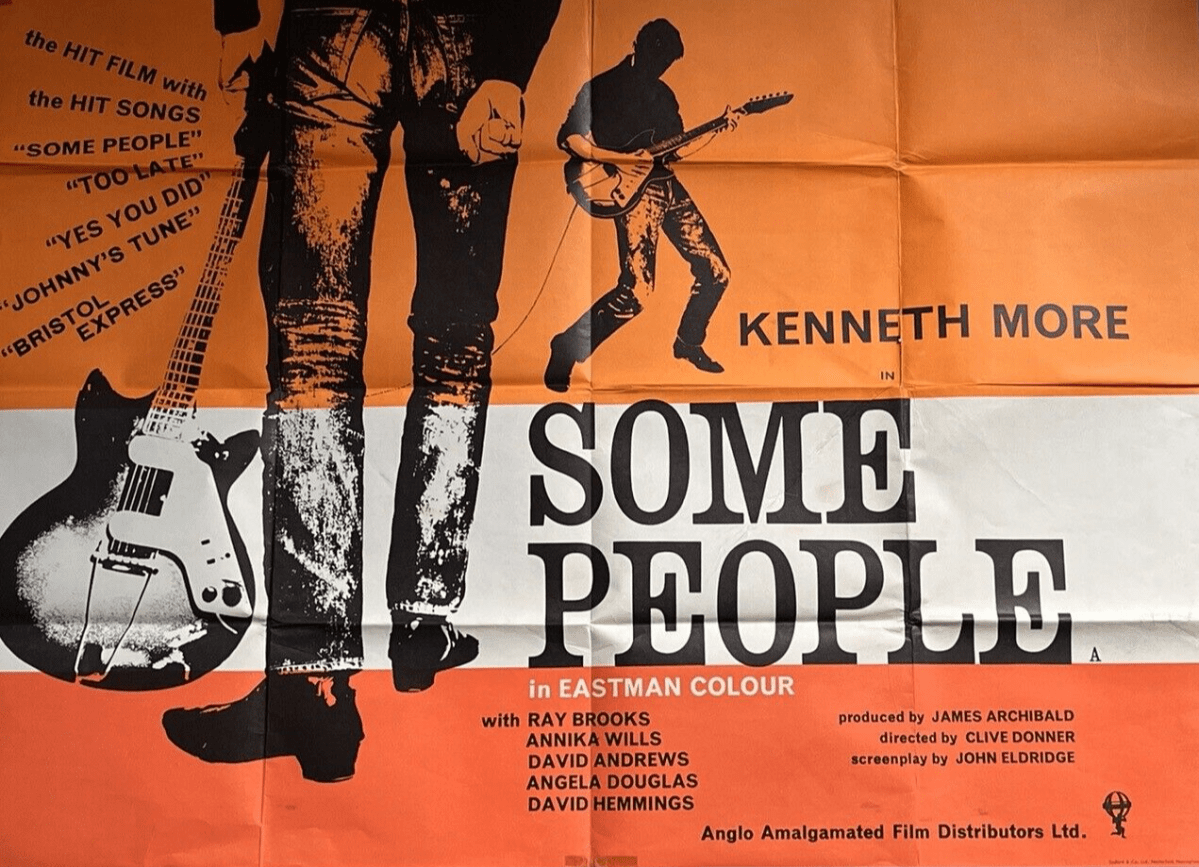
Some People (1962) ***

Bet you didn’t know the Duke of Edinburgh (yep, that one, the recently deceased husband of the recently-deceased Queen Elizabeth II) was involved in the movies. Or that a film set up with the express purpose of promoting his Duke of Edinburgh Award Scheme could actually be any good.

A slice-of-life British picture that steers clear of the “kitchen sink,” so lives not blighted by alcohol, sex, abuse, unemployment which means no single mothers, no out-of-their head drunks, no railing at the government, no bloody violence. Instead, you’ve got kids in dead end jobs, refusing to conform, and then finding responsibility isn’t such a trial after all.

Not sure this notion qualifies as a promo for the Duke’s Scheme, but the movie’s probably best known for showing young women how to shrink their jeans skin-tight and, surprisingly, passing on the notion that your father would happily tolerate such behavior.

Three tearaways involved in an accident with their motorbikes lose their licences and at a loose end stumble across a benevolent choir master Smith (Kenneth More) who lets them use his church hall to rehearse their band. This is pre-Beatles so no mop-tops and screaming, but music with shades of Helen Shapiro and The Shadows, and the fancy footwork that was all the rage at the time.

The line-up is Johnnie (Ray Brooks) on piano and third guitar, Bert (David Hemmings) and bespectacled Tim (Timothy Nightingale) – a replacement for the disgruntled Bill (David Andrews). And they are joined by drummer Jimmy (Frankie Dymon) and singer Terry (Angela Douglas). The Award Scheme – a way of giving young people something to do and encouraging them to try an activity outside their usual sphere – malarkey is eased cleverly into the script, eventually becoming a challenge, though it’s somewhat gender-defined, Terry taking up knitting, while Bert helps make a canoe and plans the kind of outbound expedition with which the scheme was most associated.

There’s a punch-up and (gosh!) tables and tablecloths and crockery are destroyed, but mostly it’s just teenagers getting rid of their angst in ways that don’t define their lives (i.e. pregnant girlfriend or spell in jail.) The bulk of the aggravation comes from Bill, who refuses to join in, gets cross at being called a “teddy boy” and that his girlfriend Terry is making a play for Johnnie.

However, Johnnie is sweet on Smith’s daughter Anne (Anneka Wills), so there’s some sexual tension. Though the sexual element, despite the jeans scene, is conspicuously underplayed. Johnnie doesn’t even get to what was misogynistically referred to as “first base” in those days, restricted to kissing and a gentle hug. His romance is inevitably doomed because Anne wants to go away to college, but, by this time, despite an initial angry response, he’s grown-up enough to accept it and realize how much he’s benefitted from the relationship.

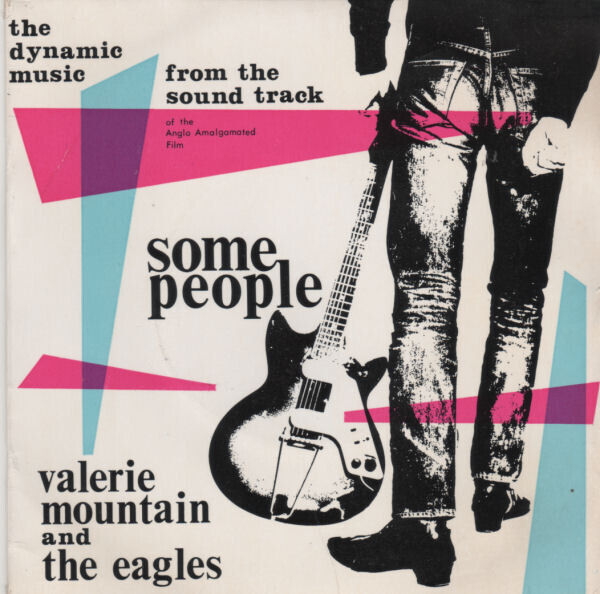
Although the actual music is supplied by The Eagles (no, not those ones), it helps that the actors look as if they know their way around music, although what they play is hardly sophisticated by the later standards of the decade.     

Critics might have preferred the more violent motorbikers of The Damned (1962) or The Leather Boys (1964) and the working class milieu of Saturday Night and Sunday Morning (1960), but this depiction of suburban life (it’s set in Bristol) is more in line with director Clive Donner’s later Here We Go Round the Mulberry Bush (1968).

You could have a high old time arguing which film is the more realistic, the ones over-teeming with violence, disillusionment  and sex, or ones where real ordinary life rarely touches such dramatic heights and relies more on people working their way through real or imagined difficulties. The slice-of-life elements involve a cigarette factory, fish-and-chips, blaring television, a father (Harry H. Corbett) out of touch with this son (one of the best scenes), roller skating, youngsters drinking Coca Cola and not booze (Johnnie has to be introduced, against his wishes, to alcohol by his father), hire purchase and a deluge of advertising promising a better life.

And it’s anchored by Kenneth More (The Comedy Man, 1964), who did this film for nothing with the unexpected bonus of meeting his third wife, Angela Douglas. On the basis of this performance, you wouldn’t be expecting David Hemmings (Blow-Up, 1966) to become the break-out star – he’s billed sixth – rather than young male lead Ray Brooks (The Knack, 1965). Angela Douglas popped up in Maroc 7 (1967) but was better known as a Carry On semi-regular. Anneke Wilks was one of The Pleasure Girls (1965) but more at home in television.

On a side note, I realized that the council-run buses in every big city had their own primary colors. Red, obviously, for London, but Bristol chose a virulent green while I remember the vehicles in my home town of Glasgow being yellow-and-green and I wondered if there was some official body that assigned color in this fashion. An idle thought.

Much better than you might expect from a movie whose main aim was to promote a scheme set up to help teenagers find their feet.  

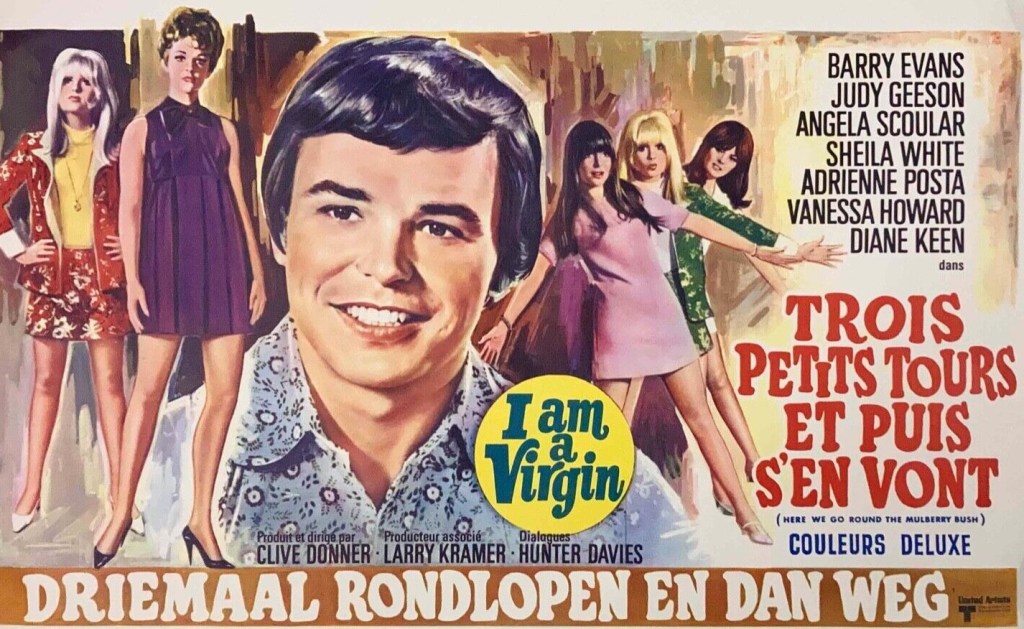
Here We Go Round the Mulberry Bush (1968) **

Breaking the fourth wall has become a common conceit these days, especially in television, so you might be surprised to learn it was the key artistic element of this otherwise straightforward British coming of age drama.

Our teenage guide Jamie (Barry Evans), a delivery boy, spends most of his time lusting after any women he meets. Like a junior version of 10 (1979) women are rated according to their physical attributes. Most, of course, are well out of his league, especially as he lacks for what counts as the smooth patter which his cocky pal Spike (Christopher Timothy) has in abundance.

Essentially a series of episodes with the opposite sex as Jamie tries to lose his virginity. But mostly, it’s just Jamie yakking on about how he’s not lost his virginity and what’s up with all those women that they can’t see what a great catch he is. He’s so determined to have sex he will even go out with the dumbest of dumb blondes, Linda (Adrienne Posta).

Naturally, since reality is too cruel, he succumbs to fantasy with a number of scenarios that seem, inexplicably, torn from silent movies, and nothing approaching the imagination of Hieronymus Merkin. For no particular reason, he strikes lucky with the adventurous Mary (Judy Geeson), whose boyfriends usually run to sports cars, but that liaison is nearly interrupted by a wet dog and Jamie’s inexperience.

Apart from the lusting, there’s little else going on, a couple of women in a fish-and-chip shop complain they are fed up with chicken and beef, his younger brother shows more spark, and his home life is pitifully dull. You can’t really blame the movie for lacking the rebelliousness that was potent at the time, there’s no political awareness and no sign Jamie is going to grow up into one of the Angry Young Man so familiar at the beginning of the decade. It’s a quaint version of American Pie.(1999).

But it’s just boring. While Barry Evans (Alfred the Great, 1969) is personable enough he doesn’t have enough in the wit department to keep you hooked for the duration, most of the humor teetering on the side of inuendo..

Unable to recognise the inherent weakness of the script, and assuming that breaking artistic boundaries with the fourth wall is enough, director Clive Donner (Alfred the Great) spends most of his time trying to visually brush everything up, with little success.

That this was a big British hit at the time might have been more to do with the soundtrack – performed and written by Steve Winwood and Traffic – and the fleeting sight of Judy Geeson (Two into Three Won’t Go, 1969) in the buff. The British censor didn’t take too kindly to the actress revealing all, so in fact audiences were treated to very little, but for teenagers at the time very little was more than usually came their way unless willing to sit through a turgid arthouse picture.

About the only thing to commend it is Geeson’s class, she stands head and shoulders above everyone else in terms of screen charisma, and that there’s a roll call of rising British stars. As well as Christopher Timothy who would achieve fame on television in the original All Creatures Great and Small, the supporting cast includes Vanessa Howard (Corruption, 1968), Angela Scoular (On Her Majesty’s Secret Service, 1969), Diane Keen (The Sex Thief, 1973) and Adrienne Posta (Some Girls Do, 1969) and, to show them all how to do it, Denholm Elliot (Maroc 7, 1967) briefly pops up.

Clive Donner (Alfred the Great) directs. Hunter Davies, making his screen debut, wrote the screenplay based on his bestseller. Generally, any film that scores two stars does so out of incompetence. This is well-enough made but never seems to shift into gear.

Discover WordPress

A daily selection of the best content published on WordPress, collected for you by humans who love to read.

The Atavist Magazine

by Brian Hannan

WordPress.com News

The latest news on WordPress.com and the WordPress community.