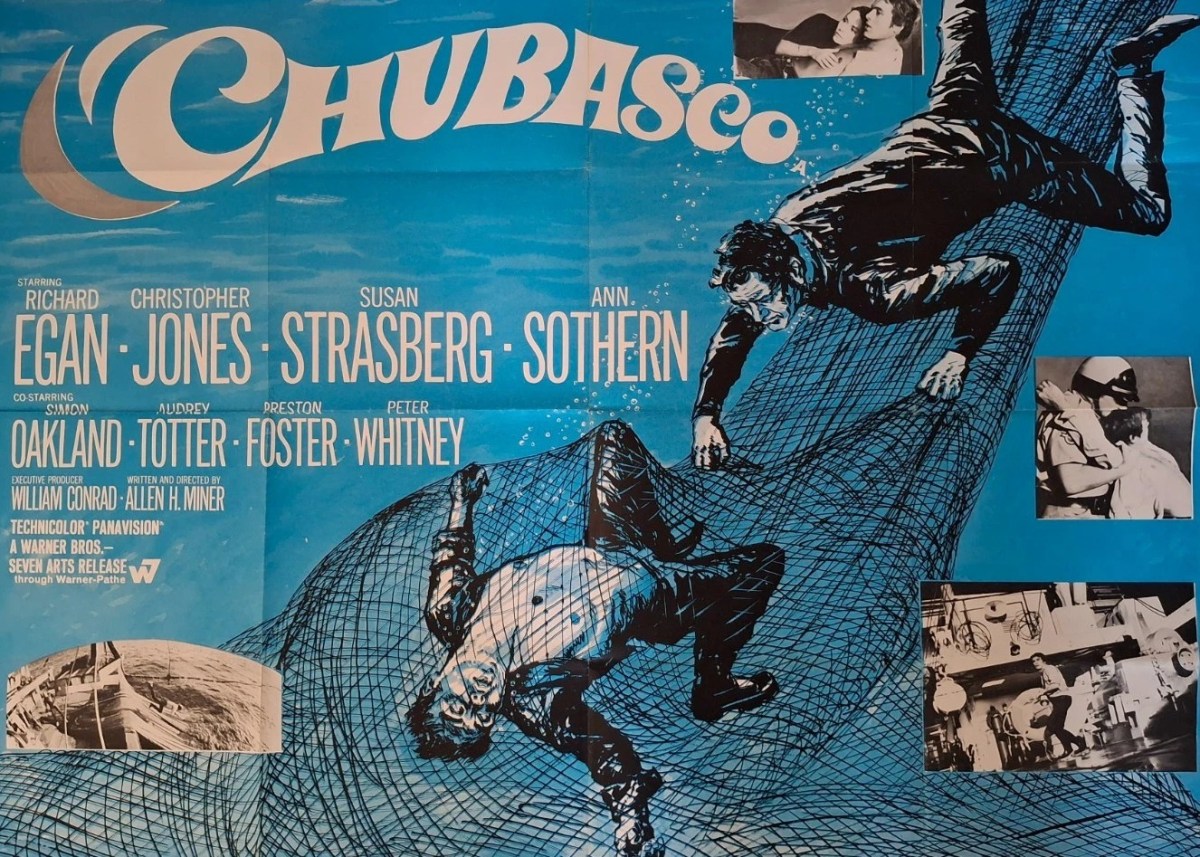
Chubasco (1968) ***

Rather desultory effort. Whatever bite it had back in the day – if it struck a chord at all – has been lost in the passage of time and proves a more suitable vehicle for the limited talents of the enigmatic Christopher Jones than David Lean’s Ryan’s Daughter (1970) for which he proved an uncomfortable fit.

I have some background in commercial fishing – not active, I hasten to add, but as a journalist, my second job being for a UK weekly Fishing News and in that capacity been out enough at sea with fisherman to understand the complexities and dangers of the job. Nothing on screen reflected that reality until The Perfect Storm (2000). And this is a very lite version of that, in part because the catching method employed here is less implicitly dangerous than in the Wolfgang Petersen epic.
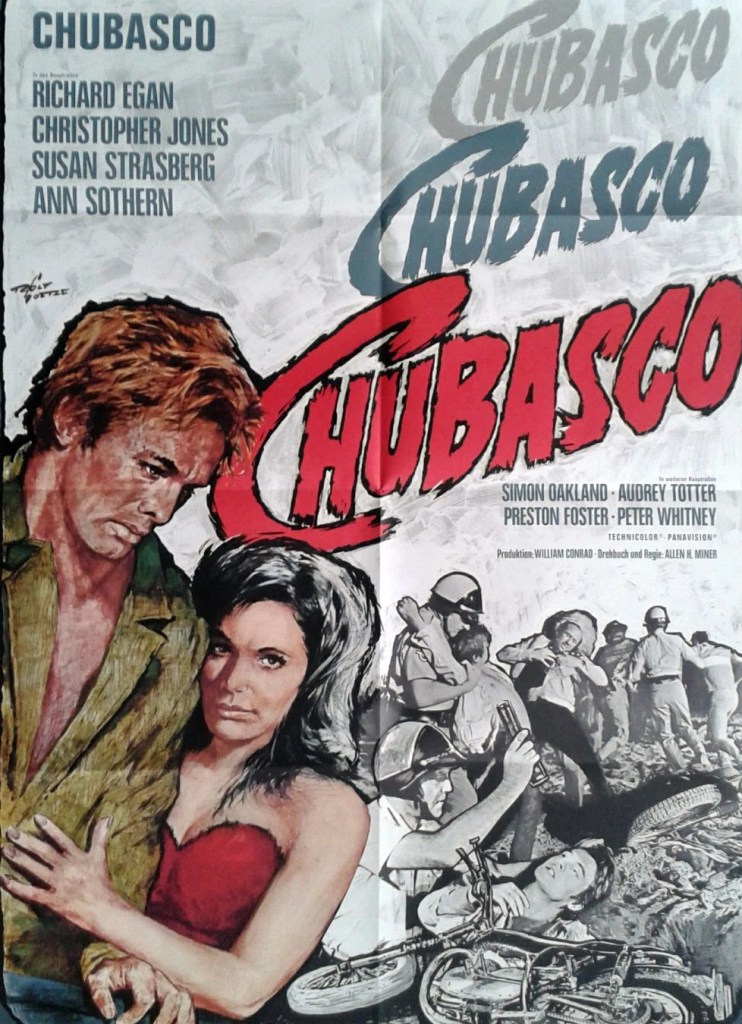
This fits into the Rebel Without a Cause mold, but with a stroppy entitled lad to the fore, struggling to elicit any sympathy from the audience and only the fact that his potential father-in-law is determined to beat him down makes him at all appealing.

The titular Chubasco (Christopher Jones), a 20-year-old lay-about who’s tangled too many times with the law, is given one last chance to go straight by being enrolled on a tuna-catching fishing vessel skippered by Laurindo (Simon Oakland). Sebastian Morino (Richard Egan), a rival fishing boat captain and father of Chubasco’s girlfriend Bunny (Susan Strasberg), is dead set on curtailing the romance.  

Naturally, Chubasco’s sullenness doesn’t endear himself to the crew, but he settles into his role on board ship, suffering beginner’s wear and tear, and gaining some credence after helping save a young man who’s fallen overboard. He’s determined to defy Sebastian and after his first, successful, voyage, plans to marry Bunny, who’s skipped out of the house. However, at the wedding, Laurindo keels over and dies, forcing Chubasco to take a job with his father-in-law, who is now set on ruining the marriage. Chubasco, equally, is determined to make his way and after an accident Sebastian and Chubasco are reconciled.
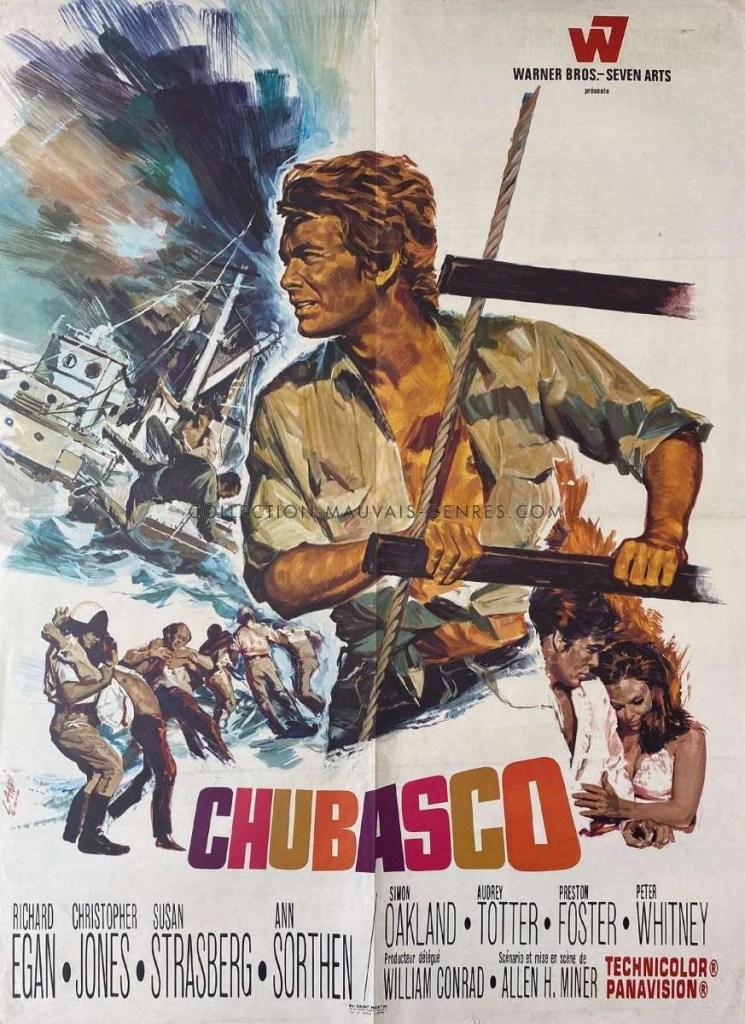
It takes a long time to get to the end and seems to weave in and out of any distraction possible to churn up what should be a straightforward tale. The fishing detail is interesting but not in the same league as The Perfect Storm, so even the danger – and there is danger – is just not as gripping. And in the absence of genuine tension on board, it’s left to the extraneous to fill in the gaps.

But given Sebastian is for the most part miles away from Chubasco, making it impossible for their paths to cross, further tension is completely absent. And, once Chubasco proves his worth on board, any tension between him and his shipmates dissipates. Too long is spent setting up the story, with Chubasco being arrested and reprieved, arrested and reprieved. Little is made of the fact that he is ultimately following in his father’s footsteps – he wears his old man’s fishing boots and carries his marlin knife – or that he is an orphan, struggling along with only his grandmother for support.

Christopher Jones was reckoned to be the successor to James Dean, but really all he had in common with the 1950s superstar was the quiff and the surly demeanor.  That didn’t seem to put producers off, his good looks making up for his lack of genuine screen persona and after his movie debut here he was given top-billing in Wild in the Streets (1968), Three in the Attic (1968), Brief Season (1969) and The Looking Glass War (1970) before falling into David Lean’s area of influence. But that would be his last role for over a quarter of a century.

Perhaps with a stronger guiding hand, he might have developed the promise studios thought he had.

Luckily, here, he’s surrounded by strong screen presences in Richard Egan (300 Spartans, 1962) and Susan Strasberg (Sisters / My Sister, My Love, 1969) but they don’t appear often enough.

Written and directed by Allen H. Miner in his sole movie outing.

A let down.

Wild in the Streets (1968) ***

Far more prophetic than you would have ever thought possible in acknowledging the growing power of the young, the pandering of politicians to them, and the unexpected ability of youth to see through politicians and set their own agenda. Plus, Christopher Jones gives the kind of performance that had David Lean rushing to sign him up for Ryan’s Daughter  (1970).

It was prescient, too, of its time, not just the notion that the young could lead the way in opposition to political forces.   

And what top pop star has not believed they could harness their global following for the greater good – Live Aid the classic example – and once you’ve bedded your way through the known female universe and sampled every drug known to man there has to be something else that’s going to grab your attention. And, for once, a movie star makes a very credible pop star.

Max Frost (Christopher Jones), channelling his inner Jim Morrison, is on top of the world, a phenomenon, the biggest thing since Elvis and The Beatles. His rebellious streak emerges at an early age. And where other nutcases would torture animals or pull the legs off spiders or play with matches, he blows up the family car. But he’s something of a statistician and reacts to the notion that there are more young people than old people – 52 per cent of the population is under 25 – by writing a song about it, a song that turns into a protest that segues into a movement.

Aspiring politician Fergus (Hal Holbrook) thinks he can harness what he perceives as a dumb youngster with fans so dumb they will ape his every command. His vote-winning idea is to campaign on a platform of lowering the voting age from 21 to 18, not that revolutionary an idea since ever since American men were shipped off the Vietnam there had been similar calls along the lines of too young to vote but not too young to die.

Max pretends to back him but instead demands the voting age be reduced to 14. This being politics, there’s negotiation, and the compromise is reducing the age to 15. The ever-read Max has songs covering whatever age is agreed.

Bandmember Sally LeRoy (Diane Varsi) is elected and gets a law passed to lower the voting age. Fearing youth and somehow assuming Max will curb their worst excesses, older politicians support his bid for the Presidency (as you may know, anyone in the U.S. can become President even if they lack political experience) but once he gains power he turns on them and forces through a law making retirement compulsory at 30. And goes about, Heaven help us all, doing good, albeit with a dictatorial agenda.

But the fairly straightforward satire, puffed out with endless scenes of public demonstration, works very well, and not just because the power of youth is demonstrated everywhere today, not least among Hollywood mavens who seem unable to make anything that doesn’t appeal to that age group, but because the brain behind the scheme are actually pretty smart. The group is presented as  clever all round, their excessive income down to the business acumen of Billy (Kevin Coughlin) so the band have no chance of ending up penniless, ripped off by everyone in sight. Sally is a former child star so she’s been taken advantage of already and ain’t going to let it happen again.  There’s a clever sting in the tale that takes the campaign to its logical conclusion.

It’s great fun seeing grizzled politicians being outsmarted by Max and his cohorts and for the older population to, unwittingly, get a taste (no pun intended) of what it’s like to be young. Audiences went for this in a big way since it presented an alternative universe, part sci-fi but also with some imminently achievable aims, some of which came to fruition. Hollywood was brought to heel the following year after Easy Rider, only in retrospect anyone realizing that the rescue from box office oblivion of 2001: A Space Odyssey (1968) by spaced-out hippies was a turning point not a one-off.  The voting age was lowered a couple of years later.  These days, of course, nobody needs elected or has to pass a law for changes to be made, and far quicker than if they had to go through the political process. Developments nobody voted for have been forced through by the court of public opinion, though sometimes by the very minorities that were once outside the existing power base.

Christopher Jones (Three in the Attic, 1968) delivers his best performance in what turned out to be a very short career. Shelley Winters (A House Is Not a Home, 1964) gives another scene-stealing turn and on back-up are Hal Holbrook (All the President’s Men, 1976) , in only his second movie, Diane Varsi in her biggest role to date, Millie Perkins (The Diary of Anne Frank, 1959) and an early showing from Richard Pryor.

Barry Shear (The Karate Killers, 1967) directed from a screenplay by Robert Thom (Death Race 2000, 1975).

You could probably go through this ticking off what predictions have come true and it’s more powerful now than it was at the time.

Discover WordPress

A daily selection of the best content published on WordPress, collected for you by humans who love to read.

The Atavist Magazine

by Brian Hannan

WordPress.com News

The latest news on WordPress.com and the WordPress community.