Rebus / Appointment in Beirut (1968) ***

Ann-Margret, at this point in her career, must have had a clause written in her contract that she gotta sing, gotta dance. And you can see the sense of that demand because, as in previous films, she proves she can shake her booty, that number more of a showstopper than her earlier crooning. But, honestly, she has taken a backward step in terms of billing. Here, she’s effectively the leading lady rather than the top-billed star, and really, beyond the dancing, little more than “the girl.”

The heist itself is niftily done, making use not just of such an old-fashioned notion as a magnet but also making a pitch for early recognition as one of the originators of solar power. (How that combination works out, I’ll leave to your imagination.) But, in a twist in the heist genre, the focus is largely on those trying to stop a major robbery from a casino in Beirut, the latest in a series of thefts from top casinos around the world. And it’s not a heist in the normal sense. Millions of dollars have gone missing, but no one can figure out how.

Naturally, your automatic port of call would be an alcoholic croupier, Jeff (Laurence Harvey), currently working at The Playboy Club in London because it’s about the only city where he’s not been blacklisted. Anyway, handed a ticket to Beirut and the prospect of some easy cash by Benson (Jose Calvo) who initially appears as a drunken apparition in the fog, Jeff decides it’s the easiest option.

Benson, it transpires, is not the shady character Jeff imagined, but some kind of investigator entrusted with finding out who is defrauding the casinos. Jeff makes the acquaintance of night club singer Laura (Ann-Margret), who soon develops a soft spot for him, but not enough to join him for a drink (or, presumably, sex) after work since that time is set aside for current squeeze Ghinis (Ivan Desny).

No sooner has Jeff worked out that a huge amount of cash is at stake than he carves himself  a slice of it, $100,000, working for Benson. But, no sooner has he won that particular lottery than the bad guys make a counter-offer, the same amount but at least you’ll come out of the deal alive. Laura is clearly some kind of bait to keep him sweet, though she could be bait for hundreds of customers as she shakes her booty during her big number, “Take a Chance,” the lyrics, ironically enough, encouraging gambling.

This being the kind of European co-production that requires assistance from the authorities, we are treated to a tour of the sights of Beirut (there’s also a journey by motorbike earlier on from Highgate in London to Mayfair and by taking rather a detour manages to take in many of the capital’s finest tourist sites). The Beirut leg of the movie itinerary takes in a traditional concert in some first-class ruins, a bazaar, and for reasons that may be more to do with commercial concerns than tourist, an oil refinery.

There’s also a very irritating shrill American, Mrs Brown (Camilla Horn), who, constantly getting in Jeff’s way, appears to be there just for comic effect, intent as if she had a social media channel to film everything in view. Turns out her movie camera and the lady herself are there for another purpose entirely.

The heist, itself, is particularly well done, especially as it appears to be achieved by a bunch of proper strangers – that is people who seem to have no connection to each other at all rather than the old trope of strangers coming together for a robbery by the end of which they know far too much about each other.  

Unfortunately, from the narrative perspective and for fans of Ann-Margret (The Swinger, 1966), she is less the femme fatale than the equivalent of the dumb blonde. But pretty much you could have advertised this as starring two Hollywood stars who had fallen from grace and were taking Italian coin because little else was on offer. Laurence Harvey (Life at the Top, 1965) is actually pretty good, when sober capable of dealing with good guys and bad guys and with still enough charm to make romance with Ann-Margret seem plausible. Except that this is not a great movie, though interesting enough in a double-cross kind of way and the heist is good, both actually acquit themselves well, Ann-Margret correct in her assumption that her dancing goes a long way to keep audiences sweet.

This was only the second film for director Nino Zanchin, and the fact that he only got to make one more tells its own story.

You may have been scratching your head, wondering when the hell “Rebus” is going to appear or perhaps imagine it’s some kind of code word or password. No amount of head-scratching by myself right to the end of the movie made any sense out of this title. That was the original title, but some distributors, fed up presumably with scratching their heads, opted for the more sensible Appointment in Beirut.

An okay watch, some decent twists and lifted I guess you would have to say by Ann-Margret’s dance number more than Laurence Harvey’s snippy performance

Lansky (2021) ****

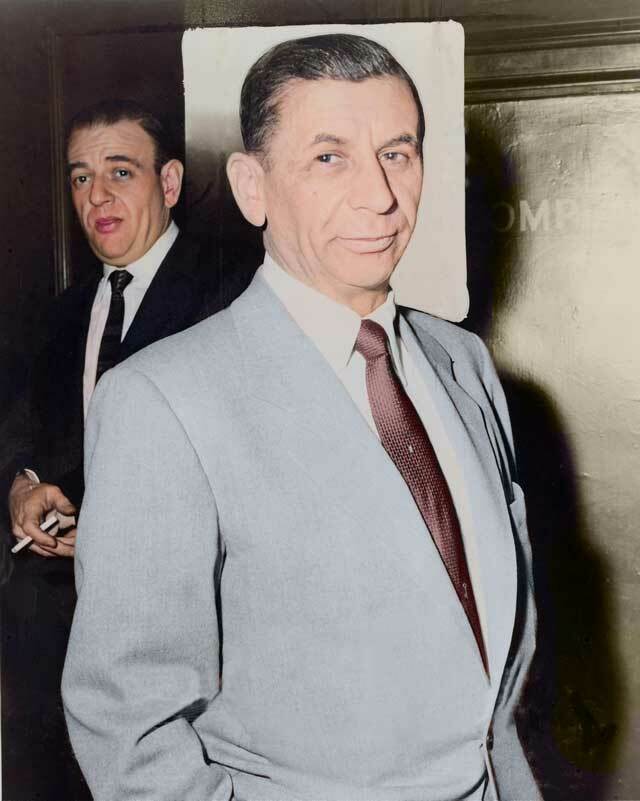
Murder Inc. gangster Meyer Lansky has featured in over a dozen Hollywood movies and television series from Lee Strasberg in The Godfather (1972) to Ben Kingsley in Bugsy (1991) and Dustin Hoffman in The Lost City (2015) so you could be asking why do we need another one? And it’s a good question because this part docu-drama, while recounting the well-known aspects of the mobster’s career, also examines less obvious areas as well as bringing the story up-to-date in a duel of wits between Lansky (Harvey Keitel) and the F.B.I. still chasing him for $300 million it presumes he has hidden away.  

The movie is framed by journalist David Stone (Sam Worthington) interviewing Lansky about his life. This turns out to be far more interesting than previously portrayed. Sure, there’s plenty of executions, but Lansky was also the most financially acute of gangsters, taking the business legitimate in the fashion of Michael Corleone in The Godfather, realising that rather than killing businessmen who could not pay their debts it was more sensible to take over their businesses and improve them, and in order to keep everything above board when contracted to oversee all the casinos in Cuba refusing to rig machines in the house’s favour.

Lansky in his heyday.

He’s also got a crippled son whose illness he perceives as a mathematical equation and is convinced he can beat the odds. In the course of his interviews, Stone falls for a honey trap and is blackmailed/bribed by the F.B.I.  So tension is raised by the government agency hovering in the background, the mystery of the missing millions, and Stone’s fears that Lansky will find out he is being betrayed.

Biopics succeed or failed based on what aspects of the subjects life they choose to cover. All the big names are here – Al Capone (Robert Walker Branchaud), Lucky Luciano (Shane McRae), Salvatore Maranzano (Jay Giannone), Bugsy Siegel (David Cole) – but we also delve into territory almost foreign to the gangster genre with Lansky’s patriotism leading him to root out Nazi spies and sympathizers during world War Two, in return for which he secures the release from prison of Lucky Luciano. His return to Israel is scuppered by U.S.-Israel relations. And, no matter his courtesy and manners, he’s also a scumbag of the first order, committing wife Anne (AnnaSophia Robb) to a psychiatric hospital because she has the audacity to blame him for his crimes.

Adding some depth is the “currency” of traded favours, that the U.S. government had little compunction in utilising his services at a time when it was trying to crack down on organised crime. Even the ageing Lansky is clever enough to outwit his pursuers.

But, of course, movie length works against the film. It would have been better as a limited series, exploring the man’s entire career. Even so, it certainly provides new insight into the mind of a gangster who was a businessman, in the correct term of the word, first and foremost. In another world, he might have been acclaimed as the man who pioneered a  gambling industry now worth $250 billion annually to the U.S. economy.

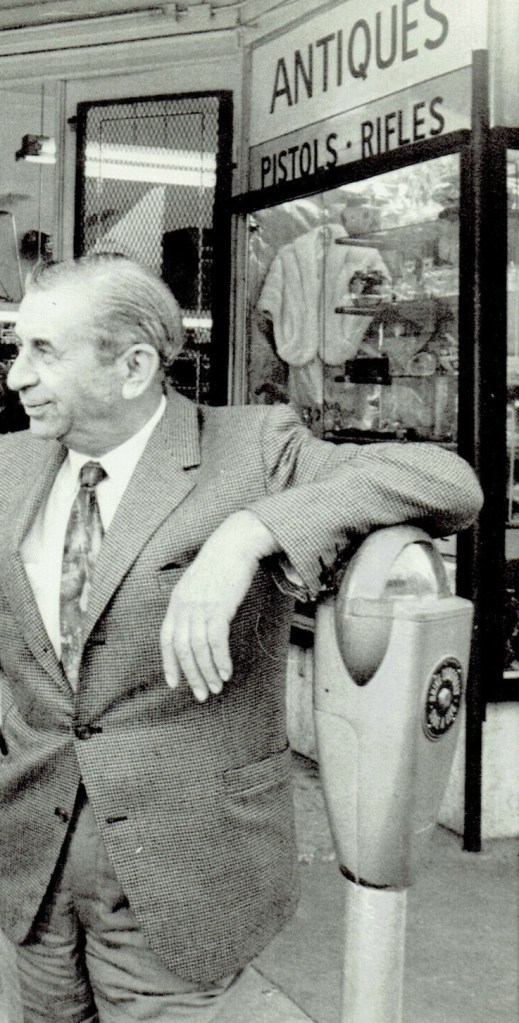
Just another elderly citizen.

Harvey Keitel (The Irishman, 2019) shows no sign of calling time on a career over half a century old and his bemused take on the gangster is solid work. Sam Worthington (Fractured, 2019) is excellent as the compromised journalist trying to keep family and finances together. Look out for David Cade (Into the Ashes, 2019) as Lansky’s lifelong buddy, Minka Kelly (She’s in Portland, 2020) as the deceitful girlfriend and AnnaSophia Robb (Words on Bathroom Walls, 2020) as the showgirl who realises marriage is not all it’s cracked up to be.

This was something of a personal project for writer-director Eytan Rockaway (The Abandoned, 2015) since his father was the journalist in the film. Rockaway’s approach is an interesting twist on the gangster film and he elicits strong performances all round. The final scene you won’t see coming.

Nobody Runs Forever (1968) / The High Commissioner ****

Character-driven intelligent thriller ripe for re-evaluation. And not just because it stands out from the decade’s genre limitations, neither hero threatened by mysterious forces in the vein of Charade (1963) or Mirage (1965) nor, although espionage elements are involved, fitting into the ubiquitous spy category. Instead, it loads mystery upon mystery and leaves you guessing right to the end.

And a deluge of mystery would not work – even with the London high-life gloss of cocktail parties, casinos and the Royal Box at Wimbledon – were it not for the believable characters. Rough Aussie Outback cop Scobie Malone (Rod Taylor) is despatched to London at the behest of New South Wales prime minister (Leo McKern) to bring home Australian High Commissioner Sir James Quentin (Christopher Plummer) to face a charge of murder.

Probably a better title than either “Nobody Runs Forever”
or “The High Commissioner.”

Unlike most cop pictures, Malone is not sent to investigate a case, he is merely muscle. While he may have his doubts about the evidence against Quentin, suspected of murdering his first wife, he resists all attempts to re-open the case. Arriving in the middle of a peace conference hosted by the principled Quentin, he agrees to investigate security leaks from Australia House and along the way turns into an impromptu bodyguard when Quentin’s life is endangered. But Quentin’s wife Sheila (Lilli Palmer) and secretary Lisa (Camilla Sparv) are not taken in by the deception and so Malone himself forms part of the mystery.

With a preference for cold beer to expensive champagne, you might expect Malone to be a bull in a china shop. Instead, dressed for the part by the solicitous Quentin, Malone fits easily into high society, taking time out from his duties for a dalliance with the elegant Madame Chalon (Daliah Lavi). The background is not the gloss but the passion the Quentins still feel for each other, she willing to do anything (literally) to save her husband, he losing the thread of an important speech when worried about his wife.
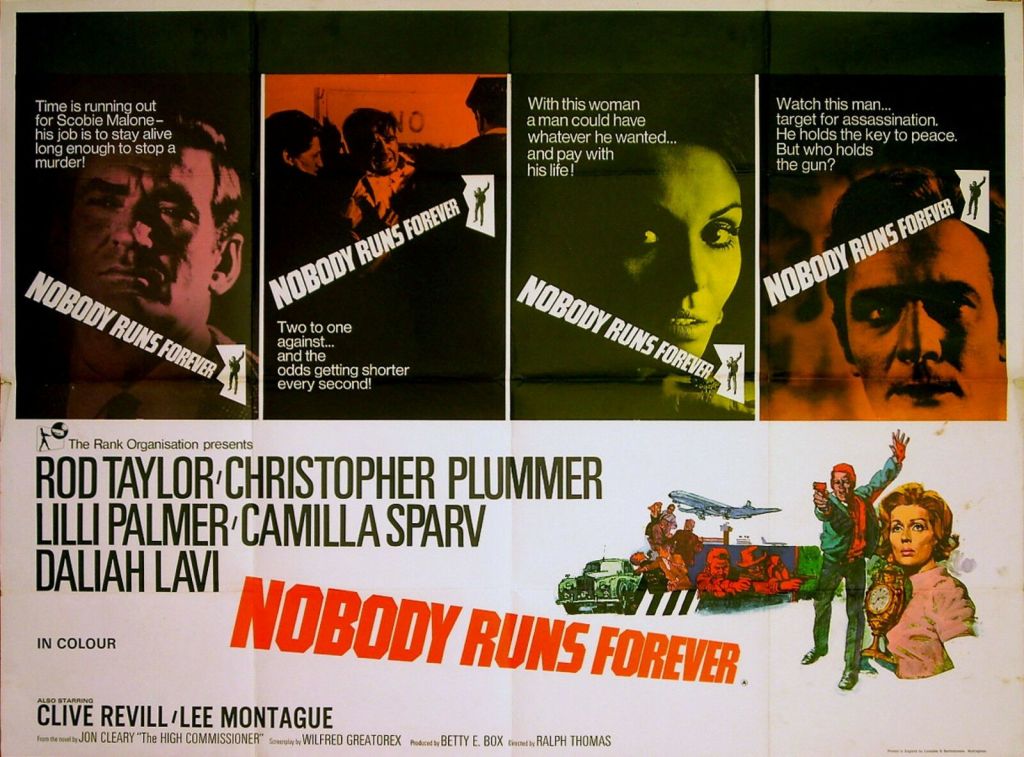
While there is no shortage of suspects for all nefarious activities, red herrings abound and cleverly you are left to make up your own mind, rather than fingers being ostentatiously pointed. There is some delicious comedy between Malone and Quentin’s uptight butler (Clive Revill), enough punch-ups, chases and clever tricks to keep the movie more than ticking along but at its core are the relationships. Malone’s growing respect for Quentin does not overrule duty, Lisa’s evident love for Quentin cannot be taken the obvious further step, Sheila’s overwhelming need to safeguard her husband sends her into duplicitous action.

The politics are surprisingly contemporary, attempts to alleviate hunger and prevent war, and while there was much demonstration during the decade in favor of world peace, this is the only picture I can think of where a politician’s main aim is not self-aggrandisement, greed or corruption. There are some twists on audience expectation – the dinner-jacketed Malone in the casino does not strike a James Bond pose and start to play, he is seduced rather than seducer, and remains a working man throughout.

Rod Taylor (Dark of the Sun, 1968) and Christopher Plummer (Fall of the Roman Empire, 1964) are terrific sparring partners, red-blooded male versus ice-cool character, their jousts verbal rather than physical. The rugged Taylor turns on the charm when necessary, a throwback to his character in Fate Is the Hunter (1964). Thoughts of his wife soften Plummer’s instinctive icy edge. Lilli Palmer (The Counterfeit Traitor) is superb as yet another vulnerable woman, on the surface in total control, but underneath quivering with the fear of loss. Two graduates of the Matt Helm school are given meatier roles, Daliah Lavi (The Silencers, 1966), as seductress-in-chief is a far cry from her stunning roles in The Demon (1963) and The Whip and the Body (1963) – and it still feels a shame to me that she was so ill-served in the way of roles by Hollywood. Camilla Sparv (Murderers Row, 1966) has a more low-key role.

Clive Revill (The Double Man, 1967) has another scene-stealing part and look out for Calvin Lockhart (Dark of the Sun), Burt Kwouk (The Shoes of the Fisherman, 1968) and, shorn of his blond locks, an unrecognizable Derren Nesbit (The Naked Runner, 1967) and in his final role Hollywood legend Franchot Tone (Mutiny on the Bounty, 1935).

Ralph Thomas (Deadlier than the Male, 1967) directs with minimum fuss, always focused on character, although there is a sly plug for Deadlier than the Male in terms of a cinema poster. (Speaking of posters, I couldn’t help notice this interesting advert at an airport for a VC10 promoted as “10derness.”) Wilfred Greatorex (The Battle of Britain, 1969) made his screenplay debut, adapting the bestseller by Jon (The Sundowners) Cleary. This may not be quite a true four-star picture but it is a grade above three-star.

CATCH-UP: Rod Taylor films reviewed in the blog so far are Seven Seas to Calais (1962), Fate Is the Hunter (1964), The Liquidator (1965), The Glass Bottom Boat (1966), Hotel (1967) and Dark of the Sun (1968).

Discover WordPress

A daily selection of the best content published on WordPress, collected for you by humans who love to read.

The Atavist Magazine

by Brian Hannan

WordPress.com News

The latest news on WordPress.com and the WordPress community.