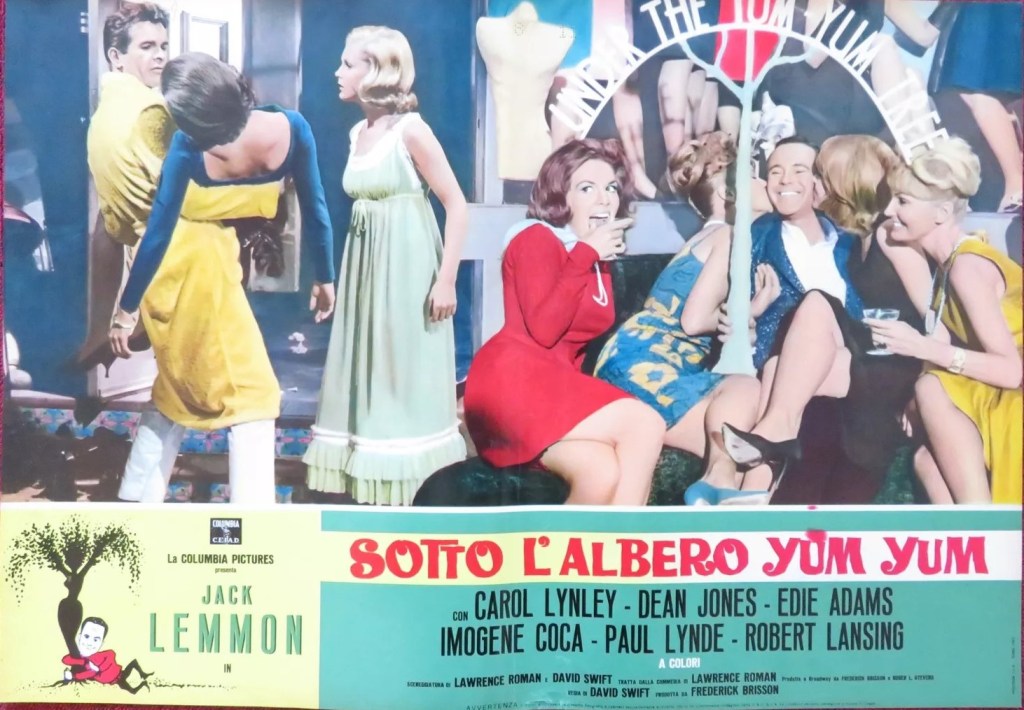
Under the Yum Yum Tree (1963) ***

Must have seemed a good idea at the time. A switcheroo from The Apartment (1960), where Jack Lemmon is the sap caught in middle of illicit affairs, to setting him up as the ace seducer with a string of girls at his beck and call. Except this won’t wash for contemporary audiences given that, effectively, he’s a sexual predator (seducer if you want to be nice about it), peeping tom (no way to dress that up) and eavesdropper (could have taught a class in  The Conversation, 1974). He lets out plush apartments to beautiful girls who either pay no rent or very low rents in return for favors granted.

He uses his own key to let himself into apartments and he’s got a telescope at the ready although that’s hardly required since all the ladies leave windows and doors open permitting him to gawk whenever he wishes.
Luckily, he’s not the mainstay of the tale. Nope, that’s breaking down another barrier, and very cleverly for the times. At this time, sex on the screen was usually the result of illegitimate affairs, involving at least one husband or wife, or it was a sex worker by any other name (Elizabeth Taylor in Butterfield 8, 1960, expects presents in lieu of cash). The idea of living in sin, as it used to be called, i.e. cohabiting without a marriage licence, was not generally on the cards.

So the deal here, to get round the snippy censor, was that Robin (Carol Lynley) and Dave (Dean Jones) set up home together to test out their compatibility but without sex entering the equation, him sleeping in a separate bed. Their apartment is let out by Hogan (Jack Lemmon), the predatory landlord. He has just been dumped by Robin’s aunt Irene (Edie Adams), hence the vacancy, and believes it’s two beautiful women moving in, not a couple. So his plan to offer two damsels a romantic meal with candles and violins (these play automatically) and a roaring fire (also electronic) falls apart.

That doesn’t prevent him from using his own key to enter the apartment at inappropriate moments and continuing his ardent wooing while trying to get rid of Dave or cause the kind of ruckus that’s going to cause the boyfriend to quit, leaving the coast clear.

Luckily, which gives the movie some acceptable life of its own, the dodgy landlord aspect takes second place to the lust vs logic argument that’s intrinsic to the idea of marriage. The couple spend most of the time arguing, and the movie is quite specific, much more than you might expect, on the ways in which a lusty young fellow can keep his ardor in check.

It’s based on a stage play, of the farce kind, so it relies on misunderstandings and misalignments and finds various ways of getting various combinations of the trio (and occasionally a quartet when Irene returns) in the room at the same time. There’s the usual problems when exchanges get heated.

Lurking in the background are married housekeeper Dorkus (Imogene Coca) and handyman Murphy (Paul Lynde), at opposite ends of the approval scale, the man even creepier than his employer.

Previously, I hadn’t found Jack Lemmon’s schtick so wearing, but his acting style is so frenetic you wonder how it ever found expression except in madcap comedy. It’s not just that his jaw constantly drops, but his eyebrows go up at the same time, and he might even be chucking in that trademark cackle. He toned it down for Days of Wine and Roses (1962) and jacked it up for The Great Race (1965) and somehow anything in between doesn’t quite work unless he’s got Billy Wilder on his tail.

But there are several pluses here. Carolyn Lynley (Bunny Lake Is Missing, 1965) proves an adept comedienne and Dean Jones was clearly in rehearsal for his later Disney pictures like The Love Bug (1967). Imogene Coca had been a legendary television staple, with her own show in the 1950s. There are fleeting glimpses of Bill Bixby (The Incredible Hulk, 1977-1982) and Variety columnist Army Archerd and James Darren (The Guns of Navarone, 1961), who died recently, sings the title song, and has a more robust voice than I had assumed for a pop singer.

David Swift (The Interns, 1962) directed and co-wrote the script with Lawrence Roman (The Swinger, 1966) from the latter’s Broadway hit.

A film of two halves. You can only cringe at the attitudes on display but enjoy the pre-marital ding-dongs between the couple.

Period of Adjustment (1962) ***

You want angst, frustration, tragedy, Tennessee Williams is your man. Comedy? Not so much. He had pretty much supplied Hollywood with an unending stream of hits. From The Glass Menagerie (1950), quadruple Oscar-winner A Streetcar Named Desire (1951), triple Oscar-winner The Rose Tattoo (1955) and four-time Oscar nominee Baby Doll (1956) to Cat on a Hot Tin Roof (1958) with six nominations, Suddenly, Last Summer (1959) three nominations, The Fugitive Kind (1960), Summer and Smoke (1961) four nominations, and Oscar-winner Sweet Bird of Youth (1962) his movies attracted the cream of Hollywood.  The likes of Marlon Brando (twice), Elizabeth Taylor (twice), Montgomery Clift, Vivien Leigh, Paul Newman (twice) and Katharine Hepburn stood in line for the honor of participating.

Tennessee Williams was, unusually for a writer, a marquee name. He promised sensation, sex, scintillation. Audiences in need of a few laffs didn’t look towards his work.

So what to make of his first comedy? He was the biggest name by far involved. And the marketeers made sure audiences were aware this was a comedy and not a searing drama. But absence of the kind of big-name star generally associated with the playwright’s adaptations might have made them leery. Director George Roy Hill making his debut. Anthony Franciosa in his first top-billed role, fourth movie for Jane Fonda, Jim Hutton downgraded to second male lead from being star of his previous picture, Lois Nettleton in her debut. But who knows? It might make stars of them all.

The story itself is slight. A couple with different expectations of each other coming to terms with marriage. There’s a racy element, too. New husband George (Jim Hutton) is suffering from stage fright, can’t deliver in the bedroom department on their honeymoon. Wife Isabel (Jane Fonda) is a bit too ditzy, far removed from the efficient nurse he fell, too fast, in love with. He’s got some odd ideas of his own, a hearse his notion of acceptable transportation.

Anyway, they end up in the home of his Korean War buddy Ralph (Anthony Franciosa) whose marriage to Dorothea (Lois Nettleton) is in tatters. It’s a soft soap version of Who’s Afraid of Virginia Woolf as the newly-weds get a glimpse of what can happen way down the line when marriage is out of control.

Luckily, it’s built as a comedy not as drama, so nothing gets that much out of control and if anything it’s heading in the direction of warm-hearted as the newly-weds find ways to patch up their differences while the warring couple discover exactly what’s gone wrong with their relationship, primarily that good old Ralph married his wife for her money.

But, mostly, instead of trying to fix their own marriages, the couples are more intent on offering advice to the other. The pal’s in-laws take the brunt of the blame. Dysfunctional family and potentially dysfunctioning family have to suck it up and change.

There’s some obvious comedy thrown in to lighten the load, this taking place at Christmas, a bunch of choristers, going door to door, get drunker with every stop-off. But the movie doesn’t quite go in the direction you expect. There’s no easy fix, though there is a fix, but each character goes through a definite change rather than just flipping a switch.

Though Jane Fonda (Barbarella, 1968) is the one who became a star, it took her quite a few acting iterations to achieve it, and this sees her going down the Marilyn Monroe route of  blatant sexiness so in a sense hers is the least interesting character because she’s so shallow to begin with. Anthony Franciosa (Fathom, 1967) is the pick, in part because he’s playing a more genuine character rather than the schemer or matinee idol that he essayed in so many later movies. Jim Hutton (The Hellfighters, 1968) is still in lightweight mode.

George Roy Hill (Butch Cassidy and the Sundance Kid, 1969) is occasionally stagey in his direction but manages to pull out the performances required to make this work. Isobel Lennart (Funny Girl, 1968) does the adaptation.

Not just for Tennessee Williams or Jane Fonda completists.

Discover WordPress

A daily selection of the best content published on WordPress, collected for you by humans who love to read.

The Atavist Magazine

by Brian Hannan

WordPress.com News

The latest news on WordPress.com and the WordPress community.