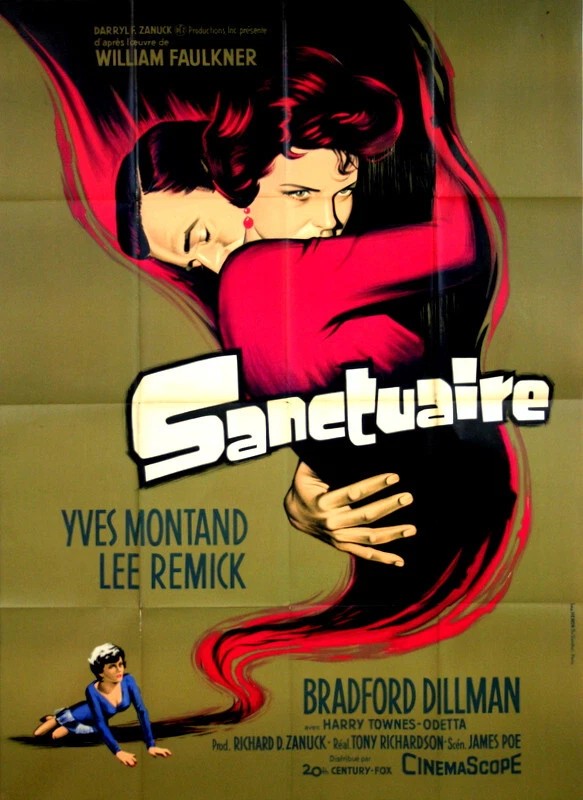
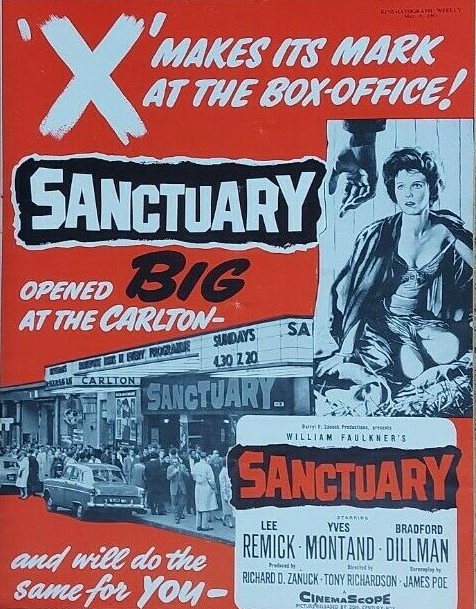
This overheated melodrama stands as a classic example of Hollywood’s offensive attitudes to women. Nobel prize-winning author William Faulkner could hardly blame the movies for sensationalizing his misogynistic source material since if anything the movie took a softer line. Told primarily in flashback as headstrong southern belle Temple Drake (Lee Remick) attempts to mitigate the death sentence passed on her maid Nancy (Odetta). Given that such appeals are directed at Drake’s Governor father (Howard St John), and that the maid has been condemned for murdering Drake’s infant child, that’s a whole lot of story to swallow.
Worse is to follow. Drake takes up with Prohibition bootlegger Candy Man (Yves Montand) after being raped by him and thereafter appears happy to live with him in a New Orleans brothel – the “sanctuary,” no irony intended, of the title – despite him slapping her around. The film steers clear of turning her into the prostitute of the original book, but pretty much sets up the notion that high class women will fall for a low-class tough guy whose virility is demonstrated by his brutality. In other words a “real man” rather than the dilettantes she has previously rejected.
After the Candy Man dies, Drake returns home and marries wealthy suitor Gowan Stevens (Bradford Dillman) who blames himself, rightly, for Drake falling into the clutches of the gangster in the first place. But a past threatening to engulf her precipitates the infanticide.
Faulkner was a Hollywood insider, adapting Sanctuary for The Story of Temple Drake (1933) and earning high praise for his work on Bogart vehicles To Have and Have Not (1944) and The Big Sleep (1946). The success of The Tarnished Angels (1957) starring Rock Hudson, The Long, Hot Summer (1958) with Paul Newman and The Sound and the Fury (1959) headlined by Yul Brynner had sent his cachet rocketing. But all three were directed by Americans – Douglas Sirk and Martin Ritt – who had a distinctive visual style and an ear for what made melodrama work.
Sanctuary had been handed to British director Tony Richardson (Look Back in Anger, 1959) and he didn’t quite understand how to make the best of the difficult project. So while Lee Remick manages to suggest both strength and fragility, and makes her character’s wanton despair believable, Yves Montand is miscast and Bradford Dillman fails to convince even though portraying a weak character. Too many of the smaller roles appear as cliches. And it’s hard to believe the maid’s motivation in turning murderer.
What was acceptable steamy melodrama in the 1930s fails to click three decades on. Faulkner’s thesis that high-falutin’ women want a man to master them and furthermore will fall in love with their rapist seems to lack any understanding of the female mind and will not appeal to the modern sensibility than it did on release. Lee Remick is what holds the picture together, in part because she plays so well the role of a woman embracing degradation, and refusing – no matter how insane the idea appears – to let go of the man she believes is the love of her life. It’s not Fifty Shades of Grey, but it’s not that far off that kind of fantasy figure, and given the success of that book, it’s entirely possible there is a market for what Faulkner has to peddle.
Controversy breeds controversy. Convicted killer Nathan Leopold was furious when author Meyer Levin reneged on his deal to write a book concentrating only on the murderer’s prison time, instead churning out a fictionalized account of the “crime of the century.” Levin’s novel, published in October 1956 by Simon & Schuster in the U.S., was snapped up by Darryl F. Zanuck for an upfront fee of $150,000 and the same again when the movie appeared.
A play, also ensnared in controversy, preceded the movie. Broadway producer Michael Myerberg was so dissatisfied by Levin’s script that he called in Robert Thom as co-writer. For his efforts Thom was due one-fifth of Levin’s share of the stage royalties. The play opened at the Ambassador in New York on 24 October 24, enjoying a healthy 18-week run.
There was contemporary feel to the cast given that, like now, Broadway was recruiting big names from Hollywood including Rex Harrison, Richard Burton, Walter Pidgeon, Anne Baxter, Joan Blondell, Paulette Goddard and for Compulsion rising star Dean Stockwell (Gun for a Coward, 1956). Actually, there was a heck of cast. As in the movie Stockwell played Judd. Roddy McDowell (Five Card Stud, 1968) played Arthur. But the big sensation was an “obscure actor” understudy Michael Constantine (Beau Geste, 1966), thrown into the limelight by illness, in the key role of the defense attorney. Also in small roles were Ina Balin (The Commancheros, 1961), Barbara Loden (Fade In, 1968), Suzanne Pleshette (Nevada Smith, 1966) and John Marley (The Godfather, 1972).
Levin complained he had been forced “under duress” to take on Thom as a co-writer and refused to pay him. The case went to court. Levin lost but he won a victory of a sort in writing Thom out of the play when it made its London West End debut. Meanwhile, Leopold was intent on his own revenge, on release from prison on parole in 1958 and having published his own autobiography, suing Levin and Zanuck, among others, for $1.5 million. He, too, was a loser in court.
In an early version of the nepo baby, Darryl F. Zanuck gave son Richard a leg-up by assigning him to be producer of the movie.
When director Richard Fleischer entered the equation Orson Welles was already cast as the defense attorney modelled after Clarence Darrow. The director might well have signed up on the strength of the script by Oscar-nominated Frank Murphy (Broken Lance, 1954). “It was the best I ever read,” he said. Among other things, Murphy had tightened up on the action of the play, removing scenes set in prison long after event, and taking a documentary-style approach to the film.
On hearing Welles was involved, “my tongue was hanging out,” admitted Fleischer. Given Welles’ murky finances, time was always going to be of the essence. Tax problems limited the amount of time – ten days exactly – he was available for shooting. And nobody was going to waste any of that valuable time on rehearsals. He arrived from Mexico on the day of the shooting and was booked onto a voyage to China the night filming finished.
Welles always supplied himself with a false nose, and that was the director’s first astonishing encounter with his star, on the first day of shooting. Welles explained his real nose was “just a button” and only once had appeared with it in a movie. He claimed Laurence Olivier was prone to the same insecurity. That wasn’t the actor’s only peccadillo.
He had trouble remembering lines. To cover this up he would claiming he was “reaching” for the words, actorspeak for showing thinking on camera. Fleischer discovered the way to challenge the actor over this was to tell him his reaching was so “realistic” it looked like he had forgotten his lines. In addition, Welles hated having anyone in his eye line, couldn’t cope with eye contact at all. So when it came for his part of a two-person scene he would play it to a blank wall, but with pauses, laughter, “exactly as though there were someone speaking to him.”
In the normal course of filming such a problem could be accommodated. It was a different story when it came to the movie climax, an 18-minute speech, the longest uninterrupted monologue in movie history. It was impossible to film it in one take. Apart from anything else, a movie camera only held ten minutes of film. So it needed broken down into smaller sections, some of which were quite long in themselves. As some of the speech was directed in general terms to the courtroom that didn’t demand eye contact so Welles was safe there.
But other sections had to be directed to the prosecutor (E.G. Marshall) and his team. To get round the problem of maintaining eye contact, Welles had a simple solution. All the other actors had to keep their eyes closed. And that’s what they did. Fleischer recalled as “a ludicrous but memorable sight” seeing all the actors “line up, listening intently, with their eyes closed.”
Only four days were left for the speech. So the director pointed his three cameras in one direction and shot every section of the speech that applied to, then moved the cameras around until he had completed a 360-degree rotation. However, the last section was filmed in one complete, technically complicated, three-minute section. It was rehearsed to fulfil the technical criteria and then Welles was left alone on the set for a couple of hours to do his own rehearsal. He didn’t want Fleischer to see any of his performance beforehand, just come in and film it. In other words, trust the actor. A dangerous proposition given this was the second last day Welles was available. However, Welles delivered a virtuoso performance captured by intricate camerawork.
To save money, the studio had revamped a set from another picture, dressed up with “a little paint, some different trim…a set for almost no cost.” Fleischer had redressed an older that set lacked one wall. Welles, clearly unaware of budgetary problems, wanted to make his exit from the scene through the side that had no wall. Told that was impossible, Welles noted that, if director, he would have stood up to the studio, forced them to build a wall so he could exit in the manner that seemed most appropriate. “That’s why I’m directing this picture and not you,” was the director’s prompt reply.
Needless to say, Welles was not always on his best behaviour. Sometimes, he was playing to the gallery, especially if the producer hove into view, or if he was feeling narked that a director with conspicuously lesser directorial skills was in charge. Among those to receive both barrels were a hapless stills photographer and a publicity man guilty of an imaginary slight. Both these incidents could be brushed off, the collateral of tension on any movie. It was a different story when the director was in the legendary actor’s sights, as occurred when Welles had the opportunity to view dailies. He took the film apart, “a total disaster from beginning to end.” Explanation for the unexpected explosion came from the fact that his salary had been “garnished” by a tax official, meaning he wouldn’t be paid.
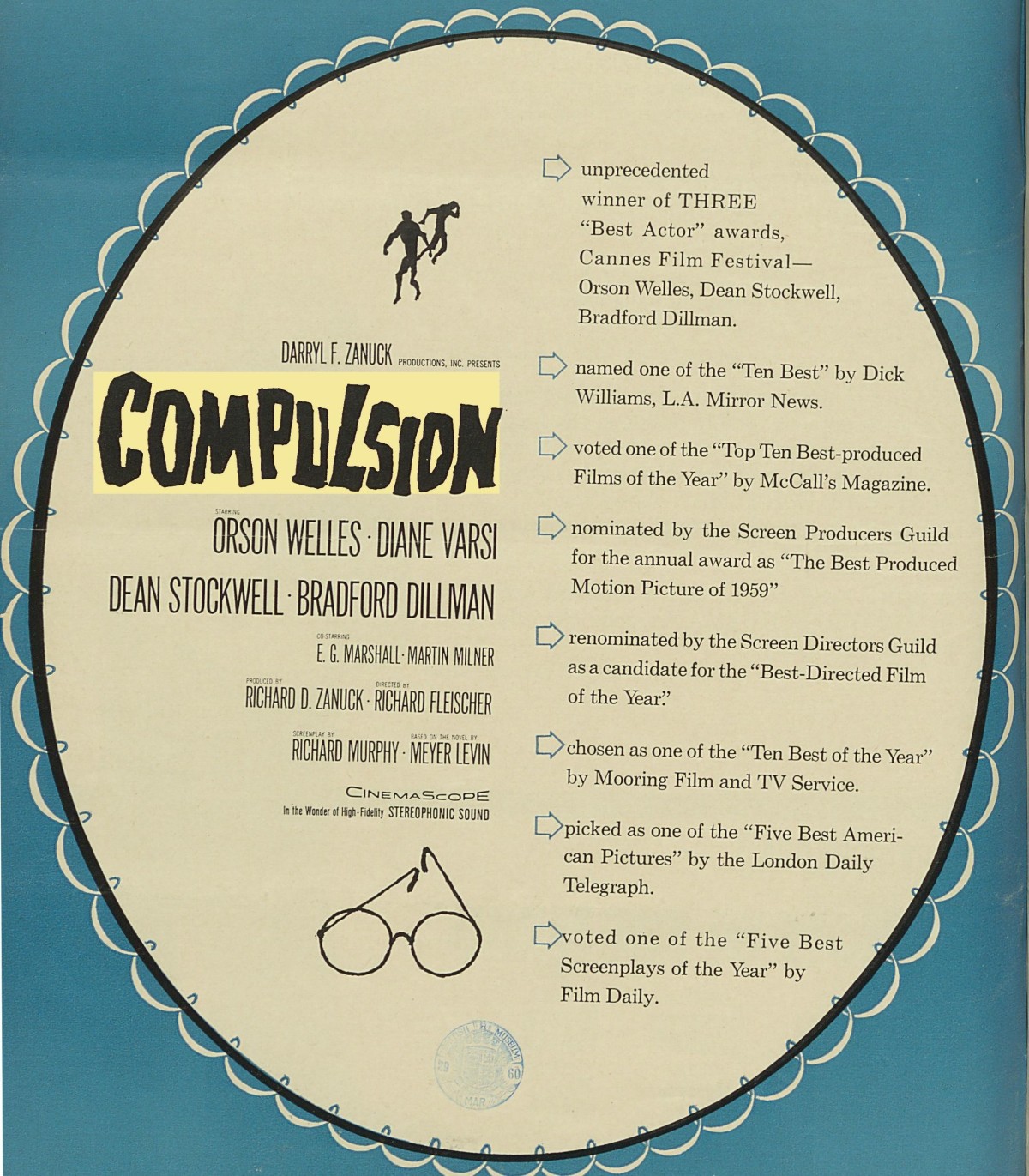
At Cannes the three stars shared Best Actor honors. Fleischer was nominated for a Bafta and a DGA. Despite fears that to avoid stirring up old controversy Chicago would be denied a release, that city proved one of the earliest to show the movie. It did well in the big cities, less well elsewhere. Rentals were a disappointing $1.8 million, ranking it 48th for the year. In London, exhibitors exploited the old gimmick of denying patrons entrance once Orson Welles lumbered to his feet for his big speech.
Despite success in the big-budget adventure field with movies like 20,000 Leagues under the Sea (1954) and The Vikings (1958), Fleischer hankered after independence. He set up his own shingle Nautilus but complained that with so many “properties” tied up by the studios, and likewise marquee names, he was reduced to “combing library shelves and finding properties major studios had missed.” He had three projects on his planned indie slate – Willing Is My Lover, an original screenplay by Frank Murphy, an adaptation of Tolstoy’s Resurrection and Trouble in July by Erskine Caldwell. But none ever saw the light of day.
SOURCES: Richard Fleischer, Just Tell Me When To Cry, Carroll & Graf, 1993, p161-175; “Writers Harvest,” Variety, December 5, 1956; “Compulsion Producer,” Variety, September 25, 1957, p1; “Legit Increasingly Recruits Players from Film,” Variety, October 9, 1957, p63; “Shows on Broadway,” Variety, October 30, 1957, p82; “Levin Withholds Thom Royalties for Compulsion,” Variety, December 11, 1957, -p73; “Meyer Must Pay,” Variety, March 12, 1958, p73; “Meyer Levin to London,” Variety, December 28, 1958, p49; “Old Gimmick, New Pic,” Variety, May 13, 1959, p12; “Properties, Stars Monopolized,” Variety, July 22, 1959, p10; “Now-Free Slayer Sues on Privacy,” Variety, October 7, 1959, p21.
One movie that didn’t need Orson Welles to ride in and save the day and in some senses he gets in its way. Not because he’s – as was often his wont if lacking strong direction – over-acting but because his presence shifts the narrative imperative from motive and psychiatric investigation to a plea against passing the death sentence. A fictionalized version of the “crime of the century,” the kidnapping and killing of a young boy by Leopold and Lowe, a pair of intellectually arrogant wealthy young men, in Chicago 1924, it would make ideal fodder for a Netflix true crime slot, especially as there was no contesting the evidence.
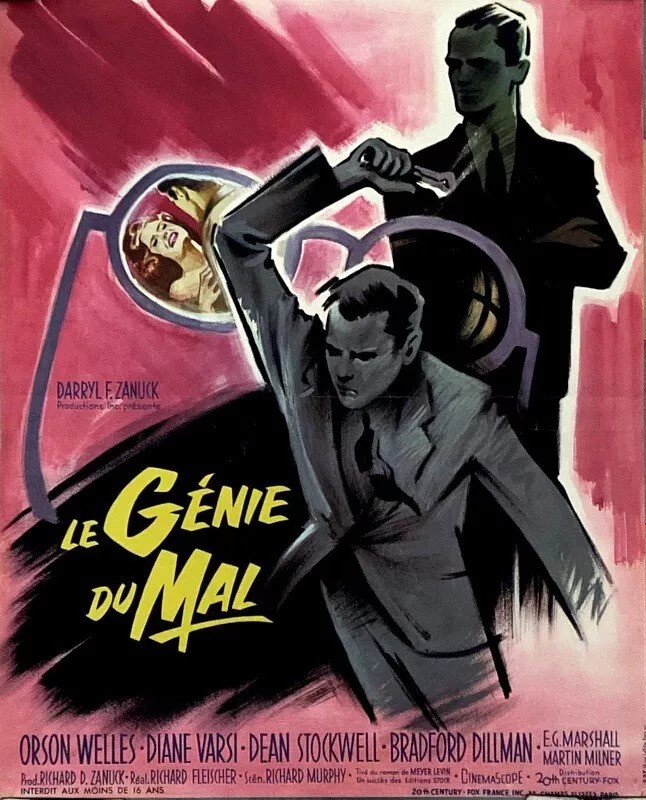
Until the arrival of woebegone defense attorney Jonathan Wilks (Orson Welles) – Clarence Darrow in the real case – this has been given a low key docu style treatment even if it only touches upon what might have caused Arthur (Bradford Dillman) and Judd (Dean Stockwell) to embark on their terrible deed. They have intellectualized murder, believing that they are beyond mortals in their cranial superiority and therefore not only capable of committing the perfect crime, but relishing the prospect of getting away with it and rubbing their inferiors’ noses in the dirt.
Cocky sexually confident Arthur is the dominant one, constantly tormenting his friend for his social deficiencies, Judd the more vulnerable, astonished to find that someone can interpret the loss of his mother as impinging on his emotional security. We enter the tale post-crime and the narrative assumes the audience is already familiar with the Leopold and Lowe case, which proves a distraction now because I had to look them up to fill in the blanks.
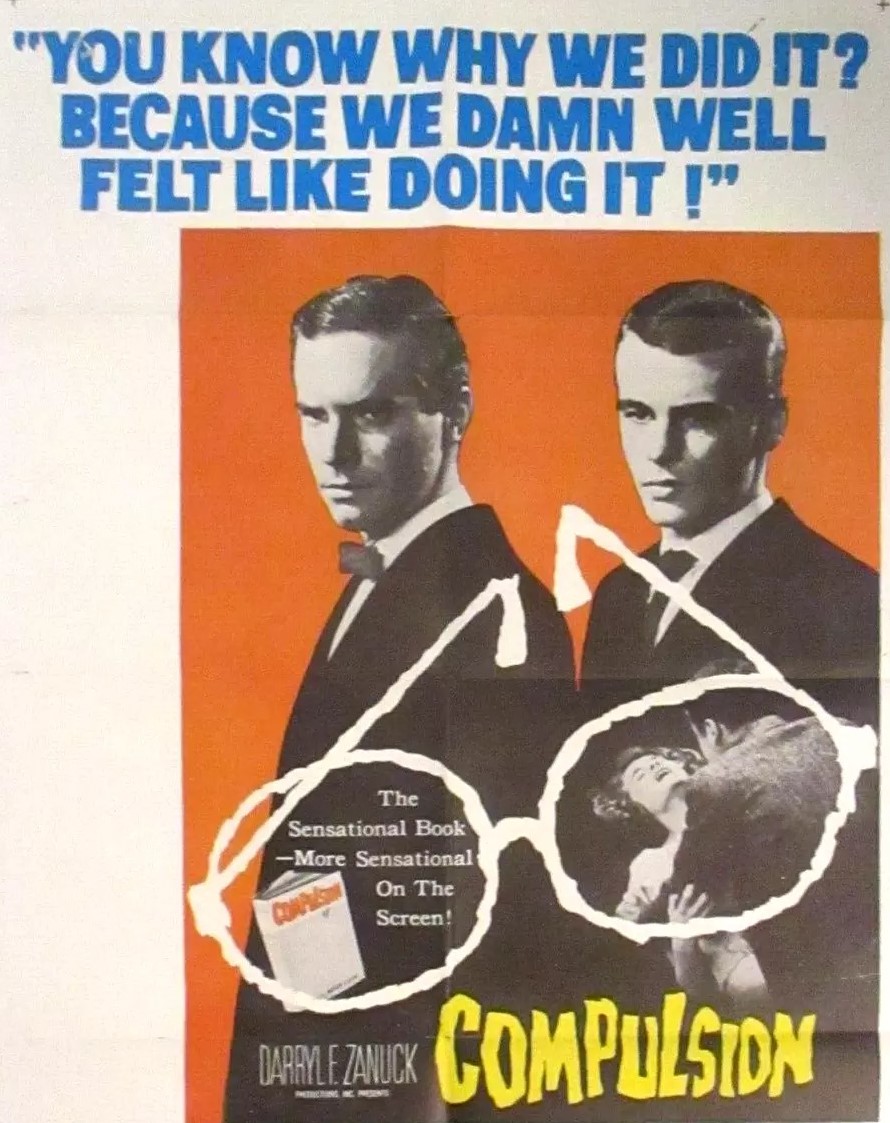
Setting aside their superiority, the movie brings to the fore aspects of criminal behavior only familiar to us from more recent analysis. For example, Arthur wants to remain close to the investigation, offering the police advice, and taking malicious enjoyment out of pointing out possible suspects. Police procedure, which would still have been in its infancy, nonetheless turns upon tracing 4,200 purchases of a very common type of spectacles which, in an unexpected twist, is suddenly whittled down to three thanks to this particular pair containing an unique advanced design element.
However, alibis only fall apart by accident as the pair stick to their rehearsed stories even in the face of intense interrogation, especially Judd’s contention that his spectacles could have fallen from his jacket pocket close to where the body was discovered by pure coincidence. The pair have already confessed when Wilks rides to the rescue, or at least save them from corporal punishment. Most of this is via a legal trick. He places the onus of deciding their fate on the thoughtful judge who can follow legal argument more easily than a bloodthirsty jury appalled at the crime and out for revenge.
In his deployment of Orson Welles, director Richard Fleischer (The Boston Strangler, 1968) plays a blinder. Audiences expecting to see Welles in full bombastic oratory flow were blindsided by the almost apologetic tone taken. There’s virtually none of the usual courtroom sparring and there’s no last-minute witness final twist as was de rigeur for the genre. But, then, you’ve got Orson Welles, the greatest American actor never to win an Oscar, given what he could do with words, glances, whispers and silence. He’s always going to get the last laugh in an exchange of banter, but with a life a stake this isn’t the time for bluster.
It’s an incredibly well-judged performance. Setting aside the monologue, the kind actors would kill for, it’s his general demeanor, almost self-effacing, nothing swanky in his dress, and yet not resorting either to actor gimmicks like wiping sweat from his head with a handkerchief nor even raising his voice. Compare this to the Oscar-winning performance of Gregory Peck in To Kill a Mockingbird (1962) and you’ll wonder why the Academy chose to overlook Welles.
But he’s not the only standout. Bradford Dillman (Circle of Deception, 1961) has the showiest role, oozing icy charm and indifference, but the more obviously emotionally-crippled Dean Stockwell (Psych-Out, 1968) has the more difficult. Perhaps Diane Varsi (Wild in the Streets, 1968) has the toughest part, convincing as the girl who finds something worth caring about inside a killer.
Richard Fleischer has always been unfairly tabbed as the not-great director who made a number of great films. Whichever way your sympathy falls on this issue, this is one of his great movies, steering clear of the sensational, cleverly keeping Welles out of sight until virtually the final third of the movie and then, courtesy of how well he has managed the material, not allowing the actor to steal the show.
Hardly dated at all given the death penalty is still practised in many U.S. states and countries around the world. The plea for clemency isn’t so much the driving force as the acceptance that money doesn’t buy immunity from psychiatric disorder and may well be its cause. Despite his arrogance, Arthur seeks the approval of “Mumsy”, while Judd has no mother. With a host of servants to carry out the parenting, the actual parents can go off and enjoy themselves, ignorant of the dangers of lack of attachment.
It’s still hard to feel any sympathy for the pair, indulging in a thrill kill because wealth protects them and at the mercy of intellect, and while Fleischer makes no attempt at exoneration or mitigation a contemporary audience would intuit more about the family imperfections or lack of parental care or psychiatric awareness that drove them to this.
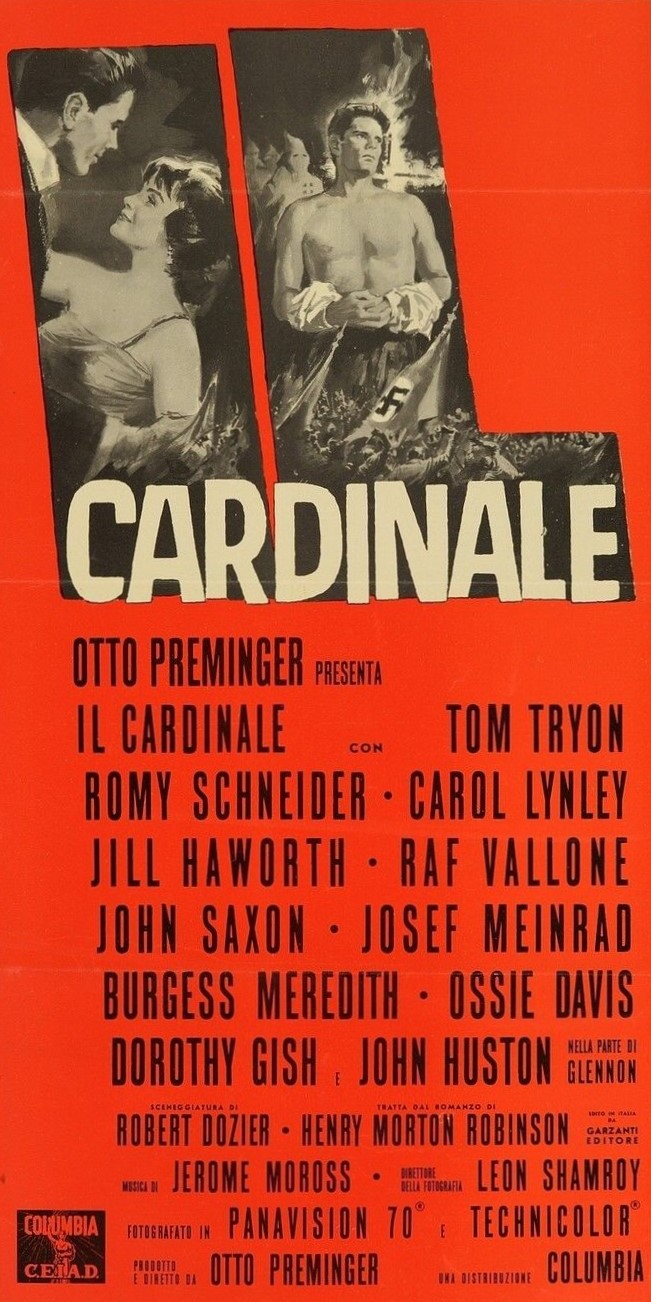
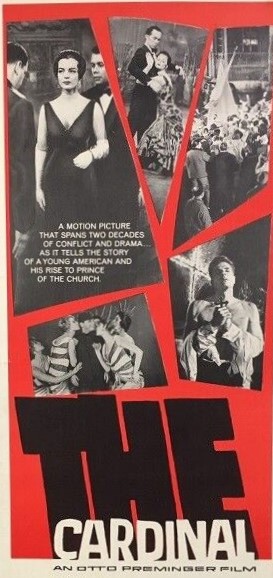
Otto Preminger was beaten to the punch on this one, the scandalous Henry Morton Robinson bestseller snapped up in 1955 by producer Louis de Rochemont (The Roman Spring of Mrs Stone, 1961) who had a tie-up with Columbia. Due to interference from the Catholic Church, de Rochemont dropped his option which Preminger picked up in 1961 while working on Advise and Consent (1962).
The last section of the novel, set in Austria during the Anschluss, reverberated with the director who was born in what was then the Austro-Hungarian Empire and although a Jew was well acquainted with Catholic society. One of his most significant changes to the book was introducing the Austrian cardinal who endorsed Hitler.
The first two screenwriters James Lee (Banning, 1967) and Daniel Taradash (Castle Keep, 1969) failed to whittle down the complex novel to cinematic proportions. So Preminger brought in Robert Dozier (The Big Bounce, 1969) and began working with him in summer 1962 making other alterations to heighten the drama. The incident involving the unborn child of the sister of Fr Fermoyle (Tom Tryon) acquires greater emotional power in the film, touching on the ambiguities inherent in any institution and provoking the priest’s guilt.
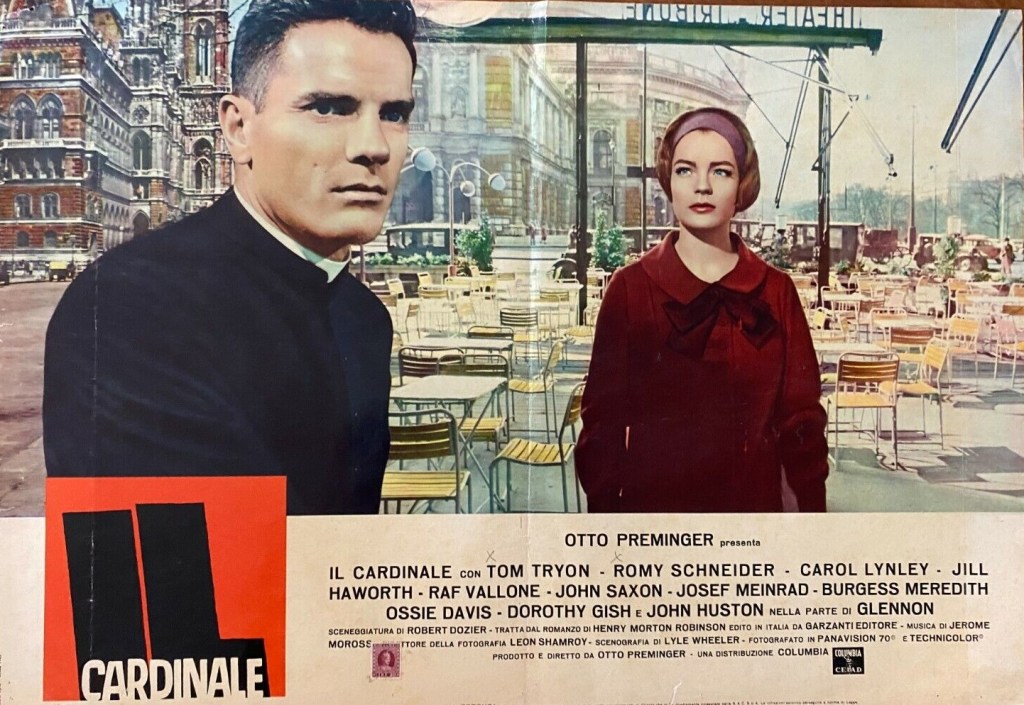
Gore Vidal (The Best Man, 1964) also worked on the script, swapping the novel’s Italian countess for the Viennese Annemarie (Romy Scheider) who, abandoned by the priest had married and was reunited with him prior to the Anschluss, and is sympathetic to Hitler until her husband’s faith endangers them both. Ring Lardner, who had satirized the Catholic church in a recent novel, was the final screenwriter added, his main task to rewrite scenes “to achieve what he (Preminger) wanted,” and, more importantly, to introduce the flashback structure. Ironically, both Vidal and Lardner were atheists.
Tom Tryon and Romy Scheider meet again in Vienna.
The director considered five actors for the leading role – Hugh O’Brian (Africa – Texas Style, 1967), Stuart Whitman (The Commancheros, 1961), Cliff Robertson (The Devil’s Brigade, 1968), Bradford Dillman (Circle of Deception, 1960) and Tom Tryon (In Harm’s Way, 1965), the latter three advancing to the screen-testing stage. The 34-year-old Tryon won the role and a five-picture contract he would later regret. Carol Lynley (Bunny Lake Is Missing, 1965) who plays the priest’s sister also pacted for five movies.
Romy Scheider’s (Triple Cross, 1966) part was enhanced by the work of cinematographer Leon Shamroy who “fell madly in love with her,” resulting in the actress virtually shimmering on screen, never before “looking as beautiful.” Held in warm regard by the director, she was exempt from his tirades.
It took considerable persuasion on the part of Preminger for John Huston to participate. Curd Jurgens, initially cast as the Austrian cardinal, pulled out and was replaced by character actor Josef Meinrad whose lack of English meant he had to learn his lines phonetically.
Tom Tryon described Preminger as “tyrant who ruled by terror.” He was fired on the first day and probably wished the director had not rescinded the decision, for thereafter the actor was tabbed “lazy…a fool…stupid and unprofessional.” Commented Tryon, “I was so frightened he was going to scream that…I (just) wanted the experience to end.”
One scene with John Huston took 78 takes because Tryon could not deliver what the director wanted. And at one point first assistant director Gerry O’Hara (later director of The Bitch, 1979) found the star in tears and refusing to return unless the director agreed not to shout at him. Eventually, during the Italian section of the shoot, Tryon collapsed from nervous exhaustion, and was prescribed two days rest, and after this incident Preminger let up on his demands of the actor.
Explained Preminger, “I probably chose him without deliberation because he is weak.” He felt than an ordinary person would not side with the Church against a family member in a predicament, and that only a person “with weakness in his character” would be believable in the role. The character “fails because when you become a priest you substitute your own judgement and your own feelings for the law of the Church…The big decisions are made for him.” (Quite why he never chose an actor who could portray such weakness is not known.)
Tryon admitted that he owed a brief let-up in the bullying to “Schneider’s benign presence.” He commented, “The only fun I ever had on The Cardinal was a (ballroom) scene I did with Romy.” Prior to turning the cameras, Prior called both over, appeared ready to issue instructions, but instead waved them away “you know what to do.”
Added Schneider, “Preminger taught me an important thing: work fast. It’s true that it greatly helps our acting. Each of his directions, whether of gesture or of intonation, is precise and correct. Even better, it’s the only one possible…Each phrase, each world, each syllable are minutely weighed.” That dexterity applied to his positioning of the camera. He made decisions immediately, never hesitating “over the placement of the camera and each time…it was the simplest, the most natural and, dramatically, the best.”
Ossie Davis (The Scalphunters, 1968), who professed to have enjoyed a marvellous relationship with the director, observed: “I met actors whom Otto liked, I met actors that had no relationship or feelings one way or the other and I met actors who were almost absolutely destroyed, almost literally in panic because of Otto Preminger (who) was always looking for a spark…whether you had the spark or not, he was going to find it and even put it in you.”
But Patrick O’Neal stood his ground. “I woiuld not take it from him.” And they became friends.
The unit shot for five weeks in New England before heading to Vienna, Preminger choosing to stay in the same suite in the Hotel Imperial as appropriated by Hitler when visiting the city. Permission to shoot in the National Library, “one of the most beautiful monuments in the city” was attacked by the current minister of education who wanted the Hitler era erased from memory. And he was barred from using other government buildings for spurious reasons.
After four and a half months in Austria, the unit shifted to Rome, locations including St Peter’s Square and inside St Peter’s Cathedral and the Santa Maria sopra Minerva church, with priests and monks hired as extras for the various ceremonies. The Georgia scenes were shot in Hollywood on the Universal back lot.
Although generally dismissed by the critics and given a hard time as you might expect from the Catholic Church, The Cardinal hit a chord with audiences, who turned it into Premigner’s second-biggest hit of the decade.
There was one in every town: a woman, rich (Sanctuary, 1961) or poor (Claudelle Inglish, 1961) or in between (Butterfield 8, 1960), with a predilection for sex. There were several men in every town, queuing up to take advantage. The woman was inevitably a shameful creature, the men the envy of their peers. You don’t have to look further than Frank Sinatra’s tom-catting in Come Blow Your Horn (1963) or Omar Sharif as the romantic star of the decade with two women in tow in Doctor Zhivago (1965) for an idea of the double standards in play. Welcome to hypocritical Hollywood.
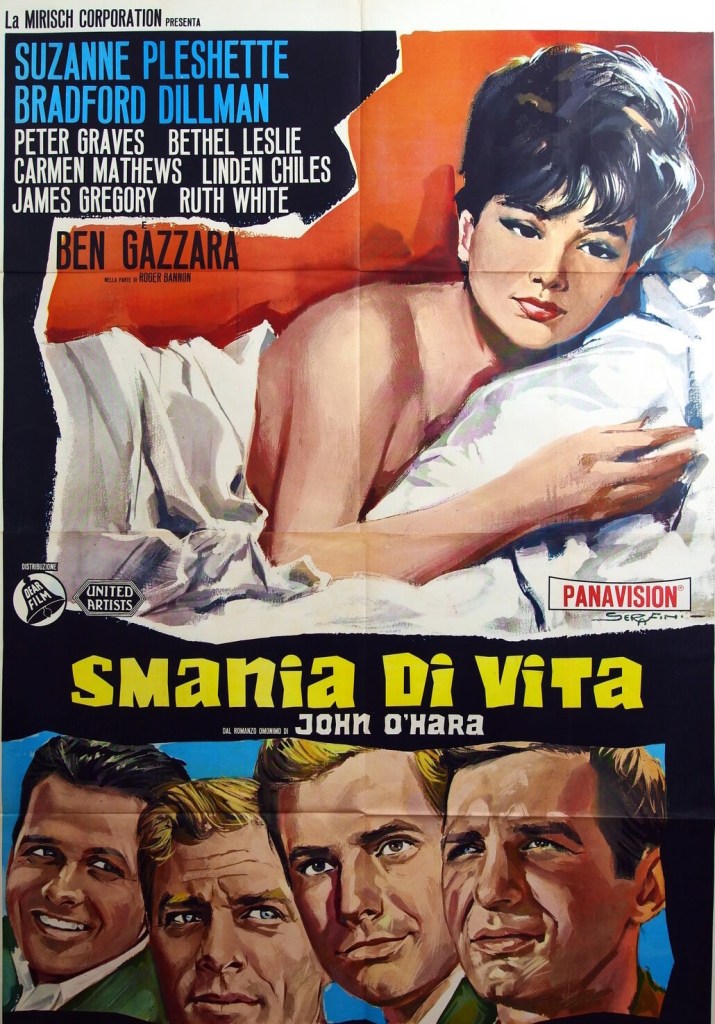
Grace (Suzanne Pleshette), father dead and stuck with a domineering mother, finds escape and fulfilment in sex, and just to give hypocrisy a final tug discovers that while boyfriends are keen to help her explore such physical needs, they take the hump when they discover they might not be the first – or the only. Parents, naturally, are appalled, and discovery of Grace’s antics – and she’s not particularly particular, a passing waiter will do – leads her mother to collapse.
Having confessed to potential husband Sidney (Bradford Dillman) that he will not be marrying a virgin and almost bursting with gratitude that he is willing to overlook her behavior, Grace becomes a farmer’s wife and then a happy mother, until construction owner Roger (Ben Gazzara) comes on strong. She might well have been able to have her cake and eat it but Roger, having fallen in love, reacts badly to being dumped and it’s only a matter of time before her world implodes.
Made a couple of years later, when the independent woman was being exalted, this would have been a different kettle of fish. Here, the boot on the other foot, the woman who picks and chooses her lovers seemed a step too far for that generation.
Before the big trouble begins, the movie does explore, though somewhat discreetly, the almost taboo notion that a woman might just enjoy sex for the sake of it. Sure, Grace likes being wanted and likes being held, but if she was around today, nobody would bat an eyelid if she just came out and expressed her preference.
Less discreetly, the subject of consensual sex comes up, but not as a question of debate, more as a matter of fact, that when Grace says no she actually means yes. There’s a very uncomfortable moment at the beginning when in a Straw Dogs-scene, though nothing like as violent, Grace appears to welcome a rape. Whether this is as bad as it sounds, or is just Hollywood hiding the blush that a woman would not seek out sex but could only discover its pleasures when forced upon her, is hard to say.
Nor is Grace a walking sex machine. She knows enough about men that she only has to put out feelers and any susceptible male will take the bait. And given the restrained times, she’s got no female pal with whom she can discuss her unseemly desires.
Of course, if this was a man, nobody would be batting an eyelid. Sure, once caught, he’d come up with all sorts of excuses, denials, begging for forgiveness, but an audience would give him a free pass. It’s only because this is a woman that it causes ructions. The movie just about gets close to what does make Grace happy and why she needs the thrill of extra marital sex but by that point the melodrama has taken over and there’s little time left for discussion, what with Roger intent on revenge and another lovelorn wife, mistakenly imagining her husband has fallen victim to Grace’s charms, also on the warpath.
Small town constraints play their part, too. Washing your dirty linen in public the worst of all offences. Author John O’Hara, on whose bestseller this is based – and whose other works Butterfield 8, Ten North Frederick (1958) and From the Terrace (1960) explored similar worlds – knows only too well that while wealth brings freedom and privilege it comes with chains attached.
And there’s some interesting role reversal, an illicit lover falling in love with a married person normally a starting point for a movie to explore happiness and its opposite rather than being the one act Grace will not tolerate in a lover, she wants strings-free sex, not anything with encumbrance. While Grace would like to act like a man, and has the wealth to shield herself from the worst of the fall-out, as a mother she is extremely vulnerable, and in this particular era could risk losing her child if seen as maternally unfit.
While lacking the sexual combustibility of Elizabeth Taylor or Lana Turner or other Hollywood heartbreakers, Suzanne Pleshette (Nevada Smith, 1966) gives a decent enough performance especially when it comes to her straightforward attitude to sex, aware she might be causing upheaval, but finding it impossible to ignore desire, or imagine a life in which that does not play an impulsive part.
Bradford Dillman (Sanctuary) has less room for character maneuver and is mostly called upon to suck it up. He comes into his own in the movie’s latter stages when bewilderment at betrayal and public humiliation clashes with continued love for his wife. Ben Gazzara (The Bridge at Remagen, 1969), trademark leer and smug face kept in check, has a showier role especially when the violent aspects of his character explode.
Director Walter Grauman, while better known for war picture 633 Squadron (1963), had just come off another picture dealing with female trauma (Lady in a Cage, 1964) and does quite a decent job here, the camera intensely focusing on the leading actress and then as the tragic outcome unfolds drawing away from her. There’s one great piece of composition. He had used tree branches and the countryside to frame Grace and Sidney at the height of their love. And he does the same again when Grace is abandoned.
Asks some difficult questions without quite getting to grip with the real subject of female sexuality. There was a sense that Hollywood was just on the cusp of accepting the independence of women, but didn’t want to go the whole hog just yet, because, apart from anything else, where would it leave the guys?
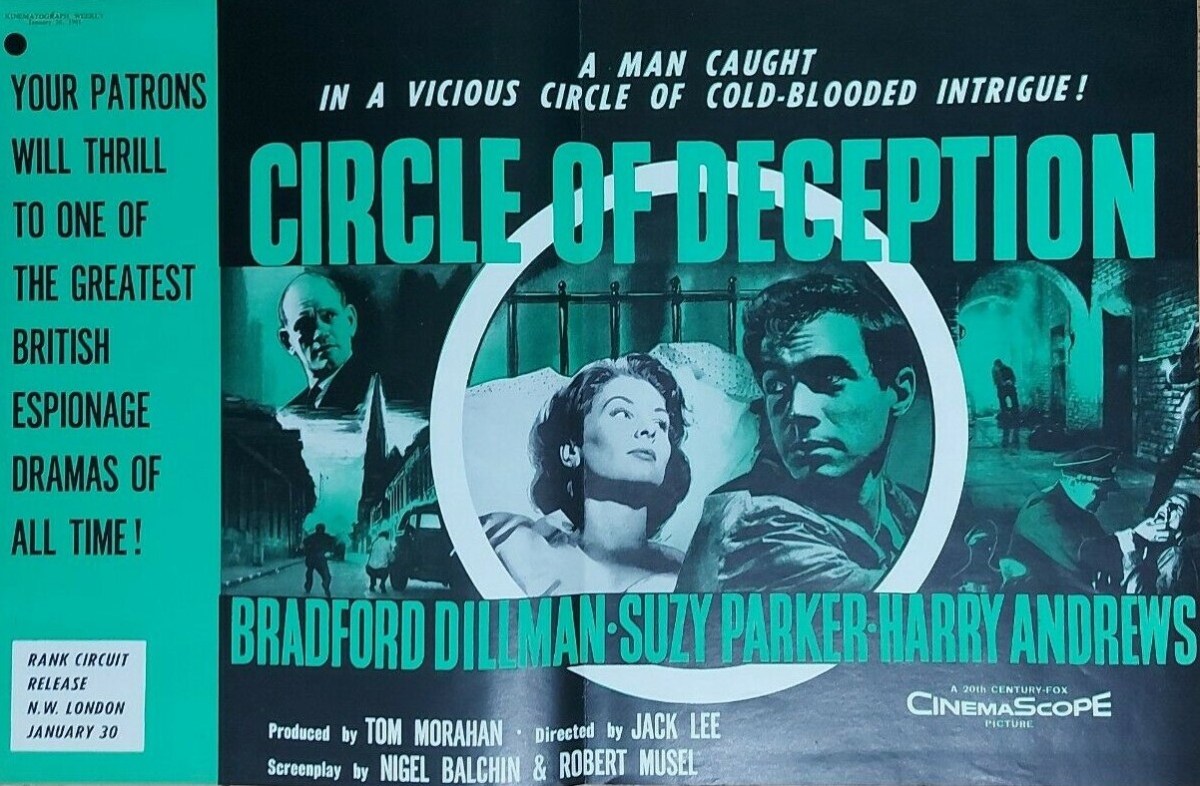
What the enemy do to an Allied spy is nothing compared to his friends. Blood brother to The Spy Who Came in from the Cold (1965) and The Quiller Memorandum (1966) where agents are mere pawns in a bigger game, this is set on the eve of D-Day. The old trope of sending a spy in with misleading information is turned upside down in that this isn’t a corpse as in The Man Who Never Was/Operation Mincemeat, but live bait.
Except the agent doesn’t know he’s being used and has been chosen because he is deemed to have sufficient courage to stand up to initial torture but not hold out forever so that when he inevitably breaks the secrets he spills are believable.
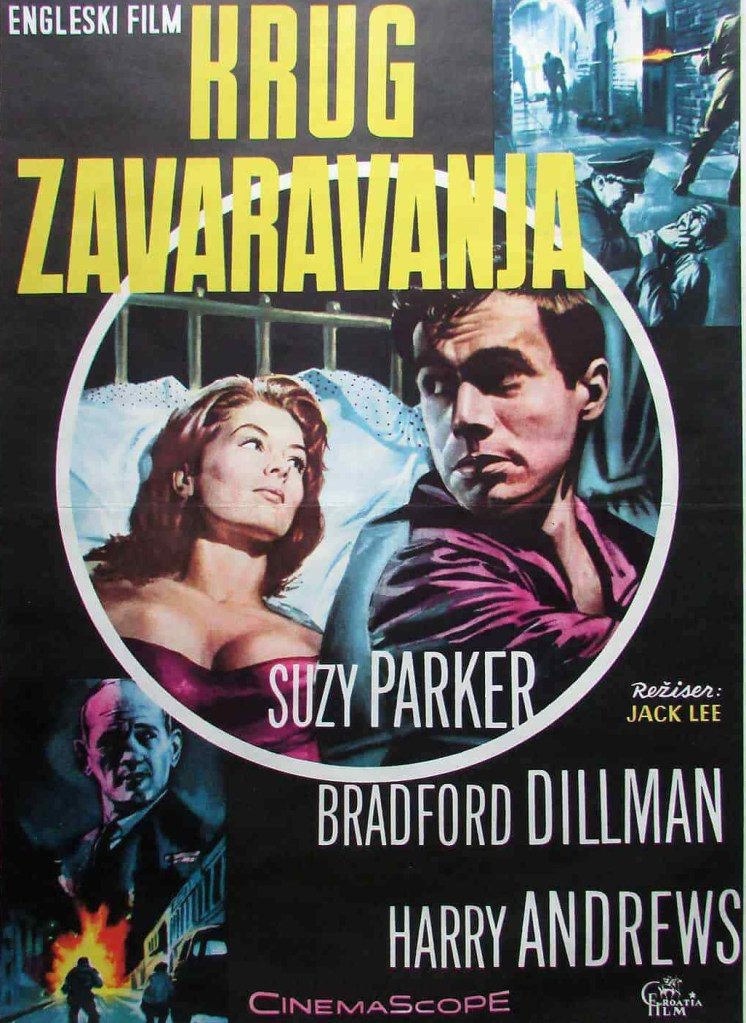
As you might expect, being accustomed now to misleading posters, Suzy Parker, given top-billing here, is nothing like as wanton, nor for that matter as bosomy.
Ruthless Capt Rawson (Harry Andrews) who devises the cunning plan employs psychiatric assessment and the romantic wiles of his secretary Lucy (Suzy Parker) to select the correct victim, Paul Raine (Bradford Dillman). “A perfectly good man is exactly what we don’t want,” expounds Rawson.
War is gender-neutral. Although from the off, Rawson is unscrupulous, with only a modicum of conscience, Lucy is more human, and when she is drawn into the deception, initially just to report on Raine’s qualities, she proves as ruthless, though afflicted more by conscience, a factor her boss dismisses as making women “singularly unsuited” for war, despite the fact that she is making greater sacrifice, having fallen in love with Raine.
Orphaned, Raine covers up the emotional instability detected by psychiatrists with derring-do, battling through terror out of fear that he will be consumed by fear. A Canadian who speaks French he is the right “wrong man” for the job.
Considerable effort goes into ensuring he won’t be caught out by detail. His French-bought watch has an English strap, for example. And although, once on enemy territory, his innate skills mean he evades capture for longer than intended. He slips off a train, passes himself off as a woodcutter’s temporary assistant.
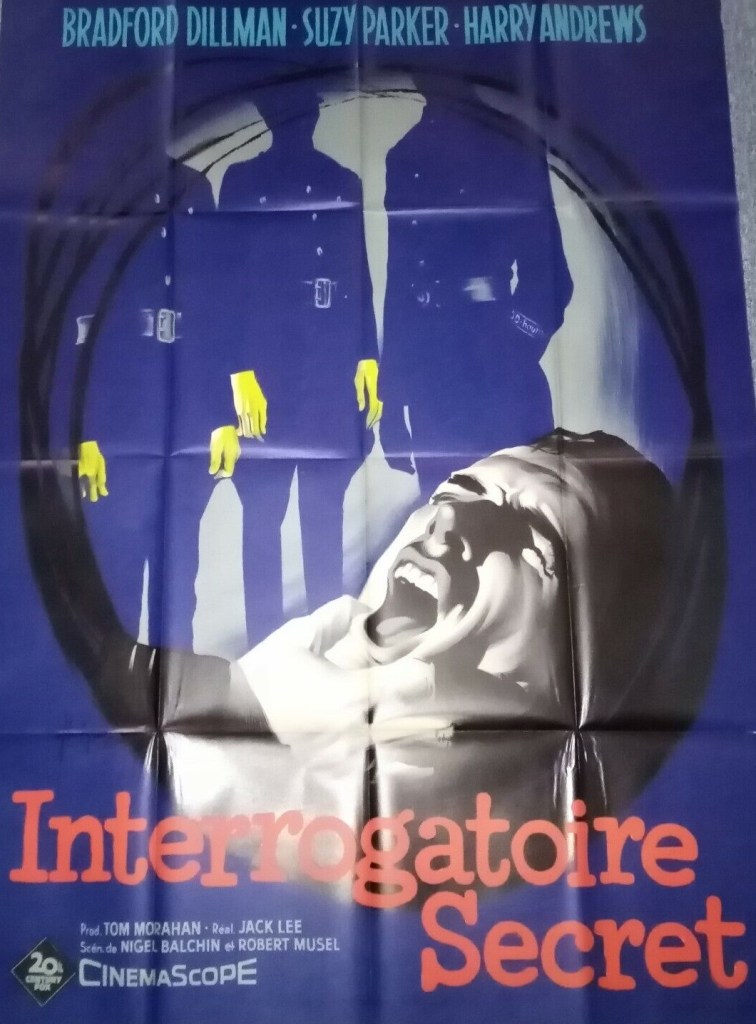
Unaware of the plot against him, when captured and brought before “good” German Capt Stein (Robert Stephens), who respects a gentleman officer, he refuses to give up his secrets, undergoing a whipping, electrocution and a primitive though equally effective form of water-boarding. At the very last, courage long gone, he aims to deprive his captors of victory by biting on a cyanide pill hidden in his tooth only to discover this is missing.
After that, all that is left is irony. He is treated as a hero, officially accorded a medal, but post-war hiding behind a bottle in Tangiers because he can’t face the truth. Lucy, scarred by her experience, knowing she is as guilty as her superior in destroying a man, tries to retrieve an irretrievable situation.
After only really knowing Bradford Dillman as often a one-note supporting actor, I’ve been surprised to discover he has a greater range of acting skills to offer. A Rage To Live (1965) provided one insight and Sgt Ryker (1968) another but this is on a different plane, mean-budgeted B-picture though it is. It’s a difficult part to pull off, afraid that his bold exterior hides a cowardly personality, and that in the final analysis his soul will be laid bare. There’s not much help in the script. He doesn’t get to explore his fears with Lucy except in the most basic fashion. He has to rely on facial expression, rather than screaming his head off, to get across the rest of it. And he is pretty exemplary on that score. And since he’s Canadian that can hardly be put down to having learned the British stiff-upper-lip.
Suzy Parker (The Interns, 1962) , formerly the world’s highest-paid model (and soon to be Mrs Dillman), has mastered her stiff-upper-lip as well as a passable British accent. She’s not permitted much in the way of anguish script-wise, and lacks Dillman’s acting skills in presenting interior feelings. But, equally, her character is a subordinate and a well brought-up English lass, as she would need to be to qualify for such a post, would not make her feelings known too forcefully to her commanding officer.
A Richard Burton or a Peter O’Toole might have injected more into the part, but Dillman does more than enough. It’s a shame Hollywood failed to recognize his talent. In his final picture Jack Lee (A Town Like Alice, 1957) directs admirably, though I could have done without the flashback structure, it might have added more tension to not know the outcome, and the rescue sequence seemed an anomaly.
Otherwise, crisply told and a precursor to the cold-blooded spy stories to come.
Universal pulled a fast one with this tidy courtroom drama. The studio resurrected a two-part television piece originally made as the The Case Against PaulRyker five years before under the Kraft Suspense Theatre brand to capitalize on the unexpected box office success of Lee Marvin, the decade’s most unlikely new star after a straight run of hits from the Oscar-winning Cat Ballou (1965) through western The Professionals (1966) to The Dirty Dozen (1967).
Re-titled and hoping audiences would not notice the sleight of hand, this was thrown out into first run. By normal standards it would be deemed a flop for a star of Marvin’s newfound magnitude but the $1 million notched up in rentals Stateside and more overseas prove a handy cache of found money for the studio. Audiences might have smelled a rat when the star’s name came at the bottom of the opening credits with an “And” billing, which generally denoted guest – rather than main – star.
Still, despite being promoted as an actioner, posters show Ryker with machine gun in hand in the midst of a battle scene – there is such a scene but Marvin plays no part in it – it’s actually a decent drama, especially given the unusual background. Set in 1951 during the Korean War there’s nothing gung-ho about it. The Americans are retreating, evacuating Seoul, when army attorney Capt Young (Bradford Dillman) feels Ryker was short-changed during a trial that condemned him to death as a traitor.
Young and Ryker’s estranged wife Ann (Vera Miles) embark on a deadline-dogged mission – he’s due to be hanged in a couple of days’ time – to clear his name. Strafed by enemy planes during a trip from Tokyo to Seoul, there’s a hint of nascent romance. And when they are later caught together in a clinch, this adds to the murky atmosphere, Young facing court martial accused of the deadly sin of having an affair with a colleague’s wife and deemed a pariah by colleagues. He has another strike against his name – he dug up a grave.
The situation is exacerbated by high command caught between troops needing the morale-booster of seeing a traitor hanged and fearing scandal if they are found after the event to have sent an innocent man to the gallows. And there is the irony that Young, in his capacity as prosecutor, was the man who found Ryker guilty in the first place. He only ends up on the opposite side as punishment for exposing technical irregularities in the defence’s handling of the case.
Ryker doesn’t help himself by initially proving to be an unreliable witness, remembering in erroneous detail minor matters but not the one thing that could clear his name, whether his commanding officer, now deceased, had left a note clearing Ryker. The sergeant, caught behind enemy lines, had claimed he was acting under orders during a counter-intelligence mission.
So the odds are heavily stacked against Ryker, at the re-trial the sheer malevolence of his boss Major Whittaker (Peter Graves), and sex-obsessed pal Capt Appleton (Murray Hamilton) and what seems like ranks of generals barely concealed. The investigation focuses on finding missing items – watch, pen, notebook – of the dead officer, none of which it transpires helps the case.
The courtroom has plenty of the usual twists including a surprise witness proving Ryker fraternised before the war with a Korean general. So, with army politics and a downbeat take on war thrown into the mix it’s a generally absorbing drama.
Bradford Dillman (A Rage to Live, 1965), usually relegated to leading man or supporting star in the credits, one or two places below the star in the billing, gets the chance to shine, essaying both a man standing up for his principles against heavy opposition and a lover guilty of attempting to steal another man’s wife. Appearing in virtually every scene, he gives a better account of his acting skills than in most of his movies, far more than the often one-note performances to which he was consigned. One-time Hitchcock protegee Vera Miles (Hellfighters, 1968) doesn’t bring quite enough of the internal conflict to her role but she’s a reasonable sidekick.
Had any big studio been paying attention, Lee Marvin gave pretty good notice of his potential for star status especially the menace he could impart with just a glance rather than the showy over-acting to which he was inclined in previous villainous outings such as The Man Who Shot Liberty Valance (1962). He’s careful to allow the shiftier and gloomier elements of his character to come into play rather than playing the role as heroic innocent. There’s good back-up from Peter Graves and allowed, a little leeway from their normal movie personas, Murray Hamilton md Norman Fell (both from The Graduate, 1967).
Buzz Kulik (Villa Rides, 1968) directed from a screenplay by Seeleg Lester (Change of Mind, 1969) and William D. Gordon (Cotter, 1973).
At a crisp 85 minutes it doesn’t outstay its welcome as long as you’re not taken in by the still-misleading poster. A good example of the species with excellent performances.
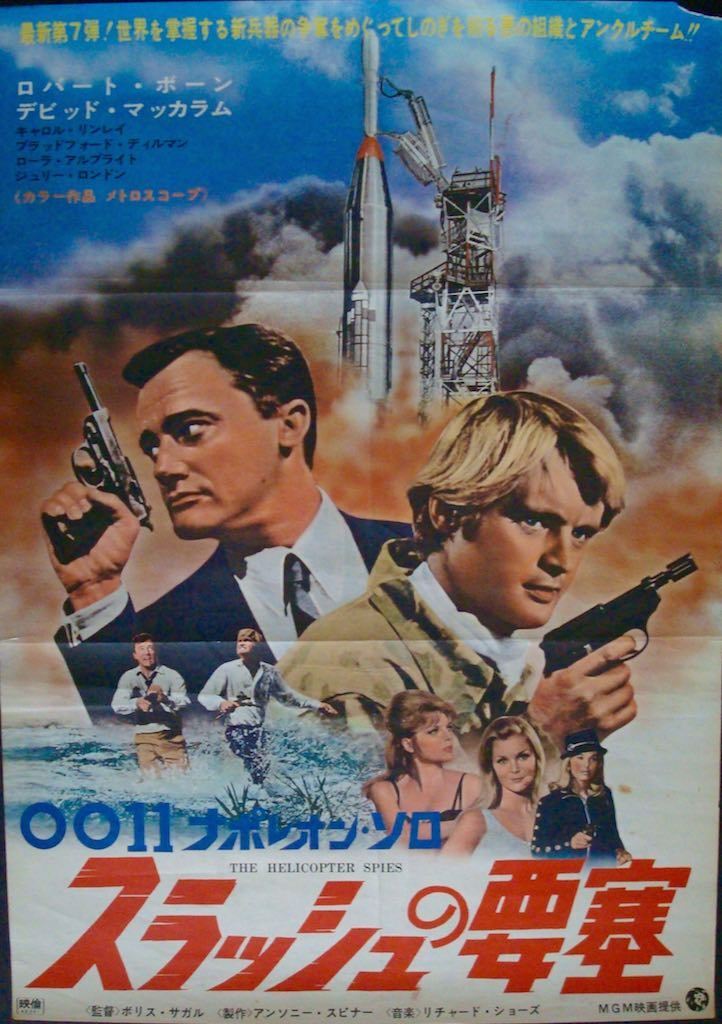
Takes a little while to come to the boil what with disreputable women, a crew of platinum-white-haired thugs, a religious cult, some very dry dialog, a high priestess with her own chorus line of psychedelic dancers, four identical brothers, and a female lead parading a prize shaggy dog story. Our intrepid heroes appear more capable this time round, the previously inept Napoleon Solo (Robert Vaughn) not beaten up quite so often, though he does end up being drowned in sand (water too precious to spare, apparently).
This time round, too, the good guys are taken for a ride by mad scientist Luther Sebastian (Bradford Dillman) who hoodwinks the U.N.C.L.E. organisation into stealing a “thermal prism” from the fortress of another mad scientist Dr Kharmusi (John Dehner). To put his own grand plan into operation Sebastian just has to hijack a rocket. And you should be aware going into this that there’s not the amount of helicoptering you might expect given the title.
This time round, too, there’s hardly a good gal in sight. Azalea (Lola Albright), aforementioned high priestess of cult The Third Way, has betrayed the good doctor in favor of Sebastian. Sebastian’s wife Laurie (Julie London) pretends to a) be out of contact with him for years and b) maintain a virtuous existence. And that’s before we come to the plainly bonkers, but still traitorous, Annie (Carol Lynley) who will make up any story in a bid to free an imprisoned unseen husband.
Sebastian has some neat touches as a leader, rewarding his team of thugs with booze and women as a prelude to killing them all off. He’s got an ejection seat in his car for getting rid of troublesome passengers. He prefers efficiency, to the point of iciness, to sexiness in his paramour and female underlings. And he has a very dry manner, which elicits a good few laughs.
But some of his thugs just ain’t that bright, the one instructed to follow Solo has just allowed him access to Laurie’s house. Laurie ain’t that bright, either, falling for an old trick by Solo who, as usual, is less bright that Ilya Kuryakin (David McCallum).
Some of the set pieces are excellent. Sebastian’s followers meet in an abandoned movie theater where Azalea gives the lowdown on the grand plan assisted by her bevy of dancers. Infiltrating the organisation by the simple device of dying his hair, Solo ‘s disguise is uncovered after being sprayed with champagne.
There are a surprising number of human touches. Head henchman Carl (Roy Jenson) vowing to take “Mom” away from her dingy life running her eponymous diner finds she enjoys too much her dingy life. Carl, appreciative of the disguised Solo’s efforts, apologises for making him ride in the baggage train. Annie can stretch innocence to breaking point, to an extent where nobody cares about her problems.
But where The Karate Killers had a straightforward storyline – find the five daughters of a dead scientist – this gets a tad lost in the first section introducing the thermal prism, the cult, doubling down on mad scientists, and giving Annie all the importance of a red herring.
I thought for a moment that this was the end of the line in my appreciation of the U.N.C.L.E. franchise, the one where it all fell flat on its face and we could see the joins, but after the shaky start it picked up and became quite enjoyable in the series’ inimitable barmy fashion. I suppose I should applaud the initial narrative boldness, audience pretty much fooled from the off, the fortress assault not much more than an extended MacGuffin, with neither Sebastian nor Azalea what they seemed.
I could quibble about the guest stars but in fact this is a superb deadpan performance from Bradford Dillman (Sanctuary, 1961) and quite a departure for the Carol Lynley of Bunny Lake Is Missing (1965). And you could say the same for Lola Albright, previously seen essaying a different kind of character in The Way West (1967).
Boris Sagal (The Omega Man, 1971) directed from a screenplay by Dean Hargrove (One Spy Too Many, 1966).
I’ve only got a couple to go to wrap up the entire series and for your sake I will persevere. If you’ve not already done so, it’s back to the box set.
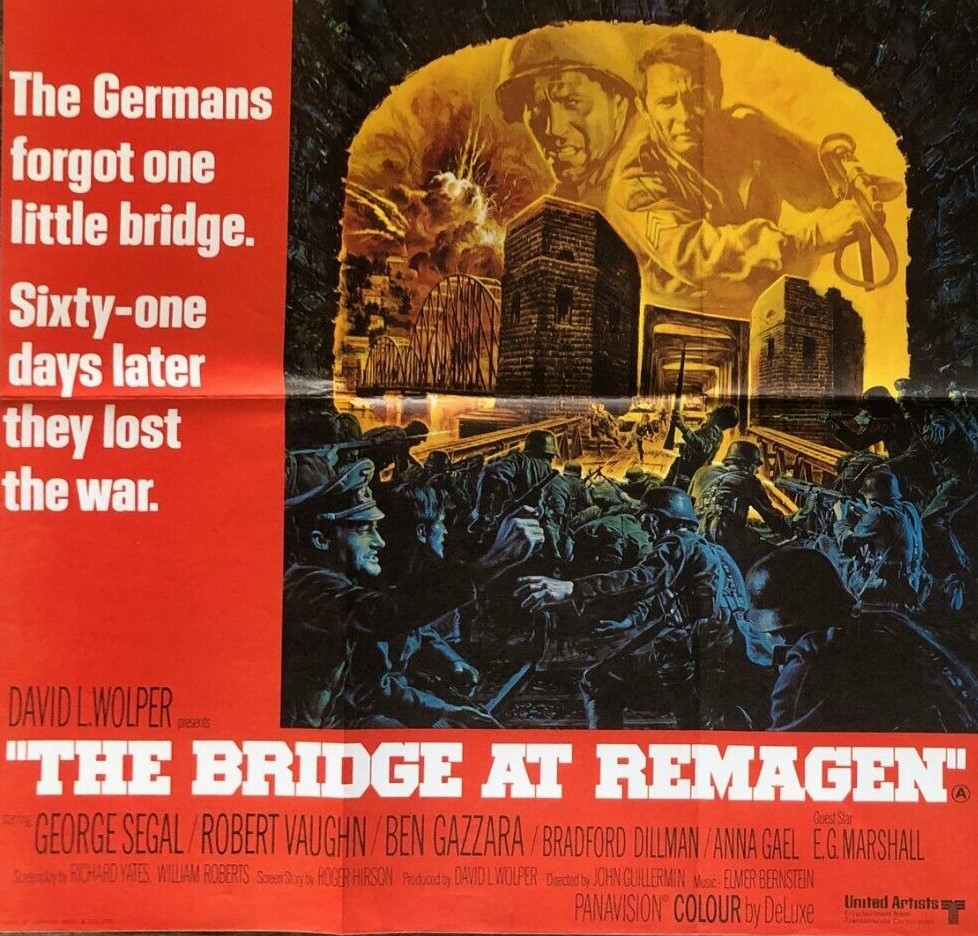
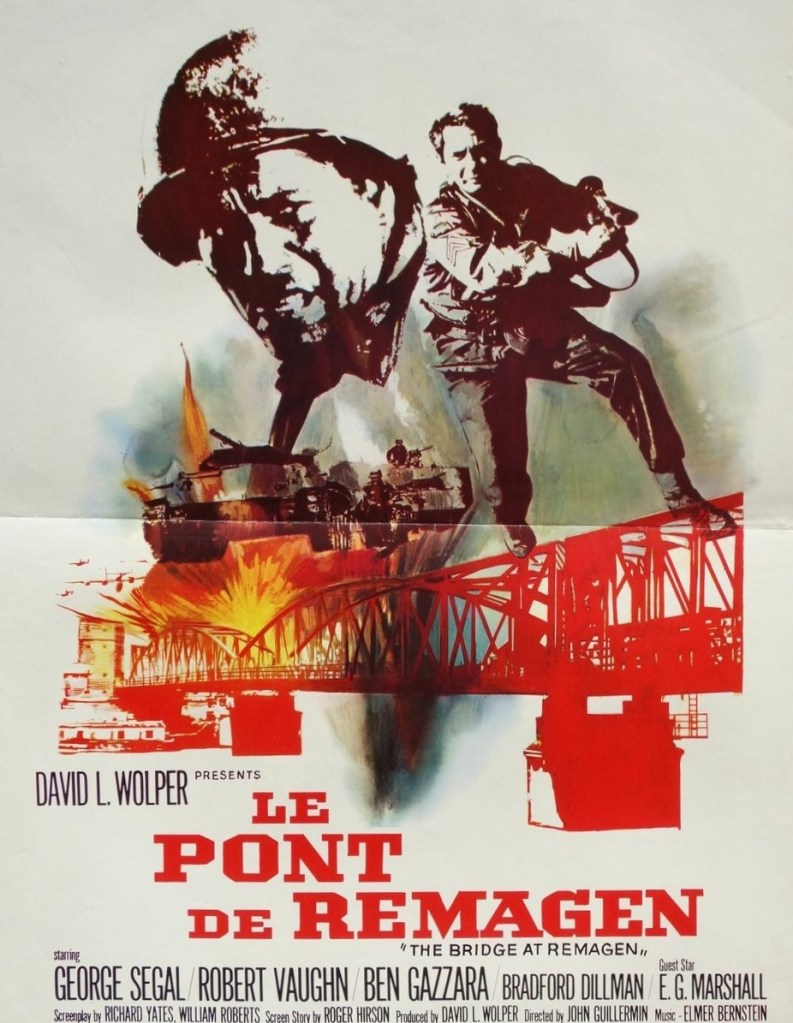
Superior war film, somewhat underrated. Not just realistic battle scenes, but realistically weary soldiers and taking an even-handed approach to war in the manner of Battle of the Bulge (1965). The Americans want to destroy the bridge to trap 75,000 German soldiers on the wrong side of the Rhine, the German Major Krueger (Robert Vaughn) overrides his orders to also destroy the bridge and prevent the Allies with a direct route to Berlin. Instead with depleted forces – think Zulu (1963) – and hugely outnumbered he attempts to keep the bridge open so the cornered Germans can escape.
Unlike most war films there’s no time for comedy to lighten the spirits, it’s gruelling non-stop action. Even when the advance company, headed by grizzled Lt. Hartman (George Segal) find an abandoned village where the exhausted squad could rest up for a bit, they are ordered to keep going until they find more enemy to engage. Unlike the humane Krueger, the Allied high command are merciless, gung-ho Major Barnes (Bradford Dillman) and glory-hunter Brigadier Shinner (E.G. Marshall) drive their troops on, the latter not bothered how many of his men die in an attempt to blow up the bridge – “it’s a crap shoot” is the closest he gets to apology, claiming his actions will shorten the war.
When Allied attempts to blow the bridge fail and with the enemy so close Krueger has to proceed with detonating the explosives littering the bridge and that plan is also scuppered, it’s a battle to the death to secure the crossing. And the story itself is accentuated by nods to the grisly cost of war – on both sides. Heartless Sgt Gazzaro (Ben Gazzaro), whose freebooting Hartman despises, is brought up short when he kills a youth commandeered into action by Krueger in a bid to bolster his meagre outfit – barely 200 men when he expected a force of around 1600. Krueger is sickened to see a German firing squad executing deserters, but has little sympathy for an innkeeper who has lost a son to the fighting when four million Germans are already dead.
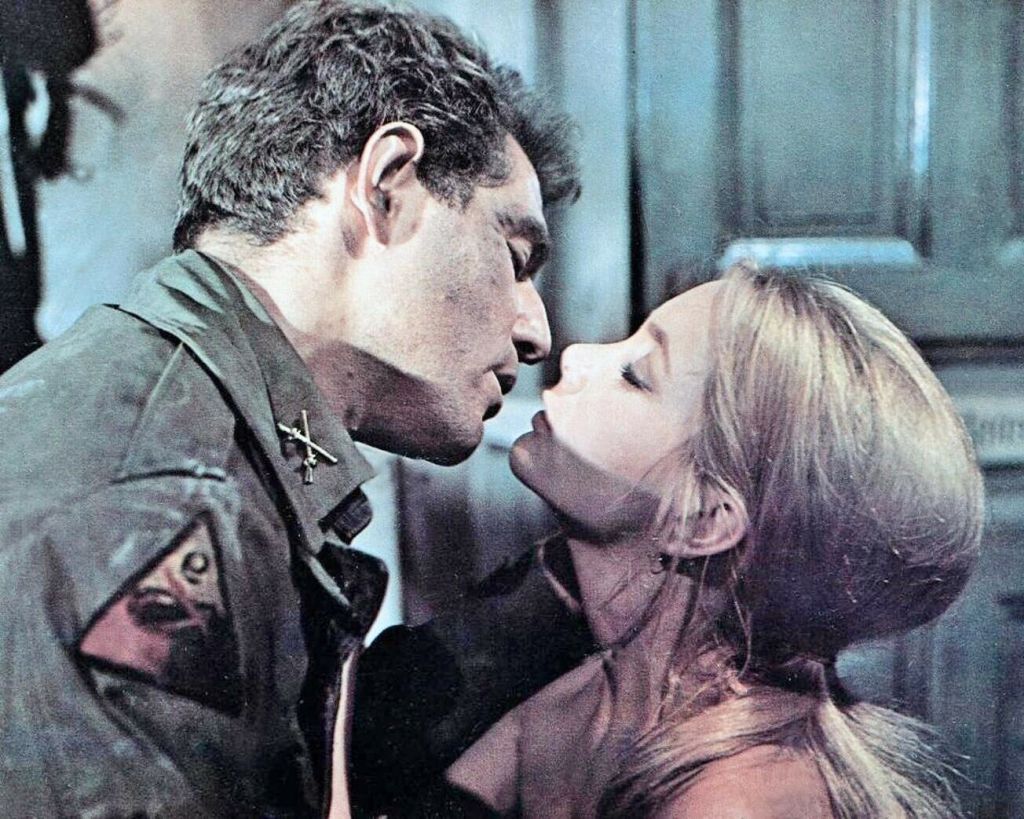
While reining in the worst excesses of Angelo, preventing him taking advantage of a captured woman (Anna Gael) and refusing himself to accept her offer of sex, Hartman does not rail (like Patton, 1970) against those of his men who succumb to pressure. Finding one soldier collapsed, he sympathizes, “sometimes it hits you like that,” and he refuses to put his men in unnecessary line of fire, prompting Barnes into almost killing him. Unlike Battle of the Bulge, however, there is no arrogant German commander (like Robert Shaw) nor complacent Americans.
The action is not only non-stop but hectic and the film begins brilliantly with tracking cameras scarcely able to keep up with American tanks barrelling along the road and aerial shots showing the destruction of another bridge over the Rhine. American tanks and German artillery exchange fire over the river. Buildings are blown out or majestically collapse (turns out these were real buildings, not mock-ups). Bridge stanchions fall in slow motion into the water. Refugees are collateral damage, the camera hardly registering a crying child or an abandoned doll.
As in the best war pictures, strategy and tactics are laid out for the audience, the American blunderbuss approach compares poorly to Krueger’s desperate attempts to utilise every advantage to the point of arming a barge in the river. Hartman and Krueger are well-matched in courage, the former thrown endlessly into action by cynical superiors, the latter, having discharged himself from hospital to fight on, landed with the task of rallying defeatist troops, and leading them into harm’s way in a manner that the American’s immediate superior, Barnes, point-blank refuses to do. Pride drives on the German, the war is almost lost, but surrender would be tantamount to humiliation. All Hartman has to fall back on is an inner core and the chain of command, soldiers obey orders.
Both George Segal (The Quiller Memorandum, 1966) and Robert Vaughn (The Venetian Affair, 1966) are well outside their acting comfort zone. Two stars whose hallmarks are cocky characters and suave charm turn into determined men who barely crack a smile. Segal has done cynical before but not to this degree and what catches the eye more is his sheer physical exhaustion. This is an early career highlight for Vaughn, rarely offered such juicy roles.
Although associated in the general audience mind for playing creepy, not to mention sleazy, characters, Ben Gazzara (Capone, 1975) had not made much impact on 1960s moviegoers, and beyond a handful of supporting roles best known to Americans for a starring role in television series Arrest and Trial (1963-1964). The general untrustworthy screen persona he would come to inhabit is given a good work-out here except for two scenes where his character takes unselfish action. Bradford Dillman, also best known for television (Court Martial, 1965-1966), portrays a largely one-dimension character lifted out of the ordinary in a couple of scenes.
E.G. Marshall (The Defenders, 1961-1965) and Peter Van Eyck (Station Six Sahara, 1963) are the opposing commanders. You can also spot Hans Christian Blech (Battle of the Bulge), Anna Gael (Therese and Isabelle, 1968), Sonja Zieman (The Secret Ways, 1961) and Bo Hopkins (The Wild Bunch, 1969).
John Guillermin (The Blue Max, 1966) directs with aplomb from a screenplay by William Roberts (The Devil’s Brigade, 1968) and novelist Richard Yates (Revolutionary Road, 2008) in his only work for the screen.
This overheated melodrama stands as a classic example of Hollywood’s offensive attitudes to women. Nobel prize-winning author William Faulkner could hardly blame the movies for sensationalising his misogynistic source material since if anything the movie took a softer line. Told primarily in flashback as headstrong southern belle Temple Drake (Lee Remick) attempts to mitigate the death sentence passed on her maid Nancy (Odetta). Given that such appeals are directed at Drake’s Governor father (Howard St John), and that the maid has been condemned for murdering Drake’s infant child, that’s a whole lot of story to swallow.
Worse is to follow. Drake takes up with Prohibition bootlegger Candy Man (Yves Montand) after being raped by him and thereafter appears happy to live with him in a New Orleans brothel – the “sanctuary,” no irony intended, of the title – despite him slapping her around. The film steers clear of turning her into the prostitute of the original book, but pretty much sets up the notion that high class women will fall for a low-class tough guy whose virility is demonstrated by his brutality. In other words a “real man” rather than the dilettantes she has previously rejected.
After the Candy Man dies, Drake returns home and marries wealthy suitor Gowan Stevens (Bradford Dillman) who blames himself, rightly, for Drake falling into the clutches of the gangster in the first place. But a past threatening to engulf her precipitates the infanticide.
Faulkner was a Hollywood insider, adapting Sanctuary for The Story of Temple Drake (1933) and earning high praise for his work on Bogart vehicles To Have and Have Not (1944) and The Big Sleep (1946). The success of The Tarnished Angels (1957) starring Rock Hudson, The Long, Hot Summer (1958) with Paul Newman and The Sound and the Fury (1959) headlined by Yul Brynner had sent his cachet rocketing. But all three were directed by Americans – Douglas Sirk and Martin Ritt – who had a distinctive visual style and an ear for what made melodrama work.
Sanctuary had been handed to British director Tony Richardson (Look Back in Anger, 1959) and he didn’t quite understand how to make the best of the difficult project. So while Lee Remick manages to suggest both strength and fragility, and makes her character’s wanton despair believable, Yves Montand is miscast and Bradford Dillman fails to convince even though portraying a weak character. Too many of the smaller roles appear as cliches. And it’s hard to believe the maid’s motivation in turning murderer. Watch out for Strother Martin (Cool Hand Luke, 1967).
What was acceptable steamy melodrama in the 1930s fails to click three decades on. Faulkner’s thesis that high-falutin’ women want a man to master them and furthermore will fall in love with their rapist seems to lack any understanding of the female mind and will not appeal any more to the modern sensibility than it did on release. Lee Remick is what holds the picture together, in part because she plays so well the role of a woman embracing degradation, and refusing – no matter how insane the idea appears – to let go of the man she believes is the love of her life. It’s not Fifty Shades of Grey, but it’s not that far off that kind of fantasy figure, and given the success of that book, it’s entirely possible there is a market for what Faulkner has to peddle.
Not easy to find. This is actually on YouTube if you go onto that channel and search. Strangely enough, if I post a link, it says it is no longer playing there – but just as strangely if you go looking you will find it.












 The Magnificent 60s