Behind the Scenes: United Artists Goes to War on a Low Budget – “Submarine X-1” (1968) and Five Others

With the contraction of Hollywood production in the 1960s, cinemas worldwide were always crying for pictures – any pictures – that could take up a weekly slot or pad out a double bill. (The single-bill programming that is standard these days was not welcome in most cinemas, except a prestigious few, and audiences expected to see two movies for the price of their ticket). Indie unit Mirisch had scored such a big hit with aerial war number 633 Squadron (1964) – it recouped its entire cost from British distribution so was in profit for the rest of its global run – that Walter Mirisch persuaded distribution partner United Artists to attempt to capitalize on the idea and thus set in progress a series of war pictures to be made in Britain.

There would be cost savings through the Eady Plan. Each film would have a “recognizable American personality in the lead” and have American directors. Budgets would be held under $1 million. Half a dozen movies were planned, the first appearing in 1967, the last in 1970.
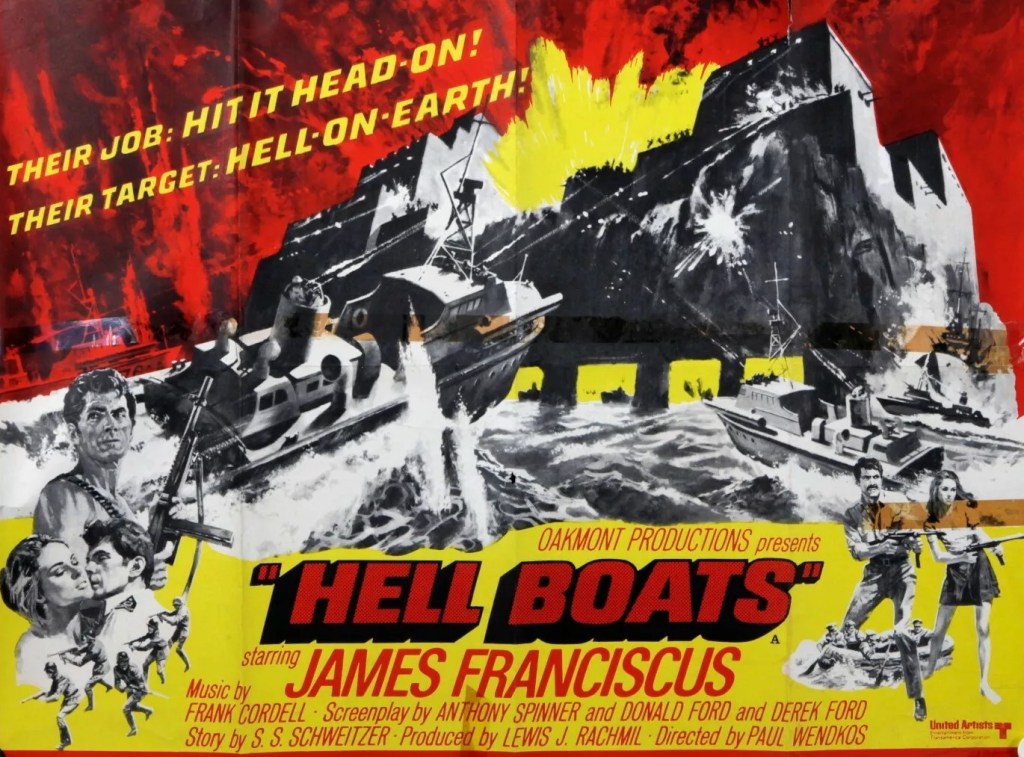
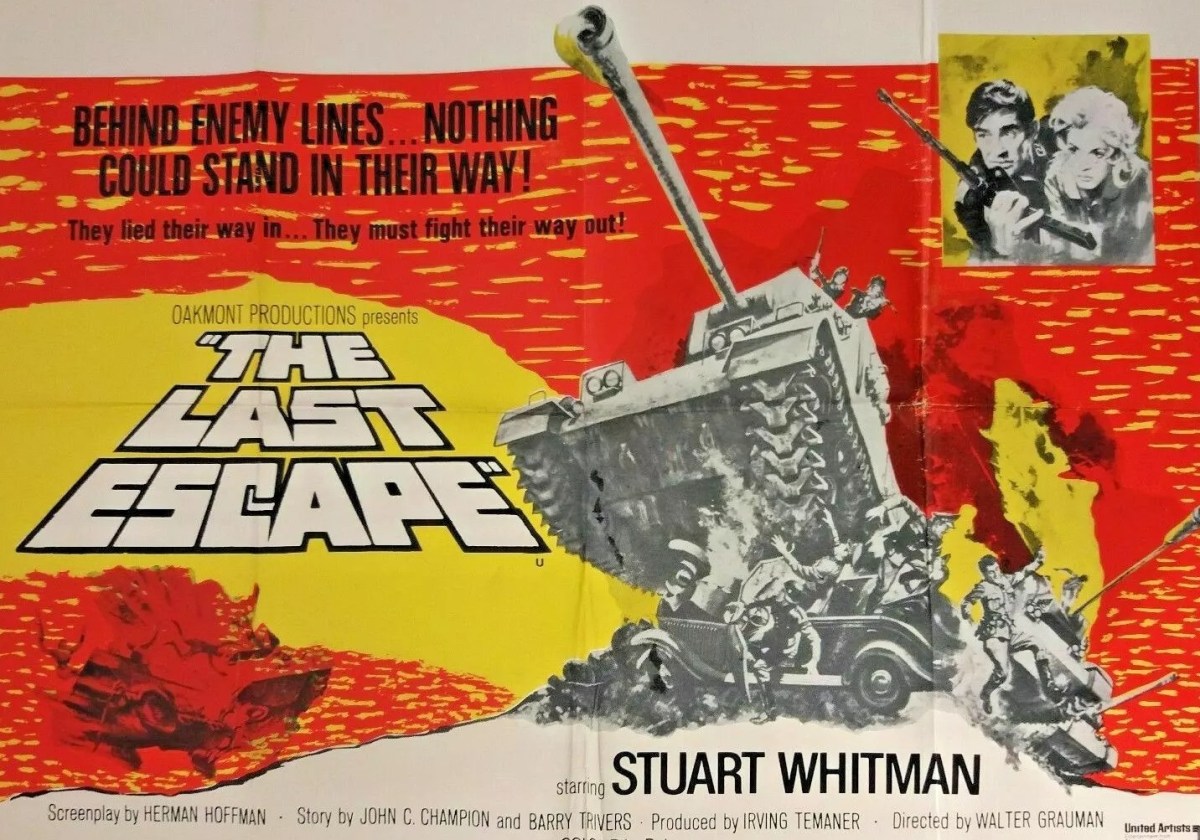
Quite whether James Caan (Red Line 7000, 1965) passed muster as a well-known enough star to qualify as a “personality” at the time he headlined Submarine X-1 (1968) is debatable, as was the presence of James Franciscus (The Valley of Gwangi, 1969) in Hell Boats (1970) and Christopher George (Massacre Harbor, 1968)  in The Thousand Plane Raid (1969) though Stuart Whitman (Rio Conchos, 1964)  exerted a higher marquee appeal for The Last Escape (1970). Veteran Lloyd Bridges (Around the World under the Sea, 1966) who headlined Attack on the Iron Coast (1968) was probably the best known, but these days that was mostly through television. And David McCallum owed whatever fame he had to television as part of The Man from U.N.C.L.E. double act and the idea that would still be enough to attract an audience for Mosquito Squadron (1969) seemed dubious.

Beyond setting up the project, Walter Mirisch had little to do with the actual production, putting that in the hands of Oakmont Production, which beefed up the action with judicious use of footage from other pictures. Invariably, reasons had to be given to explain why actors with American accents were members of the British fighting forces – most commonly they were represented as Canadian volunteers or might have British nationality by dint of having a British mother.

Storylines followed a similar template. At its heart was a dangerous mission. Leaders were invariably hated for some previous misdemeanor or because they were ruthless and drove the men too hard. If there was romance – not a given – it would border on the illicit. And someone required redemption.

And while none of the stars chose – or were chosen to – repeat the experience, Oakmont established something of a repertory company behind the scenes, writers, directors and producers involved in more than one movie.
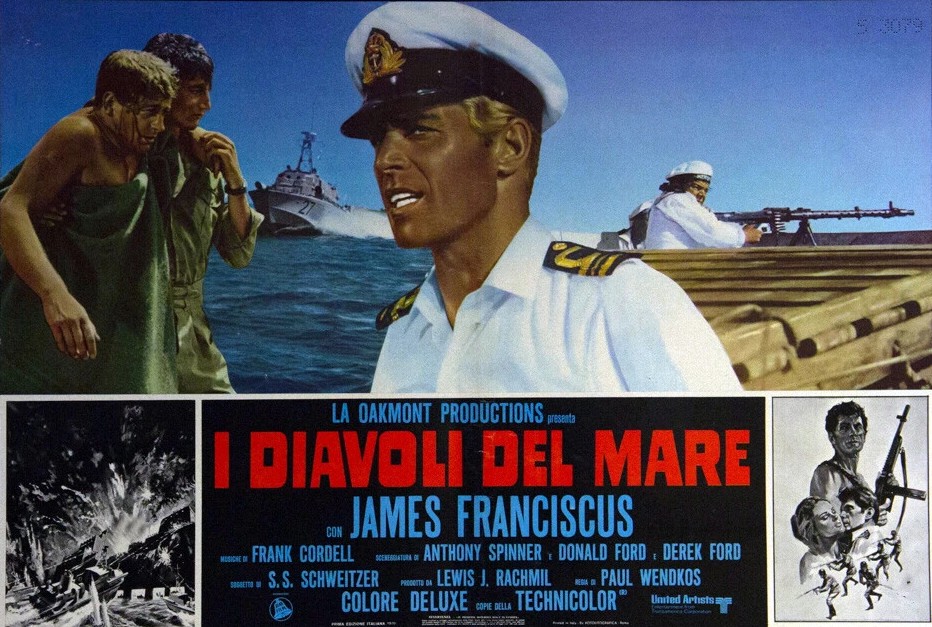
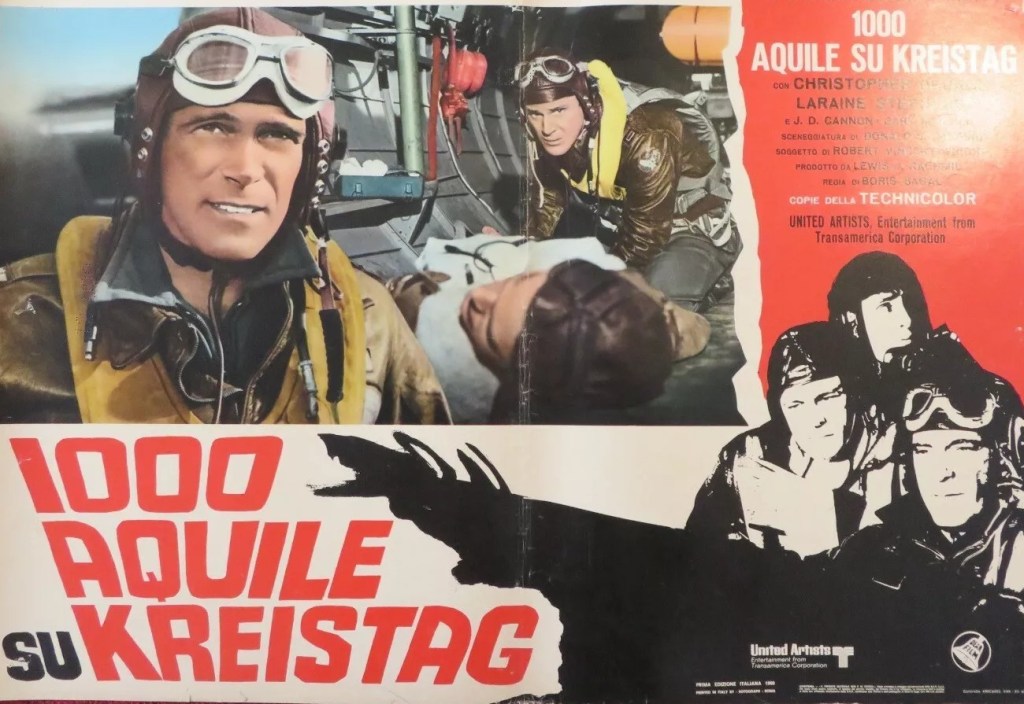
Italian poster (photobusta) for “Hell Boats”. I found Japanese and Australian posters
for most of the films in the series.

Boris Sagal (Made in Paris, 1966) directed both The Thousand Plane Raid and Mosquito Squadron and then made his name with The Omega Man (1971). Paul Wendkos (Angel Baby, 1961) helmed Attack on the Iron Coast and Hell Boats. Walter Grauman who had kicked off the whole shebang with 633 Squadron returned for The Last Escape. William Graham (Waterhole #3, 1967) as the only outlier with just Submarine X-1 to his name.

Veteran producer Lewis Rachmil (A Rage to Live, 1965) oversaw three in the series – Hell Boats, Mosquito Squadron and The Thousand Plane Raid. Another veteran John C. Champion, younger brother of celebrated Broadway choreographer Gower Champion, was involved in a variety of categories. Champion is almost an asterisk these days, best known these days for producing the film Zero Hour! (1957) that inspired disaster parody Airplane! (1980). He was only 25 when he produced his first picture, low-budget western Panhandle (1948). He was behind another four low-budget westerns pictures before Zero Hour!, which had a decent cast in Dana Andrews and Linda Darnell. But that was his last movie for nine years as he switched to television and Laramie (1959-1963), barely reviving his movie career with The Texican (1966) starring Audie Murphy.

He produced Attack on the Iron Coast and Submarine X-1 and was credited with the story for both plus The Last Escape. Irving Temaner produced The Last Escape and received an executive producer credit on Attack on the Iron Coast and Submarine X-1.  Donald Sanford (Battle of Midway, 1976) was the most prolific of the writers, gaining screenplay credits for Submarine X-1, The Thousand Plane Raid and Mosquito Squadron. Herman Hoffman (Guns of the Magnificent Seven) wrote Attack on the Iron Coast and The Last Escape.

Cinema managers were not, it transpired, queuing up for the product. Most commonly, when reviewed in the British trade press, their release date was stated as “not fixed” which generally meant that United Artists was hoping the review would do the trick and alert cinema owners.

In the United States, they rarely featured in the weekly box office reports, though Portland in Oregon appeared partial to the product, Attack on the Iron Coast appearing there as support to Hang ‘Em High (1968), Mosquito Squadron supported The Christine Jorgensen Story (1970), Hell Boats supported Lee Van Cleef western Barquero (1970) while The Last Escape supported Mick Jagger as Ned Kelly (1970). To everyone’s astonishment a double bill of Hell Boats / The Last Escape reported a “big” $10,000 in San Francisco, but that proved an anomaly.

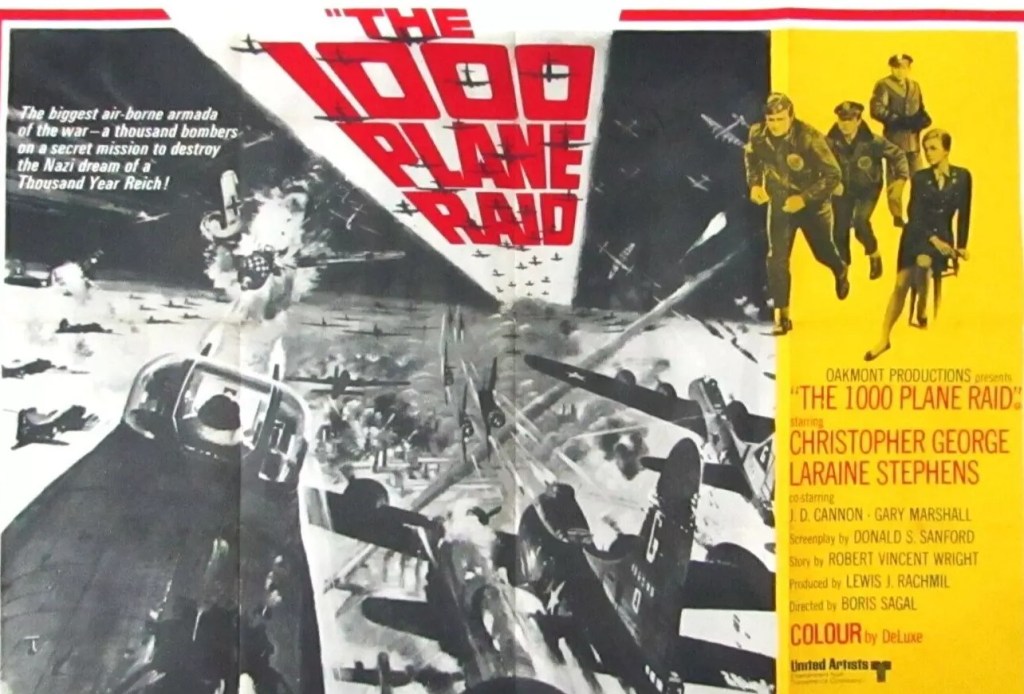
In Britain, the movies fulfilled their purpose as programmers, not good enough to qualify as a proper double bill, but accepted as supporting feature for a circuit release on the Odeon chain. Since UA supplied Odeon with its main features, it proved relatively easy to persuade the circuit to take the war films to fill out a program. This kind of second feature would be sold for a fixed price not sharing in the box office gross. However, they were given the kind of all-action poster they hardly deserved.

So in 1968 Attack on the Iron Coast went out with The Beatles Yellow Submarine. In 1969, Submarine X-1 supported slick heist picture The Thomas Crown Affair, which with Steve McQueen and Faye Dunaway in top form scarcely needed any help securing an audience. Hell Boats was supporting feature in 1970 to Master of the Islands (as The Hawaiians starring Charlton Heston was known). As well as accompanying it on the circuit Mosquito Squadron in 1970 made a very brief foray into London’s West End with thriller I Start Counting and then reappeared a few months later as an alternative choice of support for Billy Wilder flop The Private Life of Sherlock Holmes. If you went to see Burt Lancaster western Lawman in 1971 you might have caught The Last Escape – equally it could have been If It’s Tuesday, It Must Be Belgium (cinema managers could choose either).

United Artists, under the financial cost in the early 1970s, pulled the plug on “programmers” such as these. Walter Mirisch in his biography, disingenuously suggested that the six movies had done relatively well. But that wasn’t supported by the studio’s own figures.

Collectively, they made a loss of $1.7 million. Only Attack on the Iron Coast made it into the black and then by only $59,000. Hell Boats lost $700,000. None of the movies earned more than $200,000 in rentals in the United States.

Although Mirisch managed to keep budgets down to around the million-dollar mark, they would have had to be much smaller to see a profit. Ironically, it was the cheapest, Attack on the Iron Coast costing $901,000,  that made the most. Submarine X-1 lost $150,000 on a $1 million budget, Mosquito Squadron lost $253,000 on a $1.1 million budget while The Thousand Plane Raid lost $50,000 more on the same budget. The longer the series went on, the worse the losses – The Last Escape lost $449,000 on a $995,000 budget while for Hell Boats the budget was $1.36 million.

SOURCES: United Artists Archives, University of Wisconsin; Walter Mirisch, I Thought We Were Making Movies, Not History (University of Wisconsin Press, 2008) p204; Reviews, Kine Weekly – Feb 9 1968, Aug 31 1969, January 1970, April 18 1970; “Flops Loss-Cutting,” Variety, August 26, 1970, p6; “Picture Grosses,” Variety – March 13 1968, May 8 1968, April 24 1968, October 2 1968, June 10 1970, July 1 1970, July 8, 1970, August 12 1970, August 26 1970.
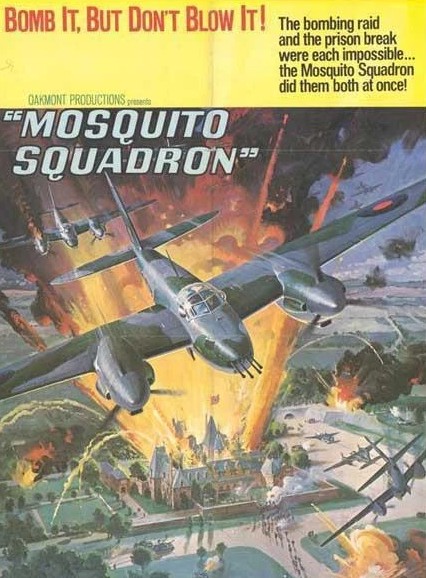
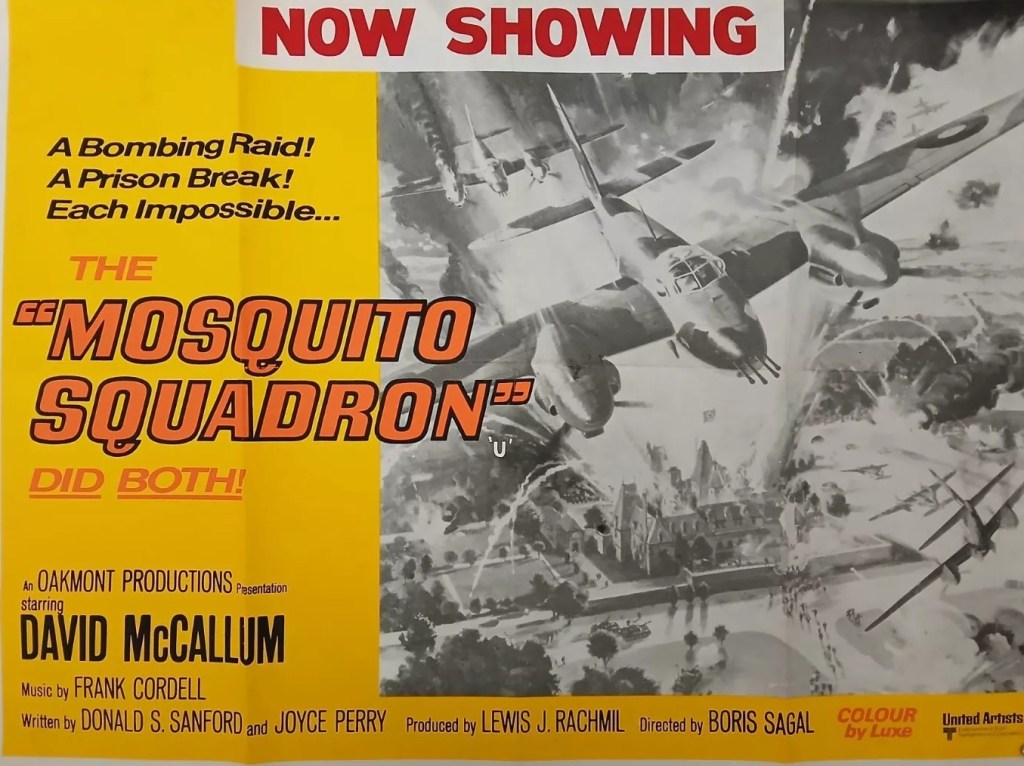
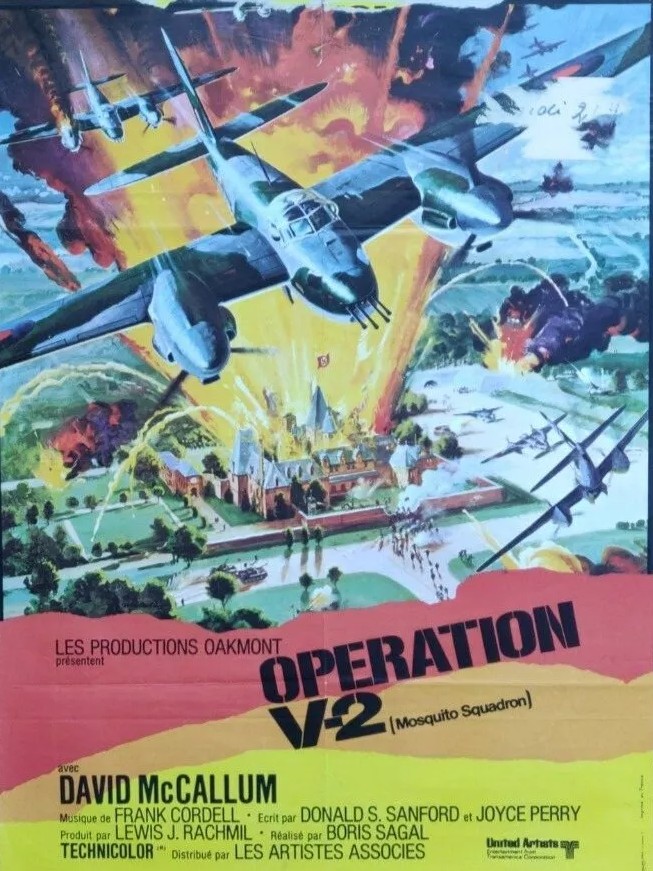
Mosquito Squadron (1969) ****

Surprisingly somber, unusually reflective and exceptionally well-constructed. Except for taking the easy way out at the end, could easily have found itself in the classic finale stakes in the same league as Casablanca (1942) or The Third Man (1949) where true love is thwarted. More than enough aerial action for aficionados and an excellent battle sequence.

In addition we have that very contemporary trope of the human shield and the argument by British officers of obeying orders that would take on a different significance from the enemy perspective at the end of World War Two. Throw in an unexpected slug of guilt, a number of understated scenes, and a very clever wheeze from the Germans and you have a movie that rises well above the standard programmer.

Quint Munroe (David McCallum) is an orphan, taken in at a young age by the family of Squadron Leader “Scottie” Scott (David Buck) whom he regards as a brother. Also a pilot, Quint watches Scottie’s plane explode in a bombing raid over France. Next in line for promotion, Quint, with the usual survivor’s guilt, takes over.

In the first of the sequences that are notably out of place in a standard gung-ho World War Two picture, Quint is sent to tell the bad news to Scottie’s wife Beth (Suzanne Neve). He doesn’t have to say a word. She recognizes the look on his face. Quint had barely escaped from his own burning cockpit, a fact that’s gone unreported to Beth, but when she comes to her husband’s quarters at the air base, she gasps at the burn marks on the back of his jacket. There are four or five instances, again understated, in this scene when Beth is brutally reminded of her husband’s death. And Quint’s colleague Douglas (David Dundas) rejoices in the fact that he’s lost an arm because that’s saved his life, it’s his “ticket” to remain earthbound, and he can safely get married in the knowledge his wife won’t be receiving a knock on the door anytime soon.

This is a mission picture in case you haven’t noticed from my concentration on the other more interesting aspects of the movie. The RAF needs to bomb an experimental station developing the next range of German rockets that’s buried underneath a chateau in France. Flattening the area in the normal fashion won’t do it, the bombers need to be able to hit a very small target indeed, the entrance of the secret hideaway. So they turn to a version of Barnes Wallis bouncing bomb (see The Dam Busters, 1955) and have to practise like billy-oh against a very tight deadline to hit such a target.

Meanwhile…meanwhie…meanwhile. There are three dramatic meanwhiles. Quint begins an understated romance with Beth, he filled with remorse at stealing his dead pal’s wife, she less concerned because there was a hint of earlier romance between them. The Germans protect the chateau behind a human shield of captured RAF pilots. In carrying out the attack, the pilots are condemning colleagues to death, a worry knocked on its head by the gung-ho likes of Air Commodore Hufford (Charles Gray), but other more sensitive high-ranking officers resort to the “obeying orders” routine. Final twist: among the prisoners is Scottie.

Nobody outside the base is permitted to know about the prisoners in case taking such an action damages public morale, so now Quint is in a bind. There’s a final twist to the twists – Scottie has lost his memory so badly that even if he could return to Britain it’s doubtful if he would know who Beth was, though, of course, they would still be married, so that would scupper Quint’s chances unless the story went onto a fourth act in the vein of Random Harvest (1942).

The French Resistance are called in to launch a daring raid to free the prisoners and assuage guilt all-round. Quint is shot down and joins the brutal battle action in which, as predicted by Hufford, the escapees are mown down by superior German firepower. He finds Scottie, who doesn’t recognize him at all. Scottie is also of the gung-ho brigade and dies stopping a German tank.

Meanwhile, Douglas has got into trouble for telling too many people about the prisoners. He’s very good friends with Beth.

You can see the cinematic opportunity. Quint returns knowing he is free to marry Beth only to find Beth turns away from him because he went on an expedition that could kill her husband. But the producers bottle it and go for the happy ending instead.

David McCallum (Sol Madrid/The Heroin Gang, 1968) remains in low gear throughout, and though Suzanne Neve (Naked Evil, 1966) more than makes up for him, you would wonder at the wife of a dead pilot taking up with another flier who could end up the same way.

Director Boris Sagal (Made in Paris, 1966) is to be commended for spending so much time on the themes of guilt and loss and keeping reality to the forefront. Some of the sequences have been stolen from other movies or are stock footage. Written by Donald S. Sanford (The Thousand Plane Raid, 1969) and actress Joyce Perry in her big screen debut.

Raises far more issues than the normal war movie, certainly blown away at the box office by the bigger-budgeted all-star-cast Battle of Britain the same year, but more than holds its own, and if it had been an American low-budgeter with some better-known lesser stars would have probably been re-evaluated long before now.

Impressive.

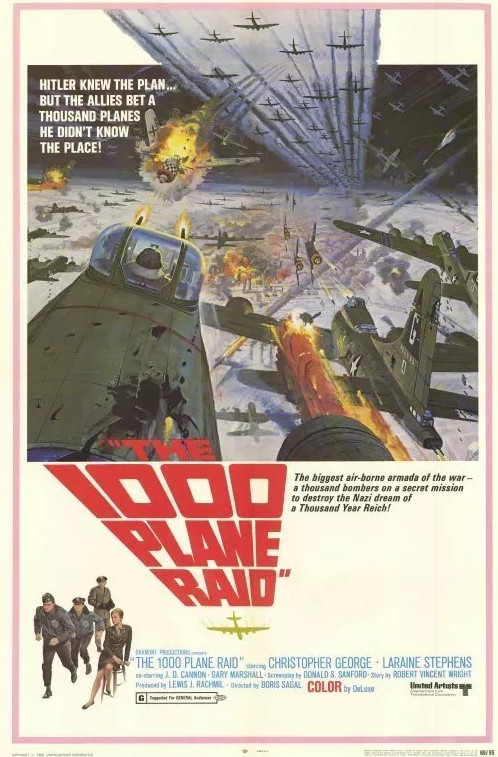
The Thousand Plane Raid (1969) ***

Let’s be honest. Like 633 Squadron (1964) and perhaps even, despite its all-star cast, Battle of Britain (1969), many in the audience will only be there for the hardware, the chance to see the flying battle buses that took the Allies to victory in World War Two. There’s not going to be much of a story anyway – rivalry between commanders, tension on the ground, a romance beginning or breaking apart, a stash of info dumps. That can hardly compare to the grace of the big birds in the air, usually a mixture of stock footage and new work with refurbished old planes.

This one has even re-purposed – perhaps stolen would be a better word – a mission from earlier in the war which was planned and carried out by the RAF so that it could be planned and in part carried out by the Yanks. Still, it was the Yanks putting up the money so I guess they can change history whenever they like.

U.S. Air Force Col Brandon (Christopher George), leading an American bomber group stationed in England, has worked out that while night-time missions result in fewer casualties they are increasingly failing to get the job done, only one on five bombs hitting the designated target. He reckons a gigantic air attack in daylight is the only way to succeed. His boss General Palmer (J.D. Cannon) grants him the chance to pitch his idea to the assembled RAF high command. Despite the risks, they agree and then need to come up with about million gallons of fuel and about a million-and-half tons of bombs, and requisition 30 airfields for the bombers and the same number for the fighter support.

Various elements make life tougher for Brandon. The mission chosen is much further afield than he originally imagined, the deadline is brought forward, his crew is unprepared and needs toughened up, plus his romance with WAC Lt Gabby Ames (Laraine Stephens) has hit a sticky patch and he’s having to deal with a cocky RAF fighter pilot Wing Commander Howard (Gary Marshal) who’s been seconded to the operation. To annoy Brandon further Howard befriends disgraced American pilot Lt Archer (Ben Murphy) who’s been accused of cowardice.

Before we can get to the big event, Brandon also undergoes a crisis of confidence and it’s as much as he can do to pull himself together in time. The screenwriter has arranged for the three main characters to end up in the one plane, allowing Archer to prove himself in battle and Howard to manage some heroics.

The sight of a huge array of WW2 planes in the air without the help of CGI still takes the breath away. Even though the final action pales in comparison with 633 Squadron or Battle of Britain it’s visually powerful enough to see us through.

By the end of the 1960s, B-pictures cost a lot more, but that didn’t necessarily result in better performances. Christopher George (El Dorado, 1966), signed up to a five-picture deal by United Artists, isn’t the breakout star. In fact there isn’t one, neither Laraine Stephens (40 Guns to Apache Pass, 1967) nor Gary Marshal (Camelot, 1967), in his second and final movie, making much of an impression. However, the picture was more notable for members of the supporting cast including J.D. Cannon (Krakatoa: East of Java, 1968), Ben Murphy (Alias Smith and Jones TV series, 1971-193), Bo Hopkins (The Wild Bunch, 1969), future director Henry Jaglom (A Safe Place, 1971) and Tim McIntyre (The Sterile Cuckoo, 1969).

One who certainly made the step up was director Boris Sagal (Made in Paris, 1966); in a couple of years he would be helming cult number The Omega Man (1971). Written by Donald S. Sanford (Midway, 1976).

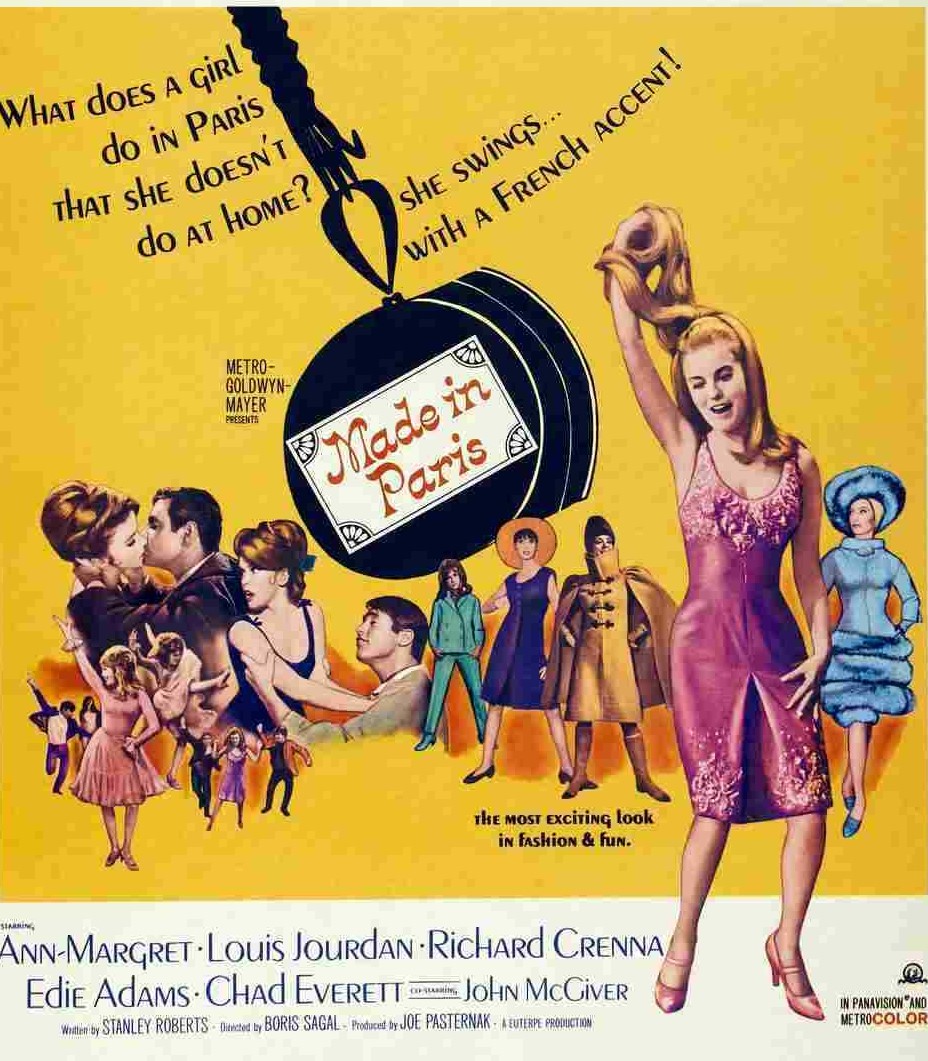
Made in Paris (1966) ***

She sings, she dances, she shakes her booty. What else would you expect from Ann-Margret in light comedic mode (i.e. The Swinger, 1966) rather than serious drama (i.e. Stagecoach, 1966). While appearing as free-and-easy as in The Swinger, she’s actually a dedicated virgin, as was par for the course before the Swinging Sixties kicked in. But the way she lets it all hang out, you’d be forgiven (if you were a predatory male) for guessing the opposite.

Maggie (Ann-Margret) is a career girl, assistant fashion buyer in a New York store, having come up the hard way, small-town-girl then model then salesperson. When the Paris buyer Irene (Edie Adams) quits her job to get married, Maggie is shipped out as her replacement, not as a reward for all her hard work but as punishment because she refuses to sleep with the boss’s cocky son Ted (Chad Everett). The idea is she’ll be so out of her depth, she’ll return humiliated and only too happy to jump into bed.

What do poster designes have against certain colors?
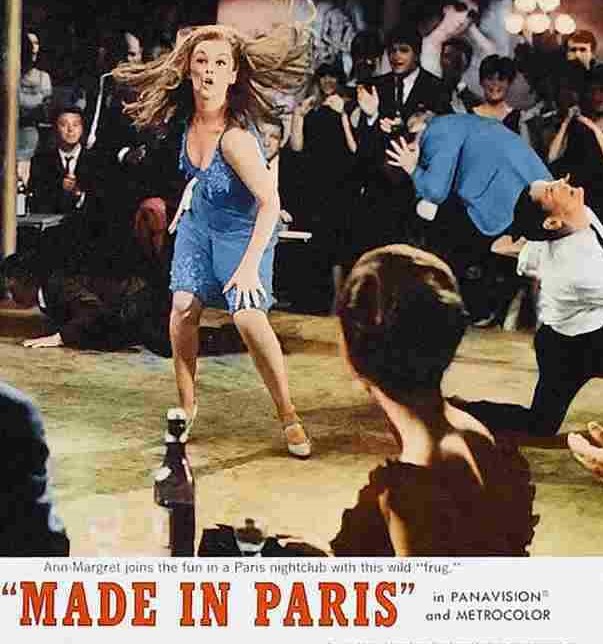
In the movie Ann-Margret dances in blue. In the poster, the dress turns red.

Turns out Irene quit so fast she didn’t have time to tell her Parisian boyfriend and fashion designer Marc (Louis Jourdan) so on Maggie’s first night in the company’s luxurious apartment he turns up. Naturally, he expects a bit of the old-fashioned quid pro quo, je ne sais quoi, whatever they call sex when they are being coy about it, and when she refuses to play ball he cables New York to demand her dismissal. Even when the New York boss (John McGiver) relents, she is banned from Marc’s fashion shows, meaning she can’t buy clothes she is forbidden to view.

Enter Ted’s buddy Herb (Richard Crenna), from the same lothario mold. Just to even things up or add further complication, Ted realizes he is actually in love with a girl who said no after a thousand boring girls who said yes. Trying to win her way back into Marc’s good books, with Herb as her guide she tracks the designer through the night clubs, eventually putting on the kind of sexy wild impromptu dance exhibition that the more staid Maggie could only have achieved if she’d taken lessons from Ann-Margret.

That does the trick and they share an impromptu number (“Paris Lullaby”) on the banks of the Seine although Marc still insists she shed her inhibitions before marriage if she wants to be considered a true Parisienne. The arrival of Mark and then Irene, abandoning her husband on their honeymoon when called in to retrieve the situation, adds fuel to the fire and then it’s one mishap after another, especially when Maggie discovers the pleasures of absinthe and ends up in Herb’s bed (yep, she has a hell of a time wondering not just how she got there but if, Heavens to Murgatroyd as Snagglepuss would say, she committed the terrible deed).

Unbelievably, and just as well perhaps from the narrative perspective, Herb isn’t a love rival. Maggie isn’t his type, its transpires. Shoot that man on sight – doesn’t fancy Ann-Margret?  Lock him up!

You won’t be surprised to learn that it all sorts itself out in the end but you might be a bit taken aback how quickly a dedicated career girl throws away her career once a marriage proposal comes her way.

You might have expected from the title that Maggie would be a model, the best excuse you could find for the actress to cavort in a series of skimpy costumes, as she does in the pre-credit sequence, an exquisite dialogue-free montage with a clever pay-off  that makes you think this is going to be much more stylish – excluding the fashion show of course – than it is.

Ann-Margret has such a dazzling screen persona she makes light work of even the lightest of confections. She does all that her most fervent fans would want but it’s not her fault she’s been cast in a Doris Day comedy that ensures she can only properly express her character by acts of exhibition. Louis Jourdan (Can-Can, 1960) keeps creepy entitlement at bay with lashings of Gallic charm. Despite his character’s playboy tag, Chad Everett (The Impossible Years, 1968) is the squarest of squares.

Richard Crenna (The Midas Run, 1969) spins his normal hard-ass screen persona into something a bit more sympathetic. Edie Adams (The Honey Pot, 1967) and John McGiver (Fitzwilly/Fitzwilly Strikes Back, 1967) add a bit of dash in support.

You’d never guess the director was Boris Sagal of The Omega Man (1971) fame. Stanley Roberts (Come September, 1961) wrote the screenplay.

Ann-Margret at her zingiest. What more could you ask?

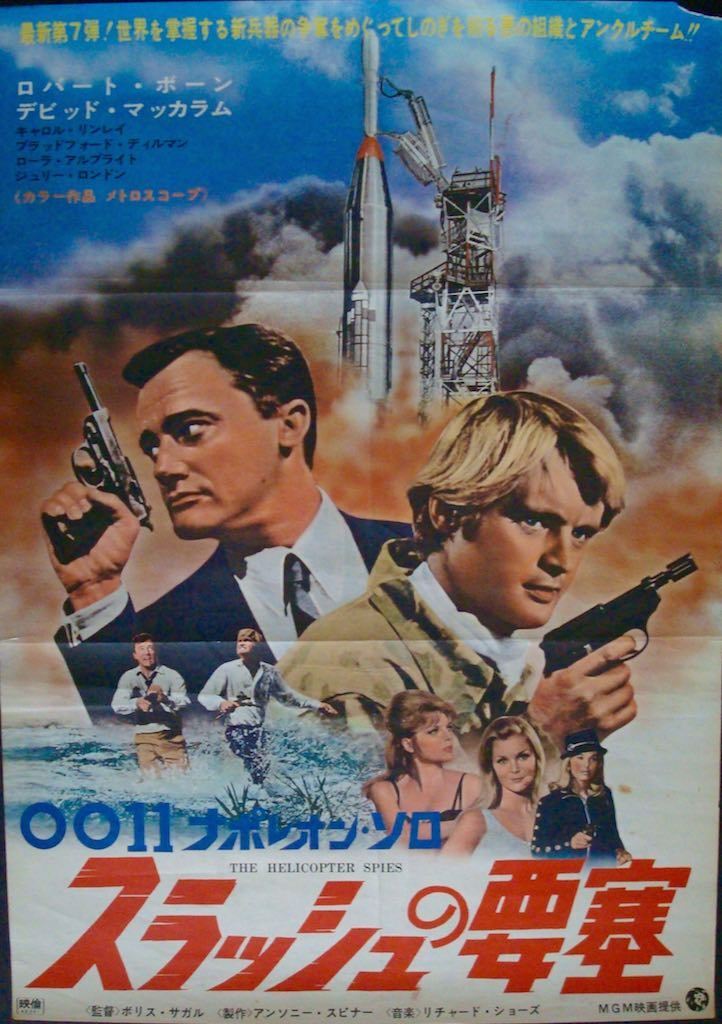
Helicopter Spies (1968) ***

Takes a little while to come to the boil what with disreputable women, a crew of platinum-white-haired thugs, a religious cult, some very dry dialog, a high priestess with her own chorus line of psychedelic dancers, four identical brothers, and a female lead parading a prize shaggy dog story. Our intrepid heroes appear more capable this time round, the previously inept Napoleon Solo (Robert Vaughn) not beaten up quite so often, though he does end up being drowned in sand (water too precious to spare, apparently).

This time round, too, the good guys are taken for a ride by mad scientist Luther Sebastian (Bradford Dillman) who hoodwinks the U.N.C.L.E. organisation into stealing a “thermal prism” from the fortress of another mad scientist Dr Kharmusi (John Dehner). To put his own grand plan into operation Sebastian just has to hijack a rocket. And you should be aware going into this that there’s not the amount of helicoptering you might expect given the title.

This time round, too, there’s hardly a good gal in sight. Azalea (Lola Albright),  aforementioned high priestess of cult The Third Way, has betrayed the good doctor in favor of Sebastian. Sebastian’s wife Laurie (Julie London) pretends to a) be out of contact with him for years and b) maintain a virtuous existence. And that’s before we come to the plainly bonkers, but still traitorous, Annie (Carol Lynley) who will make up any story in a bid to free an imprisoned unseen husband.

Sebastian has some neat touches as a leader, rewarding his team of thugs with booze and women as a prelude to killing them all off. He’s got an ejection seat in his car for getting rid of troublesome passengers. He prefers efficiency, to the point of iciness, to sexiness in his paramour and female underlings. And he has a very dry manner, which elicits a good few laughs.

But some of his thugs just ain’t that bright, the one instructed to follow Solo has just allowed him access to Laurie’s house. Laurie ain’t that bright, either, falling for an old trick by Solo who, as usual, is less bright that Ilya Kuryakin (David McCallum).  

Some of the set pieces are excellent. Sebastian’s followers meet in an abandoned movie theater where Azalea gives the lowdown on the grand plan assisted by her bevy of dancers. Infiltrating the organisation by the simple device of dying his hair, Solo ‘s disguise is uncovered after being sprayed with champagne.

There are a surprising number of human touches. Head henchman Carl (Roy Jenson) vowing to take “Mom” away from her dingy life running her eponymous diner finds she enjoys too much her dingy life. Carl, appreciative of the disguised Solo’s efforts, apologises for making him ride in the baggage train. Annie can stretch innocence to breaking point, to an extent where nobody cares about her problems.

But where The Karate Killers had a straightforward storyline – find the five daughters of a dead scientist – this gets a tad lost in the first section introducing the thermal prism, the cult, doubling down on mad scientists, and giving Annie all the importance of a red herring.

I thought for a moment that this was the end of the line in my appreciation of the U.N.C.L.E. franchise, the one where it all fell flat on its face and we could see the joins, but after the shaky start it picked up and became quite enjoyable in the series’ inimitable barmy fashion. I suppose I should applaud the initial narrative boldness, audience pretty much fooled from the off, the fortress assault not much more than an extended MacGuffin, with neither Sebastian nor Azalea what they seemed.

I could quibble about the guest stars but in fact this is a superb deadpan performance from Bradford Dillman (Sanctuary, 1961) and quite a departure for the Carol Lynley of Bunny Lake Is Missing (1965). And you could say the same for Lola Albright, previously seen essaying a different kind of character in The Way West (1967).

Boris Sagal (The Omega Man, 1971) directed from a screenplay by Dean Hargrove (One Spy Too Many, 1966).

I’ve only got a couple to go to wrap up the entire series and for your sake I will persevere. If you’ve not already done so, it’s back to the box set.

Discover WordPress

A daily selection of the best content published on WordPress, collected for you by humans who love to read.

The Atavist Magazine

by Brian Hannan

WordPress.com News

The latest news on WordPress.com and the WordPress community.