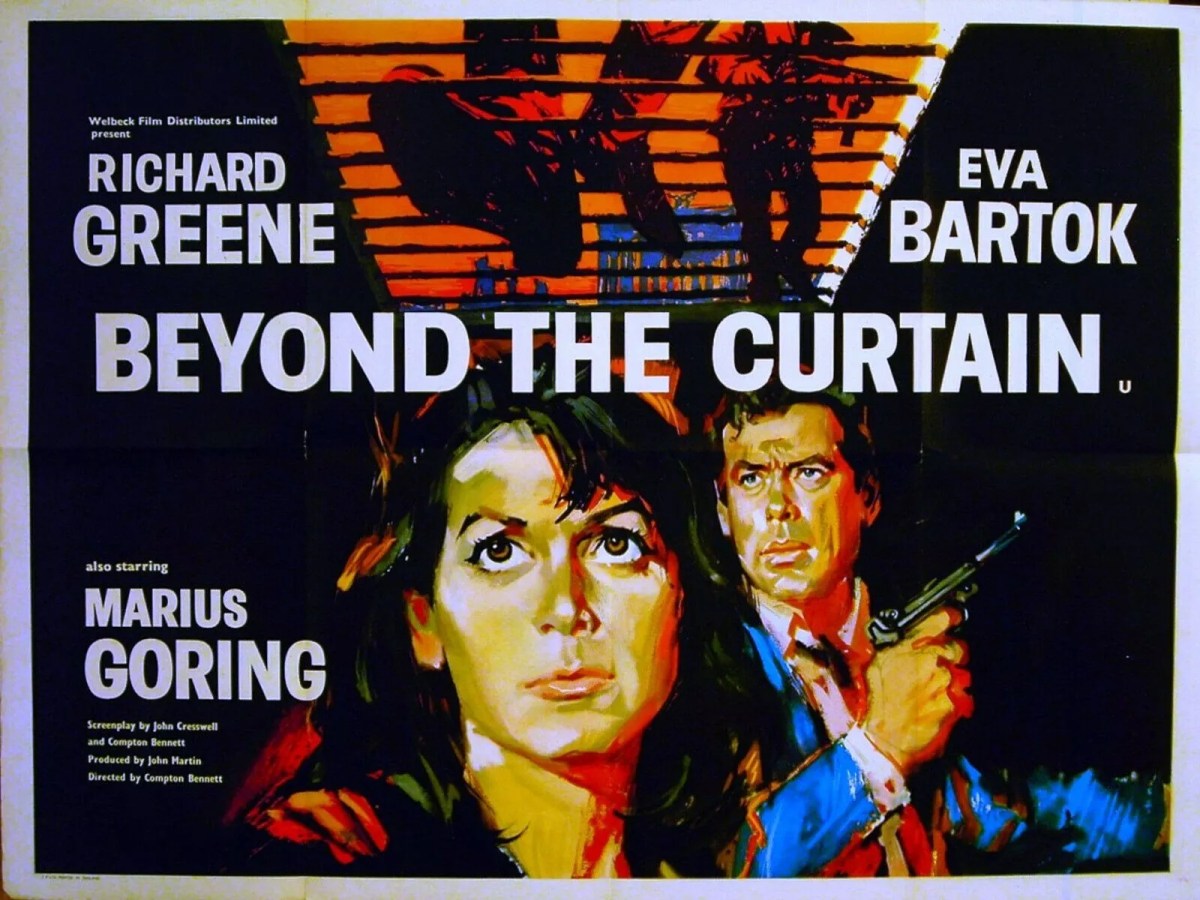
Richard Greene had been a childhood idol as that dashing hero Robin Hood in long-running British television series (The Adventures of Robin Hood, 1955-1960) and movie Sword of Sherwood Forest (1960) so I was rather at a loss to discover that his career appeared to stumble thereafter. Only one movie in seven years and then a short stint as the hero in The Blood of Fu Manchu (1968) and The Castle of Fu Manchu (1969). What I hadn’t realized given his eternal youthful demeanor was that he was already approaching 40 when he first donned the tights for Robin Hood and that he was coming to the end of a reasonable stint as a leading man in both Hollywood and domestically.
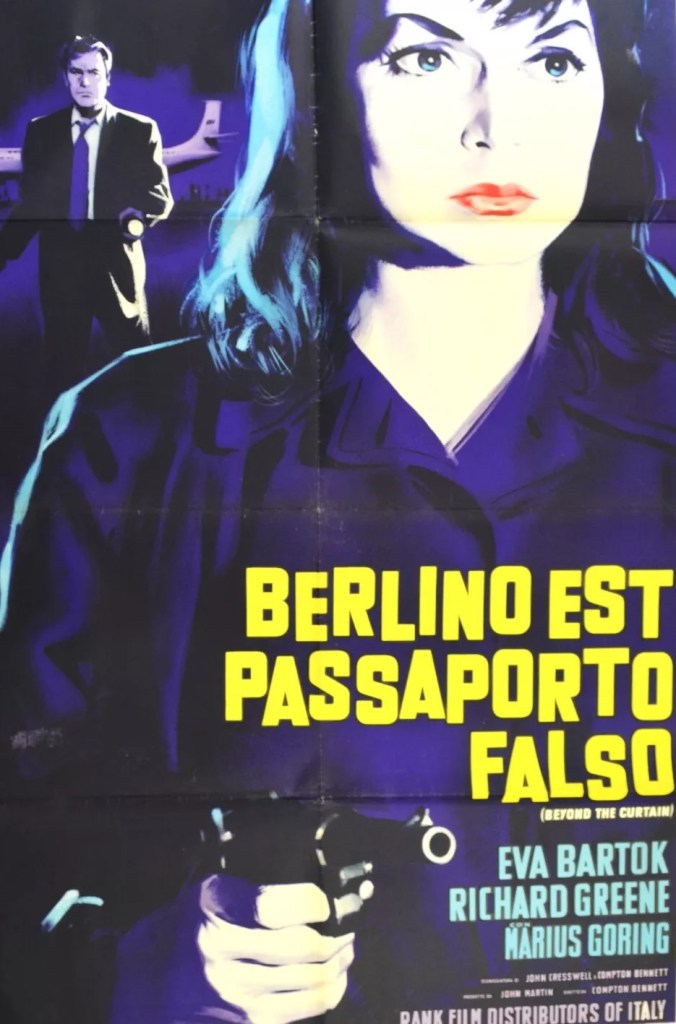
So I shouldn’t really have been surprised that he turned up in this Cold War B-picture. Precisely because he was the star the movie didn’t make the inroads it should have done, given the subject matter and the sensitive playing of Hungarian female lead Eva Bartok (Blood and Black Lace, 1964) whose career was equally foundering after a promising start as Burt Lancaster’s squeeze in The Crimson Pirate (1951).
Audiences were probably baffled by the technicality on which the story pivots. As the Cold War begins – the titular Curtain is The Iron Curtain – air space was as important a national border as land and venturing into foreign air space was construed as deliberate provocation.
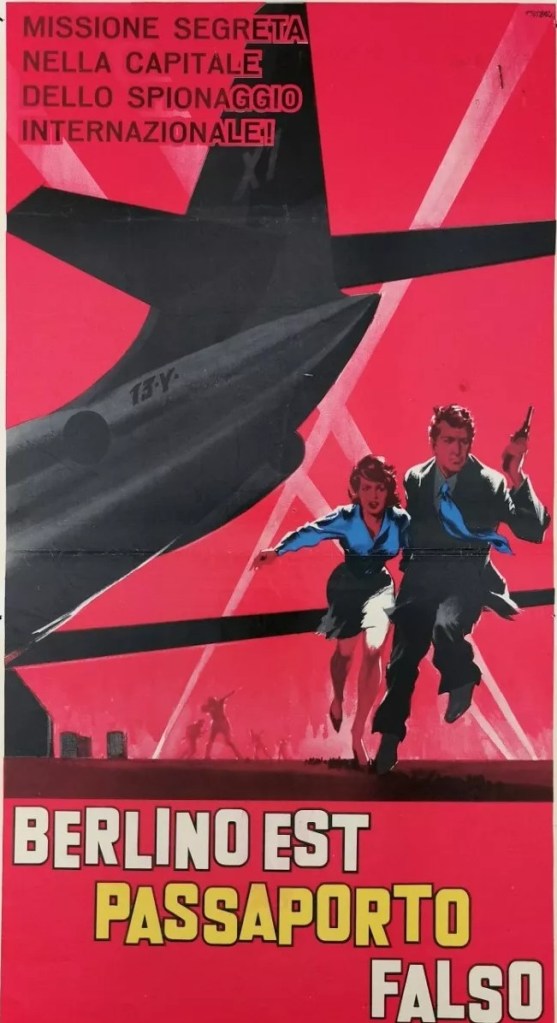
East German stewardess Karin (Eva Bartok), a refugee in Britain from her home country, is arrested when her airplane touches down in East Germany after losing its way in a storm. Pilot fiancé Capt Jim Kyle (Richard Greene), who is let go by the Soviet-influenced authorities, returns to East Germany to try to rescue her.
This resonates more than it did at the time when the Berlin Wall was not yet in existence and the Cold War consisted more of saber-rattling than anything as perilous as the Cuban Missile Crisis. And there’s a definite Kafkaesque tone. Karin is treated as a traitor for attempting to flee her native land and is equally used as bait by her captors to attempt to draw out of hiding her dissident brother Pieter (George Mikell). Outside of Kyle, there’s a sense of romantic revenge, old friend Hans (Marius Goring) now leading the forces hoping to entrap her brother.
There’s plenty of the usual escape ploys, and the atmosphere has noir-antecedents with lighting that exploits shadow and night. And while the thriller aspects work well enough, especially the exciting climax in a tunnel, they carry less impact than the emotions. Karin is terrified of not just being held against her will and interrogated by the fierce secret police, but the prospect of repatriation – or more likely imprisonment – in a country she now despises and had managed to escape is proof that you can’t go home again.
If you remember the scene in Doctor Zhivago (1965) of Omar Sharif after the war returning to his palatial apartment and finding it filled up with other occupants and his family relegated to a very small space, this is its precedent. Karin’s family home is ruled by a sinister landlady-cum-busybody-cum-informant and her suicidal mother (Lucie Mannheim) lives in the attic and suffers delusions. The despair of living in a totalitarian regime comes across very well.
While reminiscent of elements of The Third Man (1949) and thoroughly overtaken in the espionage genre by the likes of The Spy Who Came in from the Cold (1965) and The Quiller Memorandum (1966), this makes it mark by concentrating on entrapment and lack of freedom.
Richard Greene is in his element as the dashing hero, but he’s outshone by Eva Bartok who has much more to lose.
Final feature of British stalwart Compton Bennett (King Solomon’s Mines, 1950) who injects occasional style into proceedings. Written by the director and John Cresswell (Spare the Rod, 1961) from the bestseller by Charles F Blair and A.J. Wallis.
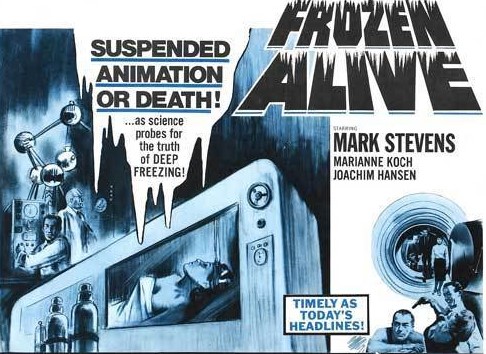
Sometimes the stars fail to align, initial promise fizzling out. Mark Stevens, rising post-war star, top-billed in film noir The Street Has No Name (1948) and Between Midnight and Dawn (1950), paired with Olivia de Havilland in The Snake Pit (1949), seemed all set for major stardom. No go. By the end of the 1950s he was mostly seen in low-budget westerns, and too few of them. September Storm (1960) was his first picture in two years. He had tried his hand at direction, but landed in B-movie hell with titles like Escape from Hell Island (1963) and after a bit part in Fate Is the Hunter (1964) hightailed it to Germany for this.
Not quite the sc-fi or noir number it says on the tin, more an exploration of personal and professional jealousies in the scientific community. You probably didn’t know the World Health Organization ran a Low Temperature Unit engaged in cryogenics experiments. Maybe they did, this being promoted as a timely movie.
Dr Overton (Mark Stevens) along with lab partner Dr Wieland (Marianne Koch) are on the verge of a breakthrough in their cryogenic experiments with monkeys. Although she has a lover Tony (Joachim Hansen), his unfaithful alcoholic journalist wife Joan (Delphi Lawrence) is jealous of his success and of Wieland and dreads leaving the fast lane for life in the country and potential motherhood.
Professional jealousy results in the successful scientific team being split up, so before that can be actioned, Overton decides to embark on a human experiment with himself as the guinea pig.
All the tension of watching an inert frozen human being relies on wondering whether he’s going to wake up and will he have all his working parts, brain especially. So, just to heighten that tension, Overton could face a murder charge when he does emerge. And Wieland, in love with him, has to decide whether it’s better to let him die than go to prison.
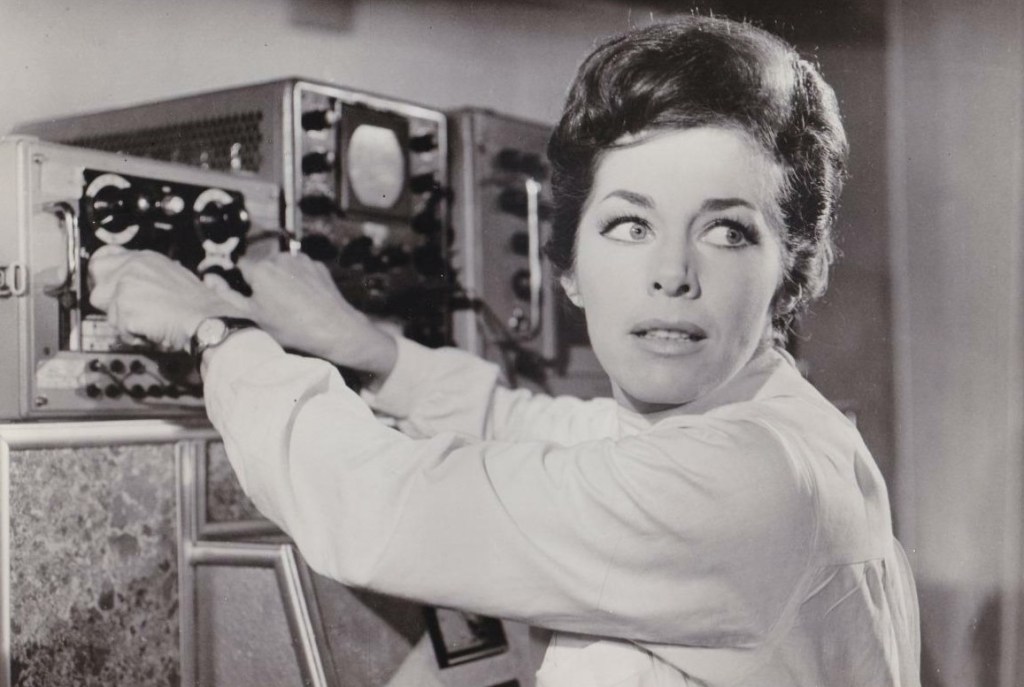
Marianne Koch at the controls. Will she let the suspected murderer live – or die?
The crime aspect is something of an oddity. The time element puts Overton potentially in the frame. And there’s a definite Hitchcockian element to the death, that in one sense robs it of tension, but in the other jacks it up to eleven. Because what we know but Wieland doesn’t is that Joan died by accident, playing with the gun of her lover.
So not only could an innocent man go to jail in the first place, stacked up against him his potential anger at potentially discovering his wife has a lover, but Wieland could let him die only to find out afterwards that he’s innocent all along.
It’s a good job Joan did die because she was stealing the picture. But even being soused in booze doesn’t dampen her zest for life, the kind of woman whose life mostly exists in cocktail bars and smart parties, dressed to the nines, showing enough cleavage to annoy her husband but tease potential suitors, and with enough toughness to dump any lover that gets too close. She’s sassy fun and married the wrong dull guy.
And she’s smart enough with her “intelligent anticipation” to figure out that husband is soon going to cosy up to lab buddy. Overton’s boss notices the signs when he’s not too busy covering his own back. “You sit on the fence and if someone makes a fuss later I take the rap.”
The Mind Benders the previous year covered similar territory but concentrated on the post-experiment after-effects, so this is almost a prologue to that, and interestingly, setting Joan aside, delivered with almost a British stiff upper lip, secret passion kept under wraps, lust revealed in lingering looks, while the cut-throat elements of ambition are played out under the guise of a civil service mentality.
Not quite what you’d expect from the title, but then it’s kind of a cul de sac in sci fi terms, as it’s generally the awakening that produces the problems and this doesn’t go there. But still a decent watch. British actress Delphi Lawrence (Farewell Performance, 1962) steals the show but the simmering turn from Marianne Koch (A Fistful of Dollars, 1964) comes close. Mark Stevens doesn’t have as much to play with and he’s pretty much kept his emotions tamped down up to this point so hardly going to let rip now. Wolf Rilla (The Secret Ways, 1961) has a small part.
Bernard Knowles (Hell Is Empty, 1967) directed television writer Evelyn Frazer’s only screenplay. You might dwell on the irony that Delphi Lawrence’s star turn here led to nothing as much as Mark Steven’s career dwindled.
Something of a cult possibly because it’s hard to find.
Stylish cat-and-mouse thriller that fits into the relatively small sub-genre of intelligent spy pictures. George Segal was a difficult actor to cast. He had a kind of shiftiness that lent credibility to a movie like King Rat (1965), a cockiness that found a good home in The Southern Star (1969) and an earnestness ideal for Who’s Afraid of Virginia Woolf (1966).
But Quiller fit his screen persona like a glove. The part called for charm to the point of smarminess and courage to the point of callousness. A lone wolf for whom relationships were a means to an end, he adopted identities – journalist, swimming coach etc– as the occasion suited. His undercover mission is to expose a neo-Nazi organisation. But just as he seeks to discover the location of this secret enterprise, so his quarry attempts to find out where his operation is based.
Michael Anderson (The Dam Busters, 1955) had just finished his first spy effort, Operation Crossbow (1966) and that film’s documentary-style approach was carried on here but with a great deal more style. There is consistent use of the tracking shot, often from the point-of-view of one of the protagonists, that gives the film added tension, since you never know where a tracking shot will end. Although the film boasts one of John Barry’s best themes, Wednesday’s Child, there was a remarkable lack of music throughout. Many chase scenes begin in silence, with just natural sounds as a background, then spill out into music, and then back into silence.
But much of the heavy lifting is done by playwright Harold Pinter (The Servant, 1963) in adapting Adam Hall’s prize-winning novel. Hall was one of the pseudonyms used by Trevor Dudley-Smith who wrote The Flight of the Phoenix (1965) under the name Elleston Trevor. The Quiller Memorandum involved wholesale change, from the title (the book was called The Berlin Memorandum) onwards. Quiller is now an American, not British, drafted in from the Middle East.
The book is set against the background of war crime trials; Quiller a British wartime rescuer of Jews now tracking down war criminals; the main female character (played in the film by Senta Berger) had, as a child, been in Hitler’s bunker; and there is a subplot concerning a bubonic plague; there was a preponderance of obscure (though interesting for a reader) tradecraft; plus the Nazi organisation was named “Phoenix.”
While retaining the harsh realities of the spy business, Pinter junks most of this in favour of a more contemporary approach. Instead of meeting his superior Pol (Alec Guinness) in a theater, this takes place in the Olympiad stadium. Guinness’s upper crust bosses, Gibbs (George Sanders) and Rushington (Robert Flemyng), are more interested in one-upmanship. Berlin still showed the after-effects of the war and Pinter exploits these locales.
One lead takes him to Inge (Senta Berger), an apparently innocent teacher in a school where a known war criminal had worked.
But the core remains the same, Quiller prodding for weaknesses in the Nazi organisation. his opposite number Oktober (Max von Sydow) allows him to come close in the hope of reeling him in and forcing him to reveal the whereabouts of his operation. Quiller plays along in order to infiltrate the Nazis.
There is a lot of tradecraft: “do you smoke this brand” (of cigarettes) is the way spies identify themselves; Quiller followed on foot turns the tables on his quarry; the American is poisoned after being prodded by a suitcase; Quiller employs word associations to avoid giving away real information.
Having flushed out his adversaries, Quiller is now dangerously exposed. But that’s his job. He’s just a pawn to both sides. He’s virtually never on top unlike the fantasy espionage worlds inhabited by James Bond, Matt Helm and Derek Flint.
The structure is brilliant. Quiller spends most of the picture in dogged bafflement. The supercilious Pol flits in and out, as if such work is beneath him.Quiller is stalked and stalks in return. There are exciting car chases but the foot chases (if they can be called that) are far more tense.
But the core is a bold thirteen-minute interrogation scene where Quiller s confronted by Oktober. As an antidote to the thuggery and danger to which he is exposed, Quiller becomes involved with Inge.
Segal is a revelation, grown vastly more mature as an actor after Who’s Afraid of Virginia Woolf (1966) for which he was Oscar-nominated, confident enough to abandon the showy carapace of previous pictures. This is a picture where he sheds layers, from the opening brashness to the sense of defeat in surviving the interrogation ordeal, knowing the only reason he is still alive is to lead the enemy to his own headquarters, buoyed only by inner grit. He hangs on to his identity by his fingertips.
And it’s a revelation, too, or perhaps a backward step for Max von Sydow, who presented a less clichéd character in The Reward (1965). While dangerous enough, it looks like he is already slipping into the category of foreign villain.
Senta Berger (The Secret Ways, 1961) is hugely under-rated as an actress. She was in the second tier of the European sex bombs who came to prominence in the 1950s and 1960s, the top league dominated by Brigitte Bardot, Sophia Loren and Gina Lollobrigida. On screen she is not as lively as those three, but the quiet intensity of her luminous beauty draws the camera in.
Here, she is utterly believable as the innocent women who, in falling for Segal, is dragged into his dangerous world. She was criminally under-used by Hollywood, often in over-glamourous roles such as The Ambushers (1967) or as the kind of leading lady whose role is often superfluous.
Discussion of Alec Guinness as a spy inevitably turns to his role as George Smiley in the BBC series Tinker, Tailor, Soldier, Spy (19790 and its sequel three years later, but this is a less dour portrayal, almost whimsical in a way.
The Godfather Part II of action movies. It’s taken me three visits to fully appreciate the visual, aural and thematic splendor. Usually when someone pays homage to the likes of John Ford, David Lean, Francis Coppola, Akira Kurosawa, Luchino Visconti, Ridley Scott, Michael Mann, James Bond (yup) and the myriad directors who filmed a car chase, the result is rarely top-notch. That’s not the case here.
Let’s begin with sound. The bone-jarring punch that opens this picture is easily the best aural opening of any picture and would make the case for Imax straight off the bat. That’s followed by thematic motifs, the sun (I can’t tell if it’s rising or falling) and the stairs that will figure so prominently, the sun especially a gorgeous palette, whether streaming through the Eiffel Tower or in fabulous sunrise mode to indicate the beginning of the climactic duel, a throwback to the classic western, and as operatic in its composition as anything Sergio Leone could throw at us.
Not to mention that this is essentially a story of bounty hunters, and that puts it squarely in the window of the spaghetti western. And could you get any closer to Leone than naming one of the pair of assassins in pursuit Mr Nobody? As the price on John Wick’s head reaches dizzying proportions – $40 million – it’s open season. Setting aside the punching and kicking and whacking and ramming with cars, nobody has filmed shoot-outs like these since the glory days of Michael Mann.
And that’s before we come to Hollywood’s best-ever dog, a cojones-chewing throat-mauling nutcase that can turn cute at any given moment. And if you are looking for thematic completion there you have it, this entire series began because an idiot killed John Wick’s dog. This is a dog as if it had somehow been born out of John Wick.
Perhaps the best element of the spoken and unspoken brotherhood that infuses the picture is the underlying cynicism that accompanies it. You save someone and they owe you. Mr Nobody (Shamier Anderson) comes to Wick’s rescue twice, once cynically because the price on his head is not yet high enough and then out of acknowledgement for his enemy’s action regarding the dog.
And it takes a moment, given Wick is never permitted explanation, to realise that Wick’s final action will provide a satisfactory outcome to all concerned.
Only a director of note would think to capture the sound of sand tricking through an hourglass and the silence when it stops, or the tap of a tiny spoon against the tip of a tiny coffee cup. The Marquis (Bill Skarsgard), tasked by the invisible High Table with bringing down Wick, enjoys such extraordinary wealth you wonder what more does a man need – except of course to satisfy his ambitions within the closed circle of the High Table. Probably no supporting member of any cast has ever been provided with such elegant narrative.
Underneath blazing chandeliers in a room the size of a small town, he chooses one cake from an immeasurably large selection – the rest of which presumably go to waste – and only, delicately with a fork, eats half. As if never sated, he must lick the last of his coffee from his spoon. The female riders in his stables are practising with sabers, you imagine for more than acrobatic purpose. His final act reveals the man in all his arrogance and cowardice.
You wonder where the heck did Chad Stahelski come from to make a movie of such majesty. Yes, I know he’s a former stunt man but that’s like asking Yakima Canutt to conjure up something as iconic as The Searchers. The preceding Wick trilogy, as good as they are, did not set you up for this.
There’s not a single wasted character. The previous betrayer Winston (Ian McShane) returns and is not just blamed for the whole debacle but finds his prospects tied in even more closer to his one-time buddy. The Harbinger (Clancy Brown), who begins as messenger and transitions to intermediary and finally judge, has such a mythical presence you wish Marvel could pay heed and hire someone with his gravitas.
Stahelski has such command of his material that he can set up twists for which his narrative skills provide solution. Instead of the traditional sons of gangster pictures, and bear in mind it was an errant son who started this whole business off, it’s daughters, one innocent of her father’s occupation, the other complicit. Some codes are replete with honor, others more practical.
Once the deadline is set for a duel to resolve the situation, blind assassin Caine (Donnie Yen) needs Wick to make it, but, having assisted him, evens the odds by slicing through his hand. At the end of a tortuous ordeal fending off the multitudes in Paris, Wick has a 200-step climb to his final destination. Further multitudes lie in wait. He gets to the top before he rolls back down and has to start all over again, the clock ticking.
And there can’t have been a better final image than in Wick loosening his belt.
Brilliant script by Shay Hatten (Army of the Dead, 2021) and Michael Finch (Predators, 2010), with some lines that will enter the screenwriting Hall of Fame, and Wick and his supporting cast are stupendous, but in the end this film belongs to the director and a movie that calls out to be seen in the cinema and to be called a masterpiece.
Editor wanted to stop self-indulgent director sabotaging his own work. Normally, this would be a producer’s job but there’s so many of them (I counted 14) in this co-production that I doubt any was at the wheel of the ship, trusting the director wouldn’t do something so guaranteed to alienate an audience as stick in four minutes (or more) of credits on a blank screen at the start. Credits that, virtue-signalling gone mad, list every Tom, Dick and Harry (and potentially their dog) who so much as pushed a pen for any of the production companies involved.
That won’t erode much of the mighty 158 minutes but it will make it appear several minutes shorter, assuming the audience bolts at the end. The cinema audience I saw it with wasn’t so courteous. Some were bolting long before the end. The sound of clacking chairs could be heard on a regular basis from halfway through the film.
You what!!! But this is an acclaimed picture, 92 Metascore on Imdb! Are we going to have start screening audiences now so that only people with the taste to sit to the end are allowed in?
To be honest, I shared their pain. Absolutely terrific Oscar-worthy performance by Cate Blanchett, pretty good work too from Nina Hoss as her long-suffering partner, but boy does it go on. And on. Was the director assuming the audience was too thick to get that the eponymous lead was a bit of a fitness freak without sticking that in endlessly? It’s not like it builds tension a la Vertigo with James Stewart’s apparently endless driving.
I enjoyed quite a lot of this even though at times it felt like one of those Classic Albums documentaries where those involved dissect their work, explaining how they married a riff here with a riff there, except given the composers are all dead the only creative force available is the conductor, otherwise those pesky musicians will just go off and do their own thing.
The problem is a lot of the dialog is “dead.” It doesn’t enhance our understanding of character, build character or (God forbid!) narrative or tension. One way or another it’s just intellectual discussion of classical music. Which is fascinating – but only for a time.
The story itself is told with subtlety in some places and with a sledgehammer in others. You couldn’t have telegraphed more an impending problem with an unseen musician than have Tar (Cate Blanchett) delete email correspondence. And the minute cellist Olga (Sophie Kauer) appears on the scene with her come-to-bed eyes, you know this is a femme fatale on the prowl, and expect speedy unfair promotion is on the cards at some point.
That power corrupts, whether in male or female hands, appears to the driving point of the rest of the story but you have to wait a good 90 minutes before that assumes any real significance, plus social media is presented here in its best guise as an instrument of truth.
It’s a rise and fall tale, although the climax doesn’t ring true, the director either dodging the true climactic scene, a confrontation with Tar over an enforced change in her professional status, or that didn’t take place and the first thing the conductor knows about what has occurred is when she’s about to take her place on stage. Neither decision makes much sense.
So, onto the good parts. Blanchett puts in a riveting performance, not just in her sense of her own superiority, but in managing so effortlessly to make a conversation just sound like a conversation rather than a string of points making dramatic emphasis. She leaves most of the parenting of their child to partner Sharon (Nina Hoss) only stepping in when someone needs to put a bullying girl in her place. That this relationship is long past its best is obvious from the off, and that Tar has a wandering eye is plain once Olga appears.
And although Tar seems to have a fine grasp of orchestral politics and can drive a hard bargain with those seeking financial gain, she is blind to consequence, needlessly making enemies of long-standing supporters, failure to provide promised promotion triggering betrayal.
What the film does get right (I guess, since I’m no expert) is the role of the big-name music director/conductor in the classical world, ferried across continents in private planes, knowing how to bend the rules in a business where, it transpires, the orchestra wields a great deal of power, and with a genuine genius for imbuing listeners with her enthusiasm for music.
Her interpretation of “Mahler’s Symphony No 5,” initially fascinating, soon lost its hold because I had no idea what she was up to (so I hold my hands up on that one) but you’d have to be intimately acquainted with the work to get so much out of it given the time spent exploring it. This isn’t about a composer of course and lacks Peter Shaffer’s instinct with Amadeus (“too many notes” and the scene where the ill Mozart describes his music to his arch-enemy) so quite a lot of the music stuff went over my head, leaving me with no interest in large sections of the film.
Cut down to two hours plus, okay, those four minutes of credits back in their proper position at the end, and you would have a very satisfactory movie that explored the classical musical world while detailing the downfall of a female tyrant.
Director Todd Field (Little Children, 2006) carries the can on this one.
But I would also point out to him that if you’re appealing to an adult audience and a largely arthouse one at that you’re trying to target generations that have seen all the best stuff, that respond to unusual films that take them to new places dramatically or stylistically and will not stand to be bored rigid.
People slapping down £14 to see it in their local Odeon aren’t going to be as inclined to tell people to go see it than critics watching it for free. And anybody who thinks a streaming audience isn’t going to be reaching for the switch-off button during the marathon opening credits is asking for further financial misery.
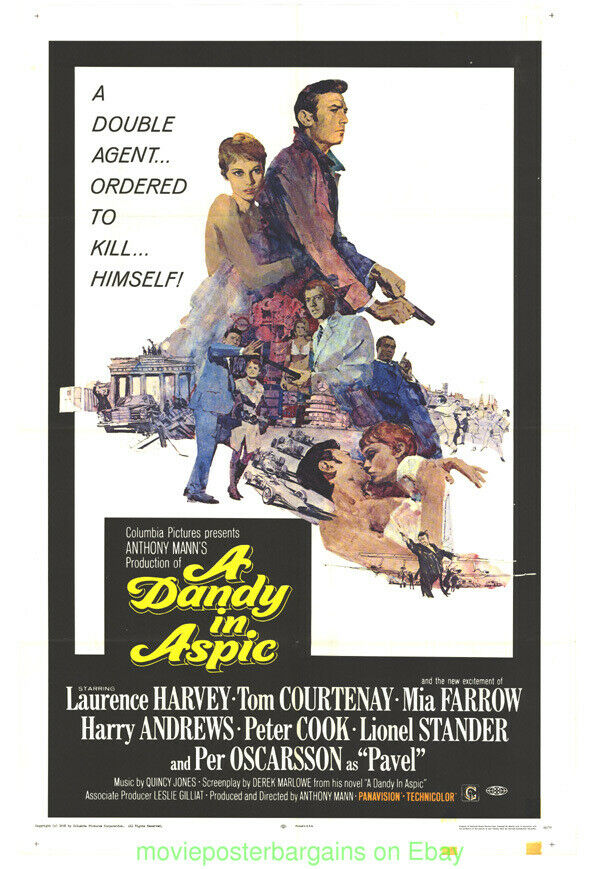
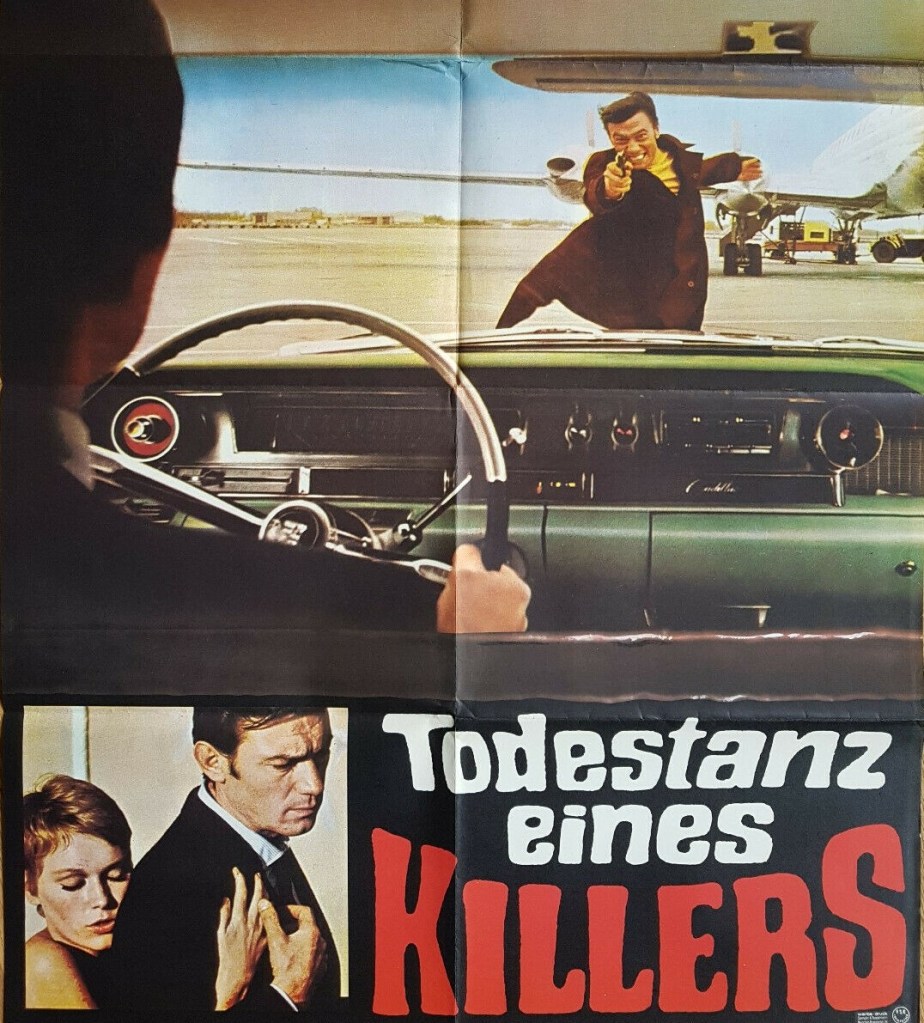
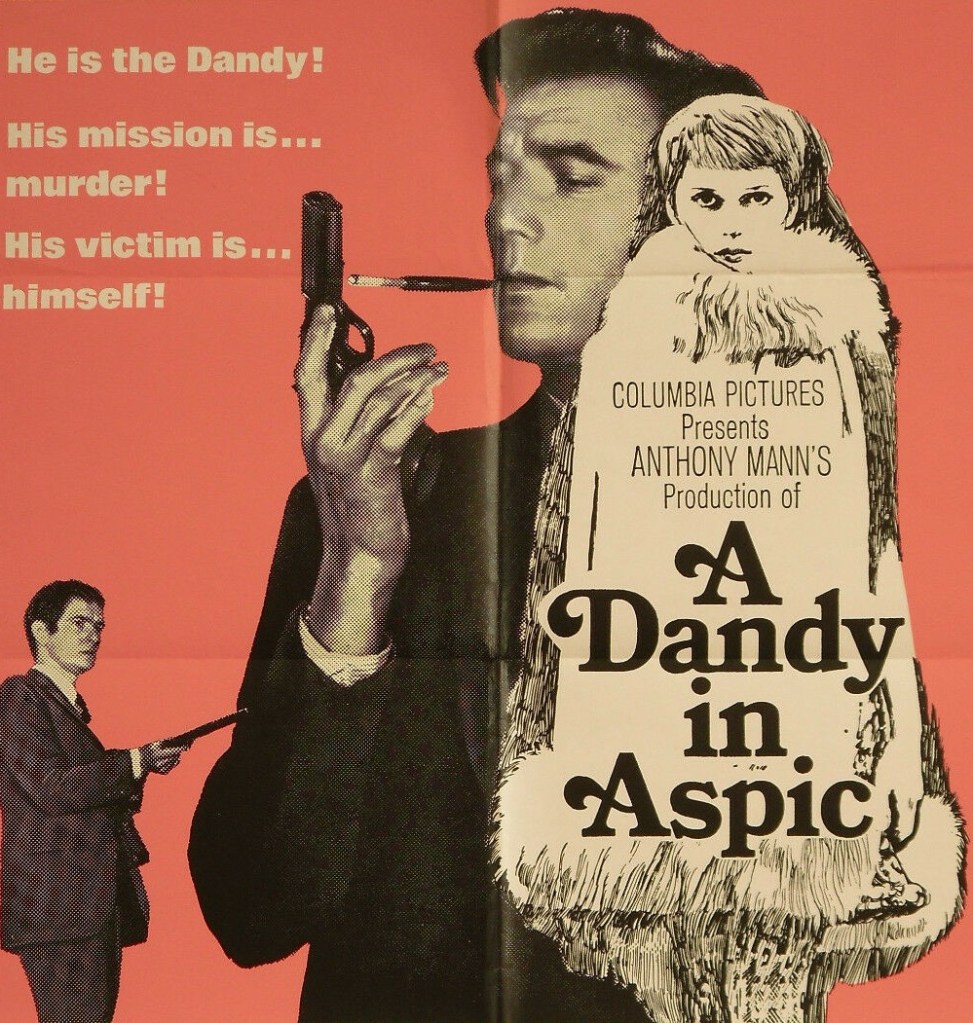
Belongs to the “serious spy” genre that exposed the nitty-gritty espionage business, often more concerned with the impact of the job on the spy than on the mission on which they have been sent. The biggest successes came early on – The Spy Who Came in from The Cold (1965), The Ipcress File (1965) and The Quiller Memorandum (1966). A Dandy in Aspic is one of the latest in the series of sad spies and like The Defector (1966) it’s more of a character study than an action picture. The tone is set with the credits, a puppet dangling to the point of being tormented, on a string.
The character in question is Eberlin (Laurence Harvey), a spy who wants to quit and go home. He knows only too well what happens to the burnt-out case, one of his colleagues is a drug addict. Only in this case home is Russia. But the feedback he receives is that nobody back home wants him to quit. His British bosses send him to go to Berlin to assassinate a dangerous Russian spy called Krasnevin. The only problem is, Eberlin is Krasnevin and so begins a game of bluff and double bluff while he fails to uncover the supposed foreign assassin his ruthless British unwanted colleague Gatiss (Tom Courtenay) is helping him locate.
Thrown into the mix is a girl, Caroline (Mia Farrow) a casual pick-up, a photographer he met in London who turned up in Berlin. Happenstance? Perhaps. But there is no such thing for a suspicious spy and to tell the truth even the moviegoer will treat her as just too good to be true even though she is a delightful personality and beautiful to boot. The fact that Eberlin has a girlfriend Miss Vogler (Barbara Murray) doesn’t seem to bother him, spies, as you will know by now, discarding women like old shoes.
If a noose is closing in, it’s a strange one, and feels more like it’s coming from the East rather than the West. He is blocked from taking a trip to East Berlin. Cops are tipped off when he makes contact with someone who could get him over/through the Wall. His Eastern masters seem willing to pay good money to find out the identity of Krasnevin.
It’s all twisted and complex and all sorts of strange characters come out of the woodwork. For no reason at all one sequence is set at a Grand Prix race, one of the drivers paid to cause a distraction to allow someone to be shot. Like The Defector, this is a movie that unravels backwards. Once you get to the end it makes a lot more sense. If you were asked to choose, on the basis of the characters presented, whether the Russians or British had more principles you would be hard put to decide.
Laurence Harvey (The Running Man, 1963) is one of the few actors with the vicious fragility to carry this off. He is coming apart at the seams. He can hold onto his good looks far longer than his mental stability. His rare acts of violence seem petulance. And since we are never allowed inside his head, since he cannot confess his feelings to Caroline, he cannot explain what it’s like to be abandoned by your native country, cast aside like an old lover. It’s left to the audience to work this out for themselves, that a true patriot risking his life for his country is refused sanctuary.
He’s doomed and soon he knows it, nowhere left to run, the sense that the trap is closing and perhaps the few hours spent with Caroline are like a condemned man’s final wishes.
Filmed in bleak London and Berlin, the setting reflects the character’s mindset. There’s a bit too much fancy cinematography and sound effects, but otherwise it’s solid entry into the “more real than reality” subgenre. Director Anthony Mann (The Heroes of Telemark, 1965) died during the making of the film, Laurence Harvey taking the helm for the last two weeks of shooting and post-production so it’s possible this is not quite the film Mann had in mind.
You can see here elements of the documentary style Mann developed in The Heroes of Telemark and it’s possible that when it came to the editing director Harvey accorded himself more prominence than Mann might have, leaving a complex tale more difficult to follow than necessary.
Harvey is very good in the role of the ruthless narcissist, Mia Farrow – she followed this with Rosemary’s Baby (1968) – with a creditable English accent is excellent as the lover though Tom Courtenay (Operation Crossbow, 1965) seems miscast. Excellent support is provided by Lionel Stander (Once Upon a Time in the West, 1968), Harry Andrews (Danger Route, 1967) and Per Oscarsson (Who Saw Him Die?. 1968). Look out for comedian Peter Cook (Bedazzled, 1967) as an unlikely lothario, Barbara Murray (television series The Power Game, 1965-1969) and Calvin Lockhart (Dark of the Sun, 1968).
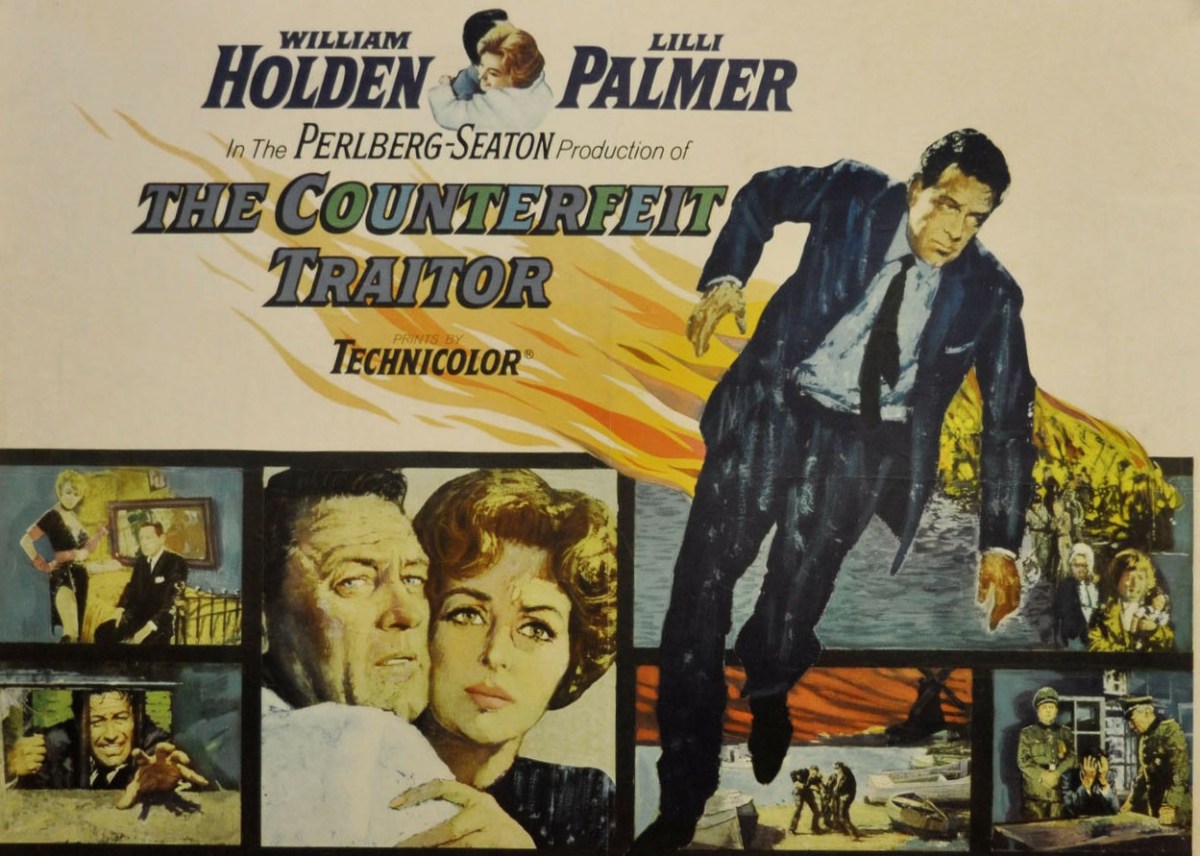
Authenticity came at a cost. In electing to film in Europe veteran producer-director team of William Perlberg and George Seaton, their partnership stretching back two decades, incurred the ire of U.S. movie unions campaigning against “runaway” productions and tax-avoiding stars like William Holden. Feelings ran so high the movie was picketed on release, even though it had received a Presidential seal of approval after John F. Kennedy requested a screening.
Perlberg and Seaton were lucky not to be indicted for a further act of anti-Hollywood behavior, the hiring of so many European actors and actresses in favor of the home-grown variety, but with the incursion of Sophia Loren, Brigitte Bardot and Gina Lollobrigida into the U.S. box office introducing another big female star into the Hollywood firmament would likely have been welcomed.
Producer Perlberg bluntly defended the decision to film abroad a movie set in war-torn Europe (where much of the damage caused by the war had not been rectified). “Where would you find three solid blocks of rubble but Berlin?” he demanded. “Or a prison like Moabit? Our company was yesterday filming in a partially bombed out section of the Altona railway station, six stories high. Action involved a 14-car German train (which Union Pacific can’t reproduce). How can we build Stockholm in Hollywood.” More to the point, he added, “Of course where in the world can you get weather like this? It’s been raining every day.”
Perlberg and two-time Oscar winner Seaton (Airport, 1970), separately and together, had considerable experience of war pictures, having between them made The Proud and the Profane (1956) and The Bridges at Toko-Ri (1954), both pictures, incidentally, starring Holden. The Alexander Klein bestseller The Counterfeit Traitor, purchased in 1957 for a modest $75,000, appeared to follow a similar trajectory. “Competition for the entertainment dollar has wedded us to big films and global stories,” maintained Perlberg despite complaint by Hollywood unions that such films, in the face of shrinking U.S. production, denied their members work.
Although the European locations would shave $500,000 from the budget of The Counterfeit Traitor, still coming in at a hefty $3.4 million and originally to be filmed under the title Man in the Middle, Perlberg was adamant that “the picture could never be made in Hollywood with justice to the subject and story… We are shooting this picture where it happened. On the streets that Eric Erickson (the character William Holden plays) walked; in the houses that were his hideouts.”
Perhaps key to this philosophy was the ability to shoot inside the notorious and still-active Moabit Prison, housing 1,300 prisoners and located close to Berlin’s famous Tiergarten. Amazingly, the prison warden granted permission not just to shoot in the courtyard but also inside the actual building. The prison officials initially denied that anyone was shot in the courtyard (a key scene in the film) until Erickson turned up and testified to the contrary, standing in the cell through whose bars he had witnessed the execution. You could not buy such authenticity and certainly not recreate it in a Hollywood back lot.
Paperback movie tie-in.
The 100-day shooting schedule included a month in Berlin, two months in Hamburg and scenes set in Copenhagen and Stockholm. It was the epitome of a multi-country adventure – the cameraman French (Jean Bourgoin who shot Tati’s Mon Oncle), wardrobe coordinator Italian, sound mixer German and assistant director British. But in Denmark, they worked with a Danish crew, in Sweden a Swedish crew. “I doubt that any other picture has been made with this type of operation – changing crews with each country involved. It has certain pitfalls but we’ve found in Germany alone that it would have been foolish to do it any other way,” added Perlberg.
“Hollywood set dressers, for instance, are great but no amount of research can match actual experience. Our interior decorators lived in the environment, witnessed the events and dressed the sets accordingly.” Apart from language problems, in Germany, where the bulk of filming took place, the lack of a centrally located “movie town” like Hollywood caused issues. Actors and crew were drawn from Berlin, Munich and Hamburg, with all the cast put up in first class hotels and paid a per diem of $15. With over 70 speaking roles, the movie also called on 2,000 extras. The producers also worked in the oldest film studio in the world, Nordish Film in Copenhagen built in 1906, and the rebuilt Palladium, which had been blown up by the Germans during World War Two.
Actors and directors worked abroad to limit their U.S. tax exposure. Anyone taking advantage of foreign income was viewed as a tax cheat. William Holden, who would only make one movie in Hollywood in seven years, epitomized the wealthy tax dodger. Living abroad also cut down on paying U.S. tax. Switzerland, for example, where Holden took up residence, calculated tax on the amount you spent on the annual rental of your home, resulting in huge savings – Yul Brunner claimed this legitimate move alone had saved him $2 million.
Holden complained that he was unfairly being singled out. “How about Clark Gable in Naples, Tony Quinn, Charlton Heston in Ben- Hur? Why do they pick on me? I pay U.S. taxes in the highest brackets and will continue doing so for years.” He was a prime target not just because he was outspoken about living and working abroad but because he was, along with John Wayne, the highest-earning male actor, on $750,00 per picture plus percentage. He had the pick of the projects, linked with The Guns of Navarone (1961), The Alamo (1961), The Americanization of Emily with William Wyler in the director’s chair, The Visit with Ingrid Bergman and Melody for Sex where he would be paired with both Sophia Loren and Gina Lollobrigida. He had followed up The World of Suzie Wong (1961) filmed in Hong Kong, with Satan Never Sleeps (1961) filmed in Britain, and then was lining up The Lion in Kenya, Together in Paris (aka Paris When It Sizzles) in France and The 7th Dawn in Malaya.
Although Prussian-born Lili Palmer (Sebastian, 1968) was an established Hollywood import, the movie offered a wide range of parts to fast-rising European talent. Most major studios had already invested in “new faces from abroad” so Perlberg-Seaton were not going against the grain on this one. Paramount, for example, had hired the German Hardy Kruger and the French Gerald Blain and Michele Girardon for Hatari! (1962). Columbia lined up Frenchman Alain Delon for Lawrence of Arabia (1962) and Greek actress Irene Papas in the female lead in The Guns of Navarone (1961). MGM chose Ingrid Thulin for The Four Horsemen of the Apocalypse (1962) and United Artists set Maximilian Schell in Judgement at Nuremberg (1961). Claudia Cardinale was intended to make her Hollywood debut opposite Sidney Poitier in Iron Men – never made.
Heading the list of potential break-out stars were Ingmar Bergman protegees Sweden’s Eva Dahlbeck (Smiles of a Summer Night, 1955) and Ulf Palme (Dreams, 1955). They had appeared in two films together, Dreams and Meeting in the Twilight (1946). German Wolfgang Preiss would later appear in The Train (1965) and Von Ryan’s Express (1965). But the biggest casting coup was Klaus Kinski. “No German producer lightly engages him because most of his engagements in German theaters have ended with a resounding quarrel or scandal,” explained journalist Peter Baker, “(but he is) nevertheless regarded with awe and respect as one of the greatest actors to merge from post-war Germany.” His three days in The Counterfeit Traitor won him a role in Perlberg-Seaton’s next picture The Hook (1963).
SOURCES: William Perlberg, “Searching Europe for Authenticity,” Films and Filming, February 1961, p9; Peter Baker, “The Tour of Babel,” Films and Filming, February 1961, p10-11, 41; “Lazar Percenting Ericson Spy Tome,” Variety, October 16, 1957, p3; “Lament for B.O. Stars,” Variety, January 29, 1958, p14; “Holding Money via Residence in Switzerland,” Variety, August 5, 1959, p12;“Par’s Sex Stars,” Variety, September 2, 1959, p3; “Holden, Seaton Invade Berlin for War Film,” Variety, October 28, 1959, p7; “H’wood – O’Seas Row Boils Up,” Variety, August 24, 1960, p7; “Bill Perlberg’s Back and Loves Hollywood,” Variety, November 2, 1960, p7; “New Faces from Abroad To Make Debuts in U.S. Films During 1961–62 Season,” Box Office, September 4, 1961, p12-13; “President Kennedy Sees Counterfeit Traitor,” Box Office, May 7, 1962, pW8; “Warm-Up for Picketing Strategy,” Variety, June 6, 1962, p4.
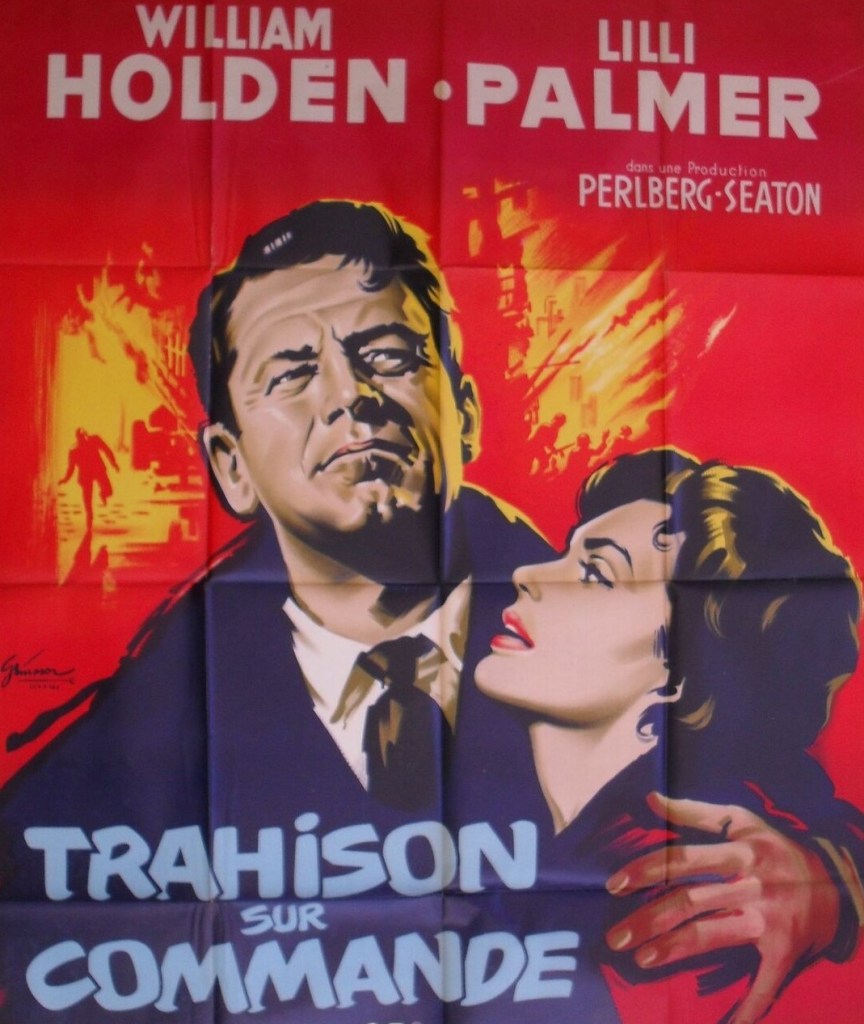
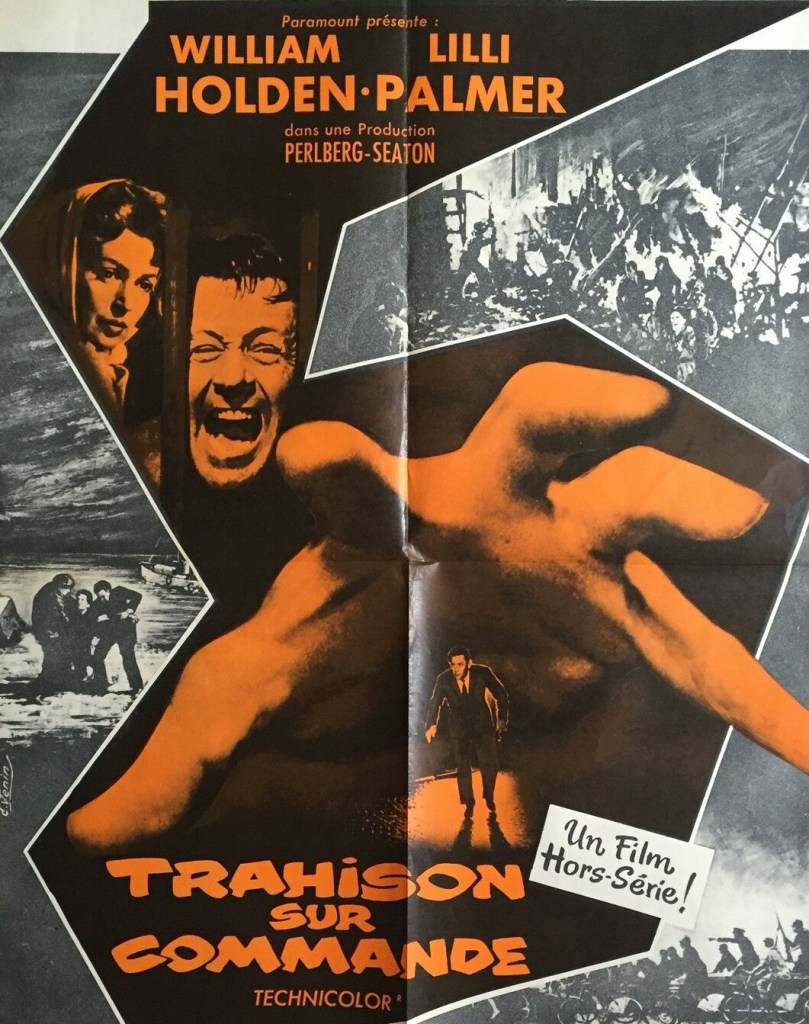
Cynical and opportunistic Swedish oil executive Eric Erickson (William Holden) blackmailed into World War Two espionage finds redemption after witnessing first-hand the horrors of Nazi Germany. Two extraordinary scenes lift this out of the mainstream biopic league, the first Erickson witnessing an execution, the second a betrayal. While some participants in the espionage game pay a terrible price, others like spy chief Collins (Hugh Griffiths) manage to maintain a champagne lifestyle.
Structurally, this is something of a curiosity. The first section, with over-emphasis on voice-over, concerns Holden’s recruitment and initial attempts at spying on German oil installations on the pretext of building a refinery in Sweden. Although resenting the manner in which he was recruited, Erickson has no qualms about resorting to blackmail himself to enlarge his espionage ring.
But it’s only when Marianne Mollendorf (Lili Palmer) enters the frame as his contact in Germany that the movie picks up dramatic heft. As cover for frequent meetings, they pretend to be lovers, that charade soon deepening into the real thing. While abhorring Hitler, she suffers a crisis of conscience after realising that the information she is passing on to the Allies results in innocent deaths. The final segment involves Erickson’s thrilling escape back home.
The picture is at its best when contrasting the unscrupulous Erickson with the principled Marianne. Virtually every character is trying to hold on to a way of life endangered by the war or created by the conflict and there are some interesting observations on the way Erickson manages to harness foreign dignitaries while being held to hostage in his home country. Loyalties are sparing and even families come under internal threat.
Sweden was neutral during the Second World War so in assisting the Allied cause Erickson was effectively betraying his country and once, in order to keep proposed German investors sweet, he begins to spout Nazi propaganda at home finds himself deserted by friends and, eventually, wife.
In some respects, Holden (The Devil’s Brigade, 1968) plays one his typical flawed personalities, easy on the charm, fluid with convention, but once he learns the true cost of his espionage a much deeper character emerges. The actor’s insistence, for tax reasons, on working abroad – this was filmed on location in Europe – would hamper his box office credibility and although not all his movie choices proved sound this was a welcome diversion. Whether American audiences were that interested in what a Swede did in the war was a moot point, as poor box office testified. And the title might have proved too sophisticated for some audiences, given there was no counterfeiting of money involved.
Lili Palmer (Sebastian, 1968) is excellent as the manipulative Marianne, betraying her country in order to save it from the depredations of Hitler, not above using her body to win favour, but paralyzed by consequence. Hugh Griffith (Exodus, 1960) provides another larger-than-life portrayal, disguising his venal core. Werner Peters (Istanbul Express, 1968) puts in an appearance and Klaus Kinski (Five Golden Dragons, 1967) has a bit part.
Double Oscar-winner George Seaton (Airport, 1970) makes a bold attempt to embrace a wider coverage of the war than the film requires and could have done with concentrating more on the central Erickson-Mollendorf drama, especially the German woman’s dilemma, but, made before James Bond reinvented the idea of espionage, this remains a more realistic examination of duplicity in wartime.
CATCH-UP: William Holden pictures reviewed in the Blog are Alvarez Kelly (1966) and The Devil’s Brigade (1968); Lili Palmer movies reviewed are Operation Crossbow (1965), Sebastian (1968) and Hard Contract (1969).
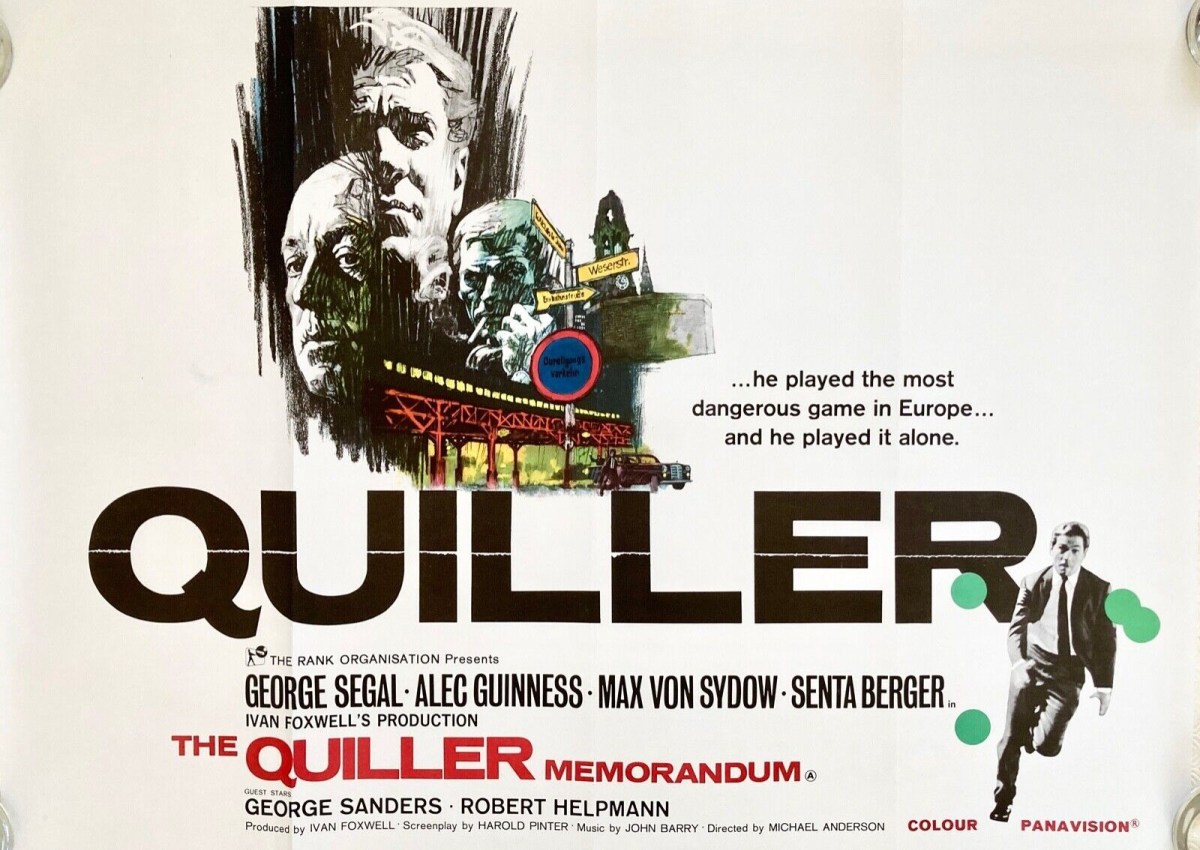
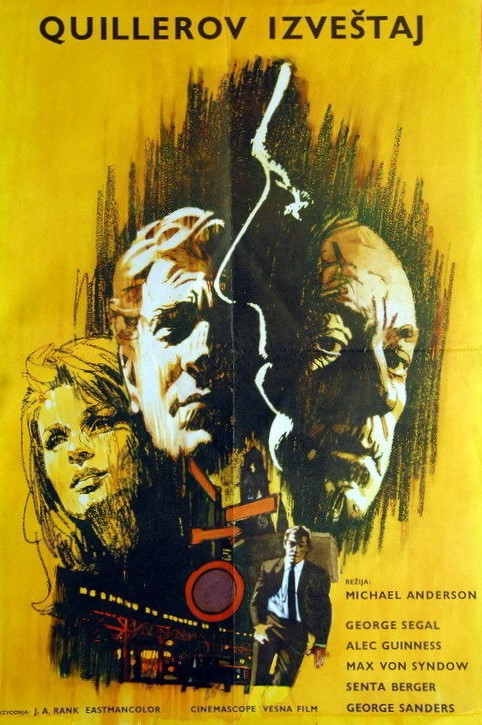
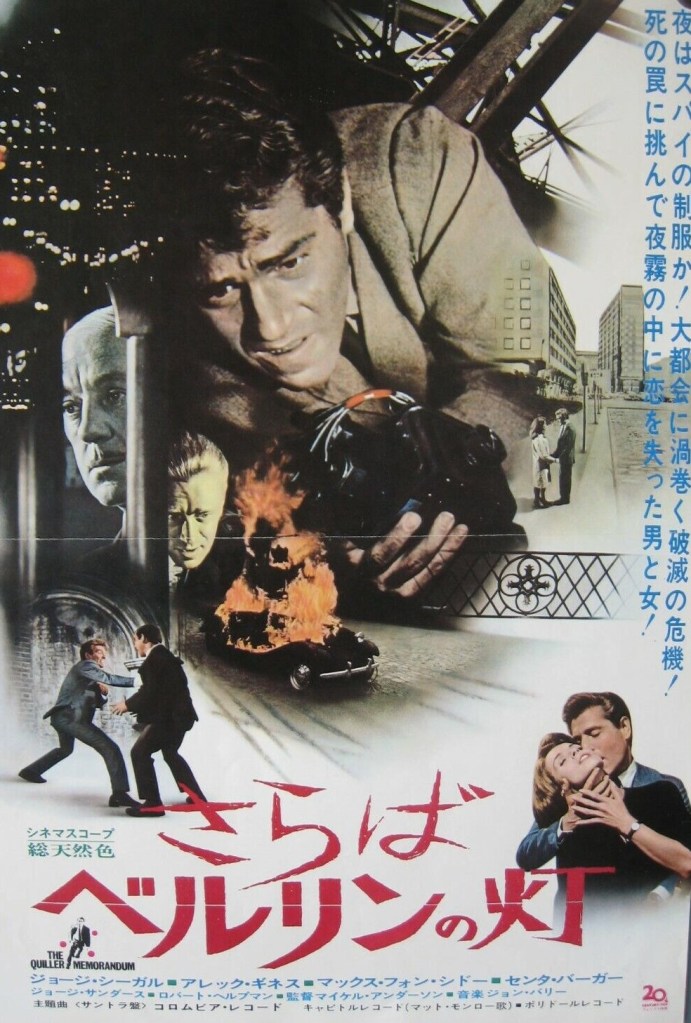
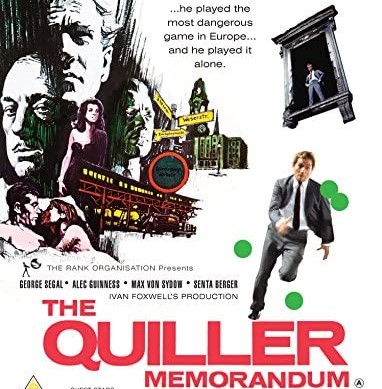
Stylish cat-and-mouse thriller that fits into the relatively small sub-genre of intelligent spy pictures. George Segal was a difficult actor to cast. He had a kind of shiftiness that lent credibility to a movie like King Rat (1965), a cockiness that found a good home in The Southern Star and an earnestness ideal for Who’s Afraid of Virginia Woolf (1966). But Quiller fit his screen persona like a glove. The part called for charm to the point of smarminess and courage to the point of callousness. A lone wolf for whom relationships were a means to an end, he adopted identities – journalist, swimming coach etc– as the occasion suited.
Quiller’s undercover mission is to expose a neo-Nazi organisation. But just as he sought to discover the location of this secret enterprise, so his quarry was attempting to find out where his operation was based.
Michael Anderson (The Dam Busters, 1955) had just finished his first spy effort, Operation Crossbow (1966) and that film’s documentary-style approach was carried on here but with a great deal more style. There is consistent use of the tracking shot, often from the point-of-view of one of the protagonists, that gives the film added tension, since you never know where a tracking shot will end. Although the film boasts one of John Barry’s best themes, Wednesday’s Child, there was a remarkable lack of music throughout. Many chase scenes begin in silence, with just natural sounds as a background, then spill out into music, and then back into silence.
But much of the heavy lifting was done by playwright Harold Pinter (The Servant, 1963) in adapting Adam Hall’s prize-winning novel. Hall was one of the pseudonyms used by Trevor Dudley-Smith who wrote The Flight of the Phoenix (1965) under the name Elleston Trevor. The Quiller Memorandum involved wholesale change, from the title (the book was called The Berlin Memorandum) onwards. The book is set against the background of war crime trials; Quiller a British wartime rescuer of Jews now tracking down war criminals; the main female character (played in the film by Senta Berger) had, as a child, been in Hitler’s bunker; and there is a subplot concerning a bubonic plague; there was a preponderance of obscure (though interesting for a reader) tradecraft; plus the Nazi organisation was named “Phoenix.”
Book jacket for film tie-in for what was originally entitled “The Berlin Memorandum.”
While retaining the harsh realities of the spy business, Pinter junks most of this in favour of a more contemporary approach. Instead of meeting his superior (Alec Guinness) in a theatre, this takes place in the Olympiad stadium. Guinness’s upper crust bosses, played by George Sanders and Robert Flemyng, are more interested in one-upmanship. Berlin still showed the after-effects of the war and Pinter exploited these locales. Senta Berger is an apparently innocent teacher in a school where a known war criminal had worked. And, of course, Segal is an American, not British, drafted in from the Middle East.
But the core remains the same, Segal prodding for weaknesses in the Nazi organisation, the Nazis hoping to reel him in and force a confession from him, Segal planning on roping them in by getting close to them. Despite receiving second-billing Alec Guinness has a minor role, but Max von Sydow as Segal’s adversary more than makes up.
There is still a lot of tradecraft: “do you smoke this brand” (of cigarettes) is the way spies identify themselves; Segal being followed on foot turning the tables on his quarry; Segal poisoned after being prodded by a suitcase; and the use of word associations Segal employs to avoid giving real information. Having flushed out his adversaries, Segal is now dangerously exposed. But that’s his job. He’s just a pawn to both sides. He’s virtually never on top unlike the fantasy espionage worlds inhabited by James Bond, Matt Helm and Derek Flint.
The structure is brilliant. Segal spends most of the picture in dogged bafflement. Guinness at his most supercilious flits in and out. Segal is stalked and stalks in return. There are exciting car chases but the foot chases (if they can be called that) are far more tense. But the core is a bold thirteen-minute interrogation scene where Segal is confronted by von Sydow, head of the shadowy neo-Nazis. And as an antidote to the thuggery and danger to which he is exposed, Segal becomes involved with Senta Berger.
Berger is hugely under-rated as an actress. She was in the second tier of the European sex bombs who came to prominence in the 1950s and 1960s, the top league dominated by Brigitte Bardot, Sophia Loren and Gina Lollobrigida. On screen she is not as lively as those three, but the quiet intensity of her luminous beauty draws the camera in. Here, she is utterly believable as the innocent women who, in falling for Segal, is dragged into his dangerous world. She was criminally under-used by Hollywood, often in over-glamourous roles such as The Ambushers (1967) or as the kind of leading lady whose role is often superfluous.
Segal is a revelation, grown vastly more mature as an actor after Who’s Afraid of Virginia Woolf (1966) for which he was Oscar-nominated, confident enough to abandon the showy carapace of previous pictures. This is a picture where he sheds layers, from the opening brashness to the sense of defeat in surviving the interrogation ordeal, knowing the only reason he is still alive is to lead the enemy to his own headquarters, buoyed only by inner grit. He hangs on to his identity by his fingertips.






 The Magnificent 60s