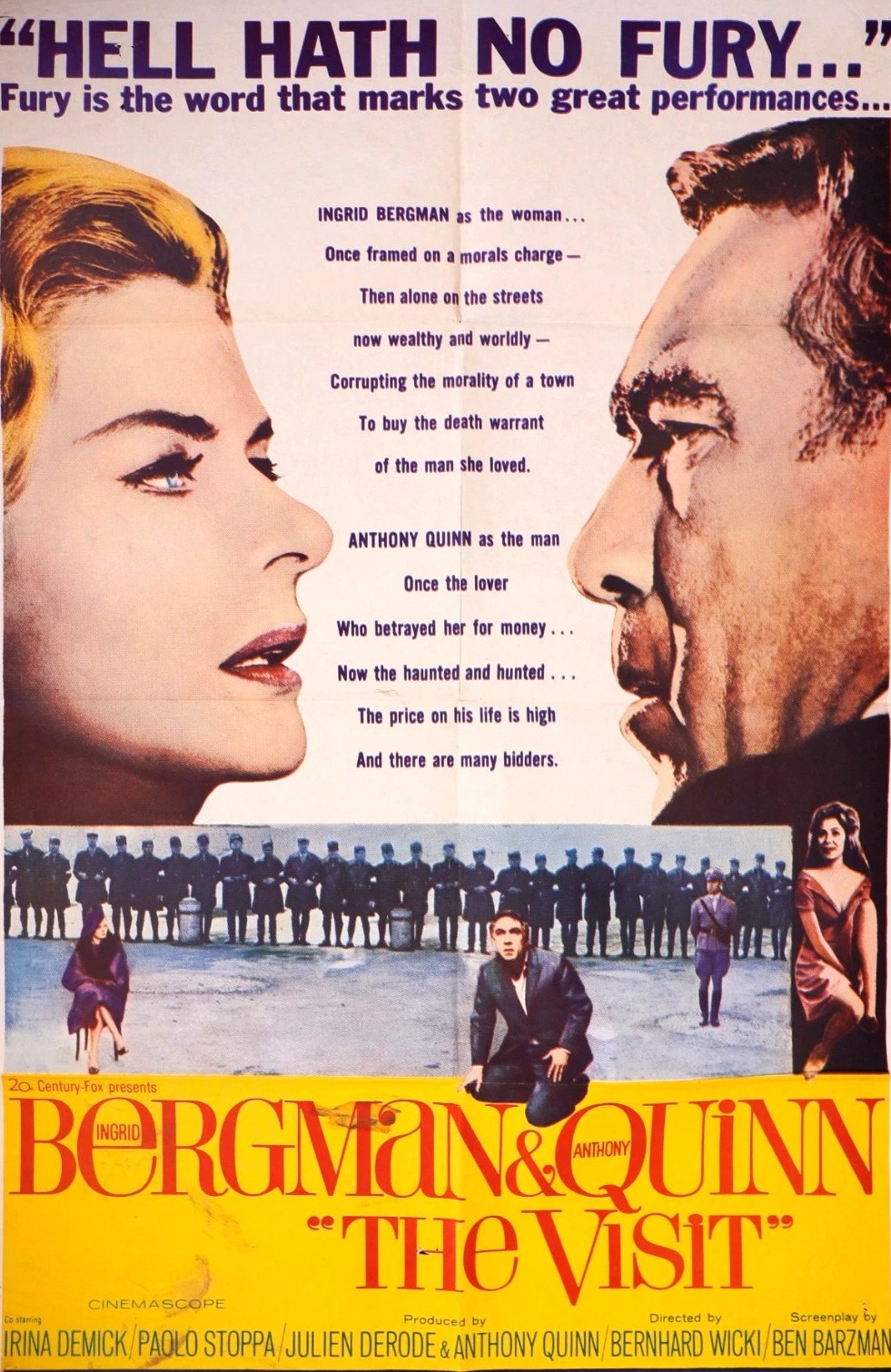
The Visit (1964) *****

Wow! How has this sailed under the radar? Not only does two-time (at this point) Oscar-winner Ingrid Bergman shred her screen persona as the loved one in a romantic interlude or as the victim, but she turns into one of the most chilling femme fatales you can imagine. Made today, this would be termed “High Concept”. But it’s better than that, it’s concept heaven, such a brilliant idea and superbly executed.

From the moment widowed billionaire Karla Zachanassian (Ingrid Bergman), dressed in white like a Hollywood star, steps off a train and cuts the waiting townspeople dead with a haughty look only to seconds later seduce them with a warm smile, you can guess this is going nowhere near where you’d expect.
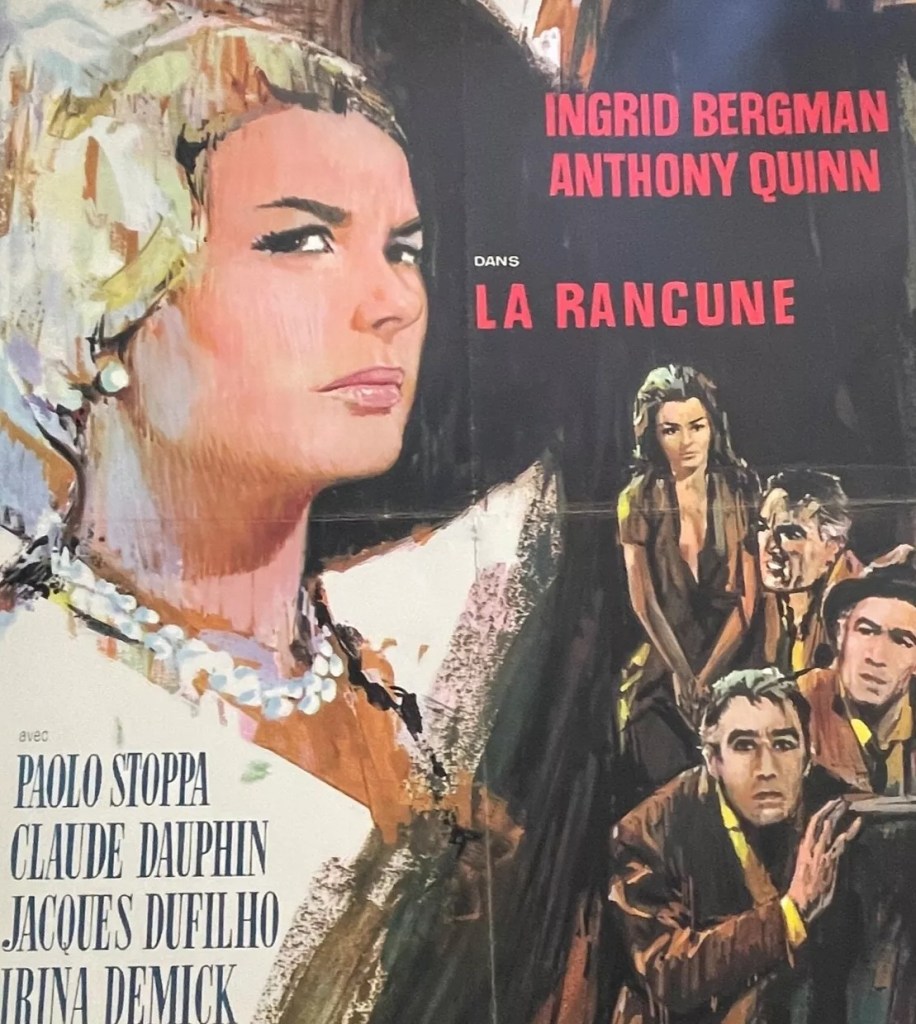
The train wasn’t scheduled to stop. She merely pulled the emergency cord as if her wealth was excuse enough. And she was only on the train because she wanted to make an entrance. For, as it transpires, her chauffeur is in attendance.

The town is bankrupt and in the way of the small-minded the townspeople imagine that the only reason she could be returning to the place where she could grew up twenty years after she left would be to rescue Guellen from its financial misery. So the townspeople are ready with a parade and welcome banners and fine speeches. Former lover Serge (Anthony Quinn), though now married to Mathilda (Valentina Corsese), is happy to play his part and recall their romance, visit the barn where they made love for the first time, as if she has returned only to satisfy memory.

But that’s not the reason. She has a different recollection of events and while she’s willing to play the role of the returning benefactor, offering the town one million and another million to be shared equally among the townspeople, there’s a condition. She wants revenge for being humiliated. Serge – who had thrown Karla over in favour on the daughter of a richer man – denied her child was his and bribed false witnesses so she was sent packing, with prostitution her only option and the child dead within a year.

So now the townspeople can show themselves to be principled, refusing to encourage her barbaric sense of justice, or, more likely, start to nip away at the idea of justice when there’s a bounty of two million at stake. Karla sits on her balcony dressed to the nines twirling her parasol and sipping an iced drink   watching like a hawk chaos unfold below or lounges in her room feeding red meat on a toasting fork to a caged cheetah.
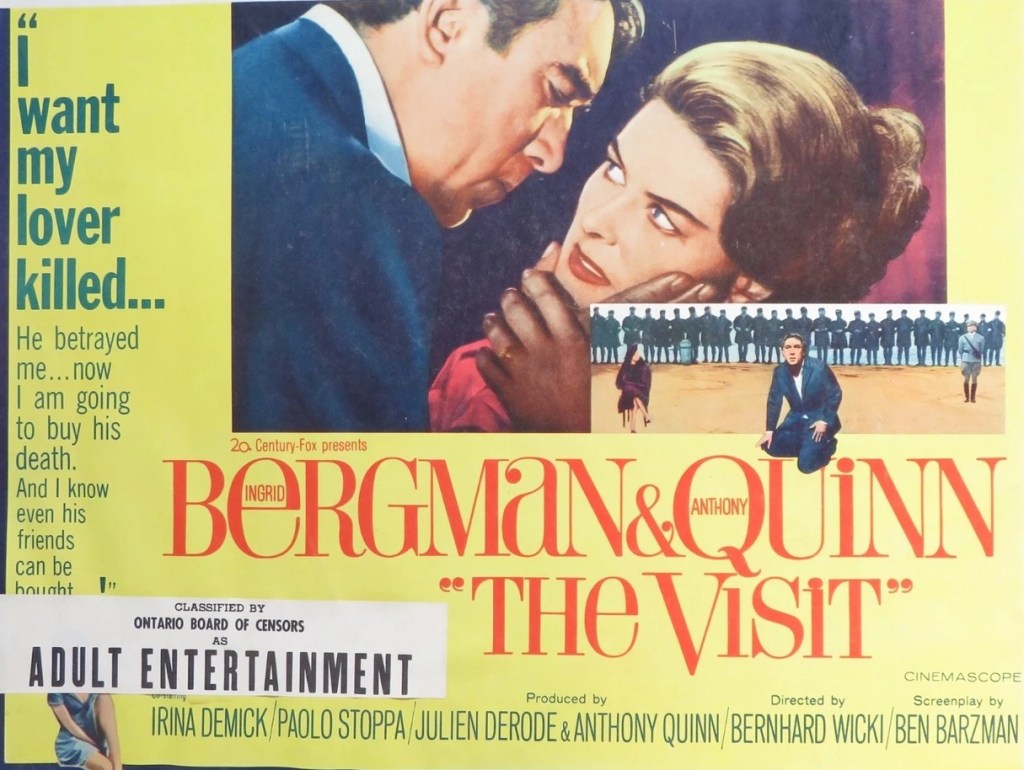
There’s some interesting satire on both bureaucracy and democracy – should people be banned from voting on such a sensitive subject or should democracy insist otherwise. And while ostensibly the powers-that-be back Serge, he gets a shock when he realizes the ordinary people have starting buying new shoes and clothes on credit in anticipation of the bounty and the going rate for an assassin is just two thousand. Soon the town is overwhelmed with retailers selling fancy goods – cars, fridges, televisions, fashion items – on credit. There’s time, too, for other stories to play out in realistic fashion.

There’s a brilliant sequence where Serge is hunted through the streets by men with rifles on the erroneous (or deliberately erroneous) belief that he’s been mistaken for a wild animal and even his wife deserts him. The climax is absolutely stunning.

There would have been many parallels at the time – Communist witch hunt, the persecution of the Jews – but from today’s perceptive it’s more like a capitalist witch hunt or judgement on a “good” society.

Anthony Quinn (Guns for San Sebastian, 1968) bought the rights because he realized Serge was a terrific part but as producer he made the mistake (or touch of genius) in hiring Ingrid Bergman (Goodbye Again, 1961). Without doubt she stole the show. Amazing that she wasn’t even nominated for an Oscar given the chilling portrayal she delivered.

Directed by Bernhard Wicki (Morituri / Code Name Morituri, 1965). Adapted by Ben Barzman (The Heroes of Telemark, 1965) and Maurice Valency (The Madwoman of Chaillott, 1969) from the play by Friedrich Durrenmatt.

When you see how hard today’s “visionaries” strive to come up with meaningful tales of a serious nature or examinations of “the human condition,” you can see how much they fall short compared to this well thought-out drama.

I was blown away.

The Ceremony (1963) ***

Actors taking the hyphenated route were quite a fad in the 1960s. Mostly, primarily for tax purposes, they turned themselves into actor-producers. But some went all-out for artistic glory, saddling themselves with the task of directing the movies in which they starred, by this point in the decade John Wayne (The Alamo, 1960) and Marlon Brando (One-Eyed Jacks, 1961) the most celebrated examples. Despite lacking that pair’s box office pulling power, Laurence Harvey (Butterfield 8, 1960) threw his hat into the ring with this often compelling, atmospheric, but occasionally pretentious, offering.

Irishman Sean McKenna (Laurence Harvey) is in prison in Tangiers – “a city of money” – for one crime he did commit (bank robbery) and one he did not (shooting a guard dead during the robbery). Although facing an imminent death penalty for the murder, he refuses to name the killer. Local prosecutor Le Coq (Ross Martin)  is intent on making him an example while the prison warden (John Ireland) pleads for clemency, especially as it is suspected the inmate is innocent.

Astonishing to imagine now but this went out on general release in Britain
as the lead film in a double bill with “Lilies of the Field.”

Meanwhile, McKenna’s girlfriend Catherine (Sarah Miles) and his brother Dominic (Robert Walker Jr) plan an audacious escape. The brother is not altogether altruistic. His price is half the hidden loot and Catherine, that part of the deal sealed when she submits to sex with him.

Dominic gains entry to the prison disguised as a priest, swapping clothes with his brother, so that when sirens sound to announce potential intrusion by Dominic’s sidekick Nicky (Lee Patterson), Sean can simply walk out unharmed. However, when Seans learns of the price to be paid he doesn’t thank Catherine for her noble sacrifice but turns against both. Dominic, now on the run and chased by the police, is virtually burned alive when his car explodes.

My apologies but in order to properly discuss this picture I’m going to have to take you through to the end. So SPOILER ALERT.

Dominic is so badly burnt in fact that he is unrecognizable and the police (decades before DNA would disprove such an assumption) believe he is actually his brother. Dominic is faced with  “the ceremony” – an ironic tittle if ever there was one – in which he is strapped to a wooden throne and shot by firing squad. Despite his brother’s betrayal, and the fact that his death would set Sean free, Sean decides it would better to “prevent the unjust killing of an innocent man” and gives himself up, too late, as it happens, to spare Dominic, but allowing Sean, in a Pieta-style gesture, to carry the corpse into the prison courtyard and announce “my brother died for me.”

Not quite the ending you would expect, not least because religious allegory has been distinctly missing from the proceedings unless you count the somewhat dotty Father O’Brian (Jack MacGowran) who spends most of his time delivering soliloquies unless you count cars, cows and mules as potential conversationalists.

You get the impression the ending was what attracted the director to the tale, and though it is quite a stunning climax, cinematically as well as thematically, Harvey has, like so many debutants, determined to make a big point. “There’s a little bit of God in everyone,” pronounces Fr O’Brian with a saintly air, which would beg the question of when the Good Lord channelled his inner bank-robber.

For all the film’s flaws there are several pluses. The atmosphere “of chilly hell” (to steal a quote about another book) is well done, footsteps echo off stone floors and cobbles, nobody in this black-and-white feature is seen without a dose of noir lighting, resulting in long shadows and aerial shots of tiny figures swarming. While everyone else over-acts for no apparent reason except directorial inexperience, when Sarah Miles (Term of Trial, 1962) overacts, lips constantly a-quiver, words delivered in gasps, she has every right to, since her character has succumbed to the most evil kind of temptation for the best sort of reason.

The only other interesting character, beyond the stock ones populating the prison, is lonely landlord Ramades (Carlos Casaravilla) who has outlived his four lives and whose rooms abut the prison and where Catherine takes refuge while the escape is going on. He senses her tension, but mistakes the cause, assuming she is here to wait for the shots announcing her husband’s death as a means of “sharing his punishment,” quite a piece of psychological insight for an ordinary guy. And there’s also a creepiness about the whole scene, a sense that she might have to give herself to him as well in order to prevent him wandering too far from the bedroom where he might discover Dominic putting into action a crucial part of the escape plan.

Among the flaws: no real tension, especially in terms of the escape, not enough directorial understanding that much more could be gained from greater focus on Catherine’s dilemma, the obvious lack of a body in the burning car, the fact that the Irishman shows no signs of an Irish accent, the priest’s scenes which provoke hilarity more than reverence, and as much as it is a strength the ending appears out of nowhere.

Robert Walker Jr (The Happening, 1967) is too much of a lightweight for this role, but John Ireland (55 Days at Peking, 1963) and Ross Martin (Experiment in Terror, 1962) excel. Look out for Fernando Rey (The French Connection, 1970).

Valiant effort by Harvey who only directed one other time, on his last film Welcome to Arrow Beach / Yellow-Head Summer (1973), plus a stint filling in for Anthony Mann who died during the filming of A Dandy in Aspic (1968). For The Ceremony Harvey was a quadruple hyphenate –  actor-producer-writer-director – for he also contributed enough dialogue to claim a screen credit along with Ben Barzman (The Blue Max, 1966) who adapted the novel by Frederic Grendel.

Discover WordPress

A daily selection of the best content published on WordPress, collected for you by humans who love to read.

The Atavist Magazine

by Brian Hannan

WordPress.com News

The latest news on WordPress.com and the WordPress community.