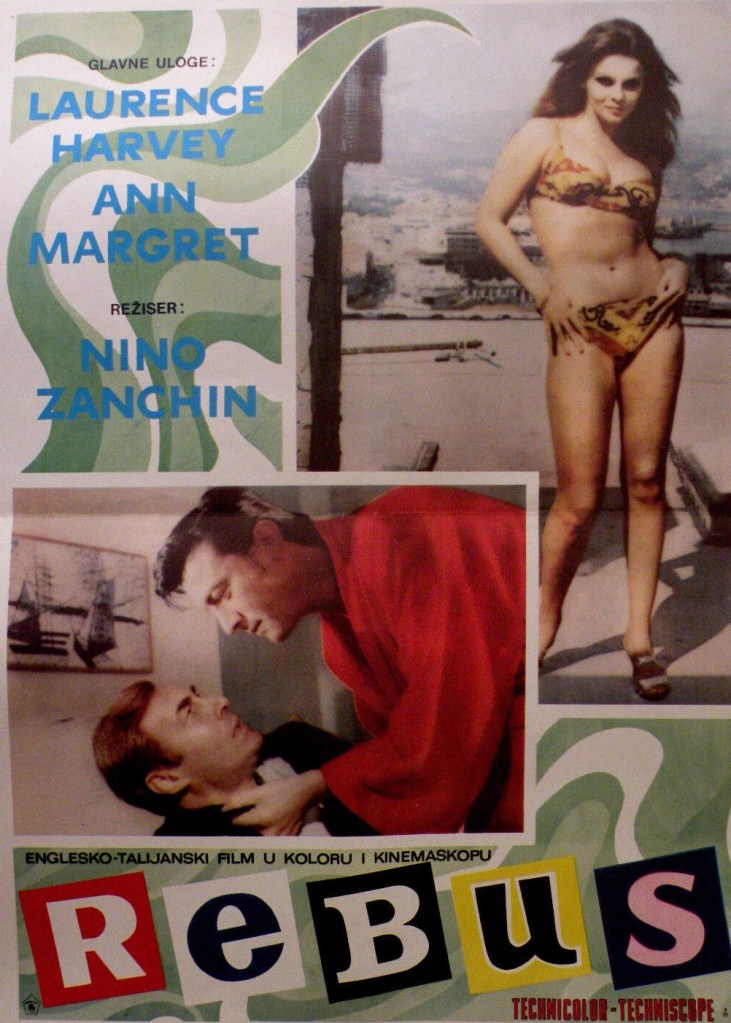
Rebus / Appointment in Beirut (1968) ***

Ann-Margret, at this point in her career, must have had a clause written in her contract that she gotta sing, gotta dance. And you can see the sense of that demand because, as in previous films, she proves she can shake her booty, that number more of a showstopper than her earlier crooning. But, honestly, she has taken a backward step in terms of billing. Here, she’s effectively the leading lady rather than the top-billed star, and really, beyond the dancing, little more than “the girl.”

The heist itself is niftily done, making use not just of such an old-fashioned notion as a magnet but also making a pitch for early recognition as one of the originators of solar power. (How that combination works out, I’ll leave to your imagination.) But, in a twist in the heist genre, the focus is largely on those trying to stop a major robbery from a casino in Beirut, the latest in a series of thefts from top casinos around the world. And it’s not a heist in the normal sense. Millions of dollars have gone missing, but no one can figure out how.

Naturally, your automatic port of call would be an alcoholic croupier, Jeff (Laurence Harvey), currently working at The Playboy Club in London because it’s about the only city where he’s not been blacklisted. Anyway, handed a ticket to Beirut and the prospect of some easy cash by Benson (Jose Calvo) who initially appears as a drunken apparition in the fog, Jeff decides it’s the easiest option.

Benson, it transpires, is not the shady character Jeff imagined, but some kind of investigator entrusted with finding out who is defrauding the casinos. Jeff makes the acquaintance of night club singer Laura (Ann-Margret), who soon develops a soft spot for him, but not enough to join him for a drink (or, presumably, sex) after work since that time is set aside for current squeeze Ghinis (Ivan Desny).

No sooner has Jeff worked out that a huge amount of cash is at stake than he carves himself  a slice of it, $100,000, working for Benson. But, no sooner has he won that particular lottery than the bad guys make a counter-offer, the same amount but at least you’ll come out of the deal alive. Laura is clearly some kind of bait to keep him sweet, though she could be bait for hundreds of customers as she shakes her booty during her big number, “Take a Chance,” the lyrics, ironically enough, encouraging gambling.
This being the kind of European co-production that requires assistance from the authorities, we are treated to a tour of the sights of Beirut (there’s also a journey by motorbike earlier on from Highgate in London to Mayfair and by taking rather a detour manages to take in many of the capital’s finest tourist sites). The Beirut leg of the movie itinerary takes in a traditional concert in some first-class ruins, a bazaar, and for reasons that may be more to do with commercial concerns than tourist, an oil refinery.

There’s also a very irritating shrill American, Mrs Brown (Camilla Horn), who, constantly getting in Jeff’s way, appears to be there just for comic effect, intent as if she had a social media channel to film everything in view. Turns out her movie camera and the lady herself are there for another purpose entirely.

The heist, itself, is particularly well done, especially as it appears to be achieved by a bunch of proper strangers – that is people who seem to have no connection to each other at all rather than the old trope of strangers coming together for a robbery by the end of which they know far too much about each other.  

Unfortunately, from the narrative perspective and for fans of Ann-Margret (The Swinger, 1966), she is less the femme fatale than the equivalent of the dumb blonde. But pretty much you could have advertised this as starring two Hollywood stars who had fallen from grace and were taking Italian coin because little else was on offer. Laurence Harvey (Life at the Top, 1965) is actually pretty good, when sober capable of dealing with good guys and bad guys and with still enough charm to make romance with Ann-Margret seem plausible. Except that this is not a great movie, though interesting enough in a double-cross kind of way and the heist is good, both actually acquit themselves well, Ann-Margret correct in her assumption that her dancing goes a long way to keep audiences sweet.

This was only the second film for director Nino Zanchin, and the fact that he only got to make one more tells its own story.

You may have been scratching your head, wondering when the hell “Rebus” is going to appear or perhaps imagine it’s some kind of code word or password. No amount of head-scratching by myself right to the end of the movie made any sense out of this title. That was the original title, but some distributors, fed up presumably with scratching their heads, opted for the more sensible Appointment in Beirut.

An okay watch, some decent twists and lifted I guess you would have to say by Ann-Margret’s dance number more than Laurence Harvey’s snippy performance

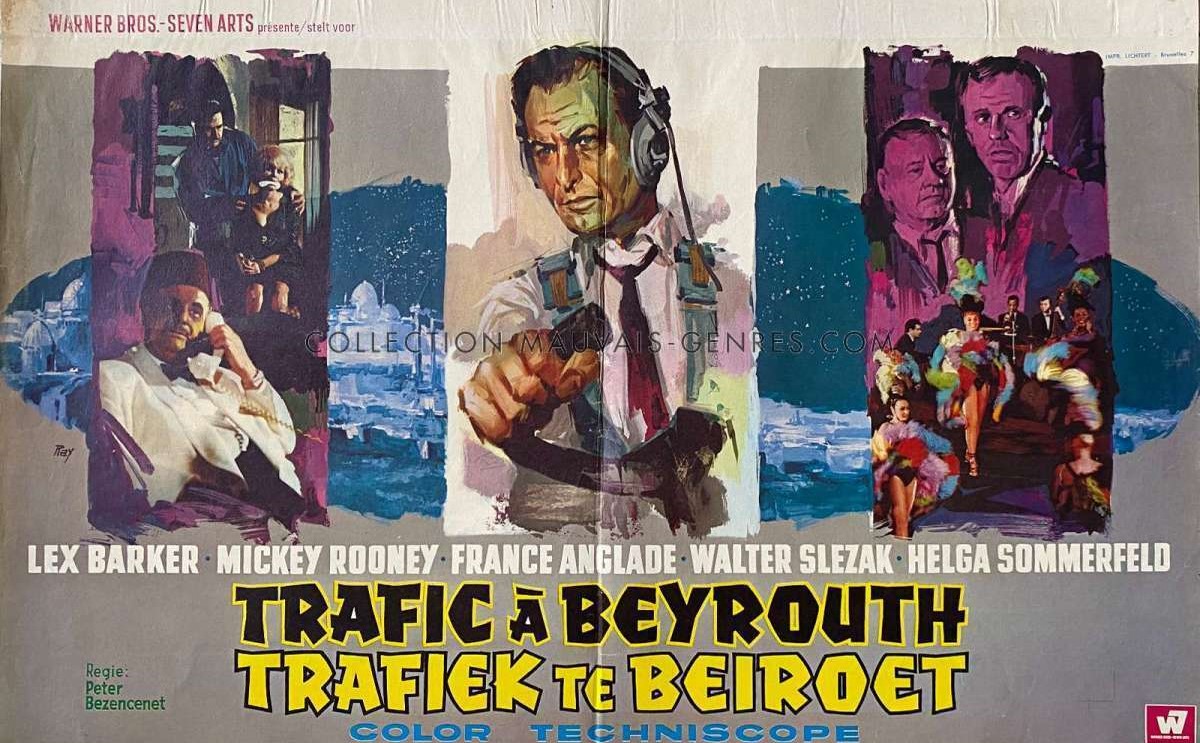
Selling the Exotic – Pressbook for “24 Hours to Kill” (1965)

No matter how small a picture, its budget had to stretch to a Pressbook. Even if the movie would end up on the bottom half of a double bill or a drive-in programmer and did not have much to shout about, it still needed a Pressbook. Low-budget films meant low-budget advertising campaigns unless your name was Joe Levine who often spent far more promoting films than he did making them.

The Pressbook was essential because it was the source of the movie’s adverts that could appear in a newspaper – these came in a variety of sizes so an  exhibitor could remove the one most relevant and take it down to their local newspaper to make up the display advertisement. In the pre-digital era, it was a crude as that, adverts were effectively cut and pasted.

While some Pressbooks could run to 16, 20 or 24 A3 pages in full color, the most basic requirement would be four pages, enough to show the ads and get the basic message across. This was of the basic variety. In this case, ads took up the first two-and-a-half pages, leaving a half-page to list the credits and explain the plot. The final page contained information about the stars..  

Perhaps as revenge for producer Harry Alan Towers not coughing up enough money for a decent Pressbook, his name was left off it. Instead, filing his slot was Oliver A. Unger, more famous as a pioneer of syndicated television, importer of foreign films and producer of The Pawnbroker (1964). In reality, he was an executive producer, in those days that function being fulfilled by someone who either invested in the picture upfront or once filming was complete bought territorial rights.

Artwork was minimal, one main advertisement, one alternative. But more or less the same taglines appear in both. Hoping to hook in the audiences was the notion of “perfumed harem…in mysterious Beirut…where every hour can be your wildest.. and your last.”

Usually films like these boasting a flotilla of European beauties devoted some space to explaining their origins and puffing up their potential. Not so here. Space is just too tight. The only actors covered are Lex Barker, Mickey Rooney and Walter Szelak. Strangely, no mention is made of Barker’s socko career as a German western hero – the notion that Europeans could make westerns remained absurd at this point (A Fistful of Dollars would take three years following completion to reach U.S. screens).

According to the Pressbook, Barker more or less jumped straight from Tarzan to this kind of thriller. Though he had been out of the loin-cloth for more than a decade (Tarzan and the She-Devil, 1953, his final appearance), the 40 pictures he had made since then (including La Dolce Vita, 1960) did not merit a sentence. The Pressbook did carry a quotable quote from Barker explaining his reasons for quitting jungle life: “It made me feel like a male Bardot because I was always parading around almost nude.” This was the type of quote that only made sense until you realised that Bardot did not become a star till three years after he quit playing Tarzan. Still, who was going to argue?

A strict regimen of physical exercise allowed him to keep in the shape necessary for the film which required him to “run for his life, rescue a pretty hostess from kidnap by helicopter and fight off thug after thug.” 

Mickey Rooney gets a better write-up, especially for making the rare jump from successful child star to accepted by audiences for his adult roles. Though the writer of the Pressbook never appeared to actually go the movies. Spot the mistake in this sentence: “Last seen in runaway box office hit It’s A Mad, Mad, Mad, Mad, World Rooney now appears for producer Oliver A. Under in a drama equally as challenging.” That the first film was actually a comedy and not a drama never seemed to sink in.

The usual promotional material – suggestions for marketing, maybe a record of the soundtrack available, perhaps a theme song to target radio stations, various stunts – was non-existent even though the movie leant itself to a tie-in with an airline or a travel company especially as the National Lebanese Tourist Council had gone out of its way to accommodate the production.

24 Hours To Kill (1965) **

When engine problems force a plane headed for Athens to land in Beirut, the past catches up with purser Norman Jones (Mickey Rooney). He manages to convince captain Jamie Faulkner (Lex Barker) and the crew that claims by ruthless gangster Malouf (Walter Szelak) claiming he has stolen his money is a mistake. But once the kidnappings begin, the doubts set in.

Producer Harry Alan Towers (Five Golden Dragons, 1967), though he remained wedded to the exotic locale, would soon learn to prioritize action over romantic entanglement and this suffers from too much romance – married Faulkner trying to resolve his relationship with stewardess girlfriend Louise (Helga Summerfeld),  co-pilot Tommy (Michael Medwin) ignoring another stewardess Franzi (France Anglade) in favour of local girl Mimi listed in his little black book of previous conquests.

After a failed attempt to kidnap Jones, the gangsters turn their attentions to female members of the crew. Slim built Tommy proves handy with his fists and soon the crew are either running from trouble or running into trouble even as they attempt to enjoy the city high life. The title has a double meaning – the crew take it to mean that they have time on their hands to pass in as pleasant manner as possible only later realizing that their accidental landing provides the gangsters with a complete day to apprehend/kill Jones before the plane’s rescheduled take-off.

Although a good sight more attractive in the 1960s than when  war destroyed the city, Beirut still had comparatively little to offer a visitor beyond a historic site claimed to the Garden of Eden, posh hotels, swimming pools and the kind of belly dancers that you could get anywhere in the Middle East. Still, the movie does its best to convince the audience they are in for an exotic treat. Unfortunately, locale and girls in bikinis do not make up for poor plotting and lack of action.

In terms of casting Towers had hit upon a decent formula in the international coproduction line, Hollywood stars who didn’t cost too much but still retained marquee value and up-and-comers who might be sold as the next best thing to their respective countries, thus bringing in global revenue.  Former MGM child star Mickey Rooney (Secret Invasion, 1964) is the requisite Hollywood star, his credentials buffed up by the hit It’s A Mad, Mad, Mad, Mad World (1963), and continually newsworthy for his love life – he was currently on marriage number five.

All-purpose action hero Lex Barker was the surprise box office package. A former Tarzan he was enjoying a new lease of life as a huge star in Germany thanks to the Old Shatterhand series of westerns. Veteran Walter Slezak (Come September, 1961) completed the small group of actors who audiences might automatically recognize.

Heading the newcomers was Englishman Michael Medwin (Crooks Anonymous, 1962) who would later turn producer of If…(1968) ably supported by a stewardess trio played by German Helga Sommerfeld (The Phantom of Soho, 1964), French starlet France Anglade  (The Oldest Profession, 1967) and Austrian Helga Lehner (Games of Desire, 1964). Likely more memorable for purveyors of the European scene would be a brief appearance by another Austrian, Maria Rohm (Five Golden Dragons), wife of the producer. You might also spot Wolfgang Lukschy (A Fistful of Dollars, 1964).

British director Peter Bezencenet (Bomb in the High Street, 1963) was better known for his editing skills but didn’t cover himself in glory in either department here. Australian Peter Yeldham (The Liquidator, 1965) wrote the screenplay along with Towers. While not a great film, you can see the Towers style in embryo, this being only the fourth of the around 100 films that would go out under his banner.

Discover WordPress

A daily selection of the best content published on WordPress, collected for you by humans who love to read.

The Atavist Magazine

by Brian Hannan

WordPress.com News

The latest news on WordPress.com and the WordPress community.