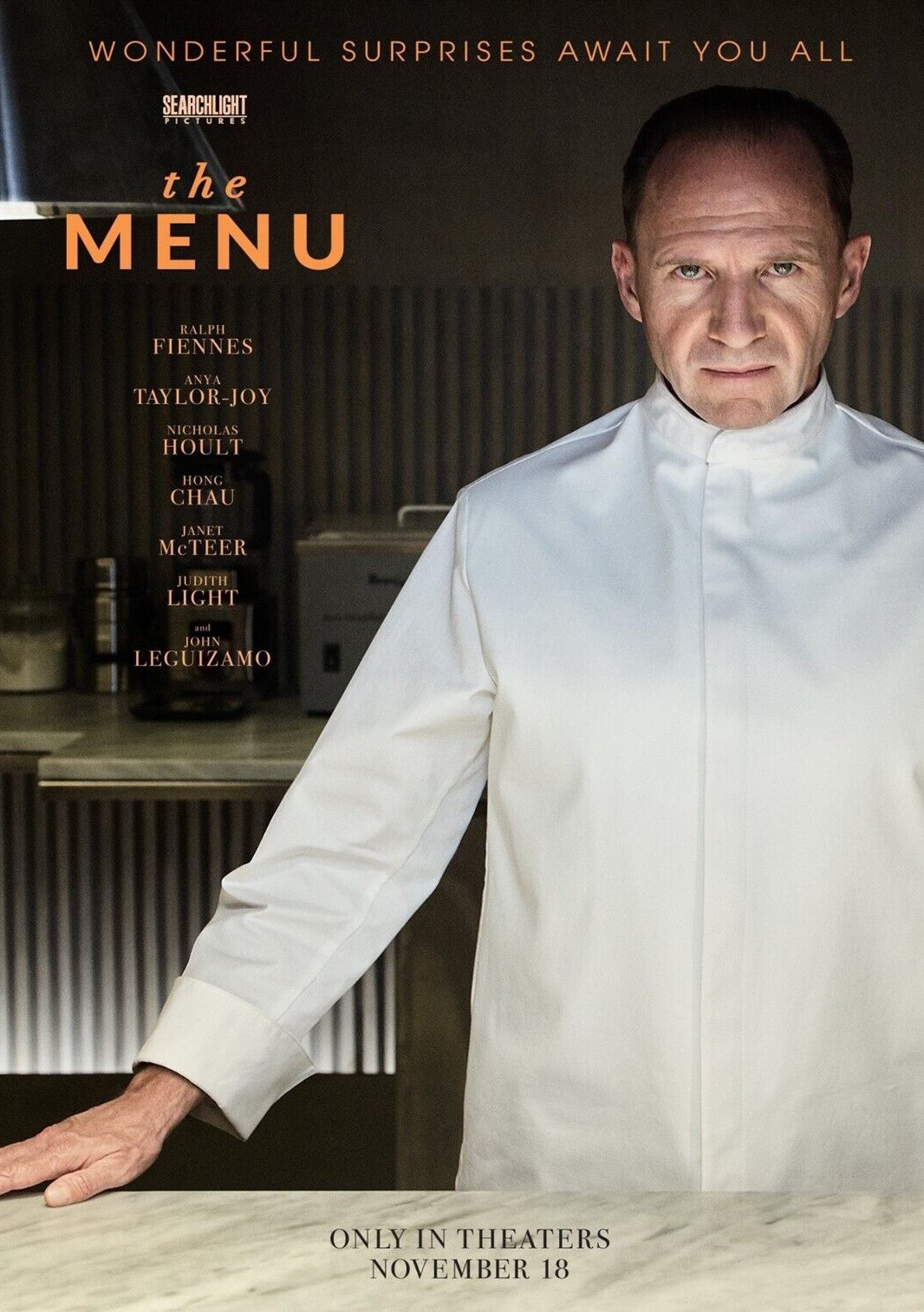
The Menu (2022) ***** – Seen at the Cinema

Hitchcock would have adored the apocalyptic flavour of this quasi haunted house psychological thriller. Setting aside its intellectual pretensions this is pure pedal-to-the-metal material. You never know what’s going to happen next in a tense environment created by dictatorial celebrity Chef Slowik (Ralph Fiennes) in whose eyes the entitled are likely to get their just desserts.

In most thrillers of this nature, the assorted bunch of potential victims usually attempt some kind of fightback, and they’re usually younger and sexier, but this crew are trapped in the headlights because they find it impossible to believe they could possibly be in the middle of a revolution.
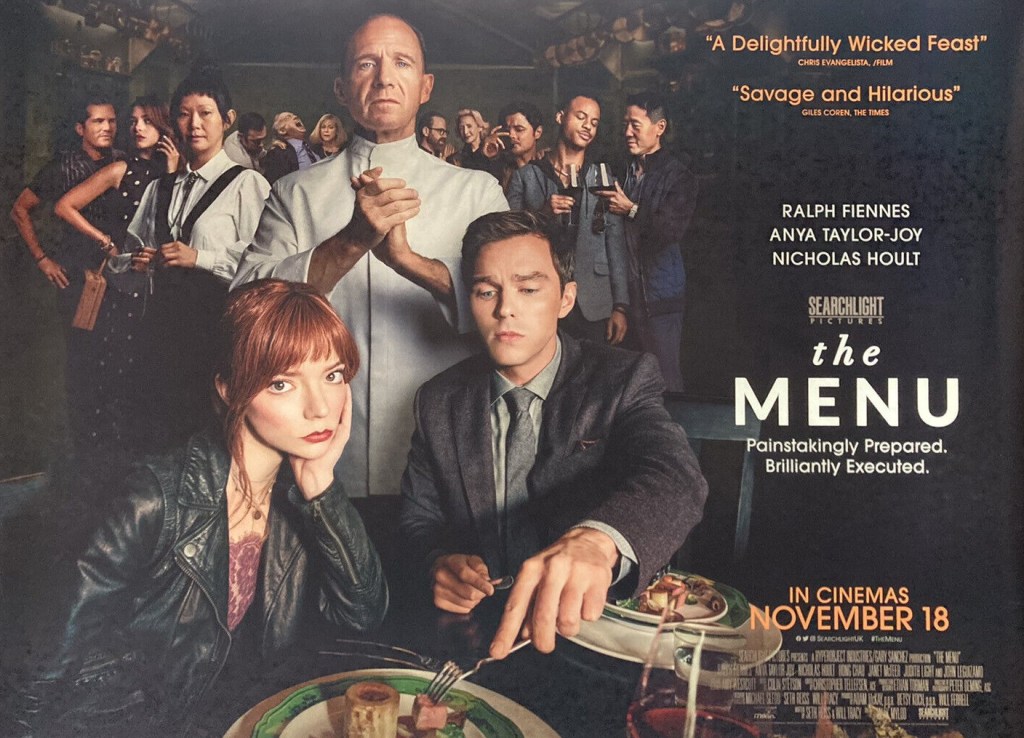
The beauty of their dilemma is that Chef is trapped, too, by his desire for fame, suffocated by pursuit of perfection, but yet, as they soon come to realise, accepting punishment for his own sins (attempted rape for one). You might be fooled by the trailer into thinking there is a way out, if only a perilous one, but that’s a bit of a red herring, and as the tension grows you realise it’s heading for an incredible conclusion.

Only the rich can afford to visit this expensive restaurant on a secluded island. Most of the guests aren’t even interested in the food – that’s one strike against them – but for the experience of having said they’d been there or to, as is the prerogative of the wealthy, be pampered within a whim of their life, or to find something minute to complain about, a niggle guaranteed to cause grief.

Creepy though they are, Chef’s thunderclapping hands that demand guest attention, the cries of “Yes, chef” from his slave-like adoring workers, the detail of high-falutin’ cooking, history and ecology lessons, a ramrod sergeant-major of a maitre’d Elsa (Hong Chau), and occasional ironic twists – a bread course that contains no bread for example – are mere hors d’oeuvres for the main event.

Chef knows a tad too much about his guests’ peccadilloes – infidelity, financial irregularity – for their liking and as the evening out begins to turn into a cul de sac and shocking incident follows shocking incident, cowardice and lack of the kind of retinue that could come to their rescue, the guests can only watch as they are served up on a platter to a madman’s ideology.

Certainly, the format is exceptionally cinematic, sequences chapterized as menu courses, and the intellectual discussion that divides the world into the servers and the served well observed, but driving the thriller engine is the most refined nutcase this side of Hannibal Lecter, a thin-lipped specter at a feast of his own devising , a creator at the end of his tether, seeking revenge on those who quibble with his talent. And yet there is something  universal about this individual, a man scrabbling so hard to stay ahead of the game that he is almost on a par with Arthur Miller’s famed salesman. Is Chef doing much more than the culinary equivalent of “riding on a smile and shoeshine?”

The guests are the usual high priests of pamperdom, food critic Lillian (Janet McTeer), movie star (John Leguizamo) planning to revive his career by fronting a food show, simulating orgasm with every taste, a trio of young financiers, a couple who have come several times but can’t recall a single dish they’ve eaten, and foodie Tyler (Nicholas Hoult) accompanied by a mysterious woman Margot (Anya Taylor-Joy) who turns out to be in a different branch of the service industry.

British director Mark Mylod (Ali G in Da House, 2002, anyone?) has learned from helming episodes of Game of Thrones and Succession how to match reaction to incident. As much as Chef is in control in the restaurant, Mylod is in control of exactly what we see. There is none of the over-acting that appears to come with the territory, certainly no screams or titillation, not a whiff of cleavage, the usual recourse of a horror film run out of ideas, though, as with that genre, it is the sexually compromised who suffer first.

Mylod’s tight rein ensures shock is just an element of the overall effect, rather than its signature dish, and that all the ruffley-truffley culinary dialog only serves to heighten morbid  sensation.

Ralph Fiennes (The Forgiven, 2021) may well have delivered a career-best performance it is so constrained. Given equally little room to manoeuvre, little time for eye-rolling or exacerbated action, Anya Taylor-Joy is back to her The Queen’s Gambit (2020) best, while Nicholas Hoult (Those Who Wish Me Dead, 2021) adds sly deviance to  a screen persona that plays on innocence. It’s an astonishing screenwriter debut for television writers Seth Reiss and Will Tracy.

As it happens, I’m very familiar with the lives of chefs, having spent three decades working with them, initially as a cossetted observer, as journalists often are, being the fawned-upon editor of Caterer & Hotelkeeper, the hugely profitable industry trade weekly in Britain, with massive sales at a time when print was the dominant media, so much so that during my time we produced a world record (for a weekly) issue of 524 pages. But when I later set up the Scottish Chefs Association, whose board comprised all the top chefs in the country, and its offshoots the Scottish Chef Awards and a cookery school for chefs, I became privy to the fears and wonders of the cooking business. So I can attest to the fear and loathing for some customers and most critics, who seemed determined in the days before social media to spoil anything they could, or demand preferential treatment.

Certainly, the restaurant is a unique kind of business, food being cooked to order, “a la minute” as the saying went, and customers disrupting a tight ecology by simply turning up late, or early, or not at all. Customers were prone to theft, teaspoons in particular replaced on a titanic scale, and the litany of complaints could outweigh a Bible. Then, as now, reputation was everything, and could be destroyed by a food critic or word-of-mouth. It wasn’t just chefs who sought perfection, but customers, any deviation from expectation harshly dealt with.

Successful chefs with investors would find that somehow they saw little share of the profits. Chefs minus investors lived a precarious existence. Good reviews would  bring in bad customers, the kind who pored over every detail, like Tyler wanting to share their paltry culinary knowledge with the expert, needed extra attention, and came to say they had been there. But I can sympathise with Margot who felt she was being experimented upon rather than fed and can recall several times buying fish and chips immediately after dining in a Michelin-starred establishment.

I remember, too, industry astonishment that celebrity-chef-du-jour Anton Mosimann began the day by walking round the kitchen shaking hands with every chef, no matter their rank, rather than starting off their day with a rant. Kitchens are organised on a brigade system, obedience imperative, no questioning of authority. But rather than derogating talent as occurs here, many top chefs proved apt talent-spotters. The Roux Brothers, for example, created a magnificent template, finding backers among their appreciative wealthy customers for the young talent in their kitchens, which resulted in a new generation of chefs setting up in business without the usual financial woes.

In Britain and Europe, however, perfection could be achieved. If you reached the highest standards set by the Michelin Guide inspectors and were awarded the coveted three stars, the highest culinary accolade that could be bestowed, you had reached the top of the tree. You couldn’t relax because one or more of the stars could be taken away, but the kind of personal obsession that afflicts Chef here would be lessened. However, since very few chefs hit the three-star mark you have hundreds if not thousands beavering away trying to achieve it.

Amsterdam (2022) **** – Seen at the Cinema

Shaggy dog story wrapped up in paranoia thriller. A shade overlong, with too many characters and too much plot but such flaws should not detract from that rare cinematic animal, a truly original movie. Brilliant screenplay, believable characters and superb acting prove an irresistible combination.

Though you can see why this sank like a stone at the box office, the all-star cast generally acting against type, idiosyncratic director given vast sums to play with, a tale that goes in too many directions at once, and the unconstitutional events of January 6, 2021, bringing this too close to home for fractured American audiences.

You don’t get this kind of writing much anymore. When individuals come together on a project – to save the world the most likely reason these days – their individuality is usually subsumed to the plot. Here, instead, the reactions of the characters remain distinct and no matter what is going on there is always time for individuality. And some of the invention is just deliciously insane, the nonsense songs for example.

Touching on the World War One aftermath of recovering from mental and physical wounds plus profiteering glee, a sense of a country racked by the Depression on the brink, mind-inducing experimentation of the political and pharmaceutical kind. A trio of war veterans, soldiers Burt (Christian Bale) and Harold (John Davidson Washington) and nurse Valerie (Margot Robbie) investigate a mysterious death, an illegal autopsy uncovering poison, only to find themselves framed for murder.

Burt is not a prime-time player according to wife Beatrice (Andrea Riseborough), and her wealthy family had dispatched him to the war in the hope he would return with bankable glory, but generally treat him as an unwanted black sheep. Valerie now makes art out of war debris, bullet shells and shrapnel, her charming brother Tom (Rami Malek) and his wife Libby (Anya Taylor-Joy) embedded in malevolence. Harold is a lawyer, for whom racism is a constant.

American and British secret service operatives, Norcross (Michael Shannon) and Canterbury (Mike Myers), float in and out. The moneyed business elite, despising White House incumbent Roosevelt, cast envious eyes at the dictatorial economic miracle of Mussolini in Italy.

On everyone’s dance card is General Dillenbeck (Robert De Niro), sought out by our intrepid trio and a mysterious cabal. All he has to do is make a speech at a veteran’s dinner. Make the right kind of speech and the trio are vindicated. Make the wrong kind and he could be assassinated.   

Like Chinatown (1974), Amsterdam is representative, a state of mind, but of freedom rather than endemic corruption. This is an intricate piece and a bit slow for today’s fast-paced generation and with more dialog than might sit well with a modern audience and flights of fancy that are far more original than anything you would find in the MCU. But it’s a hell of an intelligent thriller driven by a bunch of deadbeats.

It never goes down the obvious route. Instead of a love triangle – Valerie and Harold a pair – it’s an evocation of friendship. You don’t need umpteen clues to find the villains, they’re upfront, and they don’t think they are baddies, but cleverer people coming to the aid of the dumb masses putting too much blind faith in democracy. While this is based on a true story, in reality it’s based on the constant of the rich trying to get richer and the wealthy believing they are the best, even if unelected, candidates to run the world.

All that political stuff could have been a big turn-off if it had gone down the preachy route, but it doesn’t, instead it’s almost a miracle that it arrives at any conclusion given in whose hands the narrative has been placed. The Three Stooges would have done a better job of getting there quicker, but then you wouldn’t have had so much fun.

Not only are all the stars on their A-game but acting-wise it delivers some career-reviving turns not least from Christian Bale (Ford v Ferrari, 2019), devoid of a lifetime’s acquisition of irritating tics, John David Washington (Tenet, 2020) called upon to develop a character rather than an action-driven hero. I had to check the end credits to find out it was Mike Myers (Bohemian Rhapsody, 2018) playing the understated Canterbury and hogging the screen with none of the acting pyrotechnics that dogged previous attempts at mainstream work. Ditto Robert De Niro (The Irishman, 2019) and Rami Malek (Bohemian Rhapsody), no grandstanding this time round – don’t worry I recognized both from the off – and Anya Taylor-Joy finally delivering on the promise of The Queen’s Gambit (2020).

Margot Robbie (The Suicide Squad, 2021) is already on the rise and this will add to her growing portfolio of fascinating characters. And if you’re fed up watching any of these stars in brilliant form, there are other distractions in the form of Chris Rock (Spiral, 2021), Taylor Swift (Cats, 2019), Andrea Riseborough (The Electrical Life of Louis Wain, 2021) and Alessandro Nivolo (The Many Saints of Newark, 2021).

You often hear the term “visionary director” thrown about with indiscriminate regard, but this is the right kind of visionary, director David O. Russell (Joy, 2015) with his own way of seeing the world, and delivering it in distinctive fashion, with less of an eye on camera movement and more on dialog and motivation and staying true to a coterie of original individuals.  

I guess the money was spent on atmosphere, this is 1930s USA regurgitated in enormous detail. But you’ll forget the background, the costumes and sets, and be dazzled instead by the script and the acting, and the enveloping tale of friendship.   

A Tale of Two Duds – The Northman (2022) ** / Fantastic Beasts: The Secret of Dumbledore (2022) ** – Seen at the Cinema

Hamlet goes Viking is basically as much of a story as “visionary director” Robert Eggers (The Witch, 2015) can be bothered with. Yes, there some Viking lore and for all I know this has been exceptionally well-researched but what it amounts to is the same kind of gobbledy-gook that makes no more sense than your average horror picture, with a ton of underdeveloped occult elements. Once our hero is freed from being hung from the rafters by crows beckoned, I presume, by some unexplained mystical power, pecking at the rope – and with a sword handily discarded in the vicinity – I was even more convinced this was a load of old cobblers.

So, basically a revenge saga. Amleth (Alexander Skarsgard) – pronounced Amlet for punters too stupid to get it – manages to escape when his uncle Fjolnir (Claes Bang) murders his brother King Aurvandil (Ethan Hawke). Vowing revenge, he is next seen “years later” as part of a raiding party slaughtering a village. He discovers that his uncle has been dethroned by a bigger king and sent into exile in Iceland. So he hauls himself off there, pretending to be part of a chain gang. He has every opportunity in the world to kill his uncle – and save his mother (Nicole Kidman) who has been carried off – but there is always a really dumb reason why he can’t.

Revenge delay seems a pretty odd way of stringing out a movie. Of course, when he gets round to saving his mother it turns out she doesn’t want to be saved and – a la Hamlet – was in on the plan to kill her husband. He falls in love with fellow prisoner Olga (Anya Taylor-Joy) who spouts a lot of witch-type stuff that is no less convincing than any of the other spiritual malarkey.

There’s a lot of bloody violence, but the sexual violence is kept to a minimum on screen though Olga has clearly been abused by Fjolnir. And there’s a game that seems close to the Irish game of hurling and whole bunch of oddities thrown in there wholesale as if such a joblot will add depth to the movie. A misconceived art picture that looks more like a top-of-the-range direct-to-DVD movie that might have cost around $40 million rather than the $90 million quoted.  

There’s a smorgasbord of dodgy accents and everybody speaks in stilted English, not far short of the “thee” and “thou” dialogue that critics used to make fun of. Alexander Skarsgard (Godzilla vs Kong, 2021) and Claes Bang (Locked Down, 2021) look rugged enough but neither has the screen presence of Schwarzenegger or even Stallone and it ends up Conan-lite. Anya Taylor-Joy (Last Night in Soho, 2021) looks as if she wondered how she managed to get talked into this. Nicole Kidman (Being the Ricardos, 2021) who has a plum scene towards the end offers the only acting of any distinction.

Fantastic Beasts: The Secret of Dumbledore

I kid you not, this is about an election. Yep, someone’s greenlit a $200 million fantasy picture about an election. Whatever delightful element the original entry to this series possessed has been destroyed not just by a preposterous storyline – this is for kids, remember – but a very somber tone. Everyone talks in a low voice, it is very darkly lit and there are those awful meaningful pauses.

The story they pretend is about to occur never happens. Something about “counter-sight” if I got that bit correct and how our heroes had to act together to “confuse” the bad guy because he could see into the future. There’s never any sign of him seeing in the future and most of the confusion arises because there are just way many characters.  With a piece of Hollywood wizardry Grindelwald has completely changed his appearance, no longer Johnny Depp but Mads Mikkelson. You will be aware of the reason for this but Mads has taken on an impossible task. There already was an over-large contingent of players – Newt Scamanger (Eddie Redmayne) and his brother Theseus (Callum Turner), Albus Dumbledore (Jude Law) and his brother Abeforth (Richard Coyle), Credence Barebone (Ezra Miller), Jacob (Dan Fogler) and assorted characters who have a romantic interest in the principals.

But basically – hold your breath – Grindelwald is trying to crash an election party. Two candidates are already in contention to be, I presume, Chief Wizard. He kidnaps something that might be called a “chillin” – a mythical creature that looks like a gryphon – which like the wands in Harry Potter has a way of choosing the best person for the job. There’s very little CGI for a fantasy picture. One monster, a bunch of dancing lobsters (maybe scorpions, I couldn’t work it out) and the usual contents of Newt’s suitcase is just about it. The wands are now used more like light sabers or pistols. You won’t be surprised to learn there’s not much in the secrets department either.

There’s not enough Newt and he’s not as delightful as he once was and there’s far too much of boring electioneering, huge crowds gathered for rallies in favor of their candidates. This one cost $200 million and I have no idea what that was spent on. Certainly not the script. A franchise-killer if ever I saw one.

Last night in Soho (2021) ** – Seen at the Cinema

Genre mish-mash – sci-fi time travel time (sort of) and horror – just doesn’t come off and Anya Taylor-Joy blows the acting kudos she acquired for the Queen’s Gambit Netflix series. Honestly, we don’t care how people are transported to the past or the future but the journey has to be somehow worthwhile. If there is a such a thing for a fashion student, Eloise (Tomasin McKenzie) is somewhat on the nerdy side and when she ends up in an attic flat near London’s Soho she begins to inhabit the body of wannabe singer Sandie (Anya Taylor-Joy) whose ambitions over half a century previously took her no further than the seediest pockets of seedy crime. Eloise’s visions of recreating 1960s glamour disintegrate and she’s soon slap-bang in the middle of a horror story with leering men bursting out of the walls.

It’s always difficult to keep focus on two storylines, even when they appear to converge, but when they are over half a century apart the constant jumping back and forth is just irritating. The seediness is realistic enough, punter response to learning Sandie’s real or fake name is invariably “that’s a nice name.”  There’s a dodgy boyfriend (Matt Smith), mean girl (Synnove Karlsen) and an odd landlady (Diana Rigg) and that’s about as far as this stretches in terms of characterization. And if your bag is to spot the old-timer, then you will get glimpses of Terence Stamp (The Collector, 1963) and Rita Tushingham (The Knack, 1965) not to mention The Avengers (BBC, 1965-1968) television series reincarnation Rigg.

It’s not scary enough, fashionable enough, seedy enough, or 1960s enough – only a token nod to the period with a soundtrack from the decade and a few scenes with characters in the correct clobber or cars. It might just have worked if it had been the one actress playing both female parts because that at least might have been interesting to observe. Thomasin McKenzie (Old, 2021) is passable as the naïve young thing called upon to mostly look petrified. Anya Taylor-Joy (The New Mutants, 2020) brings nothing to a role that is just a cliché. Point the finger at Edgar Wright, whose Baby Driver (2017) I thought was a sign of him having turned a corner from previous misfires.

Discover WordPress

A daily selection of the best content published on WordPress, collected for you by humans who love to read.

The Atavist Magazine

by Brian Hannan

WordPress.com News

The latest news on WordPress.com and the WordPress community.