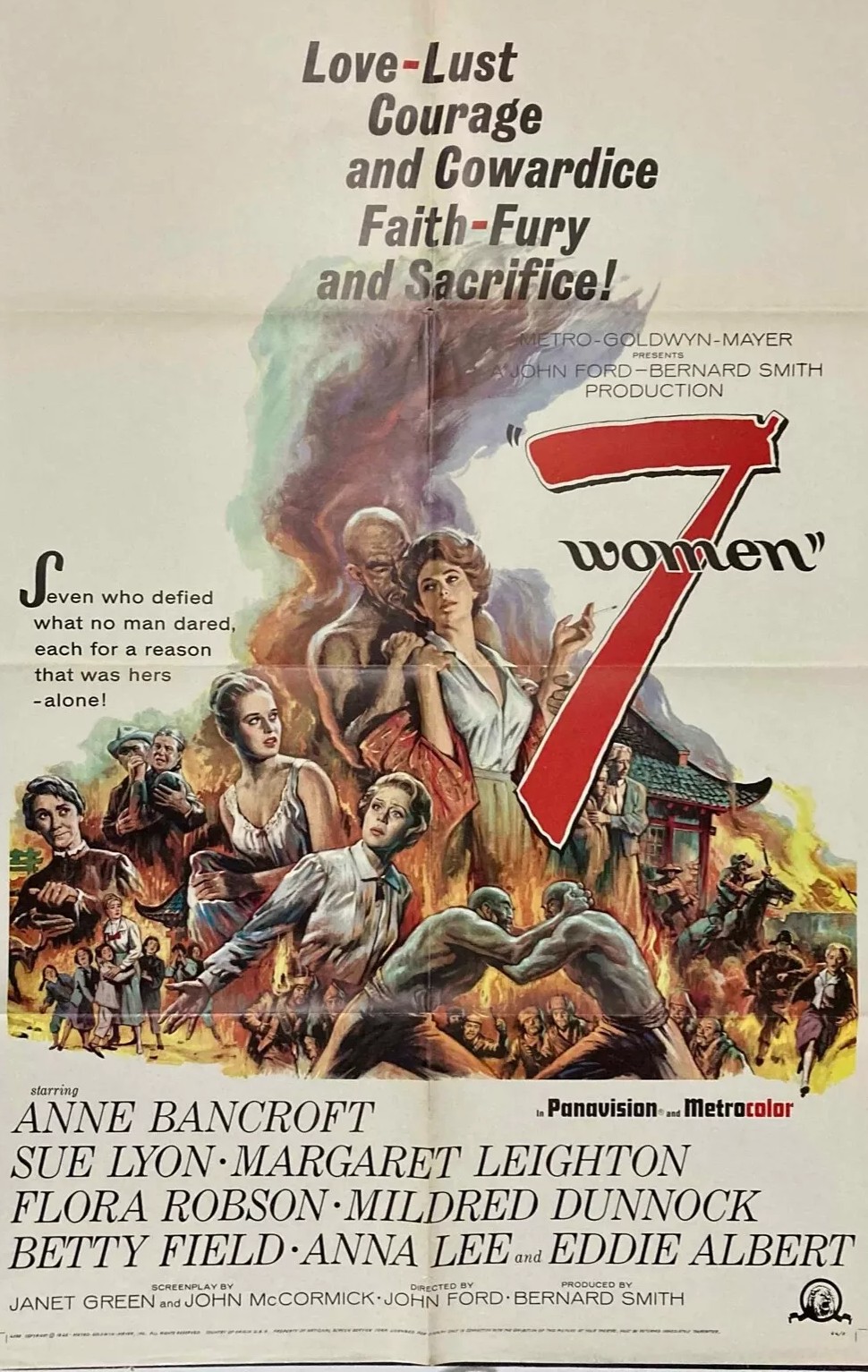
7 Women (1966) **

This is a very difficult review to write. John Ford has been one of my idols and to some extent when I first became interested in the movies I was force-fed the director, who was considered at the time to be a demi-god. While he has moved up and down in terms of critical acclaim, his westerns have stood the test of time, The Searchers (1956) still considered one of the best ever made and The Man Who Shot Liberty Valance (1962) fast challenging that dominance.

When he made westerns, he tended to be on safe ground. For other genres, acceptance was more fleeting. I can’t be the only one who was appalled by Gideon’s Day (1958) and found The Last Hurrah (1959) somewhat ho-hum and took Donovan’s Reef (1963) with a large pinch of salt. Even so, it’s with some regret that I have come to the conclusion that his final film, 7 Women, falls not just short of the high standards he set but is a poor picture.
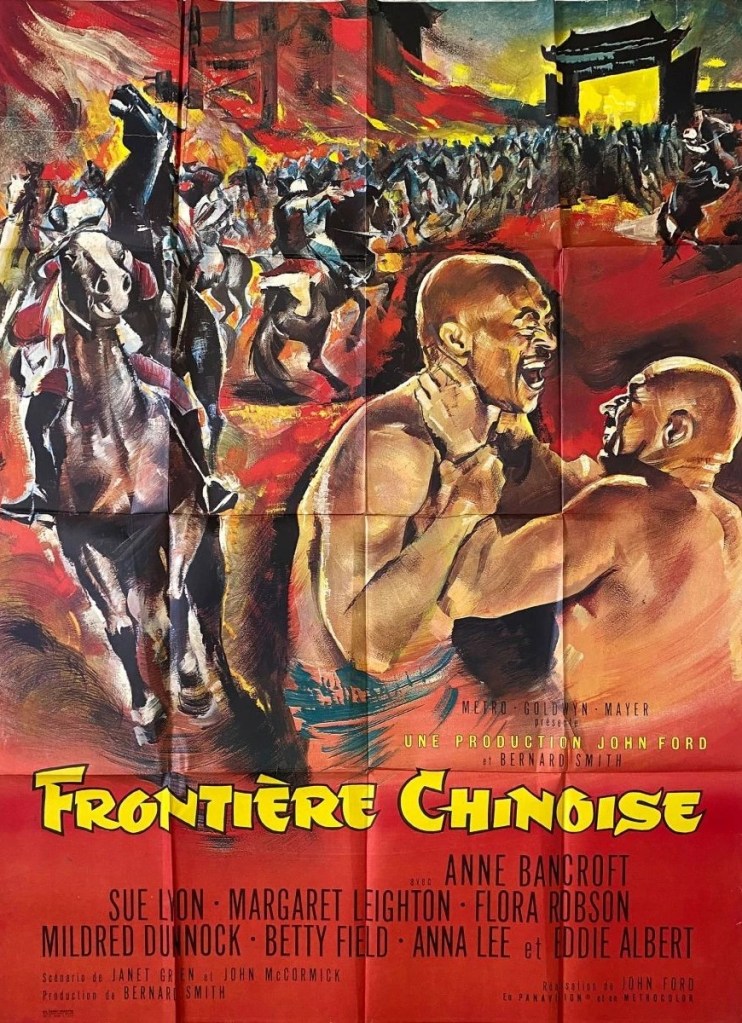
You have to wonder if he was still on the redemption streak that fueled Cheyenne Autumn (1964) and wanted to make amends for by and large reducing women to also-rans in his movies. There are some plus-points. It takes a rawer view of the Chinese missionary movie, this one set in 1935, not just the notion that Chinese rebels would not dare attack Americans but also that such establishments major on the pious and the gentle.

But in turn the constant bitching between the virtually all-female cast turns this into a glorified soap opera. There’s a constant battle between incoming heavy drinking free thinker  Dr Cartwright (Anne Bancroft) and prim mission chief Agatha Andrews (Margaret Leighton) whose management style errs on the dictatorial. Cartwright is upbraided for smoking at dinner, bringing booze to the table, not standing for Grace, and worse of all, it would appear, having had sex. While there were further penalty points for taking a married man as her lover, it’s the mere notion of anyone having sex that sets off the over-pious Andrews.

Setting a new bar in the entitlement stakes is pregnant Florrie Pether (Betty Field) who’s coming very late to motherhood – she’s 42 – and was so determined to have a baby it was conceived with two months of marriage to ineffectual second husband Charles (Eddie Albert)  and takes to the extreme the idea of pregnancy stimulating odd food needs – in the middle of nowhere in the middle of China she demands melon.
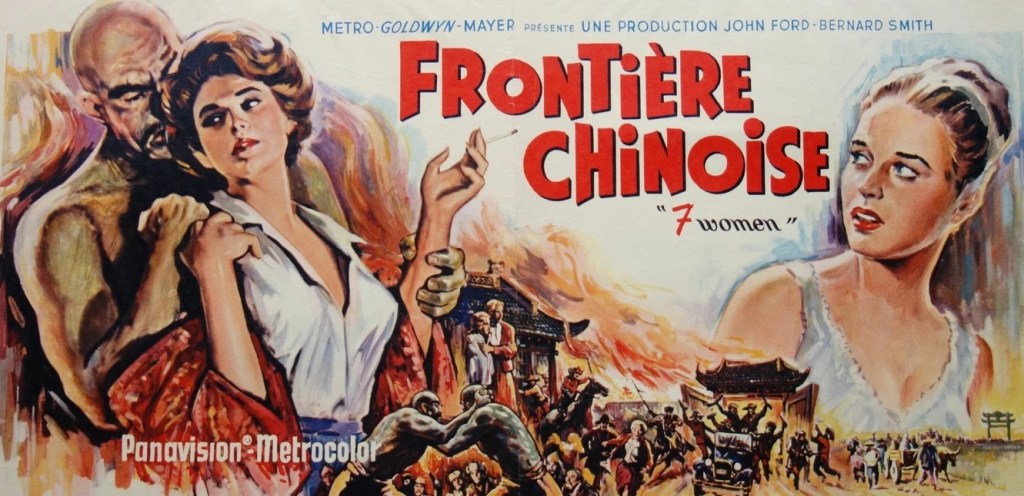
Added into the mix is that standard trope of the Chinese missionary picture, an outbreak of cholera. Mrs Pether can’t come to grips with the notion that the good doctor might have to concentrate on saving patients from plague rather than come running every time the pregnant gal feels the foetus kick.

So while Andrews and Cartwright are scoring points off each other, with the doctor further accused of corrupting the innocent young Emma Clark (Sue Lyon), outside pressures, introduced during the credit sequence but then left alone for way too long, grow. Chinese bandits are on the rampage. Another mission of a rival denomination led by Miss Binns (Flora Robson) turns up seeking refuge and eventually the bandits charge into the compound and demand ransom.

Naturally, such an invasion is going to get in the way of imminent birth, and while Andrews falls to pieces at the thought of sex producing an actual “brat”, it’s left to Cartwright to negotiate with the bandits. In return for cooperation, bandit chief Tunga (Mike Mazurki) demands sex with Cartwright. While such sacrifice only triggers further contempt and denunciation from Andrews, it does provide the other women with free passage out.

Cartwright, left behind, poisons the bandit chief and commits suicide.

There’s a heck of a lot of talk, which seems rather alien to Ford, who directs as if he’s fashioning a stage play rather than a movie, characters arranged almost in a series of tableaux. And the lighting and general atmosphere would have you believe you were watching a western rather than something set thousands of miles away.

 Anne Bancroft (The Slender Thread, 1965) looks as if she’s strolled in from a western or a film noir with her tough talking stance and cigarette perpetually dangling and all those slugs from a bottle. Margaret Leighton (The Best Man, 1964) overplays the nervous breakdown and Betty Field (Coogan’s Bluff, 1968) is too often in a lather, as if they are in a hysteria competition. Sue Lyon (The Night of the Iguana, 1964) isn’t given enough to do. The other women, since we’re counting, include a more self-aware Flora Robson (Young Cassidy, 1965), Mildred Dunnock (Sweet Bird of Youth, 1962) and Anna Lee (In Like Flint, 1967). Written by the team of Janet Green and John McCormick (Victim, 1961) from the Norah Lofts short story.

Given John Ford went to extremes to place the Native Americans who had so often played the bad guys in his movies in a better light in Cheyenne Autumn, it seems odd he has reverted to instinctive racism here. There’s no suggestion that the bandits might be trying to win their freedom and they are often referred to as degenerate and by that awful epithet regarding their supposed color of “yellow.”

And it’s about time that revisionism was applied to the notion that Christianity had any right to be invading a country that had its own long-established traditions of religion and worship.

Has more of the feel of a Tennessee Williams text gone badly wrong than a John Ford number. Not the swansong the director deserved.

The Slender Thread (1965) ****

Hollywood paranoia in the 1970s ensured that any type of electronic surveillance was treated with suspicion. Cops, too, were almost certain to be corrupt. Although he would subscribe to such paranoia and implicit corruption in Three Days of the Condor (1973), in his movie debut director Sydney Pollack turns these concepts on their head.

Crisis center volunteer Alan (Sidney Poitier) faces a battle against time to save potential suicide Inga (Anne Bancroft), using his own powers of empathy and persuasion, but helped more than a little by dedicated policemen and the system of tracking calls. On the one hand the ticking clock ensures tension remains high, on the other Alan own’s battle with his nascent abilities brings a high level of anxiety to the proceedings especially as we learn of the particular circumstances driving Inge.

Alan is studying to be a doctor and he carries within him the arrogance of his profession, namely the power to cure. But that is within the realms of the physical. When it comes to dealing with the mental side of a patient he discovers he is ill-equipped. The intimacy he strikes up with Inga ensures he cannot seek relieve by handing over the problem to anyone else, the fear being that the minute he introduces another voice the spell will be broken. His medical training means only that he knows far better than a layman the effect of the pills the woman has taken and can accurately surmise how long she has to live. In the process he experiences a wide range of emotions from caring and sympathetic to angry and frustrated.

By sheer accident Inga’s otherwise loving husband, Mark (Steven Hill), skipper of a fishing vessel, has discovered that their son is not his. On being rejected, she has nothing to live for.

The simple plotline is incredibly effective. The two main characters never meet but we discover something of Inga’s life through flashbacks as her life gradually unravels and elements of insanity creep in. Alan, meanwhile, is shut in a room, relying on feedback from colleagues such as psychiatrist Dr Coburn (Telly Savalas) and others monitoring the police investigation attempting to discover where she is. 

The fact that there actually was a suicide crisis center operating in Seattle (where the film is set) will have come as news to the bulk of the audience for whom suicide was a taboo subject and virtually never discussed in public or in the media. The fact that the telephone network could be used so effectively to trace calls would not have been such a surprise since it was an ingredient of previous cop movies, but it had never been so realistically portrayed as here, results never instant but the  consequence  of dogged work.

Initially, the movie treats Seattle as an interesting location with aerial shots over the credits and other scenes on the shore or seafront, but gradually the picture withdraws into itself, the city masked in darkness and the principals locked in their respective rooms.

Sidney Poitier is superb, having to contain his emotions as he tries to deal with a confused woman, at various times thinking he is over the worst only to discover that he is making little headway and if the movie had gone on for another fifteen minutes might have reflected how impotent he had actually been. Anne Bancroft (The Pumpkin Eater, 1964) matches him in excellence, in a role that charts her disintegration.

The fact that their character never met and that their conversations were conducted entirely by telephone says a lot about their skills as actors in conveying emotion without being in the same room as the person with whom they are trying to communicate. Telly Savalas (The Dirty Dozen, 1967) delivers a quieter performance than you might expect were you accustomed to his screen tics and flourishes. Ed Asner (The Venetian Affair, 1966) and Steven Hill, in his last film for 15 years, are effective.

The bold decision to film in black-and-white pays off, ensuring there is no color to divert the eye, and that dialog, rather than costumes or scenery, dominates. Pollack allows two consummate actors to do their stuff while toning down all other performances, so that background does not detract from foreground.

Winning the Oscar for Lilies of the Field (1963) had not turned Sidney Poitier into a leading man and in fact he took second billing, each time to Richard Widmark, in his next two pictures.  Anne Bancroft was in similar situation after being named Best Actress for The Miracle Worker (1962) and although she took top billing in The Pumpkin Eater (1964) it was her first film after her triumph and, besides, had been made in Britain. And for both 1967 would be when they were both elevated to proper box office stardom. Written by Stirling Silliphant (In the Heat of the Night, 1967) based on a newspaper article by Shana Alexander.

Given the greater awareness of suicide today, this will strike a contemporary chord.

As the High Noon of the psychological thriller this more than delivers. Gripping stuff. And it’s worth considering the courage required to undertake such subject matter for your first movie.

o

Selling Oscar Winners – Pressbook for “The Slender Thread” (1965)

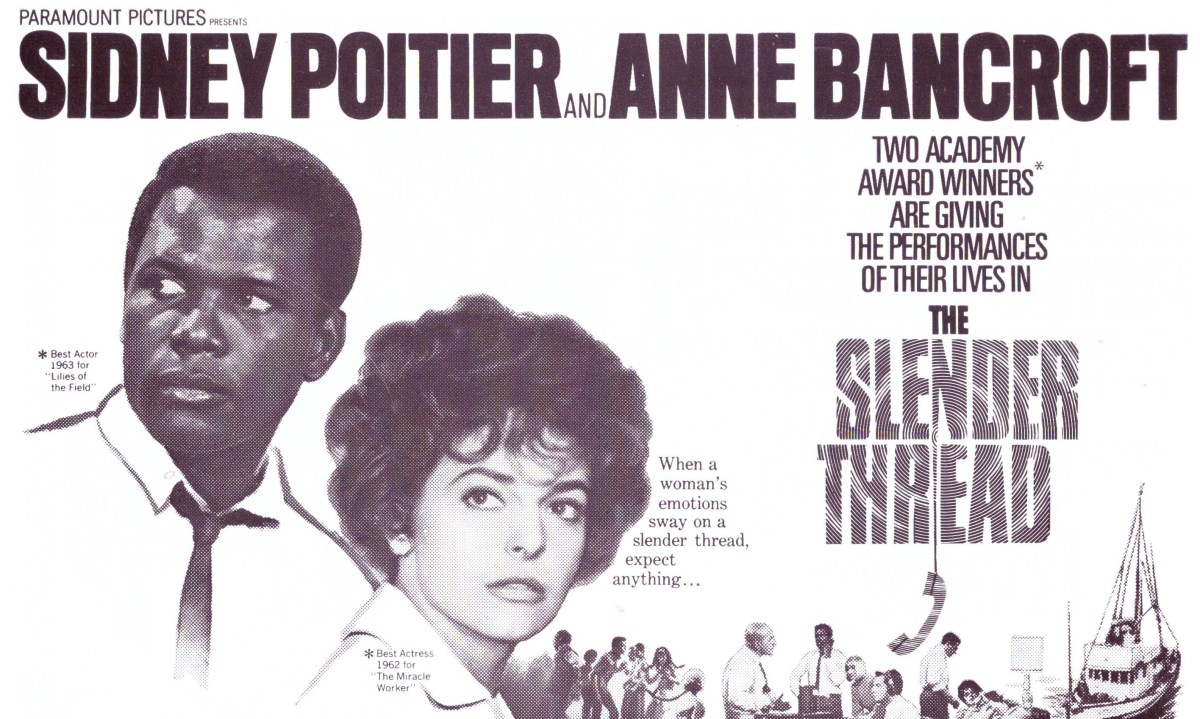
Just how do you sell a movie about a suicide to an audience for whom such a subject is still taboo? The answer is – you don’t. Instead, you fall back on your stars – and the fact that they are both Oscar winners.

We are pretty used these days to advertising campaigns, especially trailers, focusing on Academy Award recognition – The House of Gucci (2021), for example, boasting umpteen winners and nominees – but it was far rarer in the 1960s when exhibitors expected Pressbooks to provide them with sufficient marketing information to lure in the customers. Oscar success might have been mentioned in passing, forming part of a participant’s biography, but it would not be the entire focal point of the campaign.

The 16-page A3 Pressbook for The Slender Thread does nothing but. There was, of course, a link between the two stars in that Anne Bancroft recipient of the Best Actress Oscar for The Miracle Worker in 1962 had the following year presented Sidney Poitier with his Best Actor gong for Lilies of the Field (1963).

“Two Academy Award winners giving the performances of their lives” is pretty much as far as the tagline writers went in providing exhibitors with something to sell. The subsidiary tagline “when a woman’s emotions sway on a slender thread expect anything” offer little in the way of explaining the film’s content. An image of a phone plays a prominent role in artwork but again without clarifying its purpose. In much smaller writing, at the end of another reference to the Oscars, is the mention of “a motion picture rarely, if ever, surpassed in suspense” but again minus clarification.

You might actually come away with the notion that the drama takes place on the high seas since a ship features in the advertising.

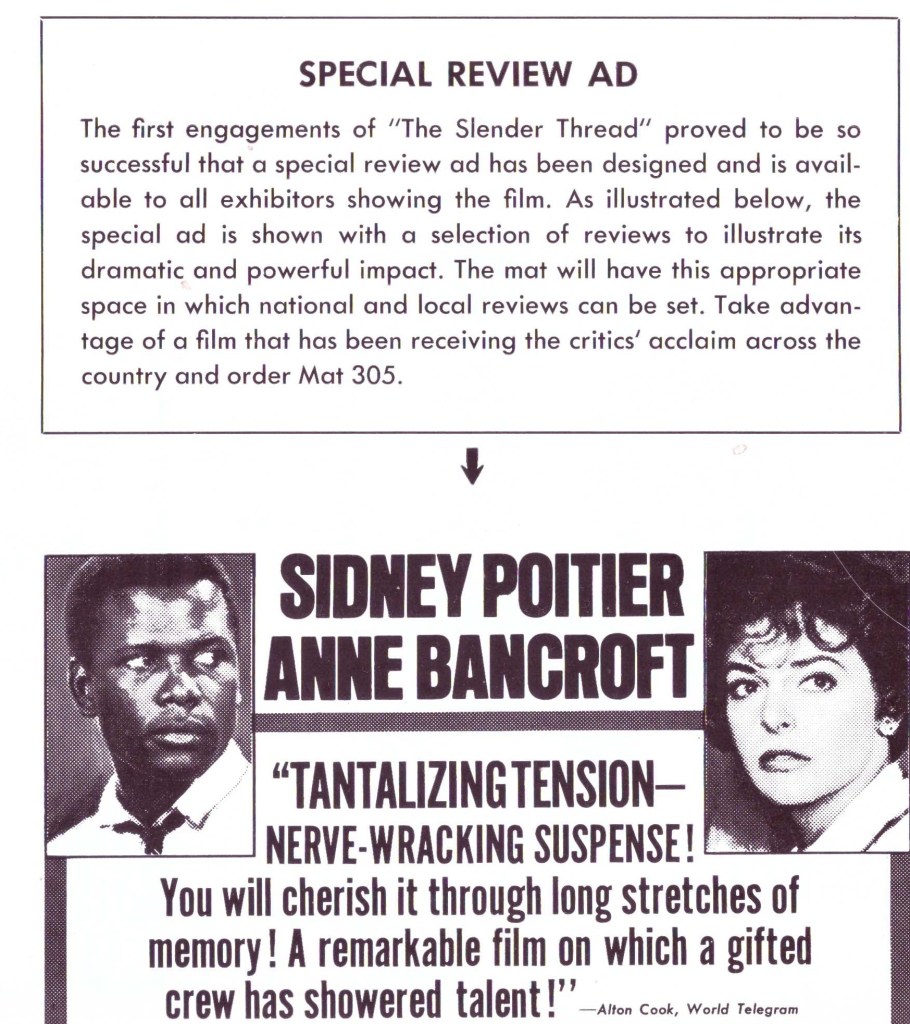
The only other assistance given exhibitors came in the form of reviews which make more mention of suspense. Cue magazine termed it “gripping, bristling tension and suspense all the way.” Kate Cameron in the Daily News concurred – “a high tension suspense film” as did Alton Cook of the World Telegram (“Tantalizing Tension! Nerve-Wracking Suspense!). Nobody mentioned what caused the tension and suspense.

The best bet for tie-ins came from record stores since record label Mercury has organised a “giant merchandising campaign” promoting the Quincy Jones soundtrack. The studio took the chance that exhibitors might take it into their own hands to organise some tie-ups with beauty salons, telephone companies and discotheques since these make an appearance in the picture.     

Quite how 16 pages of the same repeated artwork was meant to inspire exhibitors into, first all, booking the picture, and then, consequently, selling it to moviegoers is never explained.

The Slender Thread (1965) ****

Hollywood paranoia in the 1970s ensured that any type of electronic surveillance was treated with suspicion. Cops, too, were almost certain to be corrupt. Although he would subscribe to such paranoia and implicit corruption in Three Days of the Condor (1973), in his movie debut director Sydney Pollack turns these concepts on their head.

Crisis center volunteer Alan (Sidney Poitier) faces a battle against time to save potential suicide Inga (Anne Bancroft), using his own powers of empathy and persuasion, but helped more than a little by dedicated policemen and the system of tracking calls. On the one hand the ticking clock ensures tension remains high, on the other Alan own’s battle with his nascent abilities brings a high level of anxiety to the proceedings especially as we learn of the particular circumstances driving Inge.

Alan is studying to be a doctor and he carries within him the arrogance of his profession, namely the power to cure. But that is within the realms of the physical. When it comes to dealing with the mental side of a patient he discovers he is ill-equipped. The intimacy he strikes up with Inga ensures he cannot seek relieve by handing over the problem to anyone else, the fear being that the minute he introduces another voice the spell will be broken. His medical training means only that he knows far better than a layman the effect of the pills the woman has taken and can accurately surmise how long she has to live. In the process he experiences a wide range of emotions from caring and sympathetic to angry and frustrated.

By sheer accident Inga’s otherwise loving husband, Mark (Steven Hill), skipper of a fishing vessel, has discovered that their son is not his. On being rejected, she has nothing to live for.

The simple plotline is incredibly effective. The pair never meet but we discover something of Inga’s life through flashbacks as her life gradually unravels and elements of insanity creep in. Alan, meanwhile, is shut in a room, relying on feedback from colleagues such as psychiatrist Dr Coburn (Telly Savalas) and others monitoring the police investigation attempting to discover where she is.

 Initially, the movie treats Seattle as an interesting location with aerial shots over the credits and other scenes on the shore or seafront, but gradually the picture withdraws into itself, the city masked in darkness and the principals locked in their respective rooms.

Sidney Poitier is superb, having to contain his emotions as she tried to deal with a confused woman, at various times thinking he was over the worst only to discover that he was making little headway and if the movie had gone on for another fifteen minute she might have reflected how impotent he had actually been. Anne Bancroft matches him in excellence, in a role that charts disintegration. The fact that their characters never met and that their conversations were conducted entirely by telephone says a lot about their skills as actors in conveying emotion without being in the same room as the person with whom they are trying to communicate.

Telly Savalas (The Dirty Dozen, 1967) delivers a quieter performance than you might expect were you accustomed to his screen tics and flourishes. Ed Asner (The Venetian Affair, 1966) and Steven Hill, in his last film for 15 years, are effective. This was only the second screenplay of the decade by prolific television writer Stirling Silliphant (In the Heat of the Night, 1967).

The bold decision to film in black-and-white pays off, ensuring there is no color to divert the eye, and that dialogue, rather than costumes or scenery dominates. Pollack allows two consummate actors to do their stuff while toning down all other performances, so that background does not detract from foreground. As the High Noon of the psychological thriller this ore than delivers. Gripping stuff. And it’s worth considering the courage required to undertake such subject matter for your first movie.

Winning the Oscar for Lilies of the Field (1963) had not turned Sidney Poitier into a leading man and in fact he took second billing, each time to Richard Widmark, in his next two pictures.  Anne Bancroft was in similar situation after being named Best Actress for The Miracle Worker (1962) and although she took top billing in The Pumpkin Eater (1964) it was her first film after her triumph and, besides, had been made in Britain. And for both 1967 would be when they were both elevated to proper box office stardom.

CATCH-UP: Sidney Poitier performances reviewed on the Blog are Pressure Point (1962), The Long Ships (1964), The Bedford Incident (1965) and Duel at Diablo (1966); regarding Anne Bancroft only The Pumpkin Eater (1964) features here.

The Pumpkin Eater (1964) ***

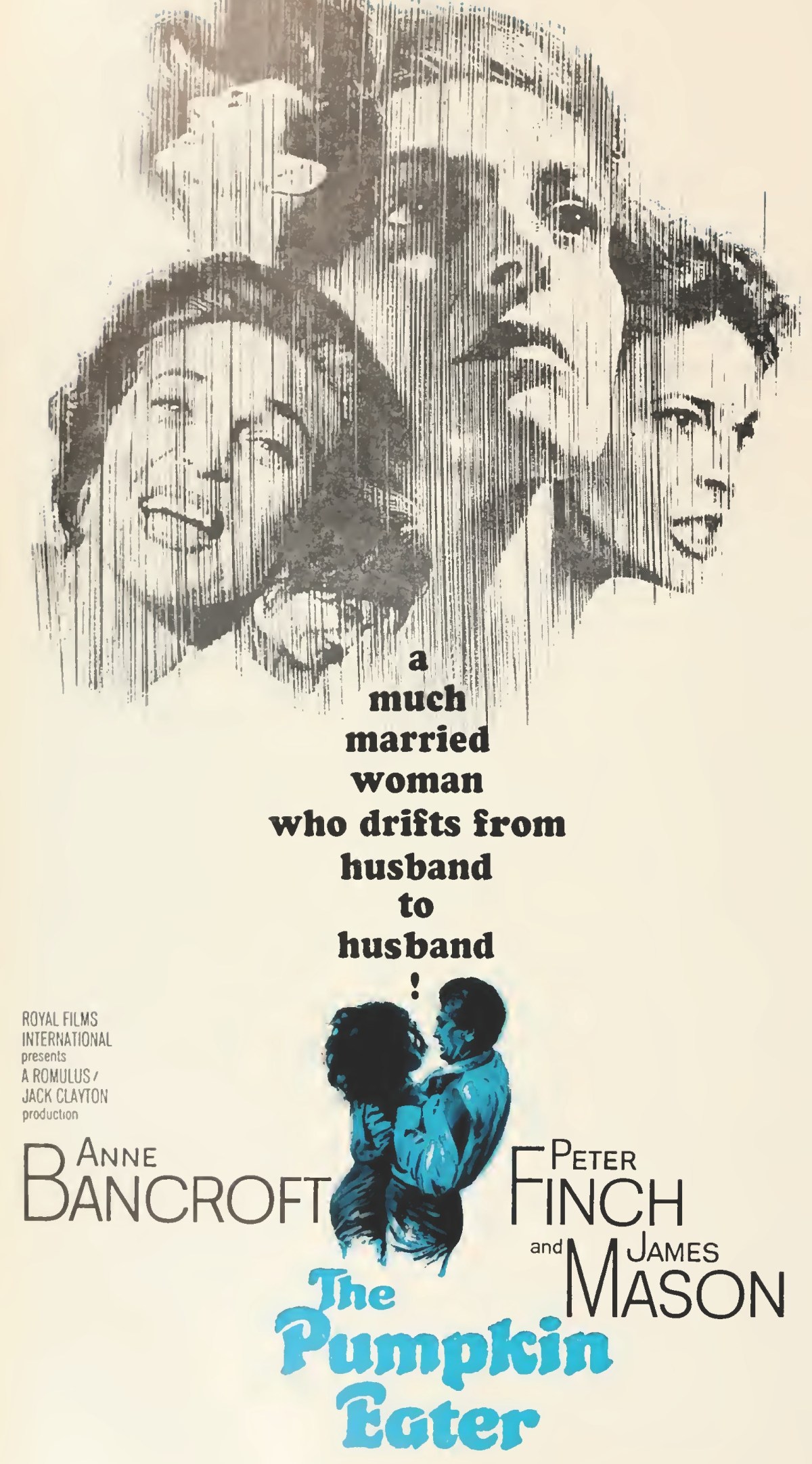
The reference point for Anne Bancroft in the 1960s is usually her cynical Mrs Robinson in The Graduate (1967) but she was Oscar-nominated here for a less ostentatious role as a woman who finds pregnancy – she has five kids by two husbands – almost a state of grace. Denied that role as a birth mother – husband number three (Peter Finch) wants an abortion – sees her tumble into depression.

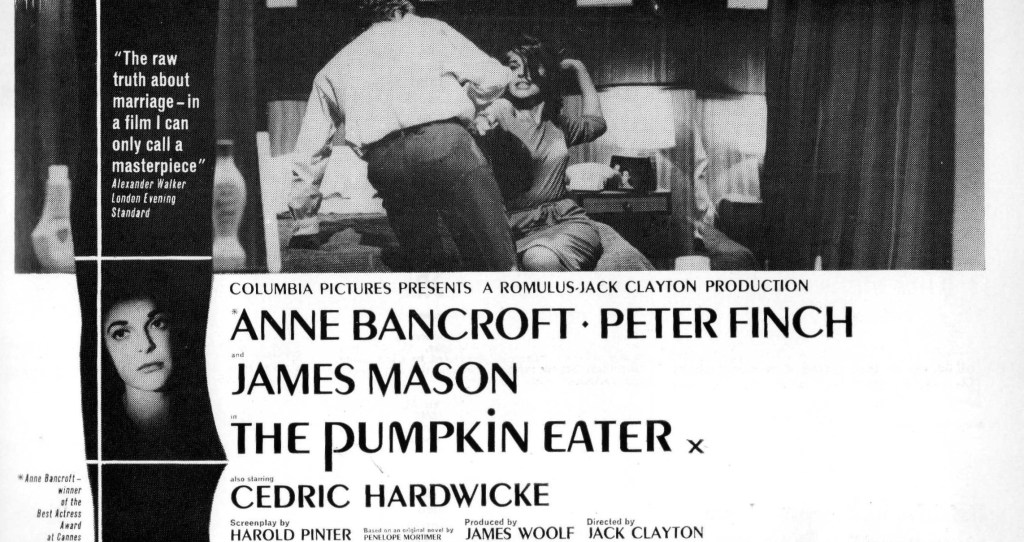
This is more a character study than anything else and despite a whole bunch of marital confrontation, clever dialog from screenwriter Harold Pinter and some artistic black-and-white cinematography, it would have benefitted greatly from Bancroft actually explaining what ails her rather than everyone around her putting the words in her mouth. Hitchcock used to employ a subsidiary character to spell out the dangers of consequences for the leading actor, but that worked well in a thriller, and less so in a drama where you are desperate to get inside the mind of a woman who shows every signs of being neurotic.

While the unstated worked exceptionally well in director Jack Clayton’s previous picture The Innocents (1961), we really here need much more clarity. It is certainly richly atmospheric in places and the sequence prior to her nervous breakdown in Harrods where without dialog the camera shows her wandering around is very well done. But spending too much time on a self-obsessed person is less appealing.

Story has Finch (The Trials of Oscar Wilde, 1960) destroying her confidence by his philandering (although she dumped her previous husband for Finch) – but it is left to the woman (Yootha Joyce) setting next to her in the hairdresser to express the feeling that a woman needs to be desired by her husband and for a psychiatrist (Eric Porter) to suggest that for her “sex is sanctified by incessant reproduction.” To neither assessment does she respond. She clearly has a happy boisterous family, one to which Finch fits in, children lining up to wave him goodbye and rushing to greet his return.

Finch is on top form as the arrogant, competitive husband with Maggie Smith, delightfully kookie, among the notches on his bedpost. James Mason has a small role as a cuckold and Richard Johnson as a discarded husband. Adapting from a novel by film critic Penelope Mortimer, Pinter provides some distinctive Pinteresque moments, and, beyond the marital disputes, while most of the story is played out at a distance, there are excellent moments of spite, not least Mason choosing to read to Bancroft a love letter from his wife to Finch. In some respects it is a raw look at marriage, but in many ways it ducks out of proper examination of the principals, his character revealed by action, hers rarely explicated.

One particular aspect of the story is glossed over, with no reaction from Bancroft, which seems implausible given her previous attitude. Abortion was still illegal in the 1960s but permission could be granted were pregnancy to jeopardize a patient’s mental health. But to endorse such a sanction also involved sterilization to prevent future occurrence. Since Bancroft offers no insight one way or the other you are left with the impression she welcomes this which would run entirely against the character we have known.

I’ve no idea why the picture did not start at a point where Bancroft initiated action, when she dumped husband number two for Finch. At that point she was responsible for making a decision and clearly some kind of illicit affair had been taking place first. Unlike, for example, The Pawnbroker in which the main character has the same defeated attitude we are given access to his tortured past and he is forced into confrontation with the present. But here passivity is an obstacle to understanding.

Setting aside all my reservations which I guess are primarily structural, it is an absorbing film and Bancroft certainly deserved the Oscar recognition. Finch and Mason are also on top form and it’s worth a look if only to see what Maggie Smith could do with a part before people (perhaps herself) decided her career should go in a different direction.

Discover WordPress

A daily selection of the best content published on WordPress, collected for you by humans who love to read.

The Atavist Magazine

by Brian Hannan

WordPress.com News

The latest news on WordPress.com and the WordPress community.